
POETIC TECHNIQUES Word Choice Simile Metaphor Enjambment Alliteration

POETIC TECHNIQUES
Word Choice Simile Metaphor Enjambment Alliteration Assonance

WORD CHOICE

SIMILE
METAPHOR

ENJAMBMENT

ALLITERATION
ASSONANCE
LEARNING INTENTIONS During this unit we will: • Read the poem Mid-Term Break by Seamus Heaney • Understand what is meant by the terms: euphemism, transferred epithet, pathos • Discuss themes and meanings of the poem • Write a critical essay Mid-Term Break By Seamus Heaney
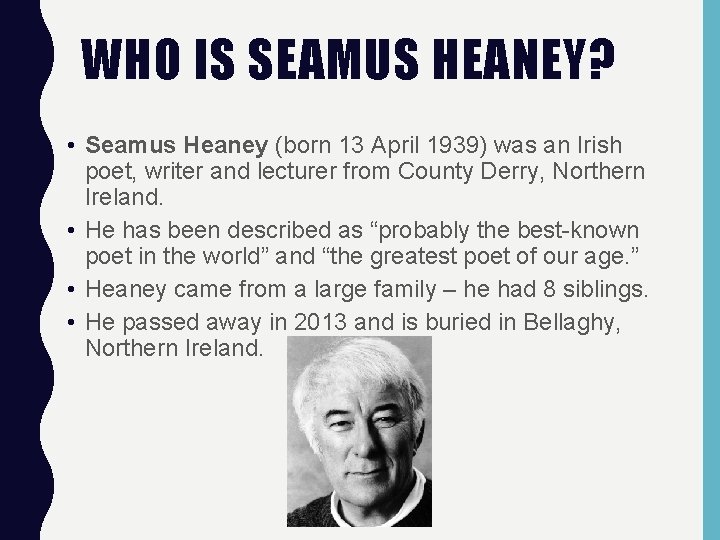
WHO IS SEAMUS HEANEY? • Seamus Heaney (born 13 April 1939) was an Irish poet, writer and lecturer from County Derry, Northern Ireland. • He has been described as “probably the best-known poet in the world” and “the greatest poet of our age. ” • Heaney came from a large family – he had 8 siblings. • He passed away in 2013 and is buried in Bellaghy, Northern Ireland.
WHAT ARE THE CHARACTERISTICS OF HEANEY’S WORK? • Naturalism: Heaney’s work often deals with the local surroundings of Ireland, particularly in Northern Ireland, where he was born and lived until young adulthood. • Sectarianism: Much of Heaney’s work also deals with sectarianism, which was rife in Ireland throughout his life. • Family: Many of his poems concern his own family history and focus on characters in his own family; they explore the real things that happened to them during their lives. Mid-Term Break By Seamus Heaney
MID-TERM BREAK BY SEAMUS HEANEY
Word Choice Simile Metaphor Enjambment Alliteration Assonance
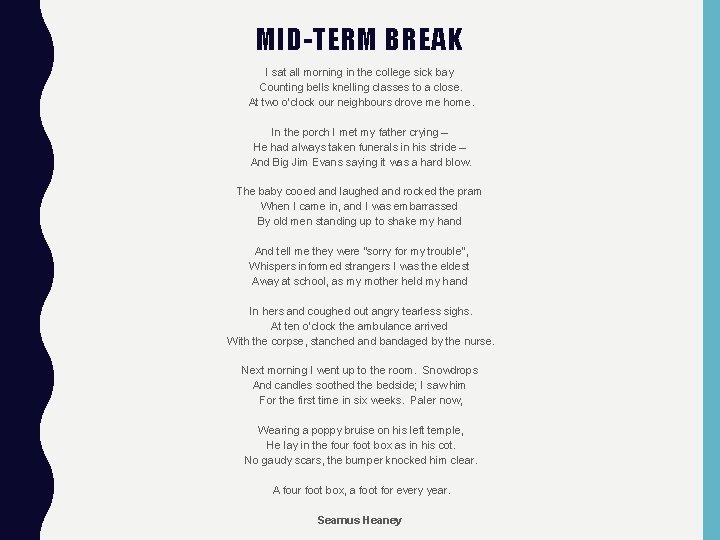
MID-TERM BREAK I sat all morning in the college sick bay Counting bells knelling classes to a close. At two o’clock our neighbours drove me home. In the porch I met my father crying – He had always taken funerals in his stride – And Big Jim Evans saying it was a hard blow. The baby cooed and laughed and rocked the pram When I came in, and I was embarrassed By old men standing up to shake my hand And tell me they were “sorry for my trouble”, Whispers informed strangers I was the eldest Away at school, as my mother held my hand In hers and coughed out angry tearless sighs. At ten o’clock the ambulance arrived With the corpse, stanched and bandaged by the nurse. Next morning I went up to the room. Snowdrops And candles soothed the bedside; I saw him For the first time in six weeks. Paler now, Wearing a poppy bruise on his left temple, He lay in the four foot box as in his cot. No gaudy scars, the bumper knocked him clear. A four foot box, a foot for every year. Seamus Heaney
WHAT IS MID-TERM BREAK ABOUT? • The poem is about the death of Heaney's infant brother (Christopher) and how people (including himself) reacted to this. • The poem is written from the point of view of a young Heaney, summoned from school after his brother died. Mid-Term Break By Seamus Heaney
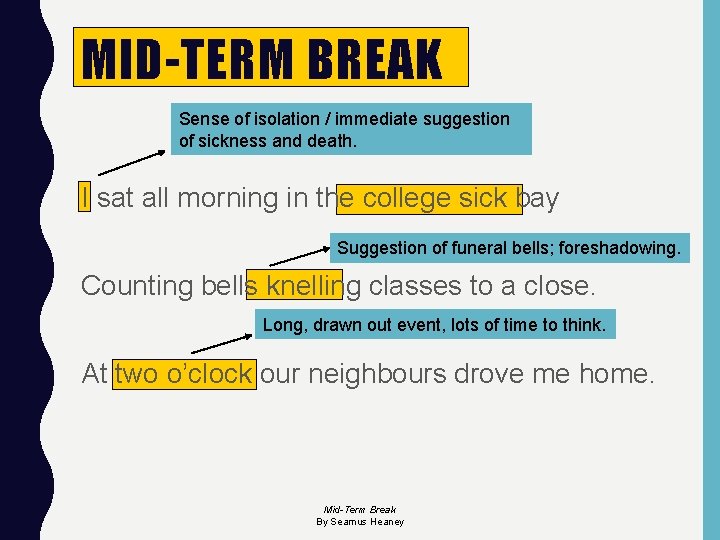
MID-TERM BREAK Sense of isolation / immediate suggestion of sickness and death. I sat all morning in the college sick bay Suggestion of funeral bells; foreshadowing. Counting bells knelling classes to a close. Long, drawn out event, lots of time to think. At two o’clock our neighbours drove me home. Mid-Term Break By Seamus Heaney
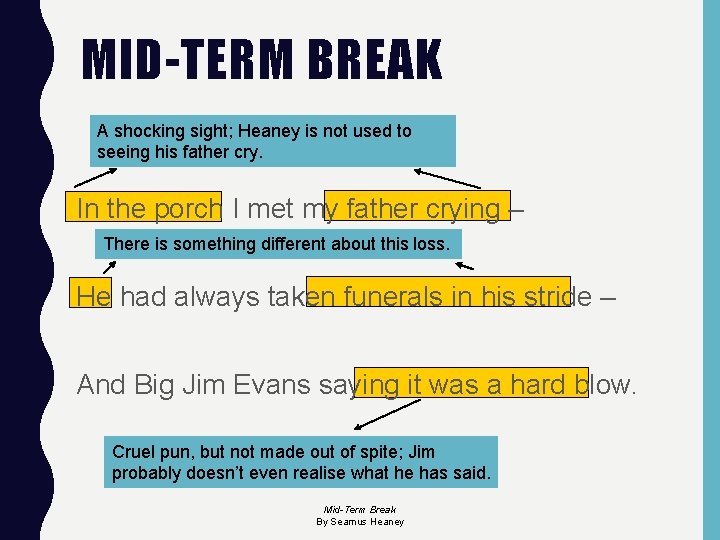
MID-TERM BREAK A shocking sight; Heaney is not used to seeing his father cry. In the porch I met my father crying – There is something different about this loss. He had always taken funerals in his stride – And Big Jim Evans saying it was a hard blow. Cruel pun, but not made out of spite; Jim probably doesn’t even realise what he has said. Mid-Term Break By Seamus Heaney
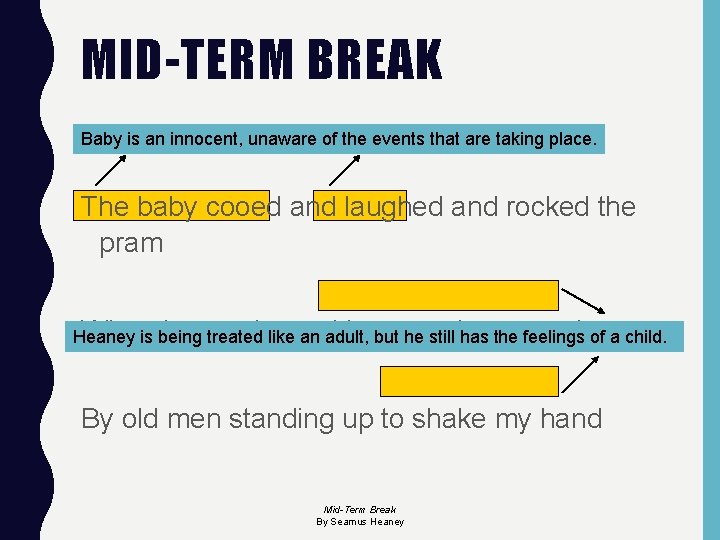
MID-TERM BREAK Baby is an innocent, unaware of the events that are taking place. The baby cooed and laughed and rocked the pram When I came I was Heaney is being treatedin, likeand an adult, but heembarrassed still has the feelings of a child. By old men standing up to shake my hand Mid-Term Break By Seamus Heaney
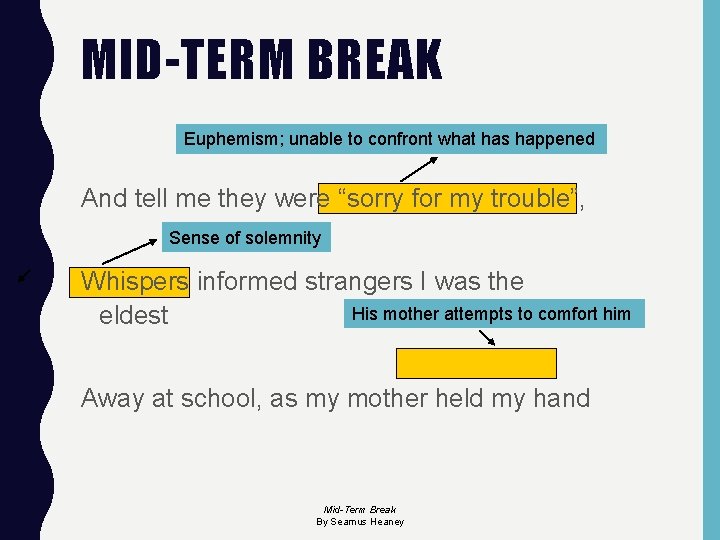
MID-TERM BREAK Euphemism; unable to confront what has happened And tell me they were “sorry for my trouble”, Sense of solemnity Whispers informed strangers I was the His mother attempts to comfort him eldest Away at school, as my mother held my hand Mid-Term Break By Seamus Heaney
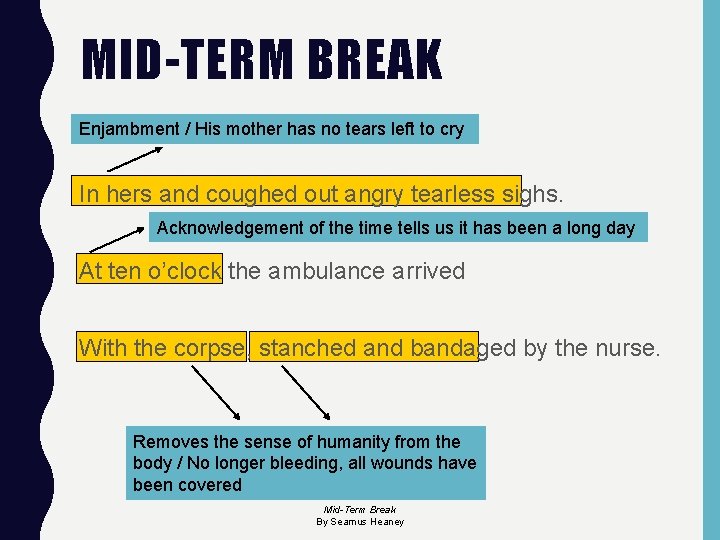
MID-TERM BREAK Enjambment / His mother has no tears left to cry In hers and coughed out angry tearless sighs. Acknowledgement of the time tells us it has been a long day At ten o’clock the ambulance arrived With the corpse, stanched and bandaged by the nurse. Removes the sense of humanity from the body / No longer bleeding, all wounds have been covered Mid-Term Break By Seamus Heaney

TRANSFERRED EPITHET • A transferred epithet is a little known - but often used - figure of speech where a modifier (usually an adjective) qualifies a noun other than the person or thing it is actually describing. • In other words, the modifier or epithet is transferred from the subject it is actually describing to another noun in the sentence. – The man walked down the weary road – She struck a careless match – They endured a sleepless night Mid-Term Break By Seamus Heaney
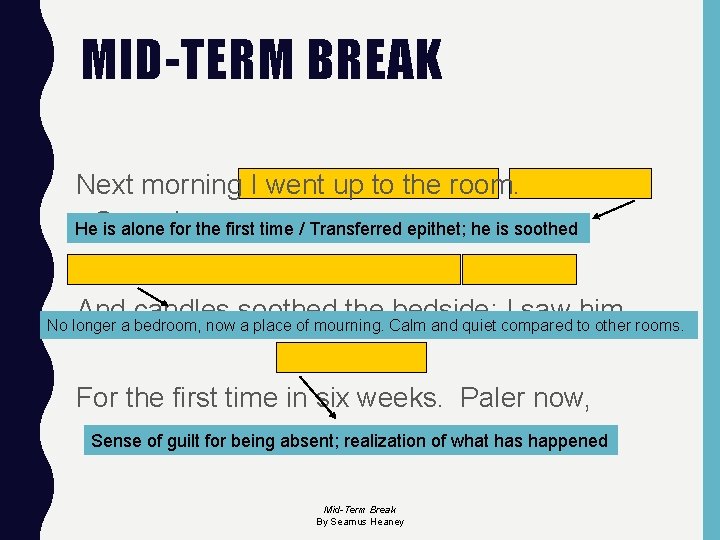
MID-TERM BREAK Next morning I went up to the room. He. Snowdrops is alone for the first time / Transferred epithet; he is soothed And candles soothed the bedside; I saw him No longer a bedroom, now a place of mourning. Calm and quiet compared to other rooms. For the first time in six weeks. Paler now, Sense of guilt for being absent; realization of what has happened Mid-Term Break By Seamus Heaney
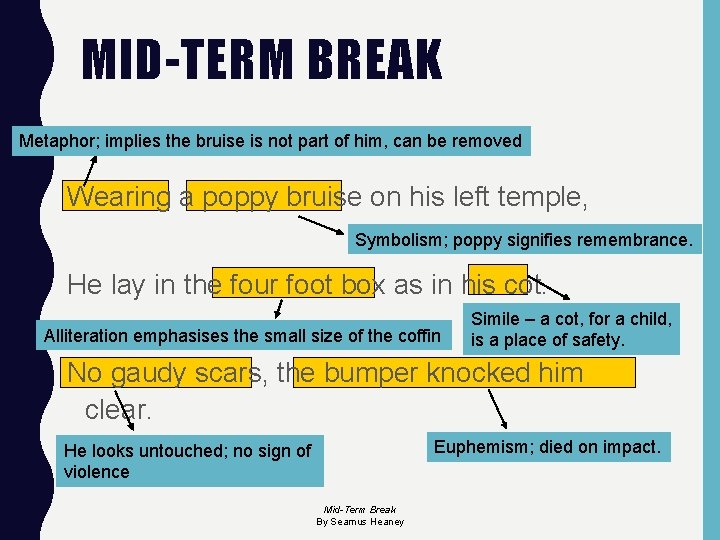
MID-TERM BREAK Metaphor; implies the bruise is not part of him, can be removed Wearing a poppy bruise on his left temple, Symbolism; poppy signifies remembrance. He lay in the four foot box as in his cot. Alliteration emphasises the small size of the coffin Simile – a cot, for a child, is a place of safety. No gaudy scars, the bumper knocked him clear. Euphemism; died on impact. He looks untouched; no sign of violence Mid-Term Break By Seamus Heaney
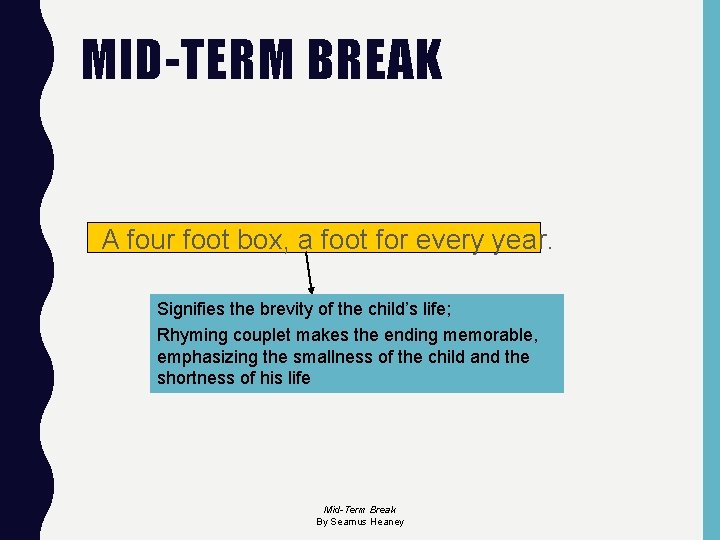
MID-TERM BREAK A four foot box, a foot for every year. Signifies the brevity of the child’s life; Rhyming couplet makes the ending memorable, emphasizing the smallness of the child and the shortness of his life Mid-Term Break By Seamus Heaney
REVISION What is: - Euphemism? - Transferred epithet? - Pathos? Mid-Term Break By Seamus Heaney
MID-TERM BREAK 1. What is unusual about the title of this poem? 2. Looking at stanza one, how do you think the poet was feeling? Quote to support your answer. 3. Why does the poet choose the word “knelling” when writing about the school bells? 4. What type of school did the poet attend? Give reasons for your answer. Mid-Term Break By Seamus Heaney
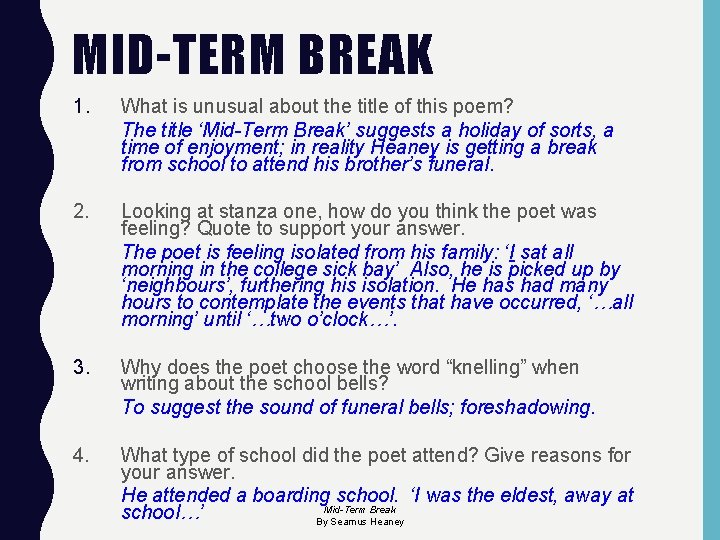
MID-TERM BREAK 1. What is unusual about the title of this poem? The title ‘Mid-Term Break’ suggests a holiday of sorts, a time of enjoyment; in reality Heaney is getting a break from school to attend his brother’s funeral. 2. Looking at stanza one, how do you think the poet was feeling? Quote to support your answer. The poet is feeling isolated from his family: ‘I sat all morning in the college sick bay’ Also, he is picked up by ‘neighbours’, furthering his isolation. He has had many hours to contemplate the events that have occurred, ‘…all morning’ until ‘…two o’clock…’. 3. Why does the poet choose the word “knelling” when writing about the school bells? To suggest the sound of funeral bells; foreshadowing. 4. What type of school did the poet attend? Give reasons for your answer. He attended a boarding school. ‘I was the eldest, away at Mid-Term Break school…’ By Seamus Heaney
MID-TERM BREAK 5. What did the poet find strange about his father’s behaviour? 6. Why is what “big Jim Evans” says an unfortunate pun? 7. Why was the baby the lucky one that day? 8. Why was the poet embarrassed by the old men shaking his ha Mid-Term Break By Seamus Heaney
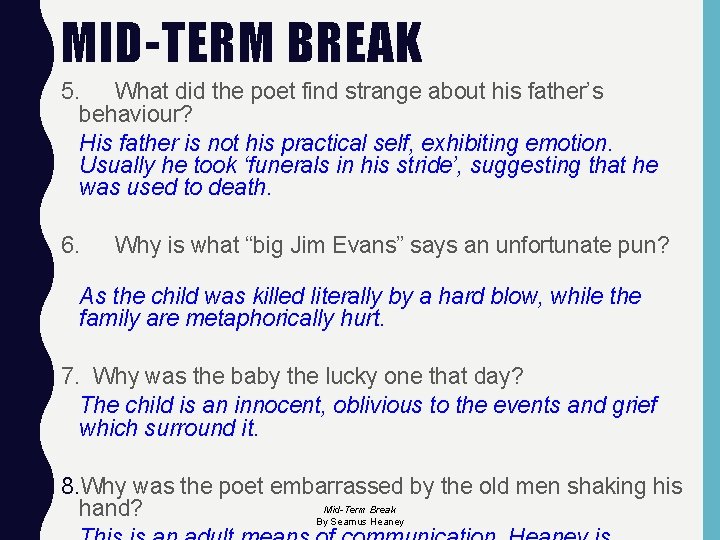
MID-TERM BREAK 5. What did the poet find strange about his father’s behaviour? His father is not his practical self, exhibiting emotion. Usually he took ‘funerals in his stride’, suggesting that he was used to death. 6. Why is what “big Jim Evans” says an unfortunate pun? As the child was killed literally by a hard blow, while the family are metaphorically hurt. 7. Why was the baby the lucky one that day? The child is an innocent, oblivious to the events and grief which surround it. 8. Why was the poet embarrassed by the old men shaking his Mid-Term Break hand? By Seamus Heaney
MID-TERM BREAK 9. What was surprising about his mother’s behaviour? 10. Contrast the reactions of both parents. With whom, do you think, is the mother angry? 11. What is unusual about the poet’s use of the phrase “the corpse”? Answer fully. 12. How does this contrast with the language describing when he is alone with his brother’s body? Mid-Term Break By Seamus Heaney
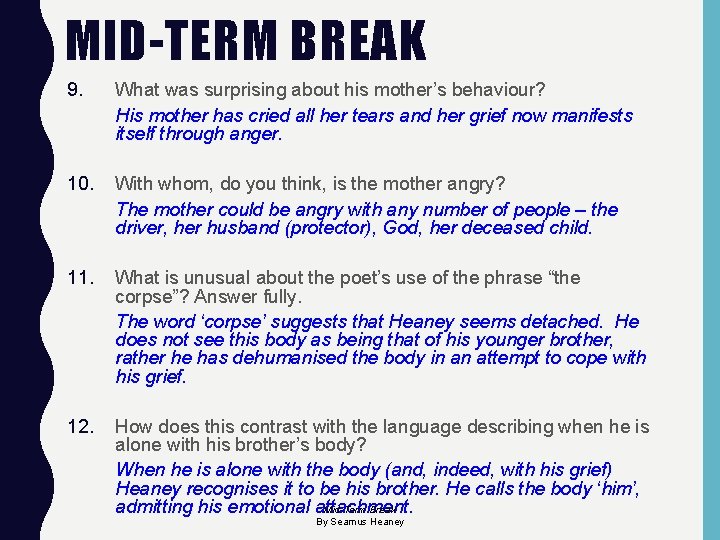
MID-TERM BREAK 9. What was surprising about his mother’s behaviour? His mother has cried all her tears and her grief now manifests itself through anger. 10. With whom, do you think, is the mother angry? The mother could be angry with any number of people – the driver, her husband (protector), God, her deceased child. 11. What is unusual about the poet’s use of the phrase “the corpse”? Answer fully. The word ‘corpse’ suggests that Heaney seems detached. He does not see this body as being that of his younger brother, rather he has dehumanised the body in an attempt to cope with his grief. 12. How does this contrast with the language describing when he is alone with his brother’s body? When he is alone with the body (and, indeed, with his grief) Heaney recognises it to be his brother. He calls the body ‘him’, admitting his emotional attachment. Mid-Term Break By Seamus Heaney
MID-TERM BREAK 13. How does the atmosphere change when Heaney is alone with his brother’s body? 14. What do you think of the last line of the poem? Mid-Term Break By Seamus Heaney
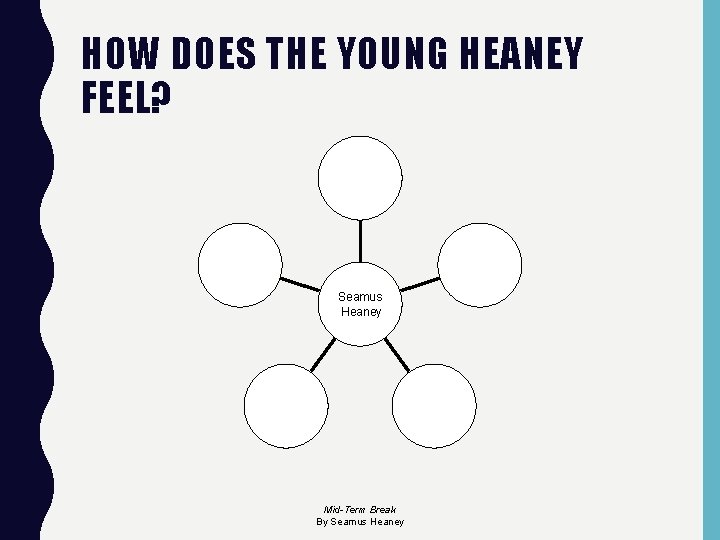
HOW DOES THE YOUNG HEANEY FEEL? Seamus Heaney Mid-Term Break By Seamus Heaney
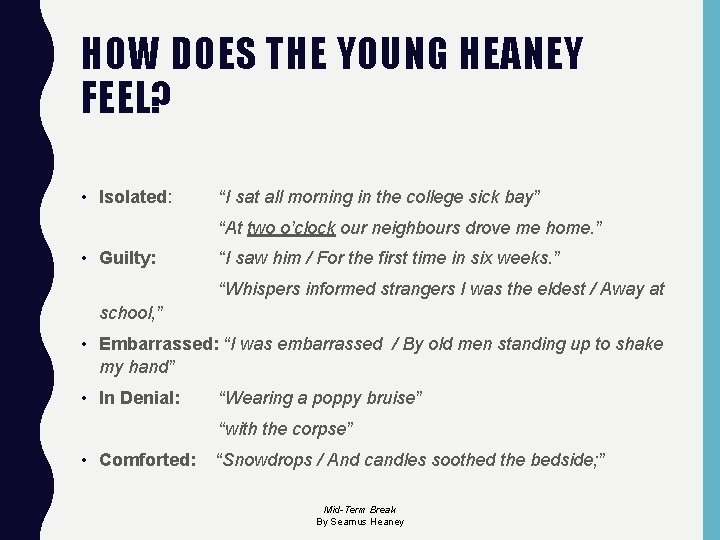
HOW DOES THE YOUNG HEANEY FEEL? • Isolated: “I sat all morning in the college sick bay” “At two o’clock our neighbours drove me home. ” • Guilty: “I saw him / For the first time in six weeks. ” “Whispers informed strangers I was the eldest / Away at school, ” • Embarrassed: “I was embarrassed / By old men standing up to shake my hand” • In Denial: “Wearing a poppy bruise” “with the corpse” • Comforted: “Snowdrops / And candles soothed the bedside; ” Mid-Term Break By Seamus Heaney
ENJAMBMENT • Enjambment is the continuation of a sentence over a line-break. • If a poet allows all the sentences of a poem to end in the same place as regular line-breaks, a kind of deadening can happen in the ear, and in the brain too, as all the thoughts can end up being the same length. • Enjambment is one way of creating interest through the unusual sound of a sentence running on when you expect it to pause. In the poem, enjambment helps to suggest how Heaney was feeling at the time (i. e. confused, unsure etc. ); his thoughts were jumbled and stilting. Mid-Term Break By Seamus Heaney
TRANSFERRED EPITHET • Technique in which the modifier or epithet is transferred from the subject it is actually describing to another noun in the sentence. The calm mood is beautifully shown in the transferred epithet, “Snowdrops/And candles soothed the bedside” - literally they soothed the young Heaney. Mid-Term Break By Seamus Heaney
EUPHEMISM • The act of substituting a mild, indirect, or vague term for one considered harsh, blunt, or offensive. – “Sorry for my trouble” – “the bumper knocked him clear” Mid-Term Break By Seamus Heaney
PATHOS • The writer provokes feelings of sadness, pity or sympathy in the reader. • The pathos in Mid-Term Break helps to deepen our understanding of Heaney’s experience and also helps us to understand the underlying themes of the poem. Mid-Term Break By Seamus Heaney
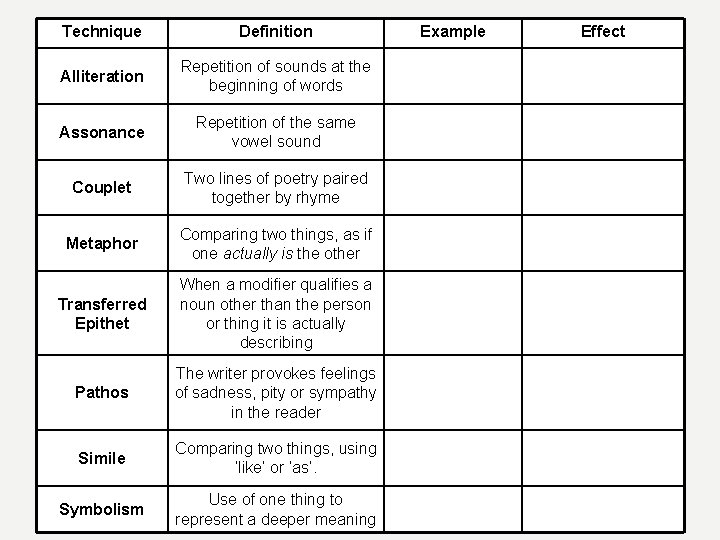
Technique Definition Alliteration Repetition of sounds at the beginning of words Assonance Repetition of the same vowel sound Couplet Two lines of poetry paired together by rhyme Metaphor Comparing two things, as if one actually is the other Transferred Epithet When a modifier qualifies a noun other than the person or thing it is actually describing Pathos The writer provokes feelings of sadness, pity or sympathy in the reader Simile Comparing two things, using ‘like’ or ‘as’. Symbolism Use of one thing to represent a deeper meaning Example Effect
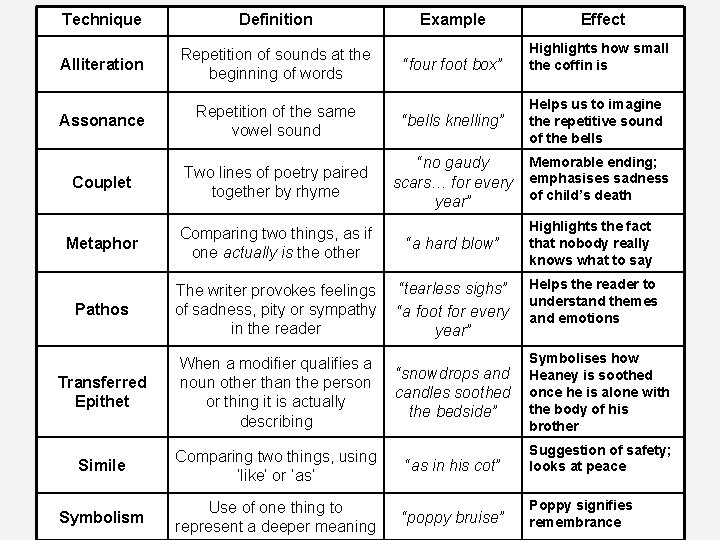
Technique Definition Example Effect Alliteration Repetition of sounds at the beginning of words “four foot box” Highlights how small the coffin is Assonance Repetition of the same vowel sound Couplet Two lines of poetry paired together by rhyme Metaphor Comparing two things, as if one actually is the other “a hard blow” Pathos The writer provokes feelings of sadness, pity or sympathy in the reader “tearless sighs” “a foot for every year” Transferred Epithet When a modifier qualifies a noun other than the person or thing it is actually describing Simile Comparing two things, using ‘like’ or ‘as’ “as in his cot” Suggestion of safety; looks at peace Symbolism Use of one thing to represent a deeper meaning “poppy bruise” Poppy signifies remembrance “bells knelling” Helps us to imagine the repetitive sound of the bells Memorable ending; “no gaudy scars… for every emphasises sadness of child’s death year” “snowdrops and candles soothed the bedside” Highlights the fact that nobody really knows what to say Helps the reader to understand themes and emotions Symbolises how Heaney is soothed once he is alone with the body of his brother
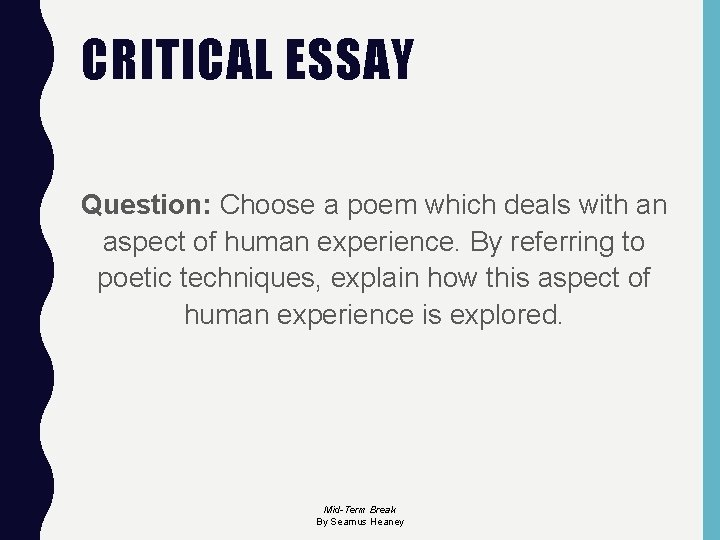
CRITICAL ESSAY Question: Choose a poem which deals with an aspect of human experience. By referring to poetic techniques, explain how this aspect of human experience is explored. Mid-Term Break By Seamus Heaney
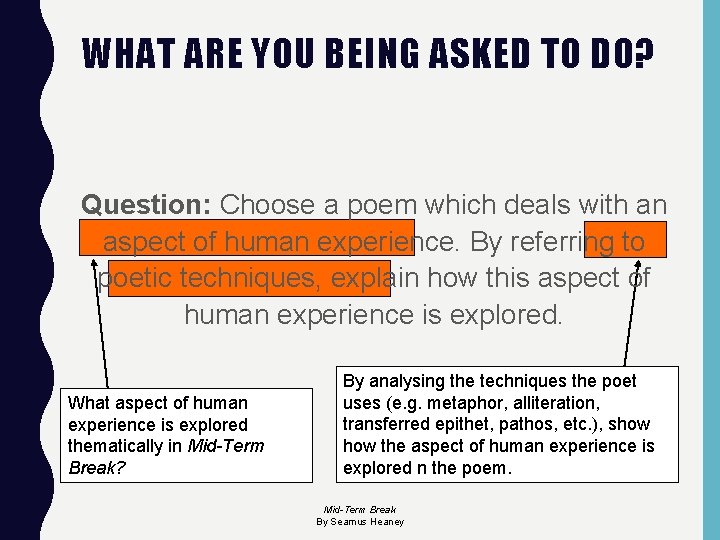
WHAT ARE YOU BEING ASKED TO DO? Question: Choose a poem which deals with an aspect of human experience. By referring to poetic techniques, explain how this aspect of human experience is explored. What aspect of human experience is explored thematically in Mid-Term Break? By analysing the techniques the poet uses (e. g. metaphor, alliteration, transferred epithet, pathos, etc. ), show the aspect of human experience is explored n the poem. Mid-Term Break By Seamus Heaney
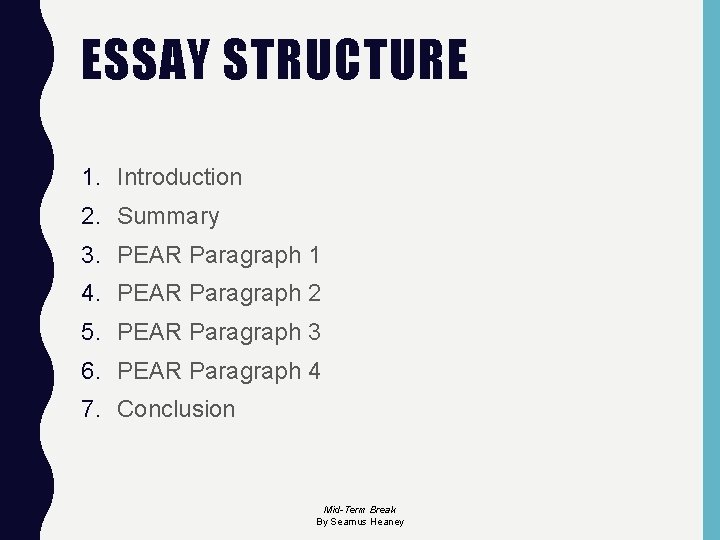
ESSAY STRUCTURE 1. Introduction 2. Summary 3. PEAR Paragraph 1 4. PEAR Paragraph 2 5. PEAR Paragraph 3 6. PEAR Paragraph 4 7. Conclusion Mid-Term Break By Seamus Heaney
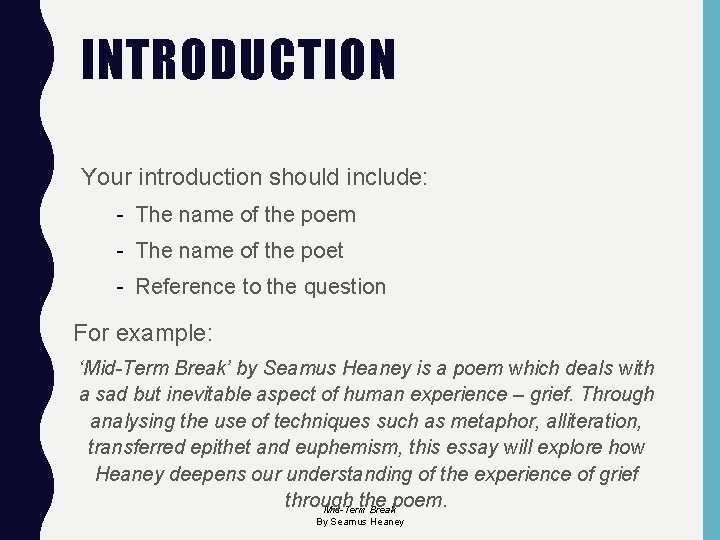
INTRODUCTION Your introduction should include: - The name of the poem - The name of the poet - Reference to the question For example: ‘Mid-Term Break’ by Seamus Heaney is a poem which deals with a sad but inevitable aspect of human experience – grief. Through analysing the use of techniques such as metaphor, alliteration, transferred epithet and euphemism, this essay will explore how Heaney deepens our understanding of the experience of grief through the poem. Mid-Term Break By Seamus Heaney
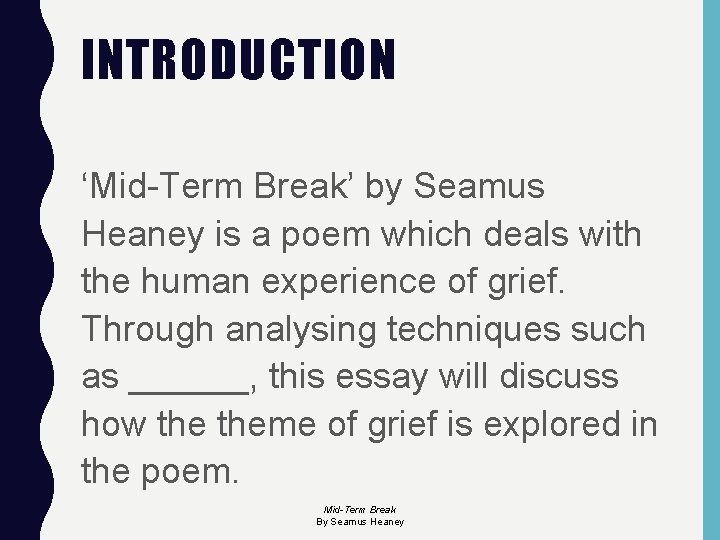
INTRODUCTION ‘Mid-Term Break’ by Seamus Heaney is a poem which deals with the human experience of grief. Through analysing techniques such as ______, this essay will discuss how theme of grief is explored in the poem. Mid-Term Break By Seamus Heaney
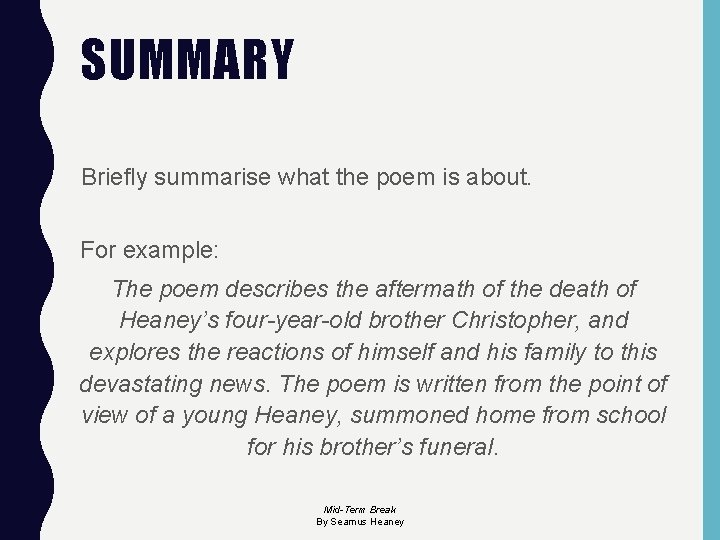
SUMMARY Briefly summarise what the poem is about. For example: The poem describes the aftermath of the death of Heaney’s four-year-old brother Christopher, and explores the reactions of himself and his family to this devastating news. The poem is written from the point of view of a young Heaney, summoned home from school for his brother’s funeral. Mid-Term Break By Seamus Heaney
HOW DOES HEANEY CONVEY THE GRIEF FELT IN MID-TERM BREAK ? 1. His own sense of isolation 2. The reactions of his parents 3. His feelings of embarrassment 4. The description of the body 5. His time spent with the body 6. His description of the coffin Mid-Term Break By Seamus Heaney
PEAR PARAGRAPHS We will be using PEAR paragraphs to structure the main body of our essays. PEAR stands for: Point Evidence Analysis Response Mid-Term Break By Seamus Heaney
PEAR PARAGRAPHS Point – State what you will be discussing in the paragraph. For example: One way Heaney explores theme of grief is through his own sense of isolation. Evidence – Give a quote from the poem. ‘I sat all morning in the college sick bay / Counting bells knelling classes to a close’. Mid-Term Break By Seamus Heaney
PEAR PARAGRAPHS Analysis – Analyse how the quote shows what you have stated in your point. For example: “The word choice of ‘I’ tells us that Heaney is alone, and gives an immediate sense of isolation in the poem. The setting of the first stanza, the ‘college sick bay’, suggests sickness…” Etc. Response – Relate back to the question and give a personal response. For example: “These techniques help us to understand that Heaney feels isolated in his grief, and that it is an experience he must endure by himself. ” Mid-Term Break By Seamus Heaney
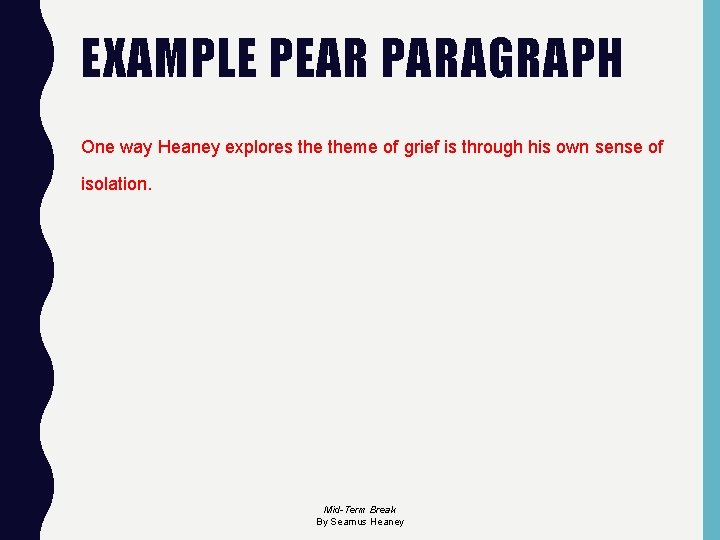
EXAMPLE PEAR PARAGRAPH One way Heaney explores theme of grief is through his own sense of isolation. Mid-Term Break By Seamus Heaney
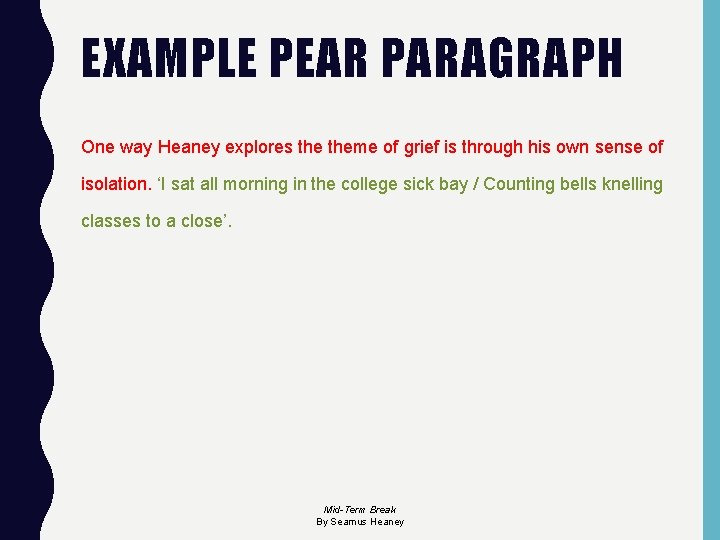
EXAMPLE PEAR PARAGRAPH One way Heaney explores theme of grief is through his own sense of isolation. ‘I sat all morning in the college sick bay / Counting bells knelling classes to a close’. Mid-Term Break By Seamus Heaney
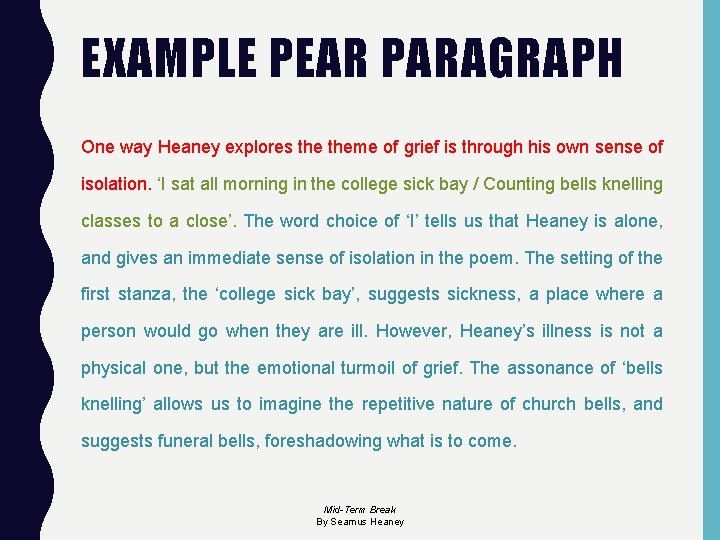
EXAMPLE PEAR PARAGRAPH One way Heaney explores theme of grief is through his own sense of isolation. ‘I sat all morning in the college sick bay / Counting bells knelling classes to a close’. The word choice of ‘I’ tells us that Heaney is alone, and gives an immediate sense of isolation in the poem. The setting of the first stanza, the ‘college sick bay’, suggests sickness, a place where a person would go when they are ill. However, Heaney’s illness is not a physical one, but the emotional turmoil of grief. The assonance of ‘bells knelling’ allows us to imagine the repetitive nature of church bells, and suggests funeral bells, foreshadowing what is to come. Mid-Term Break By Seamus Heaney
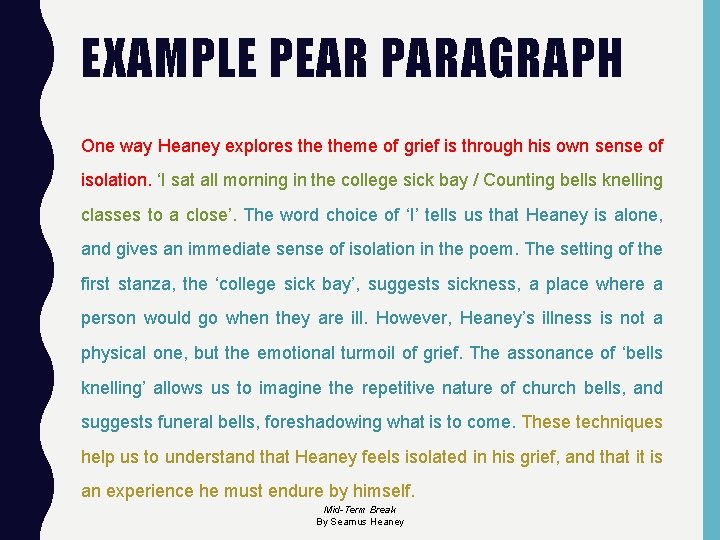
EXAMPLE PEAR PARAGRAPH One way Heaney explores theme of grief is through his own sense of isolation. ‘I sat all morning in the college sick bay / Counting bells knelling classes to a close’. The word choice of ‘I’ tells us that Heaney is alone, and gives an immediate sense of isolation in the poem. The setting of the first stanza, the ‘college sick bay’, suggests sickness, a place where a person would go when they are ill. However, Heaney’s illness is not a physical one, but the emotional turmoil of grief. The assonance of ‘bells knelling’ allows us to imagine the repetitive nature of church bells, and suggests funeral bells, foreshadowing what is to come. These techniques help us to understand that Heaney feels isolated in his grief, and that it is an experience he must endure by himself. Mid-Term Break By Seamus Heaney
CONCLUSION Your conclusion should reiterate the name of the poem, the poet, and a reference to the question you have answered. You should then discuss how effectively you think Heaney has conveyed the human experience of grief in the poem. Finally, you should give your opinion of the poem – be detailed and insightful. For example: In conclusion, ‘Mid-Term Break’ by Seamus Heaney is a poem which explores human experience through theme of grief. By using a range of techniques effectively, Heaney has created a poem which is deeply emotional and moving, and which leaves a lasting impression on the reader as the poems ends on the final rhyming couplet. In. Mid-Term my opinion, this poem is… Break By Seamus Heaney
ESSAY STRUCTURE 1. Introduction 2. Summary 3. PEAR Paragraph 1 4. PEAR Paragraph 2 5. PEAR Paragraph 3 6. PEAR Paragraph 4 7. Conclusion Mid-Term Break By Seamus Heaney
- Slides: 56