
POETIC FORM Strategies for analyzing how poetic form
- Slides: 14
POETIC FORM Strategies for analyzing how poetic form affects meaning
OBJECTIVES By the time you finish taking notes on this presentation, you should understand some key strategies for identifying the following poetic forms and identifying the effect they have on the meaning of the poem: � Form � Closed form Blank Verse Sonnet (Petrarchan and Shakespearean) Villanelle � Open form Free Verse
THE MOST IMPORTANT STRATEGY OF ALL. Read the poem again. Understanding what the poem means (what theme is) is key to seeing how its form enhances its meaning.
FORM - STRATEGIES Know that every poem has a form: it is either written in closed form or open form. Know that being able to identify a poem’s form can shed light on its meaning. Different forms create different effects.
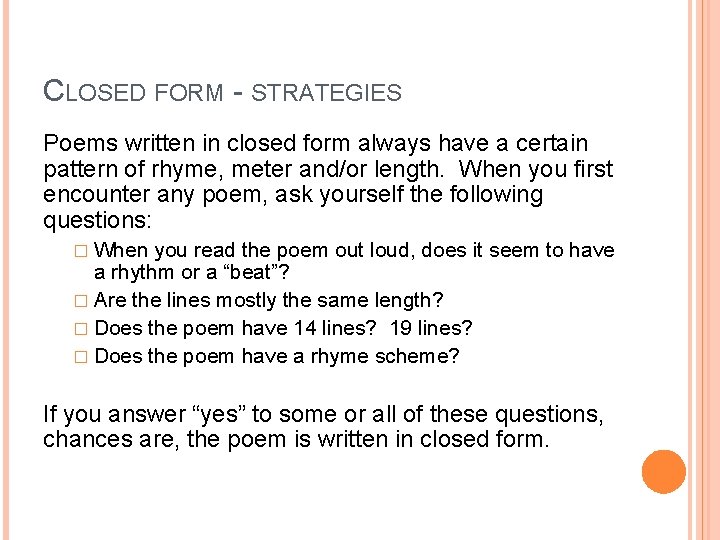
CLOSED FORM - STRATEGIES Poems written in closed form always have a certain pattern of rhyme, meter and/or length. When you first encounter any poem, ask yourself the following questions: � When you read the poem out loud, does it seem to have a rhythm or a “beat”? � Are the lines mostly the same length? � Does the poem have 14 lines? 19 lines? � Does the poem have a rhyme scheme? If you answer “yes” to some or all of these questions, chances are, the poem is written in closed form.
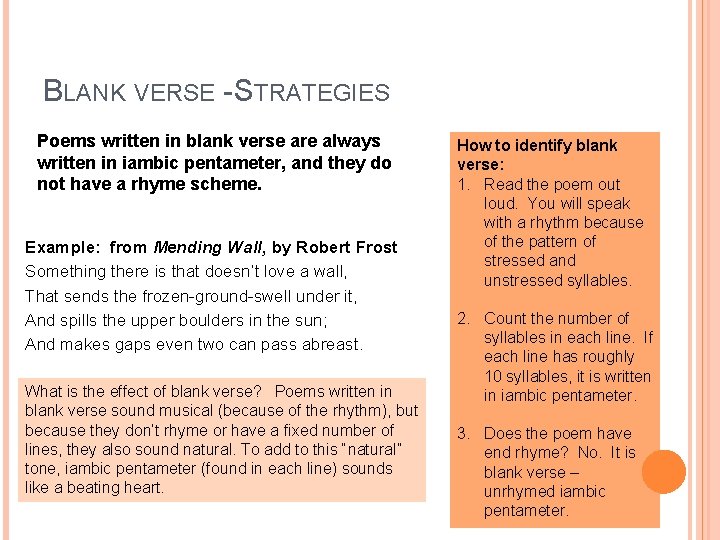
BLANK VERSE - STRATEGIES Poems written in blank verse are always written in iambic pentameter, and they do not have a rhyme scheme. Example: from Mending Wall, by Robert Frost Something there is that doesn’t love a wall, That sends the frozen-ground-swell under it, And spills the upper boulders in the sun; And makes gaps even two can pass abreast. What is the effect of blank verse? Poems written in blank verse sound musical (because of the rhythm), but because they don’t rhyme or have a fixed number of lines, they also sound natural. To add to this “natural” tone, iambic pentameter (found in each line) sounds like a beating heart. How to identify blank verse: 1. Read the poem out loud. You will speak with a rhythm because of the pattern of stressed and unstressed syllables. 2. Count the number of syllables in each line. If each line has roughly 10 syllables, it is written in iambic pentameter. 3. Does the poem have end rhyme? No. It is blank verse – unrhymed iambic pentameter.
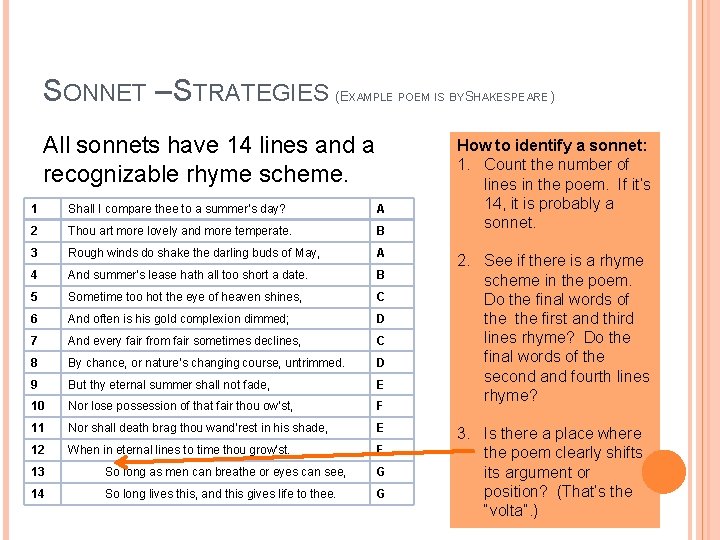
SONNET – STRATEGIES (E XAMPLE POEM IS BYSHAKESPEARE) All sonnets have 14 lines and a recognizable rhyme scheme. 1 Shall I compare thee to a summer’s day? A 2 Thou art more lovely and more temperate. B 3 Rough winds do shake the darling buds of May, A 4 And summer’s lease hath all too short a date. B 5 Sometime too hot the eye of heaven shines, C 6 And often is his gold complexion dimmed; D 7 And every fair from fair sometimes declines, C 8 By chance, or nature’s changing course, untrimmed. D 9 But thy eternal summer shall not fade, E 10 Nor lose possession of that fair thou ow’st, F 11 Nor shall death brag thou wand’rest in his shade, E 12 When in eternal lines to time thou grow’st. F 13 So long as men can breathe or eyes can see, G 14 So long lives this, and this gives life to thee. G How to identify a sonnet: 1. Count the number of lines in the poem. If it’s 14, it is probably a sonnet. 2. See if there is a rhyme scheme in the poem. Do the final words of the first and third lines rhyme? Do the final words of the second and fourth lines rhyme? 3. Is there a place where the poem clearly shifts its argument or position? (That’s the “volta”. )
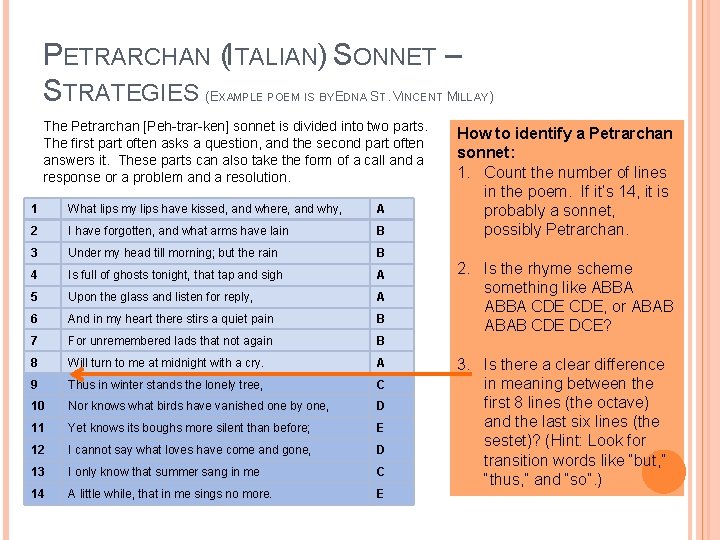
PETRARCHAN (ITALIAN) SONNET – STRATEGIES (E E S. V M XAMPLE POEM IS BY DNA T INCENT The Petrarchan [Peh-trar-ken] sonnet is divided into two parts. The first part often asks a question, and the second part often answers it. These parts can also take the form of a call and a response or a problem and a resolution. 1 What lips my lips have kissed, and where, and why, A 2 I have forgotten, and what arms have lain B 3 Under my head till morning; but the rain B 4 Is full of ghosts tonight, that tap and sigh A 5 Upon the glass and listen for reply, A 6 And in my heart there stirs a quiet pain B 7 For unremembered lads that not again B 8 Will turn to me at midnight with a cry. A 9 Thus in winter stands the lonely tree, C 10 Nor knows what birds have vanished one by one, D 11 Yet knows its boughs more silent than before; E 12 I cannot say what loves have come and gone, D 13 I only know that summer sang in me C 14 A little while, that in me sings no more. E ILLAY) How to identify a Petrarchan sonnet: 1. Count the number of lines in the poem. If it’s 14, it is probably a sonnet, possibly Petrarchan. 2. Is the rhyme scheme something like ABBA CDE, or ABAB CDE DCE? 3. Is there a clear difference in meaning between the first 8 lines (the octave) and the last six lines (the sestet)? (Hint: Look for transition words like “but, ” “thus, ” and “so”. )
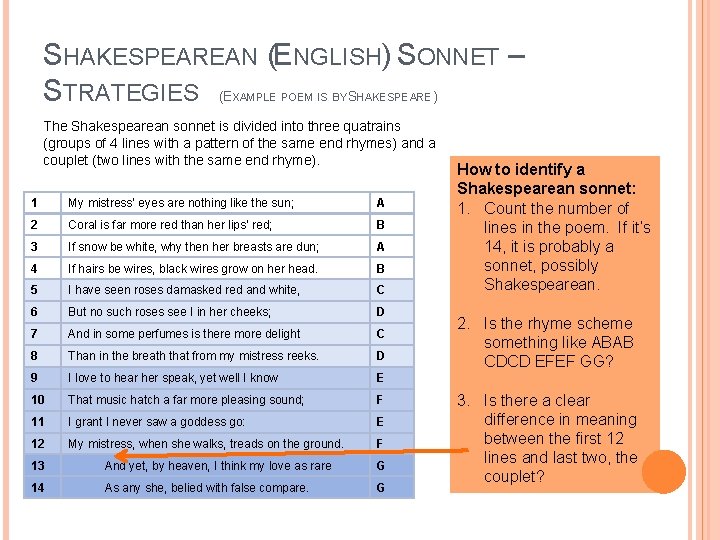
SHAKESPEAREAN (ENGLISH) SONNET – STRATEGIES (E S ) XAMPLE POEM IS BY HAKESPEARE The Shakespearean sonnet is divided into three quatrains (groups of 4 lines with a pattern of the same end rhymes) and a couplet (two lines with the same end rhyme). 1 My mistress’ eyes are nothing like the sun; A 2 Coral is far more red than her lips’ red; B 3 If snow be white, why then her breasts are dun; A 4 If hairs be wires, black wires grow on her head. B 5 I have seen roses damasked red and white, C 6 But no such roses see I in her cheeks; D 7 And in some perfumes is there more delight C 8 Than in the breath that from my mistress reeks. D 9 I love to hear her speak, yet well I know E 10 That music hatch a far more pleasing sound; F 11 I grant I never saw a goddess go: E 12 My mistress, when she walks, treads on the ground. F 13 And yet, by heaven, I think my love as rare G 14 As any she, belied with false compare. G How to identify a Shakespearean sonnet: 1. Count the number of lines in the poem. If it’s 14, it is probably a sonnet, possibly Shakespearean. 2. Is the rhyme scheme something like ABAB CDCD EFEF GG? 3. Is there a clear difference in meaning between the first 12 lines and last two, the couplet?
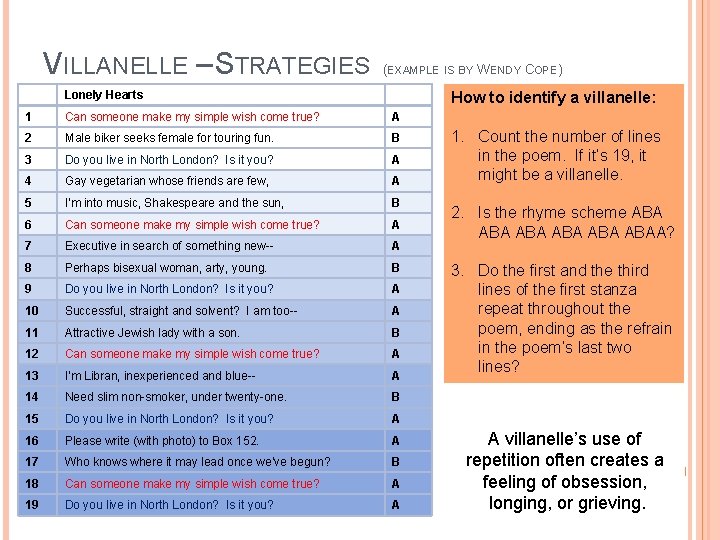
VILLANELLE – STRATEGIES (EXAMPLE IS BY WENDY COPE) Lonely Hearts How to identify a villanelle: 1 Can someone make my simple wish come true? A 2 Male biker seeks female for touring fun. B 3 Do you live in North London? Is it you? A 4 Gay vegetarian whose friends are few, A 5 I’m into music, Shakespeare and the sun, B 6 Can someone make my simple wish come true? A 7 Executive in search of something new-- A 8 Perhaps bisexual woman, arty, young. B 9 Do you live in North London? Is it you? A 10 Successful, straight and solvent? I am too-- A 11 Attractive Jewish lady with a son. B 12 Can someone make my simple wish come true? A 13 I’m Libran, inexperienced and blue-- A 14 Need slim non-smoker, under twenty-one. B 15 Do you live in North London? Is it you? A 16 Please write (with photo) to Box 152. A 17 Who knows where it may lead once we’ve begun? B 18 Can someone make my simple wish come true? A 19 Do you live in North London? Is it you? A 1. Count the number of lines in the poem. If it’s 19, it might be a villanelle. 2. Is the rhyme scheme ABA ABA ABAA? 3. Do the first and the third lines of the first stanza repeat throughout the poem, ending as the refrain in the poem’s last two lines? A villanelle’s use of repetition often creates a feeling of obsession, longing, or grieving.
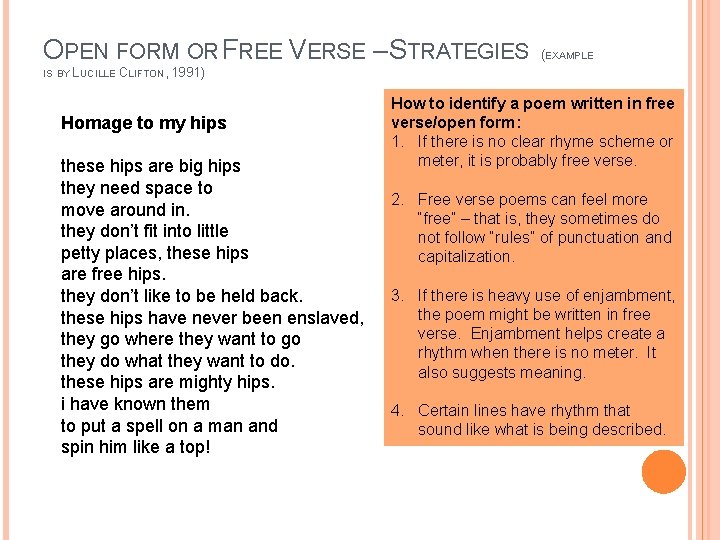
OPEN FORM OR FREE VERSE – STRATEGIES IS BY LUCILLE CLIFTON, (EXAMPLE 1991) Homage to my hips these hips are big hips they need space to move around in. they don’t fit into little petty places, these hips are free hips. they don’t like to be held back. these hips have never been enslaved, they go where they want to go they do what they want to do. these hips are mighty hips. i have known them to put a spell on a man and spin him like a top! How to identify a poem written in free verse/open form: 1. If there is no clear rhyme scheme or meter, it is probably free verse. 2. Free verse poems can feel more “free” – that is, they sometimes do not follow “rules” of punctuation and capitalization. 3. If there is heavy use of enjambment, the poem might be written in free verse. Enjambment helps create a rhythm when there is no meter. It also suggests meaning. 4. Certain lines have rhythm that sound like what is being described.
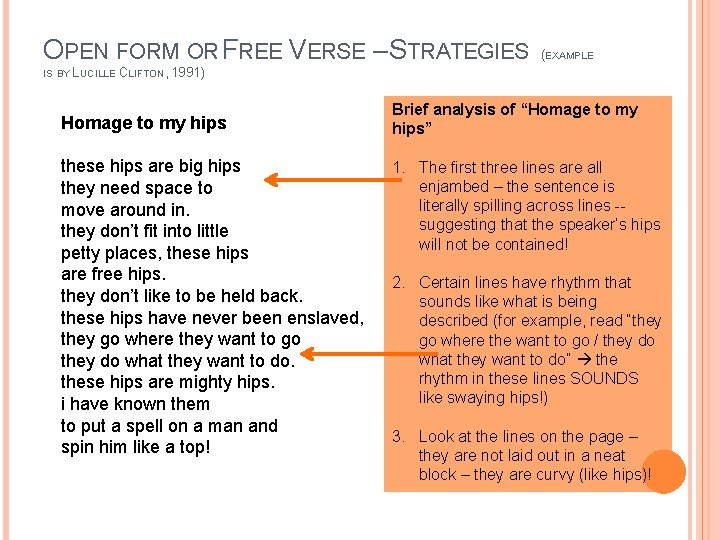
OPEN FORM OR FREE VERSE – STRATEGIES IS BY LUCILLE CLIFTON, (EXAMPLE 1991) Homage to my hips these hips are big hips they need space to move around in. they don’t fit into little petty places, these hips are free hips. they don’t like to be held back. these hips have never been enslaved, they go where they want to go they do what they want to do. these hips are mighty hips. i have known them to put a spell on a man and spin him like a top! Brief analysis of “Homage to my hips” 1. The first three lines are all enjambed – the sentence is literally spilling across lines -suggesting that the speaker’s hips will not be contained! 2. Certain lines have rhythm that sounds like what is being described (for example, read “they go where the want to go / they do what they want to do” the rhythm in these lines SOUNDS like swaying hips!) 3. Look at the lines on the page – they are not laid out in a neat block – they are curvy (like hips)!
NEXT STEPS After taking notes on these strategies, use the rest of the resources under this objective to get a few models of analyzing a poem’s form and writing about it should look like. Read the annotations and model paragraphs for “Do not go gentle into that good night, ” “Sonnet 19” “Berry Picking” as models of analysis. What is revealed about the poem’s meaning through analysis of poetic form?
REFERENCES Kennedy, X. J. and Goia, D. , eds. Literature: An introduction to fiction, poetry, drama, and writing. Pearson-Longman: New York, 2009.