
Poetic Devices THE TECHNIQUE BEHIND THE WORDS Stanza
Poetic Devices THE TECHNIQUE BEHIND THE WORDS
Stanza A stanza is a group of lines that act like sentences. The sentences combine together to make stanzas, or paragraphs, of poetry.
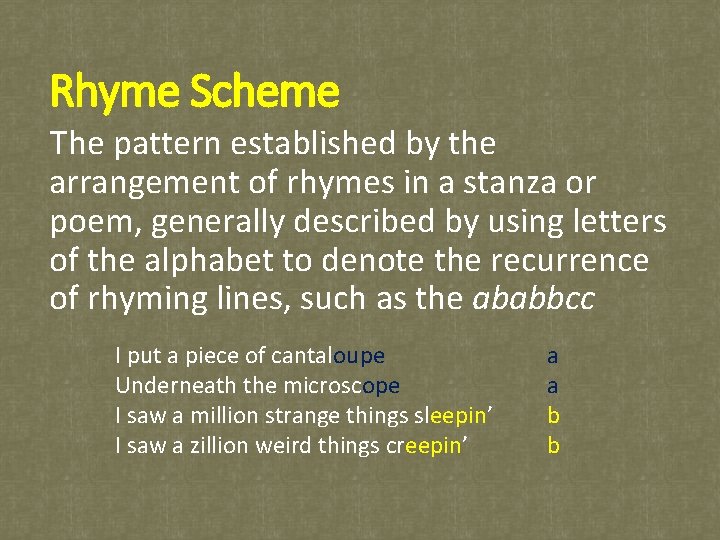
Rhyme Scheme The pattern established by the arrangement of rhymes in a stanza or poem, generally described by using letters of the alphabet to denote the recurrence of rhyming lines, such as the ababbcc I put a piece of cantaloupe Underneath the microscope I saw a million strange things sleepin’ I saw a zillion weird things creepin’ a a b b
Meter Ø Meter is internal beat or rhythm; it brings the poem to life. ØIambic = feet of poetry (two beats) Monometer – 1 foot Dimeter – 2 feet Trimeter – 3 feet Tetrameter – 4 feet Pentameter – 5 feet Hexameter – 6 feet Heptameter – 7 feet Octameter – 8 feet
Repetition Poets can utilize this technique to repeat sounds, vowels, consonants, words, single lines, or in fact whole stanzas. This repetition can help create images and feelings for the reader. Ex. : Each stanza of Edgar Allan Poe’s “The Raven” ends with: “Quoth the Raven, ‘Nevermore. ’ ”
Figurative Language What is figurative language? Language using figures of speech (a way of saying one thing and meaning another). Why use figurative language? Figurative language helps a writer show meaning and expression. If a writer does not create an image in the reader’s mind, he will lose the reader’s attention.
Simile A figure of speech that creates a comparison between two things usually unalike. The comparison is made by using such words or phrases as like, as, than, similar to, resembles, appears, or seems. Ex: “Her eyes are like stars!” “Life is like a box of chocolate. ”
Metaphor A figure of speech that creates a comparison between two things usually unalike. Doesn’t use connective words such as like or as. Ex: “Her eyes are jewels!” “Life is a game. ”
Personification A figure of speech giving human traits (qualities, feelings, action, or characteristics) to non-living objects (things, colors, qualities, or ideas). Ex: “The diamonds are jealous of your beauty!” "The wind whispered through the night. "
Alliteration Also called head rhyme or initial rhyme, the repetition of the initial sounds (usually consonants) of stressed syllables in neighboring words or at short intervals within a line or passage, usually at word beginnings Ex. : wild and woolly OR I bear light shade for the leaves when laid
Assonance The relatively close juxtaposition of the same or similar vowel sounds, but with different end consonants in a line or passage, thus a vowel rhyme – words with internal rhyme. Ex. : date and fade
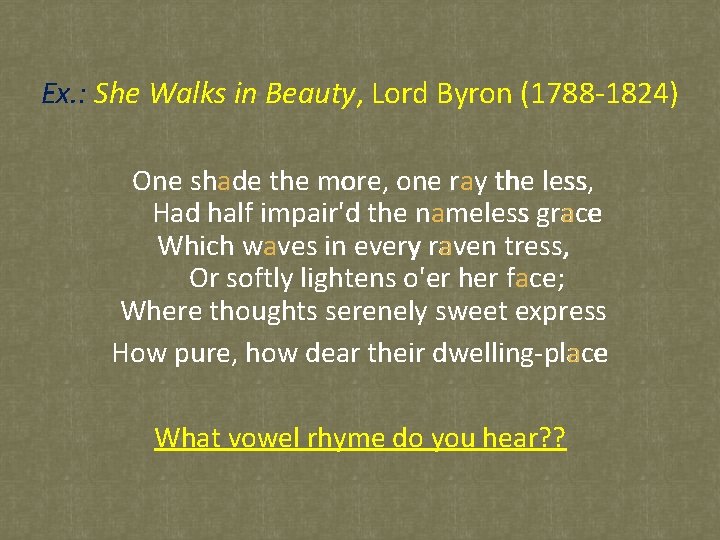
Ex. : She Walks in Beauty, Lord Byron (1788 -1824) One shade the more, one ray the less, Had half impair'd the nameless grace Which waves in every raven tress, Or softly lightens o'er her face; Where thoughts serenely sweet express How pure, how dear their dwelling-place What vowel rhyme do you hear? ?
- Slides: 12