
Podcast 4 8 IB Chemistry Northwestern High School

Podcast 4. 8 IB Chemistry Northwestern High School Dr. J. Venables
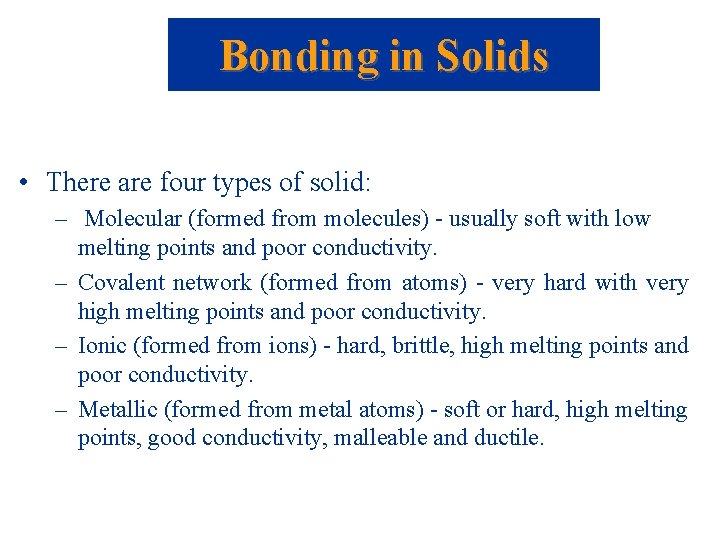
Bonding in Solids • There are four types of solid: – Molecular (formed from molecules) - usually soft with low melting points and poor conductivity. – Covalent network (formed from atoms) - very hard with very high melting points and poor conductivity. – Ionic (formed from ions) - hard, brittle, high melting points and poor conductivity. – Metallic (formed from metal atoms) - soft or hard, high melting points, good conductivity, malleable and ductile.
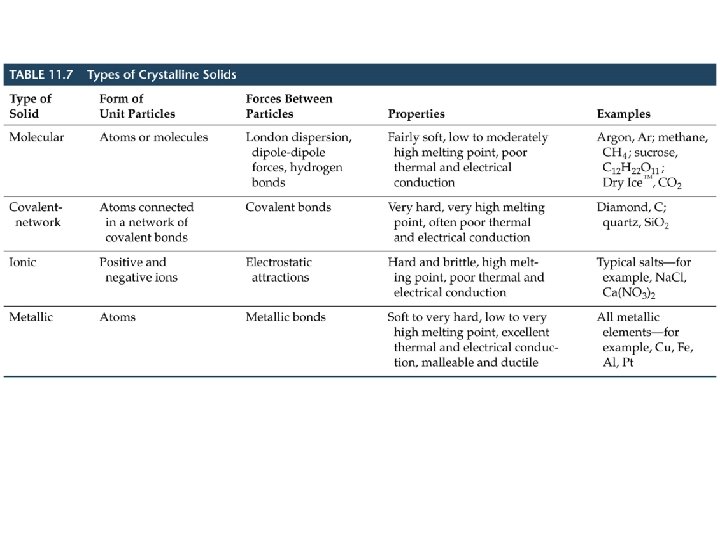
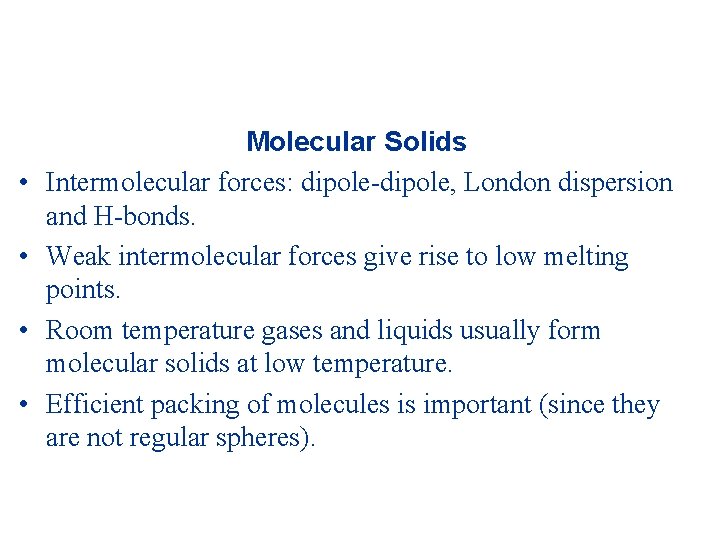
• • Molecular Solids Intermolecular forces: dipole-dipole, London dispersion and H-bonds. Weak intermolecular forces give rise to low melting points. Room temperature gases and liquids usually form molecular solids at low temperature. Efficient packing of molecules is important (since they are not regular spheres).
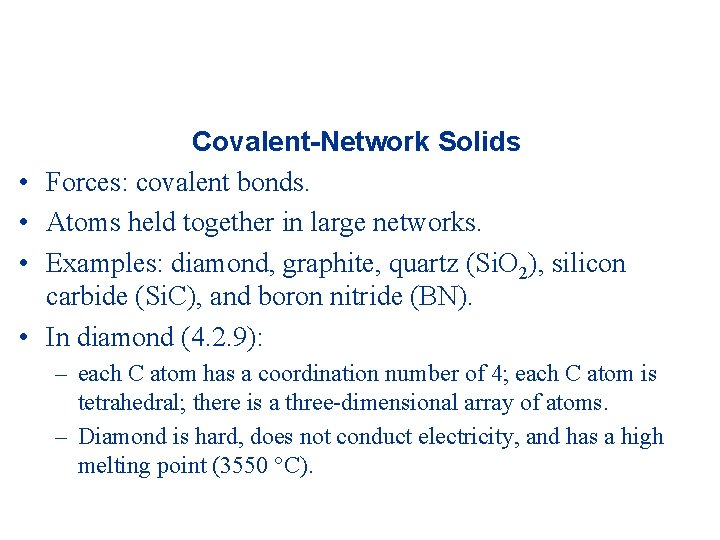
• • Covalent-Network Solids Forces: covalent bonds. Atoms held together in large networks. Examples: diamond, graphite, quartz (Si. O 2), silicon carbide (Si. C), and boron nitride (BN). In diamond (4. 2. 9): – each C atom has a coordination number of 4; each C atom is tetrahedral; there is a three-dimensional array of atoms. – Diamond is hard, does not conduct electricity, and has a high melting point (3550 C).

Covalent-Network Solids
• (4. 2. 9) • In graphite – each C atom is arranged in a planar hexagonal ring; – layers of interconnected rings are placed on top of each other; – the distance between C atoms is close to benzene (1. 42 Å vs. 1. 395 Å in benzene); – the distance between layers is large (3. 41 Å); layers are held together by LDF between delocalized pi electrons and can “slide” past one another (good lubricant). – electrons move in delocalized orbitals (good conductor).
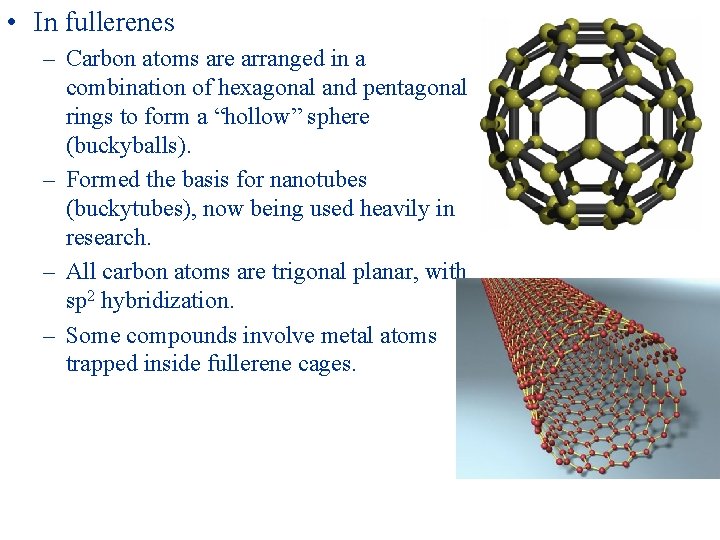
• In fullerenes – Carbon atoms are arranged in a combination of hexagonal and pentagonal rings to form a “hollow” sphere (buckyballs). – Formed the basis for nanotubes (buckytubes), now being used heavily in research. – All carbon atoms are trigonal planar, with sp 2 hybridization. – Some compounds involve metal atoms trapped inside fullerene cages.
Ionic Solids • Ions (spherical) held together by electrostatic forces of attraction. • There are some simple classifications for ionic lattice types.
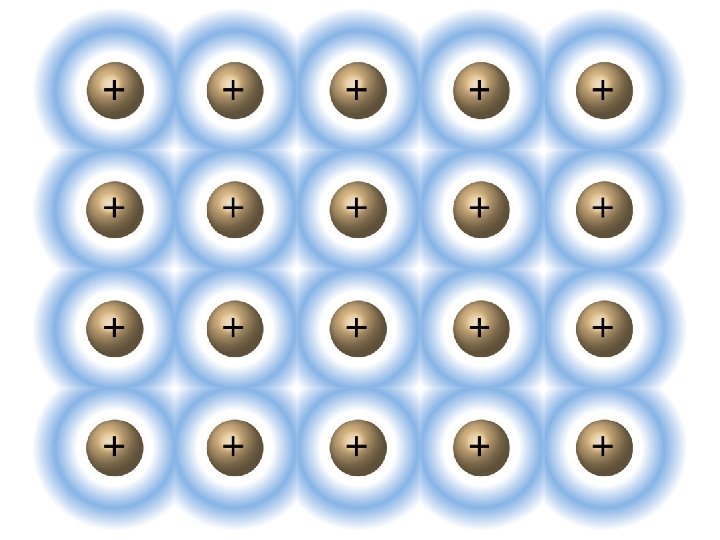
Metallic Solids • Problem: the bonding is too strong for London dispersion and there are not enough electrons for covalent bonds. • Resolution: the metal nuclei float in a sea of valence electrons. • Metals conduct because the electrons are delocalized and are mobile.
- Slides: 11