
Po C METAL DIAMOND ADDITIVE MANUFACTURING Investigation of


- Slides: 19
Po. C – METAL DIAMOND ADDITIVE MANUFACTURING Investigation of new methods for manufacturing of Copper. Diamond Composites with tailored thermo-physical properties David Grech, Michael Kitzmantel, Erich Neubauer, 2 nd annual ARIES meeting, Budapest 8. 4. 2019 1 ARIES is co-funded by the European Commission Grant Agreement number 73087
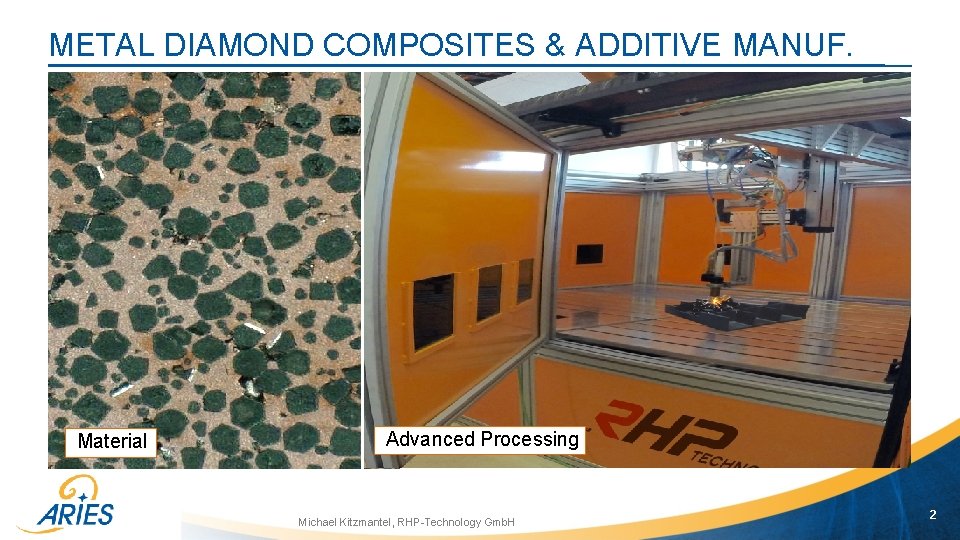
METAL DIAMOND COMPOSITES & ADDITIVE MANUF. Material Advanced Processing Michael Kitzmantel, RHP-Technology Gmb. H 2
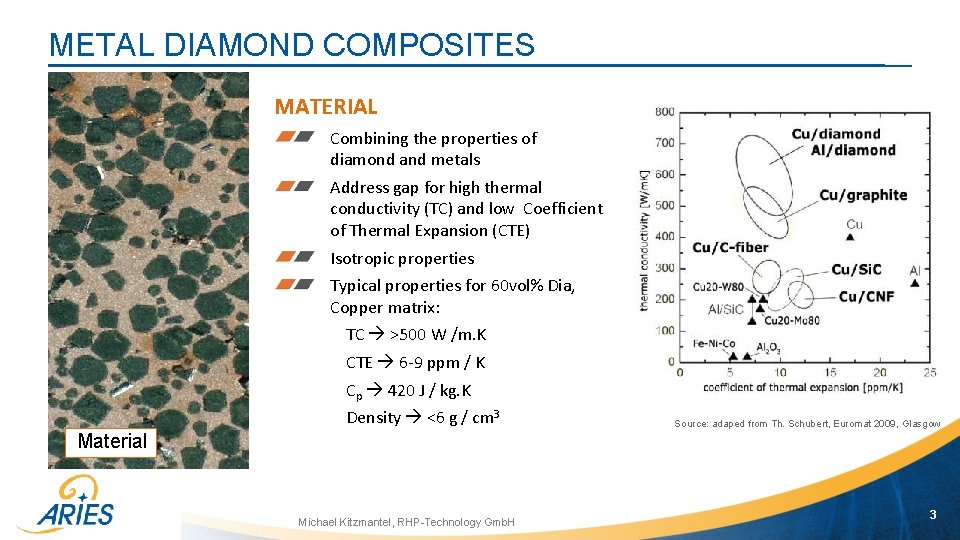
METAL DIAMOND COMPOSITES MATERIAL Combining the properties of diamond and metals Address gap for high thermal conductivity (TC) and low Coefficient of Thermal Expansion (CTE) Isotropic properties Typical properties for 60 vol% Dia, Copper matrix: TC >500 W /m. K CTE 6 -9 ppm / K Cp 420 J / kg. K Density <6 g / cm 3 Source: adaped from Th. Schubert, Euromat 2009, Glasgow Material Michael Kitzmantel, RHP-Technology Gmb. H 3
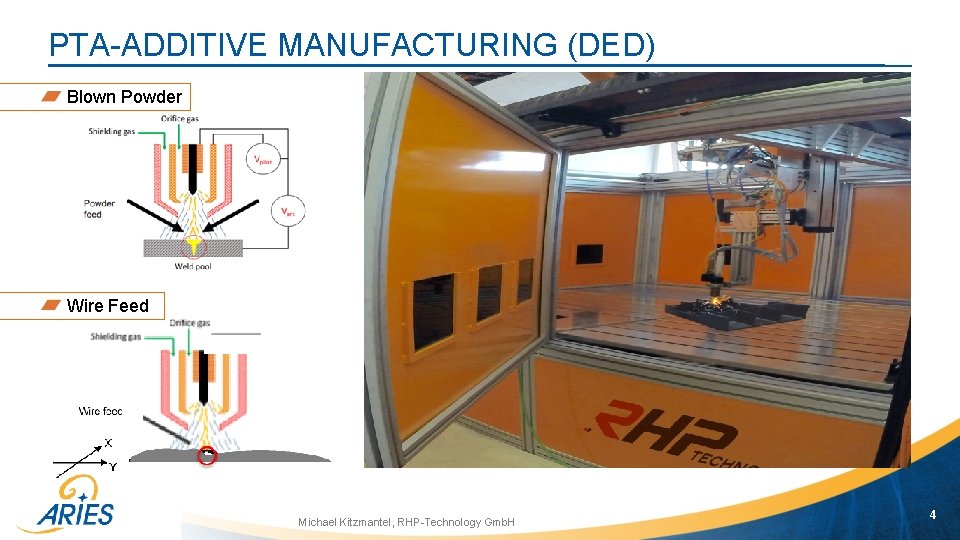
PTA-ADDITIVE MANUFACTURING (DED) Blown Powder Wire Feed Michael Kitzmantel, RHP-Technology Gmb. H 4
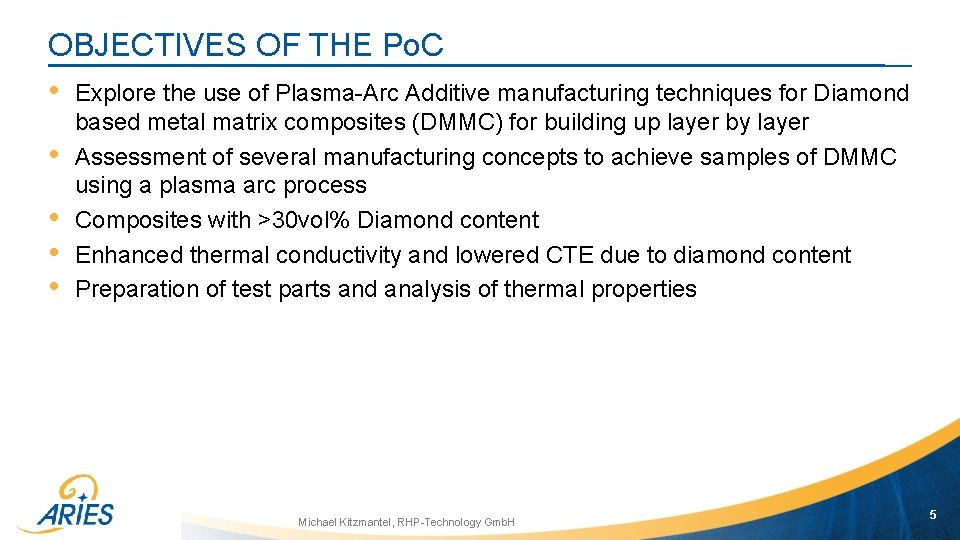
OBJECTIVES OF THE Po. C • Explore the use of Plasma-Arc Additive manufacturing techniques for Diamond • • based metal matrix composites (DMMC) for building up layer by layer Assessment of several manufacturing concepts to achieve samples of DMMC using a plasma arc process Composites with >30 vol% Diamond content Enhanced thermal conductivity and lowered CTE due to diamond content Preparation of test parts and analysis of thermal properties Michael Kitzmantel, RHP-Technology Gmb. H 5
CHALLENGES IN DMMCs • Diamonds-to-Metal interface • • Mismatch of diamonds with high thermally conductive matrix materials, namely Cu and Al Need for a mechanical and thermal interlayer -> formation of carbides Diamond graphitization when exposed to high temperatures -> hot-pressing vs plasma-arc process Severe limitation in machining • • • Near-net shape fabrication of simple small structures -> blocks or cylinders possible Use of metallic case / shell / cladding to achieve accurate dimensions Choice of machining processes (Electric discharge machining, Waterjet cutting, Laser cutting – to some extent) Michael Kitzmantel, RHP-Technology Gmb. H 6
INVESTIGATED CONCEPTS • Copper and Aluminium based matrix • • • Blown powders • • Mixture of pure metal and coated diamond powders Mixture of alloyed metal and diamond powders Blown powder and wire feed • • Blown coated diamonds and metal wire Blown diamonds and alloy metal wire Diamond containing feeding rods • • Diamond-metal composite rod feed Diamond powder-filled cored wire Michael Kitzmantel, RHP-Technology Gmb. H 7
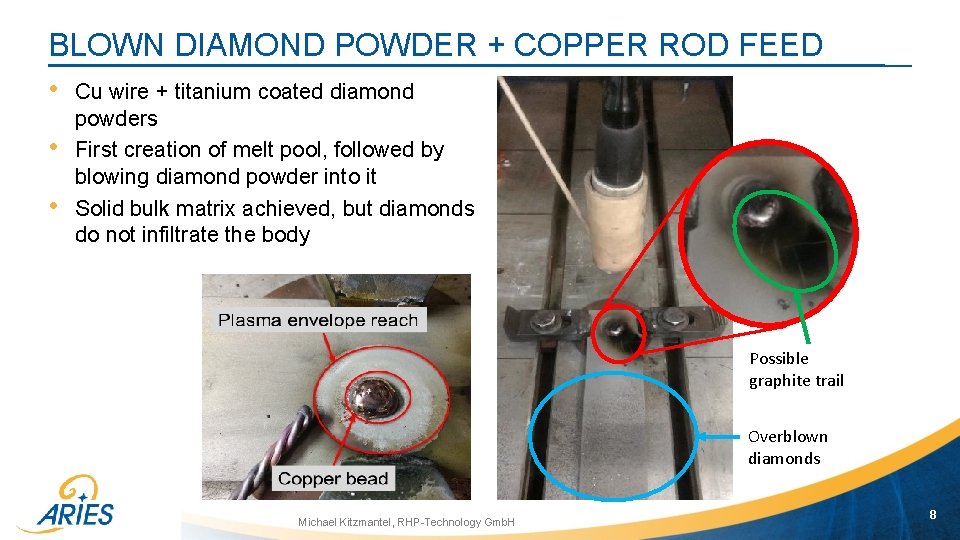
BLOWN DIAMOND POWDER + COPPER ROD FEED • • • Cu wire + titanium coated diamond powders First creation of melt pool, followed by blowing diamond powder into it Solid bulk matrix achieved, but diamonds do not infiltrate the body Possible graphite trail Overblown diamonds Michael Kitzmantel, RHP-Technology Gmb. H 8
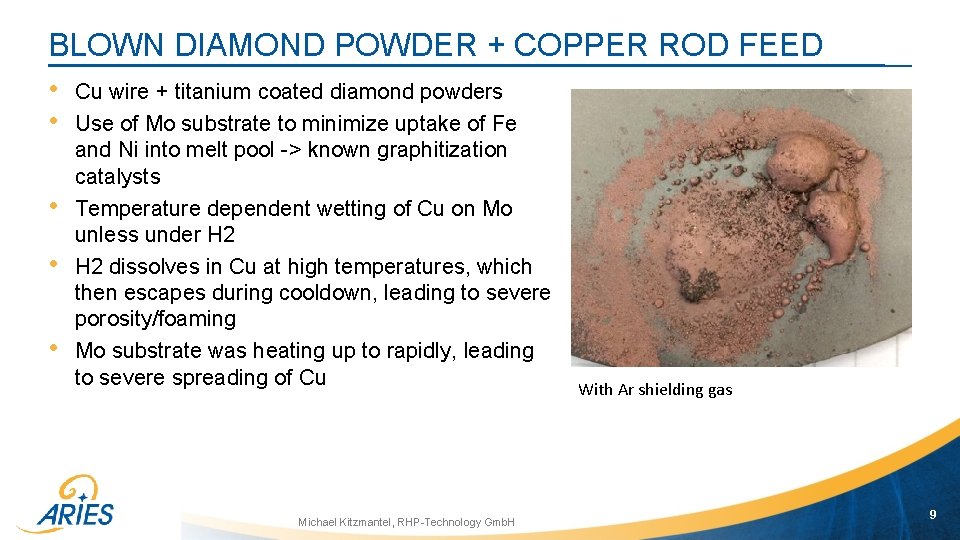
BLOWN DIAMOND POWDER + COPPER ROD FEED • • • Cu wire + titanium coated diamond powders Use of Mo substrate to minimize uptake of Fe and Ni into melt pool -> known graphitization catalysts Temperature dependent wetting of Cu on Mo unless under H 2 dissolves in Cu at high temperatures, which then escapes during cooldown, leading to severe porosity/foaming Mo substrate was heating up to rapidly, leading to severe spreading of Cu Michael Kitzmantel, RHP-Technology Gmb. H With Ar shielding gas 9
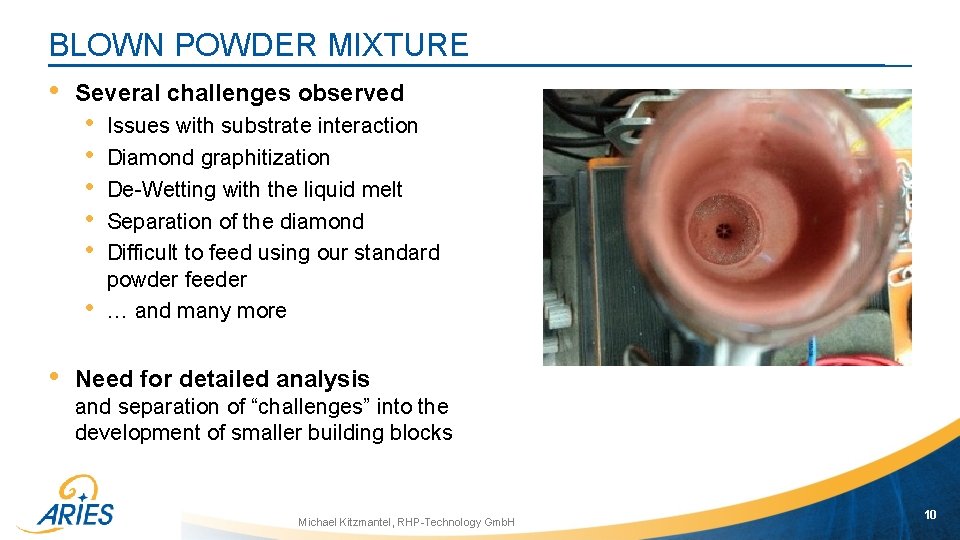
BLOWN POWDER MIXTURE • Several challenges observed • • Issues with substrate interaction Diamond graphitization De-Wetting with the liquid melt Separation of the diamond Difficult to feed using our standard powder feeder … and many more Need for detailed analysis and separation of “challenges” into the development of smaller building blocks Michael Kitzmantel, RHP-Technology Gmb. H 10
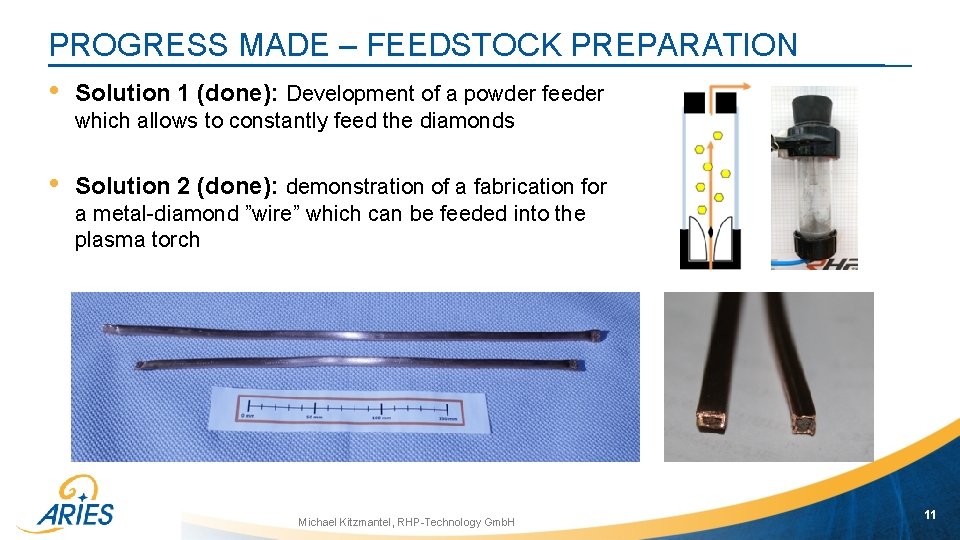
PROGRESS MADE – FEEDSTOCK PREPARATION • Solution 1 (done): Development of a powder feeder which allows to constantly feed the diamonds • Solution 2 (done): demonstration of a fabrication for a metal-diamond ”wire” which can be feeded into the plasma torch Michael Kitzmantel, RHP-Technology Gmb. H 11
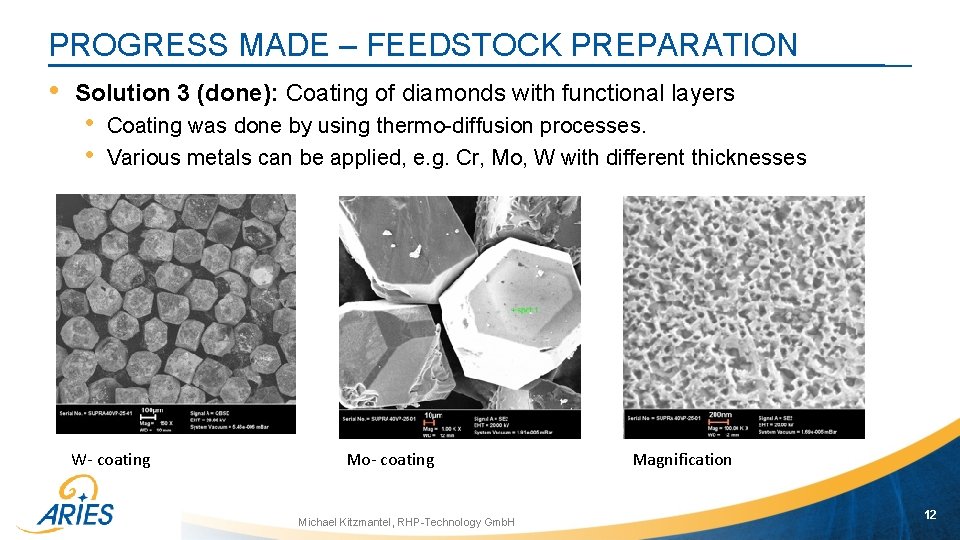
PROGRESS MADE – FEEDSTOCK PREPARATION • Solution 3 (done): Coating of diamonds with functional layers • • Coating was done by using thermo-diffusion processes. Various metals can be applied, e. g. Cr, Mo, W with different thicknesses W- coating Mo- coating Michael Kitzmantel, RHP-Technology Gmb. H Magnification 12
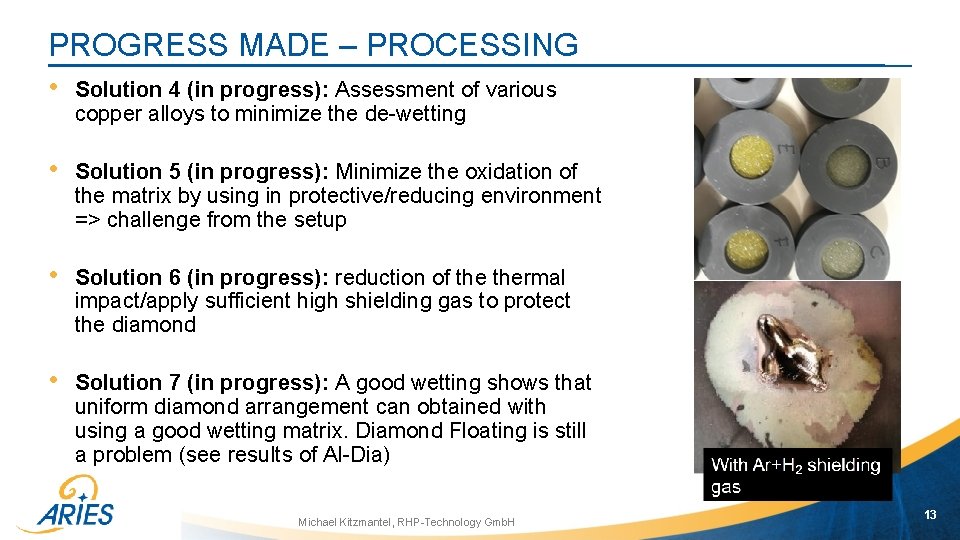
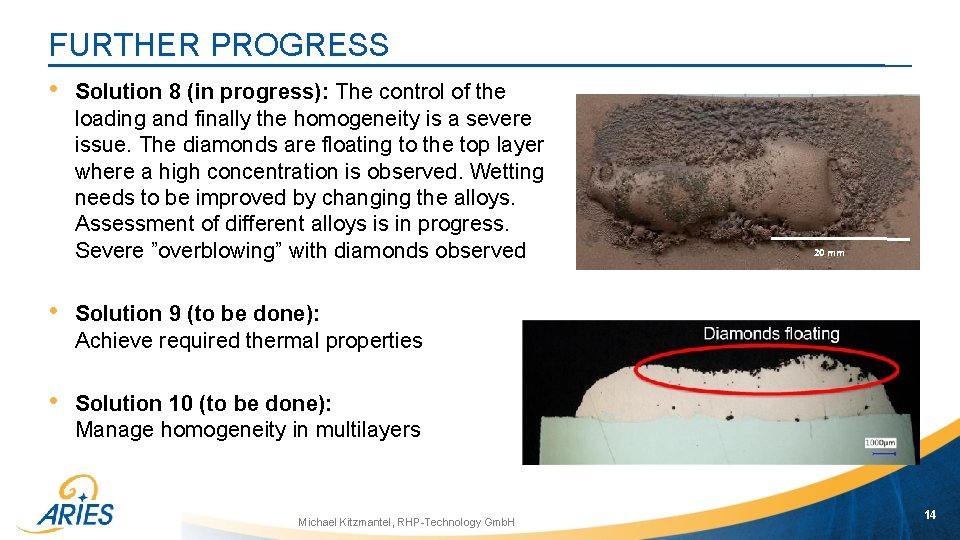
PROGRESS MADE – PROCESSING • Solution 4 (in progress): Assessment of various copper alloys to minimize the de-wetting • Solution 5 (in progress): Minimize the oxidation of the matrix by using in protective/reducing environment => challenge from the setup • Solution 6 (in progress): reduction of thermal impact/apply sufficient high shielding gas to protect the diamond • Solution 7 (in progress): A good wetting shows that uniform diamond arrangement can obtained with using a good wetting matrix. Diamond Floating is still a problem (see results of Al-Dia) Michael Kitzmantel, RHP-Technology Gmb. H 13
FURTHER PROGRESS • Solution 8 (in progress): The control of the loading and finally the homogeneity is a severe issue. The diamonds are floating to the top layer where a high concentration is observed. Wetting needs to be improved by changing the alloys. Assessment of different alloys is in progress. Severe ”overblowing” with diamonds observed • Solution 9 (to be done): Achieve required thermal properties • Solution 10 (to be done): Manage homogeneity in multilayers Michael Kitzmantel, RHP-Technology Gmb. H 20 mm 14
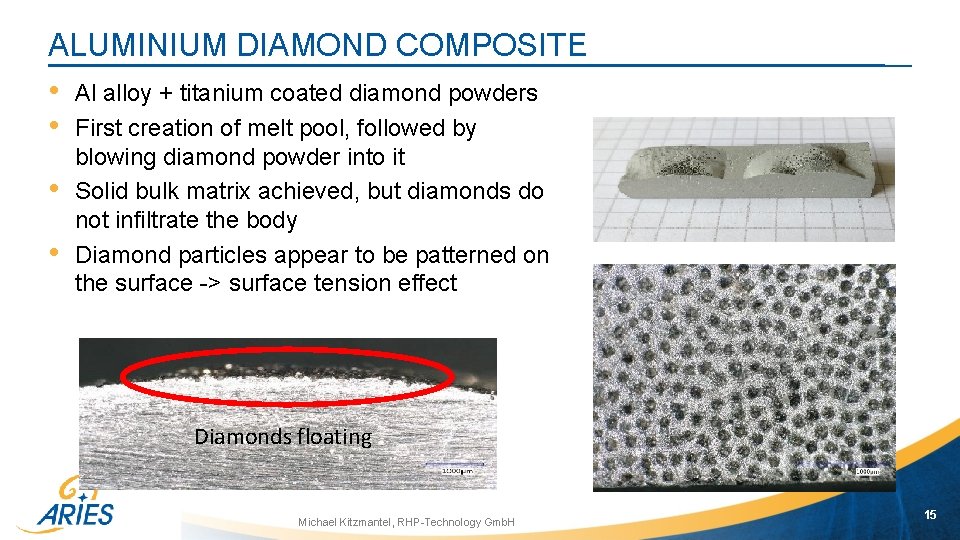
ALUMINIUM DIAMOND COMPOSITE • Al alloy + titanium coated diamond powders • First creation of melt pool, followed by • • blowing diamond powder into it Solid bulk matrix achieved, but diamonds do not infiltrate the body Diamond particles appear to be patterned on the surface -> surface tension effect Diamonds floating Michael Kitzmantel, RHP-Technology Gmb. H 15
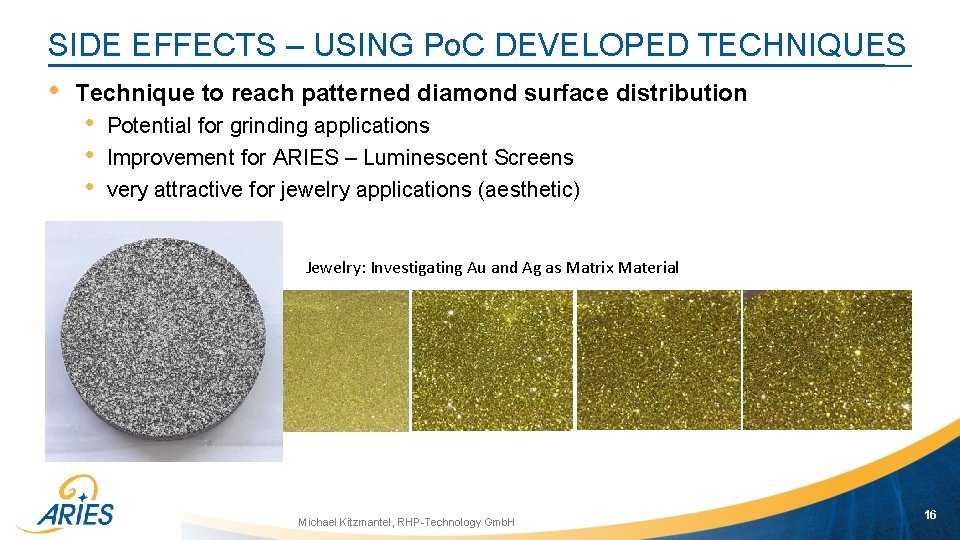
SIDE EFFECTS – USING Po. C DEVELOPED TECHNIQUES • Technique to reach patterned diamond surface distribution • • • Potential for grinding applications Improvement for ARIES – Luminescent Screens very attractive for jewelry applications (aesthetic) Jewelry: Investigating Au and Ag as Matrix Material Michael Kitzmantel, RHP-Technology Gmb. H 16
CONCLUSIONS • • Severe distinction between the physical and electrical properties of diamonds with copper and aluminium lead to disappointing behavior during the plasma arc deposition process Several issues have been identified Concept was developed to separate the different issues and to tackle them individually Powder deposits appear to have very high diamond volume fraction, indication of diamonds preferably sticking together than into molten pool Metal rod feeding promises better bulk densities at the cost of lower diamond content and increased graphitization / burning of diamonds Very low capture of diamond particles observed – large overspray due to a bad wetting Stability of plasma arc was destabilized by the blowing powder Indications of high buoyancy and surface tension forces Michael Kitzmantel, RHP-Technology Gmb. H 17
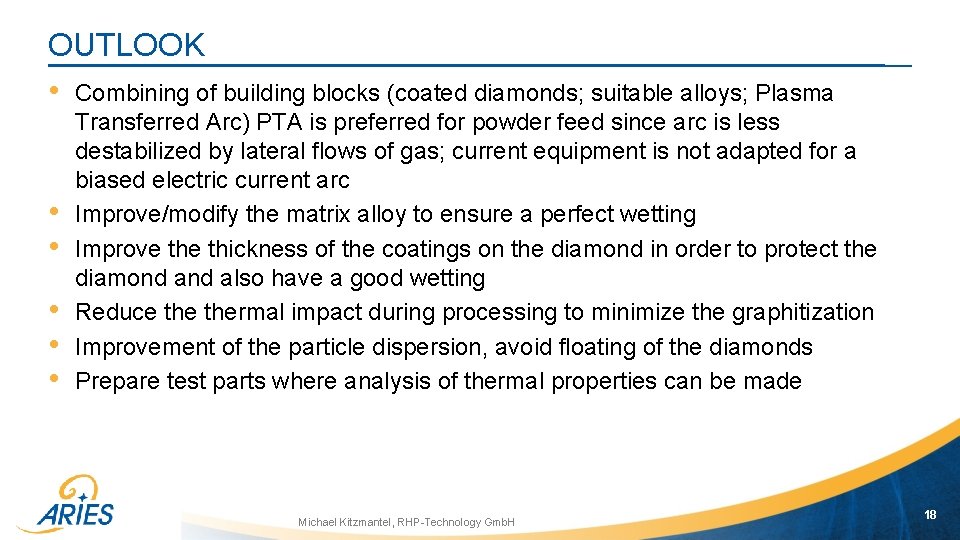
OUTLOOK • Combining of building blocks (coated diamonds; suitable alloys; Plasma • • • Transferred Arc) PTA is preferred for powder feed since arc is less destabilized by lateral flows of gas; current equipment is not adapted for a biased electric current arc Improve/modify the matrix alloy to ensure a perfect wetting Improve thickness of the coatings on the diamond in order to protect the diamond also have a good wetting Reduce thermal impact during processing to minimize the graphitization Improvement of the particle dispersion, avoid floating of the diamonds Prepare test parts where analysis of thermal properties can be made Michael Kitzmantel, RHP-Technology Gmb. H 18
THANK YOU FOR YOUR ATTENTION Michael Kitzmantel, RHP-Technology Gmb. H +43 2255 20600 – 120 // m. ki@rhp. at 19