
Pneumatic Power Pneumatics vs Hydraulics Pneumatic Systems Use

- Slides: 11
Pneumatic Power
Pneumatics vs. Hydraulics Pneumatic Systems. . . Use a compressible gas Possess a quicker, jumpier motion Are not as precise Require a lubricant Are generally cleaner Often operate at pressures around 100 psi Generally produce less power
Properties of Gases are affected by 3 variables – Temperature (T) – Pressure (p) – Volume (V) Gases have no definite volume Gases are highly compressible Gases are lighter than liquids
Properties of Gases Absolute Pressure Gauge Pressure: Pressure on a gauge does not account for atmospheric pressure on all sides of the system Absolute Pressure: Atmospheric pressure plus gauge pressure Gauge Pressure + Atmospheric Pressure = Absolute Pressure
Properties of Gases Absolute Pressure (p) is measured in pounds per square inch (lb/in. 2 or psi) Standard atmospheric pressure equals 14. 7 lb/in. 2 If a gauge reads 120. 0 psi, what is the absolute pressure? 120. 0 lb/in. 2 + 14. 7 lb/in. 2 = 134. 7 lb/in. 2
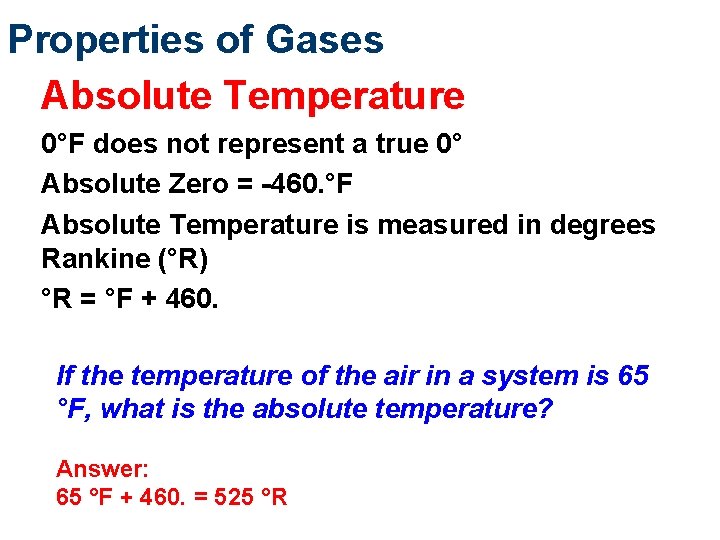
Properties of Gases Absolute Temperature 0°F does not represent a true 0° Absolute Zero = -460. °F Absolute Temperature is measured in degrees Rankine (°R) °R = °F + 460. If the temperature of the air in a system is 65 °F, what is the absolute temperature? Answer: 65 °F + 460. = 525 °R
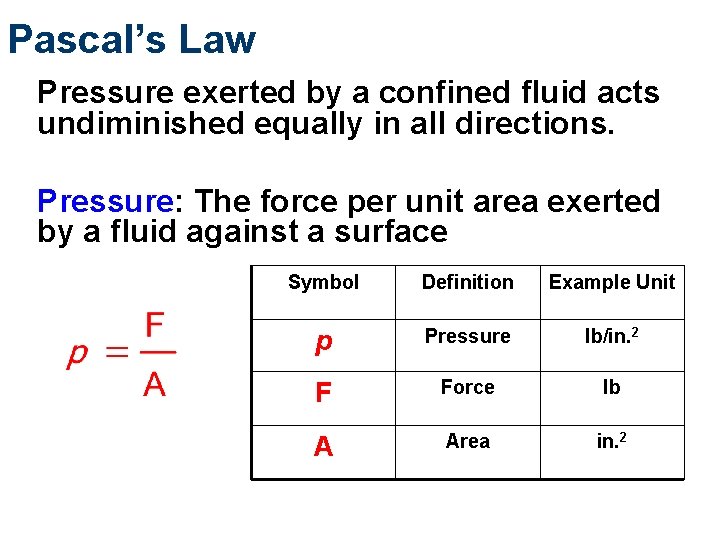
Pascal’s Law Pressure exerted by a confined fluid acts undiminished equally in all directions. Pressure: The force per unit area exerted by a fluid against a surface Symbol Definition Example Unit p Pressure lb/in. 2 F Force lb A Area in. 2
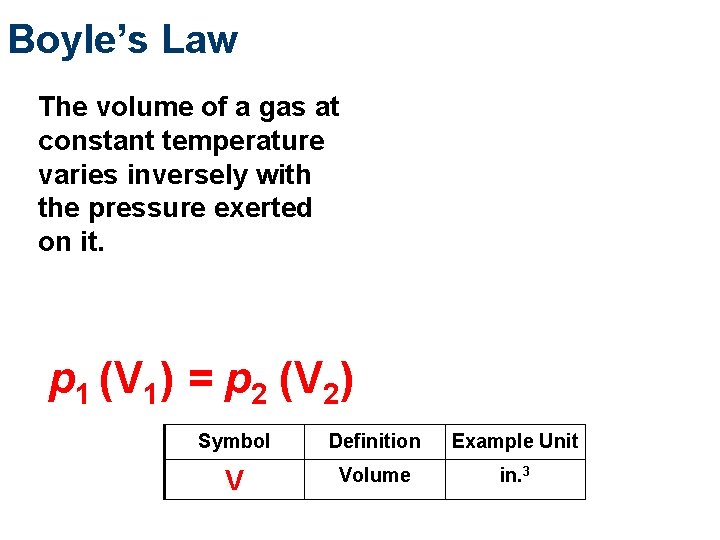
Boyle’s Law The volume of a gas at constant temperature varies inversely with the pressure exerted on it. p 1 (V 1) = p 2 (V 2) Symbol Definition Example Unit V Volume in. 3
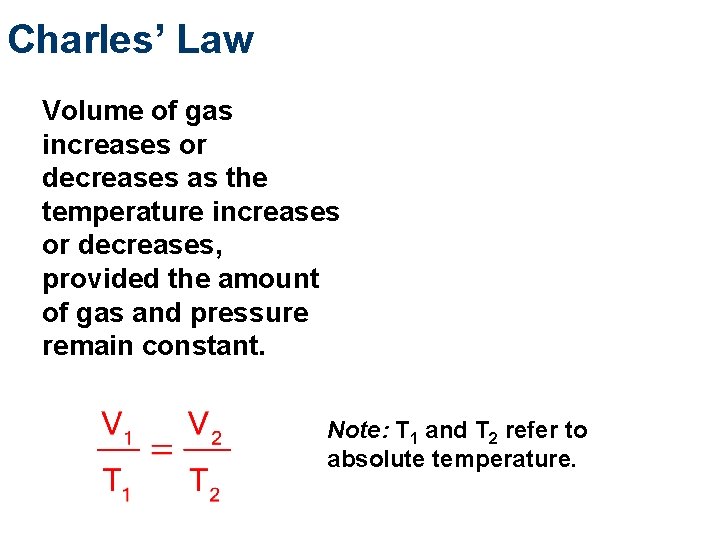
Charles’ Law Volume of gas increases or decreases as the temperature increases or decreases, provided the amount of gas and pressure remain constant. Note: T 1 and T 2 refer to absolute temperature.
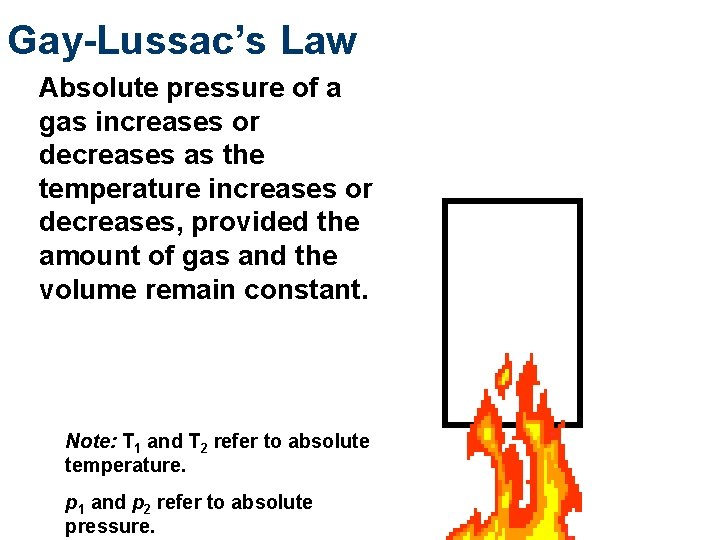
Gay-Lussac’s Law Absolute pressure of a gas increases or decreases as the temperature increases or decreases, provided the amount of gas and the volume remain constant. Note: T 1 and T 2 refer to absolute temperature. p 1 and p 2 refer to absolute pressure.
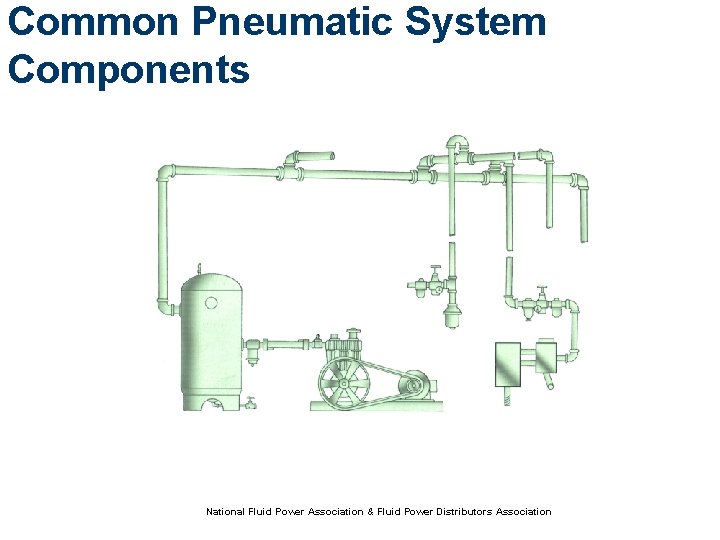
Common Pneumatic System Components National Fluid Power Association & Fluid Power Distributors Association