
Pneumatic Power FRC Conference 42706 By Raul Olivera

Pneumatic Power FRC Conference 4/27/06 By Raul Olivera
Agenda • Some Basics of Pneumatics and Associated Physics – – – – Pressure - Absolute & Gage Force, Pressure & Area Air Properties Flow Rates Electrical Analogy Mechanical Power & Work Pneumatic Energy & Power • Managing Pneumatic Energy Capacity • Power Experiment • Pneumatics vs. Motors
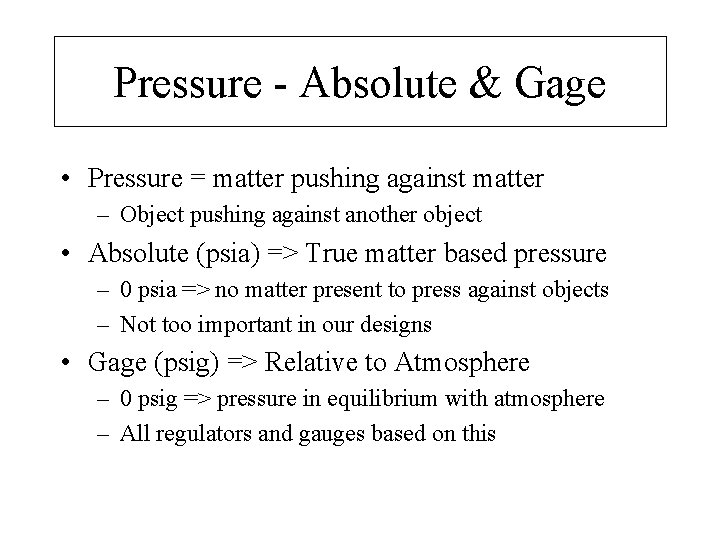
Pressure - Absolute & Gage • Pressure = matter pushing against matter – Object pushing against another object • Absolute (psia) => True matter based pressure – 0 psia => no matter present to press against objects – Not too important in our designs • Gage (psig) => Relative to Atmosphere – 0 psig => pressure in equilibrium with atmosphere – All regulators and gauges based on this
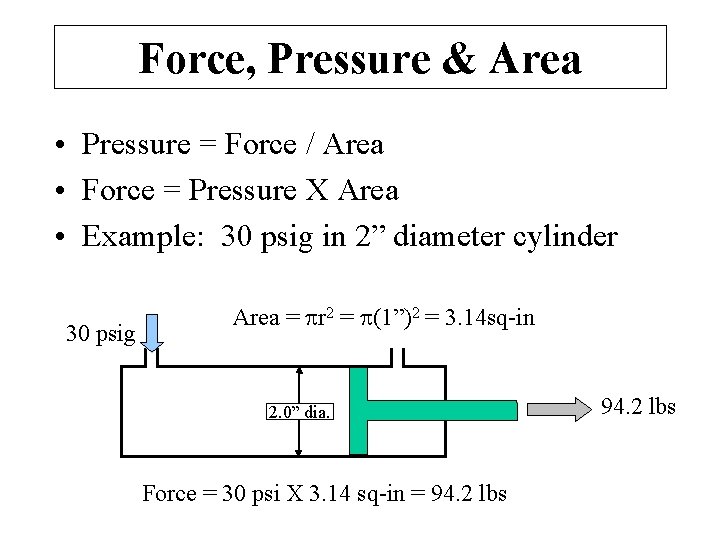
Force, Pressure & Area • Pressure = Force / Area • Force = Pressure X Area • Example: 30 psig in 2” diameter cylinder 30 psig Area = pr 2 = p(1”)2 = 3. 14 sq-in 2. 0” dia. Force = 30 psi X 3. 14 sq-in = 94. 2 lbs
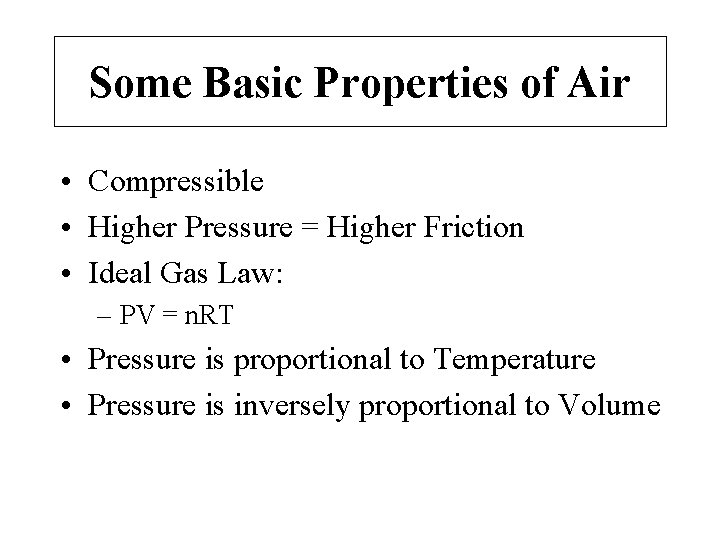
Some Basic Properties of Air • Compressible • Higher Pressure = Higher Friction • Ideal Gas Law: – PV = n. RT • Pressure is proportional to Temperature • Pressure is inversely proportional to Volume
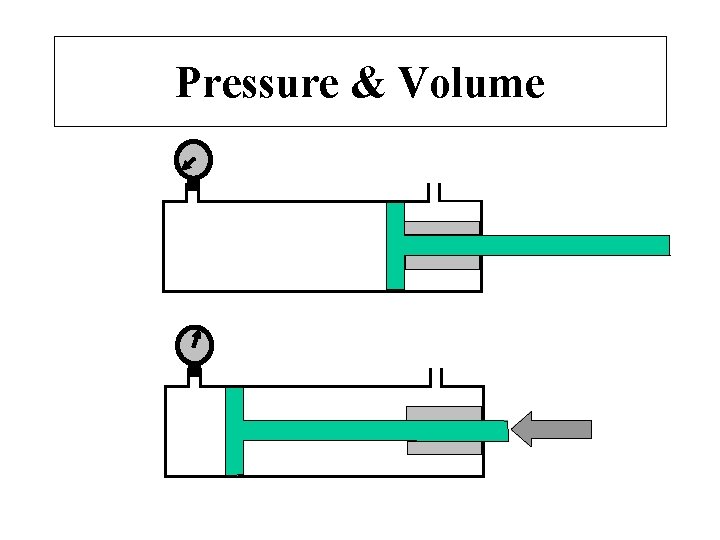
Pressure & Volume
Flow Rates • Flow rate = Volume / time – i. e. CFM (L/min, cu-in/sec) • Flow Controls - Valves – – Solenoid Value Check Valve Relief Valve Flow Control Valve • Unintended Flow Restrictions: – Narrow Passages – Flow Friction – Pressure drops while it is flowing due to restrictions
Electrical Analogy • • Pressure = Voltage Volume = Capacitance Flow rate = Current Flow Restrictions = Resistance • HOWEVER: Air is compressible => more non-linearities than those in electrical systems
Mechanical Power & Work • Work = Force x Distance – Also Work = Torque x Revolutions – Mechanical Energy is always involved in doing work • It is transferred or converted • Power = Work / Time – or Energy / Time • Power Concept – How far an object can be moved in a given time – The power rating of motors is what allows us to determine which ones can be used for a given job • Power rating for pneumatic actuators? – Depends greatly on the rest of the pneumatic system
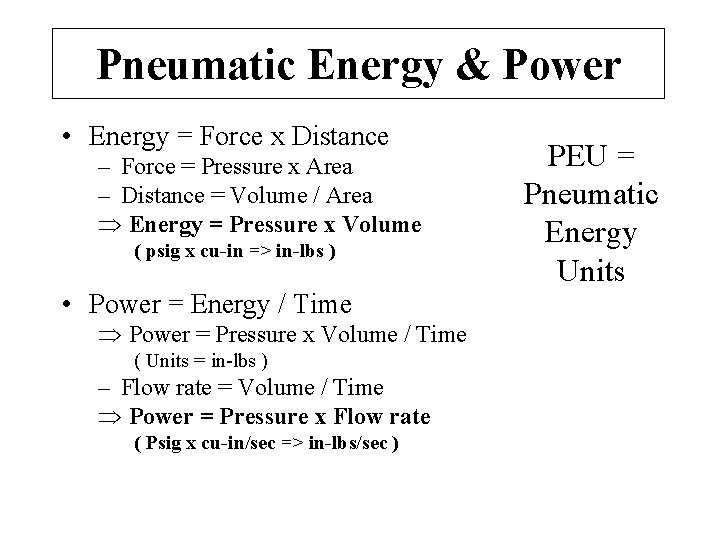
Pneumatic Energy & Power • Energy = Force x Distance – Force = Pressure x Area – Distance = Volume / Area Þ Energy = Pressure x Volume ( psig x cu-in => in-lbs ) • Power = Energy / Time Þ Power = Pressure x Volume / Time ( Units = in-lbs ) – Flow rate = Volume / Time Þ Power = Pressure x Flow rate ( Psig x cu-in/sec => in-lbs/sec ) PEU = Pneumatic Energy Units
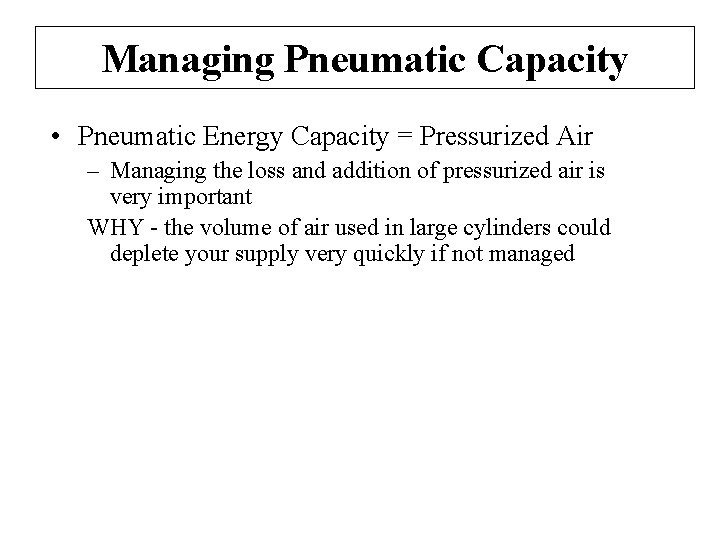
Managing Pneumatic Capacity • Pneumatic Energy Capacity = Pressurized Air – Managing the loss and addition of pressurized air is very important WHY - the volume of air used in large cylinders could deplete your supply very quickly if not managed
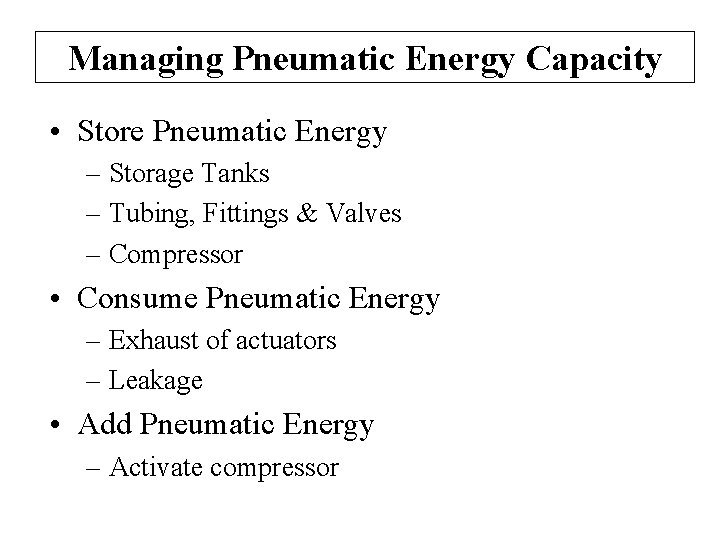
Managing Pneumatic Energy Capacity • Store Pneumatic Energy – Storage Tanks – Tubing, Fittings & Valves – Compressor • Consume Pneumatic Energy – Exhaust of actuators – Leakage • Add Pneumatic Energy – Activate compressor
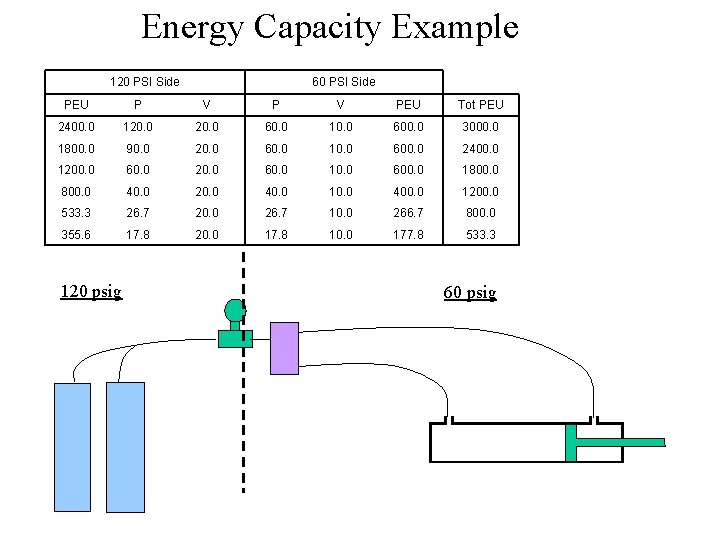
Energy Capacity Example 120 PSI Side 60 PSI Side PEU P V PEU Tot PEU 2400. 0 120. 0 60. 0 10. 0 600. 0 3000. 0 1800. 0 90. 0 20. 0 60. 0 10. 0 600. 0 2400. 0 1200. 0 60. 0 20. 0 60. 0 10. 0 600. 0 1800. 0 40. 0 20. 0 40. 0 10. 0 400. 0 1200. 0 533. 3 26. 7 20. 0 26. 7 10. 0 266. 7 800. 0 355. 6 17. 8 20. 0 17. 8 10. 0 177. 8 533. 3 120 psig 60 psig

Managing Pneumatic Energy Capacity • Energy Capacity Example: – Storage Tanks • Volume = 18. 85 cu-in (37. 7 cu-in for 2 tanks) • Pressure = 120 psig => Energy Capacity = 4524 (2 tanks) – Cylinder - 2” dia x 24” stroke • Volume = 75. 4 cu-in • Pressure = 60 psig => Energy Capacity used = 4524 • Conclusion: After 2 extensions and one contraction, the pressure in the tanks drops to less than 20 psig
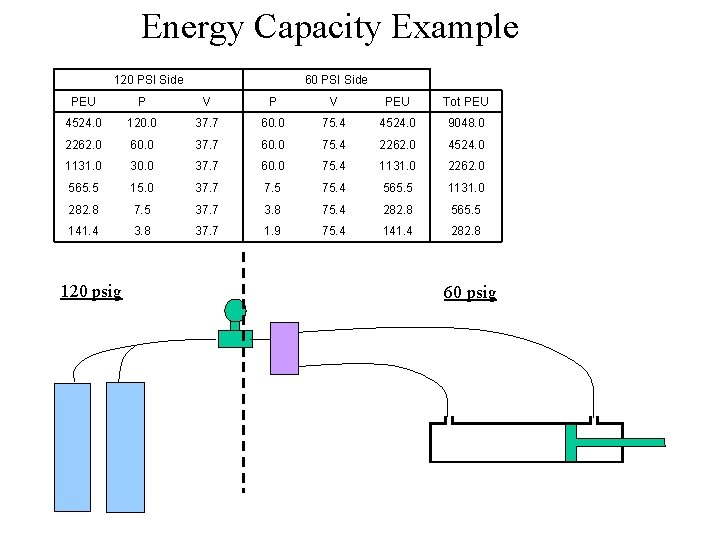
Energy Capacity Example 120 PSI Side 60 PSI Side PEU P V PEU Tot PEU 4524. 0 120. 0 37. 7 60. 0 75. 4 4524. 0 9048. 0 2262. 0 60. 0 37. 7 60. 0 75. 4 2262. 0 4524. 0 1131. 0 30. 0 37. 7 60. 0 75. 4 1131. 0 2262. 0 565. 5 15. 0 37. 7 7. 5 75. 4 565. 5 1131. 0 282. 8 7. 5 37. 7 3. 8 75. 4 282. 8 565. 5 141. 4 3. 8 37. 7 1. 9 75. 4 141. 4 282. 8 120 psig 60 psig
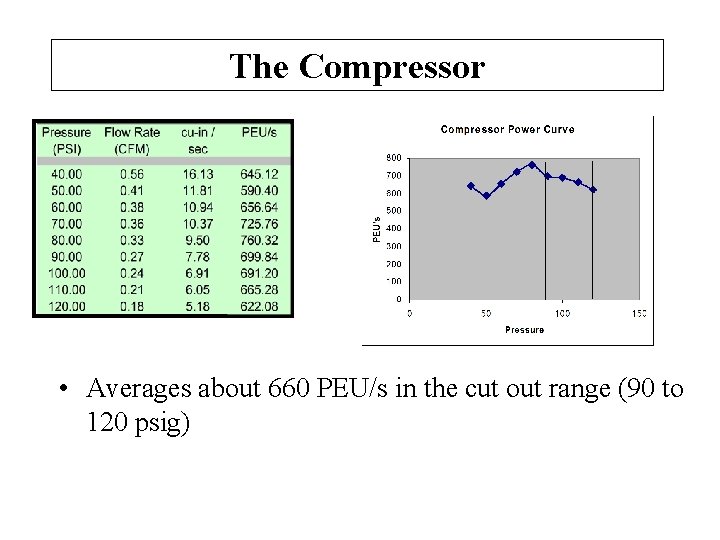
The Compressor • Averages about 660 PEU/s in the cut out range (90 to 120 psig)
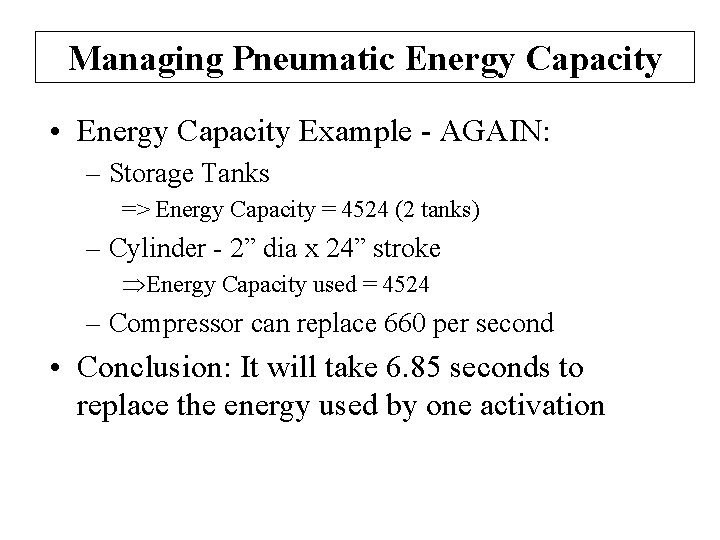
Managing Pneumatic Energy Capacity • Energy Capacity Example - AGAIN: – Storage Tanks => Energy Capacity = 4524 (2 tanks) – Cylinder - 2” dia x 24” stroke ÞEnergy Capacity used = 4524 – Compressor can replace 660 per second • Conclusion: It will take 6. 85 seconds to replace the energy used by one activation
Managing Pneumatic Energy Capacity • Managing the Loss of Energy – Use only the amount of energy required, not too much more - WHY? – Minimize Volume: • tubing length - valve to cylinder • cylinder stroke • cylinder diameter – Minimize regulated pressure • But, keep above valve pilot pressure requirement
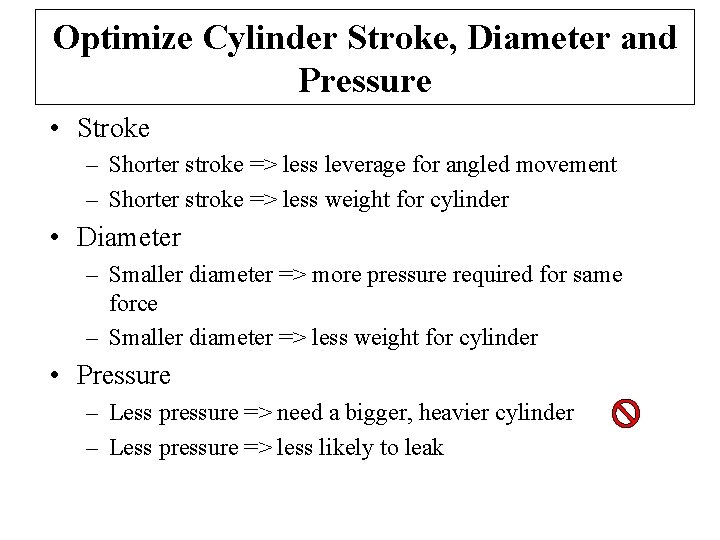
Optimize Cylinder Stroke, Diameter and Pressure • Stroke – Shorter stroke => less leverage for angled movement – Shorter stroke => less weight for cylinder • Diameter – Smaller diameter => more pressure required for same force – Smaller diameter => less weight for cylinder • Pressure – Less pressure => need a bigger, heavier cylinder – Less pressure => less likely to leak
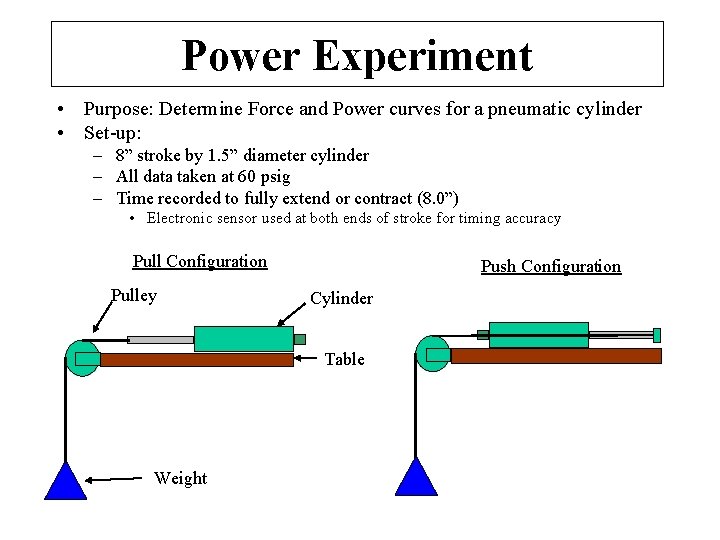
Power Experiment • Purpose: Determine Force and Power curves for a pneumatic cylinder • Set-up: – 8” stroke by 1. 5” diameter cylinder – All data taken at 60 psig – Time recorded to fully extend or contract (8. 0”) • Electronic sensor used at both ends of stroke for timing accuracy Pull Configuration Pulley Push Configuration Cylinder Table Weight
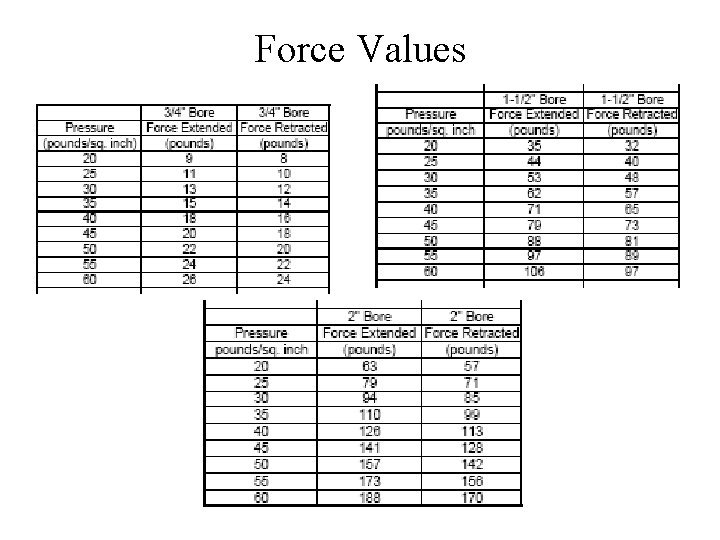
Force Values
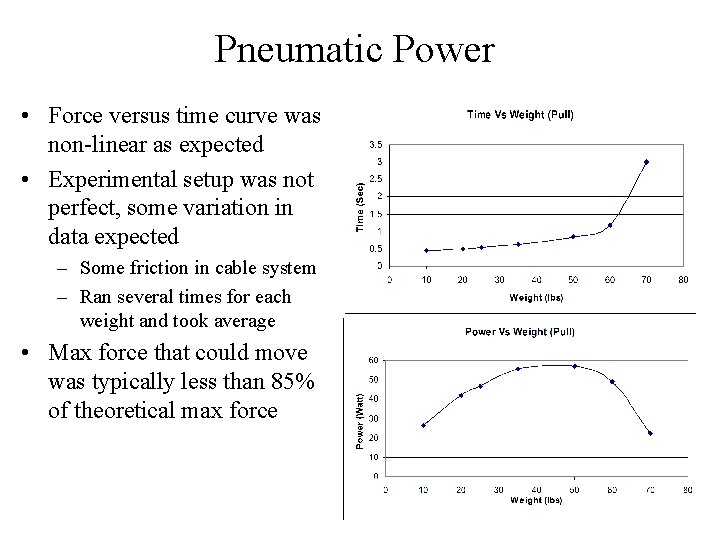
Pneumatic Power • Force versus time curve was non-linear as expected • Experimental setup was not perfect, some variation in data expected – Some friction in cable system – Ran several times for each weight and took average • Max force that could move was typically less than 85% of theoretical max force
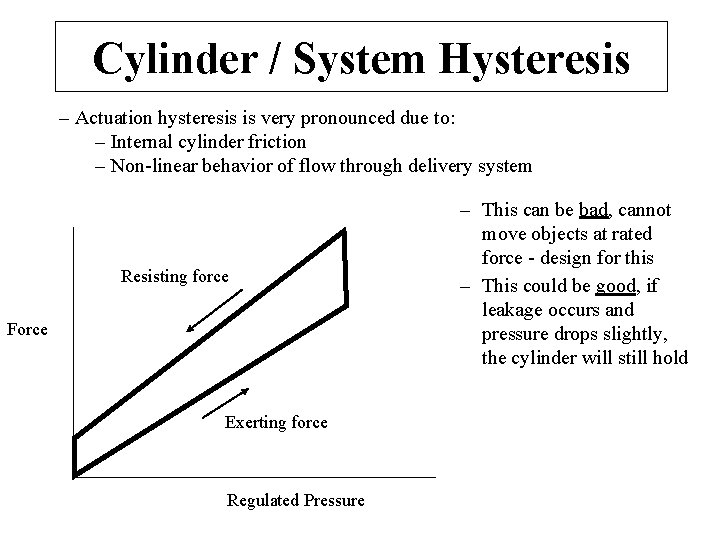
Cylinder / System Hysteresis – Actuation hysteresis is very pronounced due to: – Internal cylinder friction – Non-linear behavior of flow through delivery system Resisting force Force Exerting force Regulated Pressure – This can be bad, cannot move objects at rated force - design for this – This could be good, if leakage occurs and pressure drops slightly, the cylinder will still hold
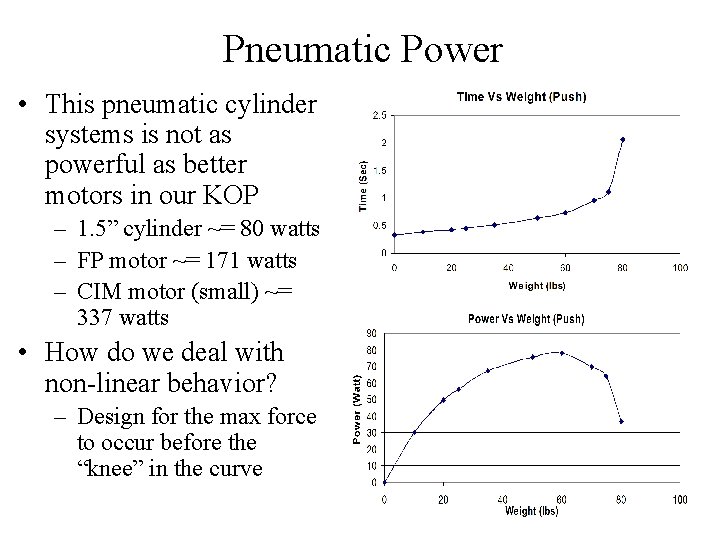
Pneumatic Power • This pneumatic cylinder systems is not as powerful as better motors in our KOP – 1. 5” cylinder ~= 80 watts – FP motor ~= 171 watts – CIM motor (small) ~= 337 watts • How do we deal with non-linear behavior? – Design for the max force to occur before the “knee” in the curve
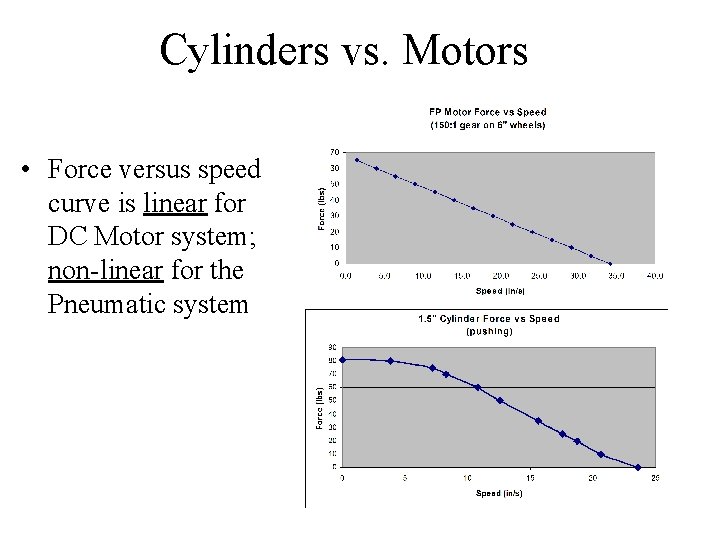
Cylinders vs. Motors • Force versus speed curve is linear for DC Motor system; non-linear for the Pneumatic system
Pneumatics vs. DC Motors Some, but not all important differences • You are allowed to use as many cylinders as you like • However, you are limited in the types and sizes of cylinders allowed • You are limited to the KOP Motors • Most of what you need for the pneumatic system is provided in the KOP or easily ordered • Motors have to be geared to produce the desired forces – Cylinders size can just be picked for the forces you need • Pneumatics are best suited for linear motion • Motors are best suited for angular motion
Pneumatics vs. DC Motors Some, but not all important differences • Our ability to control the position of mechanisms actuated by cylinders is very limited – We are not given integrated, dynamic airflow or pressure controls – We are given much more versatile electronic controls for motors • Cylinders can be stalled without damage to the pneumatic system – Motors will draw large current and let out the magic smoke • Cylinders absorb shock loads rather well and bounce back – However, be careful of over pressure conditions caused by flow control valves – Motors have to be actively held with feedback controls or locked
Pneumatics vs. DC Motors Some, but not all important differences • Cylinders use up their power source rather quickly – The 2 air tanks we are allowed do not hold much work capacity – Motors use up very little of the total capacity of the battery • The decision to use Pneumatics – The initial investment in weight is great - mostly due to compressor – Otherwise, very limited air capacity if leave compressor off robot – Once invested use for as many applications as feasible • Easy to add more functionality • Cylinders used with single solenoid valves are great for Armageddon devices - stuff happens when power is shut off – This could be good or bad - use wisely
- Slides: 28