
Pneumatic Components Unit 2 Outline FlapperNozzle Air Filter





- Slides: 39
Pneumatic Components Unit 2
Outline • Flapper-Nozzle, • Air Filter Regulator lubricator, • Volume Booster, • Pneumatic Relay-Bleed/ Non-bleed, • Direct/Reverse
Flapper-Nozzle
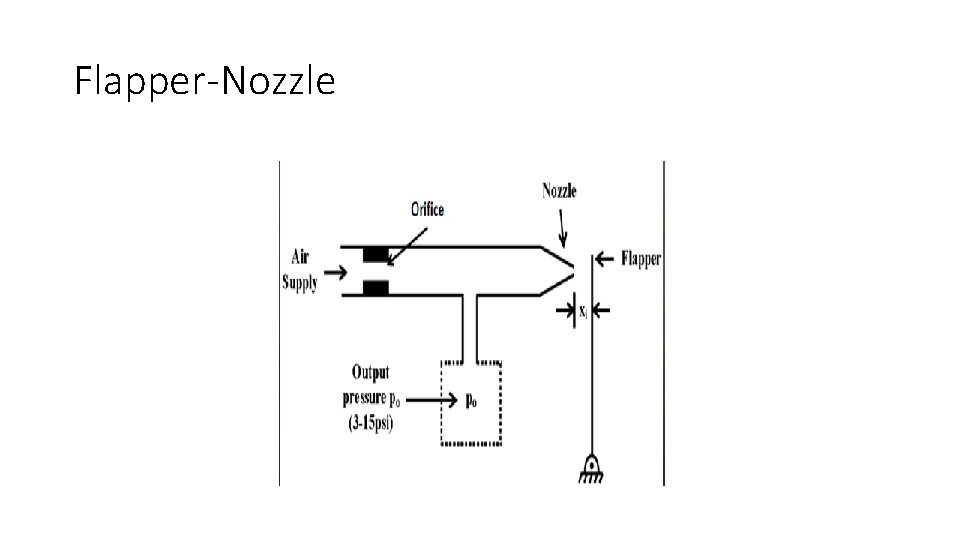
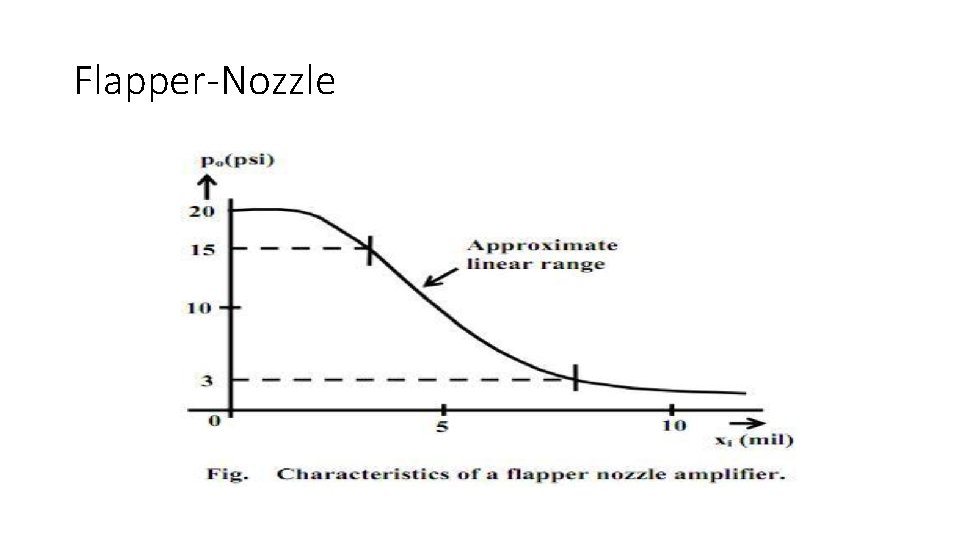
Flapper-Nozzle • It converts very small displacement signal (in order of microns) to variation of air pressure. • Constant air pressure is supplied to one end of the pipeline. There is an orifice at this end. At the other end of the pipe, there is a nozzle and a flapper • The gap between the nozzle and the flapper is set by the input signal. As the flapper moves closer to the nozzle, there will be less airflow through the nozzle and the air pressure inside the pipe will increase. • if the flapper moves further away from the nozzle, the air pressure decreases. At the extreme, if the nozzle is open (flapper is far off), the output pressure will be equal to the atmospheric pressure. If the nozzle is blocked, the output pressure will be equal to the supply pressure.
Flapper-Nozzle
Flapper-Nozzle • https: //www. youtube. com/watch? v=a. C 0 w. CYIk. JQc • https: //www. youtube. com/watch? v=8_UPBYuc. UM 0
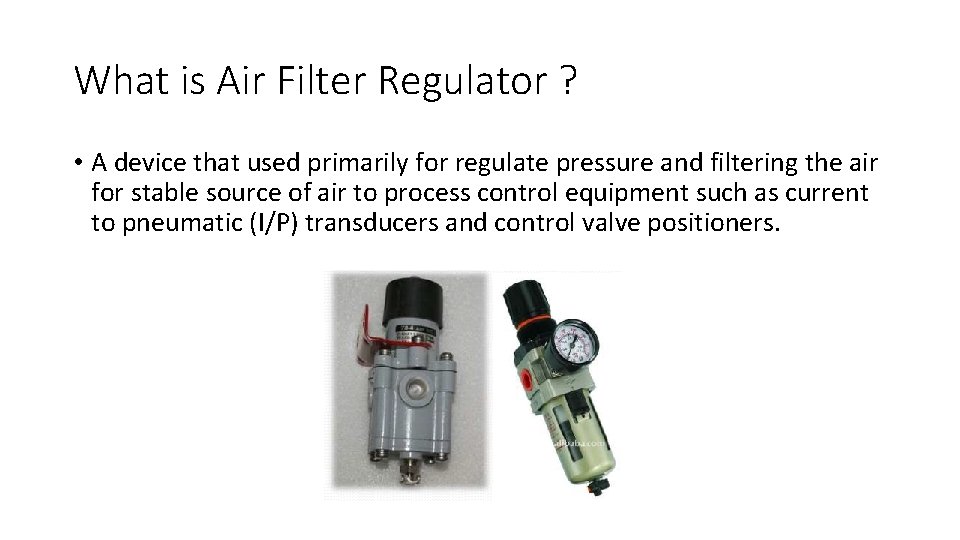
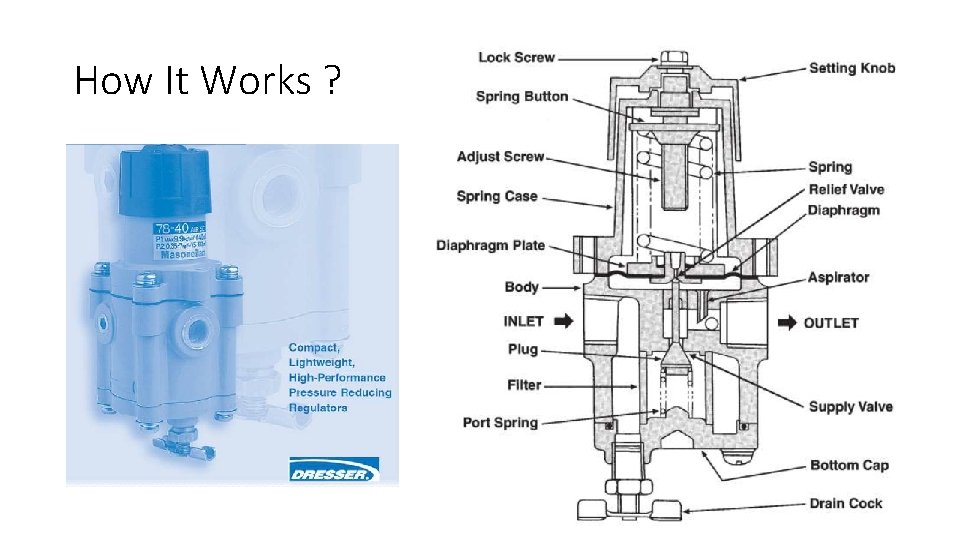
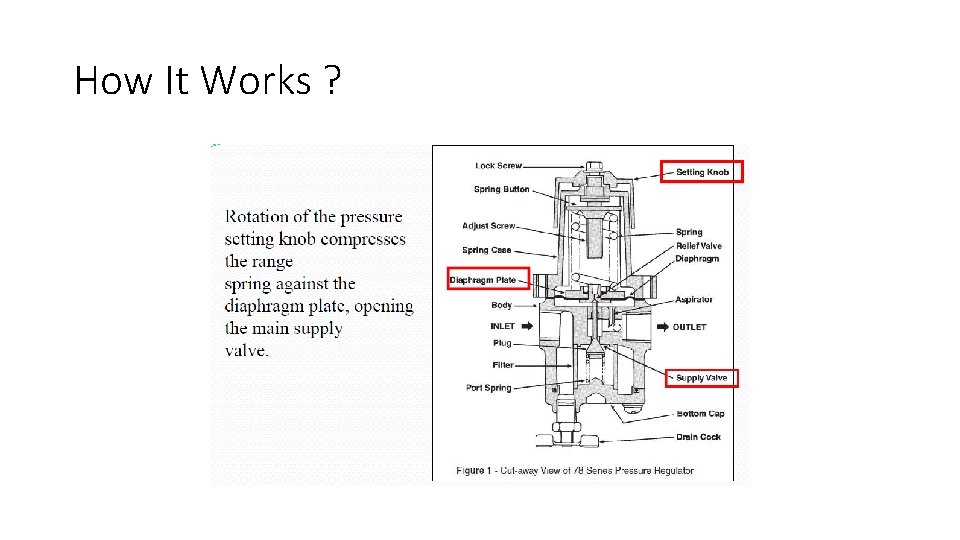
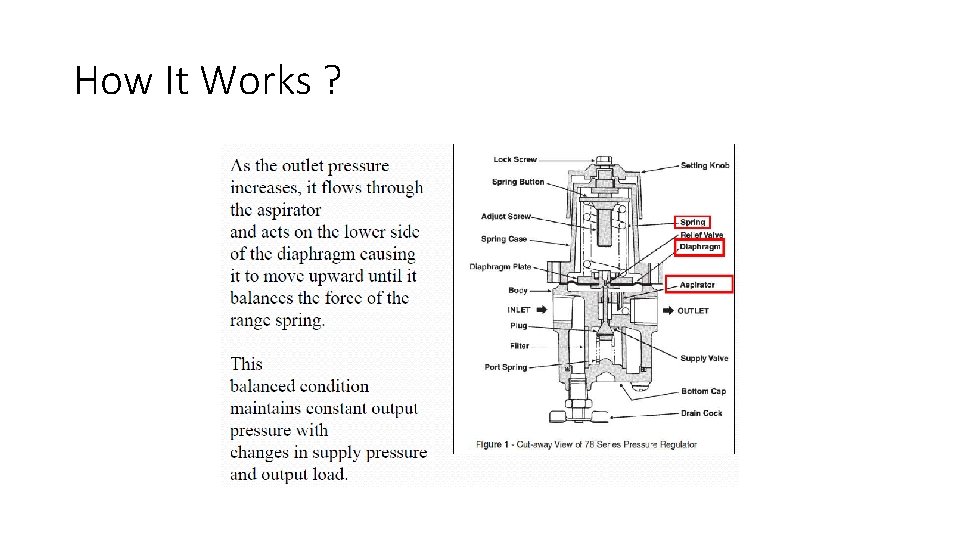
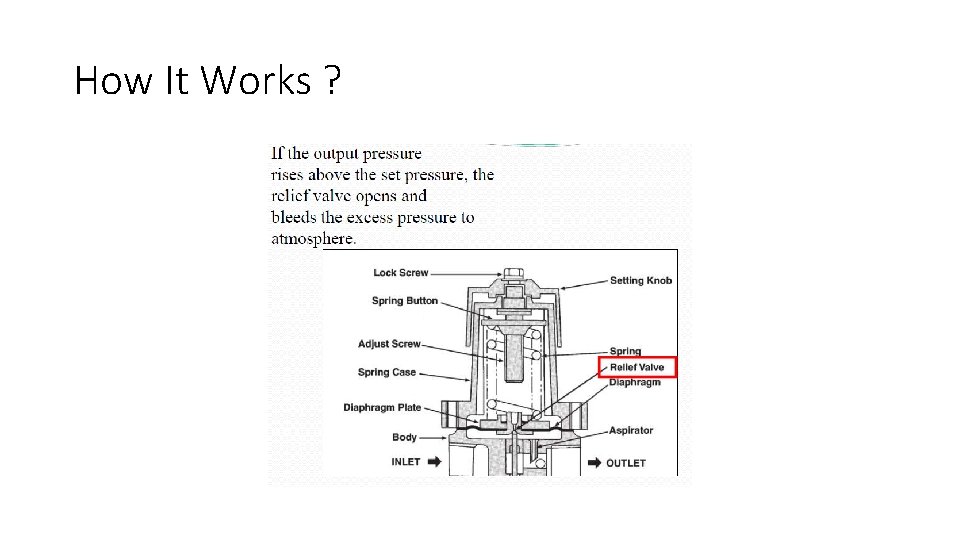
What is Air Filter Regulator ? • A device that used primarily for regulate pressure and filtering the air for stable source of air to process control equipment such as current to pneumatic (I/P) transducers and control valve positioners.
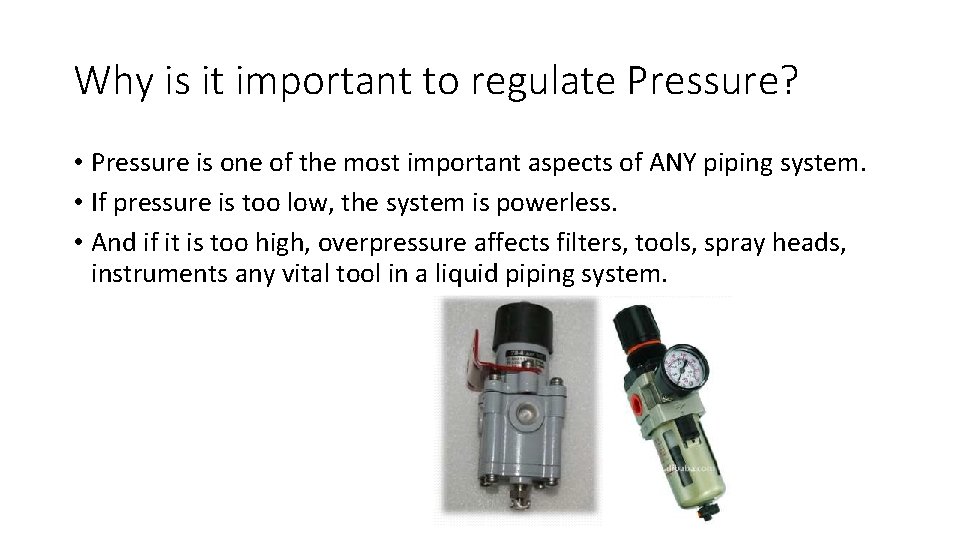
Why is it important to regulate Pressure? • Pressure is one of the most important aspects of ANY piping system. • If pressure is too low, the system is powerless. • And if it is too high, overpressure affects filters, tools, spray heads, instruments any vital tool in a liquid piping system.
Uses of a Pressure Regulator: 1. As a control element - to ensure that downstream pressure does not exceed a set point. 2. As a safety device - to protect equipment from harmful overpressure. 3. Regulate to the correct pressure range - so that a flow system or piece of equipment can operate safely and effectively.
Simple definition A pressure regulator is a normally-open valve that takes a high inlet pressure and converts it to a lower, pre-set downstream pressure. • What a Pressure Regulator WON’T Do: (common misconceptions) 1. It can’t convert a low inlet pressure to a higher downstream pressure – it won’t function like a pump. 2. It won’t control backpressure.
How It Works ?
How It Works ?
How It Works ?
How It Works ?
How It Works ?
Use
Use
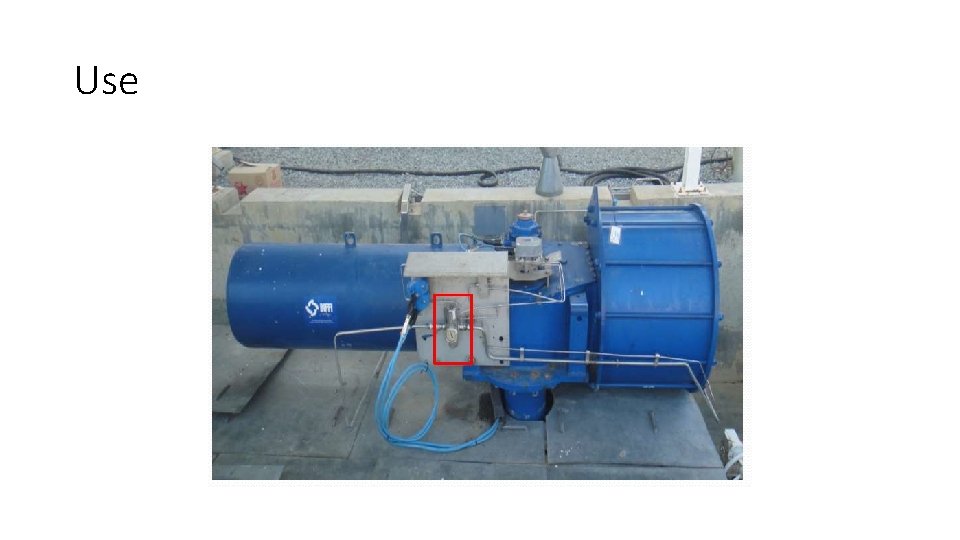
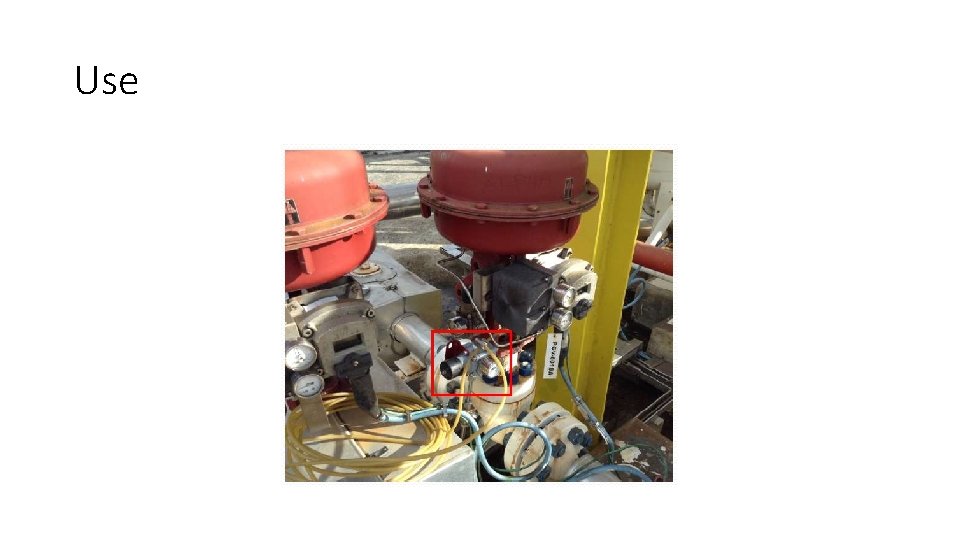
Air filter regulator • The air filter regulator is a very important device in process system to regulate the pressure and to filter the air. • Without this device, the over-pressure can occur and causing a damage to other device. • The wet and dirty air can cause corrosion and clogging to other equipment.
Air filter regulator • https: //www. youtube. com/watch? v=c. GN_l. Tm. IOa. Y • https: //www. youtube. com/watch? v=7 hb. IF 8 t. AZVA • https: //www. youtube. com/watch? v=Kf 3 xc 1 BGYGo • https: //www. youtube. com/watch? v=Qil. Lt. DMXO 1 I • https: //www. youtube. com/watch? v=fu 08 KCospi. Y
Volume Booster • A pneumatic air volume booster reproduce a low flow control signal with a higher regulated flow output pressure. It uses an unregulated input pressure to maintain a regulated output pressure under flowing and nonflowing conditions. • The volume booster is connected to the supply line and the output plumbing. It receives a pneumatic control signal, however, from another device, such as a transducer, valve positioner or other control means. • This pneumatic signal controls the pressure into and out of the booster, while allowing the booster to flow the maximum volume of the supply line. Boosters may also be referred to as pilot-operated regulators, as your control or pilot signal maintains the pressure control.
Volume Booster • The regulated output of a pneumatic air volume booster can be any of the following: • A direct reproduction of the pneumatic control signal • A multiple of the pneumatic control signal • A fraction of the pneumatic control signal • The volume booster ratio is the multiplier or divider of signal pressure to output pressure. For example, a 2: 1 ratio means output pressure is 1/2 the signal pressure. Similarly, a 2: 1 ratio would provide output pressure twice the signal pressure. Note, however, the output pressure can never exceed the supply pressure to the booster.
Volume Booster • Often the signal pressure is lower than the supply pressure because a control device (valve positioner, I/P, etc. ) will only handle a lower supply pressure. • The volume booster is used to improve stroking speed. If precision valve control is required, the use of a positioner is recommended. If the volume booster is to be used for on/off control, the integral bypass restriction on the booster must be closed.
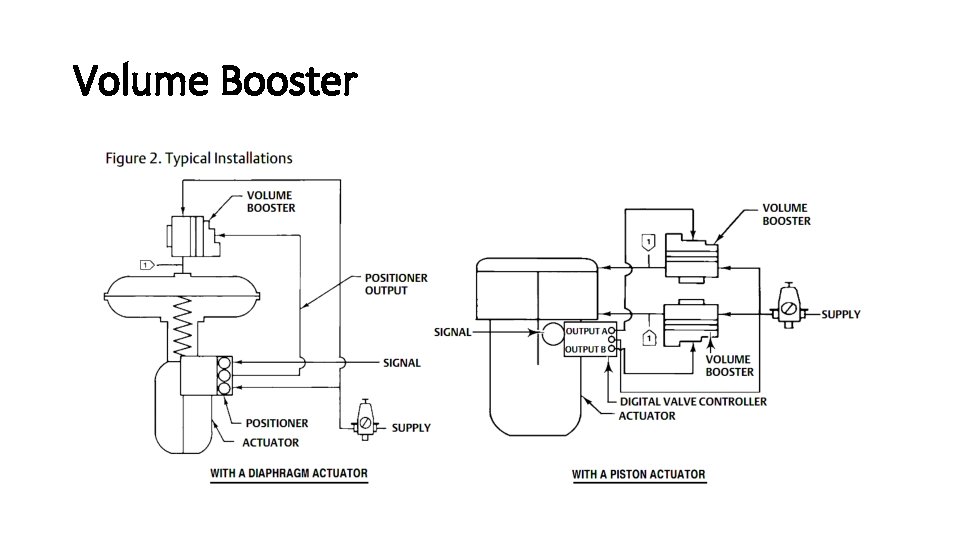
Volume Booster • A volume booster is used in a pneumatic control system to relay a low flow signal as one with greater flow volume. The common configuration is to provide a 1: 1 ratio between the input and output pressure, keeping the input and output signals the same pressure. Products are available that deliver different ratios. • The general purpose of a volume booster is to provide a relay between a system with low flow volume and one with higher volume requirements. • A typical example is a pneumatic actuator. The flow available through the pneumatic signal line may be insufficient to deliver the response rate desired from the pneumatic actuator.
Volume Booster
Volume Booster
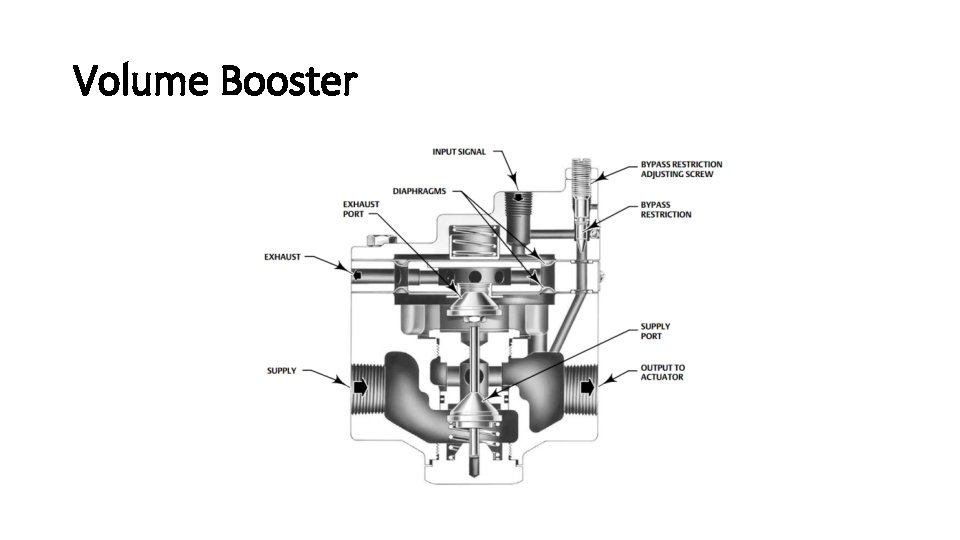
Volume Booster • Principle of Operation • Refer to figures 1 and 2. Because of the bypass restriction, large input signal changes register on the booster input diaphragm sooner than in the actuator. • A large, sudden change in input signal causes a pressure differential to exist between the input signal and the output of the booster. • When this occurs, the diaphragms move to open either the supply port or the exhaust port, whichever action is required to reduce the differential. • The port remains open until the difference between the booster input and output pressures returns to within the deadband limit of the booster. • With the bypass restriction adjusted for stable operation, a signal with small magnitude and rate changes passes through the bypass restriction and into the actuator without initiating booster operation. • Both supply and exhaust ports remain closed, preventing unnecessary air consumption and possible saturation of positioner relays.
Volume Booster • Advantages : • Quick response with increased actuator stroking speeds • Maintains correct actuator positioning at high stroking speeds • Adjustable by pass valve provides good operational sensitivity • High stability which allow normal slow actuator response to slow signal changes • Capable of using high pressure plant air supply • Different Booster sizes available to suit wide range of actuator sizes • Main internal air supply valve with Soft seat insert for tight shut off
Volume Booster • https: //www. youtube. com/watch? v=UUK 7 t 41 j 4 y. E • https: //www. youtube. com/watch? v=e. Mf. Lxz 6 Y 1 CQ • https: //www. youtube. com/watch? v=k. Nv. DAM 2 foy. A&t=87 s
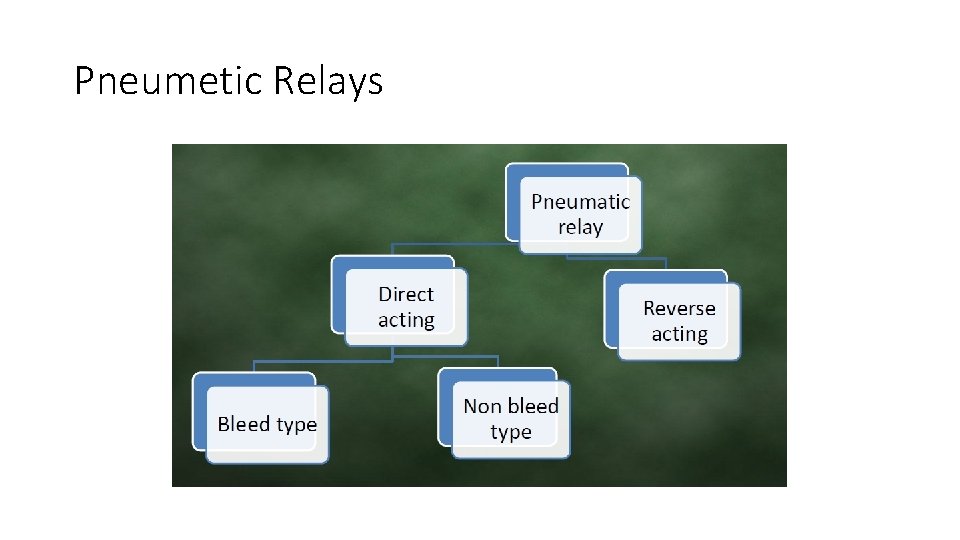
Pneumetic Relays
DIRECT ACTING RELAYS • In direct acting relays, the input is directly proportional to the output. So when the input increases , the output also increases. And when the input decreases, the output also decreases.
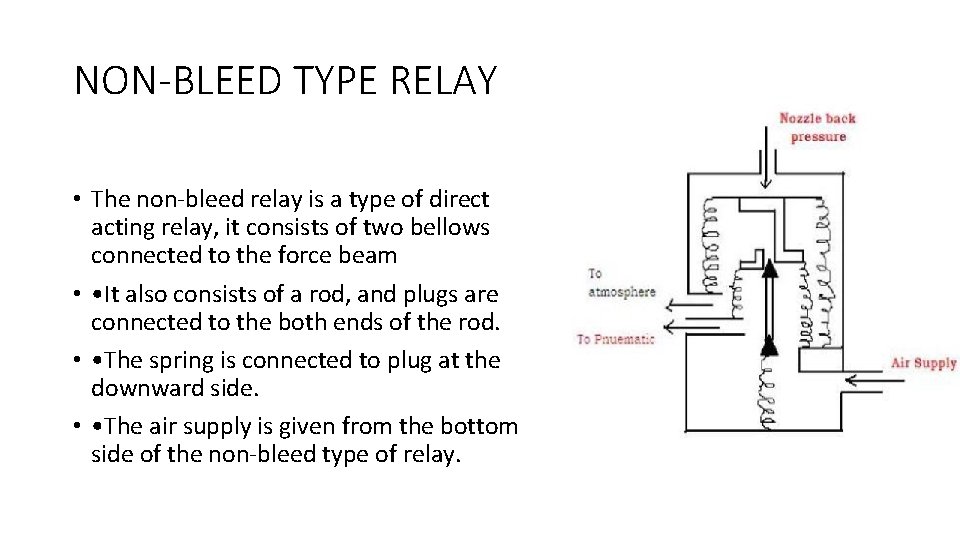
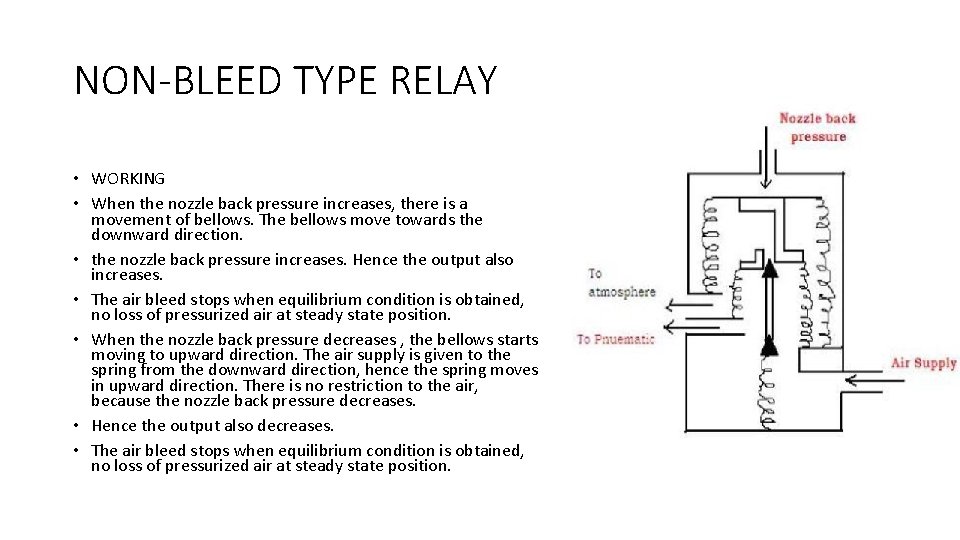
NON-BLEED TYPE RELAY • The non-bleed relay is a type of direct acting relay, it consists of two bellows connected to the force beam • • It also consists of a rod, and plugs are connected to the both ends of the rod. • • The spring is connected to plug at the downward side. • • The air supply is given from the bottom side of the non-bleed type of relay.
NON-BLEED TYPE RELAY • WORKING • When the nozzle back pressure increases, there is a movement of bellows. The bellows move towards the downward direction. • the nozzle back pressure increases. Hence the output also increases. • The air bleed stops when equilibrium condition is obtained, no loss of pressurized air at steady state position. • When the nozzle back pressure decreases , the bellows starts moving to upward direction. The air supply is given to the spring from the downward direction, hence the spring moves in upward direction. There is no restriction to the air, because the nozzle back pressure decreases. • Hence the output also decreases. • The air bleed stops when equilibrium condition is obtained, no loss of pressurized air at steady state position.
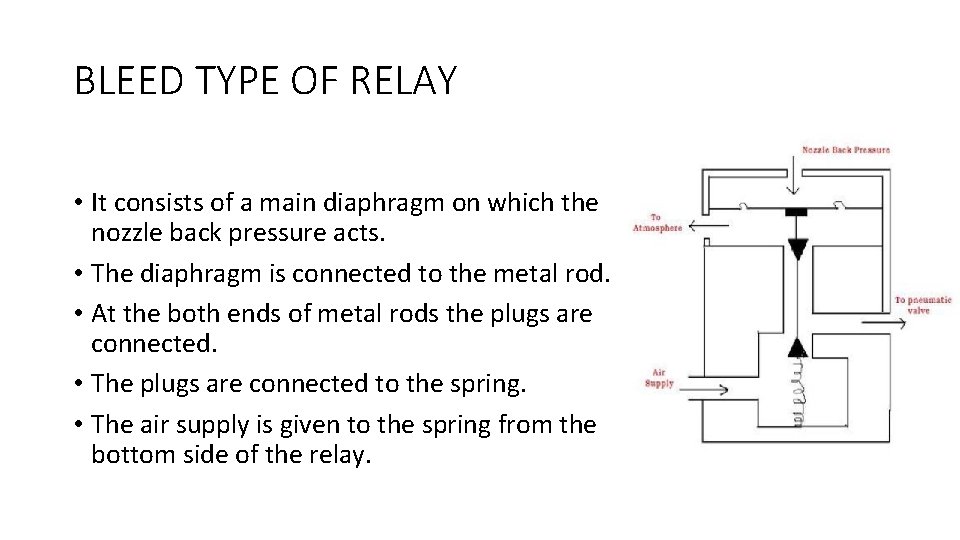
BLEED TYPE OF RELAY • It consists of a main diaphragm on which the nozzle back pressure acts. • The diaphragm is connected to the metal rod. • At the both ends of metal rods the plugs are connected. • The plugs are connected to the spring. • The air supply is given to the spring from the bottom side of the relay.
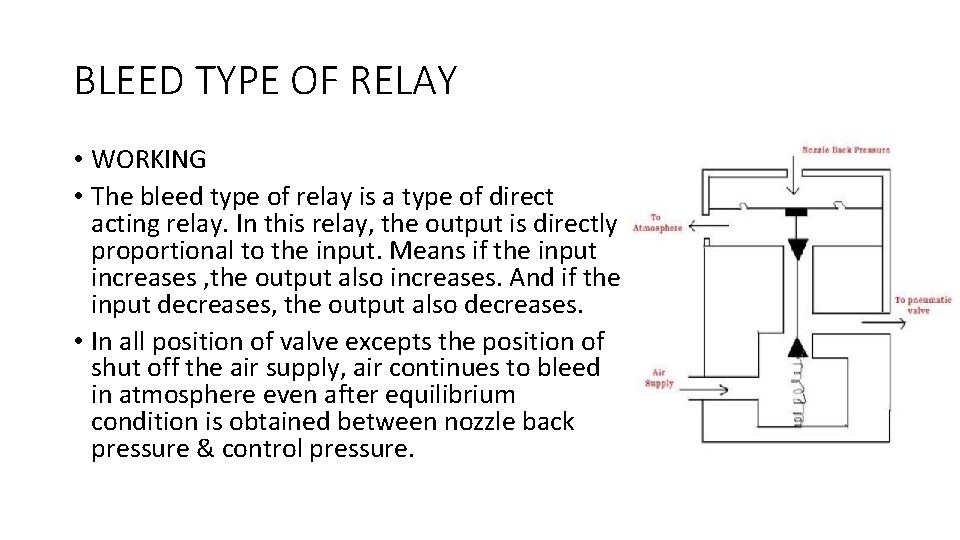
BLEED TYPE OF RELAY • WORKING • The bleed type of relay is a type of direct acting relay. In this relay, the output is directly proportional to the input. Means if the input increases , the output also increases. And if the input decreases, the output also decreases. • In all position of valve excepts the position of shut off the air supply, air continues to bleed in atmosphere even after equilibrium condition is obtained between nozzle back pressure & control pressure.
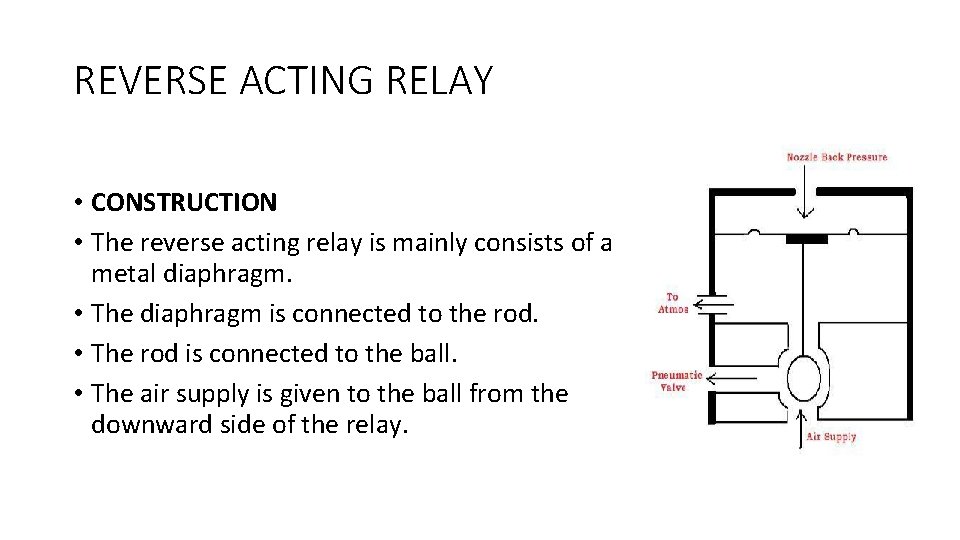
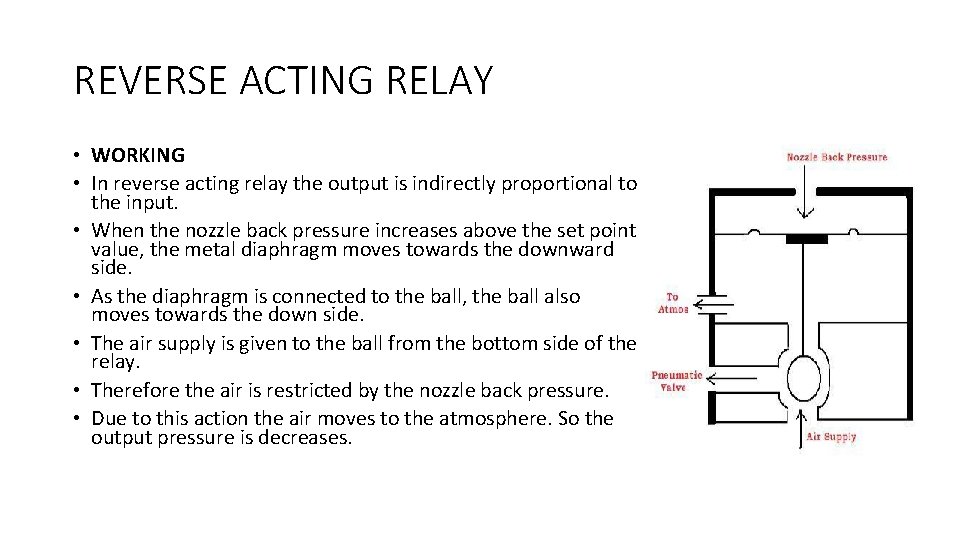
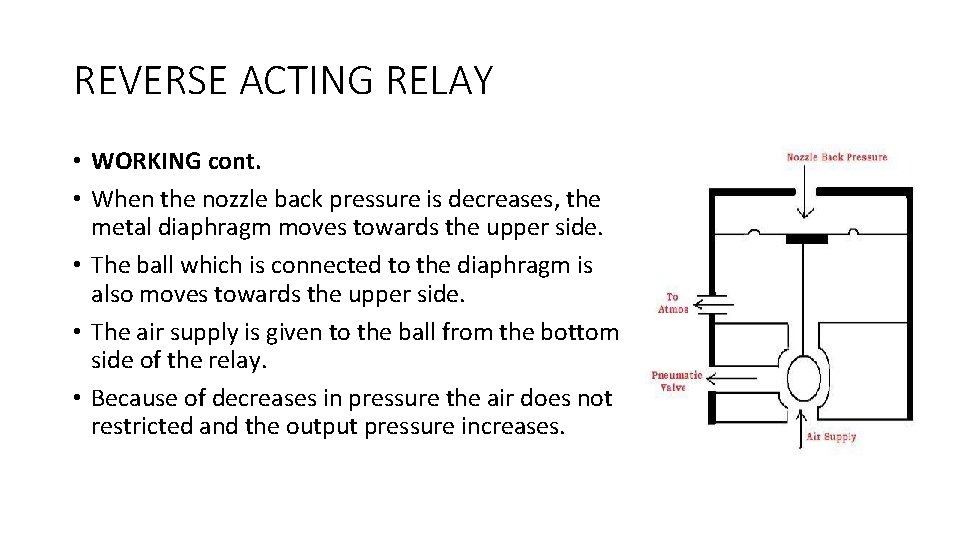
REVERSE ACTING RELAY • CONSTRUCTION • The reverse acting relay is mainly consists of a metal diaphragm. • The diaphragm is connected to the rod. • The rod is connected to the ball. • The air supply is given to the ball from the downward side of the relay.
REVERSE ACTING RELAY • WORKING • In reverse acting relay the output is indirectly proportional to the input. • When the nozzle back pressure increases above the set point value, the metal diaphragm moves towards the downward side. • As the diaphragm is connected to the ball, the ball also moves towards the down side. • The air supply is given to the ball from the bottom side of the relay. • Therefore the air is restricted by the nozzle back pressure. • Due to this action the air moves to the atmosphere. So the output pressure is decreases.
REVERSE ACTING RELAY • WORKING cont. • When the nozzle back pressure is decreases, the metal diaphragm moves towards the upper side. • The ball which is connected to the diaphragm is also moves towards the upper side. • The air supply is given to the ball from the bottom side of the relay. • Because of decreases in pressure the air does not restricted and the output pressure increases.
Air Relays • https: //www. youtube. com/watch? v=OBf. CO 4 K 5088 • https: //www. youtube. com/watch? v=7 bo. Utu. LUQEI • https: //www. youtube. com/watch? v=BLqwc 2 -Oc. Ho • https: //www. youtube. com/watch? v=f 3 LD 8 M 0 HKjo
Thanks