
PN Counting from Raw Exhaust via Fixed Dilution
- Slides: 9
PN Counting from Raw Exhaust via Fixed Dilution and PMP Round Robin Project JRC and ACEA
Current status • Interest in this approach confirmed by some engine manufacturers and some instrument manufacturers • 01 Series of amendments to Reg. 132 already includes such possibility but the procedure is not defined • First analysis of potential benefits/issues presented during the last meetings • Correlation with other methods (CVS and partial flow system) and advantages/disadvantages to be checked – Additional data required
Current status • Experimental program (Ricardo 37 th PMP meeting) – Primary dilution (cold / hot) – Losses (thermophoresis, agglomeration) – Volatile removal efficiency (CS or ET) – Pressure effects – Time alignment • Interested parties are expected to generate data to be then discussed within the PMP group • Limited number of tests from JRC from PN-PEMS for HD program
Testing program • Raw exhaust sampling – Uncertainty vs CVS or PFDS – Robustness of systems – Technical specifications – Equations • Sub-23 nm
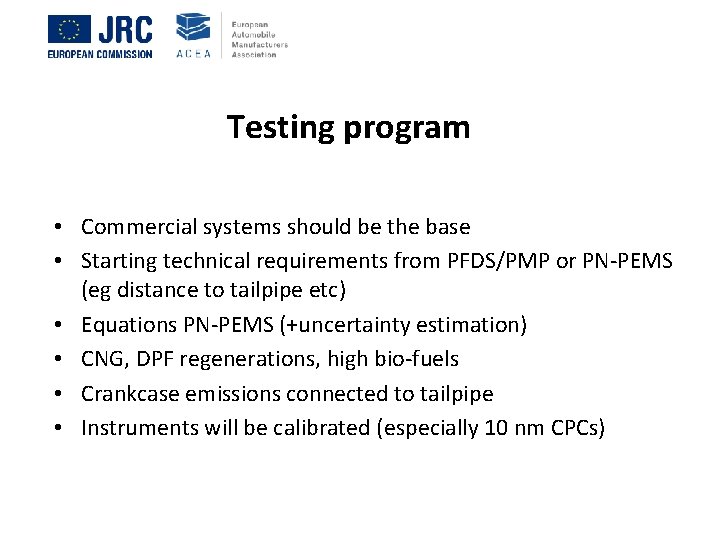
Testing program • Commercial systems should be the base • Starting technical requirements from PFDS/PMP or PN-PEMS (eg distance to tailpipe etc) • Equations PN-PEMS (+uncertainty estimation) • CNG, DPF regenerations, high bio-fuels • Crankcase emissions connected to tailpipe • Instruments will be calibrated (especially 10 nm CPCs)
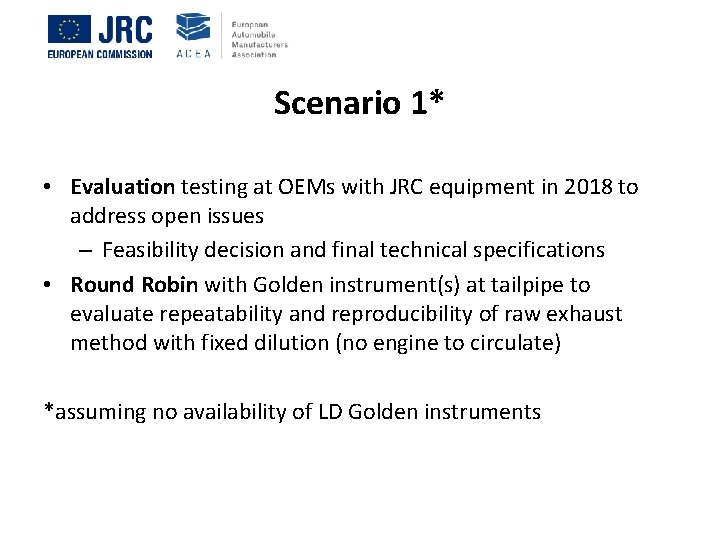
Scenario 1* • Evaluation testing at OEMs with JRC equipment in 2018 to address open issues – Feasibility decision and final technical specifications • Round Robin with Golden instrument(s) at tailpipe to evaluate repeatability and reproducibility of raw exhaust method with fixed dilution (no engine to circulate) *assuming no availability of LD Golden instruments
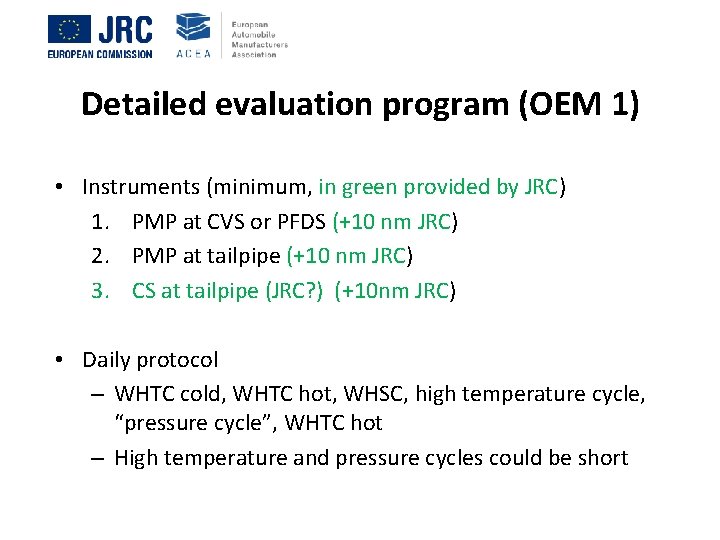
Detailed evaluation program (OEM 1) • Instruments (minimum, in green provided by JRC) 1. PMP at CVS or PFDS (+10 nm JRC) 2. PMP at tailpipe (+10 nm JRC) 3. CS at tailpipe (JRC? ) (+10 nm JRC) • Daily protocol – WHTC cold, WHTC hot, WHSC, high temperature cycle, “pressure cycle”, WHTC hot – High temperature and pressure cycles could be short
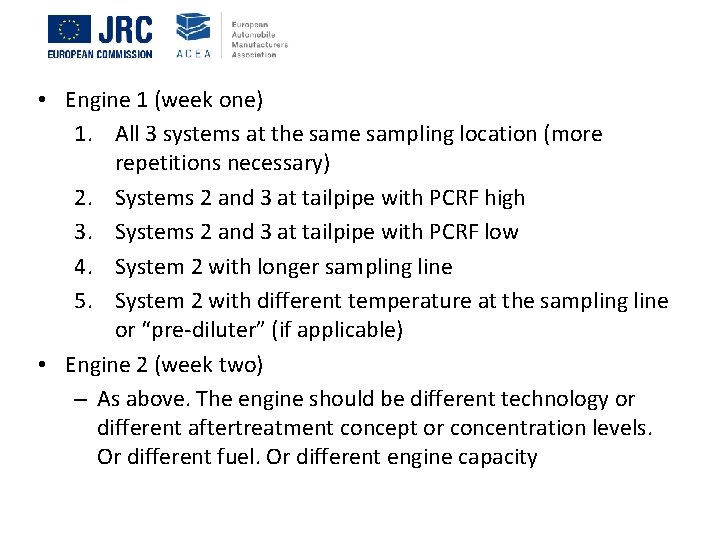
• Engine 1 (week one) 1. All 3 systems at the sampling location (more repetitions necessary) 2. Systems 2 and 3 at tailpipe with PCRF high 3. Systems 2 and 3 at tailpipe with PCRF low 4. System 2 with longer sampling line 5. System 2 with different temperature at the sampling line or “pre-diluter” (if applicable) • Engine 2 (week two) – As above. The engine should be different technology or different aftertreatment concept or concentration levels. Or different fuel. Or different engine capacity
Detailed evaluation program (OEM 2) • Instruments as OEM 1 • Daily protocol as OEM 1 • Engine 1 (week one) – If OEM 1 used PFDS, CVS should be used. – Engine 2 (week two ) desirable Final protocol decision after OEM 1 or OEM 2 • OEM 3: 2 -3 days confirmation testing • OEM 4: as above • OEM 5: as above…