
PMTest A Fast and Flexible Testing Framework for

PMTest: A Fast and Flexible Testing Framework for Persistent Memory Programs Sihang Liu 1, Yizhou Wei 1, Jishen Zhao 2, Aasheesh Kolli 3, 4, and Samira Khan 1 1 2 3 4 1
SUMMARY • The new persistent memory (PM) allows direct management of persistent data in memory • However, it is hard to guarantee crash consistency • PMTest detects such crash consistency bugs and performance bugs • PMTest is flexible • Supports kernel modules, custom PM programs, transaction-based programs, etc. • Can be extended to different PM hardware platforms • PMTest is fast • 7 X faster than the state-of-the-art tool • Less than 2 X overhead in real-workload applications • We have detected 3 new bugs in PMFS and PMDK applications with PMTest 2

BACKGROUND • The new persistent memory (PM) is • High-speed • Persistent • Byte-addressable • Benefit of using PM Intel DCPMM • Direct manipulation of persistent data in memory • No file system overhead 3
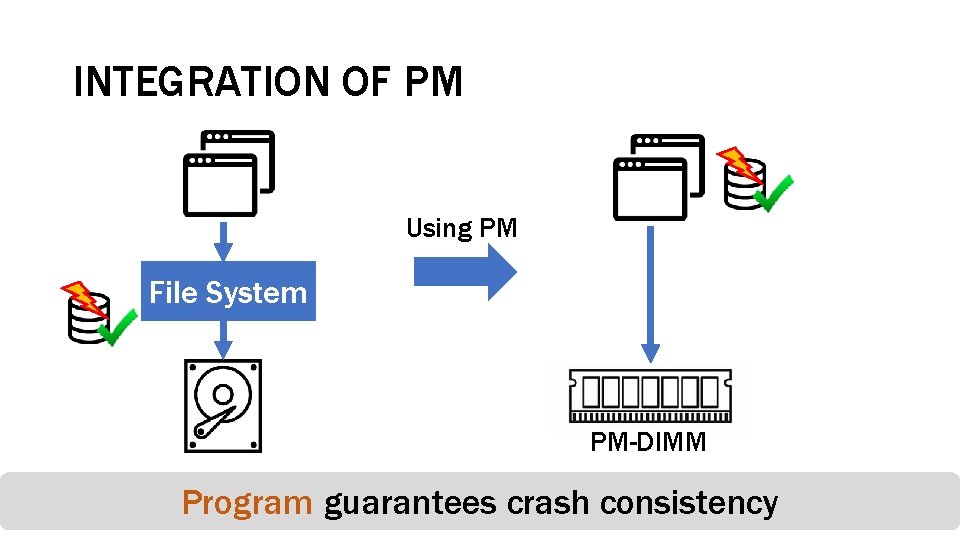
INTEGRATION OF PM Using PM File System PM-DIMM guarantees crash consistency The. Program file system guarantees crash consistency 4
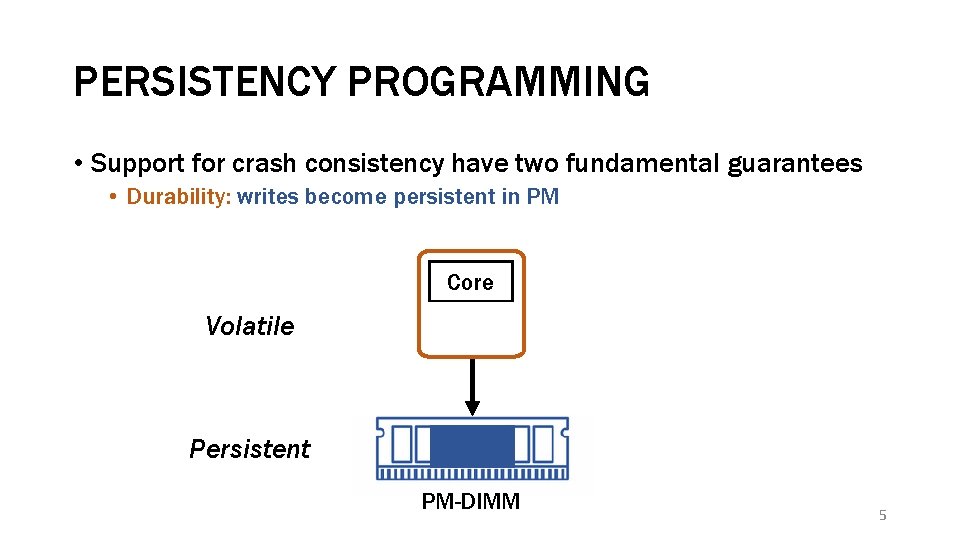
PERSISTENCY PROGRAMMING • Support for crash consistency have two fundamental guarantees • Durability: writes become persistent in PM Core Volatile Cache Persistent PM-DIMM 5
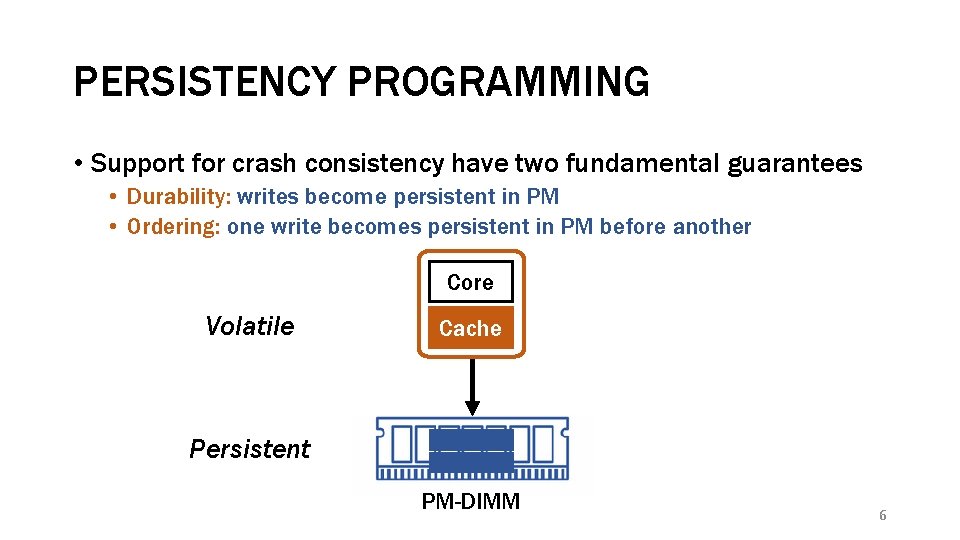
PERSISTENCY PROGRAMMING • Support for crash consistency have two fundamental guarantees • Durability: writes become persistent in PM • Ordering: one write becomes persistent in PM before another Core Volatile Cache Persistent PM-DIMM 6
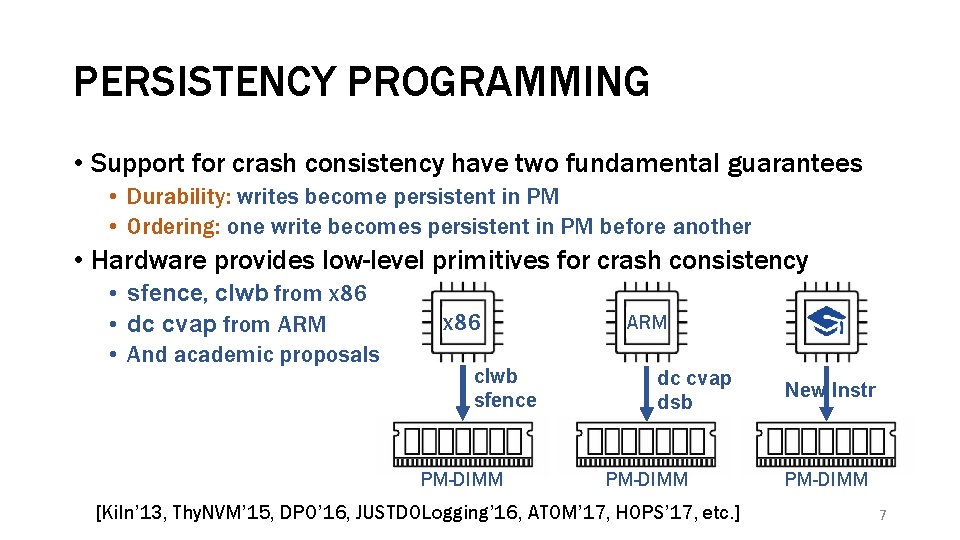
PERSISTENCY PROGRAMMING • Support for crash consistency have two fundamental guarantees • Durability: writes become persistent in PM • Ordering: one write becomes persistent in PM before another • Hardware provides low-level primitives for crash consistency • sfence, clwb from x 86 • dc cvap from ARM • And academic proposals x 86 clwb sfence PM-DIMM ARM dc cvap dsb PM-DIMM [Kiln’ 13, Thy. NVM’ 15, DPO’ 16, JUSTDOLogging’ 16, ATOM’ 17, HOPS’ 17, etc. ] New Instr PM-DIMM 7
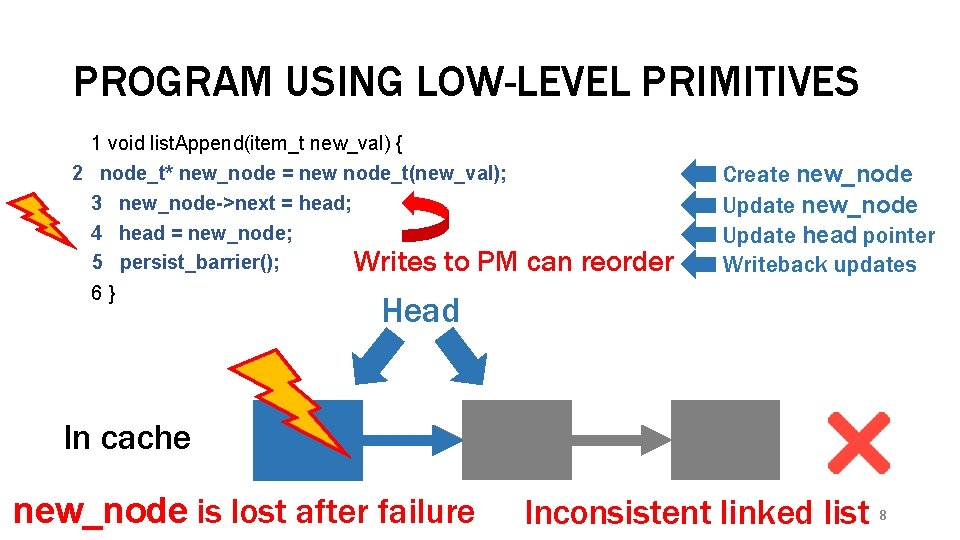
PROGRAM USING LOW-LEVEL PRIMITIVES 1 void list. Append(item_t new_val) { 2 node_t* new_node = new node_t(new_val); 3 new_node->next = head; 4 head = new_node; 5 persist_barrier(); Writes to PM 6 } can reorder Create new_node Update head pointer Writeback updates Head In cache new_node is lost after failure Inconsistent linked list 8
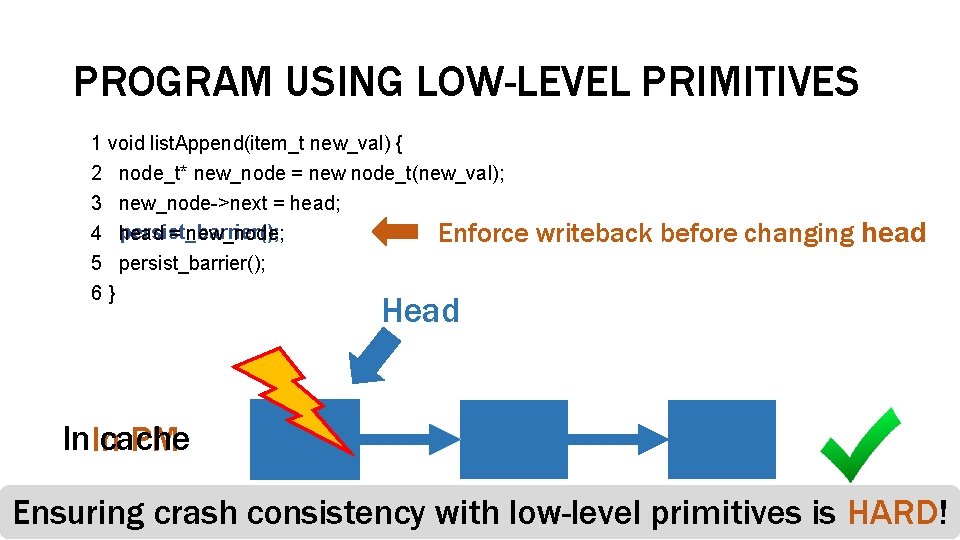
PROGRAM USING LOW-LEVEL PRIMITIVES 1 void list. Append(item_t new_val) { 2 node_t* new_node = new node_t(new_val); 3 new_node->next = head; persist_barrier(); 4 head = new_node; Enforce 5 persist_barrier(); 6 } writeback before changing head Head In. In cache PM 9 Ensuring crash consistency with low-level is HARD! Consistent linked primitives list
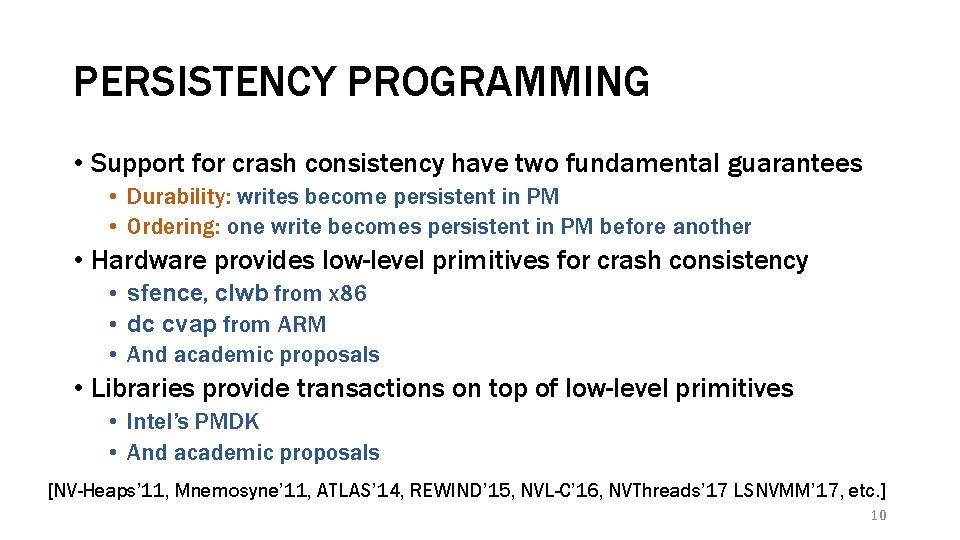
PERSISTENCY PROGRAMMING • Support for crash consistency have two fundamental guarantees • Durability: writes become persistent in PM • Ordering: one write becomes persistent in PM before another • Hardware provides low-level primitives for crash consistency • sfence, clwb from x 86 • dc cvap from ARM • And academic proposals • Libraries provide transactions on top of low-level primitives • Intel’s PMDK • And academic proposals [NV-Heaps’ 11, Mnemosyne’ 11, ATLAS’ 14, REWIND’ 15, NVL-C’ 16, NVThreads’ 17 LSNVMM’ 17, etc. ] 10
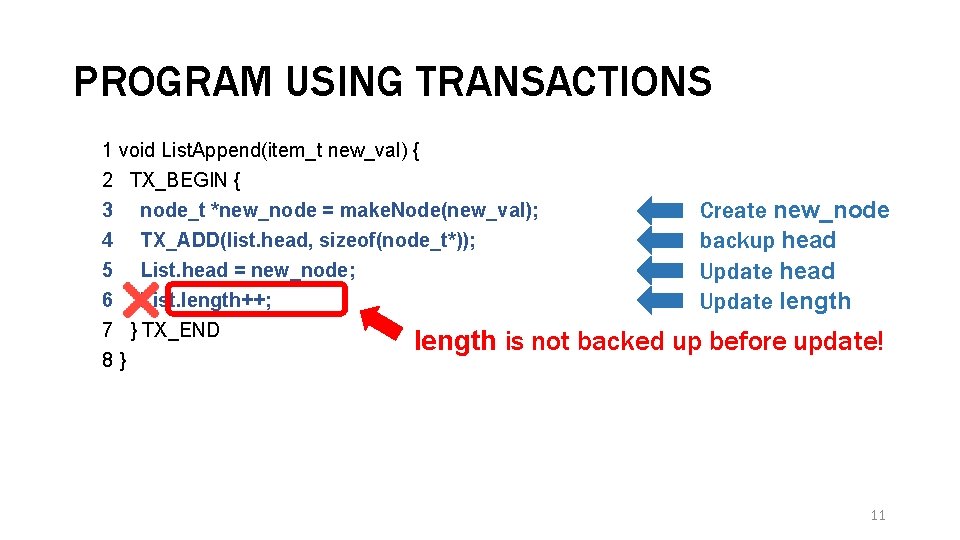
PROGRAM USING TRANSACTIONS 1 void List. Append(item_t new_val) { 2 TX_BEGIN { 3 node_t *new_node = make. Node(new_val); 4 TX_ADD(list. head, sizeof(node_t*)); 5 List. head = new_node; 6 List. length++; 7 } TX_END 8 } Create new_node backup head Update length is not backed up before update! 11
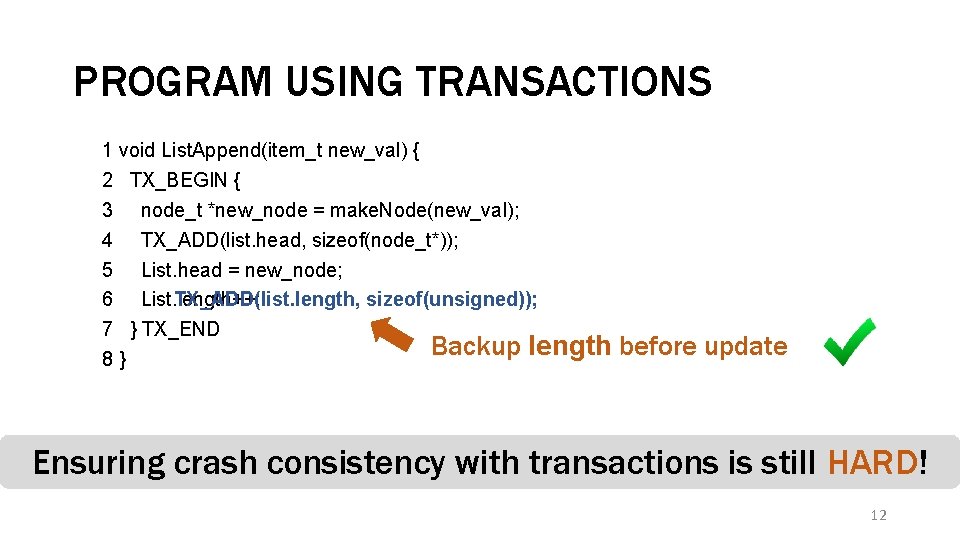
PROGRAM USING TRANSACTIONS 1 void List. Append(item_t new_val) { 2 TX_BEGIN { 3 node_t *new_node = make. Node(new_val); 4 TX_ADD(list. head, sizeof(node_t*)); 5 List. head = new_node; 6 List. length++; TX_ADD(list. length, sizeof(unsigned)); 7 } TX_END Backup length 8 } before update Ensuring crash consistency with transactions is still HARD! 12
PERSISTENCE PROGRAMMING IS HARD How to ensure crash consistency? We need a tool to detect crash consistency bugs! 13
OUTLINE BACKGROUND AND MOTIVATION REQUIREMENTS AND KEY IDEAS PMTEST INTERFACE PMTEST MECHANISM EVALUATION SUMMARY 14
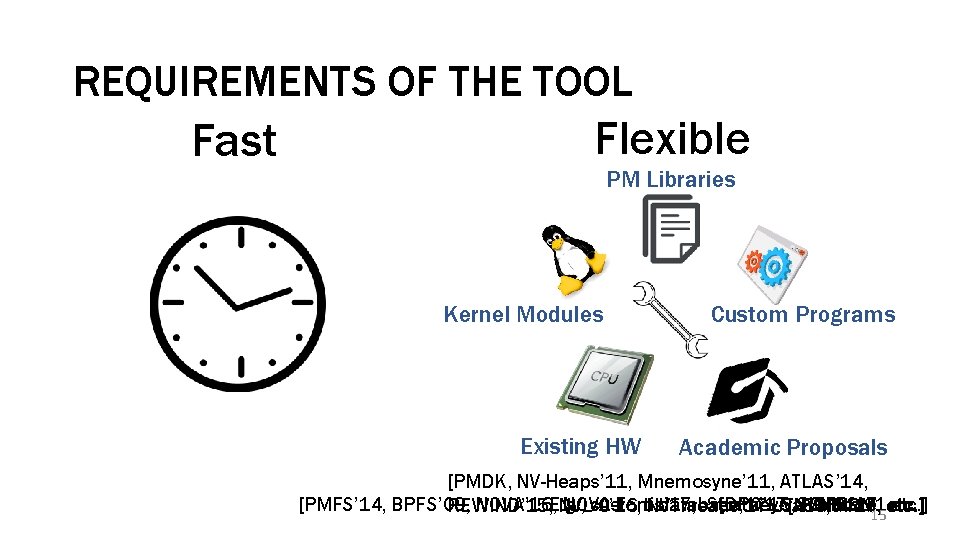
REQUIREMENTS OF THE TOOL Fast Flexible PM Libraries Kernel Modules Existing HW Custom Programs Academic Proposals [PMDK, NV-Heaps’ 11, Mnemosyne’ 11, ATLAS’ 14, [PMFS’ 14, BPFS’ 09, NOVA’ 16, E. g. , NOVA-Fortis’ 17, Strata’ 17, SCMFS’ 11 etc. ] [DPO’ 16, HOPS’ 17, custom. NVThreads’ 17 database, key-value store, etc. [x 86, ARM, etc. ] REWIND’ 15, NVL-C’ 16, LSNVMM’ 17, 15
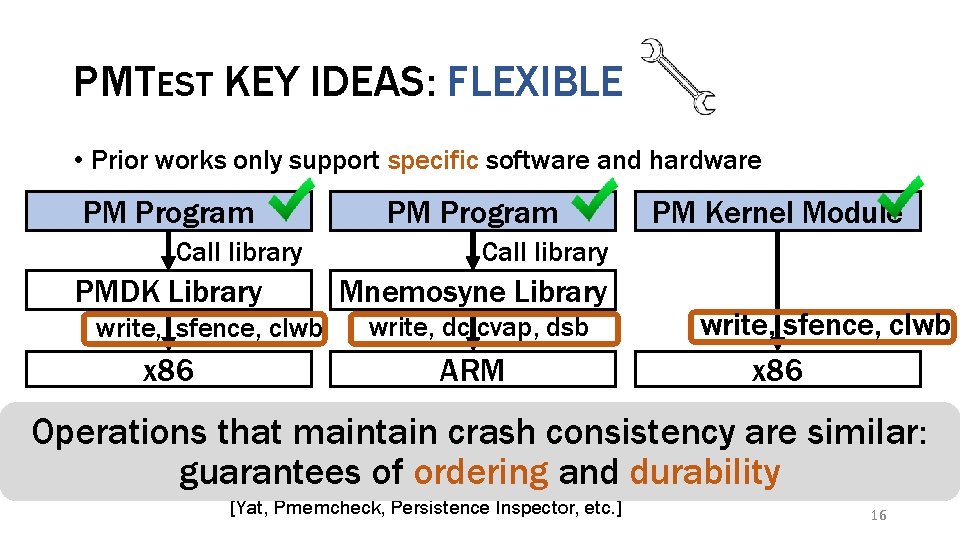
PMTEST KEY IDEAS: FLEXIBLE • Prior works only support specific software and hardware PM Program Call library PMDK Library write, sfence, clwb x 86 PM Program PM Kernel Module Call library Mnemosyne Library write, dc cvap, dsb ARM write, sfence, clwb x 86 • If the tool can test these two fundamental guarantees The challenge to support different Operations that maintainiscrash consistency are It can cover all these variations HW platforms guarantees of orderingand and. SW durability [Yat, Pmemcheck, Persistence Inspector, etc. ] similar: 16
![PMTEST KEY IDEAS: FAST • Prior work [Yat’ 14] uses exhaustive testing O(n!) n](http://slidetodoc.com/presentation_image_h/a08798f9f93847b68bebe6b7b5b64117/image-17.jpg "PMTEST KEY IDEAS: FAST • Prior work [Yat’ 14] uses exhaustive testing O(n!) n")
PMTEST KEY IDEAS: FAST • Prior work [Yat’ 14] uses exhaustive testing O(n!) n sfence write A write B write C. . . sfence write B write A write C. . . sfence write C write B write A. . . sfence write A write C write B. . . sfence write B write C write A. . . sfence write C write A write B. . . sfence Recoverable? 17
![PMTEST KEY IDEAS: FAST • Prior work [Yat’ 14] uses exhaustive testing Test at](http://slidetodoc.com/presentation_image_h/a08798f9f93847b68bebe6b7b5b64117/image-18.jpg "PMTEST KEY IDEAS: FAST • Prior work [Yat’ 14] uses exhaustive testing Test at")
PMTEST KEY IDEAS: FAST • Prior work [Yat’ 14] uses exhaustive testing Test at runtime sfence write C write B write A. . . sfence Recoverable? 18
![PMTEST KEY IDEAS: FAST • Prior work [Yat’ 14] uses exhaustive testing • PMTest](http://slidetodoc.com/presentation_image_h/a08798f9f93847b68bebe6b7b5b64117/image-19.jpg "PMTEST KEY IDEAS: FAST • Prior work [Yat’ 14] uses exhaustive testing • PMTest")
PMTEST KEY IDEAS: FAST • Prior work [Yat’ 14] uses exhaustive testing • PMTest infers the persistence interval from PM operation trace The interval in which a write can possibly become persistent write A clwb A sfence write B clwb B sfence Trace A A persists before B B Timeline 19
![PMTEST KEY IDEAS: FAST • Prior work [Yat’ 14] uses exhaustive testing • PMTest](http://slidetodoc.com/presentation_image_h/a08798f9f93847b68bebe6b7b5b64117/image-20.jpg "PMTEST KEY IDEAS: FAST • Prior work [Yat’ 14] uses exhaustive testing • PMTest")
PMTEST KEY IDEAS: FAST • Prior work [Yat’ 14] uses exhaustive testing • PMTest infers the persistence interval from PM operation trace The interval in which a write can possibly become persistent write A write B clwb A sfence clwb B sfence Trace A Interleaving A may NOT persist before B B Timeline 20
![PMTEST KEY IDEAS: FAST • Prior work [Yat’ 14] uses exhaustive testing • PMTest](http://slidetodoc.com/presentation_image_h/a08798f9f93847b68bebe6b7b5b64117/image-21.jpg "PMTEST KEY IDEAS: FAST • Prior work [Yat’ 14] uses exhaustive testing • PMTest")
PMTEST KEY IDEAS: FAST • Prior work [Yat’ 14] uses exhaustive testing • PMTest infers the persistence interval from PM operation trace The interval in which a write can possibly become persistent write A write B clwb A sfence clwb B A persists before B? sfence Trace A B Timeline 21
OUTLINE BACKGROUND AND MOTIVATION REQUIREMENTS AND KEY IDEAS PMTEST INTERFACE PMTEST MECHANISM EVALUATION SUMMARY 22
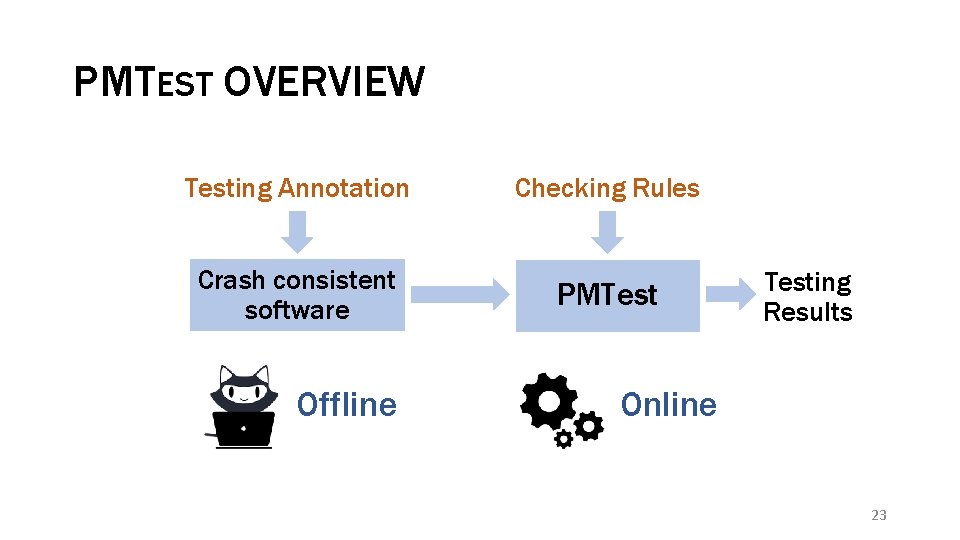
PMTEST OVERVIEW Testing Annotation Crash consistent software Offline Checking Rules PMTesting Results Online 23
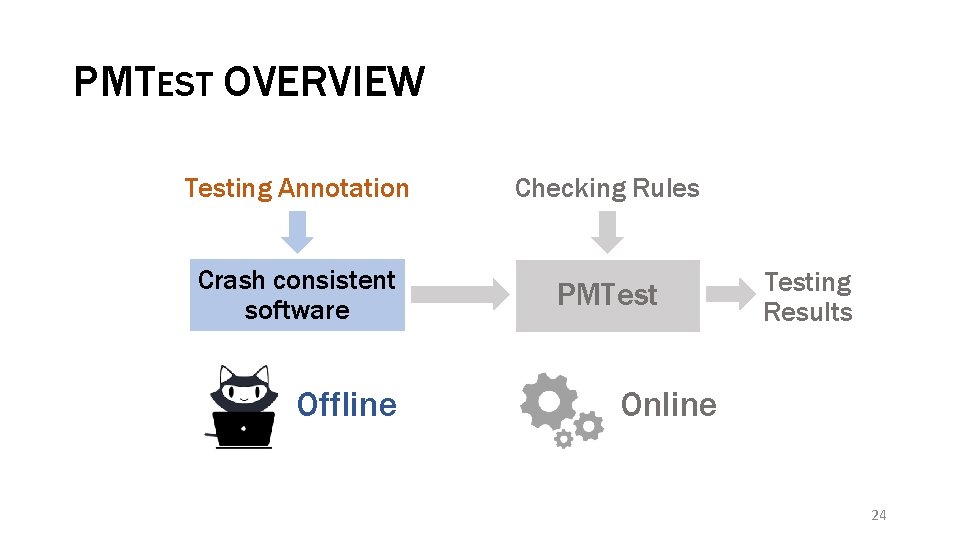
PMTEST OVERVIEW Testing Annotation Crash consistent software Offline Checking Rules PMTesting Results Online 24
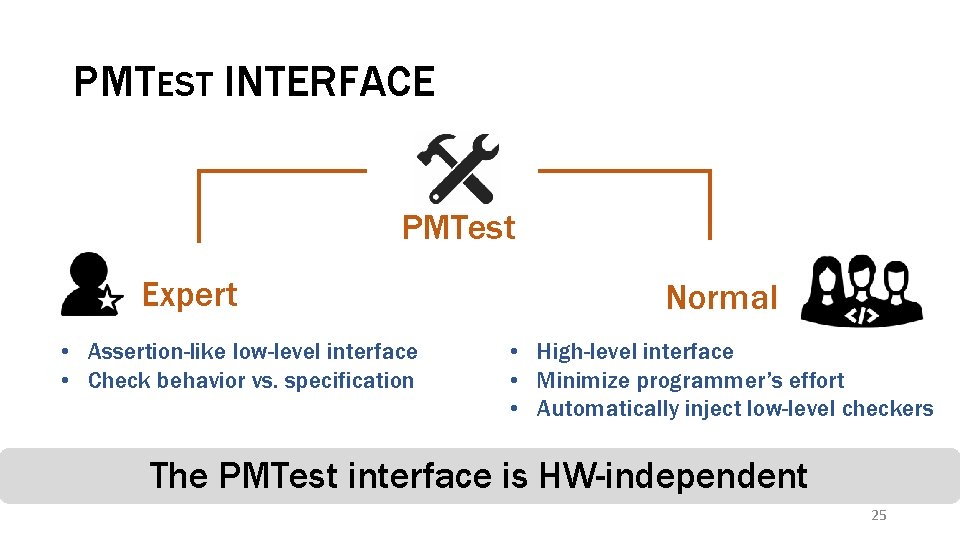
PMTEST INTERFACE PMTest Expert • Assertion-like low-level interface • Check behavior vs. specification Normal • High-level interface • Minimize programmer’s effort • Automatically inject low-level checkers The PMTest interface is HW-independent 25
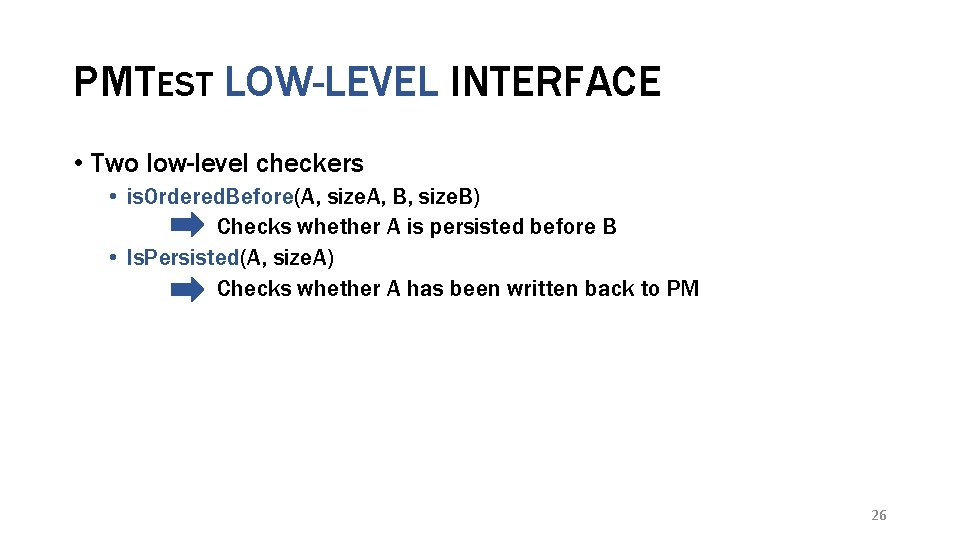
PMTEST LOW-LEVEL INTERFACE • Two low-level checkers • is. Ordered. Before(A, size. A, B, size. B) Checks whether A is persisted before B • Is. Persisted(A, size. A) Checks whether A has been written back to PM 26
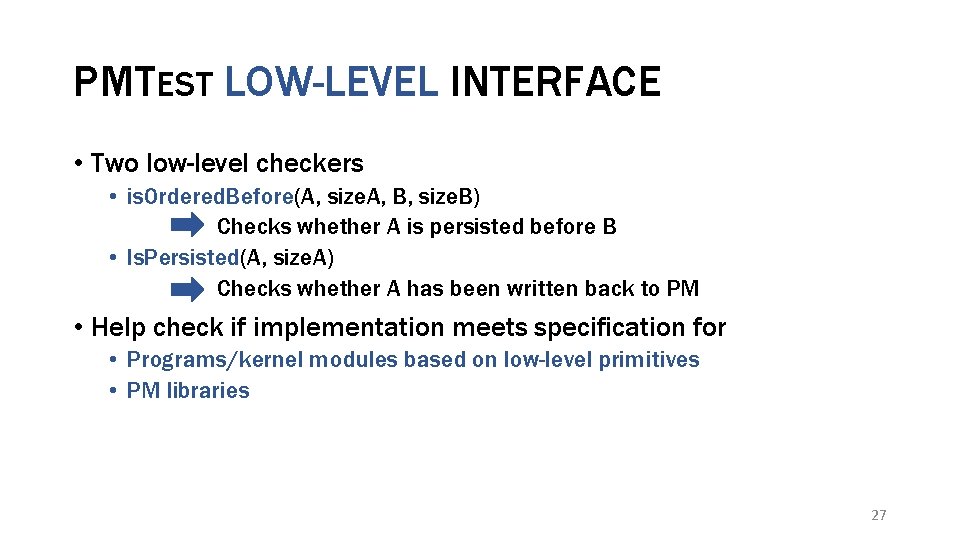
PMTEST LOW-LEVEL INTERFACE • Two low-level checkers • is. Ordered. Before(A, size. A, B, size. B) Checks whether A is persisted before B • Is. Persisted(A, size. A) Checks whether A has been written back to PM • Help check if implementation meets specification for • Programs/kernel modules based on low-level primitives • PM libraries 27
![EXAMPLE void hash. Map. Remove() { . . . remove(buckets->bucket[hash]); count--; Check if count](http://slidetodoc.com/presentation_image_h/a08798f9f93847b68bebe6b7b5b64117/image-28.jpg "EXAMPLE void hash. Map. Remove() { . . . remove(buckets->bucket[hash]); count--; Check if count")
EXAMPLE void hash. Map. Remove() { . . . remove(buckets->bucket[hash]); count--; Check if count has been persisted before rebuilding persist_barrier(); . . . hashmap_rebuild(); is. Ordered. Before(&count, sizeof(unsigned), &hashmap, sizeof(hashmap)); is. Persisted(&hashmap, size); } Check if all updates have been persisted in rebuilding *This example is inspired by hashmap_atomic from PMDK 28
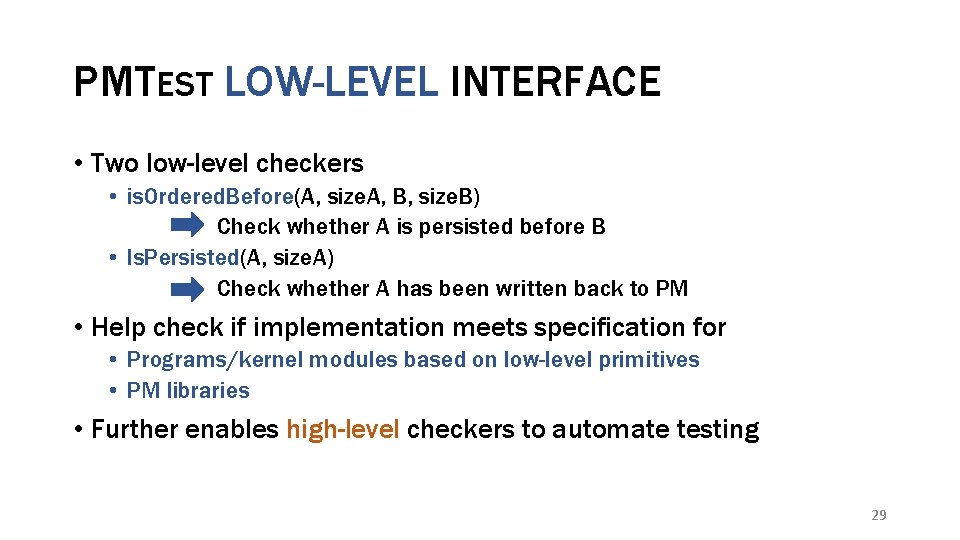
PMTEST LOW-LEVEL INTERFACE • Two low-level checkers • is. Ordered. Before(A, size. A, B, size. B) Check whether A is persisted before B • Is. Persisted(A, size. A) Check whether A has been written back to PM • Help check if implementation meets specification for • Programs/kernel modules based on low-level primitives • PM libraries • Further enables high-level checkers to automate testing 29
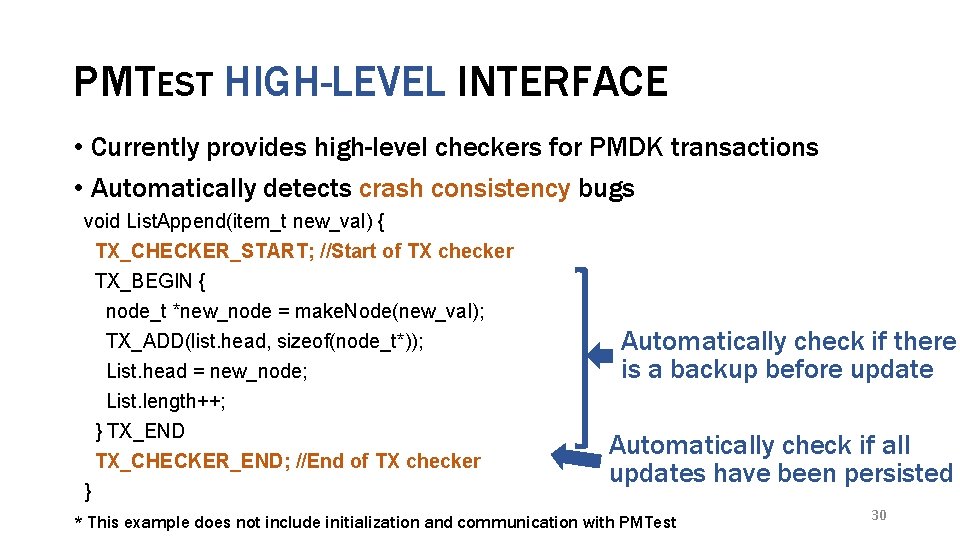
PMTEST HIGH-LEVEL INTERFACE • Currently provides high-level checkers for PMDK transactions • Automatically detects crash consistency bugs void List. Append(item_t new_val) { TX_CHECKER_START; //Start of TX checker TX_BEGIN { node_t *new_node = make. Node(new_val); TX_ADD(list. head, sizeof(node_t*)); List. head = new_node; List. length++; } TX_END TX_CHECKER_END; //End of TX checker } Automatically check if there is a backup before update Automatically check if all updates have been persisted * This example does not include initialization and communication with PMTest 30
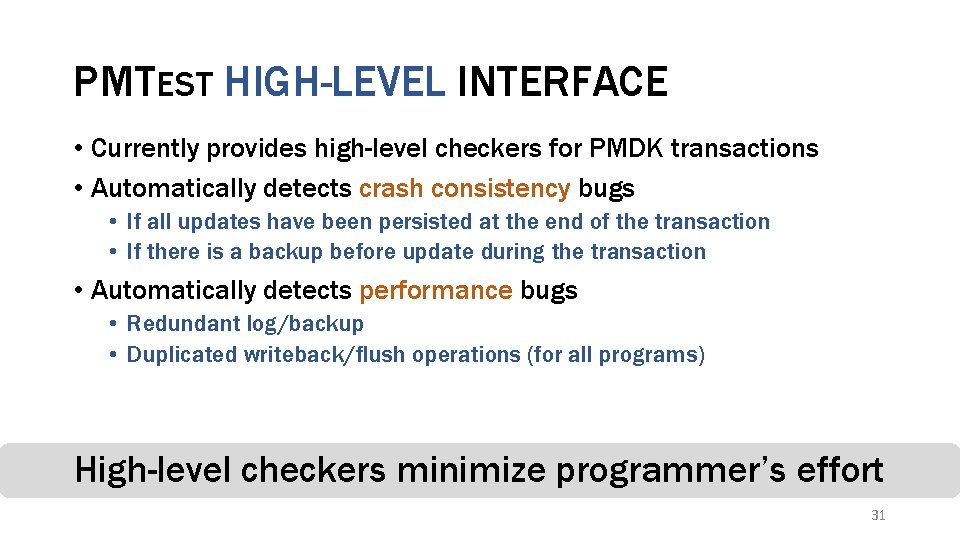
PMTEST HIGH-LEVEL INTERFACE • Currently provides high-level checkers for PMDK transactions • Automatically detects crash consistency bugs • If all updates have been persisted at the end of the transaction • If there is a backup before update during the transaction • Automatically detects performance bugs • Redundant log/backup • Duplicated writeback/flush operations (for all programs) High-level checkers minimize programmer’s effort 31
OUTLINE BACKGROUND AND MOTIVATION REQUIREMENTS AND KEY IDEAS PMTEST INTERFACE PMTEST MECHANISM EVALUATION SUMMARY 32
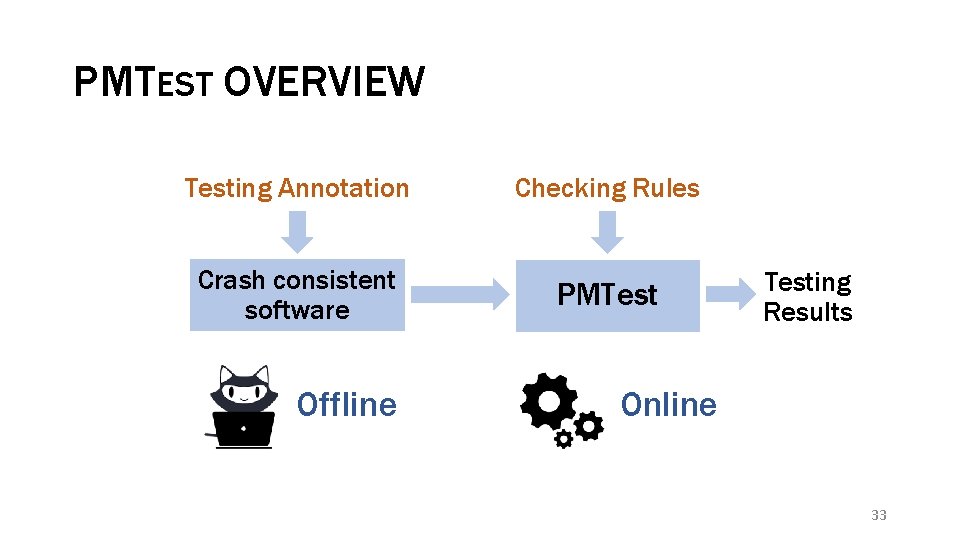
PMTEST OVERVIEW Testing Annotation Crash consistent software Offline Checking Rules PMTesting Results Online 33
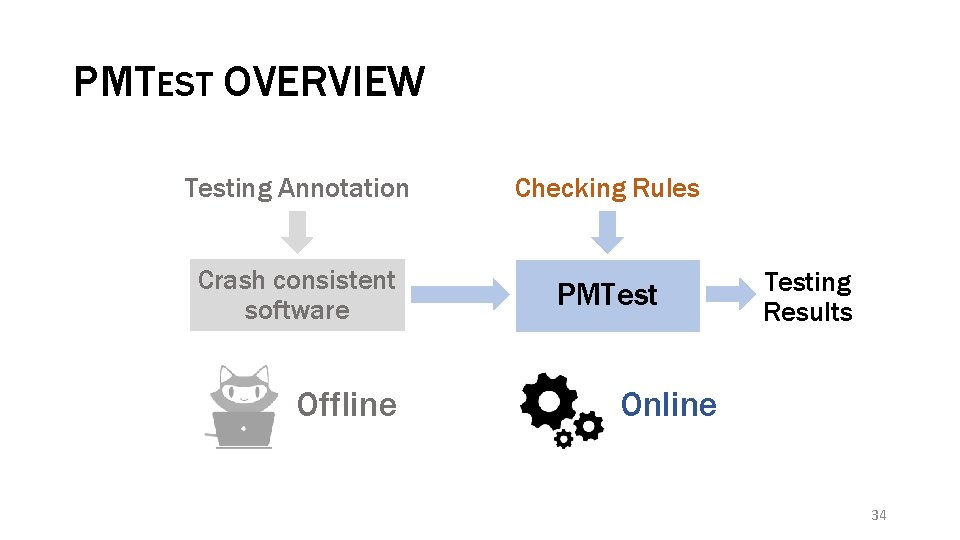
PMTEST OVERVIEW Testing Annotation Crash consistent software Offline Checking Rules PMTesting Results Online 34
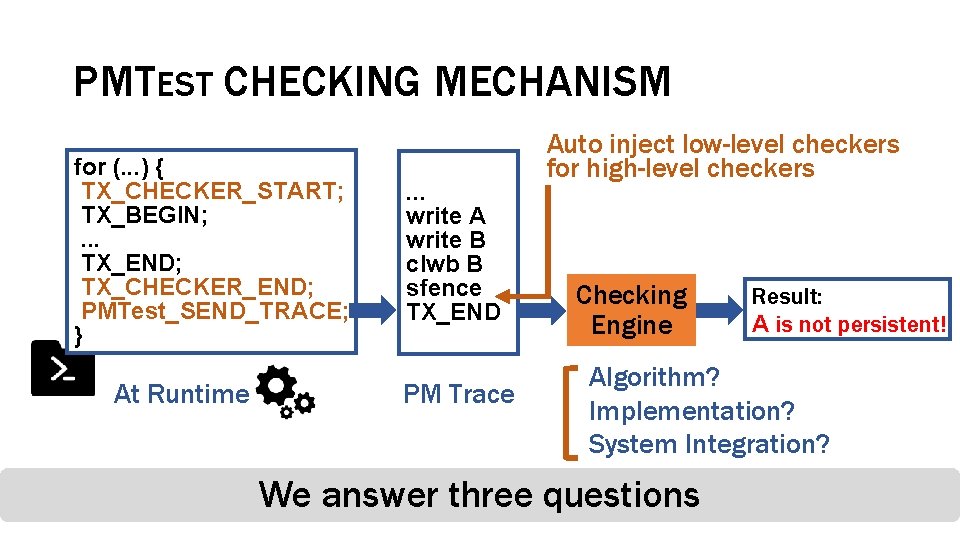
PMTEST CHECKING MECHANISM for (. . . ) { TX_CHECKER_START; TX_BEGIN; . . . TX_END; TX_CHECKER_END; PMTest_SEND_TRACE; } At Runtime . . . write A write B clwb B sfence TX_END PM Trace Auto inject low-level checkers for high-level checkers Checking Engine Result: A is not persistent! Algorithm? Implementation? System Integration? We answer three questions 35
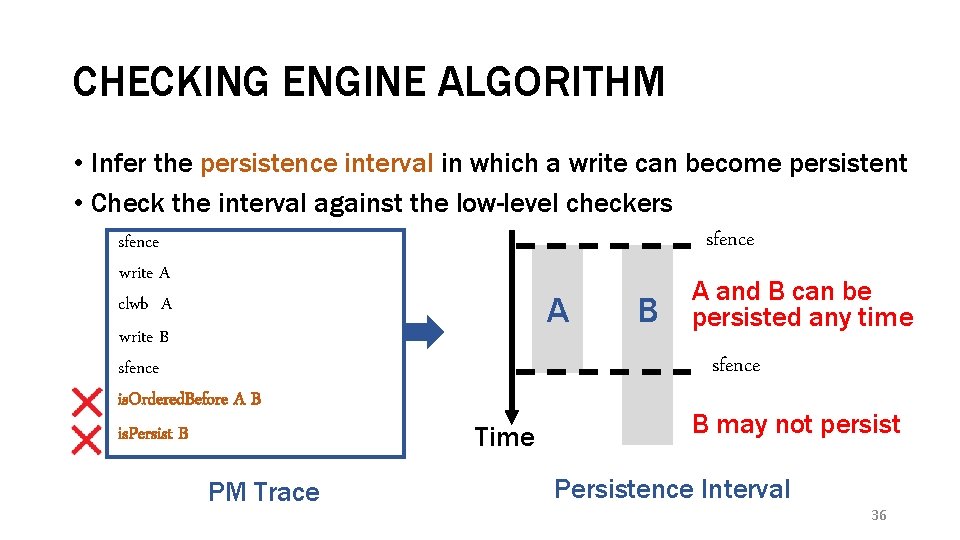
CHECKING ENGINE ALGORITHM • Infer the persistence interval in which a write can become persistent • Check the interval against the low-level checkers sfence write A clwb A write B sfence is. Ordered. Before A B is. Persist B PM Trace A B A and B can be persisted any time sfence Time B may not persist Persistence Interval 36
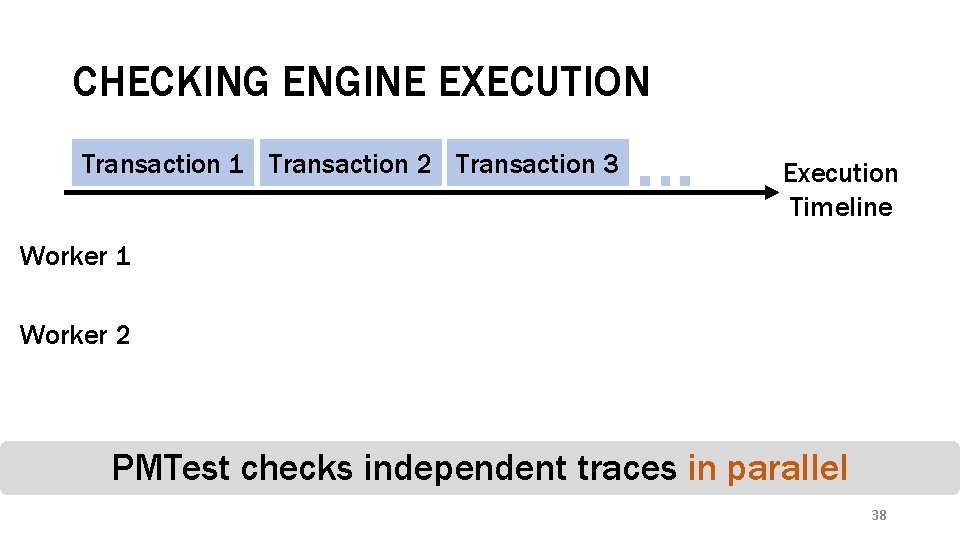
CHECKING ENGINE EXECUTION Transaction 1 Transaction 2 Transaction 3 Worker 1 Worker 2 Execution Timeline Test Trace 3 Test Trace 1 Test Trace 2 PMTest checks independent traces in parallel 38
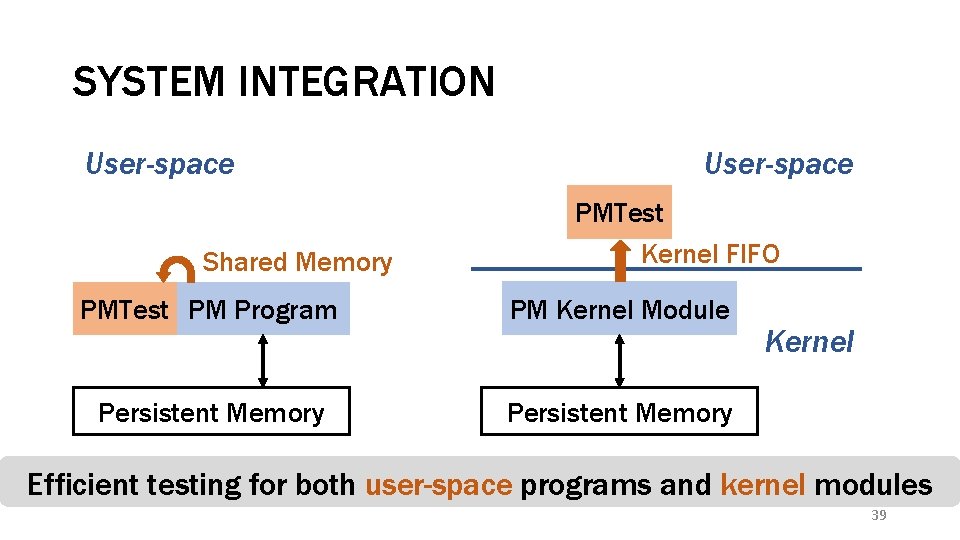
SYSTEM INTEGRATION User-space Shared Memory User-space PMTest Kernel FIFO PMTest PM Program PM Kernel Module Persistent Memory Kernel Efficient testing for both user-space programs and kernel modules 39
OUTLINE BACKGROUND AND MOTIVATION REQUIREMENTS AND KEY IDEAS PMTEST INTERFACE PMTEST MECHANISM EVALUATION SUMMARY 40
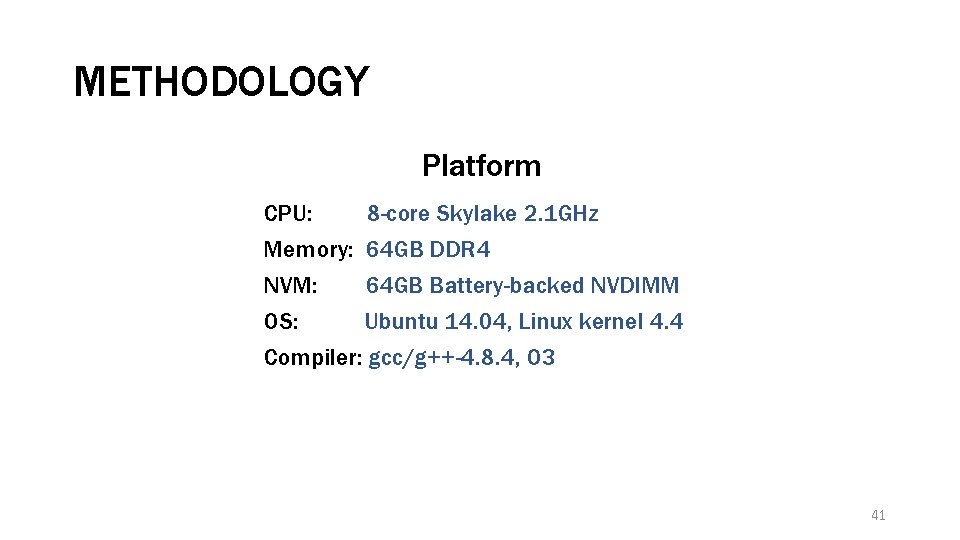
METHODOLOGY Platform CPU: 8 -core Skylake 2. 1 GHz Memory: 64 GB DDR 4 NVM: 64 GB Battery-backed NVDIMM OS: Ubuntu 14. 04, Linux kernel 4. 4 Compiler: gcc/g++-4. 8. 4, O 3 41
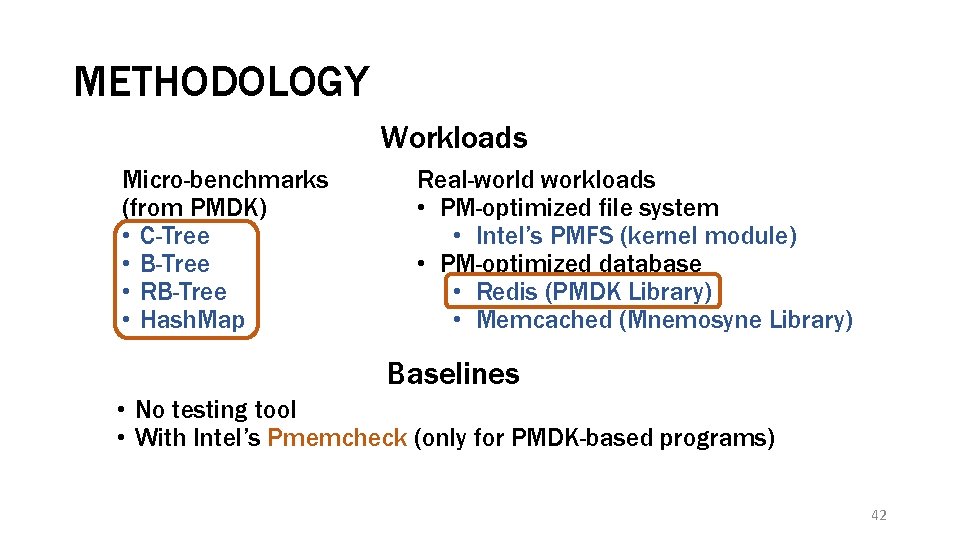
METHODOLOGY Workloads Micro-benchmarks (from PMDK) • C-Tree • B-Tree • RB-Tree • Hash. Map Real-world workloads • PM-optimized file system • Intel’s PMFS (kernel module) • PM-optimized database • Redis (PMDK Library) • Memcached (Mnemosyne Library) Baselines • No testing tool • With Intel’s Pmemcheck (only for PMDK-based programs) 42
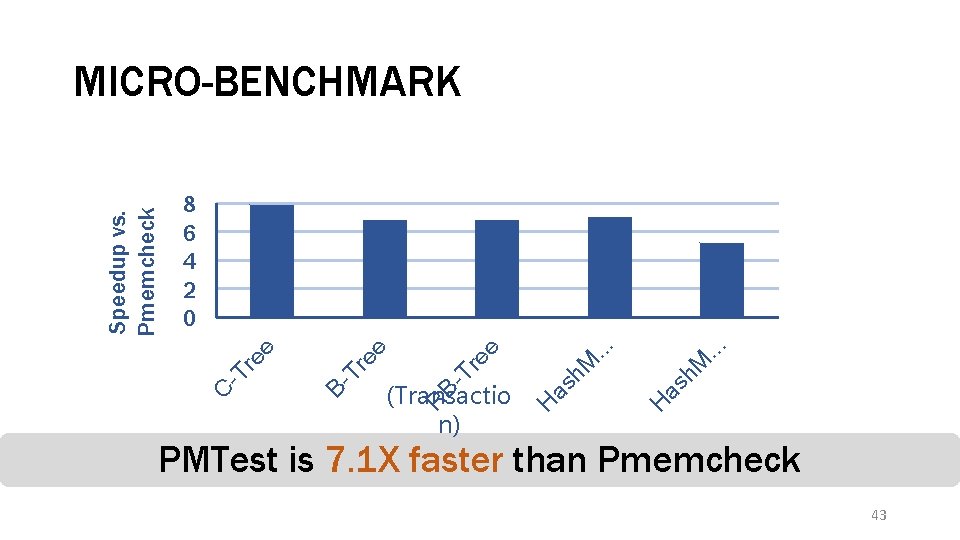
. . . H as h. M ee BTr (Transactio n) R re BT -T C e 8 6 4 2 0 re e Speedup vs. Pmemcheck MICRO-BENCHMARK PMTest is 7. 1 X faster than Pmemcheck 43
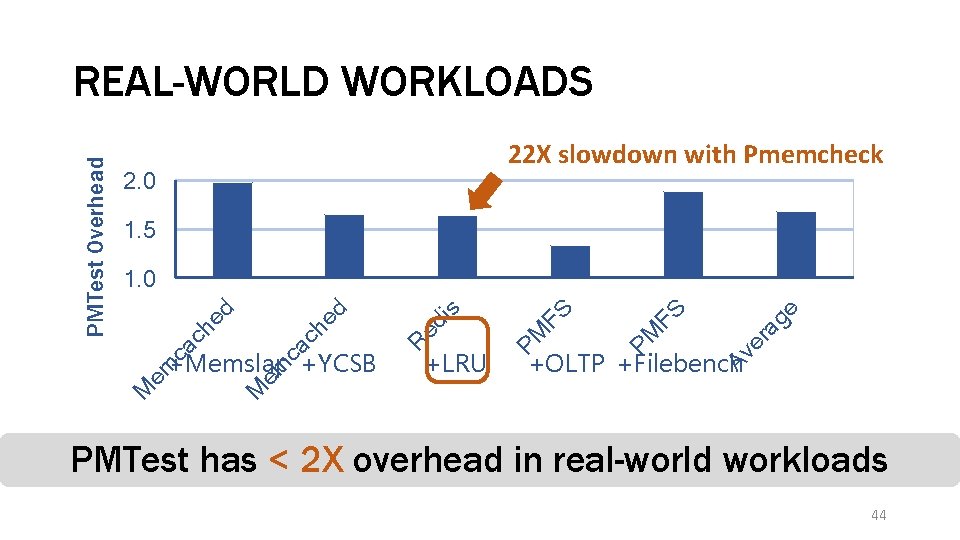
22 X slowdown with Pmemcheck 2. 0 1. 5 e Av er ag FS PM is ed +LRU +OLTP +Filebench M M +Memslap +YCSB R ed ch em ca ch ed 1. 0 em ca PMTest Overhead REAL-WORLD WORKLOADS PMTest has < 2 X overhead in real-world workloads 44
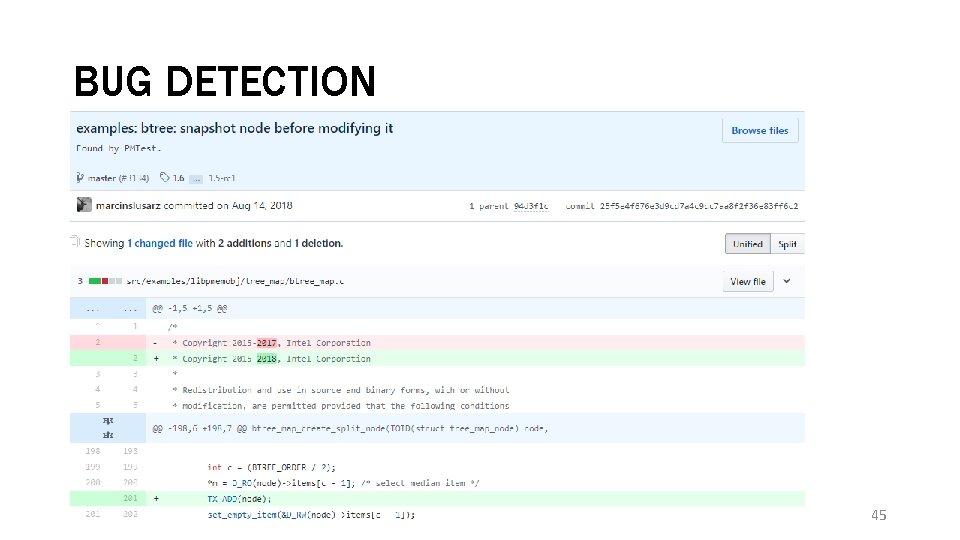
BUG DETECTION • Validated with • 42 synthetic bugs injected to micro-benchmarks • 3 existing bugs from commit history • New bugs found • 1 crash consistency bug in PMDK applications • 1 performance bug in PMFS • 1 performance bug in PMDK applications 45
OUTLINE BACKGROUND AND MOTIVATION REQUIREMENTS AND KEY IDEAS PMTEST INTERFACE PMTEST MECHANISM EVALUATION CONCLUSION 46
CONCLUSION • The new persistent memory (PM) allows direct management of persistent data in memory • However, it is hard to guarantee crash consistency • PMTest detects such crash consistency bugs and performance bugs • PMTest is fast and flexible • Supports kernel modules, custom PM programs, transaction-based programs, etc. • Can be extended to support future PM hardware platforms • Incurs < 2 X overhead in real-workload applications • PMTest has detected 3 new bugs in PMFS and PMDK applications Source code is available at pmtest. persistentmemory. org 47

PMTest: A Fast and Flexible Testing Framework for Persistent Memory Programs Sihang Liu 1, Yizhou Wei 1, Jishen Zhao 2, Aasheesh Kolli 3, 4, and Samira Khan 1 1 2 3 4 48
BACKUP SLIDES 49
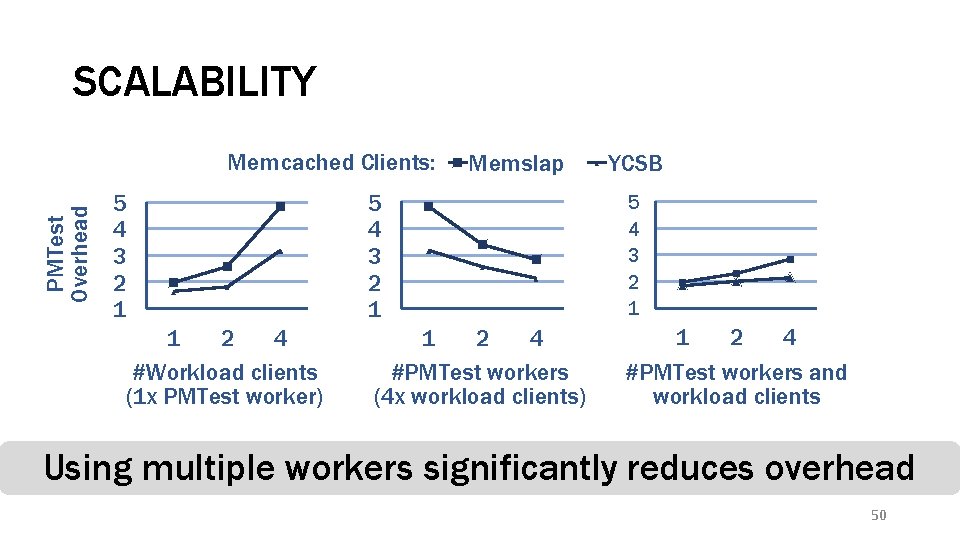
SCALABILITY PMTest Overhead Memcached Clients: 5 4 3 2 1 1 2 4 #Workload clients (1 x PMTest worker) Memslap YCSB 5 4 3 2 1 1 2 4 #PMTest workers (4 x workload clients) 1 2 4 #PMTest workers and workload clients Using multiple workers significantly reduces overhead 50
PM OPERATION TRACKING • PMTest extends the macros from WHISPER to track PM operations • Future works can use similar methods or use tool chains to inject tracking functions 51
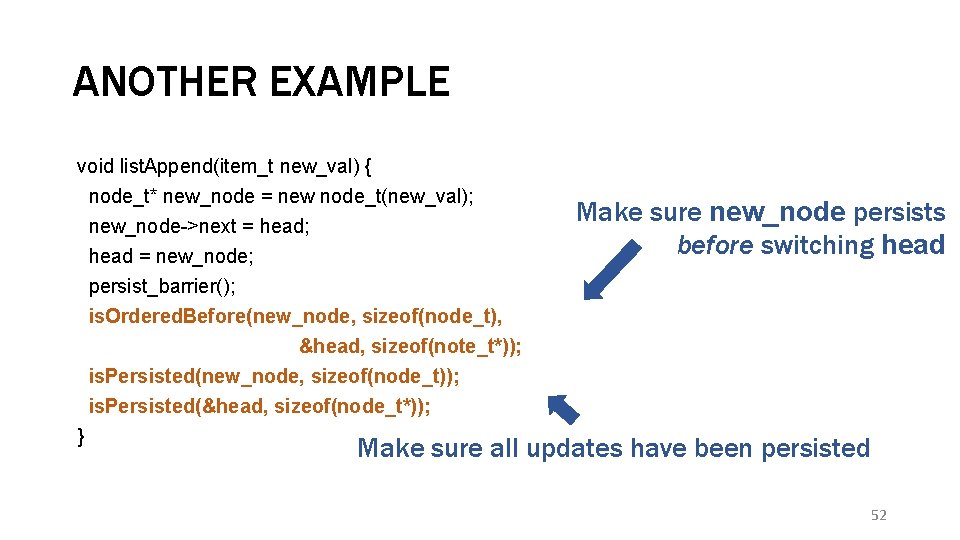
ANOTHER EXAMPLE void list. Append(item_t new_val) { node_t* new_node = new node_t(new_val); new_node->next = head; head = new_node; Make sure new_node persists before switching head persist_barrier(); is. Ordered. Before(new_node, sizeof(node_t), &head, sizeof(note_t*)); is. Persisted(new_node, sizeof(node_t)); is. Persisted(&head, sizeof(node_t*)); } Make sure all updates have been persisted 52
USING PMTEST INTERFACE • We provide two types of interface to programmers • Low-level interface for expert programmers • High-level interface for normal programmers • Low-level • We expect expert programmers have a good idea about the algorithmic correctness of the program • The low-level interface can help detect mistakes in implementation • High-level • Using the high-level interface requires minimum programmer effort without expert knowledge about the program • Correctly using the high-level interface is trivial 53
- Slides: 52