
PMT HV Base Board Engineering Requirements Nobuyoshi Kitamura

PMT HV Base Board Engineering Requirements Nobuyoshi Kitamura SSEC / UW-Madison Preliminary Design Review May 20, 2003
Outline Ice. Cube PMT HV Base Board ERD version 2. 3 (March 7, 2003) http: //www. ssec. wisc. edu/~kitamura/NK/PMT_Base/PMTHVBase. ERD_ver 2. 3. pdf 1. Functionality overview 2. Design status Status of the dual-track approach Known design / requirements issues Requirements update 3. Document walk-through with summary tables Is the requirement valid (justified)? How do you verify it? Test Analysis Inspection Demonstration Similarity 4. Discussion N. Kitamura SSEC / UW-Madison May 20, 2003 2
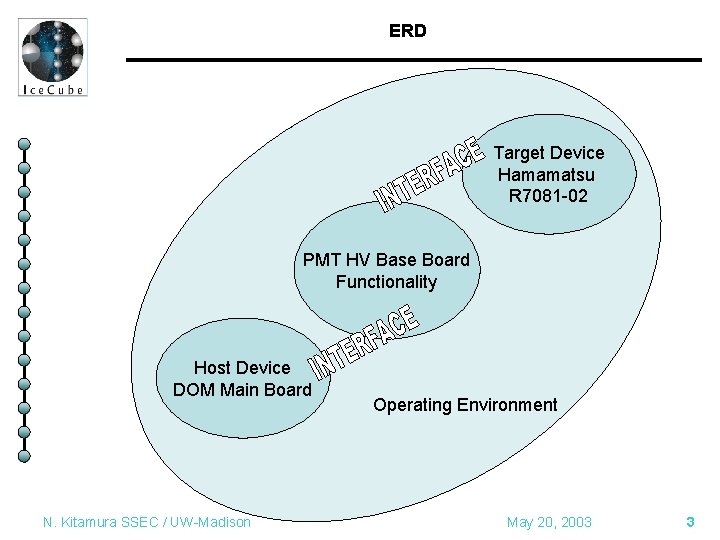
ERD Target Device Hamamatsu R 7081 -02 PMT HV Base Board Functionality Host Device DOM Main Board N. Kitamura SSEC / UW-Madison Operating Environment May 20, 2003 3
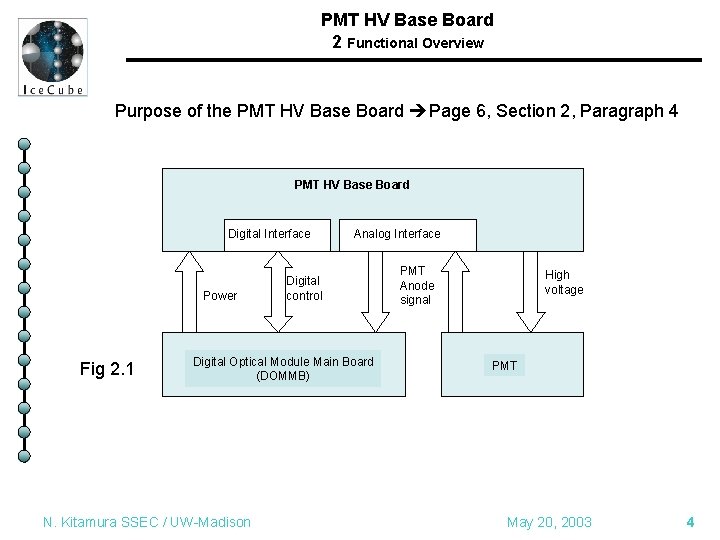
PMT HV Base Board 2 Functional Overview Purpose of the PMT HV Base Board Page 6, Section 2, Paragraph 4 PMT HV Base Board Digital Interface Power Fig 2. 1 Analog Interface Digital control Digital Optical Module Main Board (DOMMB) N. Kitamura SSEC / UW-Madison PMT Anode signal High voltage PMT May 20, 2003 4
Dual-Track Design Approach Active Base (All-in-one) approach ERD assumes this as a default configuration Passive Base approach Section 3. 1. 1. 1 allows an alternative configuration ERD Supplement (ver 0. 00 c, Jan. 13, 2003) defines alternative requirements http: //www. ssec. wisc. edu/~kitamura/NK/PMT_Base/PMTBase. ERD%20 suppl 0. 00 c. pdf N. Kitamura SSEC / UW-Madison May 20, 2003 5
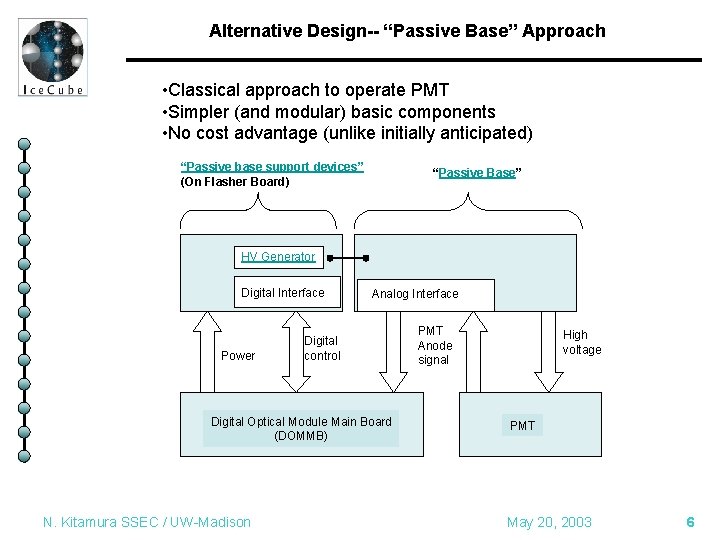
Alternative Design-- “Passive Base” Approach • Classical approach to operate PMT • Simpler (and modular) basic components • No cost advantage (unlike initially anticipated) “Passive base support devices” (On Flasher Board) “Passive Base” HV Generator Digital Interface Power Analog Interface Digital control Digital Optical Module Main Board (DOMMB) N. Kitamura SSEC / UW-Madison PMT Anode signal High voltage PMT May 20, 2003 6
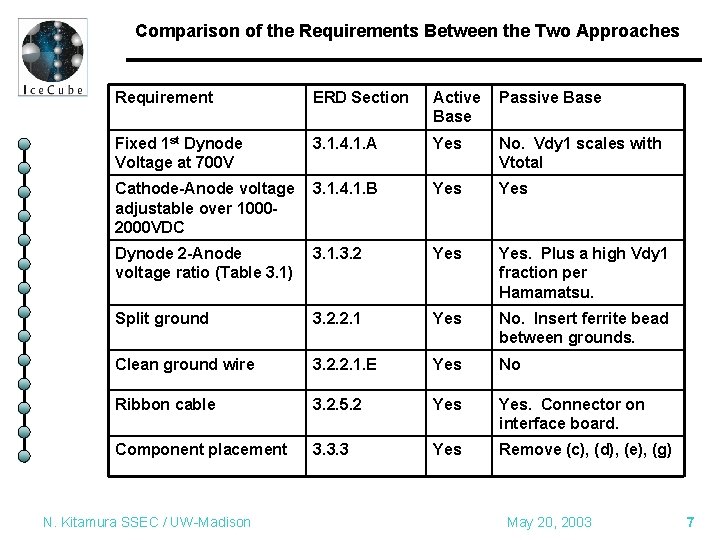
Comparison of the Requirements Between the Two Approaches Requirement ERD Section Active Base Passive Base Fixed 1 st Dynode Voltage at 700 V 3. 1. 4. 1. A Yes No. Vdy 1 scales with Vtotal Cathode-Anode voltage adjustable over 10002000 VDC 3. 1. 4. 1. B Yes Dynode 2 -Anode voltage ratio (Table 3. 1) 3. 1. 3. 2 Yes. Plus a high Vdy 1 fraction per Hamamatsu. Split ground 3. 2. 2. 1 Yes No. Insert ferrite bead between grounds. Clean ground wire 3. 2. 2. 1. E Yes No Ribbon cable 3. 2. 5. 2 Yes. Connector on interface board. Component placement 3. 3. 3 Yes Remove (c), (d), (e), (g) N. Kitamura SSEC / UW-Madison May 20, 2003 7

PMT HV Base Board Alternative Design Selection Criteria for the Passive Base Design q. Simpler and more reliable (subjective value) q. Reliable source of components No q. Cost advantage No q. Lower power consumption No q. Better performance Needs test q. Technically sound Yes Status: q 20 units each of HV generators and passive base boards have been received from vendor. q. One based on those components is available for DOM tests N. Kitamura SSEC / UW-Madison May 20, 2003 8
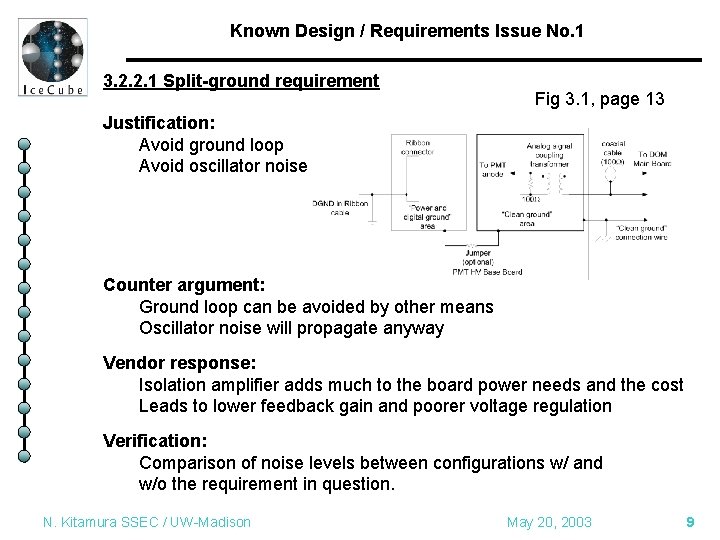
Known Design / Requirements Issue No. 1 3. 2. 2. 1 Split-ground requirement Fig 3. 1, page 13 Justification: Avoid ground loop Avoid oscillator noise Counter argument: Ground loop can be avoided by other means Oscillator noise will propagate anyway Vendor response: Isolation amplifier adds much to the board power needs and the cost Leads to lower feedback gain and poorer voltage regulation Verification: Comparison of noise levels between configurations w/ and w/o the requirement in question. N. Kitamura SSEC / UW-Madison May 20, 2003 9
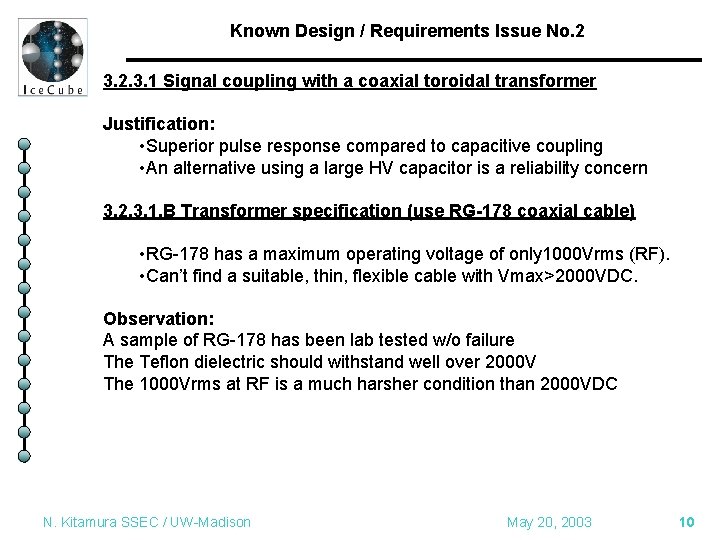
Known Design / Requirements Issue No. 2 3. 2. 3. 1 Signal coupling with a coaxial toroidal transformer Justification: • Superior pulse response compared to capacitive coupling • An alternative using a large HV capacitor is a reliability concern 3. 2. 3. 1. B Transformer specification (use RG-178 coaxial cable) • RG-178 has a maximum operating voltage of only 1000 Vrms (RF). • Can’t find a suitable, thin, flexible cable with Vmax>2000 VDC. Observation: A sample of RG-178 has been lab tested w/o failure The Teflon dielectric should withstand well over 2000 V The 1000 Vrms at RF is a much harsher condition than 2000 VDC N. Kitamura SSEC / UW-Madison May 20, 2003 10
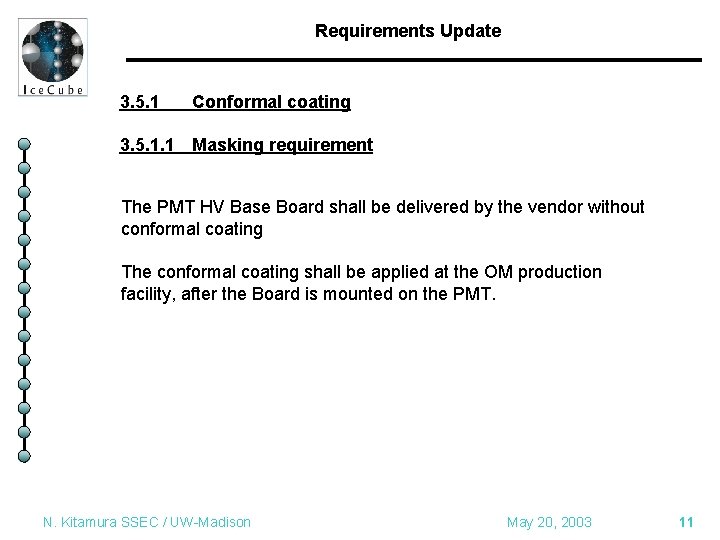
Requirements Update 3. 5. 1 Conformal coating 3. 5. 1. 1 Masking requirement The PMT HV Base Board shall be delivered by the vendor without conformal coating The conformal coating shall be applied at the OM production facility, after the Board is mounted on the PMT. N. Kitamura SSEC / UW-Madison May 20, 2003 11
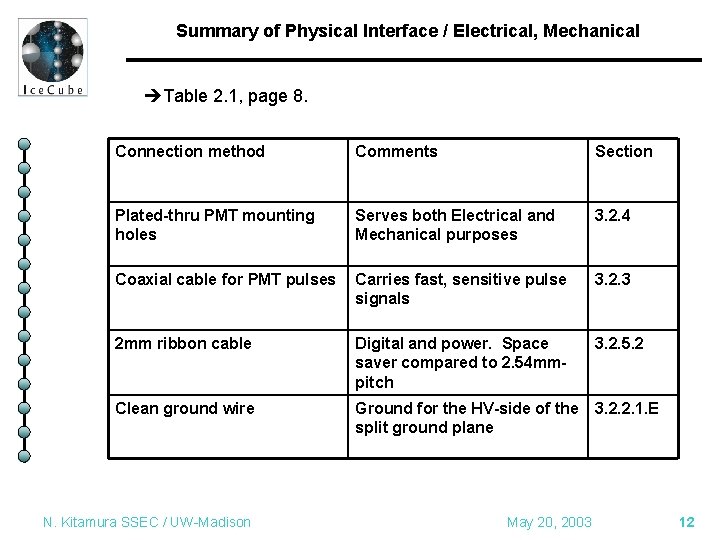
Summary of Physical Interface / Electrical, Mechanical Table 2. 1, page 8. Connection method Comments Section Plated-thru PMT mounting holes Serves both Electrical and Mechanical purposes 3. 2. 4 Coaxial cable for PMT pulses Carries fast, sensitive pulse signals 3. 2. 3 2 mm ribbon cable Digital and power. Space saver compared to 2. 54 mmpitch 3. 2. 5. 2 Clean ground wire Ground for the HV-side of the split ground plane 3. 2. 2. 1. E N. Kitamura SSEC / UW-Madison May 20, 2003 12
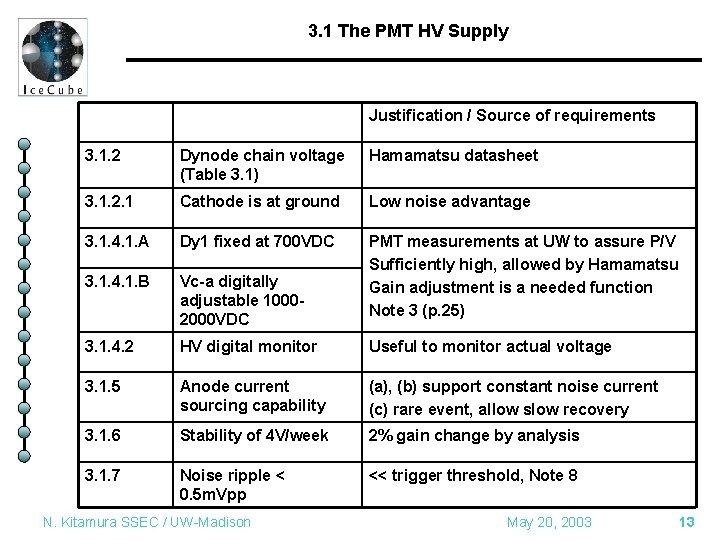
3. 1 The PMT HV Supply Justification / Source of requirements 3. 1. 2 Dynode chain voltage (Table 3. 1) Hamamatsu datasheet 3. 1. 2. 1 Cathode is at ground Low noise advantage 3. 1. 4. 1. A Dy 1 fixed at 700 VDC 3. 1. 4. 1. B Vc-a digitally adjustable 10002000 VDC PMT measurements at UW to assure P/V Sufficiently high, allowed by Hamamatsu Gain adjustment is a needed function Note 3 (p. 25) 3. 1. 4. 2 HV digital monitor Useful to monitor actual voltage 3. 1. 5 Anode current sourcing capability (a), (b) support constant noise current (c) rare event, allow slow recovery 3. 1. 6 Stability of 4 V/week 2% gain change by analysis 3. 1. 7 Noise ripple < 0. 5 m. Vpp << trigger threshold, Note 8 N. Kitamura SSEC / UW-Madison May 20, 2003 13
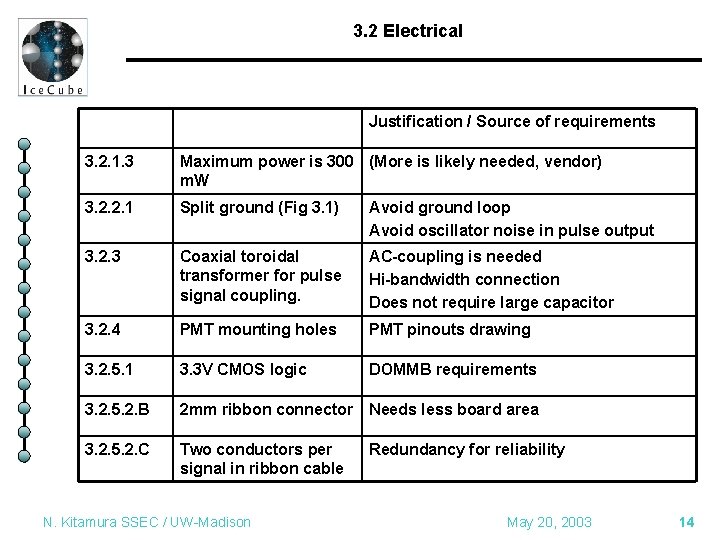
3. 2 Electrical Justification / Source of requirements 3. 2. 1. 3 Maximum power is 300 (More is likely needed, vendor) m. W 3. 2. 2. 1 Split ground (Fig 3. 1) Avoid ground loop Avoid oscillator noise in pulse output 3. 2. 3 Coaxial toroidal transformer for pulse signal coupling. AC-coupling is needed Hi-bandwidth connection Does not require large capacitor 3. 2. 4 PMT mounting holes PMT pinouts drawing 3. 2. 5. 1 3. 3 V CMOS logic DOMMB requirements 3. 2. 5. 2. B 2 mm ribbon connector Needs less board area 3. 2. 5. 2. C Two conductors per signal in ribbon cable N. Kitamura SSEC / UW-Madison Redundancy for reliability May 20, 2003 14
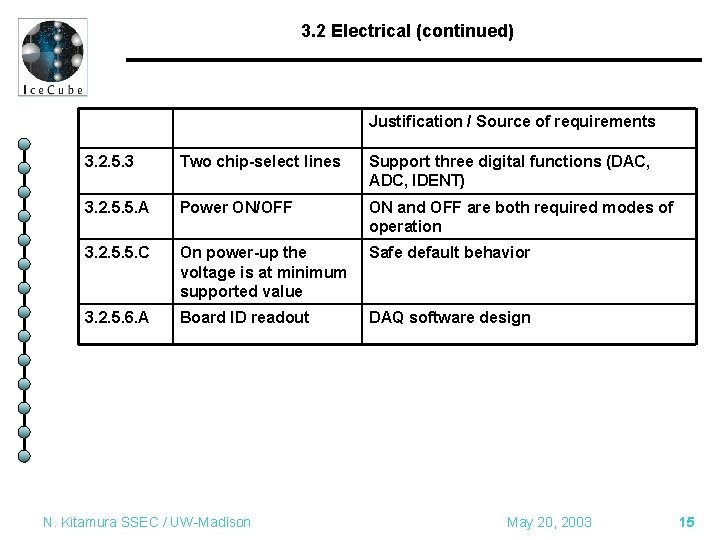
3. 2 Electrical (continued) Justification / Source of requirements 3. 2. 5. 3 Two chip-select lines Support three digital functions (DAC, ADC, IDENT) 3. 2. 5. 5. A Power ON/OFF ON and OFF are both required modes of operation 3. 2. 5. 5. C On power-up the voltage is at minimum supported value Safe default behavior 3. 2. 5. 6. A Board ID readout DAQ software design N. Kitamura SSEC / UW-Madison May 20, 2003 15
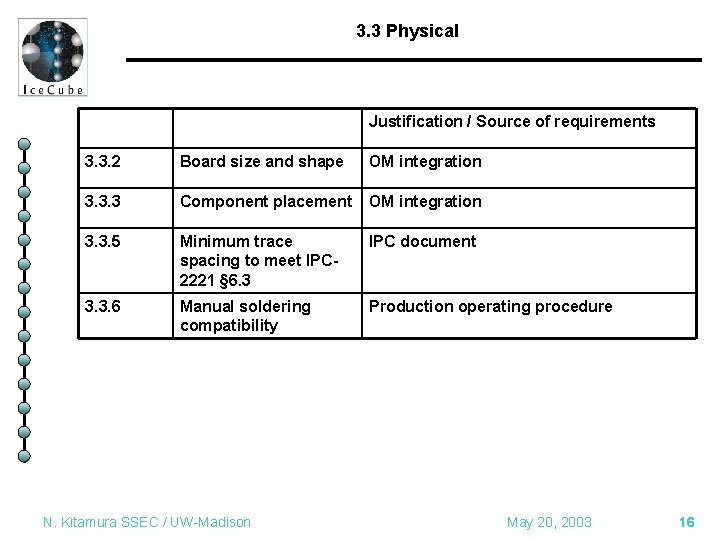
3. 3 Physical Justification / Source of requirements 3. 3. 2 Board size and shape OM integration 3. 3. 3 Component placement OM integration 3. 3. 5 Minimum trace spacing to meet IPC 2221 § 6. 3 IPC document 3. 3. 6 Manual soldering compatibility Production operating procedure N. Kitamura SSEC / UW-Madison May 20, 2003 16
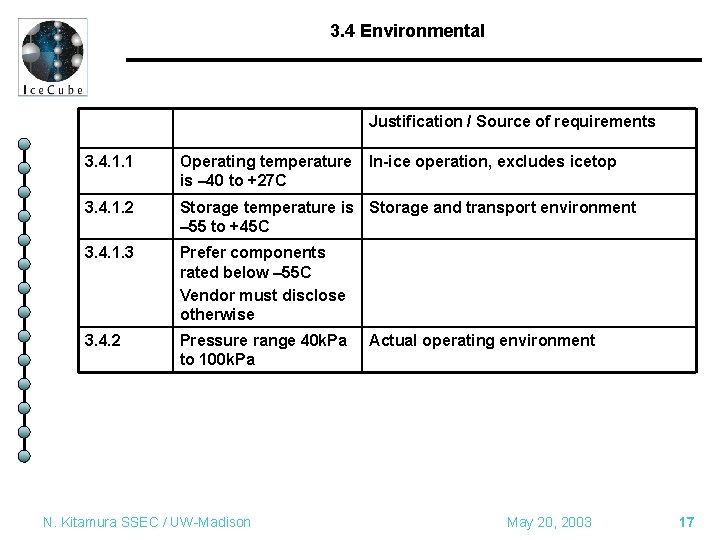
3. 4 Environmental Justification / Source of requirements 3. 4. 1. 1 Operating temperature is – 40 to +27 C 3. 4. 1. 2 Storage temperature is Storage and transport environment – 55 to +45 C 3. 4. 1. 3 Prefer components rated below – 55 C Vendor must disclose otherwise 3. 4. 2 Pressure range 40 k. Pa to 100 k. Pa N. Kitamura SSEC / UW-Madison In-ice operation, excludes icetop Actual operating environment May 20, 2003 17
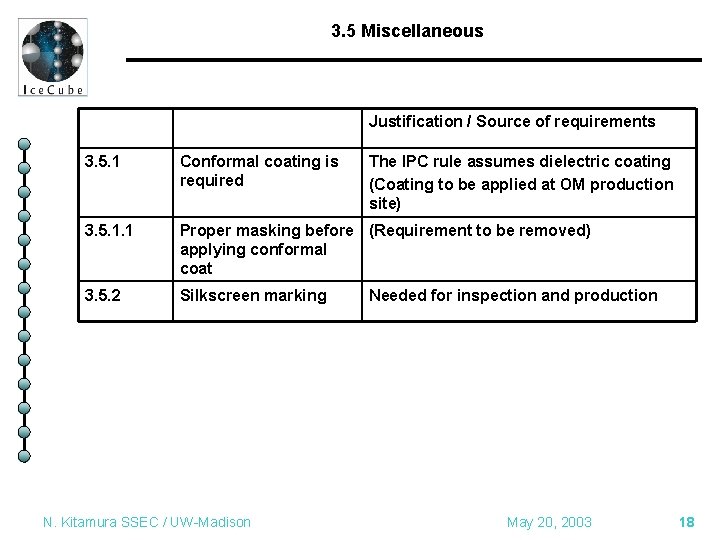
3. 5 Miscellaneous Justification / Source of requirements 3. 5. 1 Conformal coating is required 3. 5. 1. 1 Proper masking before (Requirement to be removed) applying conformal coat 3. 5. 2 Silkscreen marking N. Kitamura SSEC / UW-Madison The IPC rule assumes dielectric coating (Coating to be applied at OM production site) Needed for inspection and production May 20, 2003 18
Conclusion Test against the Exit Criteria Is the ERD in good shape? Risk items have been identified: Toroidal transformer requirement Split ground requirement Alternatives Requirements are defined Selection logic defined N. Kitamura SSEC / UW-Madison May 20, 2003 19
- Slides: 19