
PMP1 Lowering SCC is Not a Guessing Game









- Slides: 35
P-MP-1 Lowering SCC is Not a Guessing Game Jeffrey K. Reneau Professor of Dairy Management www. extension. umn. edu/dairy
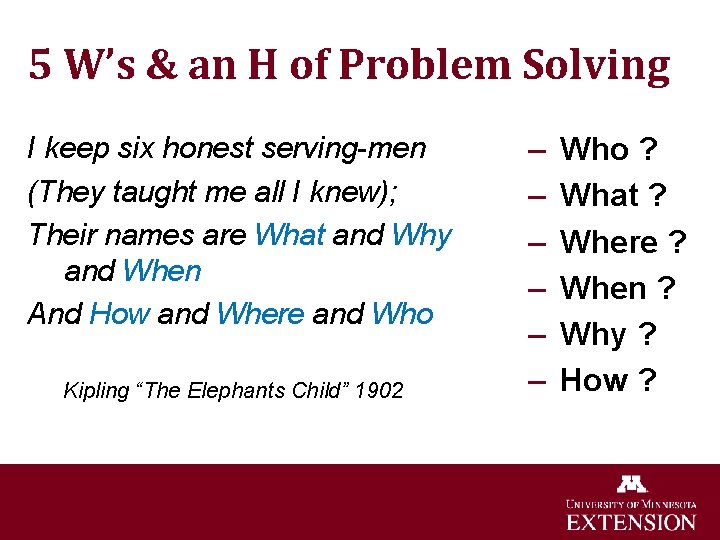
5 W’s & an H of Problem Solving I keep six honest serving-men (They taught me all I knew); Their names are What and Why and When And How and Where and Who Kipling “The Elephants Child” 1902 – – – Who ? What ? Where ? When ? Why ? How ?
What are the right questions? Who ? • Dry Cows ? • Lactating Cows ? ─ 1 st lactation ? ─ Older cows ? • Individual Cows ? Where or When? • • • Seasonal? Stage of lactation? During dry period? At calving? Location / Pen ? What or Why? • Mastitis pathogens? • Bedding management? • Cow prep? How can we improve?
Step 1. What is the problem? High BTSCC
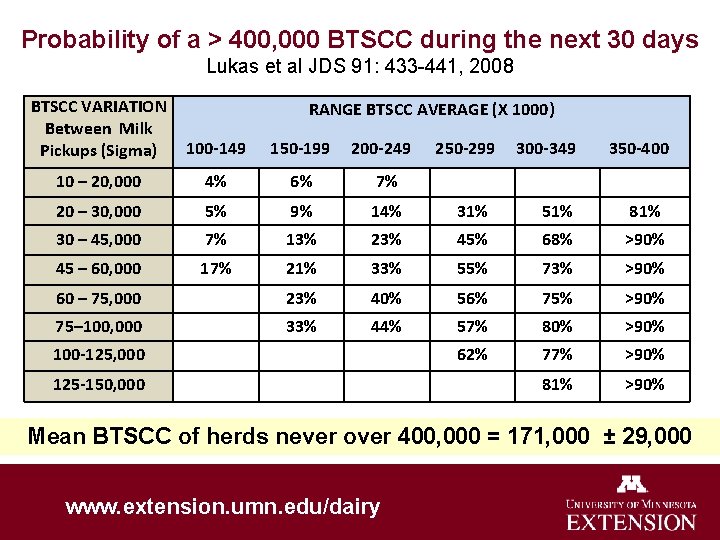
Probability of a > 400, 000 BTSCC during the next 30 days Lukas et al JDS 91: 433 -441, 2008 BTSCC VARIATION Between Milk Pickups (Sigma) 100 -149 150 -199 10 – 20, 000 4% 6% 7% 20 – 30, 000 5% 9% 14% 31% 51% 81% 30 – 45, 000 7% 13% 23% 45% 68% >90% 45 – 60, 000 17% 21% 33% 55% 73% >90% 60 – 75, 000 23% 40% 56% 75% >90% 75– 100, 000 33% 44% 57% 80% >90% 62% 77% >90% 81% >90% RANGE BTSCC AVERAGE (X 1000) 200 -249 100 -125, 000 125 -150, 000 250 -299 300 -349 350 -400 Mean BTSCC of herds never over 400, 000 = 171, 000 ± 29, 000 www. extension. umn. edu/dairy
Could solve milk quality problem overnight Win milk quality battle but still losing mastitis war
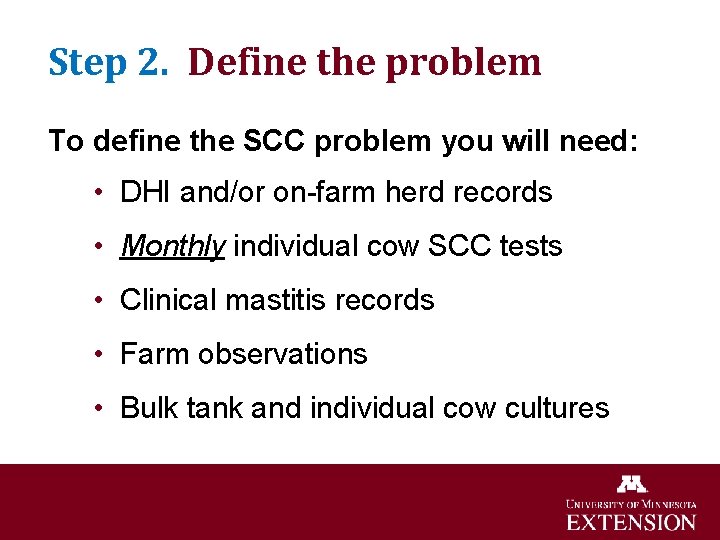
Step 2. Define the problem To define the SCC problem you will need: • DHI and/or on-farm herd records • Monthly individual cow SCC tests • Clinical mastitis records • Farm observations • Bulk tank and individual cow cultures
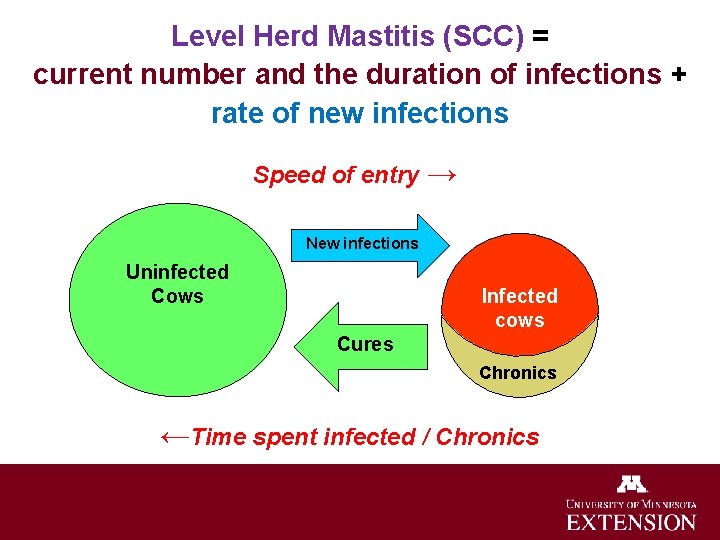
Level Herd Mastitis (SCC) = current number and the duration of infections + rate of new infections Speed of entry → New infections Uninfected Cows Infected cows Cures Chronics ←Time spent infected / Chronics
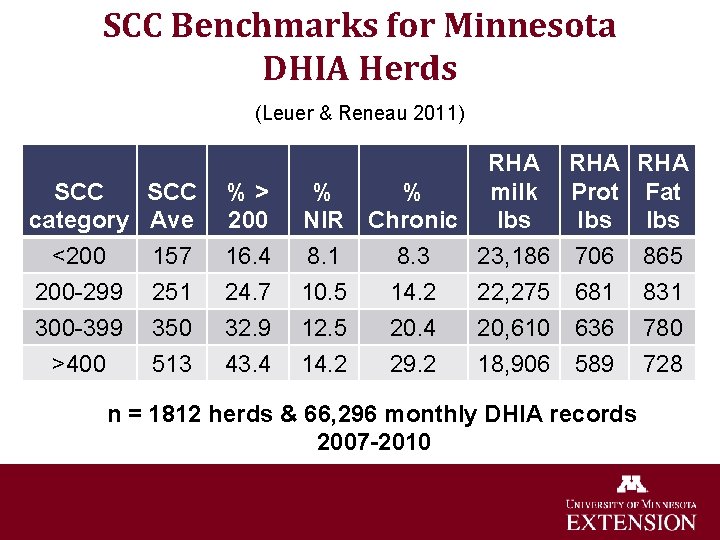
SCC Benchmarks for Minnesota DHIA Herds (Leuer & Reneau 2011) SCC category <200 200 -299 300 -399 >400 SCC Ave 157 251 350 513 %> 200 16. 4 24. 7 32. 9 43. 4 RHA RHA % % milk Prot Fat NIR Chronic lbs lbs 8. 1 8. 3 23, 186 706 865 10. 5 14. 2 22, 275 681 831 12. 5 20. 4 20, 610 636 780 14. 2 29. 2 18, 906 589 728 n = 1812 herds & 66, 296 monthly DHIA records 2007 -2010
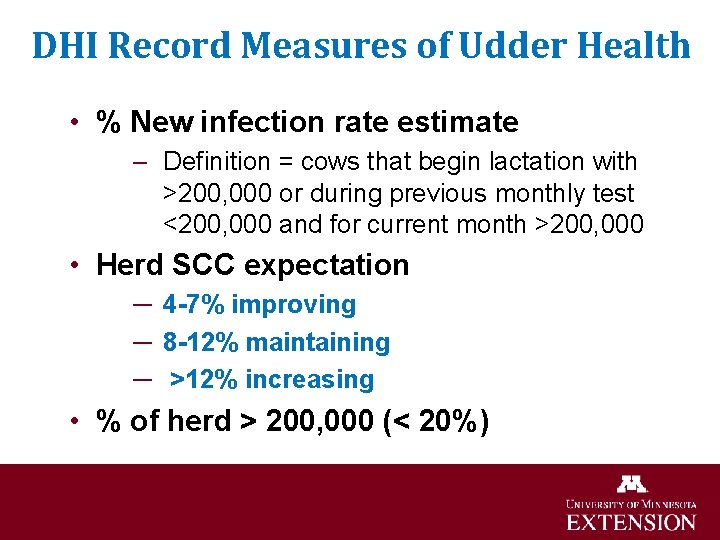
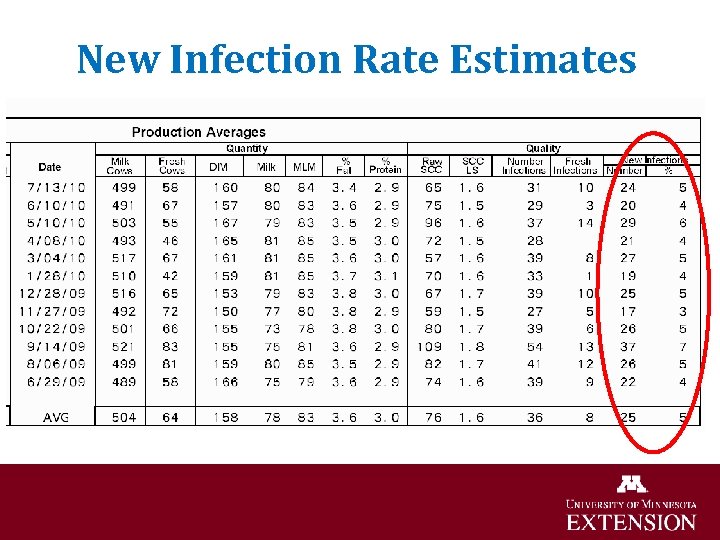
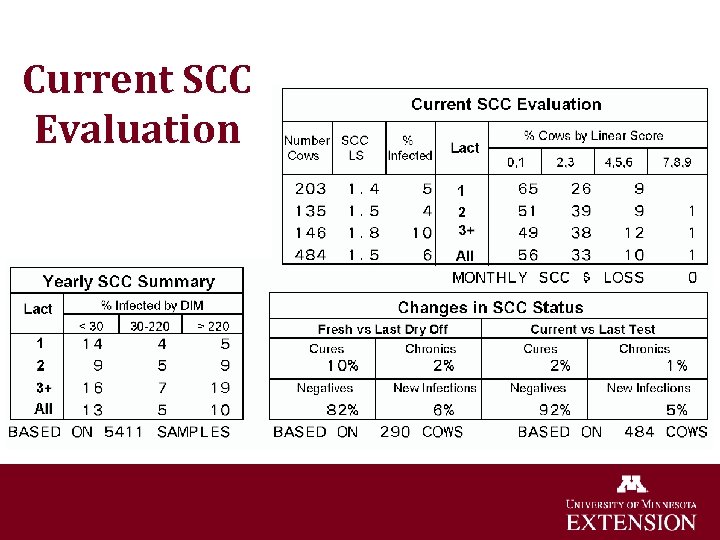
DHI Record Measures of Udder Health • % New infection rate estimate – Definition = cows that begin lactation with >200, 000 or during previous monthly test <200, 000 and for current month >200, 000 • Herd SCC expectation ─ 4 -7% improving ─ 8 -12% maintaining ─ >12% increasing • % of herd > 200, 000 (< 20%)
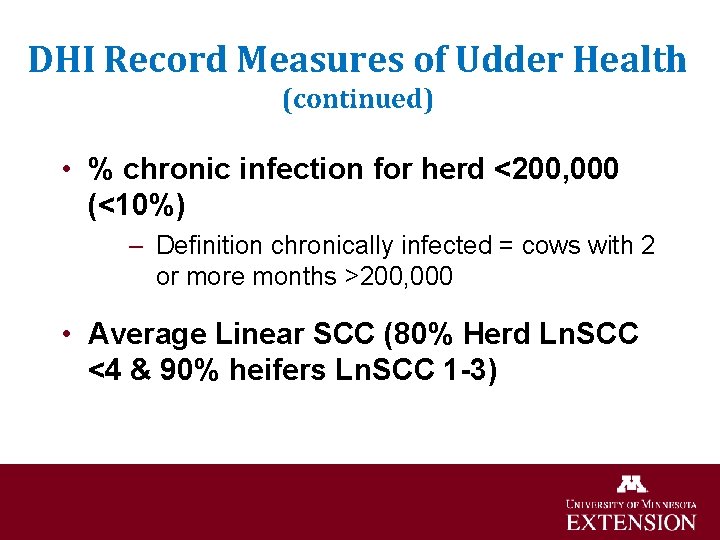
DHI Record Measures of Udder Health (continued) • % chronic infection for herd <200, 000 (<10%) – Definition chronically infected = cows with 2 or more months >200, 000 • Average Linear SCC (80% Herd Ln. SCC <4 & 90% heifers Ln. SCC 1 -3)
DHI scc kit
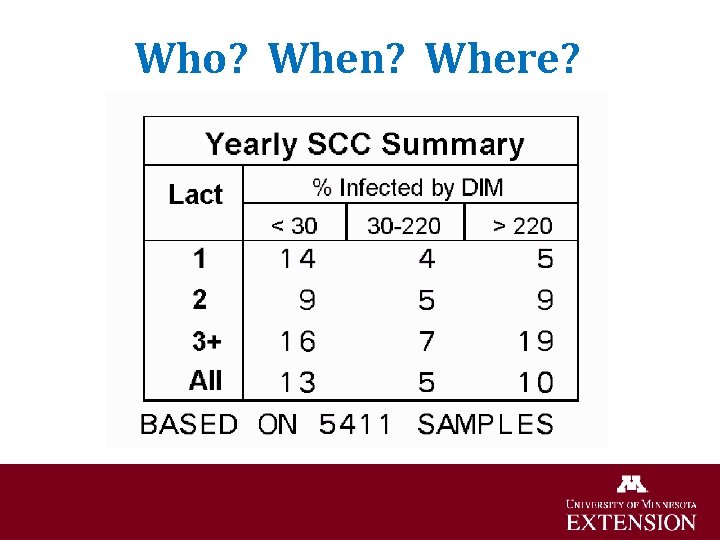
Who? When? Where?
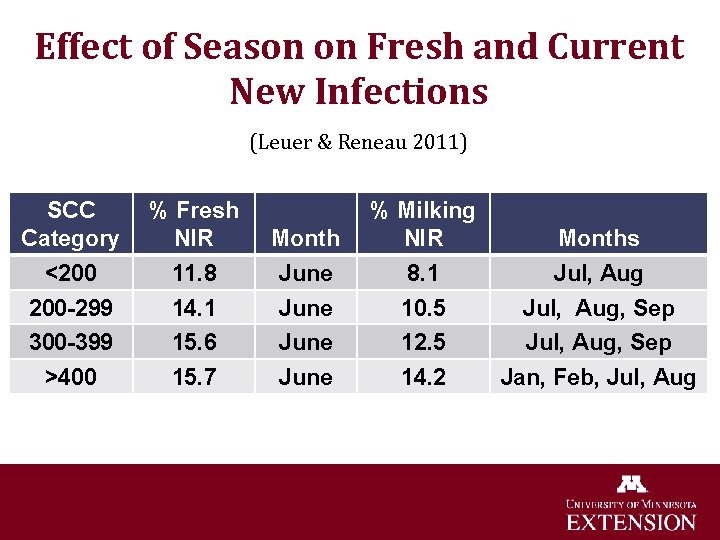
Effect of Season on Fresh and Current New Infections (Leuer & Reneau 2011) SCC Category % Fresh NIR Month % Milking NIR Months <200 11. 8 June 8. 1 Jul, Aug 200 -299 14. 1 June 10. 5 Jul, Aug, Sep 300 -399 15. 6 June 12. 5 Jul, Aug, Sep >400 15. 7 June 14. 2 Jan, Feb, Jul, Aug
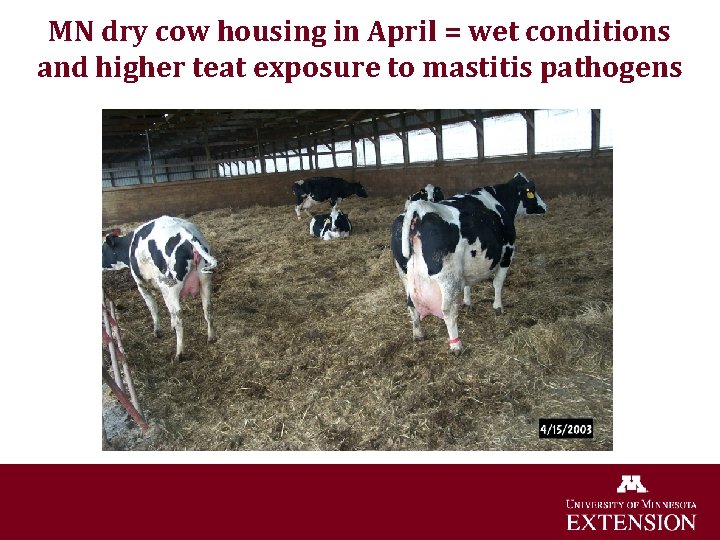
MN dry cow housing in April = wet conditions and higher teat exposure to mastitis pathogens
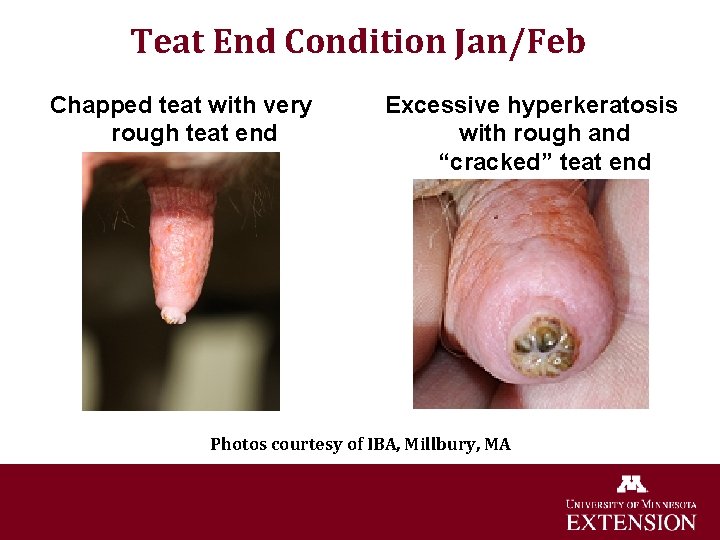
Teat End Condition Jan/Feb Chapped teat with very rough teat end Excessive hyperkeratosis with rough and “cracked” teat end Photos courtesy of IBA, Millbury, MA
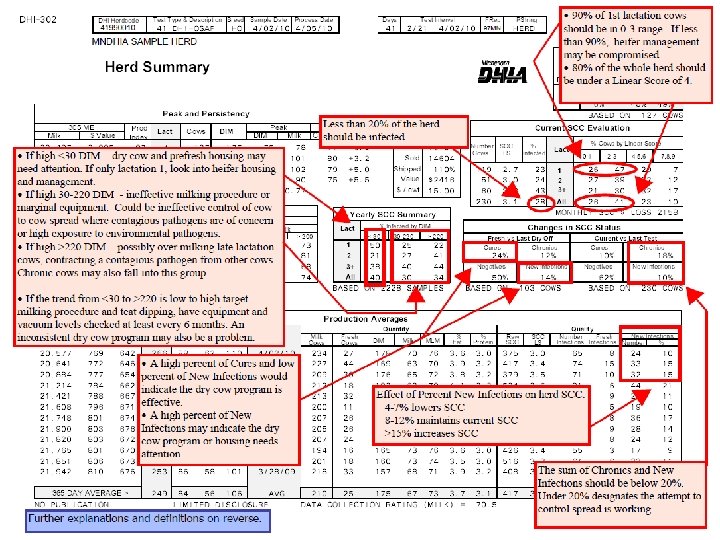
New Infection Rate Estimates
Current SCC Evaluation
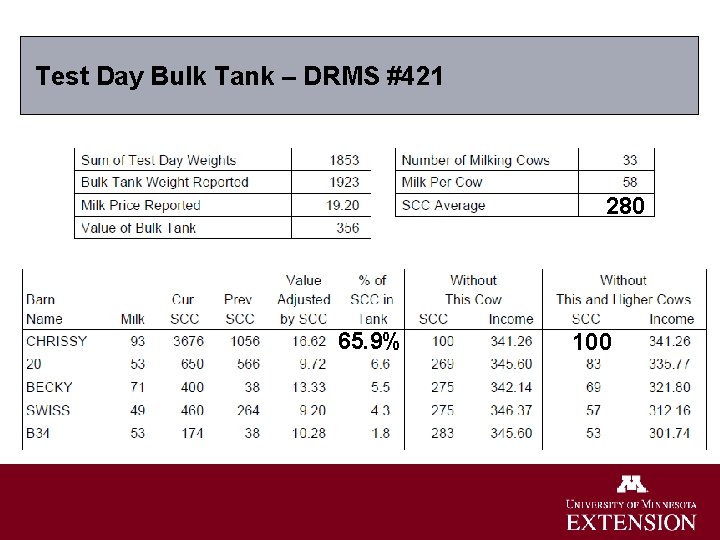
Test Day Bulk Tank – DRMS #421 280 65. 9% 100
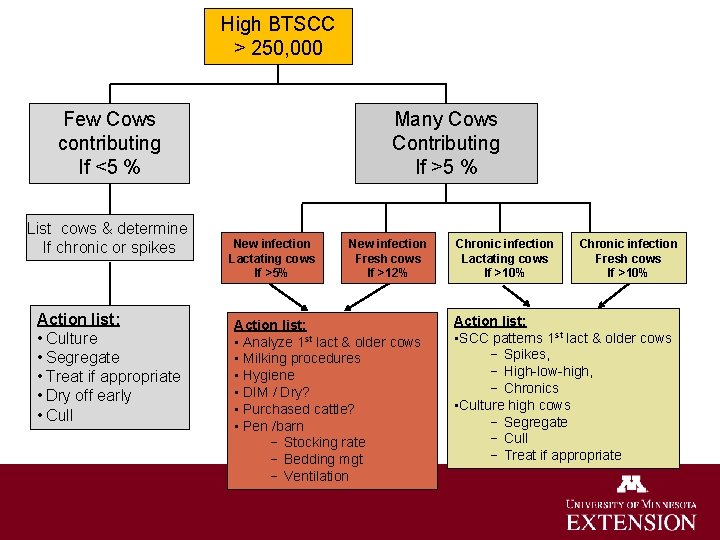
High BTSCC > 250, 000 Few Cows contributing If <5 % List cows & determine If chronic or spikes Action list: • Culture • Segregate • Treat if appropriate • Dry off early • Cull Many Cows Contributing If >5 % New infection Lactating cows If >5% New infection Fresh cows If >12% Action list: • Analyze 1 st lact & older cows • Milking procedures • Hygiene • DIM / Dry? • Purchased cattle? • Pen /barn − Stocking rate − Bedding mgt − Ventilation Chronic infection Lactating cows If >10% Chronic infection Fresh cows If >10% Action list: • SCC patterns 1 st lact & older cows − Spikes, − High-low-high, − Chronics • Culture high cows − Segregate − Cull − Treat if appropriate
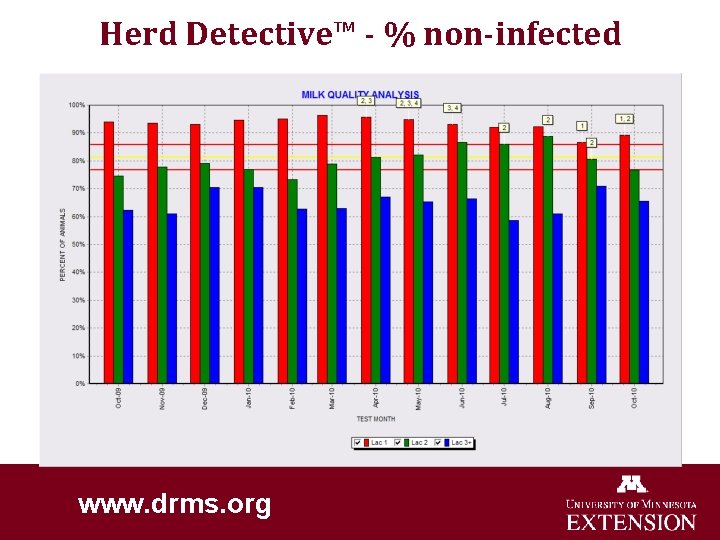
Herd Detective™ - % non-infected www. drms. org
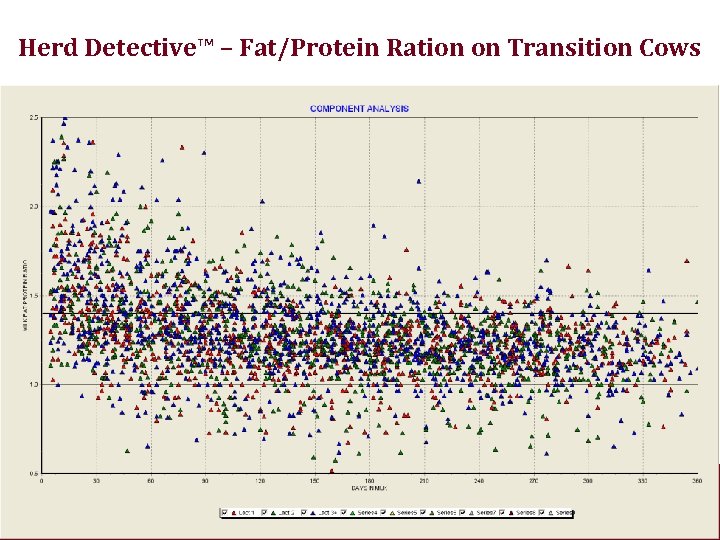
Herd Detective™ – Fat/Protein Ration on Transition Cows
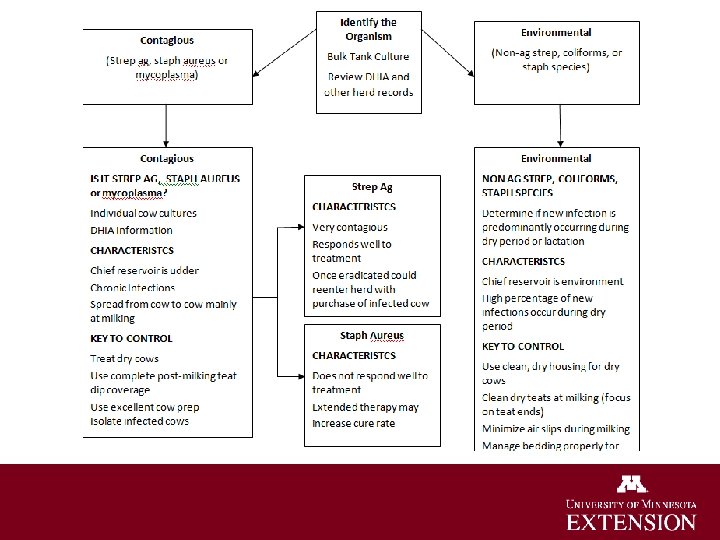
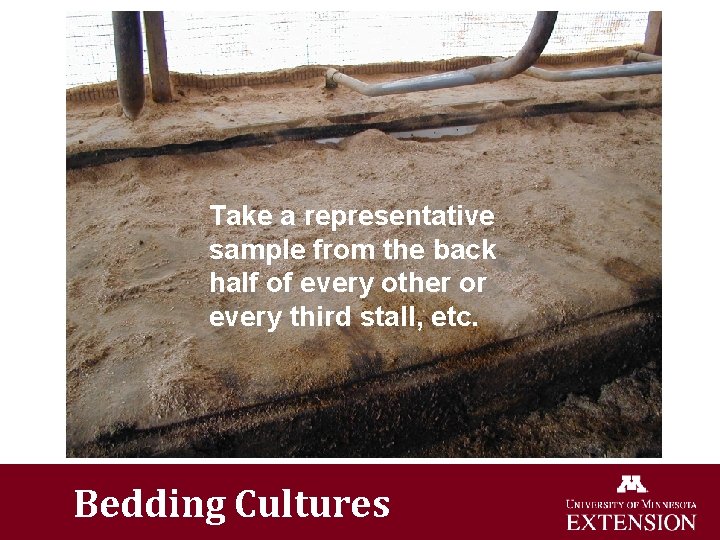
Identify what are the bacterial causes • Bulk tank milk cultures • Individual cow cultures • Bedding cultures
Take a representative sample from the back half of every other or every third stall, etc. Bedding Cultures
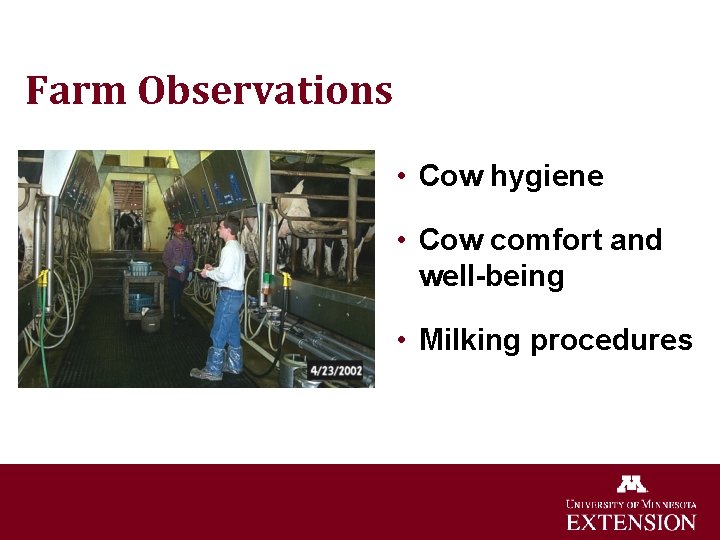
Farm Observations • Cow hygiene • Cow comfort and well-being • Milking procedures
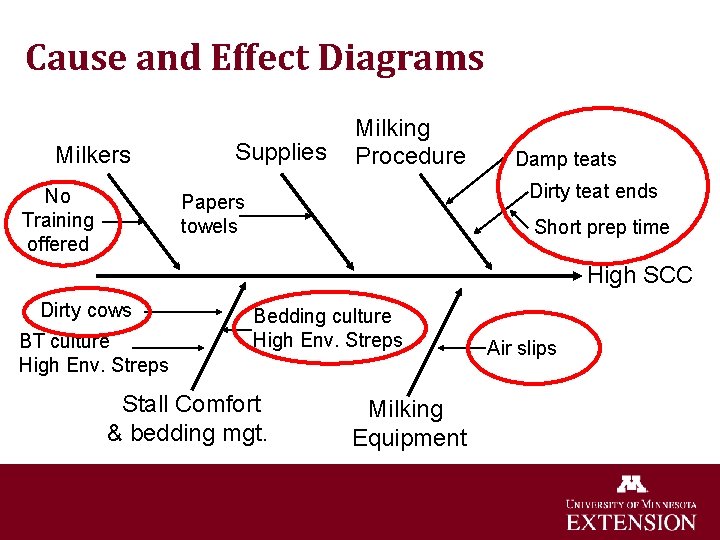
Step 3. Generate a list of possible causes • Work with your dairy management TEAM • Cause and effect diagram may be helpful in developing a “systems” perspective of what the problems are
Cause and Effect Diagrams Milkers No Training offered Supplies Milking Procedure Damp teats Dirty teat ends Papers towels Short prep time High SCC Dirty cows BT culture High Env. Streps Bedding culture High Env. Streps Stall Comfort & bedding mgt. Milking Equipment Air slips
Step 4. Develop an Action Plan • Decide on a practical plan and be specific!!! – Who will be responsible for implementing the plan? – Who will train employees? – When will the plan be implemented?
Step 5. Carry out the plan • Once the plan is initiated, stick to the plan! Give it chance to work • Do NOT tinker with the plan unless THERE IS CLEAR EVIDENCE that the plan is not working
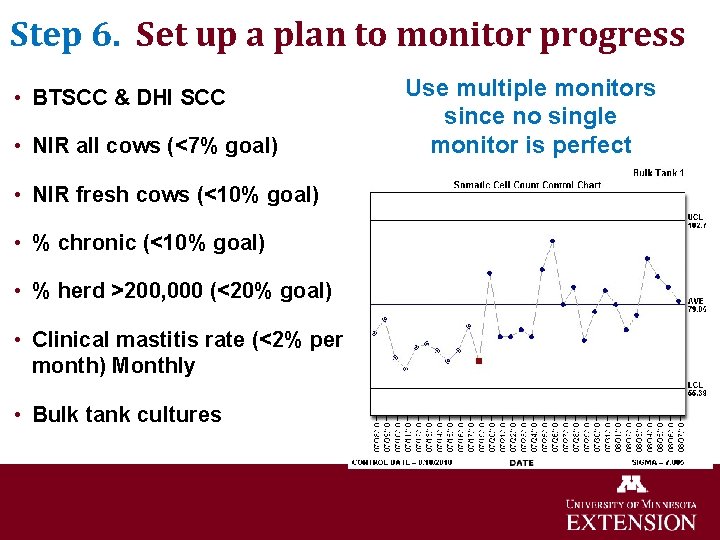
Step 6. Set up a plan to monitor progress • BTSCC & DHI SCC • NIR all cows (<7% goal) • NIR fresh cows (<10% goal) • % chronic (<10% goal) • % herd >200, 000 (<20% goal) • Clinical mastitis rate (<2% per month) Monthly • Bulk tank cultures Use multiple monitors since no single monitor is perfect
Step 7. Monitor progress and adjust plan as needed • If progress is being made, continue • If progress is not being made, then determine: – is it a failure of the plan? – is it a failure to implement the plan? • Be patient since progress can be slow, especially if the problem is chronic Staph aureus infections
Take-Home Messages • SCC/mastitis problem solving requires team work and a systematic approach • Dairy records serve as an important tool in SCC/mastitis diagnostics • Monthly individual cow SCC tests are needed for an effective analysis • Routine feedback is essential for SCC progress • <250, 000 SCC is possible for every dairy
In the Quest for Milk Quality Everyone Wins Cows……. . comfort, health, productivity Producers……… profit, personal satisfaction Processors……. . product yield, self life Consumers……. . confidence in food safety and wholesomeness
Thank You