
PMP Certification Part 1 Project Fundamentals Sections of
- Slides: 39
PMP Certification Part 1 – Project Fundamentals Sections of this presentation were adapted from A Guide to the Project Management Body of Knowledge 3 rd Edition, Project Management Institute Inc. , © 2004
What is PMI? Established 1969 to improve management of Engineering and Heavy Construction Projects Provides a common language and process for project management professionals to communicate Lessons extrapolated to numerous industries, particularly IT and software development
PMP Certification Project Management Professional (PMP) Certification n Baselines qualifications for potential employers PMP® is the recognized standard at the present time, (PMforum. org) Certified PMP’s median salary $5 K-$10 K higher than that of an MBA Graduate (www. payscale. com)
Requirements Project Management Professional (PMP) n n 4, 500 Hours of leading and directing specific tasks in Initiating, Planning, Executing, Monitoring/Controlling, and Closing domains 35 Educational Contact Hours Certified Associate in Project Management (CAPM) n 1, 500 hours work on project team or 23 hours of formal education
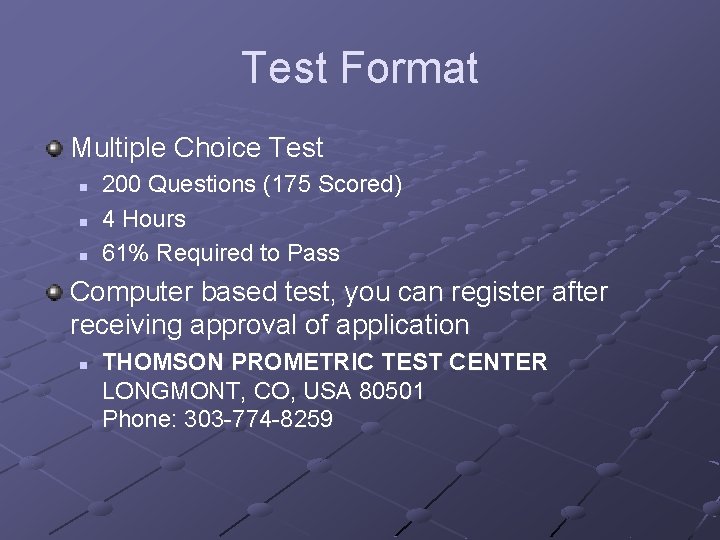
Test Format Multiple Choice Test n n n 200 Questions (175 Scored) 4 Hours 61% Required to Pass Computer based test, you can register after receiving approval of application n THOMSON PROMETRIC TEST CENTER LONGMONT, CO, USA 80501 Phone: 303 -774 -8259
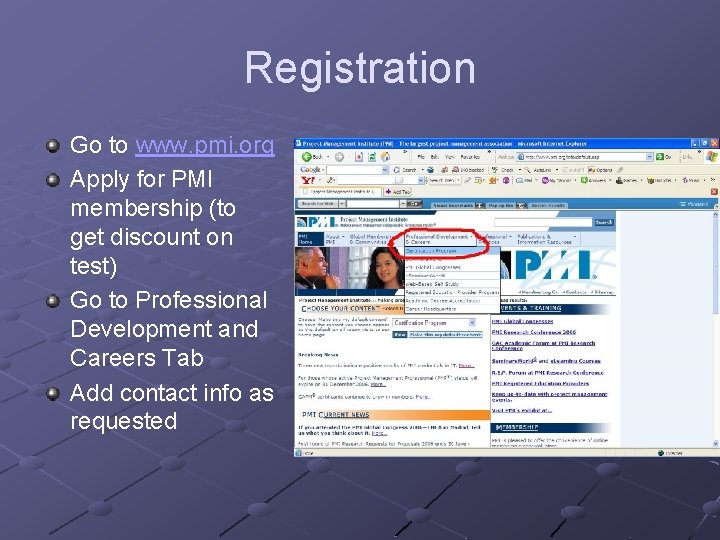
Registration Go to www. pmi. org Apply for PMI membership (to get discount on test) Go to Professional Development and Careers Tab Add contact info as requested
Registration Cont’d Worksheet tracks your experience as you add it You can save and return to where you left off Warning: Fill in ALL the required fields prior to pressing the NEXT button, incomplete sheets are deleted
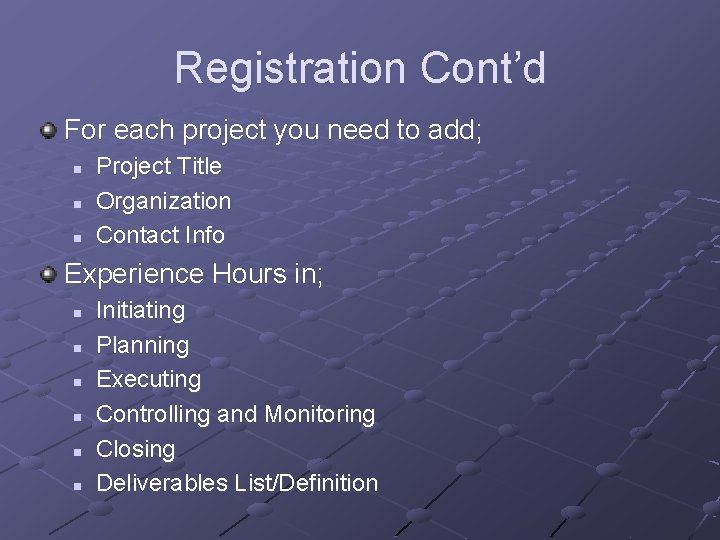
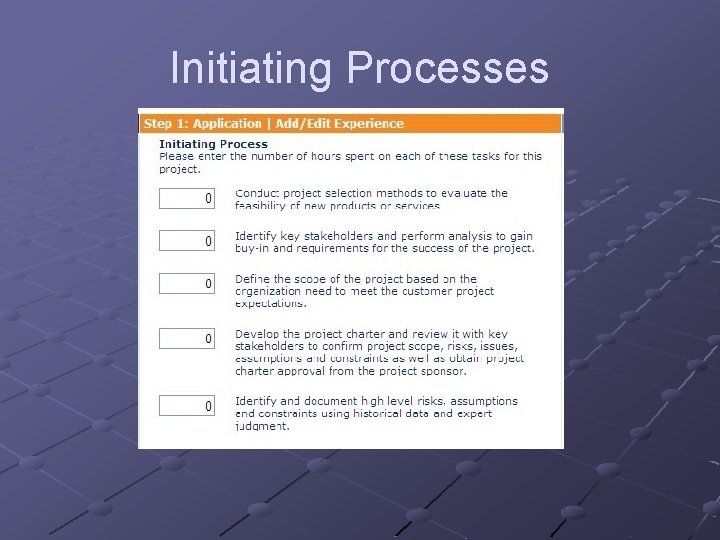
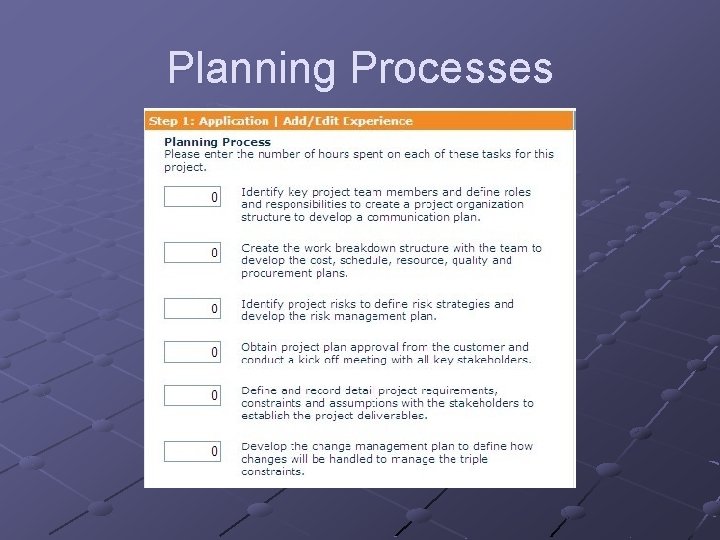
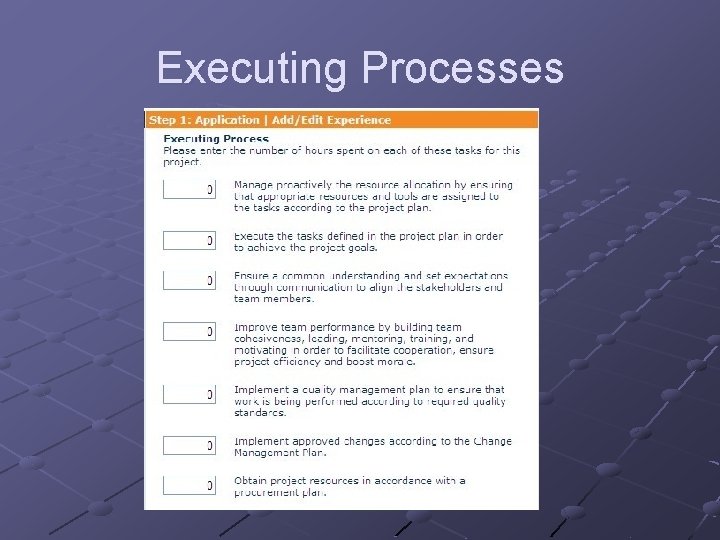
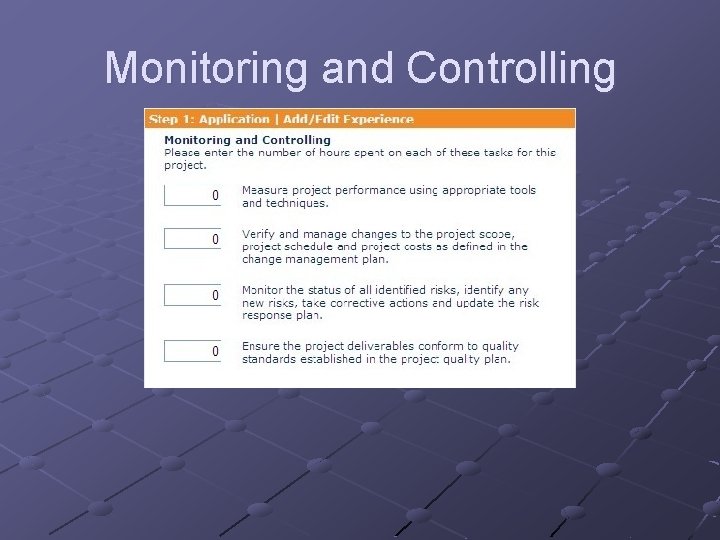
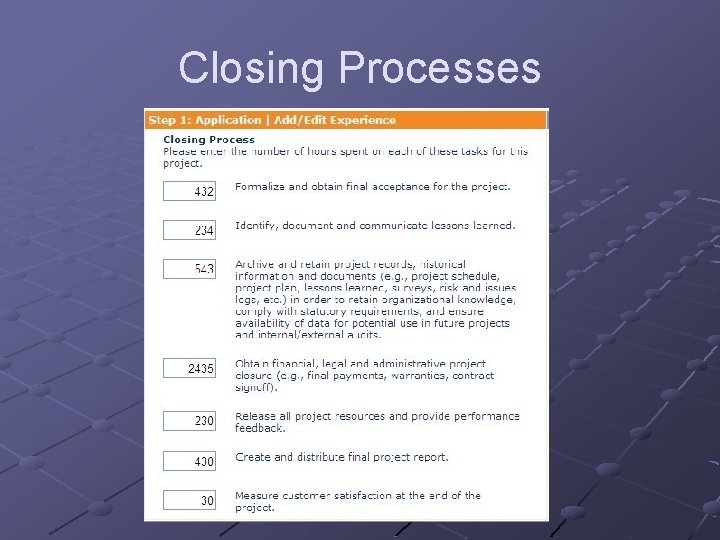
Registration Cont’d For each project you need to add; n n n Project Title Organization Contact Info Experience Hours in; n n n Initiating Planning Executing Controlling and Monitoring Closing Deliverables List/Definition
Initiating Processes
Planning Processes
Executing Processes
Monitoring and Controlling
Closing Processes
PMBOK Guide Part I Project Management Framework Part II Project Management Processes Part III Project Management Knowledge Areas
Part I – Project Management Framework What is a Project? What is Project Management? How are Projects Executed?
What is a Project? “A project is a temporary endeavor undertaken to create a unique product, service, or result” n n n Projects are finite, although work products need not be Projects should have repetitive elements, but the final product should be unique Progressive Elaboration, project becomes more detailed as it progresses
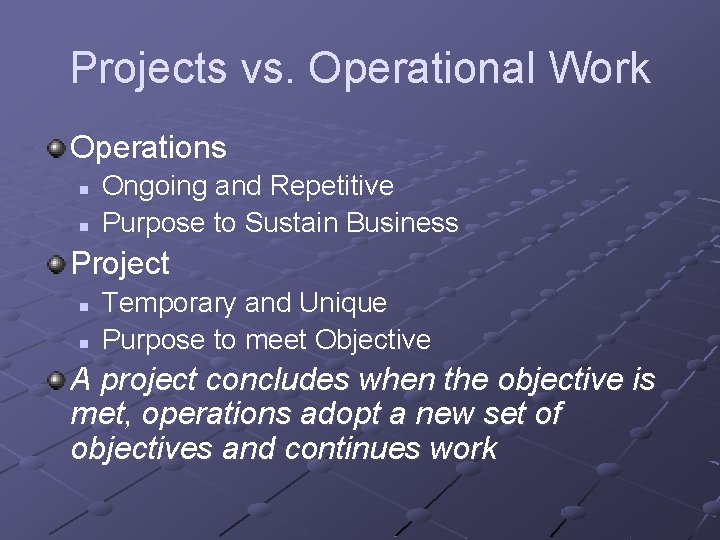
Projects vs. Operational Work Operations n n Ongoing and Repetitive Purpose to Sustain Business Project n n Temporary and Unique Purpose to meet Objective A project concludes when the objective is met, operations adopt a new set of objectives and continues work
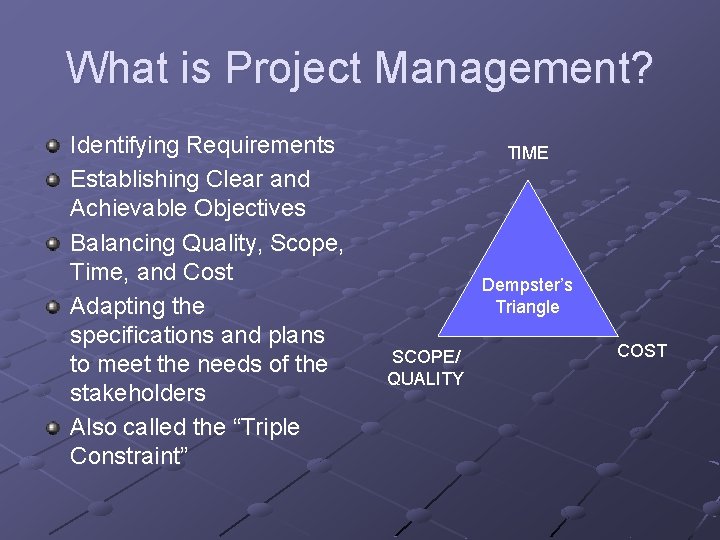
What is Project Management? Identifying Requirements Establishing Clear and Achievable Objectives Balancing Quality, Scope, Time, and Cost Adapting the specifications and plans to meet the needs of the stakeholders Also called the “Triple Constraint” TIME Dempster’s Triangle SCOPE/ QUALITY COST
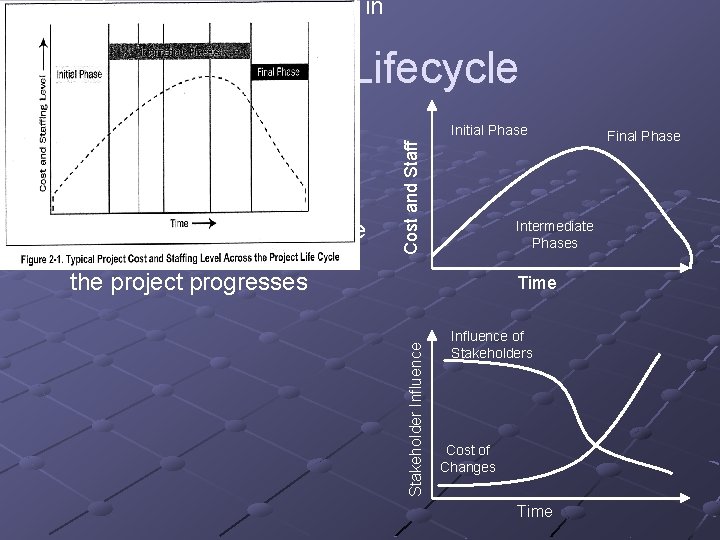
Defines resources required in each phase Different from product lifecycle – does not include ongoing maintenance Earlier changes have more value, later changes cost more Uncertainty is highest at the beginning and drops off as the project progresses Project Lifecycle Cost and Staff Initial Phase Intermediate Phases Stakeholder Influence Time Influence of Stakeholders Cost of Changes Time Final Phase
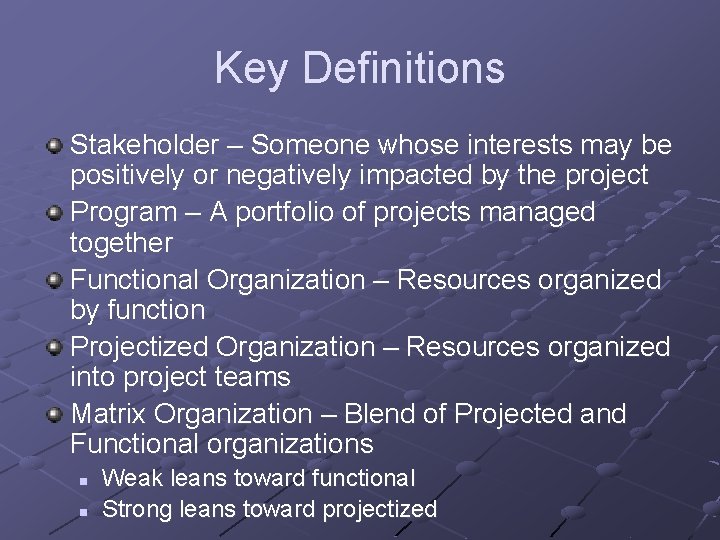
Key Definitions Stakeholder – Someone whose interests may be positively or negatively impacted by the project Program – A portfolio of projects managed together Functional Organization – Resources organized by function Projectized Organization – Resources organized into project teams Matrix Organization – Blend of Projected and Functional organizations n n Weak leans toward functional Strong leans toward projectized
Part II – Project Management Processes What is a Process? Plan-Do-Check-Act Cycle Project Management Process Groups
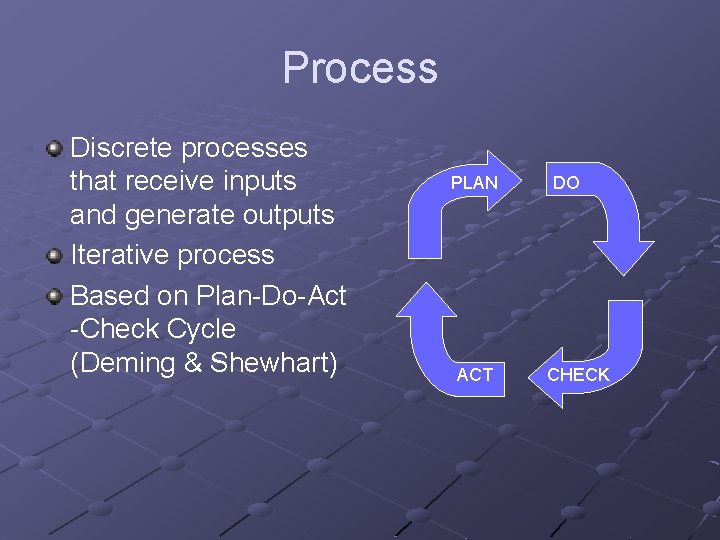
Process Discrete processes that receive inputs and generate outputs Iterative process Based on Plan-Do-Act -Check Cycle (Deming & Shewhart) PLAN ACT DO CHECK
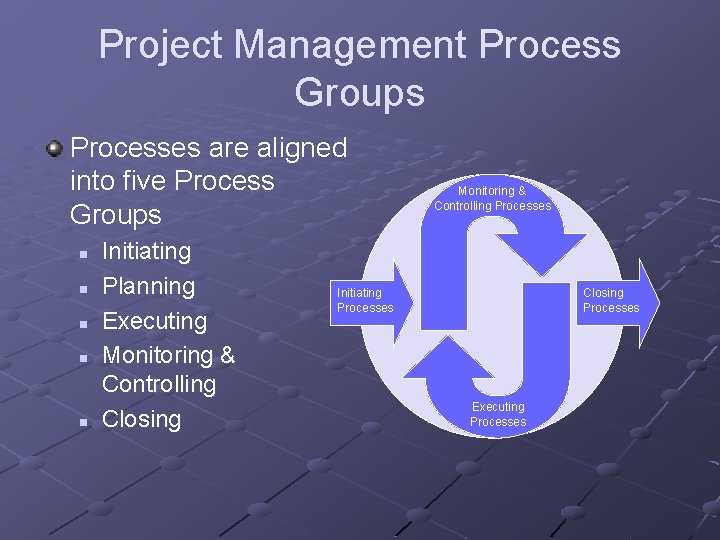
Project Management Process Groups Processes are aligned into five Process Groups n n n Initiating Planning Executing Monitoring & Controlling Closing Monitoring & Controlling Processes Initiating Processes Closing Processes Executing Processes
Project Management Process Groups Not project phases, processes can be repeated in multiple phases of a project Processes one of two types n Core & Facilitating Multiple Processes Under One Process Group
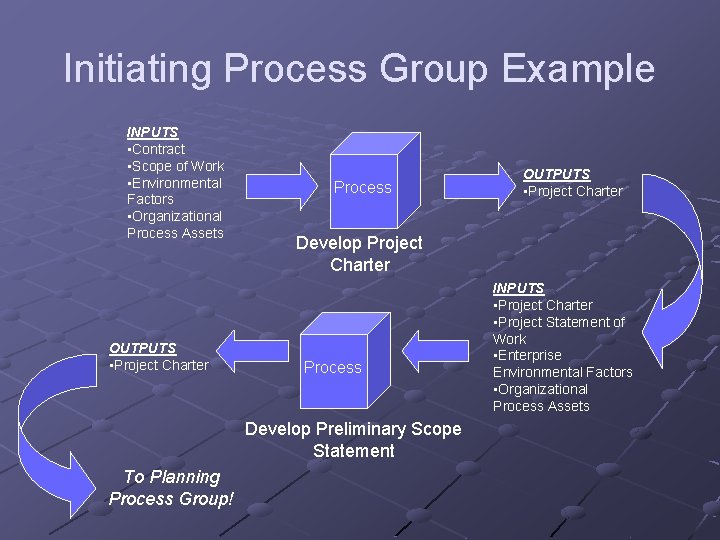
Initiating Process Group Example INPUTS • Contract • Scope of Work • Environmental Factors • Organizational Process Assets OUTPUTS • Project Charter Process Develop Preliminary Scope Statement To Planning Process Group! OUTPUTS • Project Charter INPUTS • Project Charter • Project Statement of Work • Enterprise Environmental Factors • Organizational Process Assets
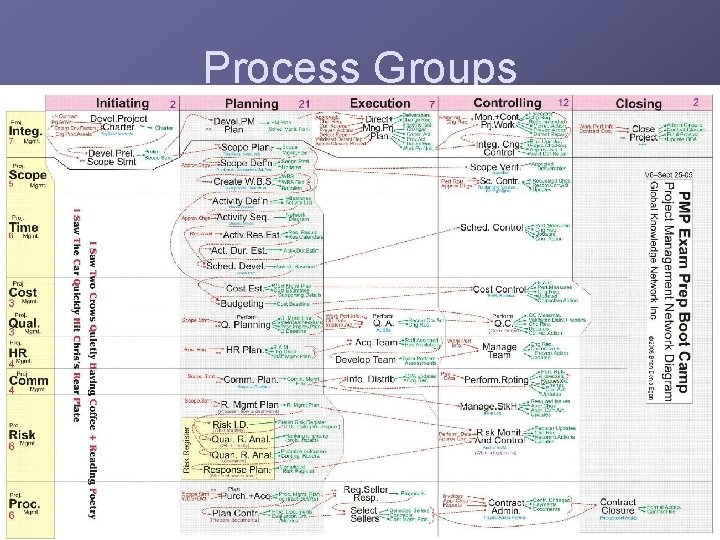
Process Groups Sequencing of processes VERY important for test! n ¼ to 1/3 of test is sequencing the processes and the inputs and outputs of each 44 Processes, need to be memorized
Process Groups
Part III Knowledge Areas What are knowledge areas? How many are there?
Knowledge Areas Process groups indicate When each process should be completed, the knowledge areas indicate What needs to be completed PMBOK Knowledge Area Chapters detail what the inputs, outputs and tools and techniques to accomplish each process
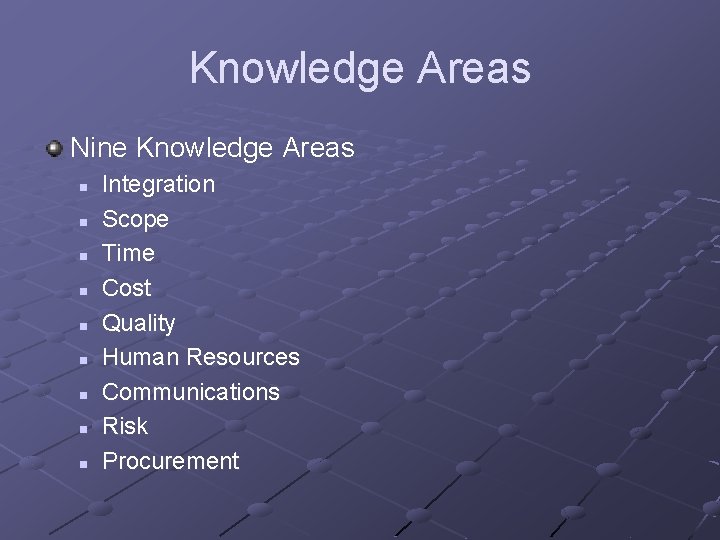
Knowledge Areas Nine Knowledge Areas n n n n n Integration Scope Time Cost Quality Human Resources Communications Risk Procurement
Integration Management Includes processes to ensure that all the elements of a project are properly coordinated Making tradeoffs among competing alternatives and objectives to meet stakeholder needs Typically the most important knowledge area for the Project Manager
Scope Management Processes to ensure that the project includes all the work required, and only the work required, to complete the project successfully Primarily concerned with what is and is not in the project
Time Management Includes the processes required to ensure timely completion of the project
Cost Management Processes used to ensure that the project is completed within the approved budget
Quality Management Processes required to ensure that the project adequately meets the needs for which it was undertaken
Human Resources Management Processes required to effectively use the people involved in the project
Communications Management Processes required to ensure timely and appropriate generation, collection, dissemination, storage, and ultimate disposition of project information
Risk Management The process of identifying, analyzing, and responding to project risk Maximize the probability and consequences of positive events while minimizing the probability and consequences of adverse events Risk = Known Unknowns
Procurement Management Processes required to acquire goods and services from outside the organization that are required to complete the project scope Procurement Management is discussed from the perspective of the buyer