
PMI A Scalable Process Management Interface for ExtremeScale
PMI: A Scalable Process. Management Interface for Extreme-Scale Systems Pavan Balaji, Darius Buntinas, David Goodell, William Gropp, Jayesh Krishna, Ewing Lusk and Rajeev Thakur
Introduction § Process management is integral part of HPC § Scalability and performance are critical § Close interaction between process management and parallel library (e. g. , MPI) is important – Need not be integrated § Separation allows – Independent development and improvement – Parallel libraries portable to different environments 2
PMI § Generic process management interface for parallel applications § PMI-1 is widely used – MVAPICH, Intel MPI, Microsoft MPI – SLURM, OSC mpiexec, OSU mpirun § Introducing PMI-2 – Improved scalability – Better interaction with hybrid MPI+threads 3
PMI Functionality § Process management – Launch and monitoring • Initial job • Dynamic processes – Process control § Information exchange – Contact information – Environmental attributes 4
System Model 5
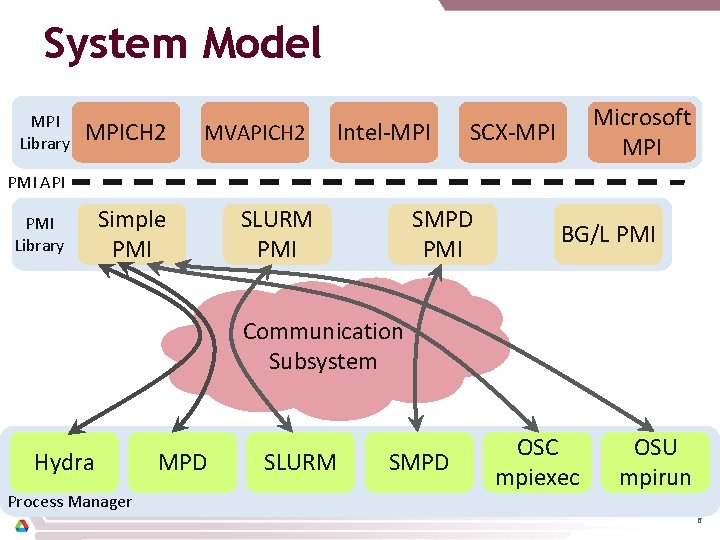
System Model MPI Library MPICH 2 MVAPICH 2 Intel-MPI Microsoft MPI SCX-MPI PMI API PMI Library Simple PMI SLURM PMI SMPD PMI BG/L PMI Communication Subsystem Hydra Process Manager MPD SLURM SMPD OSC mpiexec OSU mpirun 6
Process Manager § Handles – Process launch • Start and stop processes • Forwarding I/O and signals – Information exchange • Contact information to set up communication § Implementation – May be separate components – May be distributed § E. g. , PBS, Sun Grid Engine, SSH 7
PMI Library § Provides interface between parallel library and process manager § Can be system specific – E. g, BG/L uses system specific features § Wire protocol between PMI library and PM – PMI-1 and PMI-2 have specified wire protocols – Allows PMI lib to be used with different PM – Note: wire protocol and PMI API are separate entities • PMI implementation need not have wire protocol 8
PMI API § PMI-1 and PMI-2 § Functions associated with – Initialization and finalization • Init, Finalize, Abort – Information exchange • Put, Get, Fence – Process creation • Spawn 9
Information Exchange § Processes need to exchange connection info § PMI uses a Key-Value database (KVS) § At init, processes Put contact information – E. g. , IP address and port § Processes Get contact info when establishing connections § Collective Fence operation to allow optimizations 10
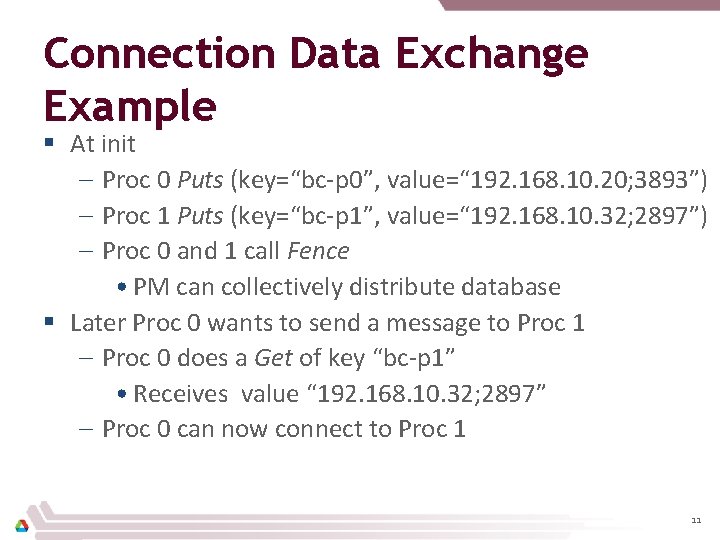
Connection Data Exchange Example § At init – Proc 0 Puts (key=“bc-p 0”, value=“ 192. 168. 10. 20; 3893”) – Proc 1 Puts (key=“bc-p 1”, value=“ 192. 168. 10. 32; 2897”) – Proc 0 and 1 call Fence • PM can collectively distribute database § Later Proc 0 wants to send a message to Proc 1 – Proc 0 does a Get of key “bc-p 1” • Receives value “ 192. 168. 10. 32; 2897” – Proc 0 can now connect to Proc 1 11
Implementation Considerations § Allow the use of “native” process manager with low overhead – Systems often have existing PM • E. g. , integrated with resource manager – Minimize async processing and interrupts § Scalable data exchange – Distributed process manager – Collective Fence provides opportunity for scalable collective exchange 12
Second Generation PMI 13
New PMI-2 Features § § § Attribute query functionality Database scope Thread safety Dynamic processes Fault tolerance 14
PMI-2 Attribute Query Functionality § Process and resource managers have systemspecific information – Node topology, network topology, etc. § Without this, processes need to determine this themselves – Each process gets each other's contact-info to discover local processes – O(p 2) queries 15
PMI-2 Database Scope § Previously KVS had only global scope § PMI-2 adds node-level scoping – E. g. , keys for shared memory segments § Allows for optimized storage and retrieval of values 16
PMI-2 Thread Safety § PMI-1 is not thread safe – All PMI calls must be serialized • Wait for request and response – Can affect multithreaded programs § PMI-2 adds thread safety – Multiple threads can call PMI functions – One call cannot block the completion of another 17
PMI-2 Dynamic Processes § In PMI-1 a separate database is maintained for each MPI_COMM_WORLD (process group) – Queries are not allowed across databases – Requires out-of-band exchange of databases § PMI-2 allows cross-database queries – Spawned or connected process groups can now query each other’s databases – Only process group ids need to be exchanged 18
PMI-2 Fault Tolerance § PMI-1 provides no mechanism for respawning a failed process – New processes can be spawned, but they have a unique rank and process group § Respawn is critical for supporting faulttolerance – Not just for MPI but other programming models 19

Evaluation and Analysis 20
Evaluation and Analysis § PMI-2 implemented in Hydra process manager § Evaluation – System information query performance – Impact of added PMI functionality over native PM – Multithreaded performance 21
System Information Query Performance § PMI-1 provides no attribute query functionality – Processes must discover local processes – O(p 2) queries § PMI-2 has node topology attribute § Benchmark (5760 cores on Si. Cortex) – MPI_Init(); MPI_Finalize(); 22
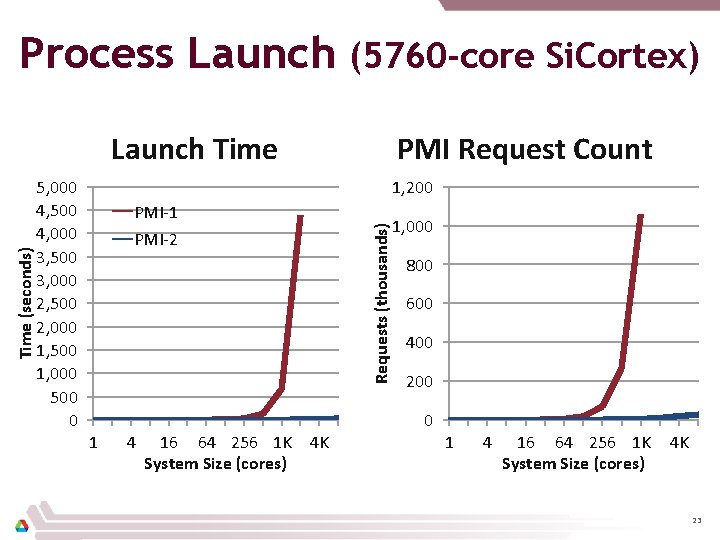
Process Launch (5760 -core Si. Cortex) 5, 000 4, 500 4, 000 3, 500 3, 000 2, 500 2, 000 1, 500 1, 000 500 0 PMI Request Count 1, 200 PMI-1 Requests (thousands) Time (seconds) Launch Time PMI-2 1 4 16 64 256 1 K System Size (cores) 4 K 1, 000 800 600 400 200 0 1 4 16 64 256 1 K System Size (cores) 4 K 23
Impact of PMI Functionality § Systems often have integrated process managers – Not all provide PMI functionality § Efficient PMI implementation must make effective use of native process managers – Minimizing overhead § Benchmark (1600 cores on Si. Cortex) – Class C BT, EP and SP – Using SLURM (which provides PMI-1) – Using Hydra over SLURM (for launch and management) plus PMI daemon 24
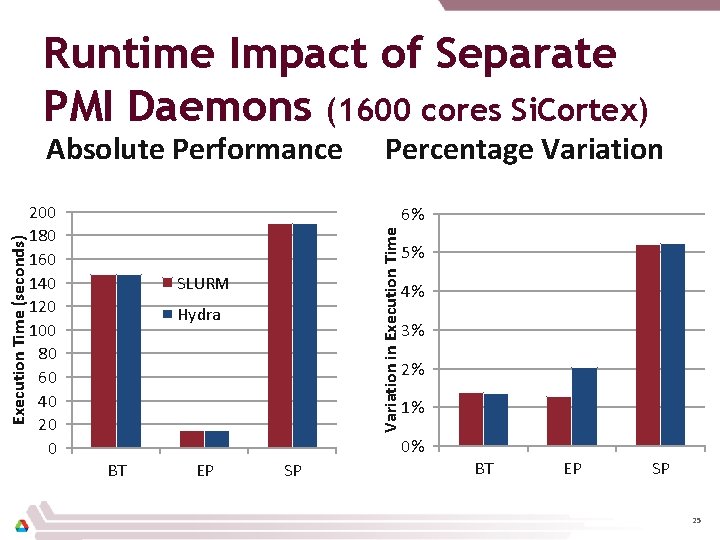
Runtime Impact of Separate PMI Daemons (1600 cores Si. Cortex) 200 180 160 140 120 100 80 60 40 20 0 Percentage Variation 6% Variation in Execution Time (seconds) Absolute Performance SLURM Hydra 5% 4% 3% 2% 1% 0% BT EP SP 25
Multithreaded Performance § PMI-1 is not thread safe – External locking is needed § PMI-2 is thread safe – Multiple threads can communicate with PM – Hydra: lock only for internal communication § Benchmark (8 -core x 86_64 node) – Multiple threads calling MPI_Publish_name(); MPI_Unpublish _name() – Work is fixed, number of threads increases 26
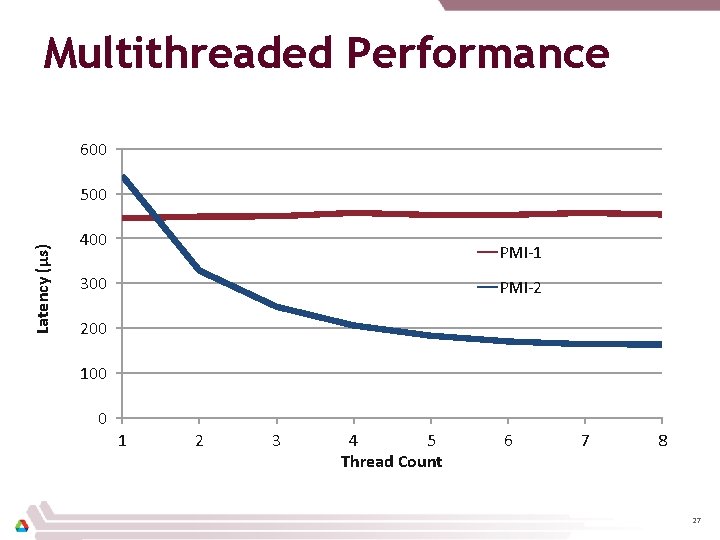
Multithreaded Performance 600 Latency (μs) 500 400 PMI-1 300 PMI-2 200 100 0 1 2 3 4 5 Thread Count 6 7 8 27

Conclusion 28
Conclusion § We presented a generic process management interface PMI § PMI-2: second generation eliminates PMI-1 shortcomings – Scalability issues for multicore systems – Issues for hybrid MPI-with-threads – Fault tolerance § Performance evaluation – PMI-2 allows better implementations over PMI-1 – Low overhead implementation over existing PM 29
- Slides: 29