
PMC Inhibits PDGFBBInduced Proliferation of Vascular Smooth Muscle
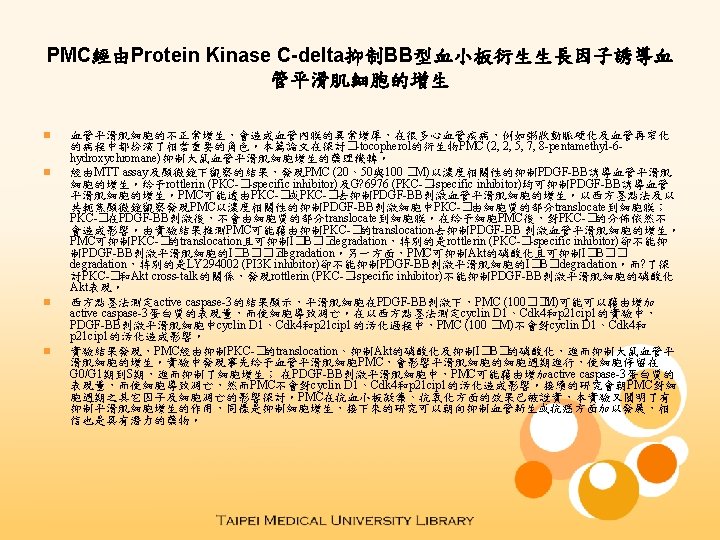
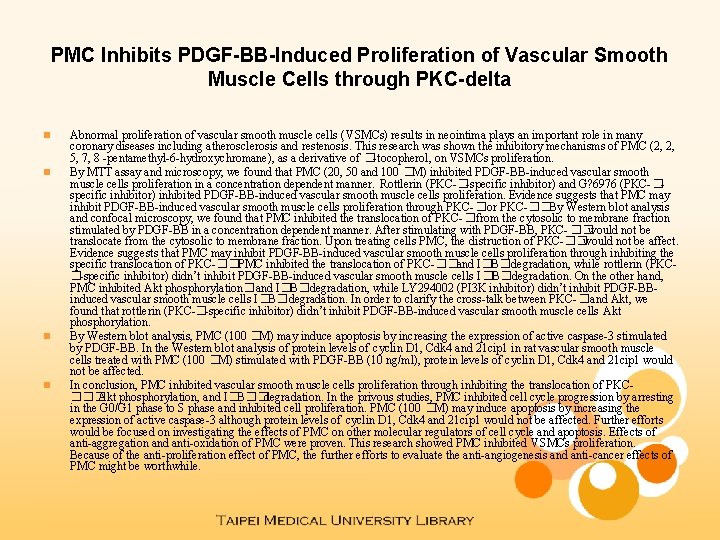
PMC Inhibits PDGF-BB-Induced Proliferation of Vascular Smooth Muscle Cells through PKC-delta n n Abnormal proliferation of vascular smooth muscle cells (VSMCs) results in neointima plays an important role in many coronary diseases including atherosclerosis and restenosis. This research was shown the inhibitory mechanisms of PMC (2, 2, 5, 7, 8 -pentamethyl-6 -hydroxychromane), as a derivative of �-tocopherol, on VSMCs proliferation. By MTT assay and microscopy, we found that PMC (20, 50 and 100 �M) inhibited PDGF-BB-induced vascular smooth muscle cells proliferation in a concentration dependent manner. Rottlerin (PKC-�-specific inhibitor) and G? 6976 (PKC-�specific inhibitor) inhibited PDGF-BB-induced vascular smooth muscle cells proliferation. Evidence suggests that PMC may inhibit PDGF-BB-induced vascular smooth muscle cells proliferation through PKC-� or PKC-��By Western blot analysis and confocal microscopy, we found that PMC inhibited the translocation of PKC-� from the cytosolic to membrane fraction stimulated by PDGF-BB in a concentration dependent manner. After stimulating with PDGF-BB, PKC- ��would not be translocate from the cytosolic to membrane fraction. Upon treating cells PMC, the distruction of PKC-��would not be affect. Evidence suggests that PMC may inhibit PDGF-BB-induced vascular smooth muscle cells proliferation through inhibiting the specific translocation of PKC-��PMC inhibited the translocation of PKC-��and I�B� degradation, while rottlerin (PKC�-specific inhibitor) didn’t inhibit PDGF-BB-induced vascular smooth muscle cells I �B� degradation. On the other hand, PMC inhibited Akt phosphorylation� and I�B� degradation, while LY 294002 (PI 3 K inhibitor) didn’t inhibit PDGF-BBinduced vascular smooth muscle cells I�B� degradation. In order to clarify the cross-talk between PKC-� and Akt, we found that rottlerin (PKC-�-specific inhibitor) didn’t inhibit PDGF-BB-induced vascular smooth muscle cells Akt phosphorylation. By Western blot analysis, PMC (100 �M) may induce apoptosis by increasing the expression of active caspase-3 stimulated by PDGF-BB. In the Western blot analysis of protein levels of cyclin D 1, Cdk 4 and 21 cip 1 in rat vascular smooth muscle cells treated with PMC (100 �M) stimulated with PDGF-BB (10 ng/ml), protein levels of cyclin D 1, Cdk 4 and 21 cip 1 would not be affected. In conclusion, PMC inhibited vascular smooth muscle cells proliferation through inhibiting the translocation of PKC��� Akt phosphorylation, and I�B��degradation. In the privous studies, PMC inhibited cell cycle progression by arresting in the G 0/G 1 phase to S phase and inhibited cell proliferation. PMC (100 �M) may induce apoptosis by increasing the expression of active caspase-3 although protein levels of cyclin D 1, Cdk 4 and 21 cip 1 would not be affected. Further efforts would be focused on investigating the effects of PMC on other molecular regulators of cell cycle and apoptosis. Effects of anti-aggregation and anti-oxidation of PMC were proven. This research showed PMC inhibited VSMCs proliferation. Because of the anti-proliferation effect of PMC, the further efforts to evaluate the anti-angiogenesis and anti-cancer effects of PMC might be worthwhile.
- Slides: 2