
PM 6522 Integrating Constructivism and Meaningful Learning in



- Slides: 28
PM 6522 Integrating Constructivism and Meaningful Learning in Student-Centred Primary Mathematics Classrooms
Course Rationale
Rationale • Traditional approaches made students learn mathematics passively - They find mathematics uninteresting and they have a shallow understanding of it. • Constructivist teaching is more meaningful and interesting and is done by actively constructing new knowledge.
Course Content
Course Content 1. TRENDS & ISSUES 2. EXEMPLARS of CONSTRUCTIVIST APPROACHES 3. CONSTRUCTIVIST-BASED ASSESSMENT 4. THEORY INTO PRACTICE
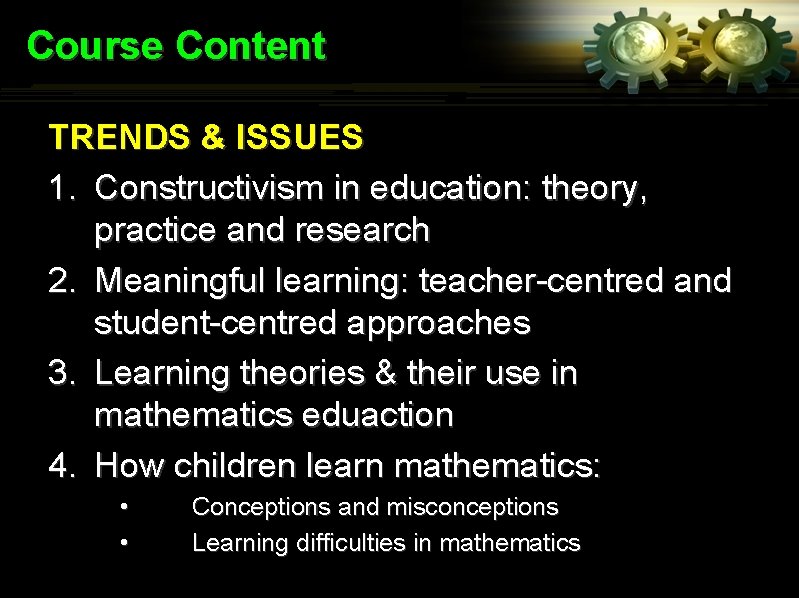
Course Content TRENDS & ISSUES 1. Constructivism in education: theory, practice and research 2. Meaningful learning: teacher-centred and student-centred approaches 3. Learning theories & their use in mathematics eduaction 4. How children learn mathematics: • • Conceptions and misconceptions Learning difficulties in mathematics
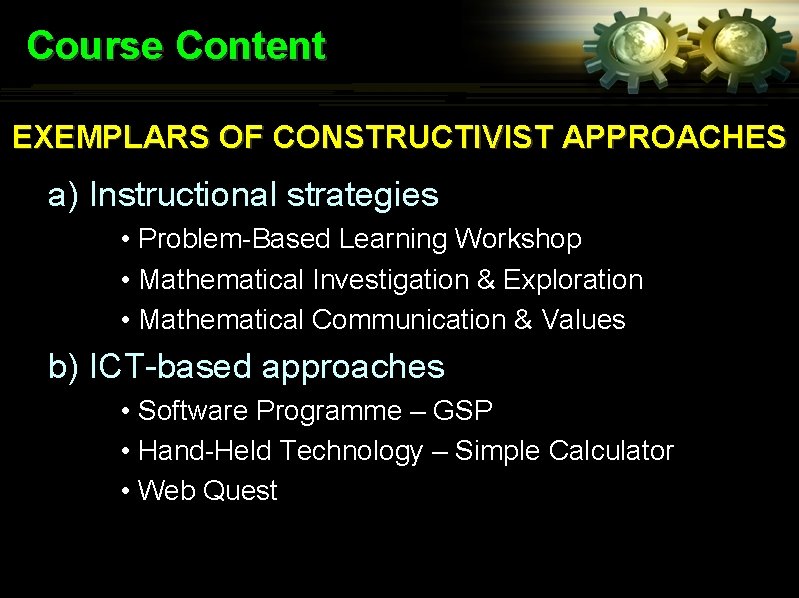
Course Content EXEMPLARS OF CONSTRUCTIVIST APPROACHES a) Instructional strategies • Problem-Based Learning Workshop • Mathematical Investigation & Exploration • Mathematical Communication & Values b) ICT-based approaches • Software Programme – GSP • Hand-Held Technology – Simple Calculator • Web Quest
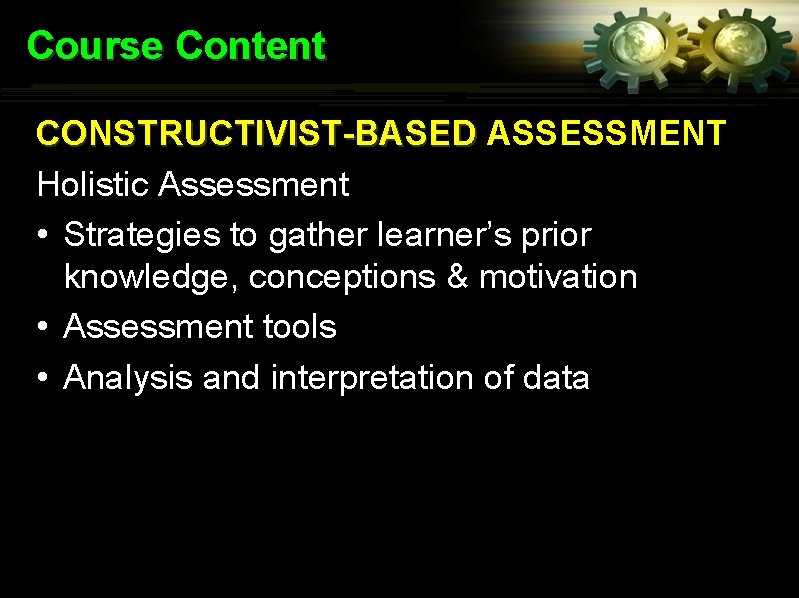
Course Content CONSTRUCTIVIST-BASED ASSESSMENT Holistic Assessment • Strategies to gather learner’s prior knowledge, conceptions & motivation • Assessment tools • Analysis and interpretation of data
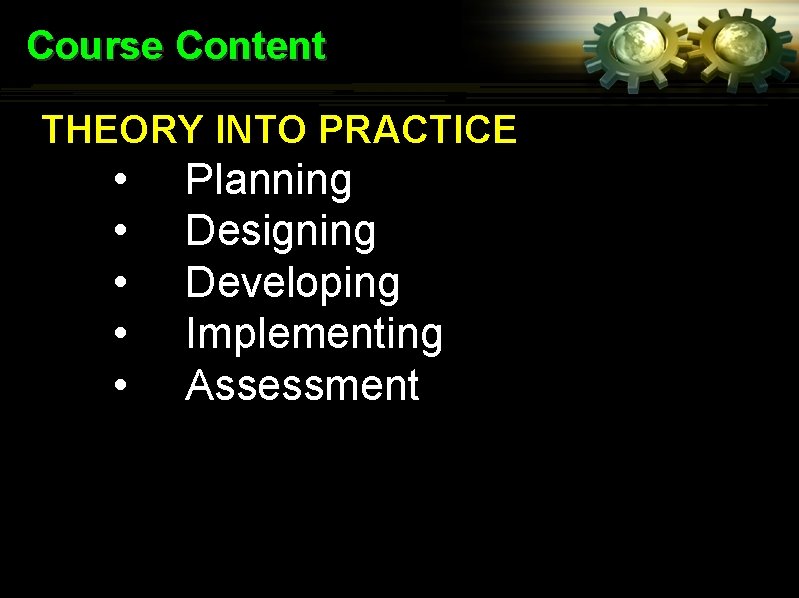
Course Content THEORY INTO PRACTICE • • • Planning Designing Developing Implementing Assessment
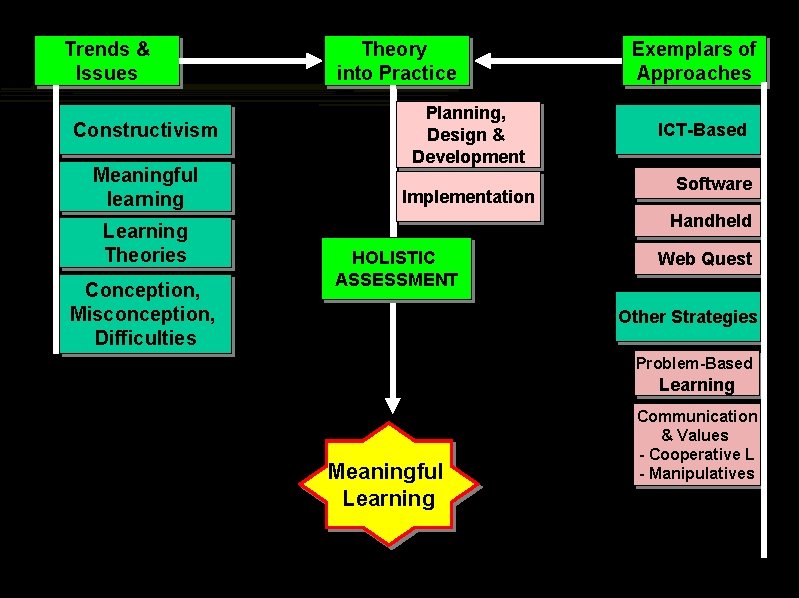
How the content area fits together? - An Overview
Trends & Issues Constructivism Meaningful learning Learning Theories Conception, Misconception, Difficulties Theory into Practice Planning, Design & Development Implementation Exemplars of Approaches ICT-Based Software Handheld HOLISTIC ASSESSMENT Web Quest Other Strategies Problem-Based Learning Meaningful Learning Communication & Values - Cooperative L - Manipulatives
Course Objectives
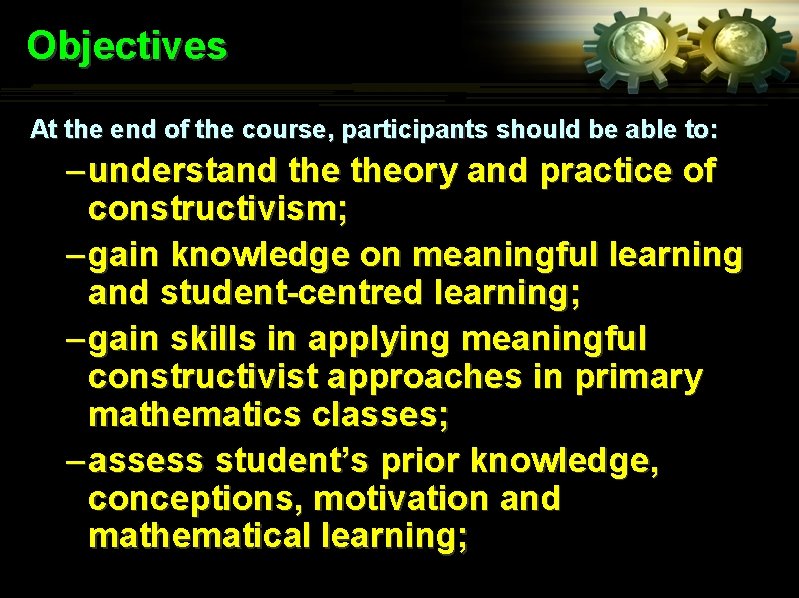
Objectives At the end of the course, participants should be able to: – understand theory and practice of constructivism; – gain knowledge on meaningful learning and student-centred learning; – gain skills in applying meaningful constructivist approaches in primary mathematics classes; – assess student’s prior knowledge, conceptions, motivation and mathematical learning;
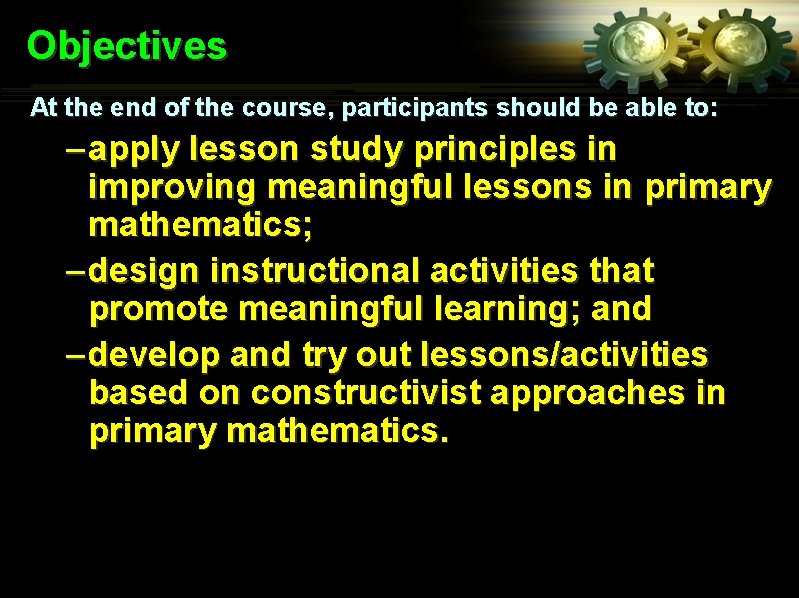
Objectives At the end of the course, participants should be able to: – apply lesson study principles in improving meaningful lessons in primary mathematics; – design instructional activities that promote meaningful learning; and – develop and try out lessons/activities based on constructivist approaches in primary mathematics.
PM 6522 Integrating Constructivism and Meaningful Learning in Student-Centred Primary Mathematics Classrooms … open to meaningful questions …
Meaningful Learning • Learning is the acquisition of knowledge and skills • Learning becomes meaningful when these knowledge and skills are transferred and used in new situations – For problem solving – For understanding new concepts (Richard Mayer, 2002)
Others 1. All must have and use an email. My email : boontat_teoh@recsam. edu. my My hp # : 016 -4542693 2. Class monitor : - mark attendance - keep extra 2 copies of notes in files - collect Weekly Evaluation Form, etc, etc… - be the papa/mama of all participants 3. Home Room 4. Night Access to Computers
Others 5. Values (1) (2) (3) (4) (5) (6) (7) (8) Attendance Interest Creativity Initiative Sense Of Responsibility Cooperation Diligence Leadership 6. Welcoming dinner –tonight 7. 45 pm at RECSAM Cafetaria 7. Farewell dinner / Cultural Night – to be fixed (final week)
Others 8. Trips i) Around Penang Week 1 (Sat) ii) To Kuala Lumpur Week 2 (Sat & Sun) iii) Hike up Penang Hill Week 4 (Thu) 9. Book Allowance : RM 100 - (keep your receipts) - RM 20 - Journal - RM 30 - Pen Drive 10. HP – silent / vibrator mode please 11. Some advice : Back up all your files – ALWAYS do this. Get a flash drive. "When there is regret, it’s usually too late. ”
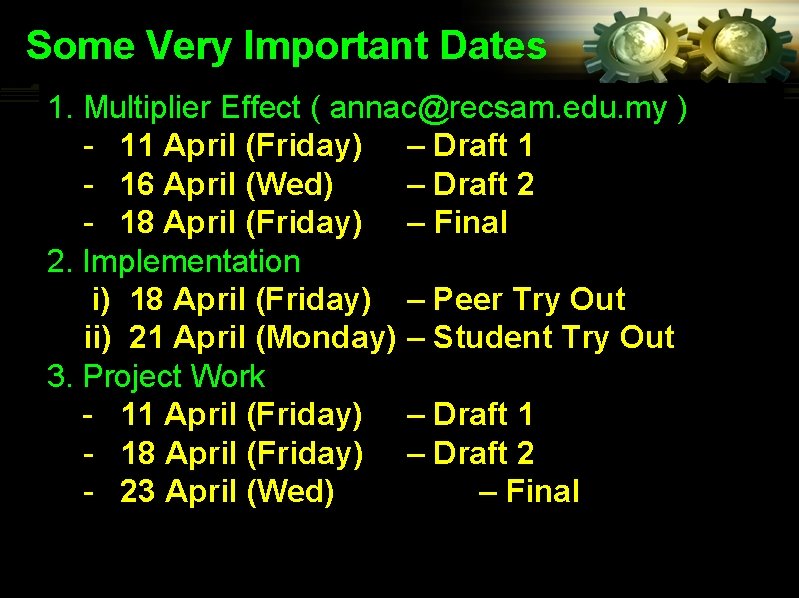
Some Very Important Dates 1. Multiplier Effect ( annac@recsam. edu. my ) - 11 April (Friday) – Draft 1 - 16 April (Wed) – Draft 2 - 18 April (Friday) – Final 2. Implementation i) 18 April (Friday) – Peer Try Out ii) 21 April (Monday) – Student Try Out 3. Project Work - 11 April (Friday) – Draft 1 - 18 April (Friday) – Draft 2 - 23 April (Wed) – Final
Project Work
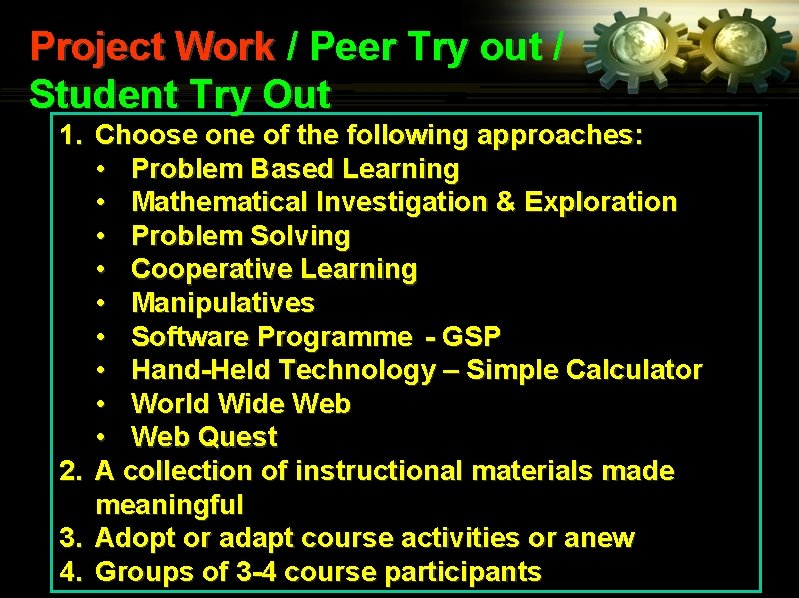
Project Work / Peer Try out / Student Try Out 1. Choose one of the following approaches: • Problem Based Learning • Mathematical Investigation & Exploration • Problem Solving • Cooperative Learning • Manipulatives • Software Programme - GSP • Hand-Held Technology – Simple Calculator • World Wide Web • Web Quest 2. A collection of instructional materials made meaningful 3. Adopt or adapt course activities or anew 4. Groups of 3 -4 course participants
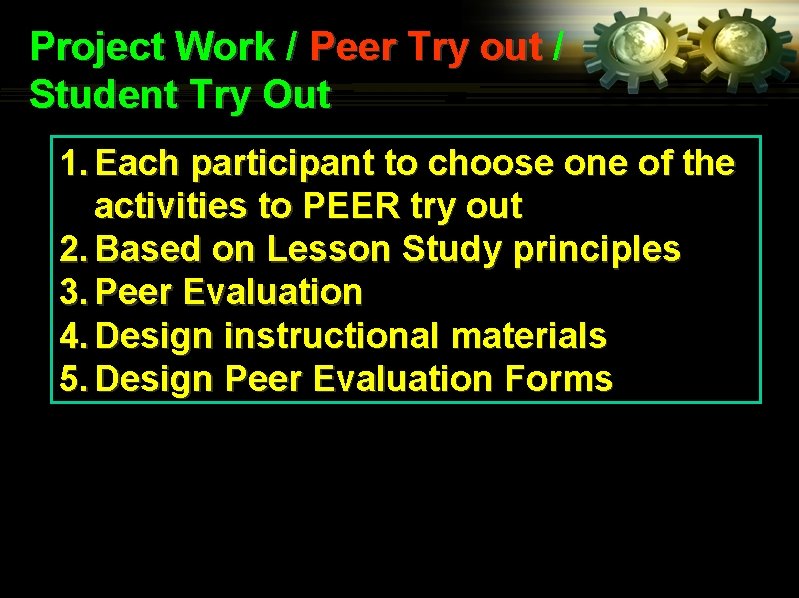
Project Work / Peer Try out / Student Try Out 1. Each participant to choose one of the activities to PEER try out 2. Based on Lesson Study principles 3. Peer Evaluation 4. Design instructional materials 5. Design Peer Evaluation Forms
Project Work / Peer Try out / Student Try Out 1. Refine the activities to be tried out with students 2. Based on Lesson Study principles 3. Redesign instructional materials 4. Design Assessment Forms
Project Work / Peer Try out / Student Try Out Grouping Group 1 • Americo • Chor Lan • Norlia Group 2 • Chantavixay • Darunee • Ramilo • Sopheap Group 3 • Aileen • Khaw Myint • Nasril • Nguyen
Today’s Planning 1. List a few t & l problems you face in your own classroom 2. Share in turn the problems with your group members 3. Identify the probable causes of the problems 4. Discuss - strategies that you have used to overcome the problems - new strategies that can be used to reduce / overcome the problems 5. What literature says…?
Topic & Level (Year) 1. Identify Topic 2. Identify Level … • By end of Week 2
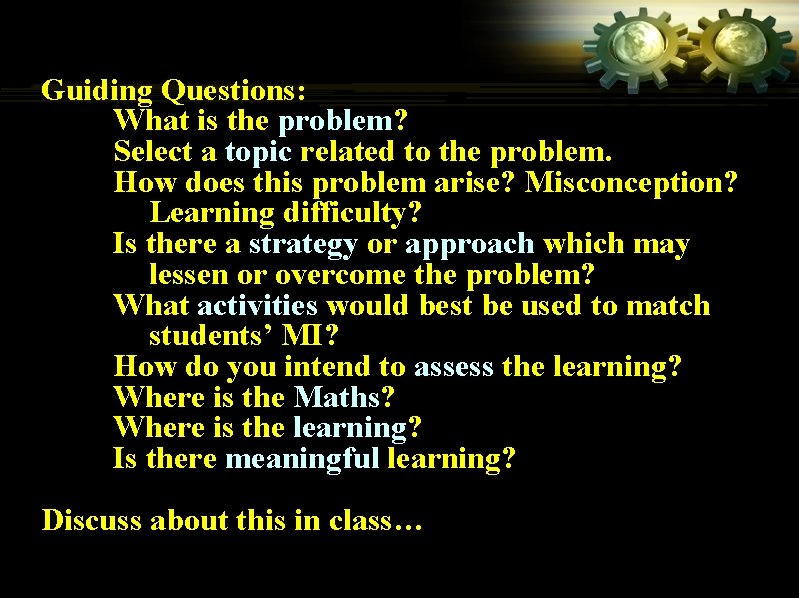
Guiding Questions: What is the problem? Select a topic related to the problem. How does this problem arise? Misconception? Learning difficulty? Is there a strategy or approach which may lessen or overcome the problem? What activities would best be used to match students’ MI? How do you intend to assess the learning? Where is the Maths? Where is the learning? Is there meaningful learning? Discuss about this in class…