
PLUS Scheme Nigel Zanker Design Education Theme Leader

- Slides: 17
PLUS+ Scheme Nigel Zanker Design Education Theme Leader and Programme Director Loughborough Design School August, 2015
Learning Theories A teacher’s role is to enable learning Learning brings together - cognitive, emotional, and environmental influences for: - acquiring, enhancing, or making changes in one’s - knowledge, skills, values and world views. (Ormrod, 2012) 2
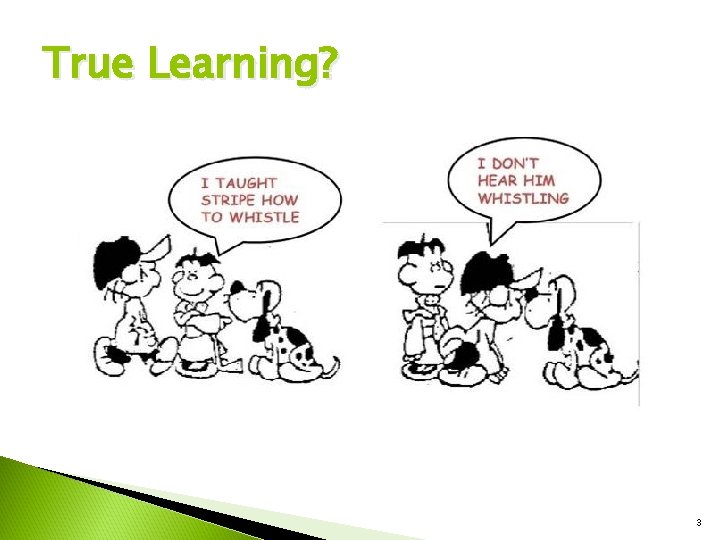
True Learning? 3
Behaviourism - ‘learns to’ Locke – blank slates (tabula rasa) Pavlov – non-conditioned/conditioned responses Skinner – stimulus-response-reward (SRR) 4
Classical constructivism -‘learns that’ Piaget – stages of development (readiness) 1) 0 -2 – sensor-motor 2) 2 -7 – preoperational 3 a) 7 -11 – concrete operational 3 b) 11+ – formal operational Scaffolding – go through each stage Learners work as ‘lone scientists’ Role of language is not important 5
Social constructivism: ‘learns with’ Vygotsky and Bruner – learning is sequential and builds on prior knowledge What a learner can do with help today, he or she can do independently tomorrow ‘Zone of Proximal Development’ (what learner already knows and what will be known) ‘Schema’ incomplete or complete concepts (no right or wrong) Learns from more knowledgeable others Language is important 6
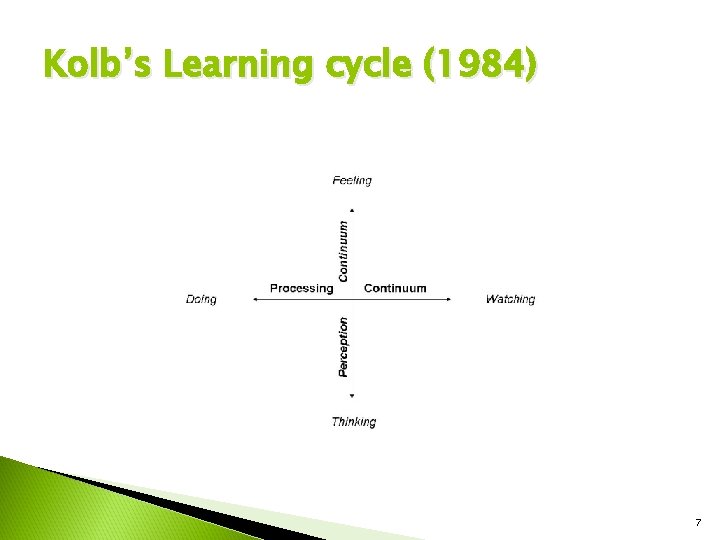
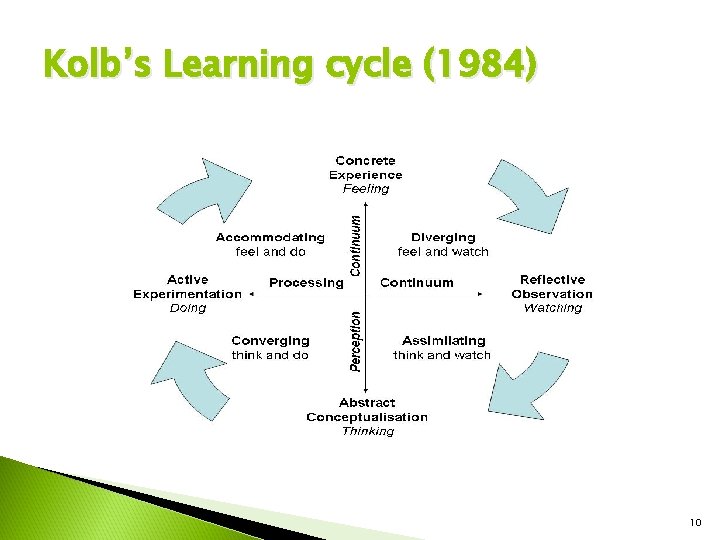
Kolb’s Learning cycle (1984) 7
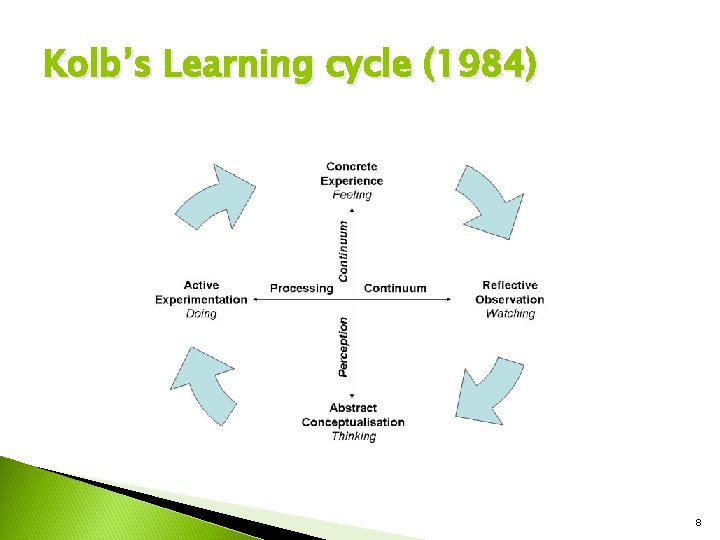
Kolb’s Learning cycle (1984) 8
Learning Styles (making sense of the world) Divergers – learn by personal experiences through feeling and watching Assimilators – learn by personal experiences watching and thinking Convergers – learn by personal experiences through thinking and doing Accommodators – learn by personal experiences through feeling and doing 9
Kolb’s Learning cycle (1984) 10
Honey and Mumford (2002) Modelled from Kolb Reflectors – reflective observation Theorists – abstract conceptualisation Pragmatists – concrete experience Activists – active experimentation 11
Learning Style Questionnaire (Honey and Mumford, 2000) Derived from Kolb’s cycle to ask people how they learn Probes general behavioural tendencies Most people have never consciously considered how they really learn Over to you 12
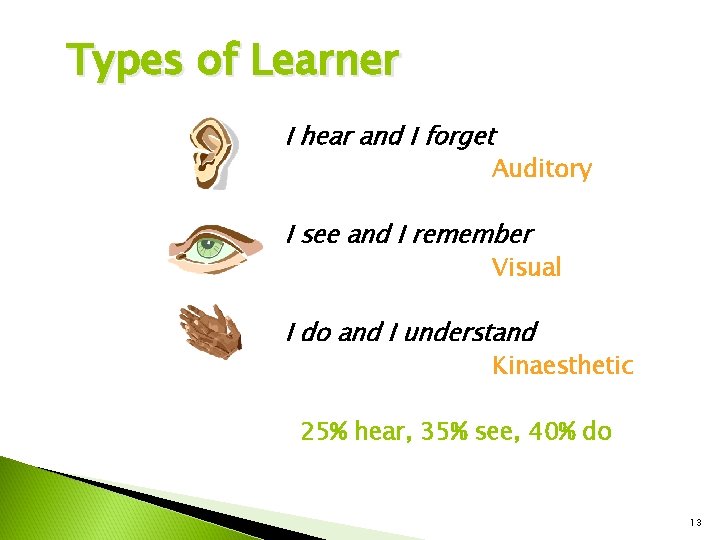
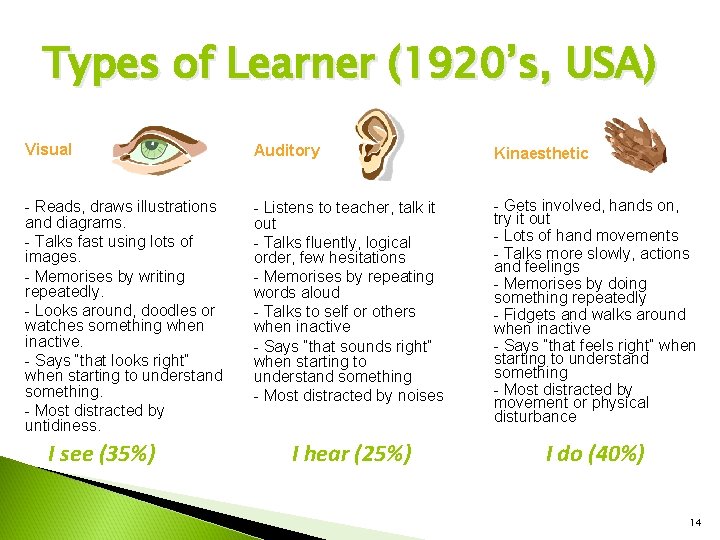
Types of Learner I hear and I forget Auditory I see and I remember Visual I do and I understand Kinaesthetic 25% hear, 35% see, 40% do 13
Types of Learner (1920’s, USA) Visual Auditory Kinaesthetic - Reads, draws illustrations and diagrams. - Talks fast using lots of images. - Memorises by writing repeatedly. - Looks around, doodles or watches something when inactive. - Says “that looks right” when starting to understand something. - Most distracted by untidiness. - Listens to teacher, talk it out - Talks fluently, logical order, few hesitations - Memorises by repeating words aloud - Talks to self or others when inactive - Says “that sounds right” when starting to understand something - Most distracted by noises - Gets involved, hands on, try it out - Lots of hand movements - Talks more slowly, actions and feelings - Memorises by doing something repeatedly - Fidgets and walks around when inactive - Says “that feels right” when starting to understand something - Most distracted by movement or physical disturbance I hear (25%) I do (40%) I see (35%) 14
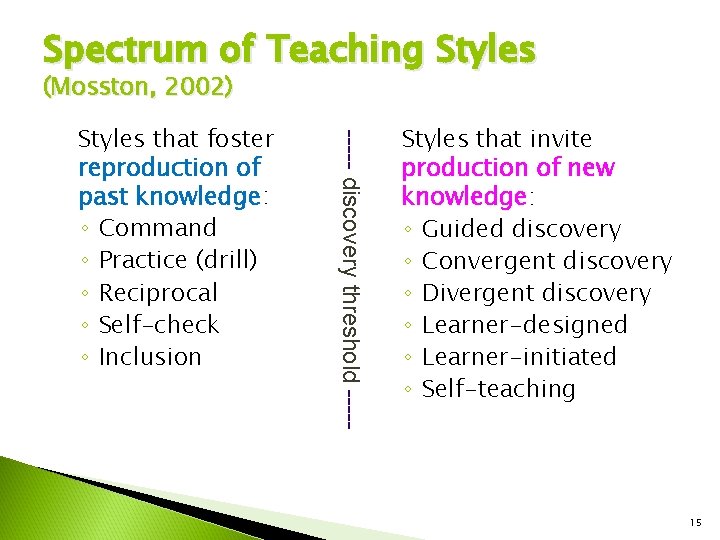
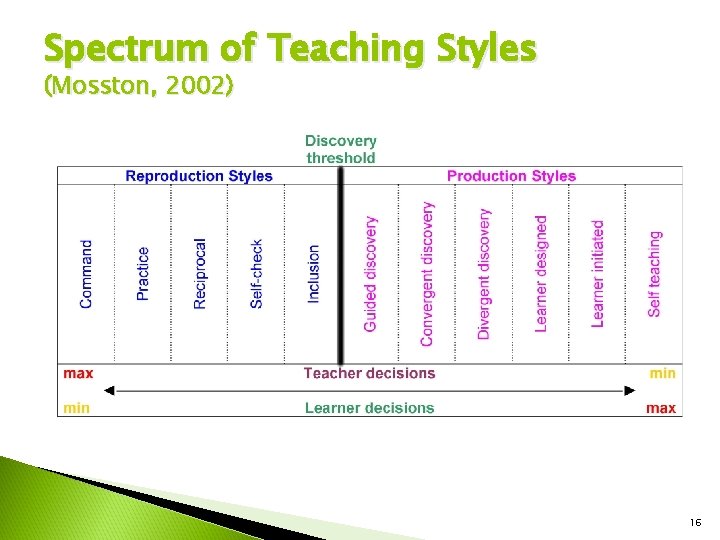
Spectrum of Teaching Styles (Mosston, 2002) ----- discovery threshold ----- Styles that foster reproduction of past knowledge: ◦ Command ◦ Practice (drill) ◦ Reciprocal ◦ Self-check ◦ Inclusion Styles that invite production of new knowledge: ◦ Guided discovery ◦ Convergent discovery ◦ Divergent discovery ◦ Learner-designed ◦ Learner-initiated ◦ Self-teaching 15
Spectrum of Teaching Styles (Mosston, 2002) 16
References Bruner, J. S. (1960), Towards a Theory of Instruction, Cambridge, MA: Harvard University Press Fry, H. , Ketteridge, S. & Marshall, S. (2009), A Handbook for Teaching and Learning in Higher Education 3 rd ed. London: Routledge Honey, P. & Mumford, A. (2000), The learning styles helper's guide, Maidenhead: Peter Honey Publications Ltd. Learning style survey, http: //www. nwlink. com/~donclark/hrd/styles/learn_style_survey. html (accessed 29/07/15) Kolb, D. A. (1984), Experiential Learning, Englewood Cliffs, NJ: Prentice Hall Mosston, M. & Ashworth S. (2002), Teaching Physical Education, 5 th ed, , San Francisco: Benjamin Cummings. ebook edition, http: //www. spectrumofteachingstyles. org/ebook (accessed 29/07/15) Ormrod, J. (2012), Human Learning, 6 th ed. , Boston: Pearson Piaget, J. (1950), The Psychology of Intelligence, London: Routledge Vygotsky, L. S. (1962), Thought and Language, New York: Wiley 17