
Plurilingualism can it help solve the current crisis

- Slides: 51
Plurilingualism – can it help solve the current crisis in our language education? Sauli Takala Kauppakirjeenvaihdosta plurilingvaalisuuteen Turun kauppakorkeakoulu September 26, 2009
CRISIS: 1) the turning point for better or worse in a short-lived and usually severe disease or fever 2) an unstable or crucial time ot state of affairs , esp. one whose outcome will make a decisive difference for better or worse
Do we have a crisis in our language education? • Undoubtedly - reasons to follow. • Several critical remarks voiced over a long period of time. Predictions of problems were corroborated. • Developments were easy to predict. Not to do so must have been due either to incompetence , indifference or a hidden agenda to weaken language education. • The worst is not over. • Difficult to reverse the trend.
Is ”crisis” an exaggeration? Golden period in the 1960 s and 1970 s: • Several important committees: major reforms proposed • All pupils started to study languages: 2 or 3 • Language study introduced in vocational education • Higher education: LSP taught by Language Centres • Matriculation Exam moved from translation to more comprehensive testing formats • Language proficiency started to improve in the population • General atmosphere: strong optimism, intensive development work, intensive in-service education. . • Now: obvious irresolution, lack of vision, helplessness, growing pessimism
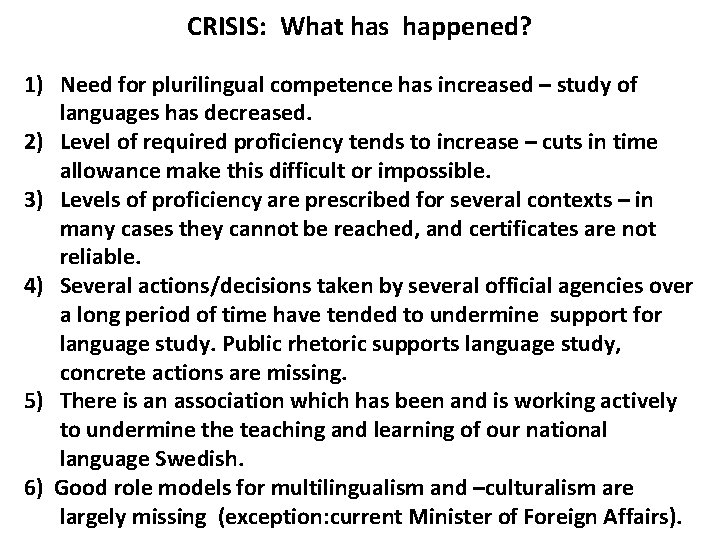
CRISIS: What has happened? 1) Need for plurilingual competence has increased – study of languages has decreased. 2) Level of required proficiency tends to increase – cuts in time allowance make this difficult or impossible. 3) Levels of proficiency are prescribed for several contexts – in many cases they cannot be reached, and certificates are not reliable. 4) Several actions/decisions taken by several official agencies over a long period of time have tended to undermine support for language study. Public rhetoric supports language study, concrete actions are missing. 5) There is an association which has been and is working actively to undermine the teaching and learning of our national language Swedish. 6) Good role models for multilingualism and –culturalism are largely missing (exception: current Minister of Foreign Affairs).
What is plurilingualism?
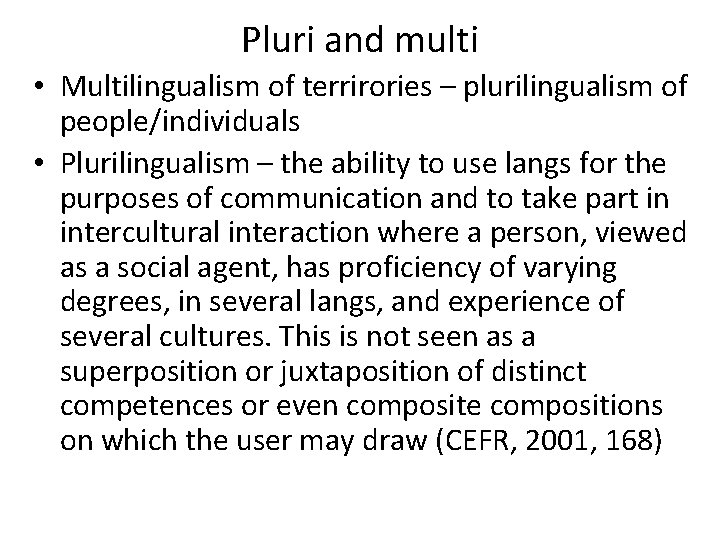
Pluri and multi • Multilingualism of terrirories – plurilingualism of people/individuals • Plurilingualism – the ability to use langs for the purposes of communication and to take part in intercultural interaction where a person, viewed as a social agent, has proficiency of varying degrees, in several langs, and experience of several cultures. This is not seen as a superposition or juxtaposition of distinct competences or even composite compositions on which the user may draw (CEFR, 2001, 168)
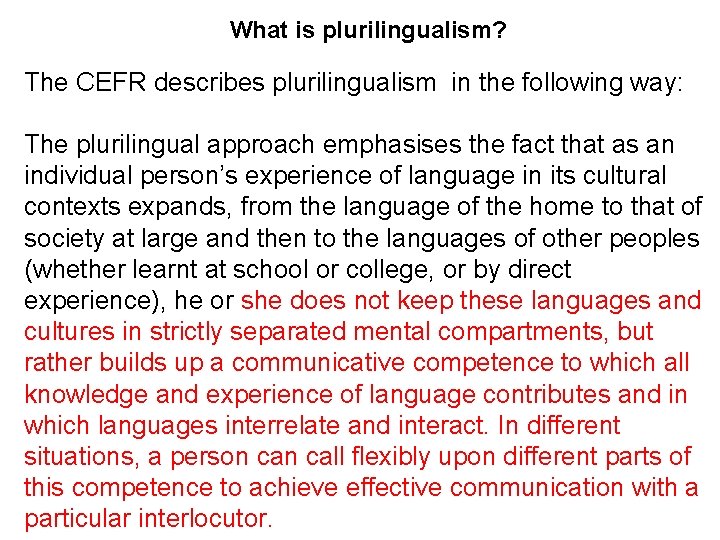
What is plurilingualism? The CEFR describes plurilingualism in the following way: The plurilingual approach emphasises the fact that as an individual person’s experience of language in its cultural contexts expands, from the language of the home to that of society at large and then to the languages of other peoples (whether learnt at school or college, or by direct experience), he or she does not keep these languages and cultures in strictly separated mental compartments, but rather builds up a communicative competence to which all knowledge and experience of language contributes and in which languages interrelate and interact. In different situations, a person call flexibly upon different parts of this competence to achieve effective communication with a particular interlocutor.
Plurilingualism - how do language choices support it ?
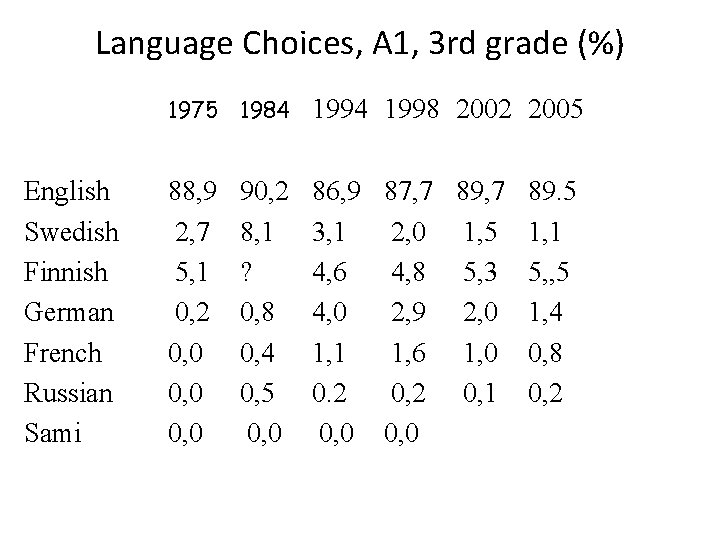
Language Choices, A 1, 3 rd grade (%) English Swedish Finnish German French Russian Sami 1975 1984 1998 2002 2005 88, 9 2, 7 5, 1 0, 2 0, 0 86, 9 87, 7 89. 5 3, 1 2, 0 1, 5 1, 1 4, 6 4, 8 5, 3 5, , 5 4, 0 2, 9 2, 0 1, 4 1, 1 1, 6 1, 0 0, 8 0. 2 0, 1 0, 2 0, 0 90, 2 8, 1 ? 0, 8 0, 4 0, 5 0, 0
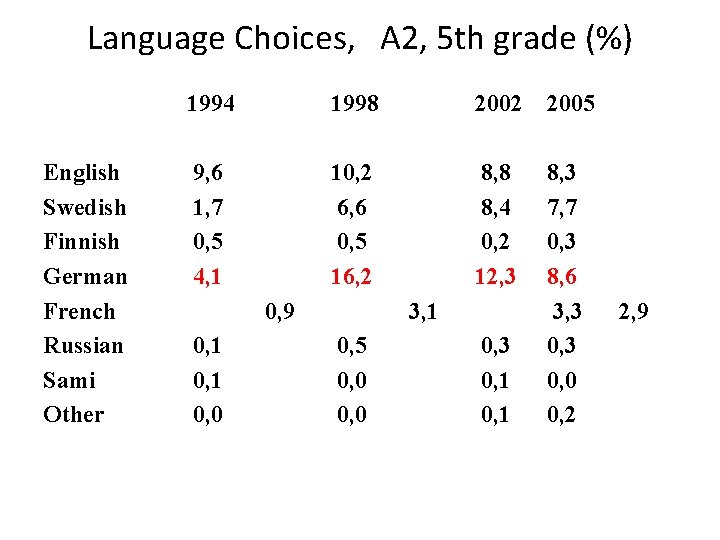
Language Choices, A 2, 5 th grade (%) English Swedish Finnish German French Russian Sami Other 1994 1998 2002 2005 9, 6 1, 7 0, 5 4, 1 10, 2 6, 6 0, 5 16, 2 8, 8 8, 4 0, 2 12, 3 8, 3 7, 7 0, 3 8, 6 3, 3 0, 0 0, 2 0, 9 0, 1 0, 0 3, 1 0, 5 0, 0 0, 3 0, 1 2, 9
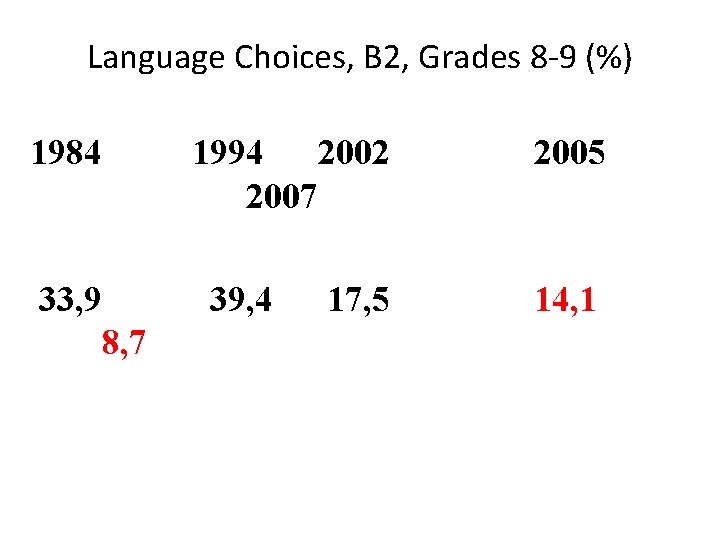
Language Choices, B 2, Grades 8 -9 (%) 1984 1994 2002 2007 33, 9 39, 4 8, 7 17, 5 2005 14, 1
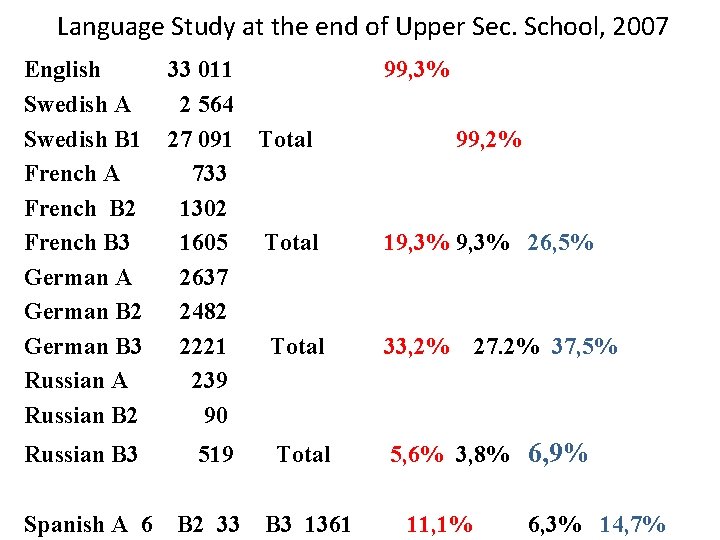
Language Study at the end of Upper Sec. School, 2007 English Swedish A Swedish B 1 French A French B 2 French B 3 German A German B 2 German B 3 Russian A Russian B 2 33 011 2 564 27 091 733 1302 1605 2637 2482 2221 239 90 Russian B 3 519 Spanish A 6 B 2 33 99, 3% Total 99, 2% Total 19, 3% 26, 5% Total 33, 2% Total 5, 6% 3, 8% 6, 9% B 3 1361 11, 1% 27. 2% 37, 5% 6, 3% 14, 7%
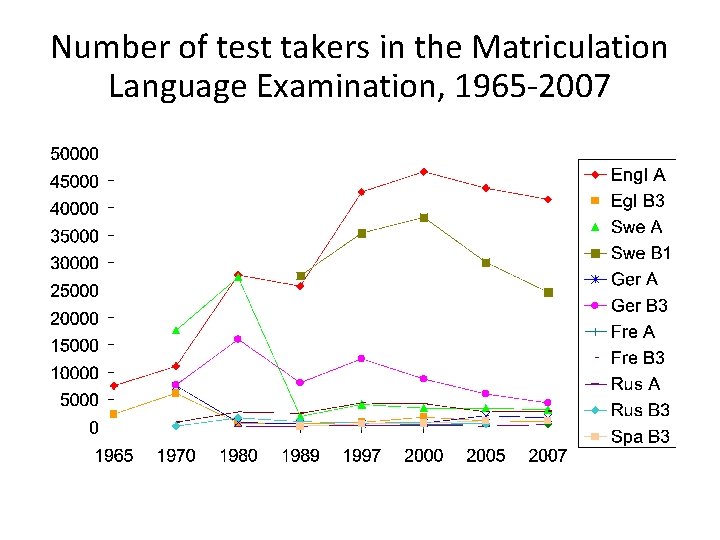
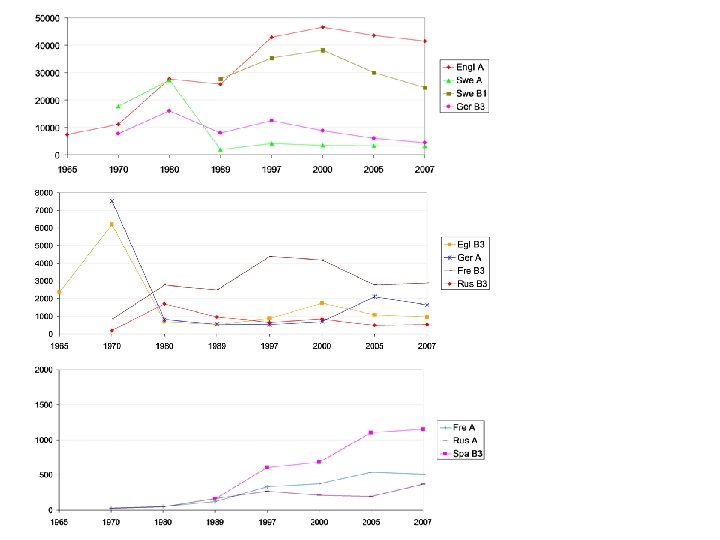
Plurilingualism – what do Matriculation Examination statistics show?
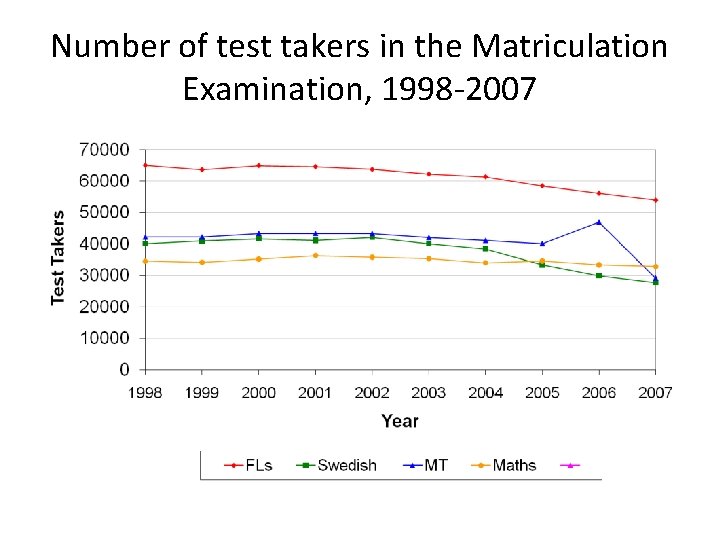
Number of test takers in the Matriculation Examination, 1998 -2007
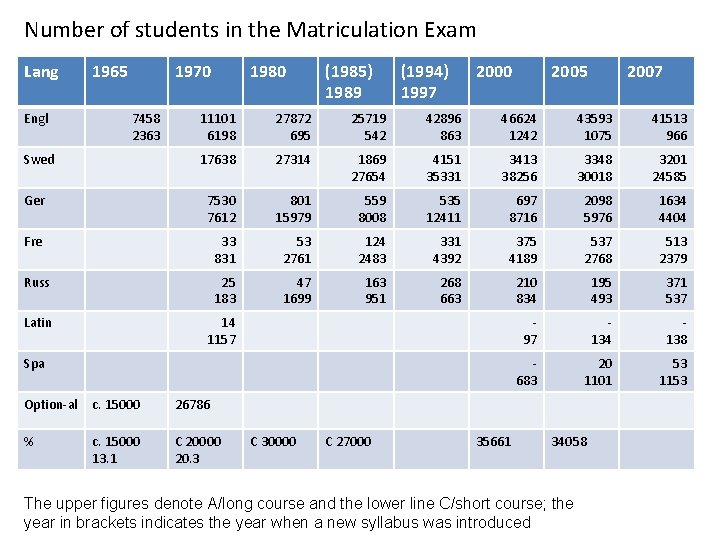
Number of students in the Matriculation Exam Lang Engl 1965 1970 7458 2363 1980 (1985) 1989 (1994) 1997 2000 2005 2007 11101 6198 27872 695 25719 542 42896 863 46624 1242 43593 1075 41513 966 17638 27314 1869 27654 4151 35331 3413 38256 3348 30018 3201 24585 Ger 7530 7612 801 15979 559 8008 535 12411 697 8716 2098 5976 1634 4404 Fre 33 831 53 2761 124 2483 331 4392 375 4189 537 2768 513 2379 Russ 25 183 47 1699 163 951 268 663 210 834 195 493 371 537 Latin 14 1157 97 134 138 683 20 1101 53 1153 Swed Spa Option-al c. 15000 26786 % c. 15000 13. 1 C 20000 20. 3 C 30000 C 27000 35661 34058 The upper figures denote A/long course and the lower line C/short course; the year in brackets indicates the year when a new syllabus was introduced
Number of test takers in the Matriculation Language Examination, 1965 -2007
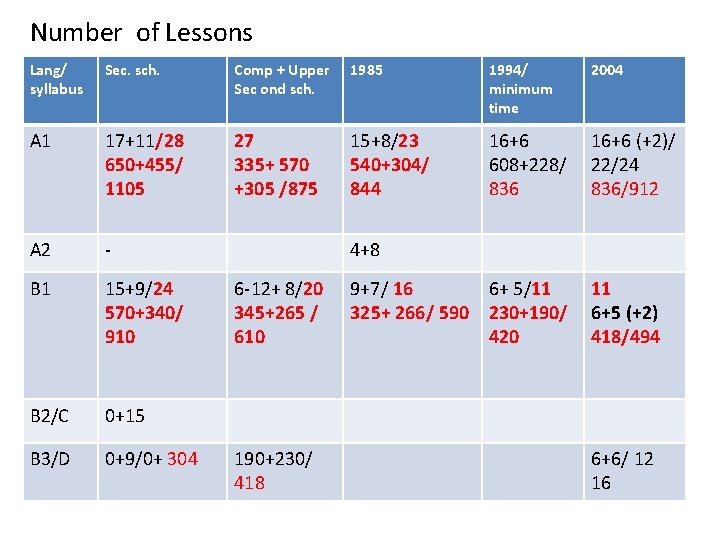
Plurilingualism – what do lesson allocation trends indicate?
Number of Lessons Lang/ syllabus Sec. sch. Comp + Upper Sec ond sch. 1985 1994/ minimum time 2004 A 1 17+11/28 650+455/ 1105 27 335+ 570 +305 /875 15+8/23 540+304/ 844 16+6 608+228/ 836 16+6 (+2)/ 22/24 836/912 A 2 - B 1 15+9/24 570+340/ 910 B 2/C 0+15 B 3/D 0+9/0+ 304 4+8 6 -12+ 8/20 345+265 / 610 190+230/ 418 9+7/ 16 6+ 5/11 325+ 266/ 590 230+190/ 420 11 6+5 (+2) 418/494 6+6/ 12 16
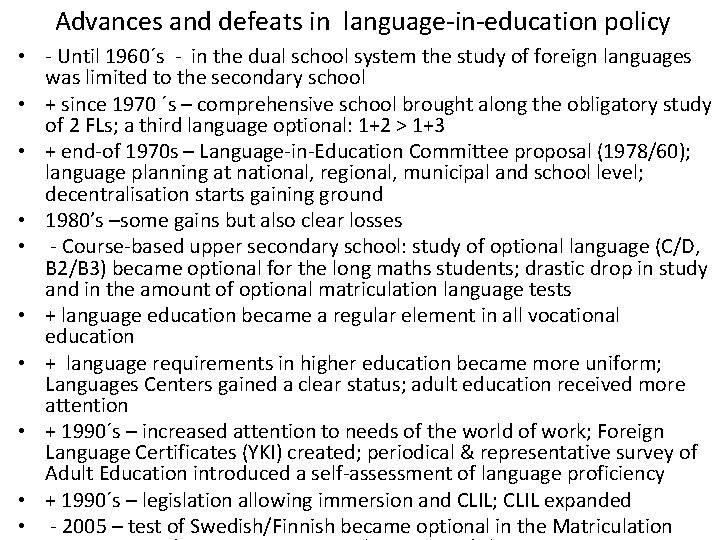
Advances and defeats in language-in-education policy • - Until 1960´s - in the dual school system the study of foreign languages was limited to the secondary school • + since 1970 ´s – comprehensive school brought along the obligatory study of 2 FLs; a third language optional: 1+2 > 1+3 • + end-of 1970 s – Language-in-Education Committee proposal (1978/60); language planning at national, regional, municipal and school level; decentralisation starts gaining ground • 1980’s –some gains but also clear losses • - Course-based upper secondary school: study of optional language (C/D, B 2/B 3) became optional for the long maths students; drastic drop in study and in the amount of optional matriculation language tests • + language education became a regular element in all vocational education • + language requirements in higher education became more uniform; Languages Centers gained a clear status; adult education received more attention • + 1990´s – increased attention to needs of the world of work; Foreign Language Certificates (YKI) created; periodical & representative survey of Adult Education introduced a self-assessment of language proficiency • + 1990´s – legislation allowing immersion and CLIL; CLIL expanded • - 2005 – test of Swedish/Finnish became optional in the Matriculation
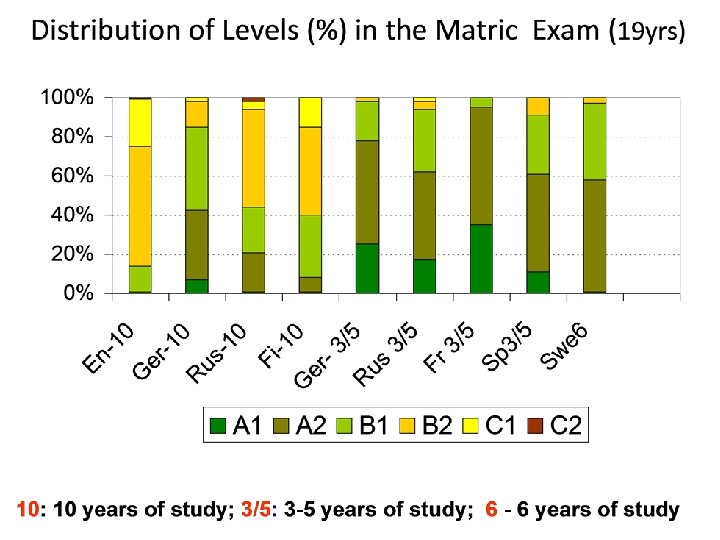
What level is attained in language education in Finland?
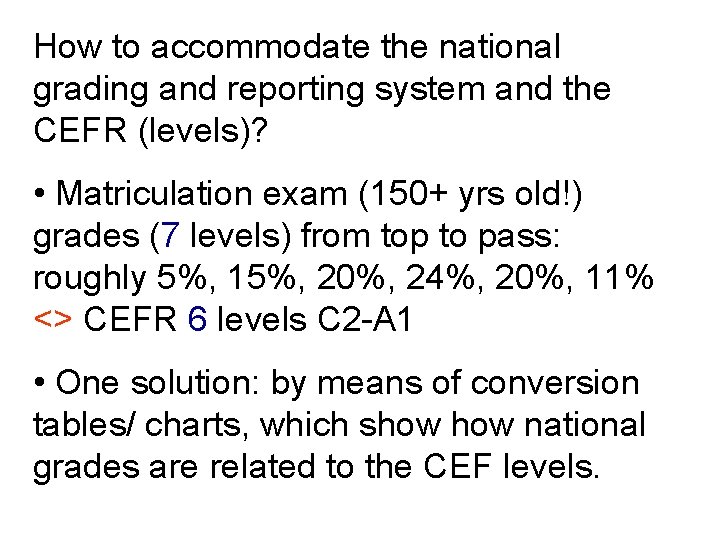
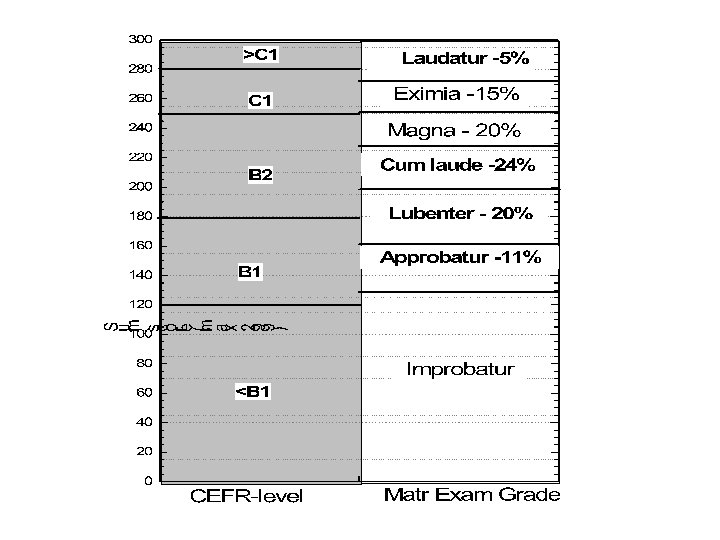
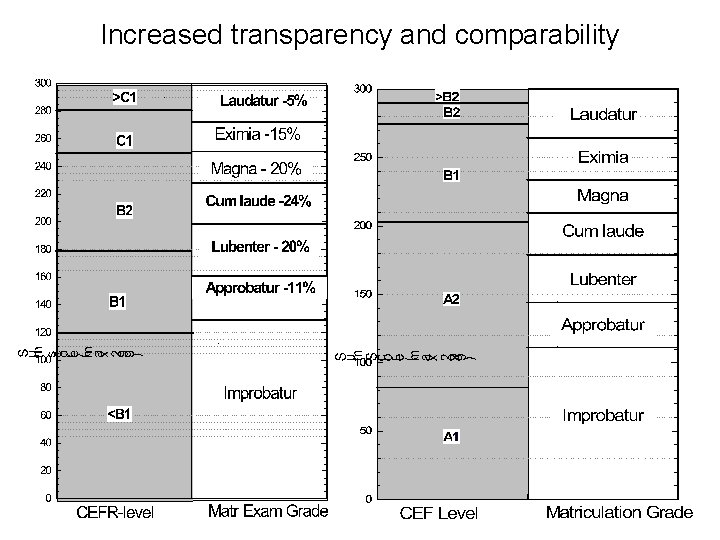
How to accommodate the national grading and reporting system and the CEFR (levels)? • Matriculation exam (150+ yrs old!) grades (7 levels) from top to pass: roughly 5%, 15%, 20%, 24%, 20%, 11% <> CEFR 6 levels C 2 -A 1 • One solution: by means of conversion tables/ charts, which show national grades are related to the CEF levels.
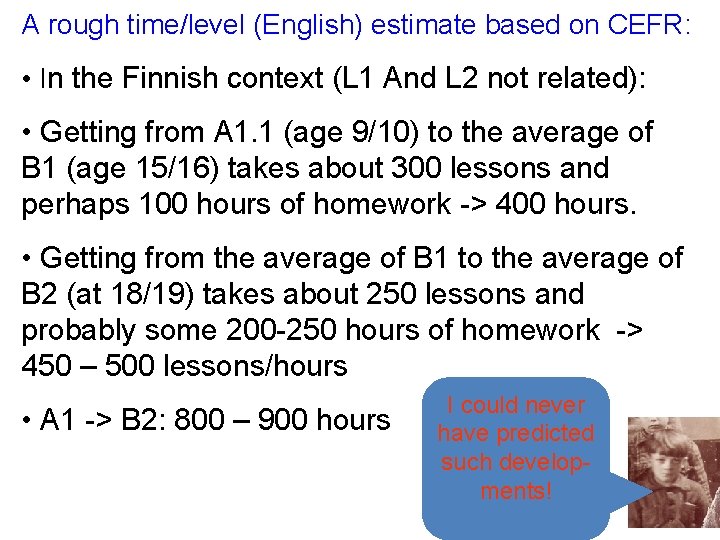
A rough time/level (English) estimate based on CEFR: • In the Finnish context (L 1 And L 2 not related): • Getting from A 1. 1 (age 9/10) to the average of B 1 (age 15/16) takes about 300 lessons and perhaps 100 hours of homework -> 400 hours. • Getting from the average of B 1 to the average of B 2 (at 18/19) takes about 250 lessons and probably some 200 -250 hours of homework -> 450 – 500 lessons/hours • A 1 -> B 2: 800 – 900 hours I could never have predicted such developments!
Increased transparency and comparability
Can plurilingualism help in the crisis?
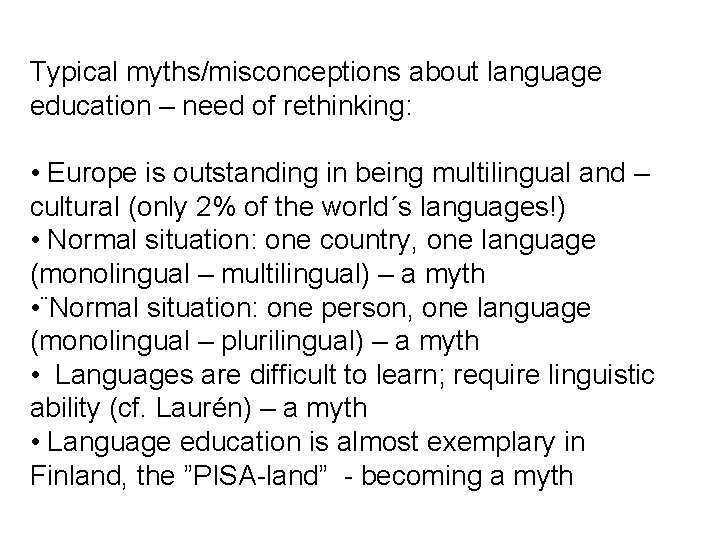
Typical myths/misconceptions about language education – need of rethinking: • Europe is outstanding in being multilingual and – cultural (only 2% of the world´s languages!) • Normal situation: one country, one language (monolingual – multilingual) – a myth • ¨Normal situation: one person, one language (monolingual – plurilingual) – a myth • Languages are difficult to learn; require linguistic ability (cf. Laurén) – a myth • Language education is almost exemplary in Finland, the ”PISA-land” - becoming a myth
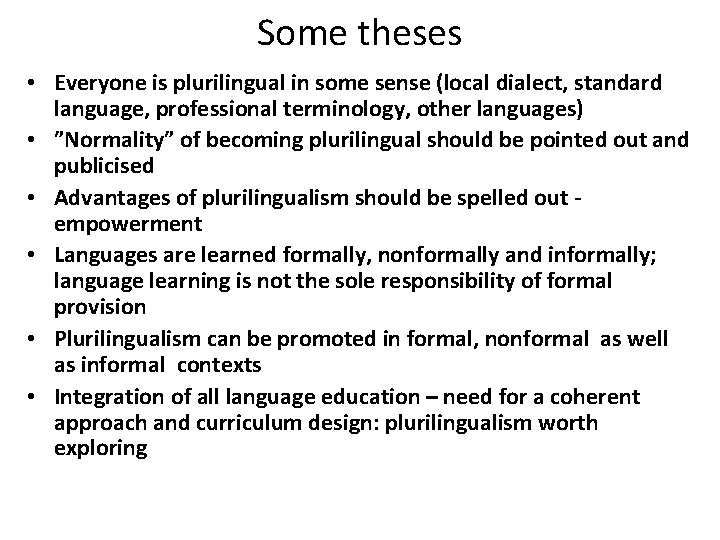
Some theses • Everyone is plurilingual in some sense (local dialect, standard language, professional terminology, other languages) • ”Normality” of becoming plurilingual should be pointed out and publicised • Advantages of plurilingualism should be spelled out empowerment • Languages are learned formally, nonformally and informally; language learning is not the sole responsibility of formal provision • Plurilingualism can be promoted in formal, nonformal as well as informal contexts • Integration of all language education – need for a coherent approach and curriculum design: plurilingualism worth exploring
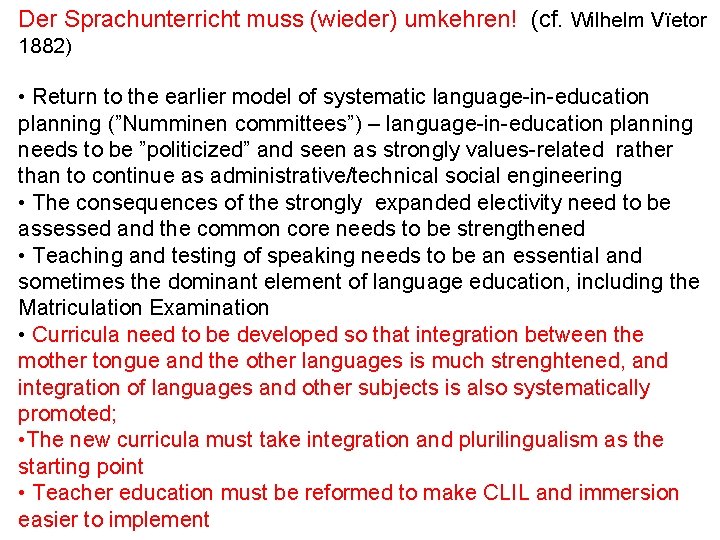
Der Sprachunterricht muss (wieder) umkehren! (cf. Wilhelm Vïetor 1882) • Return to the earlier model of systematic language-in-education planning (”Numminen committees”) – language-in-education planning needs to be ”politicized” and seen as strongly values-related rather than to continue as administrative/technical social engineering • The consequences of the strongly expanded electivity need to be assessed and the common core needs to be strengthened • Teaching and testing of speaking needs to be an essential and sometimes the dominant element of language education, including the Matriculation Examination • Curricula need to be developed so that integration between the mother tongue and the other languages is much strenghtened, and integration of languages and other subjects is also systematically promoted; • The new curricula must take integration and plurilingualism as the starting point • Teacher education must be reformed to make CLIL and immersion easier to implement
Pluri: Utilizing the potential • Not only formal language study/ language education provision – Language-in-education planning, • But also nonformal and informal language learning/ acquisition
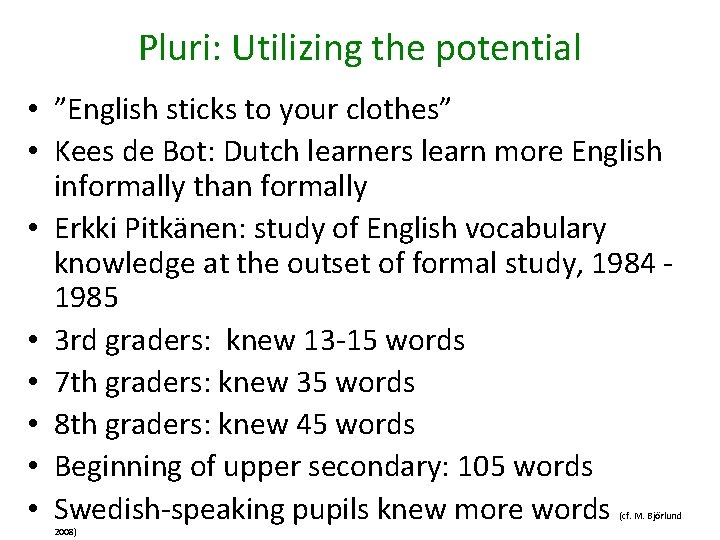
Pluri: Utilizing the potential • ”English sticks to your clothes” • Kees de Bot: Dutch learners learn more English informally than formally • Erkki Pitkänen: study of English vocabulary knowledge at the outset of formal study, 1984 1985 • 3 rd graders: knew 13 -15 words • 7 th graders: knew 35 words • 8 th graders: knew 45 words • Beginning of upper secondary: 105 words • Swedish-speaking pupils knew more words (cf. M. Björlund 2008)
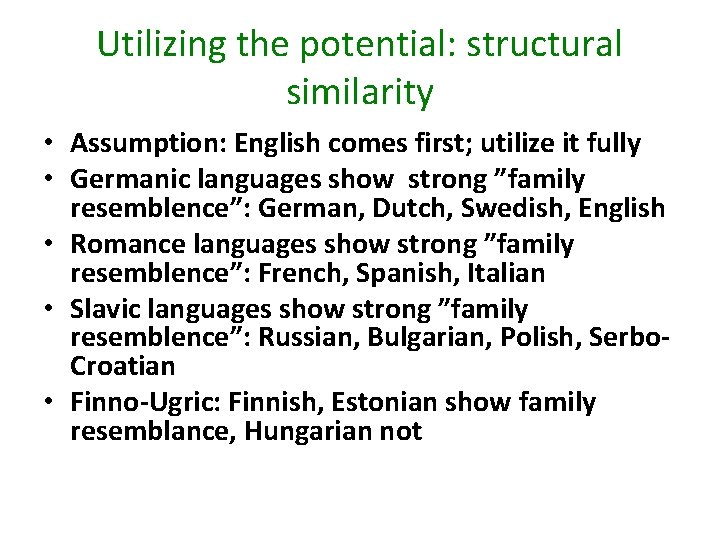
Utilizing the potential: structural similarity • Assumption: English comes first; utilize it fully • Germanic languages show strong ”family resemblence”: German, Dutch, Swedish, English • Romance languages show strong ”family resemblence”: French, Spanish, Italian • Slavic languages show strong ”family resemblence”: Russian, Bulgarian, Polish, Serbo. Croatian • Finno-Ugric: Finnish, Estonian show family resemblance, Hungarian not
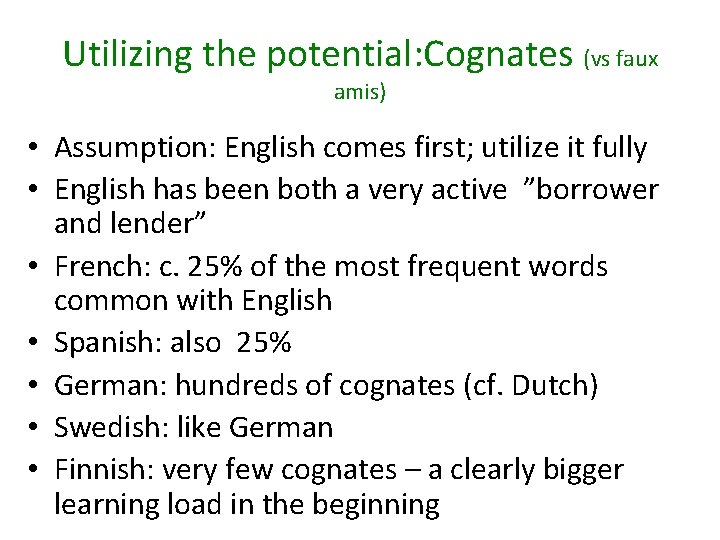
Utilizing the potential: Cognates (vs faux amis) • Assumption: English comes first; utilize it fully • English has been both a very active ”borrower and lender” • French: c. 25% of the most frequent words common with English • Spanish: also 25% • German: hundreds of cognates (cf. Dutch) • Swedish: like German • Finnish: very few cognates – a clearly bigger learning load in the beginning
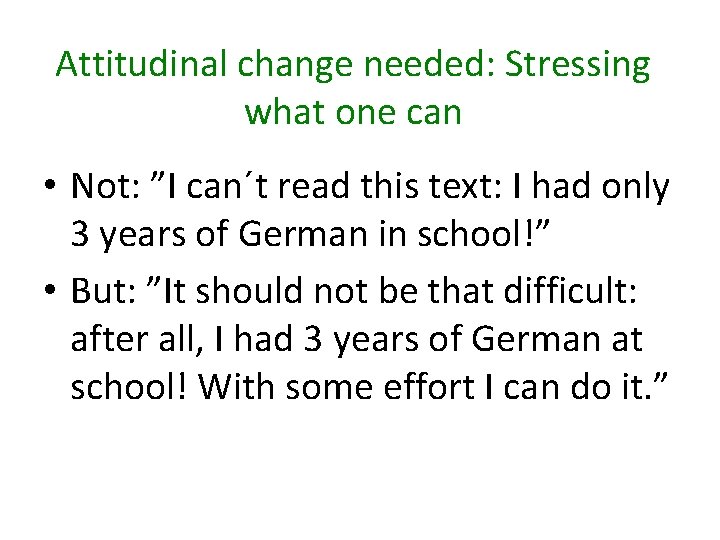
Attitudinal change needed: Stressing what one can • Not: ”I can´t read this text: I had only 3 years of German in school!” • But: ”It should not be that difficult: after all, I had 3 years of German at school! With some effort I can do it. ”
Der Sprachunterricht muss umkehren! • Languages are learned at different rates. • Nonformal and informal learning support varies. • >This must be reflected in time allocation.
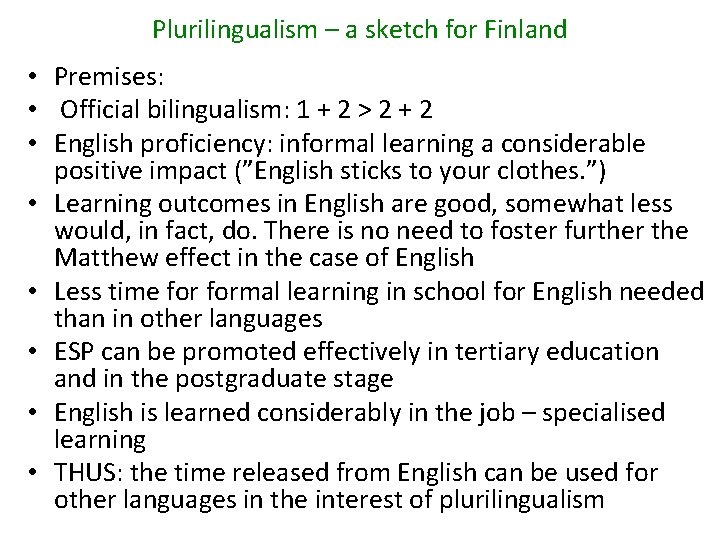
Plurilingualism – a sketch for Finland • Premises: • Official bilingualism: 1 + 2 > 2 + 2 • English proficiency: informal learning a considerable positive impact (”English sticks to your clothes. ”) • Learning outcomes in English are good, somewhat less would, in fact, do. There is no need to foster further the Matthew effect in the case of English • Less time formal learning in school for English needed than in other languages • ESP can be promoted effectively in tertiary education and in the postgraduate stage • English is learned considerably in the job – specialised learning • THUS: the time released from English can be used for other languages in the interest of plurilingualism
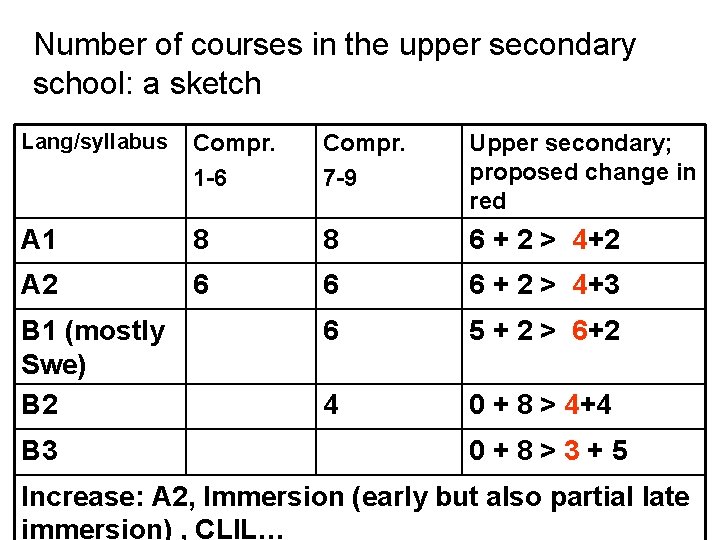
Thesis: Chances to promote plurilingualism are better in the upper secondary level than in the comprehensive school.
Number of courses in the upper secondary school: a sketch Lang/syllabus Compr. 1 -6 Compr. 7 -9 Upper secondary; proposed change in red A 1 8 8 6 + 2 > 4+2 A 2 6 6 6 + 2 > 4+3 6 5 + 2 > 6+2 4 0 + 8 > 4+4 B 1 (mostly Swe) B 2 B 3 0+8>3+5 Increase: A 2, Immersion (early but also partial late immersion) , CLIL…
The Way Ahead
Language education is based on the principles of lifelong learning, continuity of education, flexible modes of learning and equality. Language education adopts a functional approach according to which language competence is seen as the ability to act in a language use situation in a way which is appropriate linguistically, socially and culturally. Language education is a whole which comprises the mother tongues, foreign languages and minority languages without seeing them to be in competition to each other. This promotes both individual plurilingualism and societal multilingualism. It supports social and societal empowerment. (KIEPO)
The policy making and development concerning languagein-education is co-ordinated and professional and is based on the anticipation of future language competence needs and on relevant research. Learning outcomes and the impact of language education and related costs are evaluated systematically and comprehensively. Language education policy draws on an analysis the current national pool of linguistic resources and anticipates prospective language competence needs , among others, from the point of view of the world of work. (KIEPO, 37, 454 -4559
The Committee for European Languages and Cultures, a third major commission chaired by Jaakko Numminen, considered in its report in early 1991 that it is important that pupils and students are encouraged to fully utilize the opportunities that our educational system offers for obtaining a good and many-sided knowledge of foreign languages. It is equally important that foreign language teaching in our educational system is systematically developed, so that it can meet the increasing challenges. The Committee emphasized that Finland must be among the leading nations in foreign language teaching.
Ut desint vires, tamen est laudanda voluntas! We often feel that we are helpless in the present drift to decreased plurilingualism. We need to strengthen our resolve to effect a change.
Some references • Hildén, R. & Takala, S. (2007) Relating descriptors of the Finnish school scale to the CEF overall scales of communicative activities. (pdf available from sjtakala@hotmail. com; raili. hilden@helsinki. fi) • Kaftandjieva, F. (2004) Standard setting. Section B in Reference Supplement to the Manual for relating language examinations to the CEFR. Council of Europe (available at: http: //www. coe. int/T/DG 4/Linguistic/Default-en-asp) • Kaftandjieva, F. & Takala, S. (2002) Council of Europe Scales of Language Proficiency: A validation study. In Common European Framework of Reference. Case studies, Council of Europe, 106 -129. (pdf available from sjtakala@hotmail. com)
• Kaftandjieva, F. & Takala, S. (2003) Development and Validation of Scales of Language Proficiency. In: W. Vagle (ed. ) Vurdering av språkferdighet, NTNU. Trondheim, 31 -38 (pdf available from Takala: sjtakala@hotmail. com) • Takala, S. & Kaftandjieva, F. (2002) Relating the Finnish Matriculation Examination English Test Results to the CEF Scales. Helsinki Seminar, June 31 - July 2, 2002 (available by request from Takala: sjtakala@hotmail. com) • Tuokko, E. (2007) What level do pupils reach in English at the end of the comprehensive school? U of Jyväskylä, Finland. (Ph. D thesis in Finnish, with English summary: tuokko@pp. inet. fi)