
PLT 302 ELECTRICAL INSTALLATION I Chapter 6 Earthing
- Slides: 27
PLT 302 : ELECTRICAL INSTALLATION I Chapter 6: Earthing System CHAPTER 3 LIGHTING SYSTEM AND DESIGN
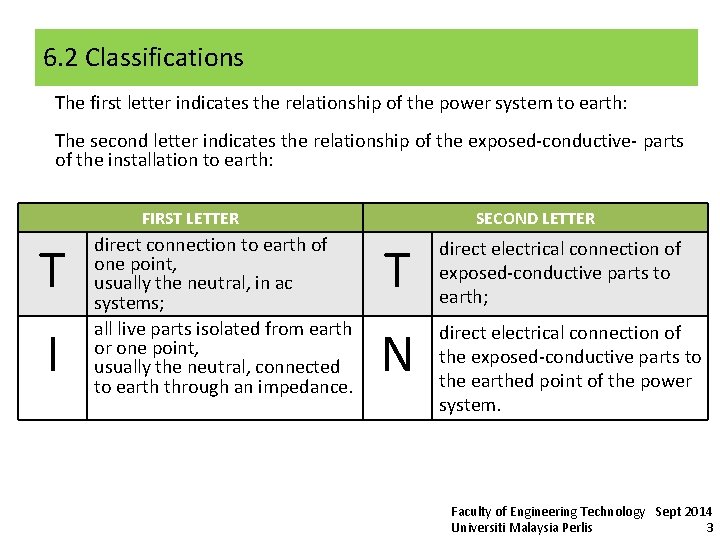
6. 1 Introduction Today the 3 earthing system such as defined in IEC 364: 1. exposed-conductive parts connected to neutral TN; 2. earthed neutral TT; 3. unearthed (or impedance-earthed) neutral IT. Faculty of Engineering Technology Sept 2014 Universiti Malaysia Perlis 2
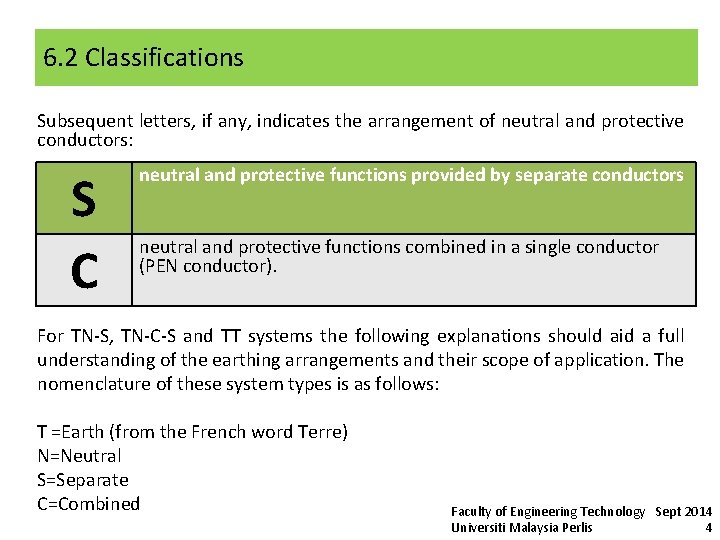
6. 2 Classifications The first letter indicates the relationship of the power system to earth: The second letter indicates the relationship of the exposed-conductive- parts of the installation to earth: FIRST LETTER T I direct connection to earth of one point, usually the neutral, in ac systems; all live parts isolated from earth or one point, usually the neutral, connected to earth through an impedance. SECOND LETTER T direct electrical connection of exposed-conductive parts to earth; N direct electrical connection of the exposed-conductive parts to the earthed point of the power system. Faculty of Engineering Technology Sept 2014 Universiti Malaysia Perlis 3
6. 2 Classifications Subsequent letters, if any, indicates the arrangement of neutral and protective conductors: S C neutral and protective functions provided by separate conductors neutral and protective functions combined in a single conductor (PEN conductor). For TN-S, TN-C-S and TT systems the following explanations should aid a full understanding of the earthing arrangements and their scope of application. The nomenclature of these system types is as follows: T =Earth (from the French word Terre) N=Neutral S=Separate C=Combined Faculty of Engineering Technology Sept 2014 Universiti Malaysia Perlis 4
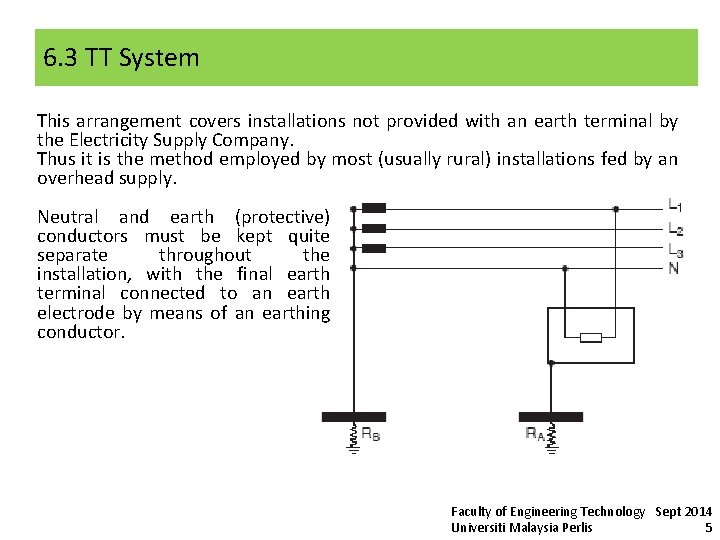
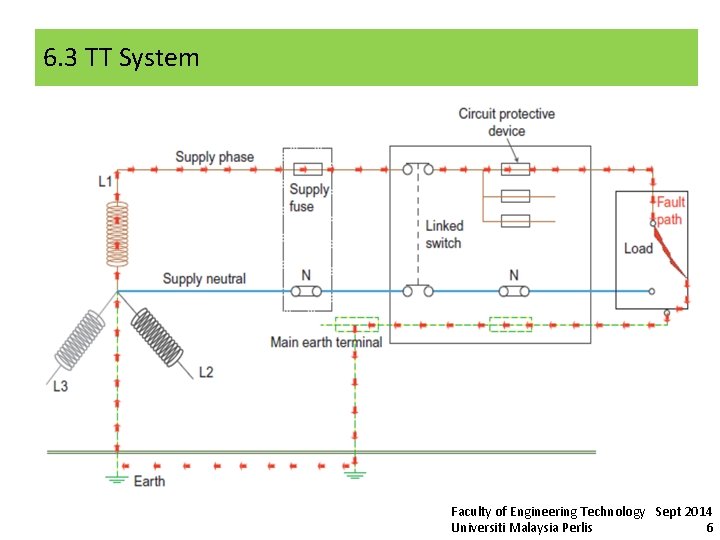
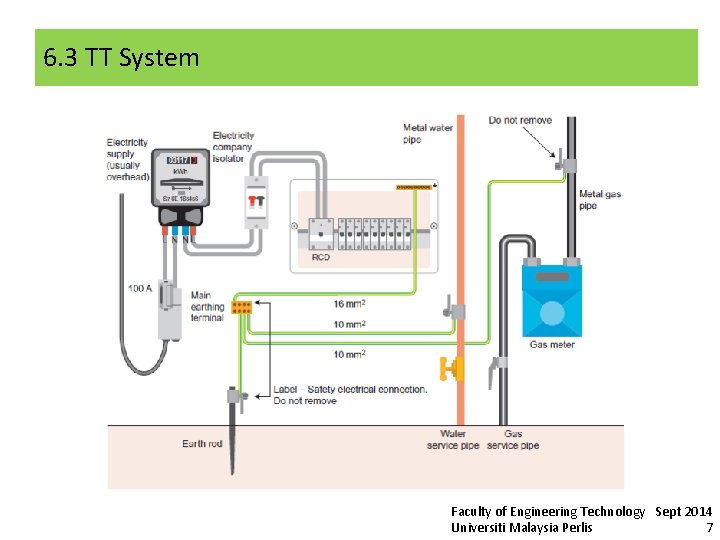
6. 3 TT System This arrangement covers installations not provided with an earth terminal by the Electricity Supply Company. Thus it is the method employed by most (usually rural) installations fed by an overhead supply. Neutral and earth (protective) conductors must be kept quite separate throughout the installation, with the final earth terminal connected to an earth electrode by means of an earthing conductor. Faculty of Engineering Technology Sept 2014 Universiti Malaysia Perlis 5
6. 3 TT System Faculty of Engineering Technology Sept 2014 Universiti Malaysia Perlis 6
6. 3 TT System Faculty of Engineering Technology Sept 2014 Universiti Malaysia Perlis 7
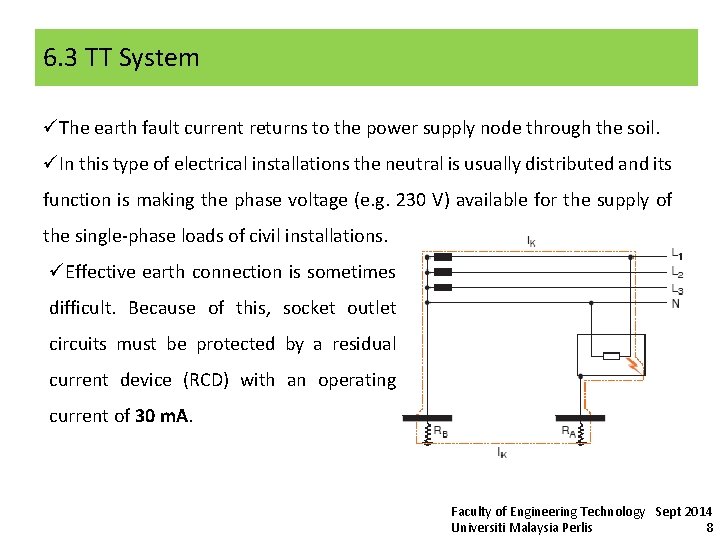
6. 3 TT System üThe earth fault current returns to the power supply node through the soil. üIn this type of electrical installations the neutral is usually distributed and its function is making the phase voltage (e. g. 230 V) available for the supply of the single-phase loads of civil installations. üEffective earth connection is sometimes difficult. Because of this, socket outlet circuits must be protected by a residual current device (RCD) with an operating current of 30 m. A. Faculty of Engineering Technology Sept 2014 Universiti Malaysia Perlis 8
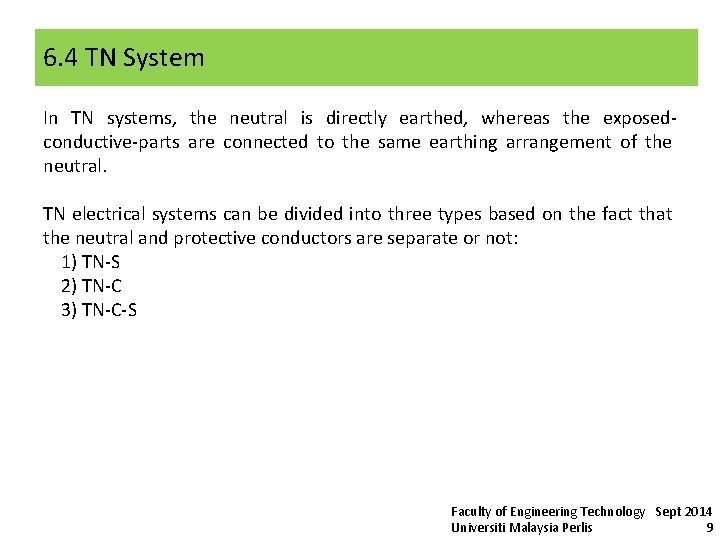
6. 4 TN System In TN systems, the neutral is directly earthed, whereas the exposedconductive-parts are connected to the same earthing arrangement of the neutral. TN electrical systems can be divided into three types based on the fact that the neutral and protective conductors are separate or not: 1) TN-S 2) TN-C 3) TN-C-S Faculty of Engineering Technology Sept 2014 Universiti Malaysia Perlis 9
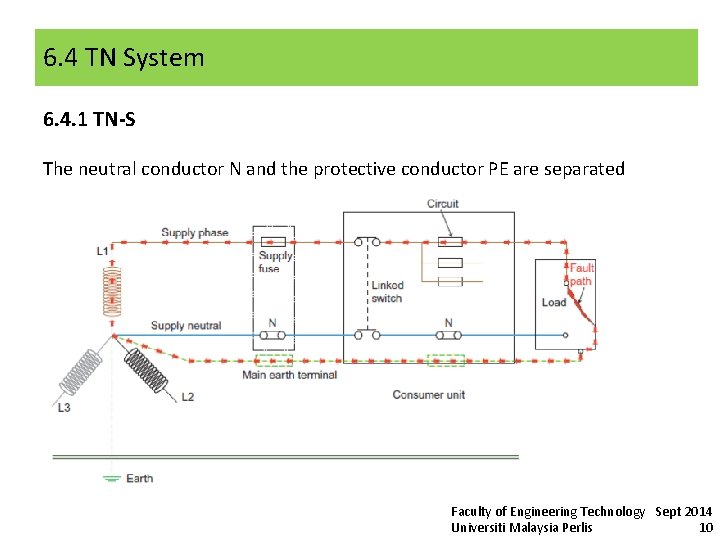
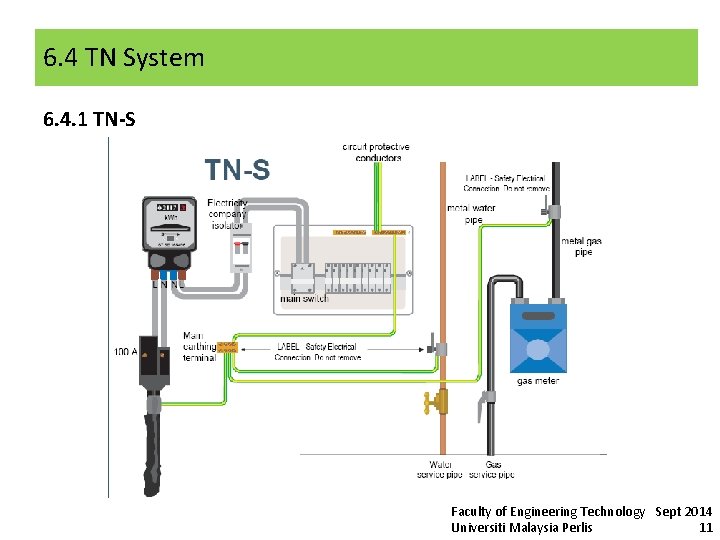
6. 4 TN System 6. 4. 1 TN-S The neutral conductor N and the protective conductor PE are separated Faculty of Engineering Technology Sept 2014 Universiti Malaysia Perlis 10
6. 4 TN System 6. 4. 1 TN-S Faculty of Engineering Technology Sept 2014 Universiti Malaysia Perlis 11
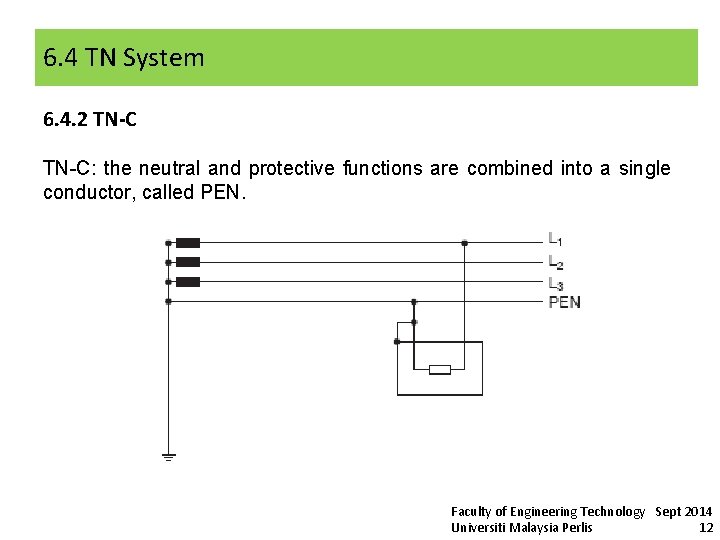
6. 4 TN System 6. 4. 2 TN-C: the neutral and protective functions are combined into a single conductor, called PEN. Faculty of Engineering Technology Sept 2014 Universiti Malaysia Perlis 12
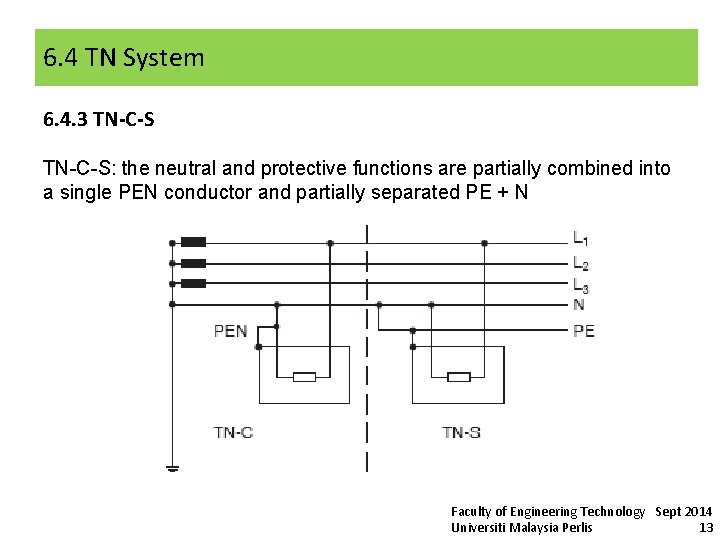
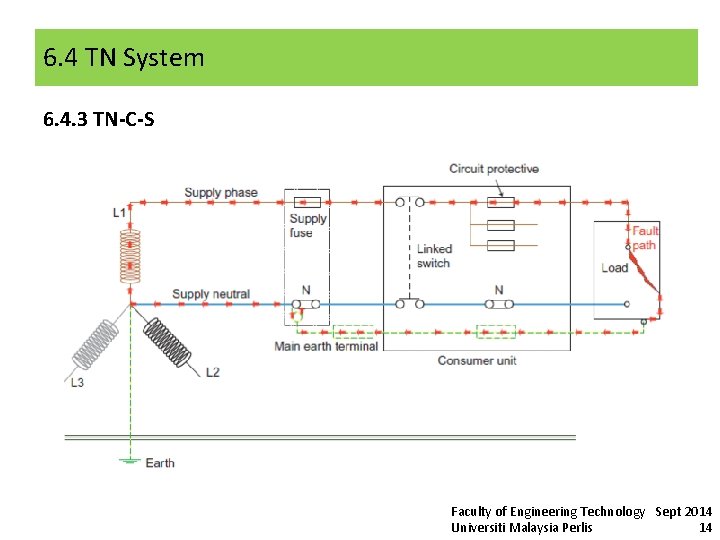
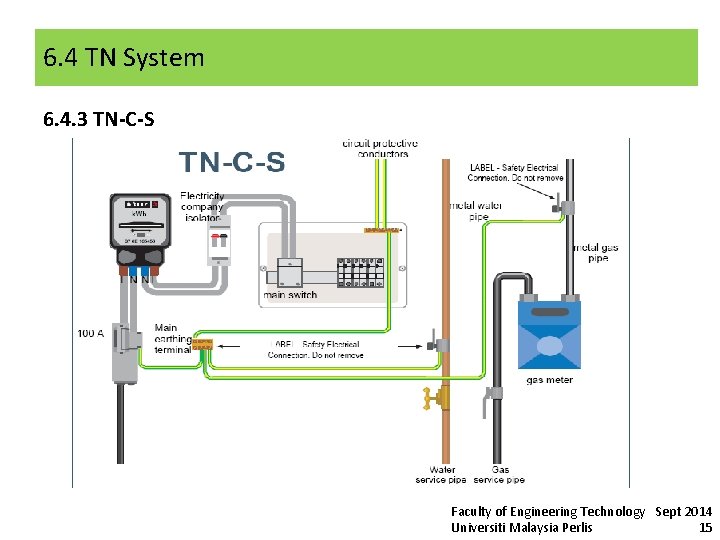
6. 4 TN System 6. 4. 3 TN-C-S: the neutral and protective functions are partially combined into a single PEN conductor and partially separated PE + N Faculty of Engineering Technology Sept 2014 Universiti Malaysia Perlis 13
6. 4 TN System 6. 4. 3 TN-C-S Faculty of Engineering Technology Sept 2014 Universiti Malaysia Perlis 14
6. 4 TN System 6. 4. 3 TN-C-S Faculty of Engineering Technology Sept 2014 Universiti Malaysia Perlis 15
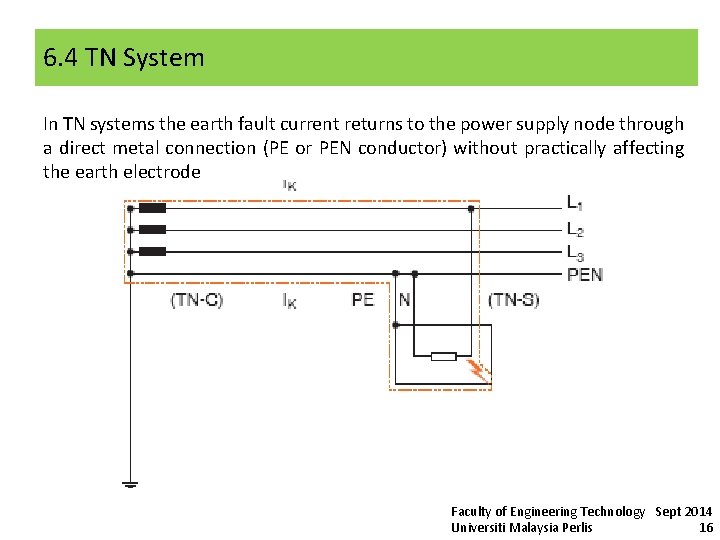
6. 4 TN System In TN systems the earth fault current returns to the power supply node through a direct metal connection (PE or PEN conductor) without practically affecting the earth electrode Faculty of Engineering Technology Sept 2014 Universiti Malaysia Perlis 16
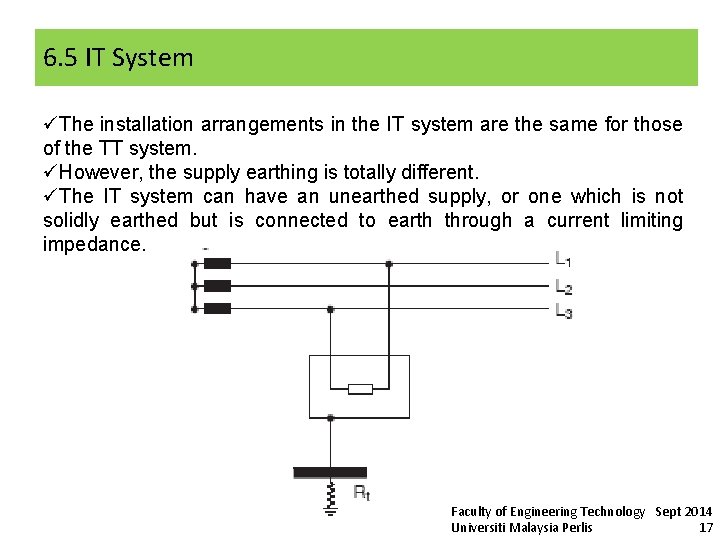
6. 5 IT System üThe installation arrangements in the IT system are the same for those of the TT system. üHowever, the supply earthing is totally different. üThe IT system can have an unearthed supply, or one which is not solidly earthed but is connected to earth through a current limiting impedance. Faculty of Engineering Technology Sept 2014 Universiti Malaysia Perlis 17
6. 5 IT System üThe total lack of earth in some cases, or the introduction of current limiting into the earth path, means that the usual methods of protection will not be effective. üFor this reason, IT systems are not allowed in the public supply system. üAn exception is in medical situations such as hospitals. Here it is recommended that an IT system is used for circuits supplying medical equipment that is intended to be used for life-support of patients. üThe method is also sometimes used where a supply for special purposes is taken from a private generator. Faculty of Engineering Technology Sept 2014 Universiti Malaysia Perlis 18
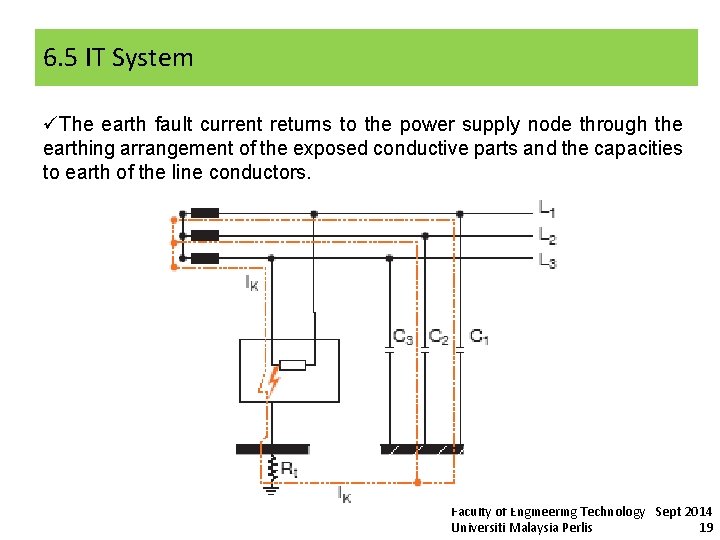
6. 5 IT System üThe earth fault current returns to the power supply node through the earthing arrangement of the exposed conductive parts and the capacities to earth of the line conductors. Faculty of Engineering Technology Sept 2014 Universiti Malaysia Perlis 19
6. 5 Basic Protection The use of a residual current device (RCD) cannot prevent this contact, but it can be used as additional protection to any of the other measures taken, provided that its rating, IΔn , is 30 m. A or less and has an operating time of not more than 40 ms at a test current of IΔn x 5. Faculty of Engineering Technology Sept 2014 Universiti Malaysia Perlis 20
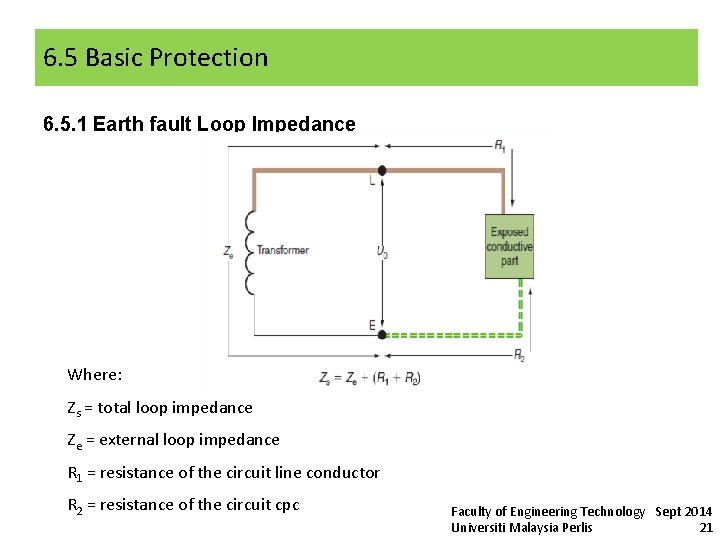
6. 5 Basic Protection 6. 5. 1 Earth fault Loop Impedance Where: Zs = total loop impedance Ze = external loop impedance R 1 = resistance of the circuit line conductor R 2 = resistance of the circuit cpc Faculty of Engineering Technology Sept 2014 Universiti Malaysia Perlis 21
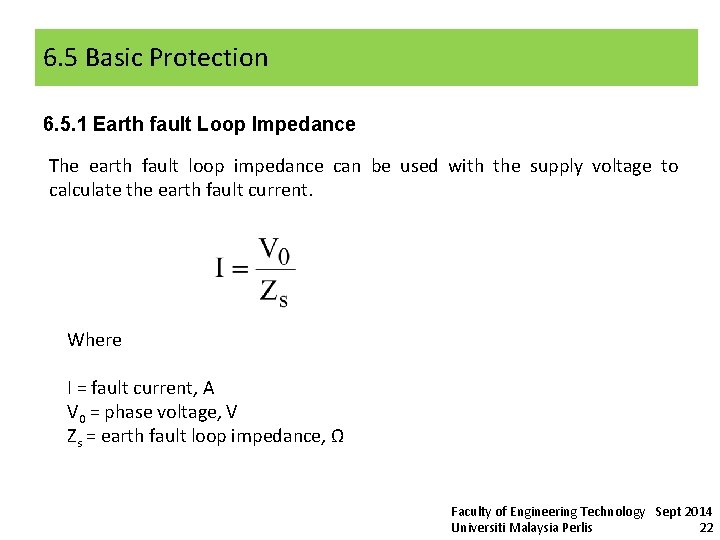
6. 5 Basic Protection 6. 5. 1 Earth fault Loop Impedance The earth fault loop impedance can be used with the supply voltage to calculate the earth fault current. Where I = fault current, A V 0 = phase voltage, V Zs = earth fault loop impedance, Ω Faculty of Engineering Technology Sept 2014 Universiti Malaysia Perlis 22
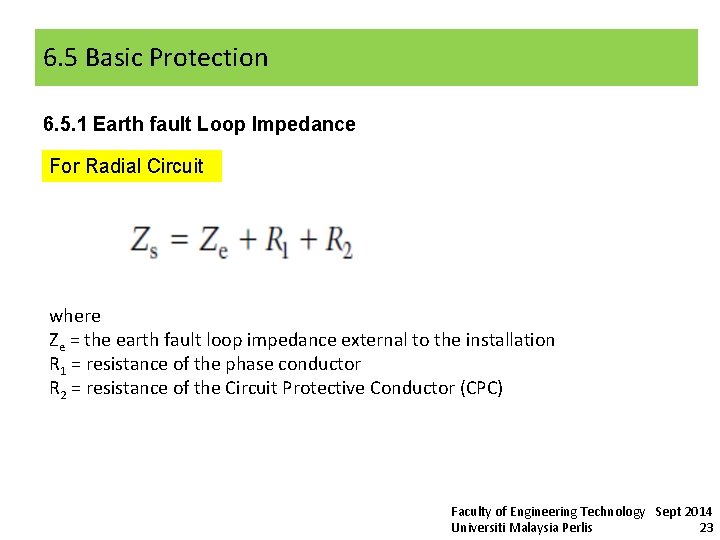
6. 5 Basic Protection 6. 5. 1 Earth fault Loop Impedance For Radial Circuit where Ze = the earth fault loop impedance external to the installation R 1 = resistance of the phase conductor R 2 = resistance of the Circuit Protective Conductor (CPC) Faculty of Engineering Technology Sept 2014 Universiti Malaysia Perlis 23
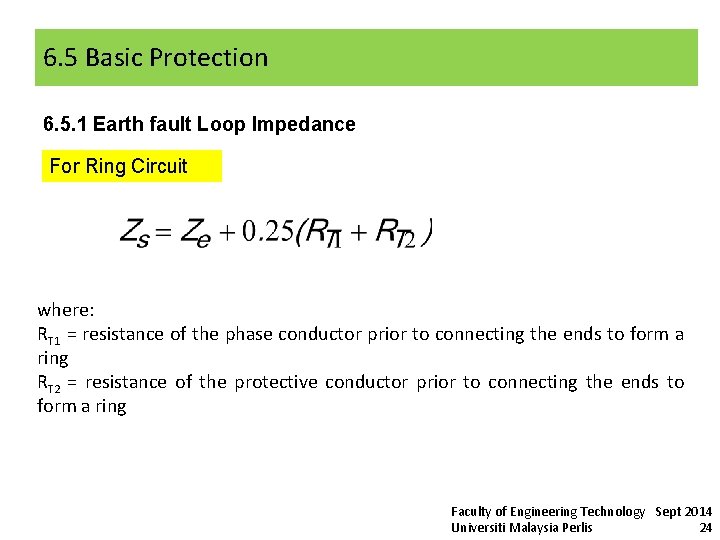
6. 5 Basic Protection 6. 5. 1 Earth fault Loop Impedance For Ring Circuit where: RT 1 = resistance of the phase conductor prior to connecting the ends to form a ring RT 2 = resistance of the protective conductor prior to connecting the ends to form a ring Faculty of Engineering Technology Sept 2014 Universiti Malaysia Perlis 24
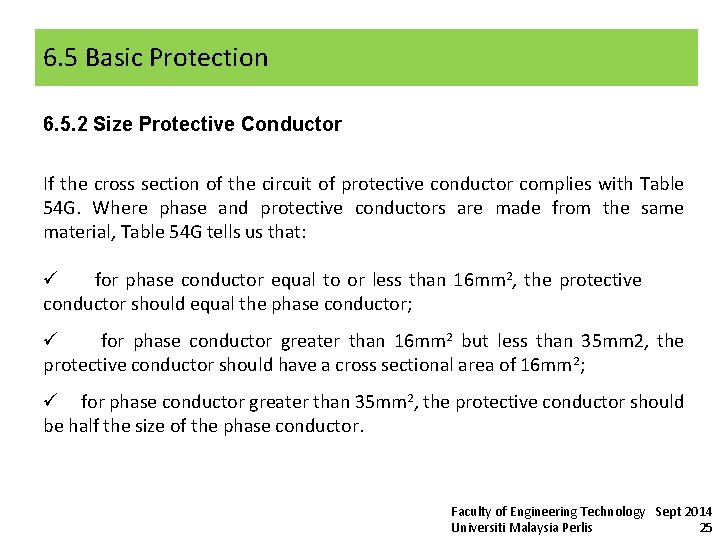
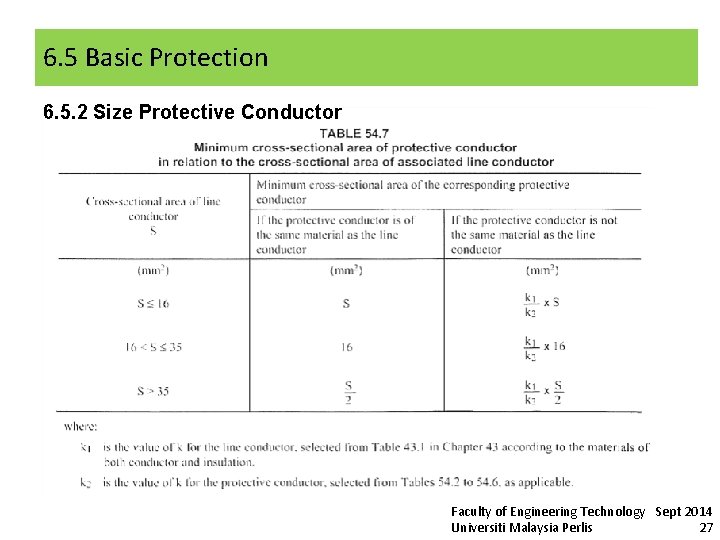
6. 5 Basic Protection 6. 5. 2 Size Protective Conductor If the cross section of the circuit of protective conductor complies with Table 54 G. Where phase and protective conductors are made from the same material, Table 54 G tells us that: ü for phase conductor equal to or less than 16 mm 2, the protective conductor should equal the phase conductor; ü for phase conductor greater than 16 mm 2 but less than 35 mm 2, the protective conductor should have a cross sectional area of 16 mm 2; ü for phase conductor greater than 35 mm 2, the protective conductor should be half the size of the phase conductor. Faculty of Engineering Technology Sept 2014 Universiti Malaysia Perlis 25
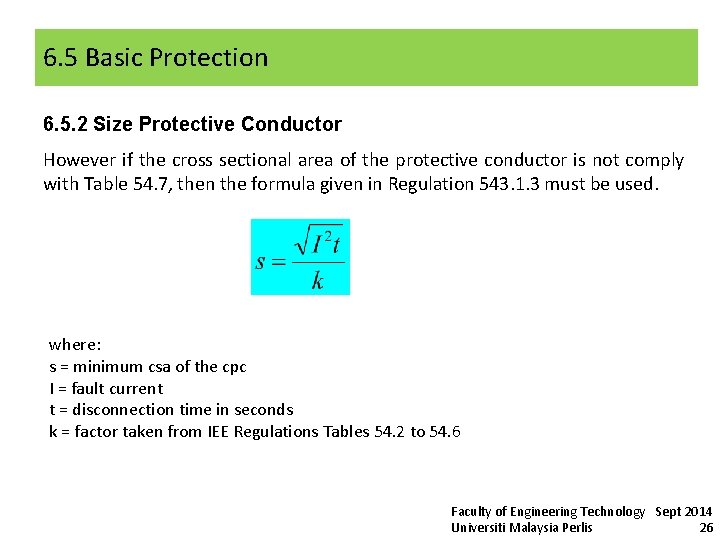
6. 5 Basic Protection 6. 5. 2 Size Protective Conductor However if the cross sectional area of the protective conductor is not comply with Table 54. 7, then the formula given in Regulation 543. 1. 3 must be used. where: s = minimum csa of the cpc I = fault current t = disconnection time in seconds k = factor taken from IEE Regulations Tables 54. 2 to 54. 6 Faculty of Engineering Technology Sept 2014 Universiti Malaysia Perlis 26
6. 5 Basic Protection 6. 5. 2 Size Protective Conductor Faculty of Engineering Technology Sept 2014 Universiti Malaysia Perlis 27