
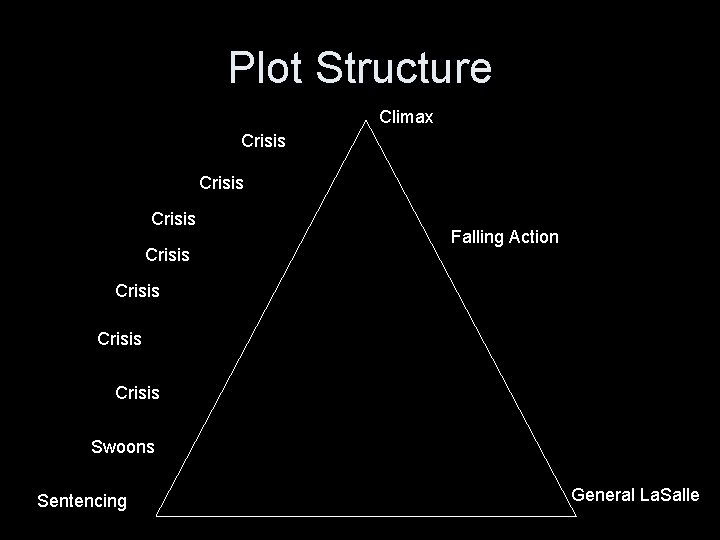
Plot Structure Climax Crisis Falling Action Crisis Swoons

- Slides: 10
Plot Structure Climax Crisis Falling Action Crisis Swoons Sentencing General La. Salle
Use DIDLS on the Following • In the confusion attending my fall, I did not immediately apprehend a somewhat startling circumstance , which yet, in a few seconds afterward, and while I still lay prostrate, arrested my attention. It was this: my chin rested upon the floor of the prison, but my lips, and the upper portion of my head, although seemingly at a less elevation than the chin, touched nothing. At the same time, my forehead seemed bathed in a clammy vapour, and the peculiar smell of decayed fungus arose to my nostrils. I put forward my arm, and shuddered to find that I had fallen at the very brink of a circular pit, whose extent of course I had no means of ascertaining at the moment. Groping about the masonry just below the margin, I succeeded in dislodging a small fragment, and let it fall into the abyss. For many seconds I hearkened to its reverberations as it dashed against the sides of the chasm in its descent ; at length there was a sullen plunge into water, succeeded by loud echoes. At the same moment there came a sound resembling the quick opening, and as rapid closing of a door overhead, while a faint gleam of light flashed suddenly through the gloom, and as suddenly faded away.
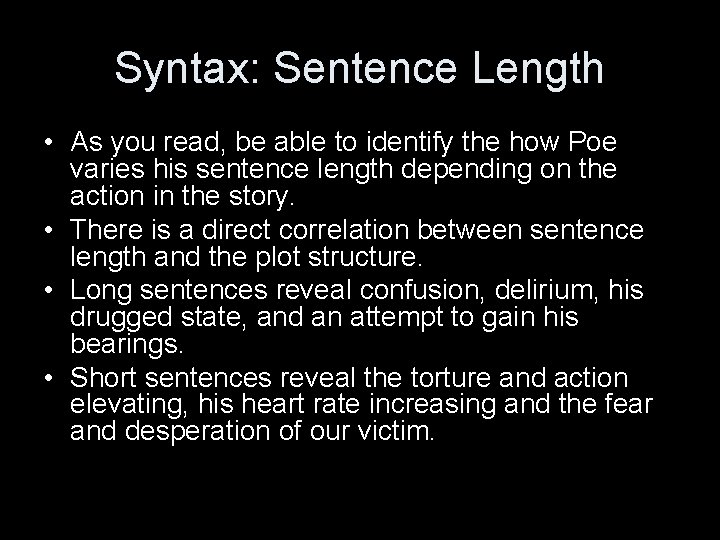
Syntax: Sentence Length • As you read, be able to identify the how Poe varies his sentence length depending on the action in the story. • There is a direct correlation between sentence length and the plot structure. • Long sentences reveal confusion, delirium, his drugged state, and an attempt to gain his bearings. • Short sentences reveal the torture and action elevating, his heart rate increasing and the fear and desperation of our victim.
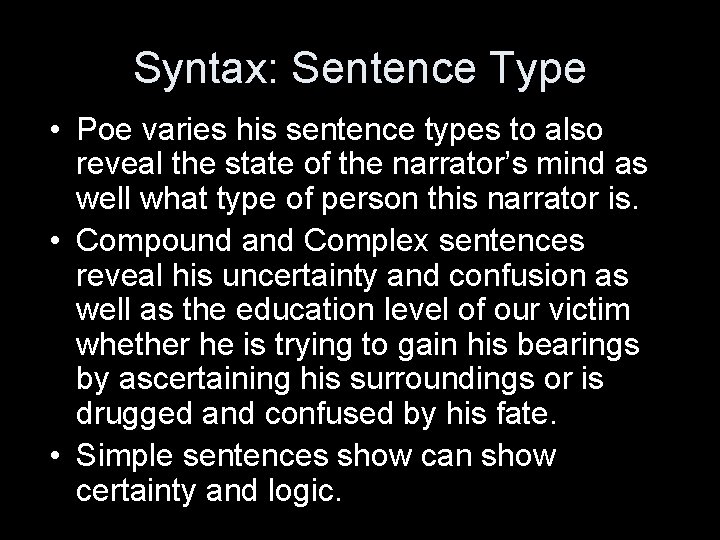
Syntax: Sentence Type • Poe varies his sentence types to also reveal the state of the narrator’s mind as well what type of person this narrator is. • Compound and Complex sentences reveal his uncertainty and confusion as well as the education level of our victim whether he is trying to gain his bearings by ascertaining his surroundings or is drugged and confused by his fate. • Simple sentences show can show certainty and logic.
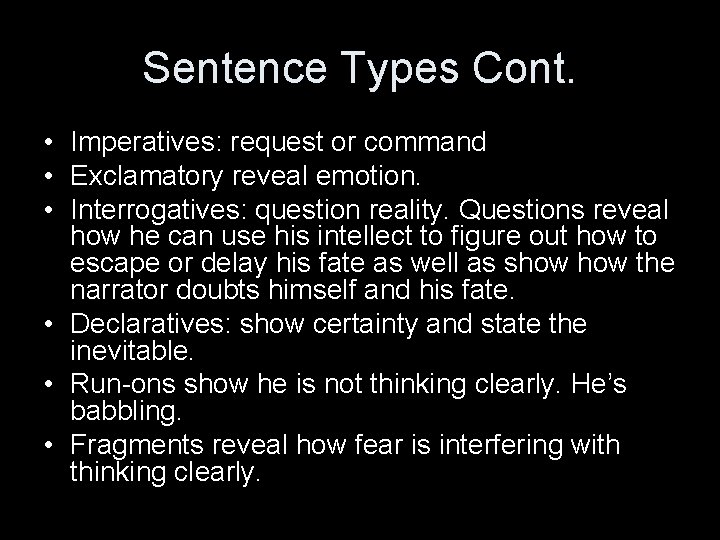
Sentence Types Cont. • Imperatives: request or command • Exclamatory reveal emotion. • Interrogatives: question reality. Questions reveal how he can use his intellect to figure out how to escape or delay his fate as well as show the narrator doubts himself and his fate. • Declaratives: show certainty and state the inevitable. • Run-ons show he is not thinking clearly. He’s babbling. • Fragments reveal how fear is interfering with thinking clearly.
Sentence Patterns: • Periodic vs. Loose sentences show his logic in action vs. his awaiting what is coming. • Interrupted sentences show he his thought process is broken. • Parallelism/anaphora is logical and creates the rhythm of the torture, his heartbeat, and a pattern that our narrator likes to follow.
Patterns cont. • Juxtaposition and antithesis contrast his fate and reality. • Repetition adds to the rhythm of the action, the pacing, his heart etc… This could be sound repetition such as alliteration. • Poly vs Asyndeton are used to interrupt or continue the pattern without stopping… Like the torture. • Chiasmus: Another logical pattern that reverses itself – just like fate is reversed.
Imagery • The lack of sight creates an enhanced sense of the senses. • What emotions are evoked in this story and how do they add to the tone?
Dante’s Method • Historical: The Spanish Inquisition had ended. • Political: • Psychological • Spiritual: • Universal:
Motif & Symbolism • What motifs & symbols are used in the story? • The Pit? • The Rats?