
Plot Conflict What makes a good story Think
- Slides: 19
Plot & Conflict
What makes a good story? Think about some of your all-time favorite stories –in movies, on television, and in books. What makes these stories so compelling? !? • Characteristics of a Good Story:
The Power of a Good Story • As you have seen, many good stories have certain elements in common. Those elements are responsible for holding your interest. A good story: 1. centers around a compelling problem or conflict 2. features characters whom you want to know more about 3. is easy to follow 4. uses techniques to build suspense or keep the audience’s interest.
Plot in Literature • When people talk about what happens in a good story, they are talking about PLOT, or the series of events. • At the heart of any compelling plot is a conflict, or struggle between forces.
What is conflict? • A conflict is a struggle between two opposing forces in the plot of the story. A conflict can be external (against an outside force) or internal (within the character).
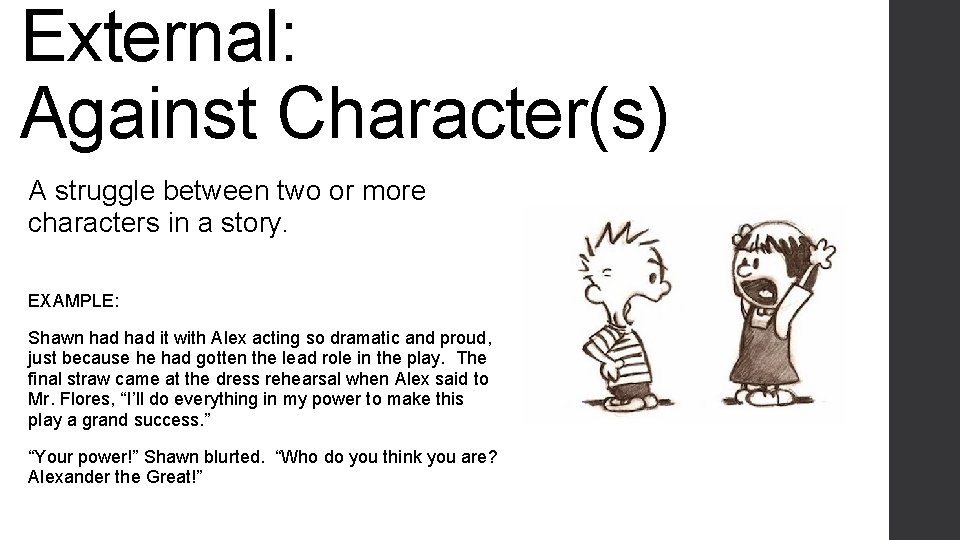
External: Against Character(s) A struggle between two or more characters in a story. EXAMPLE: Shawn had it with Alex acting so dramatic and proud, just because he had gotten the lead role in the play. The final straw came at the dress rehearsal when Alex said to Mr. Flores, “I’ll do everything in my power to make this play a grand success. ” “Your power!” Shawn blurted. “Who do you think you are? Alexander the Great!”
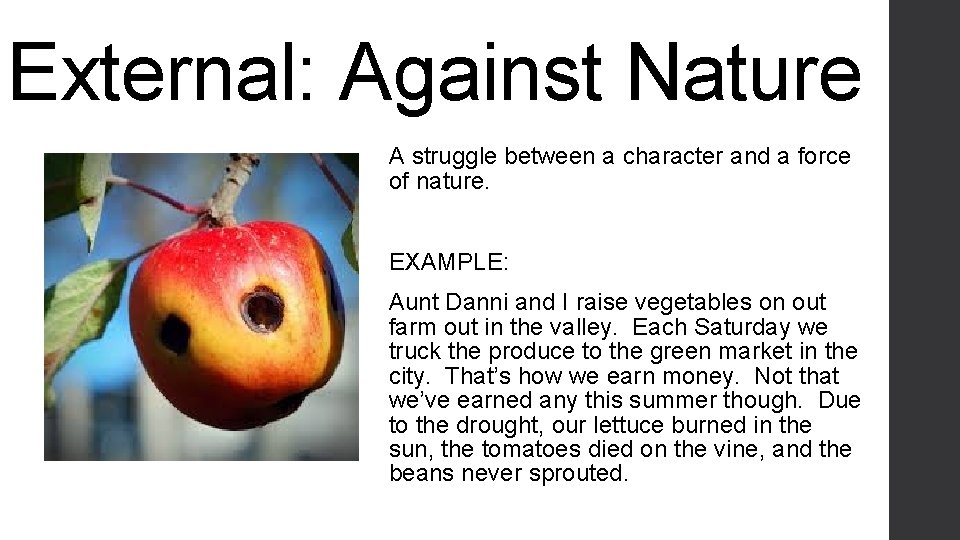
External: Against Nature A struggle between a character and a force of nature. EXAMPLE: Aunt Danni and I raise vegetables on out farm out in the valley. Each Saturday we truck the produce to the green market in the city. That’s how we earn money. Not that we’ve earned any this summer though. Due to the drought, our lettuce burned in the sun, the tomatoes died on the vine, and the beans never sprouted.
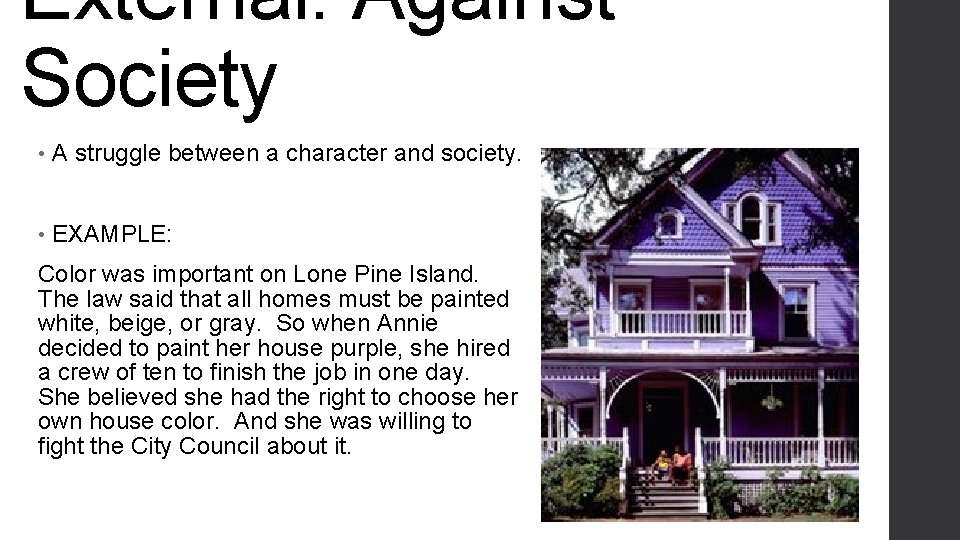
External: Against Society • A struggle between a character and society. • EXAMPLE: Color was important on Lone Pine Island. The law said that all homes must be painted white, beige, or gray. So when Annie decided to paint her house purple, she hired a crew of ten to finish the job in one day. She believed she had the right to choose her own house color. And she was willing to fight the City Council about it.
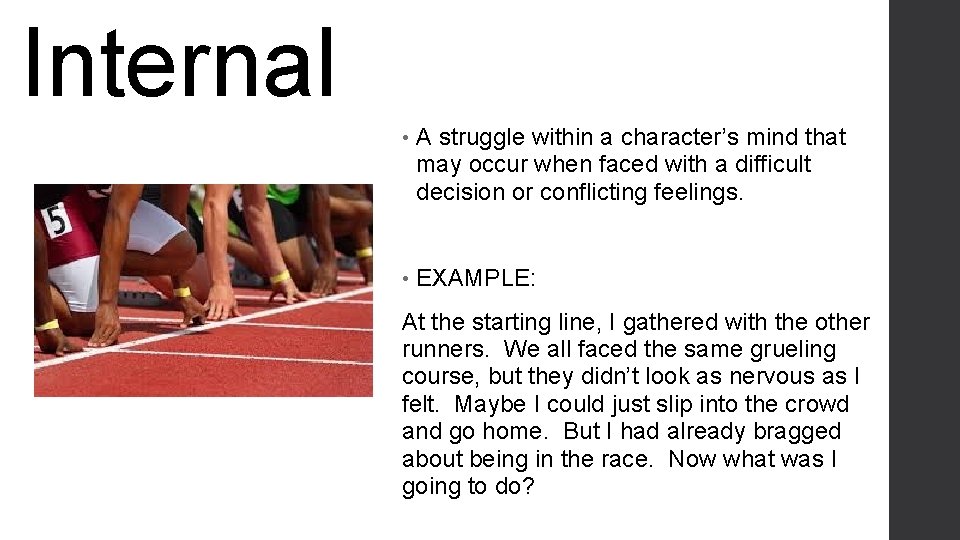
Internal • A struggle within a character’s mind that may occur when faced with a difficult decision or conflicting feelings. • EXAMPLE: At the starting line, I gathered with the other runners. We all faced the same grueling course, but they didn’t look as nervous as I felt. Maybe I could just slip into the crowd and go home. But I had already bragged about being in the race. Now what was I going to do?
NAME THAT CONFLICT!
Identify the Conflict You can use two steps to analyze plot and conflict. Read the passage from “To Build a Fire” by Jack London. Underline details that show the setting affects the man. from “To Build a Fire” by Jack London The exposed fingers were quickly going numb again. Next he brought out his bunch of sulphur matches. But the tremendous cold had already driven the life out of his fingers. In his effort to separate one match from the others, the whole bunch fell into the snow. He tried to pick it out of the snow, but failed. The dead fingers could neither clutch nor touch. He was very careful. He drove thought of his freezing feet, and nose, and cheeks, out of his mind.
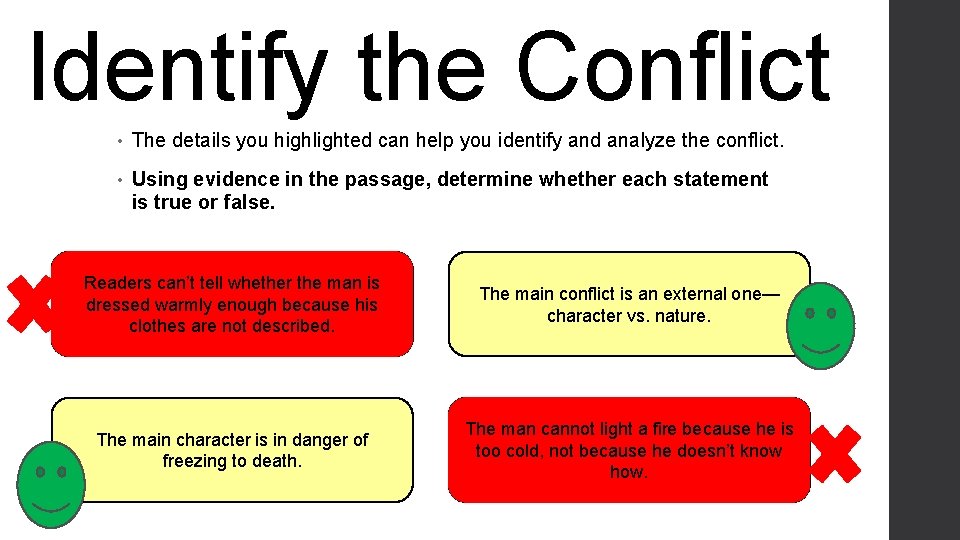
Identify the Conflict • The details you highlighted can help you identify and analyze the conflict. • Using evidence in the passage, determine whether each statement is true or false. Readers can’t tell whether the man is dressed The man warmly is notenough warmlybecause dressed. his clothes are not described. The main conflict is an external one— character vs. nature. The main character is in danger of freezing to death. The man cannot light a fire because he is The main conflict is internal; the man does too cold, not because he doesn’t know not know how to survive. how.
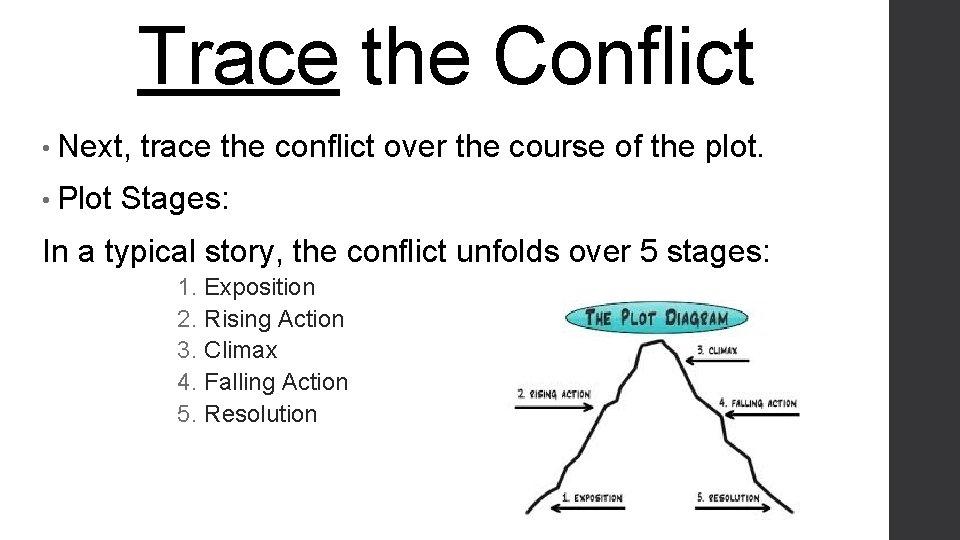
Trace the Conflict • Next, • Plot trace the conflict over the course of the plot. Stages: In a typical story, the conflict unfolds over 5 stages: 1. Exposition 2. Rising Action 3. Climax 4. Falling Action 5. Resolution
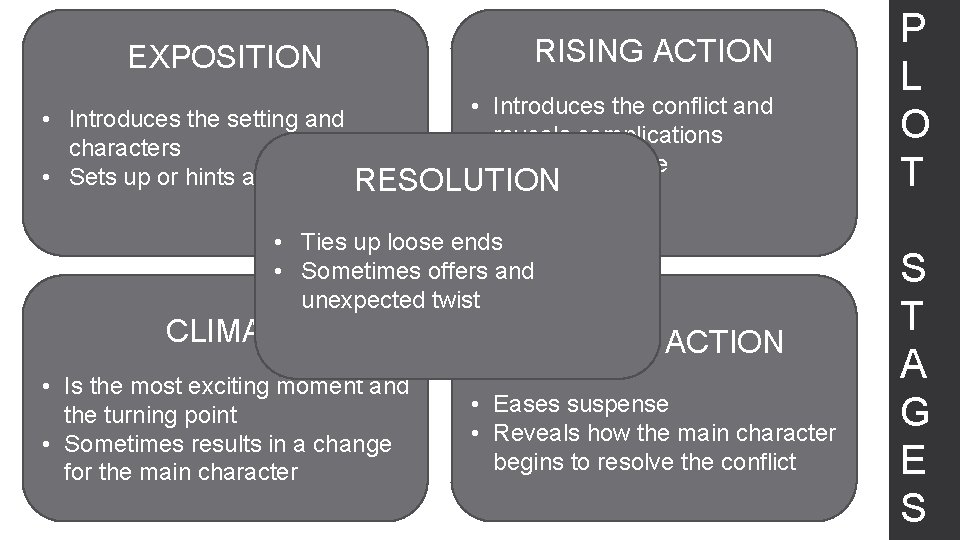
EXPOSITION RISING ACTION • Introduces the conflict and • Introduces the setting and reveals complications characters • Builds suspense • Sets up or hints at the conflict RESOLUTION • Ties up loose ends • Sometimes offers and unexpected twist CLIMAX FALLING ACTION • Is the most exciting moment and the turning point • Sometimes results in a change for the main character • Eases suspense • Reveals how the main character begins to resolve the conflict P L O T S T A G E S
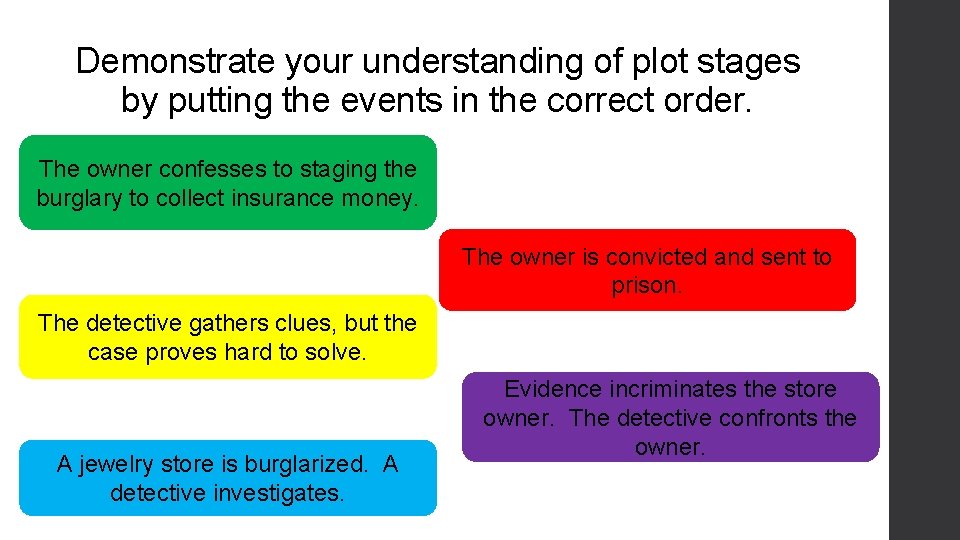
Demonstrate your understanding of plot stages by putting the events in the correct order. The owner confesses to staging the burglary to collect insurance money. The owner is convicted and sent to prison. The detective gathers clues, but the case proves hard to solve. A jewelry store is burglarized. A detective investigates. Evidence incriminates the store owner. The detective confronts the owner.
“John Henry” Directions: Read “John Henry with your should partner. Identify the Exposition, Rising Action, Climax, Falling Action, & Resolution.
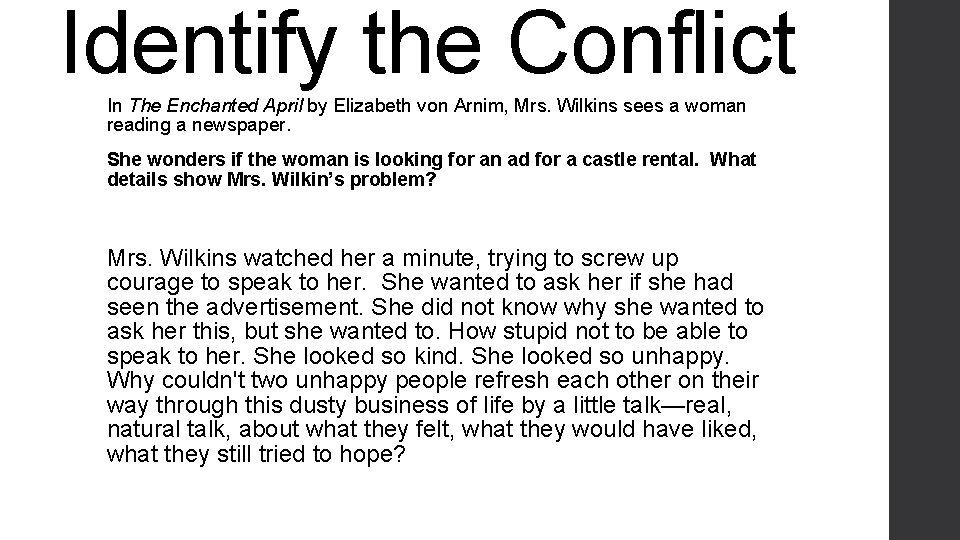
Identify the Conflict In The Enchanted April by Elizabeth von Arnim, Mrs. Wilkins sees a woman reading a newspaper. She wonders if the woman is looking for an ad for a castle rental. What details show Mrs. Wilkin’s problem? Mrs. Wilkins watched her a minute, trying to screw up courage to speak to her. She wanted to ask her if she had seen the advertisement. She did not know why she wanted to ask her this, but she wanted to. How stupid not to be able to speak to her. She looked so kind. She looked so unhappy. Why couldn't two unhappy people refresh each other on their way through this dusty business of life by a little talk—real, natural talk, about what they felt, what they would have liked, what they still tried to hope?
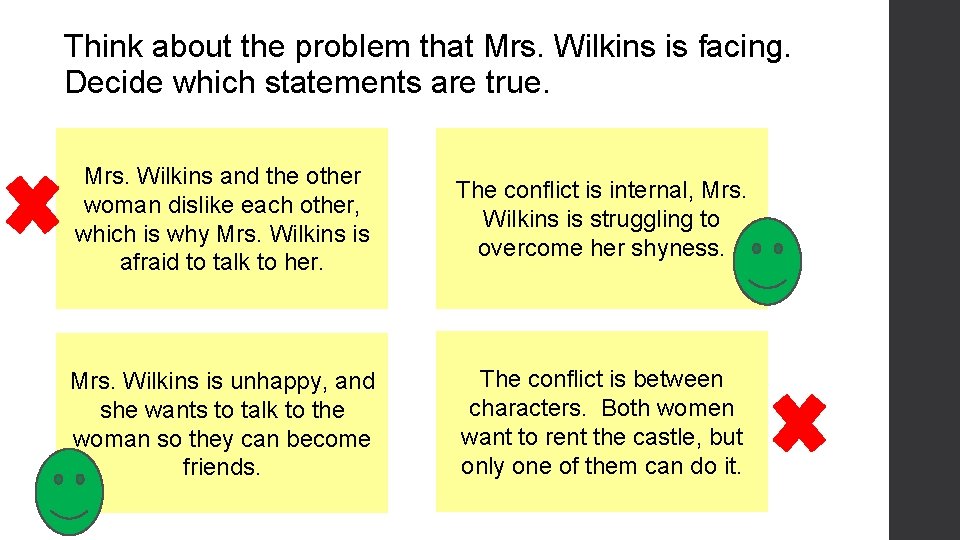
Think about the problem that Mrs. Wilkins is facing. Decide which statements are true. Mrs. Wilkins and the other woman dislike each other, which is why Mrs. Wilkins is afraid to talk to her. The conflict is internal, Mrs. Wilkins is struggling to overcome her shyness. Mrs. Wilkins is unhappy, and she wants to talk to the woman so they can become friends. The conflict is between characters. Both women want to rent the castle, but only one of them can do it.
“An Old Flame” Homework directions: Read a section from the short story, “An Old Flame”. Use your knowledge of Plot & Conflict to answer the questions in complete sentences. Homework is due: Tuesday 9/8 & Wednesday 9/9