
PLEURAL EFFUSION Pleural effusion develops when more fluid

- Slides: 17
PLEURAL EFFUSION Pleural effusion develops when more fluid enters the pleural space than is removed. Mechanisms of pleural fluid accumulation include: • Increased interstitial fluid in the lungs secondary to increased pulmonary capillary pressure (i. e. , heart failure) or permeability (i. e. , pneumonia
Mechanisms of pleural fluid accumulation include. • Decreased intrapleural pressure (i. e. , atelectasis) • decreased plasma oncotic pressure (i. e. , hypoalbuminemia). • increased pleural membrane permeability and obstructed lymphatic flow (e. g. , pleural malignancy or infection); diaphragmatic defects (i. e. , hepatic hydrothorax); and thoracic duct rupture (i. e. , chylothorax).
Initial Evaluation of Pleural Effusion • the most common causes in adults are heart failure, malignancy, pneumonia, tuberculosis, and pulmonary embolism. • The history and physical examination are critical in guiding the evaluation of pleural effusion. Signs and symptoms of an effusion vary depending on the underlying disease, but dyspnea, cough, and pleuritic chest pain are common. • Chest examination of a patient with pleural effusion is notable for dullness to percussion, decreased or absent tactile fremitus, decreased breath sounds, and no voice transmission.
Initial Evaluation of Pleural Effusion • Posteroanterior and lateral chest radiographs usually confirm the presence of a pleural effusion, but if doubt exists, ultrasound or computed tomography (CT) scans are definitive for detecting small effusions and for differentiating pleural fluid from pleural thickening.
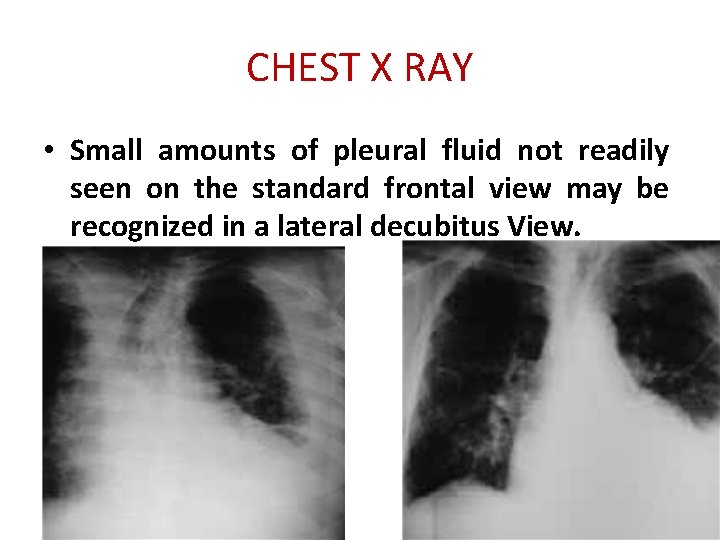
CHEST X RAY • Small amounts of pleural fluid not readily seen on the standard frontal view may be recognized in a lateral decubitus View.
CHEST X RAY • On a posteroanterior radiograph, free pleural fluid may blunt the costophrenic angle; form a meniscus laterally; or hide in a subpulmonic location, simulating an elevated hemidiaphragm. • Large effusions may opacify the entire hemithorax and displace mediastinal structures toward the opposite side
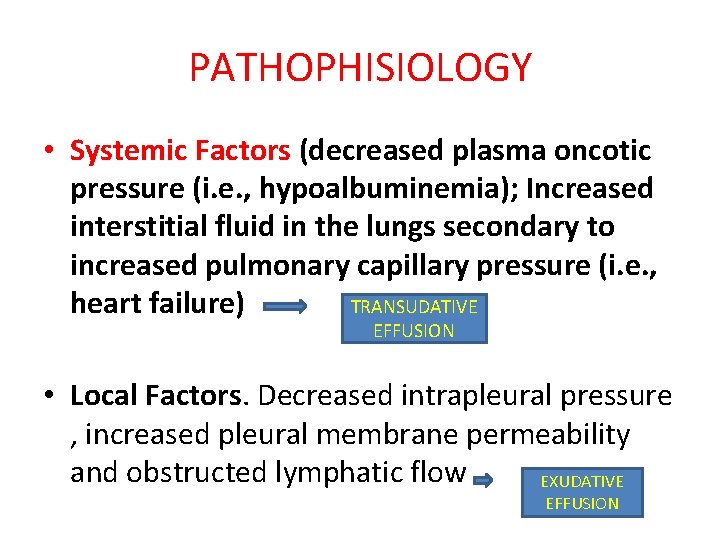
PATHOPHISIOLOGY • Systemic Factors (decreased plasma oncotic pressure (i. e. , hypoalbuminemia); Increased interstitial fluid in the lungs secondary to increased pulmonary capillary pressure (i. e. , TRANSUDATIVE heart failure) EFFUSION • Local Factors. Decreased intrapleural pressure , increased pleural membrane permeability and obstructed lymphatic flow EXUDATIVE EFFUSION
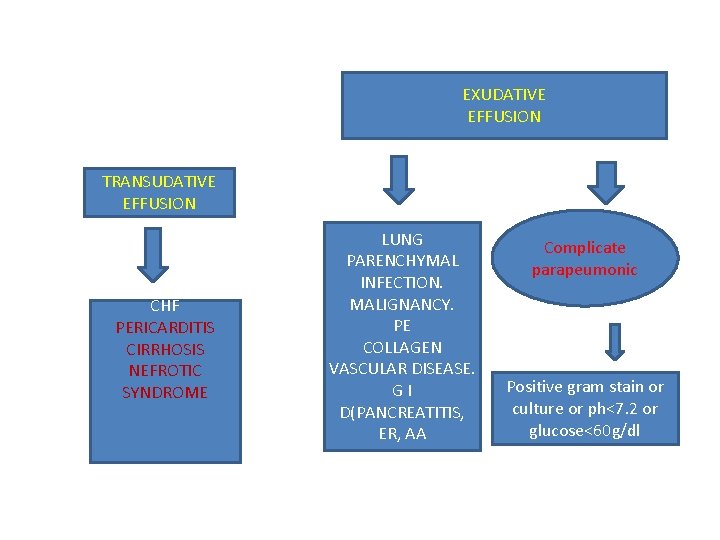
EXUDATIVE EFFUSION TRANSUDATIVE EFFUSION CHF PERICARDITIS CIRRHOSIS NEFROTIC SYNDROME PRI LUNG PARENCHYMAL INFECTION. MALIGNANCY. PE COLLAGEN VASCULAR DISEASE. GI D(PANCREATITIS, ER, AA Complicate parapeumonic Positive gram stain or culture or ph<7. 2 or glucose<60 g/dl
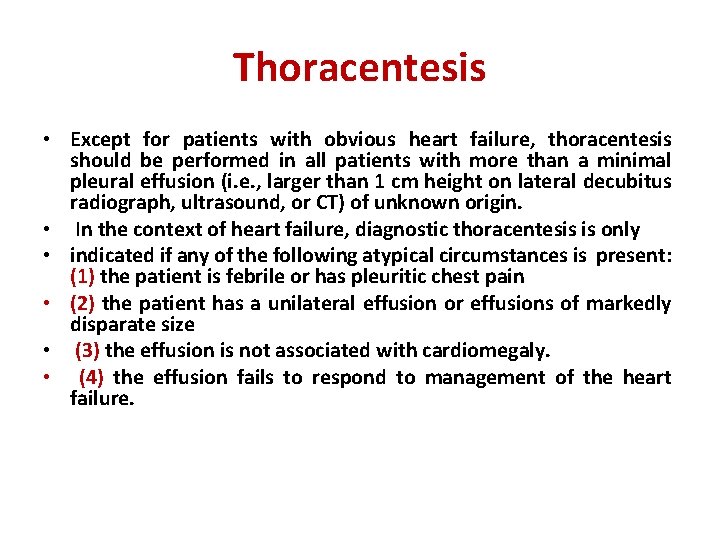
Thoracentesis • Except for patients with obvious heart failure, thoracentesis should be performed in all patients with more than a minimal pleural effusion (i. e. , larger than 1 cm height on lateral decubitus radiograph, ultrasound, or CT) of unknown origin. • In the context of heart failure, diagnostic thoracentesis is only • indicated if any of the following atypical circumstances is present: (1) the patient is febrile or has pleuritic chest pain • (2) the patient has a unilateral effusion or effusions of markedly disparate size • (3) the effusion is not associated with cardiomegaly. • (4) the effusion fails to respond to management of the heart failure.
Thoracentesis • Thoracentesis is urgent when it is suspected that blood (i. e. , hemothorax) or pus (i. e. , empyema) is in the pleural space, because immediate tube thoracostomy is indicated in these situations.
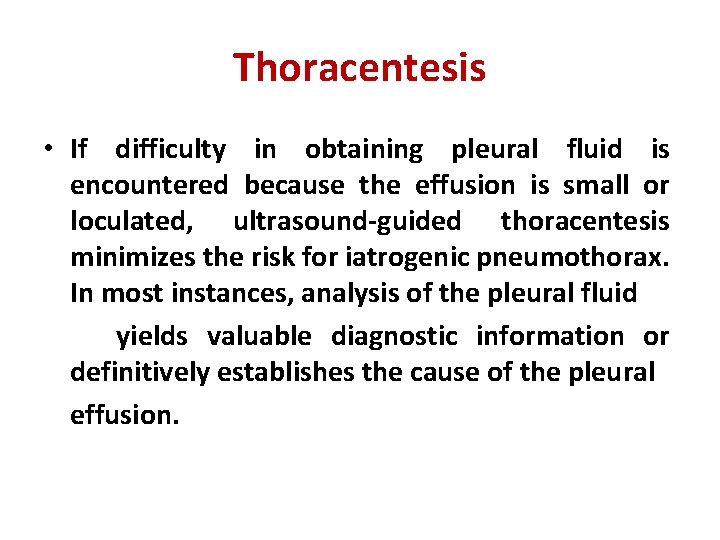
Thoracentesis • If difficulty in obtaining pleural fluid is encountered because the effusion is small or loculated, ultrasound-guided thoracentesis minimizes the risk for iatrogenic pneumothorax. In most instances, analysis of the pleural fluid yields valuable diagnostic information or definitively establishes the cause of the pleural effusion.
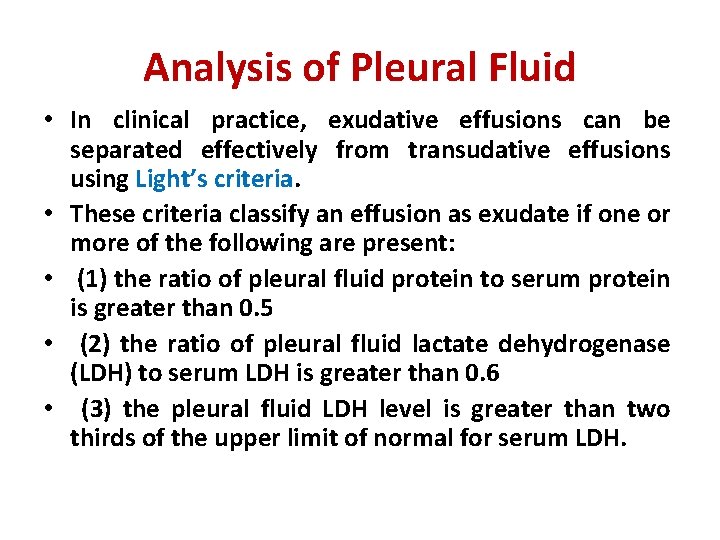
Analysis of Pleural Fluid • In clinical practice, exudative effusions can be separated effectively from transudative effusions using Light’s criteria. • These criteria classify an effusion as exudate if one or more of the following are present: • (1) the ratio of pleural fluid protein to serum protein is greater than 0. 5 • (2) the ratio of pleural fluid lactate dehydrogenase (LDH) to serum LDH is greater than 0. 6 • (3) the pleural fluid LDH level is greater than two thirds of the upper limit of normal for serum LDH.
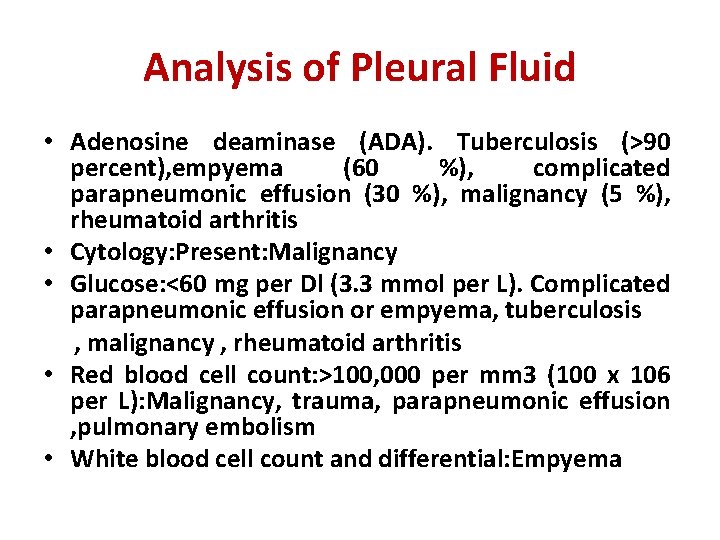
Analysis of Pleural Fluid • Adenosine deaminase (ADA). Tuberculosis (>90 percent), empyema (60 %), complicated parapneumonic effusion (30 %), malignancy (5 %), rheumatoid arthritis • Cytology: Present: Malignancy • Glucose: <60 mg per Dl (3. 3 mmol per L). Complicated parapneumonic effusion or empyema, tuberculosis , malignancy , rheumatoid arthritis • Red blood cell count: >100, 000 per mm 3 (100 x 106 per L): Malignancy, trauma, parapneumonic effusion , pulmonary embolism • White blood cell count and differential: Empyema
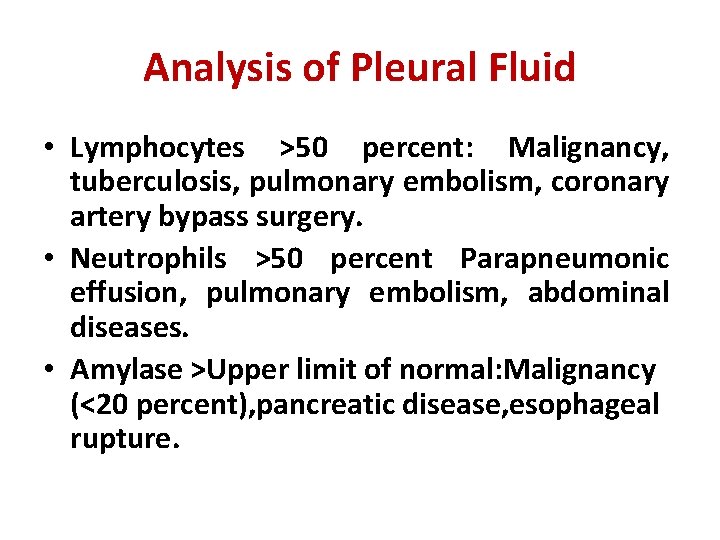
Analysis of Pleural Fluid • Lymphocytes >50 percent: Malignancy, tuberculosis, pulmonary embolism, coronary artery bypass surgery. • Neutrophils >50 percent Parapneumonic effusion, pulmonary embolism, abdominal diseases. • Amylase >Upper limit of normal: Malignancy (<20 percent), pancreatic disease, esophageal rupture.
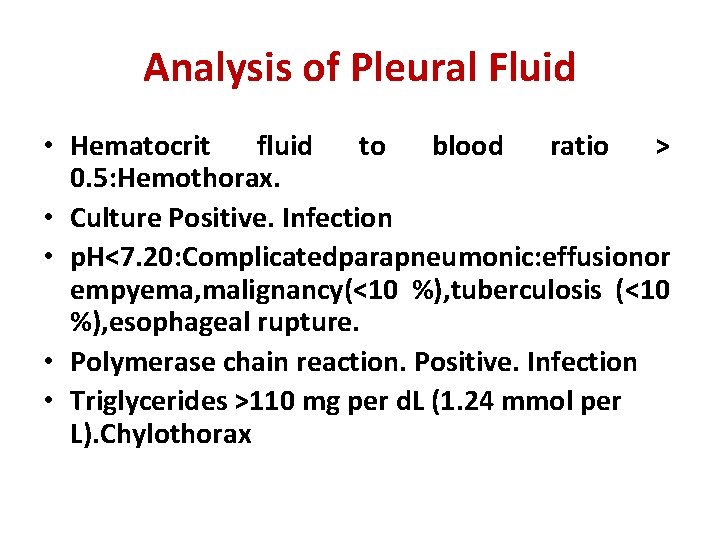
Analysis of Pleural Fluid • Hematocrit fluid to blood ratio > 0. 5: Hemothorax. • Culture Positive. Infection • p. H<7. 20: Complicatedparapneumonic: effusionor empyema, malignancy(<10 %), tuberculosis (<10 %), esophageal rupture. • Polymerase chain reaction. Positive. Infection • Triglycerides >110 mg per d. L (1. 24 mmol per L). Chylothorax
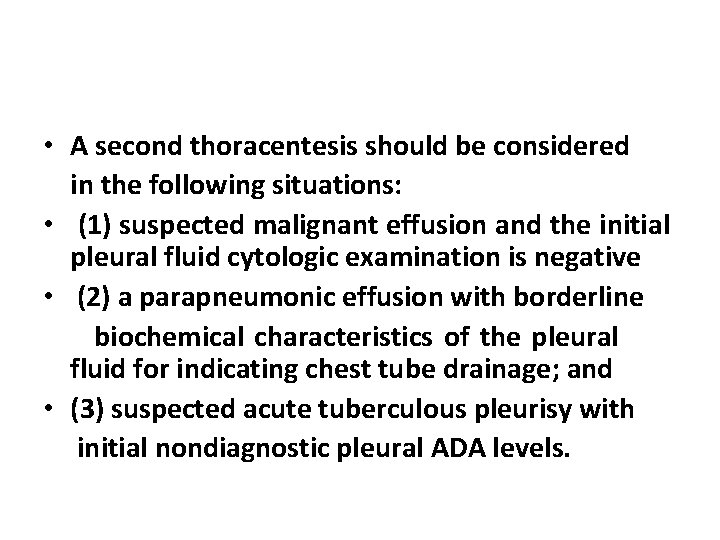
• A second thoracentesis should be considered in the following situations: • (1) suspected malignant effusion and the initial pleural fluid cytologic examination is negative • (2) a parapneumonic effusion with borderline biochemical characteristics of the pleural fluid for indicating chest tube drainage; and • (3) suspected acute tuberculous pleurisy with initial nondiagnostic pleural ADA levels.
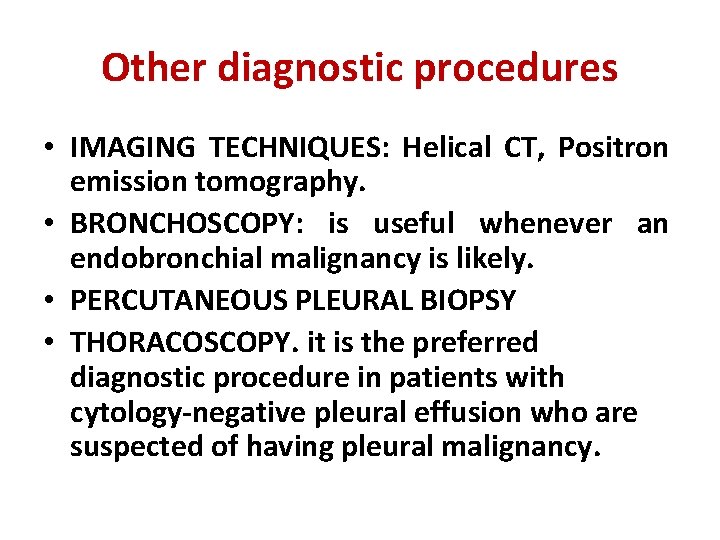
Other diagnostic procedures • IMAGING TECHNIQUES: Helical CT, Positron emission tomography. • BRONCHOSCOPY: is useful whenever an endobronchial malignancy is likely. • PERCUTANEOUS PLEURAL BIOPSY • THORACOSCOPY. it is the preferred diagnostic procedure in patients with cytology-negative pleural effusion who are suspected of having pleural malignancy.