
PLEURA LUNG Prof Saeed Abuel Makarem Objectives By
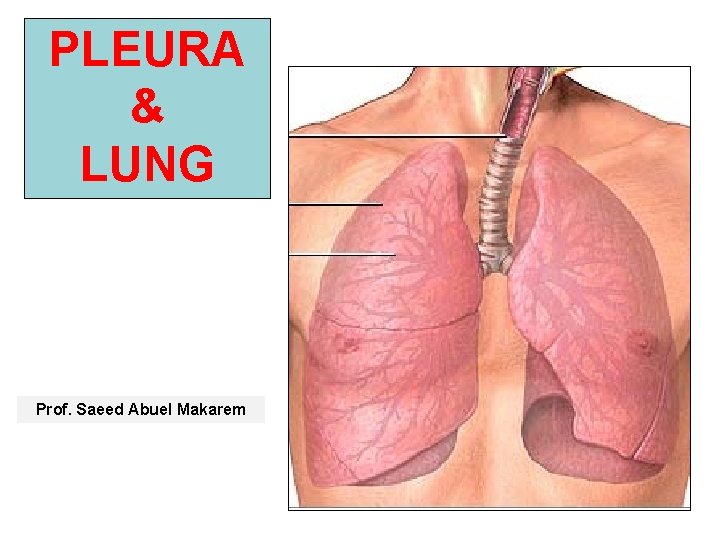
PLEURA & LUNG Prof. Saeed Abuel Makarem
Objectives By the end of the lecture, you should be able to: • Describe the anatomy of the pleura: Subdivisions: parietal & visceral pleurae, nerve supply of each part. • List the parts of parietal pleura and its recesses. • Describe the surface anatomy of both pleurae and lungs. • Describe the anatomy of lungs: shape, relations, nerve supply, blood supply. • Describe the difference between right & left lungs. • Describe the formation of bronchopulmonary segments and the main characteristics of these segment in the lung.
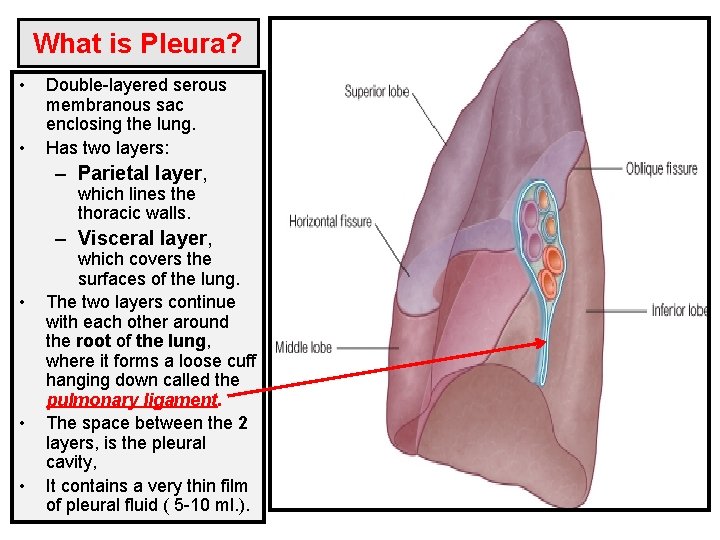
What is Pleura? • • Double-layered serous membranous sac enclosing the lung. Has two layers: – Parietal layer, which lines the thoracic walls. – Visceral layer, • • • which covers the surfaces of the lung. The two layers continue with each other around the root of the lung, where it forms a loose cuff hanging down called the pulmonary ligament. The space between the 2 layers, is the pleural cavity, It contains a very thin film of pleural fluid ( 5 -10 ml. ).
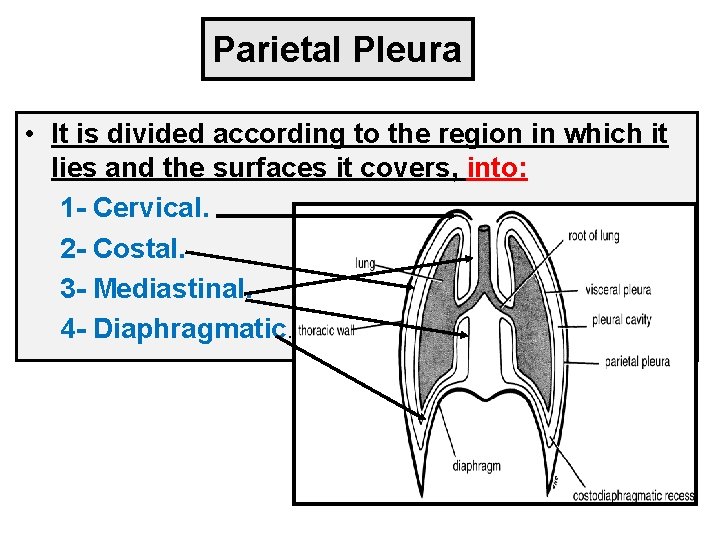
Parietal Pleura • It is divided according to the region in which it lies and the surfaces it covers, into: 1 - Cervical. 2 - Costal. 3 - Mediastinal. 4 - Diaphragmatic.
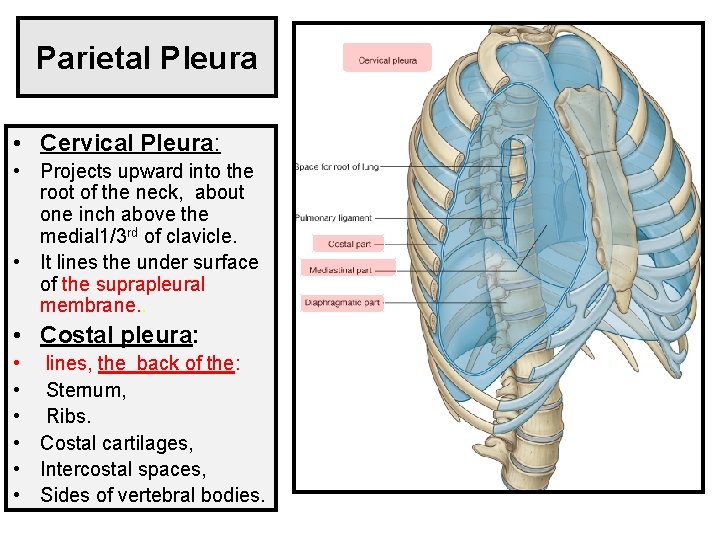
Parietal Pleura • Cervical Pleura: • Projects upward into the root of the neck, about one inch above the medial 1/3 rd of clavicle. • It lines the under surface of the suprapleural membrane. . • Costal pleura: • lines, the back of the: • Sternum, • Ribs. • Costal cartilages, • Intercostal spaces, • Sides of vertebral bodies.
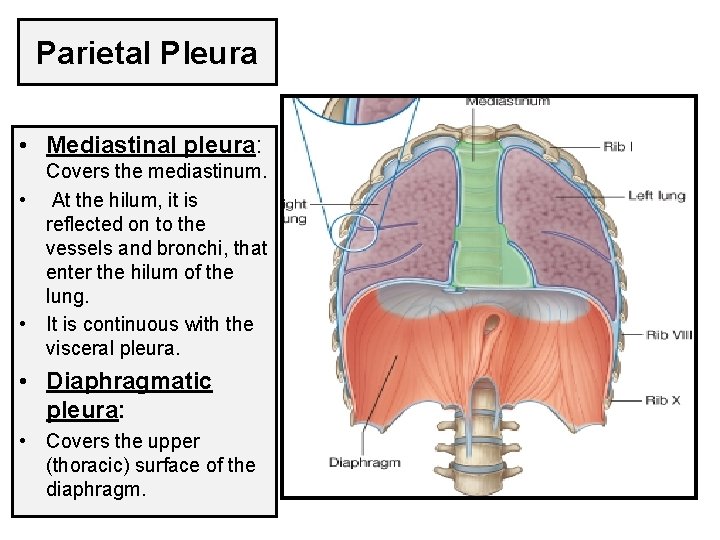
Parietal Pleura • Mediastinal pleura: Covers the mediastinum. • At the hilum, it is reflected on to the vessels and bronchi, that enter the hilum of the lung. • It is continuous with the visceral pleura. • Diaphragmatic pleura: • Covers the upper (thoracic) surface of the diaphragm.

Pleural Recesses Costodiaphragmatic: • Slit like space between costal & diaphragmatic pleurae, along the inferior border of the lung. • The lung enters through it only in deep inspiration. Costomediastinal: • Slit like space between costal and mediastinal pleurae, along the anterior border of the lung. • The lung enters through it only in deep inspiration.
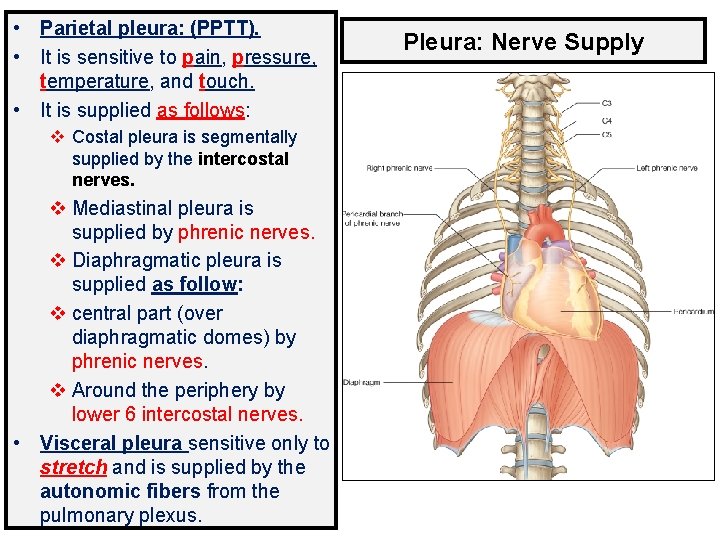
• Parietal pleura: (PPTT). • It is sensitive to pain, pressure, temperature, and touch. • It is supplied as follows: v Costal pleura is segmentally supplied by the intercostal nerves. v Mediastinal pleura is supplied by phrenic nerves. v Diaphragmatic pleura is supplied as follow: v central part (over diaphragmatic domes) by phrenic nerves. v Around the periphery by lower 6 intercostal nerves. • Visceral pleura sensitive only to stretch and is supplied by the autonomic fibers from the pulmonary plexus. Pleura: Nerve Supply
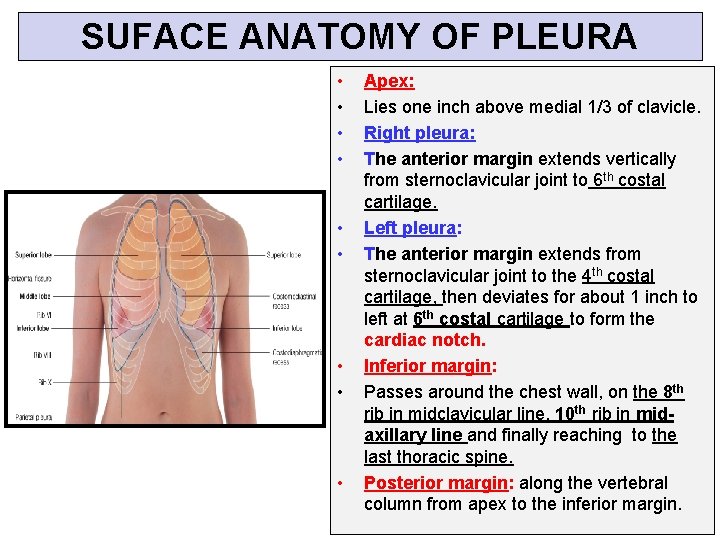
SUFACE ANATOMY OF PLEURA • • • Apex: Lies one inch above medial 1/3 of clavicle. Right pleura: The anterior margin extends vertically from sternoclavicular joint to 6 th costal cartilage. Left pleura: The anterior margin extends from sternoclavicular joint to the 4 th costal cartilage, then deviates for about 1 inch to left at 6 th costal cartilage to form the cardiac notch. Inferior margin: Passes around the chest wall, on the 8 th rib in midclavicular line, 10 th rib in midaxillary line and finally reaching to the last thoracic spine. Posterior margin: along the vertebral column from apex to the inferior margin.
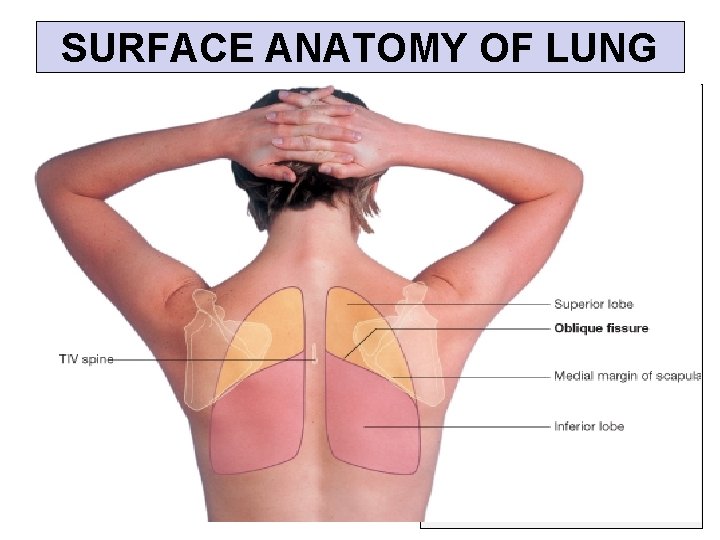
SURFACE ANATOMY OF LUNG • Apex, anterior border and posterior border correspond nearly to the lines of pleura but are slightly away from the median plane. • Inferior margin: as the pleura but more horizontally and finally reaching to the 10 th thoracic spine. Oblique fissure: • Represented by a line extending from 3 rd thoracic spine, obliquely ending at 6 th costal cartilage. Transverse fissure: Only in the right lung: represented by a line extending from 4 th right costal cartilage to meet the oblique fissure.
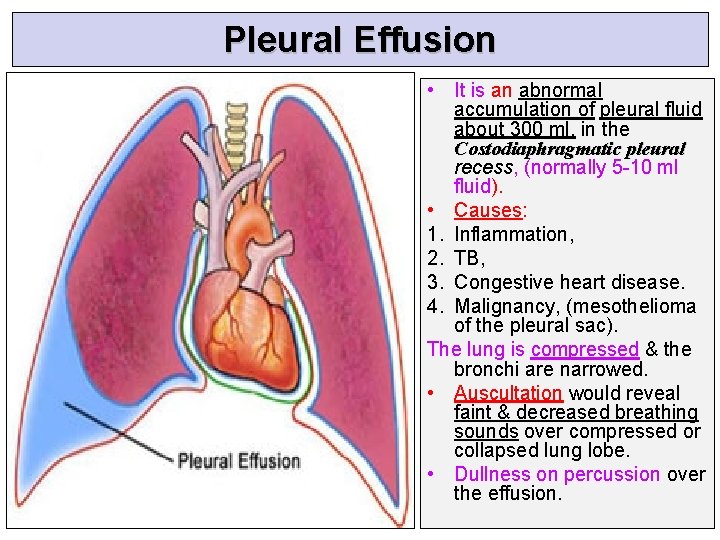
Pleural Effusion • It is an abnormal accumulation of pleural fluid about 300 ml, in the Costodiaphragmatic pleural recess, (normally 5 -10 ml fluid). • Causes: 1. Inflammation, 2. TB, 3. Congestive heart disease. 4. Malignancy, (mesothelioma of the pleural sac). The lung is compressed & the bronchi are narrowed. • Auscultation would reveal faint & decreased breathing sounds over compressed or collapsed lung lobe. • Dullness on percussion over the effusion.
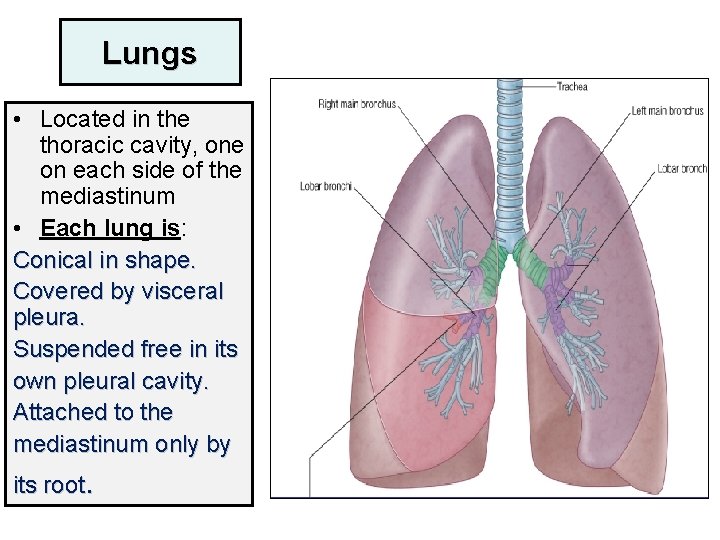
Lungs • Located in the thoracic cavity, one on each side of the mediastinum • Each lung is: Conical in shape. Covered by visceral pleura. Suspended free in its own pleural cavity. Attached to the mediastinum only by its root.
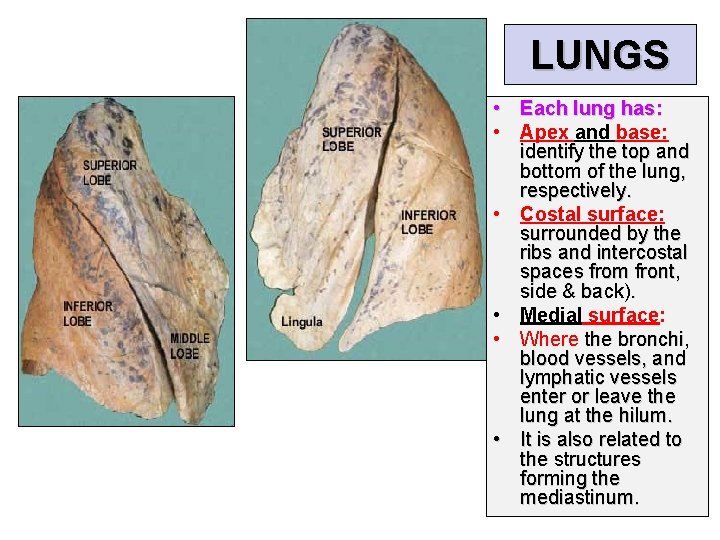
LUNGS • Each lung has: • Apex and base: identify the top and bottom of the lung, respectively. • Costal surface: surrounded by the ribs and intercostal spaces from front, side & back). • Medial surface: • Where the bronchi, blood vessels, and lymphatic vessels enter or leave the lung at the hilum. • It is also related to the structures forming the mediastinum.
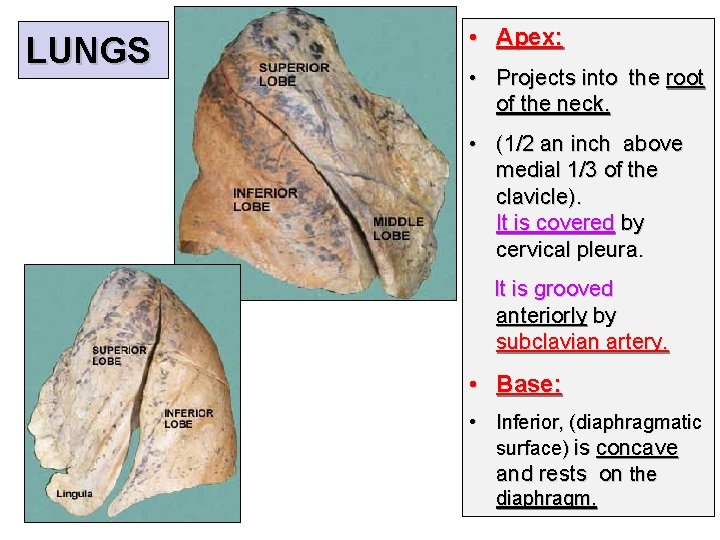
LUNGS • Apex: • Projects into the root of the neck. • (1/2 an inch above medial 1/3 of the clavicle). It is covered by cervical pleura. It is grooved anteriorly by subclavian artery. • Base: • Inferior, (diaphragmatic surface) is concave and rests on the diaphragm.
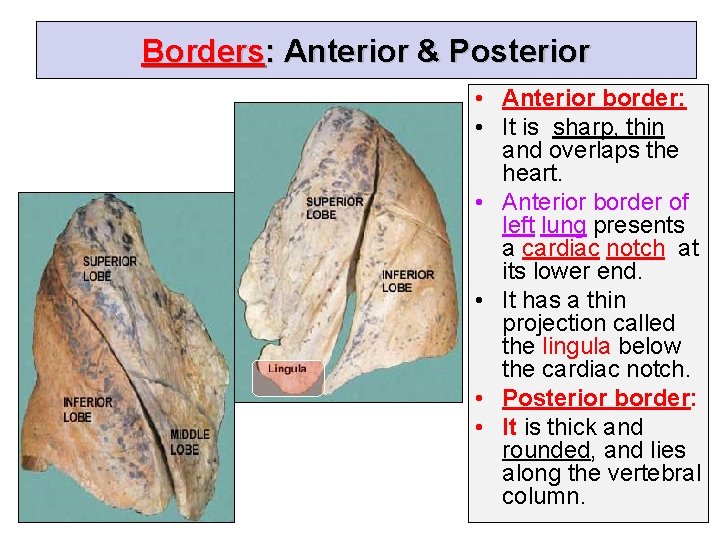
Borders: Anterior & Posterior • Anterior border: • It is sharp, thin and overlaps the heart. • Anterior border of left lung presents a cardiac notch at its lower end. • It has a thin projection called the lingula below the cardiac notch. • Posterior border: • It is thick and rounded, and lies along the vertebral column.
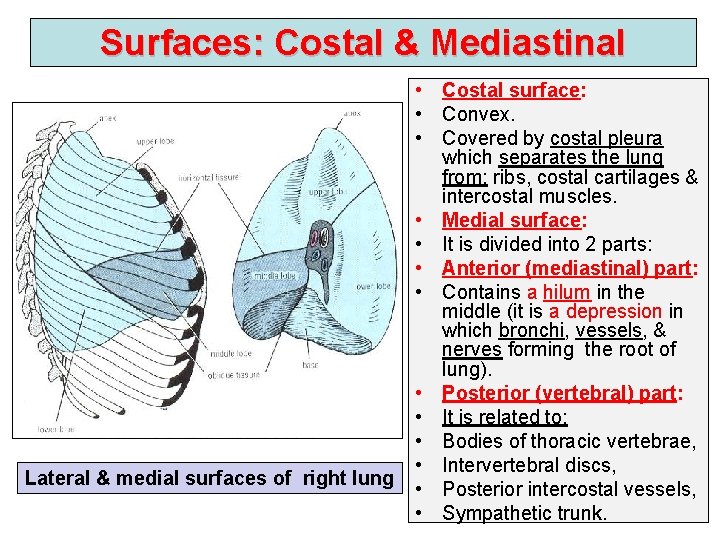
Surfaces: Costal & Mediastinal Lateral & medial surfaces of right lung • Costal surface: • Convex. • Covered by costal pleura which separates the lung from: ribs, costal cartilages & intercostal muscles. • Medial surface: • It is divided into 2 parts: • Anterior (mediastinal) part: • Contains a hilum in the middle (it is a depression in which bronchi, vessels, & nerves forming the root of lung). • Posterior (vertebral) part: • It is related to: • Bodies of thoracic vertebrae, • Intervertebral discs, • Posterior intercostal vessels, • Sympathetic trunk.
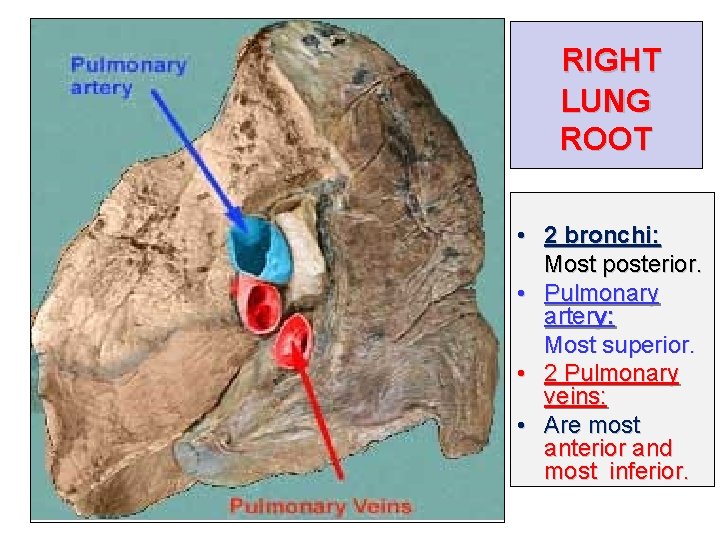
RIGHT LUNG ROOT • 2 bronchi: Most posterior. • Pulmonary artery: Most superior. • 2 Pulmonary veins: • Are most anterior and most inferior.
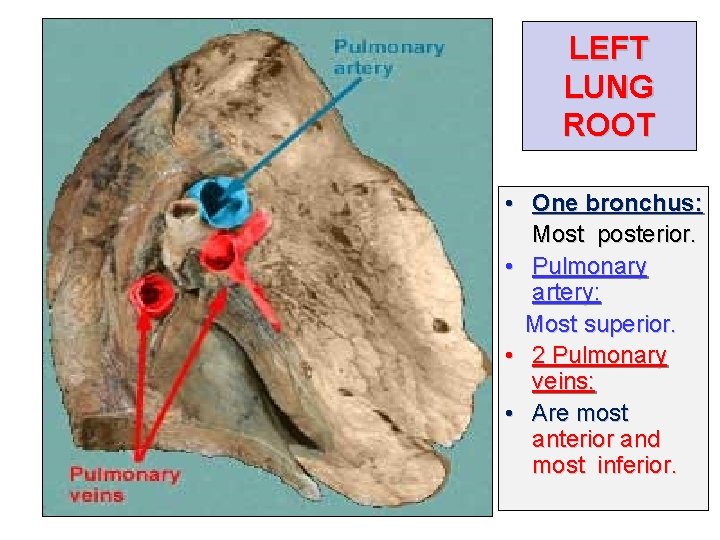
LEFT LUNG ROOT • One bronchus: Most posterior. • Pulmonary artery: Most superior. • 2 Pulmonary veins: • Are most anterior and most inferior.
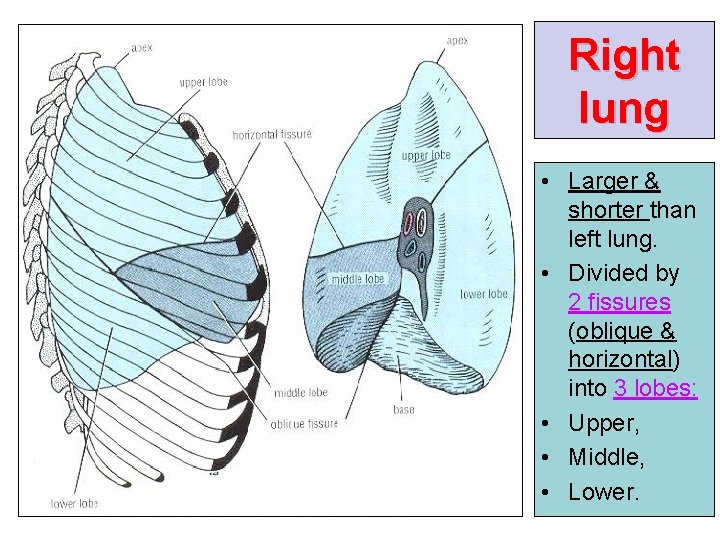
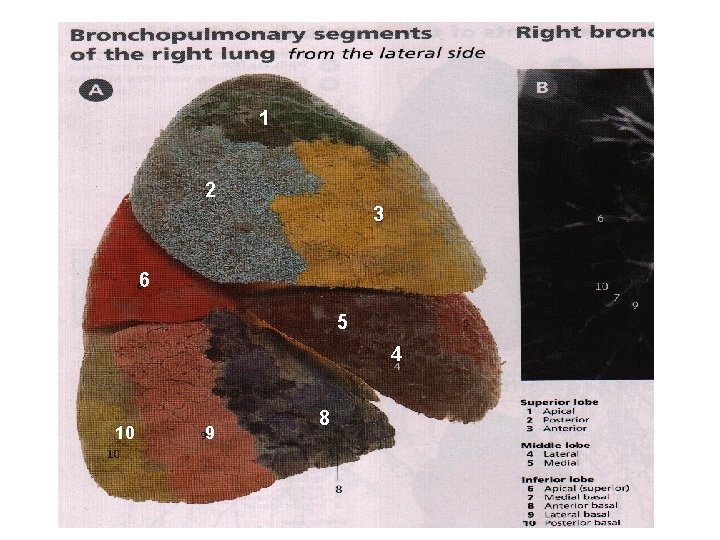
Right lung • Larger & shorter than left lung. • Divided by 2 fissures (oblique & horizontal) into 3 lobes: • Upper, • Middle, • Lower.
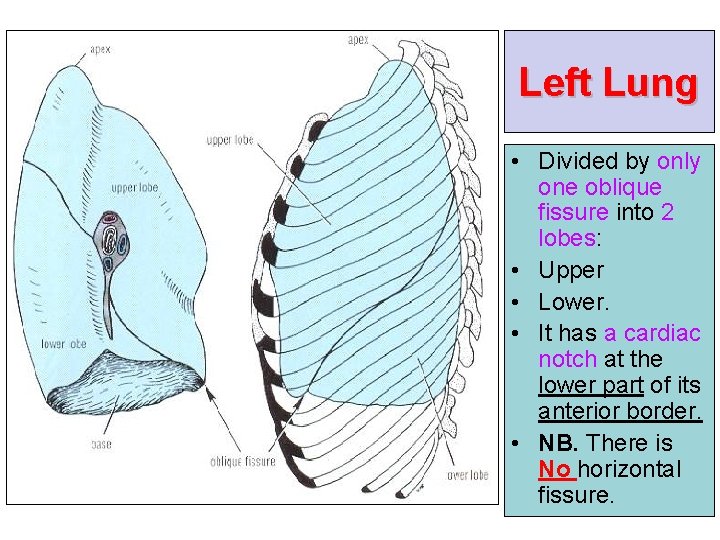
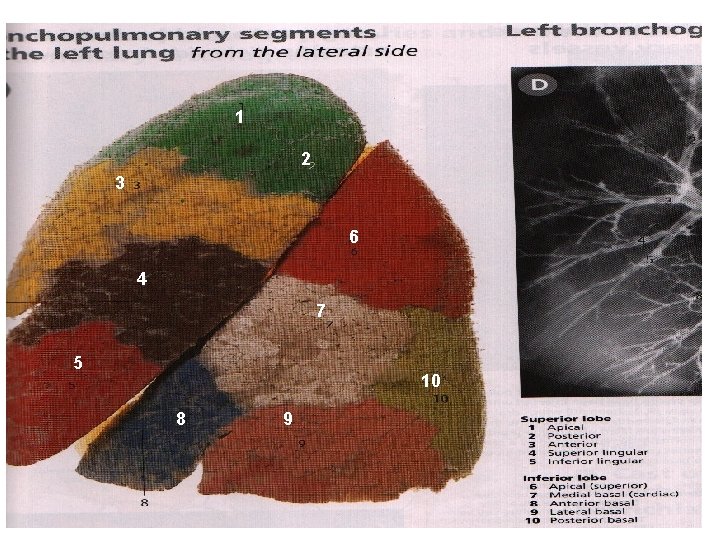
Left Lung • Divided by only one oblique fissure into 2 lobes: • Upper • Lower. • It has a cardiac notch at the lower part of its anterior border. • NB. There is No horizontal fissure.
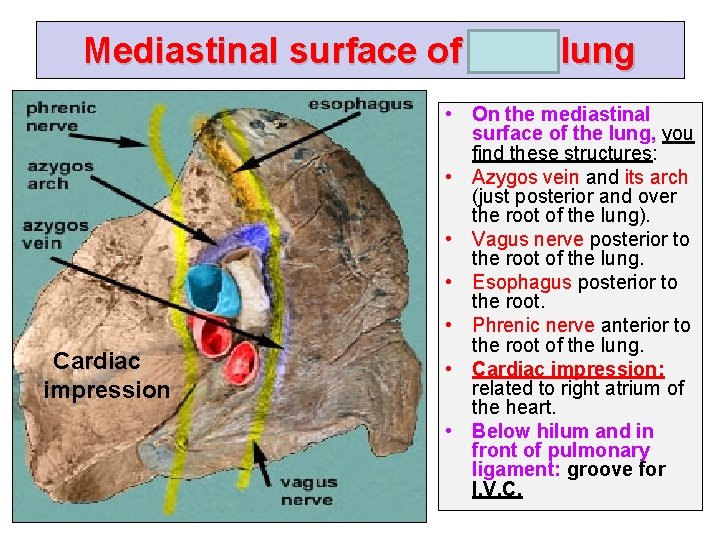
Mediastinal surface of right lung Cardiac impression • On the mediastinal surface of the lung, you find these structures: • Azygos vein and its arch (just posterior and over the root of the lung). • Vagus nerve posterior to the root of the lung. • Esophagus posterior to the root. • Phrenic nerve anterior to the root of the lung. • Cardiac impression: related to right atrium of the heart. • Below hilum and in front of pulmonary ligament: groove for I. V. C.
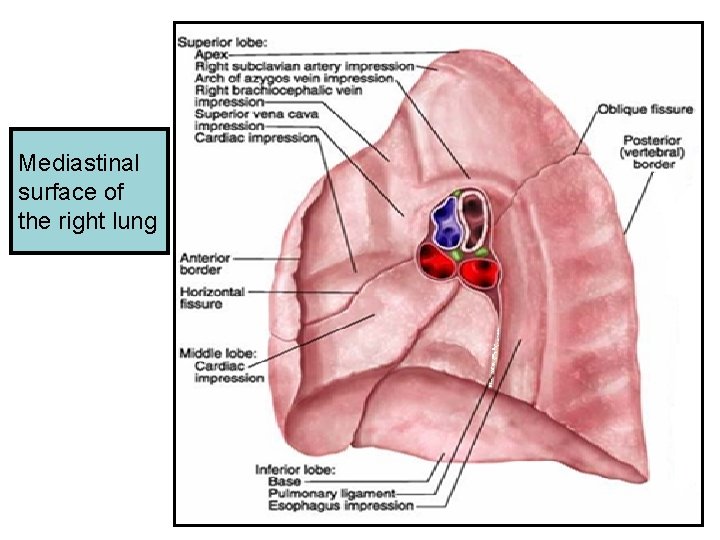
Mediastinal surface of the right lung
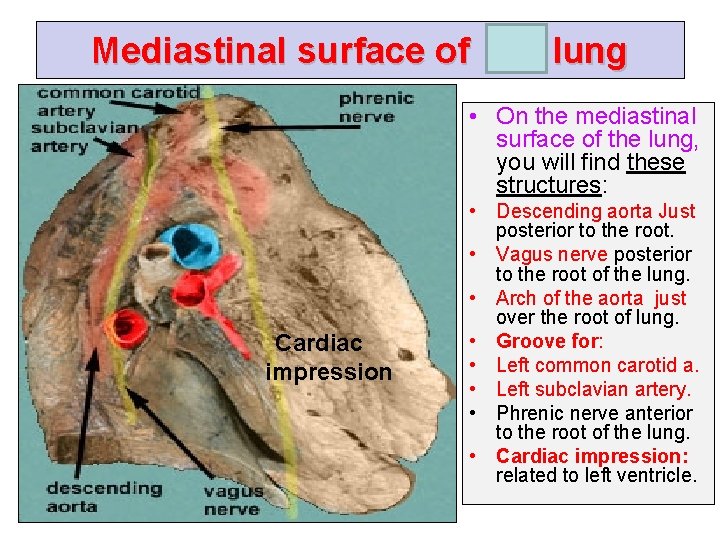
Mediastinal surface of left lung • On the mediastinal surface of the lung, you will find these structures: Cardiac impression • Descending aorta Just posterior to the root. • Vagus nerve posterior to the root of the lung. • Arch of the aorta just over the root of lung. • Groove for: • Left common carotid a. • Left subclavian artery. • Phrenic nerve anterior to the root of the lung. • Cardiac impression: related to left ventricle.
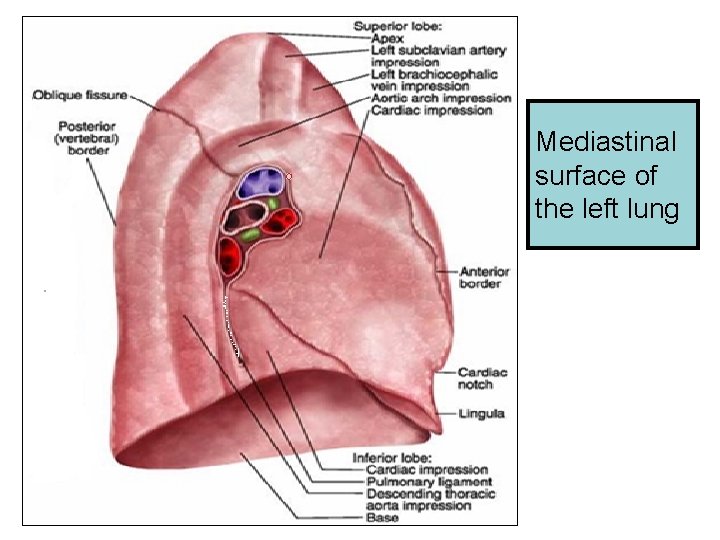
Mediastinal surface of the left lung
Blood supply of lung • Bronchial arteries (From descending thoracic aorta). It supply oxygenated blood to bronchi, lung tissue & visceral pleura. • Bronchial veins: drain into azygos & hemiazygos veins. • Pulmonary artery which carries non -oxygenated blood from right ventricle to the lung alveoli. • 2 pulmonary veins: carry oxygenated blood from lung alveoli to the left atrium of the heart.
Nerve Supply of the lung • Pulmonary plexus at the root of lung…. is formed of autonomic nervous system. (sympathetic & parasympathetic fibers). 1 - Sympathetic Fibers: From … Sympathetic trunk. Action: broncho-dilatation and vasoconstriction. 2 - Parasympathetic Fibers: From…. . Vagus nerve. Action: Broncho-constriction and secretomotor to bronchial glands and vasodilatation.
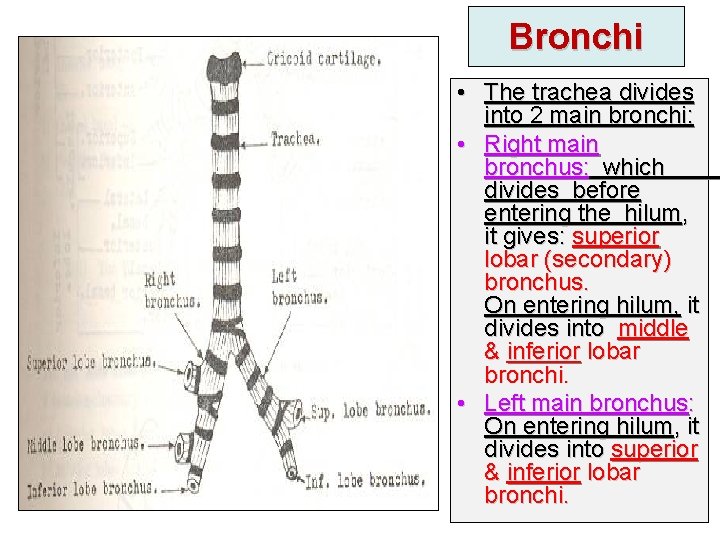
Bronchi • The trachea divides into 2 main bronchi: • Right main bronchus: which divides before entering the hilum, it gives: superior lobar (secondary) bronchus. On entering hilum, it divides into middle & inferior lobar bronchi. • Left main bronchus: On entering hilum, it divides into superior & inferior lobar bronchi.
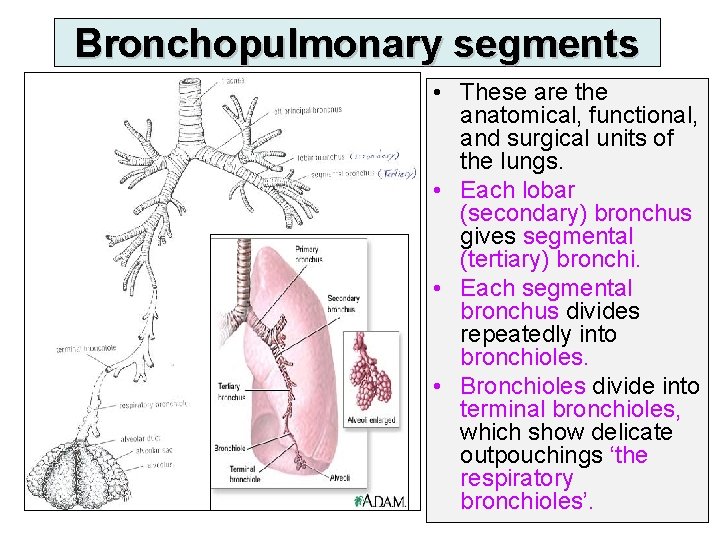
Bronchopulmonary segments • These are the anatomical, functional, and surgical units of the lungs. • Each lobar (secondary) bronchus gives segmental (tertiary) bronchi. • Each segmental bronchus divides repeatedly into bronchioles. • Bronchioles divide into terminal bronchioles, which show delicate outpouchings ‘the respiratory bronchioles’.
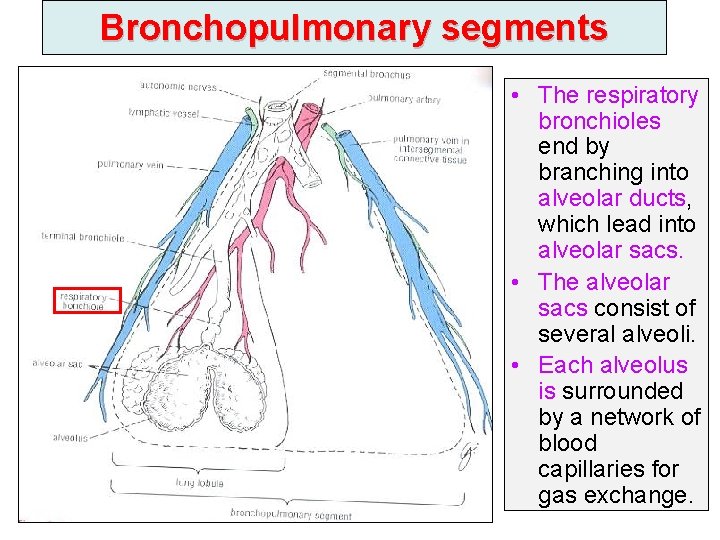
Bronchopulmonary segments • The respiratory bronchioles end by branching into alveolar ducts, which lead into alveolar sacs. • The alveolar sacs consist of several alveoli. • Each alveolus is surrounded by a network of blood capillaries for gas exchange.
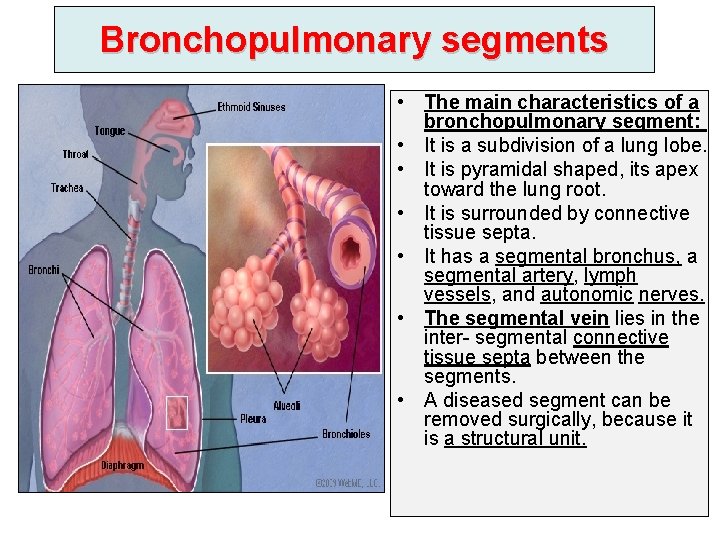
Bronchopulmonary segments • The main characteristics of a bronchopulmonary segment: • It is a subdivision of a lung lobe. • It is pyramidal shaped, its apex toward the lung root. • It is surrounded by connective tissue septa. • It has a segmental bronchus, a segmental artery, lymph vessels, and autonomic nerves. • The segmental vein lies in the inter- segmental connective tissue septa between the segments. • A diseased segment can be removed surgically, because it is a structural unit.
1 2 3 6 4 7 5 10 8 9
1 2 3 6 5 4 10 9 8

- Slides: 33