
Plenary Session Policy Component Dugong Seagrass Conservation Project

- Slides: 32
Plenary Session – Policy Component Dugong & Seagrass Conservation Project 3 rd Executive Project Steering Committee meeting 21 -23 November, 2017 Trang, Thailand
Objectives • • Review current integration of priorities and measures into relevant policy, planning and regulatory frameworks Introduce a flexible model for 1) strategic environmental assessment and 2) policy gap analysis that can be used to aid in delivering project outputs (i. e. gaps and recommendations) – – • Identify critical connections that can create enabling conditions and overcome barriers Identify effective policy integration and indicators of success (KPIs) Discuss models through use of case study of Abu Dhabi
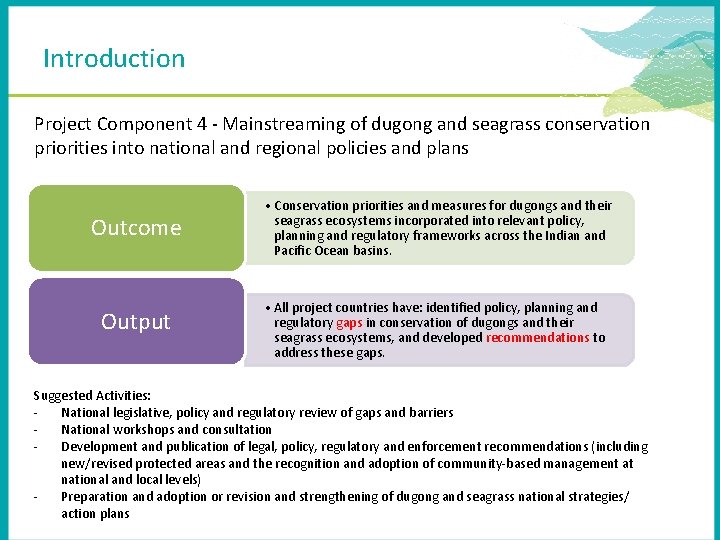
Introduction Project Component 4 - Mainstreaming of dugong and seagrass conservation priorities into national and regional policies and plans Outcome Output • Conservation priorities and measures for dugongs and their seagrass ecosystems incorporated into relevant policy, planning and regulatory frameworks across the Indian and Pacific Ocean basins. • All project countries have: identified policy, planning and regulatory gaps in conservation of dugongs and their seagrass ecosystems, and developed recommendations to address these gaps. Suggested Activities: National legislative, policy and regulatory review of gaps and barriers National workshops and consultation Development and publication of legal, policy, regulatory and enforcement recommendations (including new/revised protected areas and the recognition and adoption of community-based management at national and local levels) Preparation and adoption or revision and strengthening of dugong and seagrass national strategies/ action plans
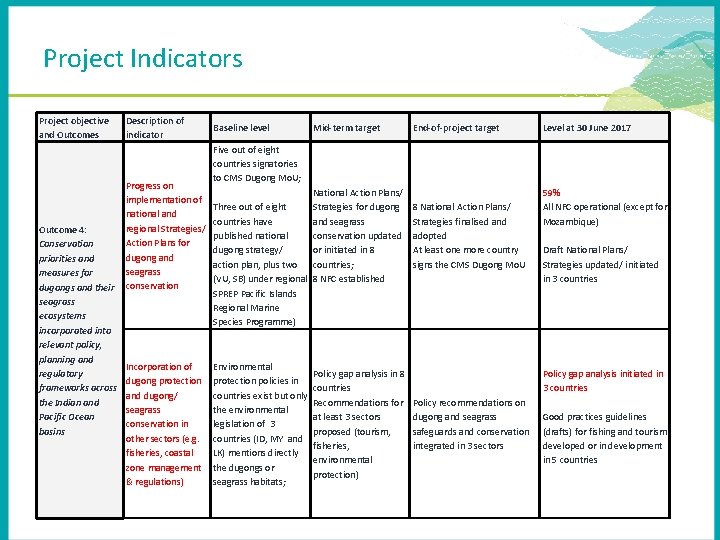
Project Indicators Project objective and Outcomes Outcome 4: Conservation priorities and measures for dugongs and their seagrass ecosystems incorporated into relevant policy, planning and regulatory frameworks across the Indian and Pacific Ocean basins Description of indicator Baseline level Mid-term target Five out of eight countries signatories to CMS Dugong Mo. U; Progress on National Action Plans/ implementation of Strategies for dugong Three out of eight national and seagrass countries have regional Strategies/ conservation updated published national Action Plans for or initiated in 8 dugong strategy/ dugong and action plan, plus two countries; seagrass (VU, SB) under regional 8 NFC established conservation SPREP Pacific Islands Regional Marine Species Programme) Incorporation of dugong protection and dugong/ seagrass conservation in other sectors (e. g. fisheries, coastal zone management & regulations) Environmental Policy gap analysis in 8 protection policies in countries exist but only Recommendations for the environmental at least 3 sectors legislation of 3 proposed (tourism, countries (ID, MY and fisheries, LK) mentions directly environmental the dugongs or protection) seagrass habitats; End-of-project target 8 National Action Plans/ Strategies finalised and adopted At least one more country signs the CMS Dugong Mo. U Level at 30 June 2017 59% All NFC operational (except for Mozambique) Draft National Plans/ Strategies updated/ initiated in 3 countries Policy gap analysis initiated in 3 countries Policy recommendations on dugong and seagrass safeguards and conservation integrated in 3 sectors Good practices guidelines (drafts) for fishing and tourism developed or in development in 5 countries
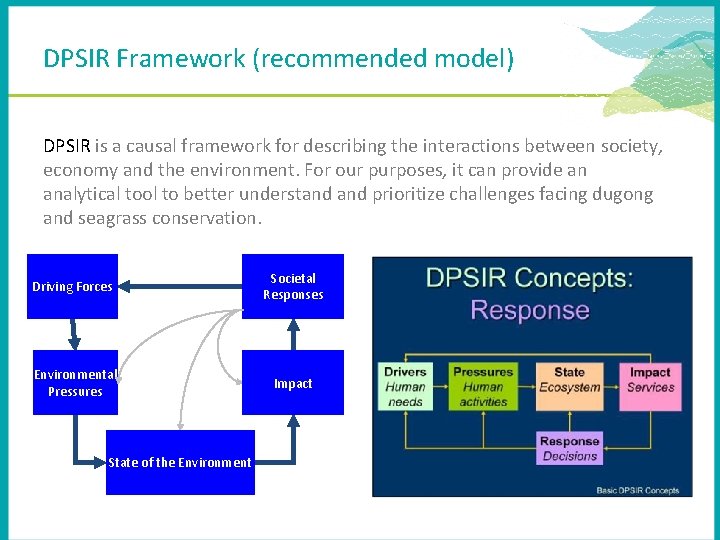
DPSIR Framework (recommended model) DPSIR is a causal framework for describing the interactions between society, economy and the environment. For our purposes, it can provide an analytical tool to better understand prioritize challenges facing dugong and seagrass conservation. Driving Forces Environmental Pressures State of the Environment Societal Responses Impact
DPSIR Framework Benefits • • Standardized and repeatable approach, which users can update over time Flexible with regard to spatial scope, temporal scope and level of detail Useful for analysis, prioritization, planning and identification of key performance measures Guides critical thinking about relationships – a form of route cause analysis Guides the identification of “key” performance indicators Process reveals data and information gaps, as well as key priorities for response Enables prioritization of key challenges and assessment of responses
DPSIR Risks/Pitfalls • • • Working with inappropriate scope / scale (i. e. spatial, temporal, environmental) Having key research gaps (i. e. environmental or socio-economic) Having key monitoring gaps (i. e. pressures and drivers) Lacking adequate information to establish root cause (i. e. drivers) Not measuring effectiveness of policy actions (i. e. responses)
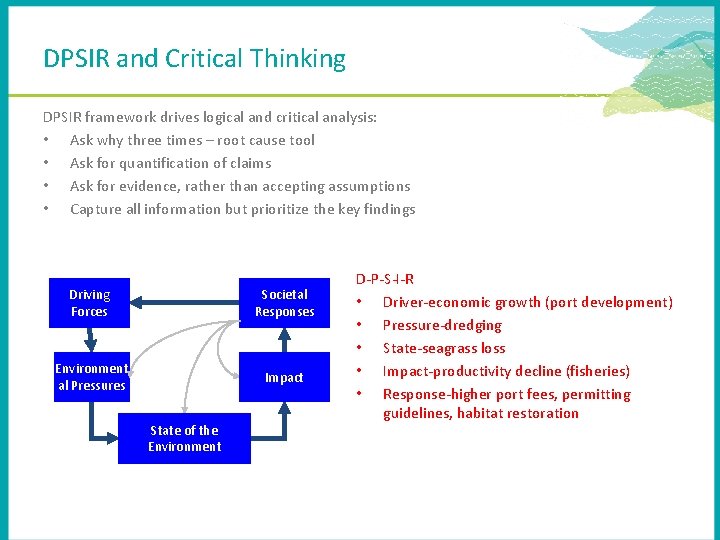
DPSIR and Critical Thinking DPSIR framework drives logical and critical analysis: • Ask why three times – root cause tool • Ask for quantification of claims • Ask for evidence, rather than accepting assumptions • Capture all information but prioritize the key findings Driving Forces Societal Responses Environment al Pressures Impact State of the Environment D-P-S-I-R • Driver-economic growth (port development) • Pressure-dredging • State-seagrass loss • Impact-productivity decline (fisheries) • Response-higher port fees, permitting guidelines, habitat restoration
DPSIR and Information Gaps DPSIR framework often reveals gaps (some important and some not): • Environmental status and trend gaps • Environmental monitoring gaps • Gaps in understanding pressures (often non-environmental) • Gaps in understanding drivers (most often non-environmental) • Gaps in impacts are common (e. g. economic impacts of environmental change) • Gaps can contribute to research agenda, monitoring programs, collaboration building and response priorities • Capture all the gaps but prioritize investments in closing gaps Don’t delay action, just because gaps are present!
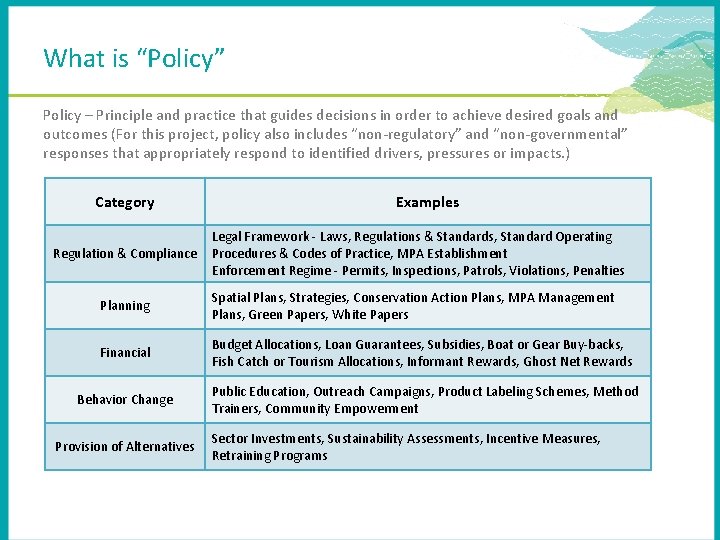
DPSIR and Response Identification DPSIR framework should capture “existing” responses: • Consider all types of responses (see “what is policy” slide) – – – • • Regulation and compliance Planning Financial Behavior change Provision of alternatives Capture details for responses to the “key” pressures and drivers identified DPSIR is not a substitute for policy gap analysis
DPSIR and Key Performance Measures DPSIR framework can improve performance management (better, not more): • Select “key” performance measures (perhaps eliminating others) • Select performance measures around each DPSIR element to monitor “dynamics” • Understand your KPIs (i. e. definition sheet/catalog) • Measure effectiveness of responses (continue effective interventions)
Policy Gap Analysis (i. e. Assessing Responses) Policy Gap Analysis is a review of existing “policy” (and the identification of barriers to successful implementation) to respond to the key drivers, pressures and/or impacts identified • Many different examples of policy gap analysis • Template provided is streamlined approach that builds on DPSIR analysis • Question driven, and assesses 1) presence and 2) effectiveness • Gaps and barriers can be addressed with new or amended policy responses
What is “Policy” Policy – Principle and practice that guides decisions in order to achieve desired goals and outcomes (For this project, policy also includes “non-regulatory” and “non-governmental” responses that appropriately respond to identified drivers, pressures or impacts. ) Category Examples Regulation & Compliance Legal Framework - Laws, Regulations & Standards, Standard Operating Procedures & Codes of Practice, MPA Establishment Enforcement Regime - Permits, Inspections, Patrols, Violations, Penalties Planning Spatial Plans, Strategies, Conservation Action Plans, MPA Management Plans, Green Papers, White Papers Financial Budget Allocations, Loan Guarantees, Subsidies, Boat or Gear Buy-backs, Fish Catch or Tourism Allocations, Informant Rewards, Ghost Net Rewards Behavior Change Public Education, Outreach Campaigns, Product Labeling Schemes, Method Trainers, Community Empowerment Provision of Alternatives Sector Investments, Sustainability Assessments, Incentive Measures, Retraining Programs
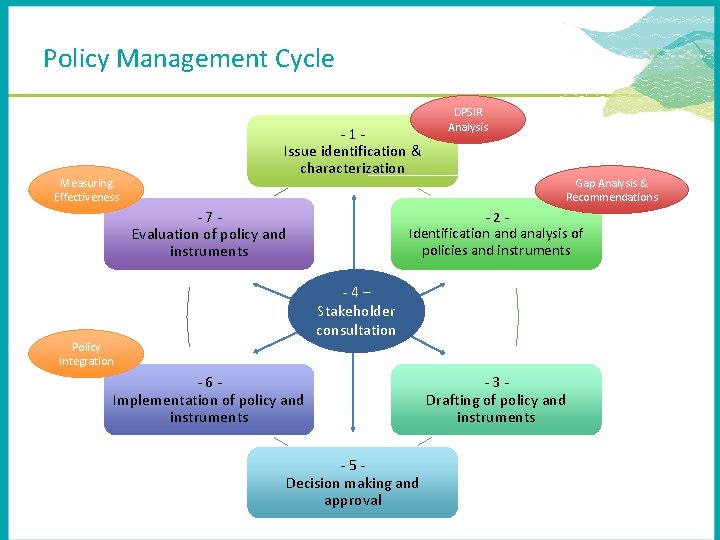
Policy Management Cycle Measuring Effectiveness - 1 - Issue identification & characterization - 7 Evaluation of policy and instruments DPSIR Analysis Gap Analysis & Recommendations - 2 Identification and analysis of policies and instruments - 4 – Stakeholder consultation Policy Integration - 6 Implementation of policy and instruments - 5 Decision making and approval - 3 Drafting of policy and instruments
Case Study – Abu Dhabi
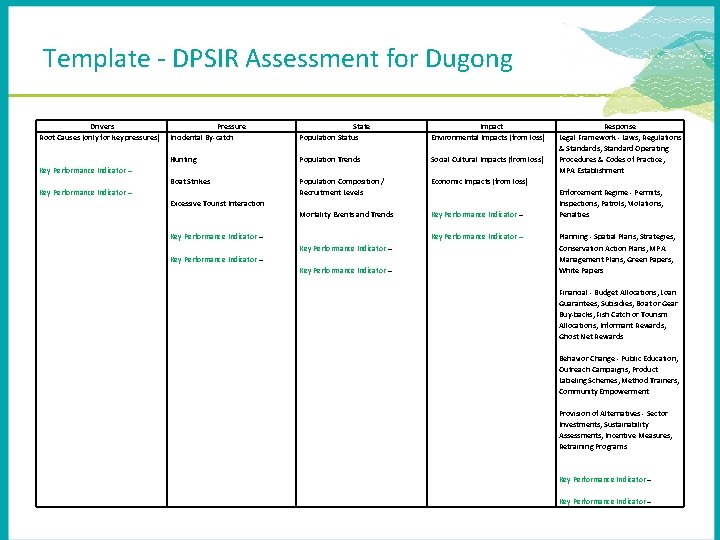
Template - DPSIR Assessment for Dugong Drivers Root Causes (only for key pressures) Key Performance Indicator – Pressure Incidental By-catch Hunting Boat Strikes Excessive Tourist Interaction Key Performance Indicator – State Population Status Population Trends Population Composition / Recruitment Levels Mortality Events and Trends Key Performance Indicator – Impact Environmental Impacts (from loss) Social Cultural Impacts (from loss) Economic Impacts (from loss) Key Performance Indicator – Response Legal Framework - Laws, Regulations & Standards, Standard Operating Procedures & Codes of Practice, MPA Establishment Enforcement Regime - Permits, Inspections, Patrols, Violations, Penalties Planning - Spatial Plans, Strategies, Conservation Action Plans, MPA Management Plans, Green Papers, White Papers Financial - Budget Allocations, Loan Guarantees, Subsidies, Boat or Gear Buy-backs, Fish Catch or Tourism Allocations, Informant Rewards, Ghost Net Rewards Behavior Change - Public Education, Outreach Campaigns, Product Labeling Schemes, Method Trainers, Community Empowerment Provision of Alternatives - Sector Investments, Sustainability Assessments, Incentive Measures, Retraining Programs Key Performance Indicator –
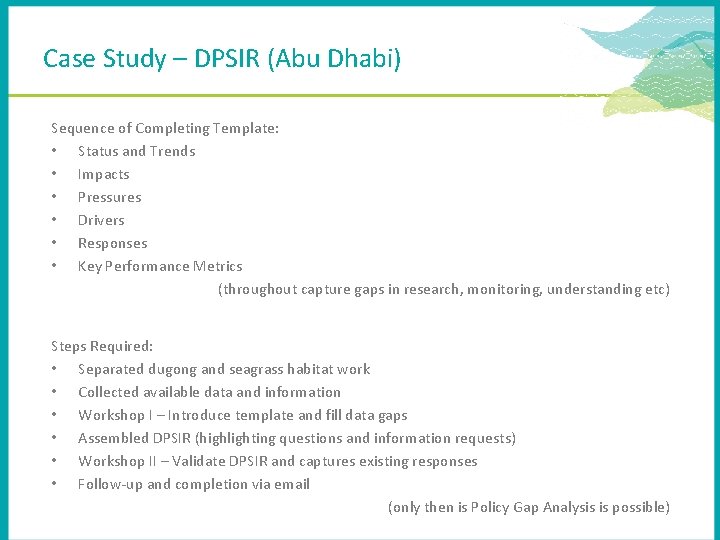
Case Study – DPSIR (Abu Dhabi) Sequence of Completing Template: • Status and Trends • Impacts • Pressures • Drivers • Responses • Key Performance Metrics (throughout capture gaps in research, monitoring, understanding etc) Steps Required: • Separated dugong and seagrass habitat work • Collected available data and information • Workshop I – Introduce template and fill data gaps • Assembled DPSIR (highlighting questions and information requests) • Workshop II – Validate DPSIR and captures existing responses • Follow-up and completion via email (only then is Policy Gap Analysis is possible)
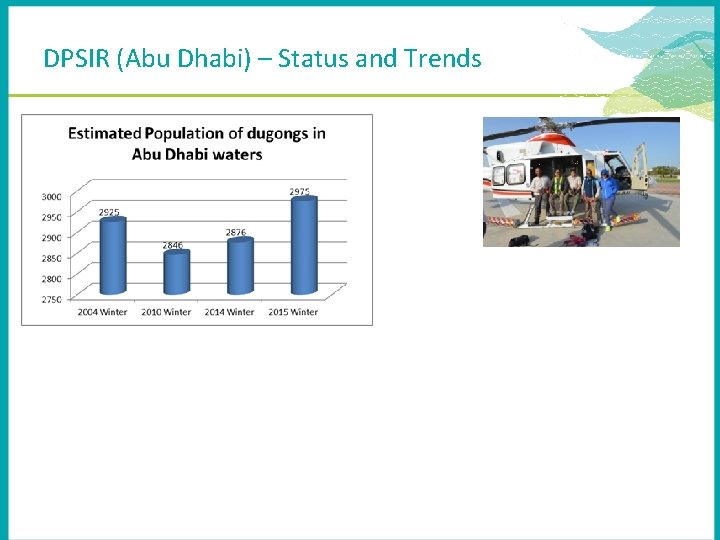
DPSIR (Abu Dhabi) – Status and Trends
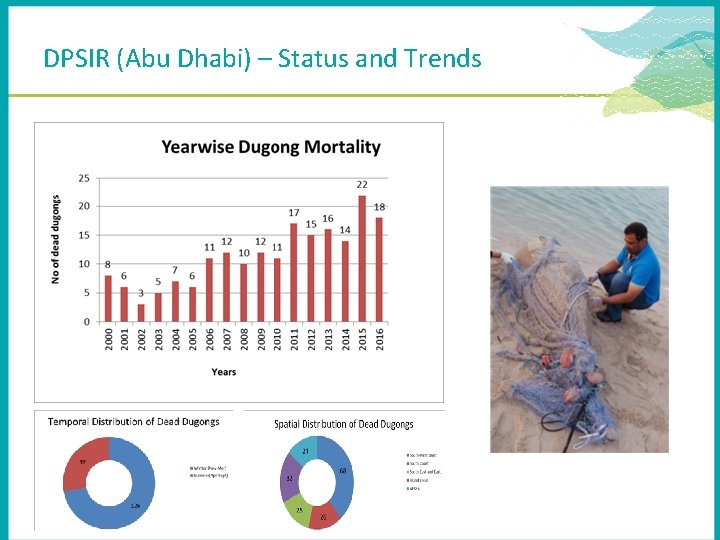
DPSIR (Abu Dhabi) – Status and Trends
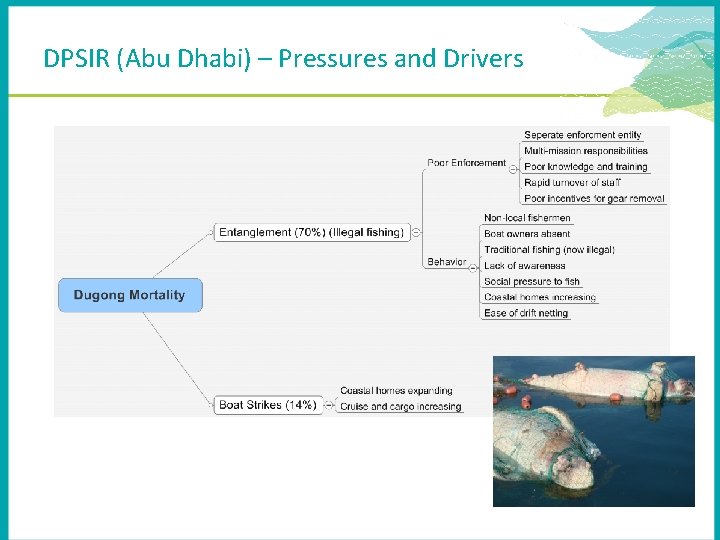
DPSIR (Abu Dhabi) – Pressures and Drivers
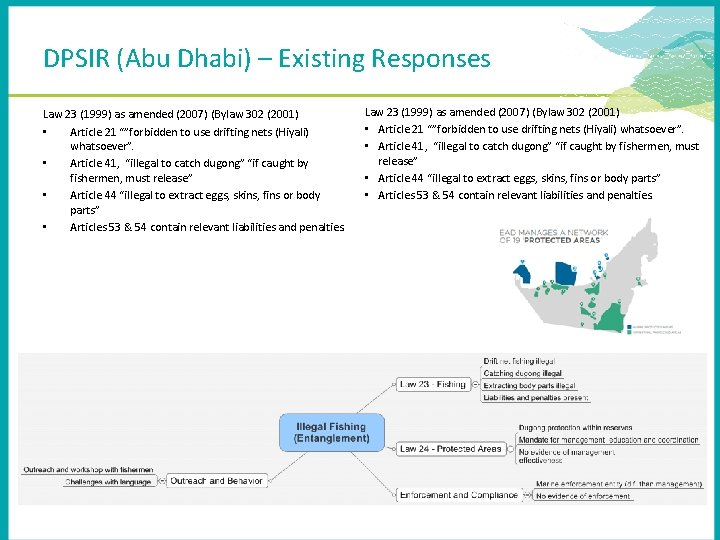
DPSIR (Abu Dhabi) – Existing Responses Law 23 (1999) as amended (2007) (Bylaw 302 (2001) • Article 21 “”forbidden to use drifting nets (Hiyali) whatsoever”. • Article 41, “illegal to catch dugong” “if caught by fishermen, must release” • Article 44 “illegal to extract eggs, skins, fins or body parts” • Articles 53 & 54 contain relevant liabilities and penalties.
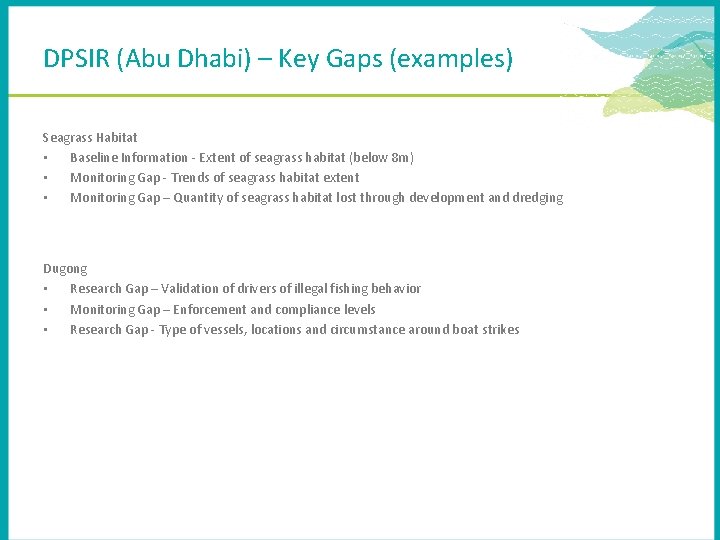
DPSIR (Abu Dhabi) – Key Gaps (examples) Seagrass Habitat • Baseline Information - Extent of seagrass habitat (below 8 m) • Monitoring Gap - Trends of seagrass habitat extent • Monitoring Gap – Quantity of seagrass habitat lost through development and dredging Dugong • Research Gap – Validation of drivers of illegal fishing behavior • Monitoring Gap – Enforcement and compliance levels • Research Gap - Type of vessels, locations and circumstance around boat strikes
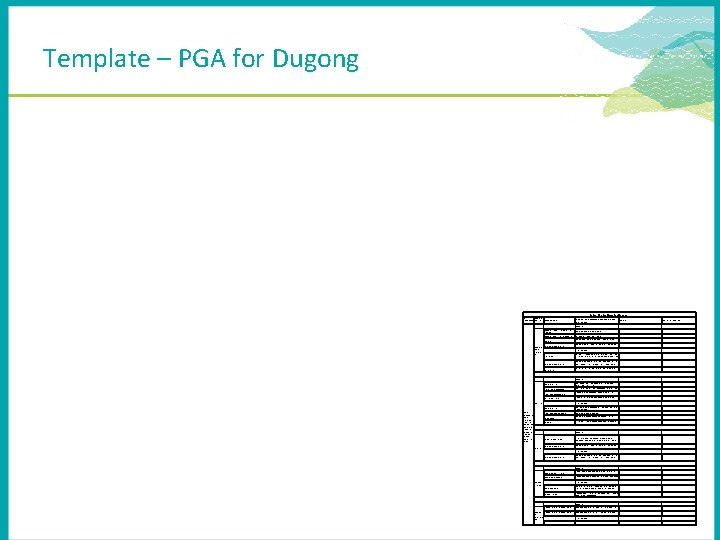
Template – PGA for Dugong Policy Gap Analysis for Dugong - Key Response Pressure(s) (Policy) Response - Detail from DPSIR Category Sample Questions (Assessing 1) presence and 2) effectiveness Yes / No Gap / Action Required Presence Legislation - specific to protecting dugongs Are dugongs protected by law? Legislation specific to the pressure Is illegal fishing defined in law? Regulation Penalties and deterrents Regulation s and Complianc e Enforcement Penalties and deterrents Judicial action Master planning Environmental Assessment Protected areas designation Fishing restrictions Planning Mortality data over 17 years indicates drowning in abandoned, lost and/or illegal fishing nets as the greatest cause of mortality at 69. 7 % Is the entity responsible for enforcement, identified in the regulations, trained, motivated and resourced to carry out enforcement action? Are penalties sever enough to act as a deterrent i. e. are fines significantly greater than the value of a dugong? Is the judiciary trained in environmental law and using the law to create a deterrent? Presence Is a coastal/maritime master planning process conducted in country? Are Environmental Impact Assessments conducted for coastal development projects? Have protected areas been established for the protection of dugong and sea grass? Have no fishing zones been established to protect dugong or closed seasons? Effectiveness Master planning Are master plans approved by the Government and implemented? Protected areas management Mitigation Is dugong and sea grass data provided into the planning process? In the planning process are steps taken to avoid or mitigate additional pressure on dugong or sea grass? Presence Net exchange scheme Effectiveness Data provision Financial Are detailed regulations present making the law legally enforceable? Are penalties for illegal fishing and killing dugongs codified in law? Penalties and deterrents Is a fishing net exchange scheme in place where financial support is provided to replace old or damaged nets providing the old one is returned to prevent ghost fishing? Are penalties for illegal fishing and killing dugongs codified in law? Effectiveness Penalties and deterrents Are penalties sever enough to act as a deterrent i. e. are fines significantly greater than the value of a dugong? Presence Stakeholder identification Stakeholder engagement Behavior Change Awareness raising Behavior change Have the key stakeholders (fisherman and fishing boat owners) been identified? Has a stakeholder engagement plan been developed and executed? Effectiveness Do fishermen and fishing boat owners understand the fishing laws and penalties and the impacts of illegal activity? Have behavior change indicators been identified and is performance assessed? Presence Provision of alternative sources of food or income Provision of alternative sources of of food or income Alternativ es Do stakeholders rely on illegal fishing to meet their basic needs for food or income? Do stakeholders rely on catching dugong to meet their basic needs for food or income? Effectiveness
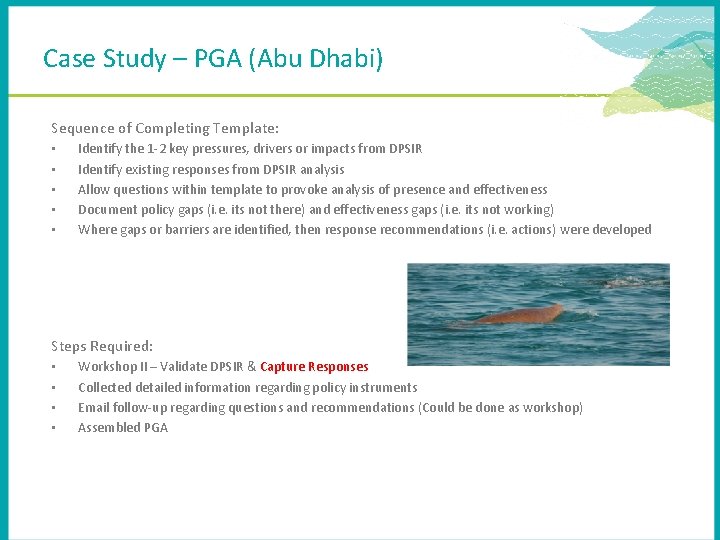
Case Study – PGA (Abu Dhabi) Sequence of Completing Template: • • • Identify the 1 -2 key pressures, drivers or impacts from DPSIR Identify existing responses from DPSIR analysis Allow questions within template to provoke analysis of presence and effectiveness Document policy gaps (i. e. its not there) and effectiveness gaps (i. e. its not working) Where gaps or barriers are identified, then response recommendations (i. e. actions) were developed Steps Required: • • Workshop II – Validate DPSIR & Capture Responses Collected detailed information regarding policy instruments Email follow-up regarding questions and recommendations (Could be done as workshop) Assembled PGA
PGA (Abu Dhabi) – Presence Gaps (Examples) Policy Gaps (Examples): • Stakeholder engagement and outreach plan for fishermen • National Conservation Management Plan • Approved Master Plans (protecting seagrass habitat) • Approved MPA Management Plans (with clear monitoring and enforcement regimes)
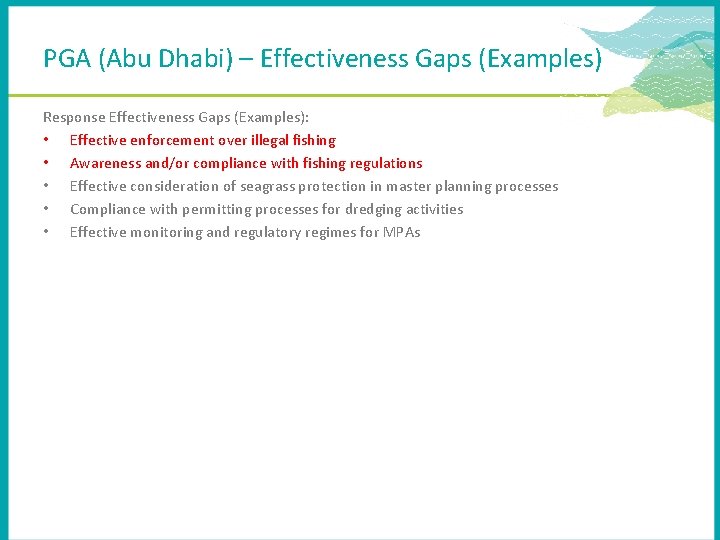
PGA (Abu Dhabi) – Effectiveness Gaps (Examples) Response Effectiveness Gaps (Examples): • Effective enforcement over illegal fishing • Awareness and/or compliance with fishing regulations • Effective consideration of seagrass protection in master planning processes • Compliance with permitting processes for dredging activities • Effective monitoring and regulatory regimes for MPAs
Discussion
Next Steps • • • DPSIR for Dugong (project-level) DPSIR for Seagrass Habitat (project-level) Policy Gap Analysis for Dugong (project-level) Policy Gap Analysis for Seagrass Habitat (project-level) GEF Project Policy Gap Assessment (Cross-country Policy Gap Assessment) Materials Provided 1) Presentation Slides 2) Case Study (Abu Dhabi) a. b. c. d. 3) DPSIR for Dugong DPSIR for Seagrass Habitat Policy Gap Analysis for Dugong Policy Gap Analysis for Seagrass Habitat Templates a. b. DPSIR Template Policy Gap Analysis Template
Contact Information MBankova@mbzfund. org Peter. Fippinger@EAD. ae Simon. Pearson@ead. ae
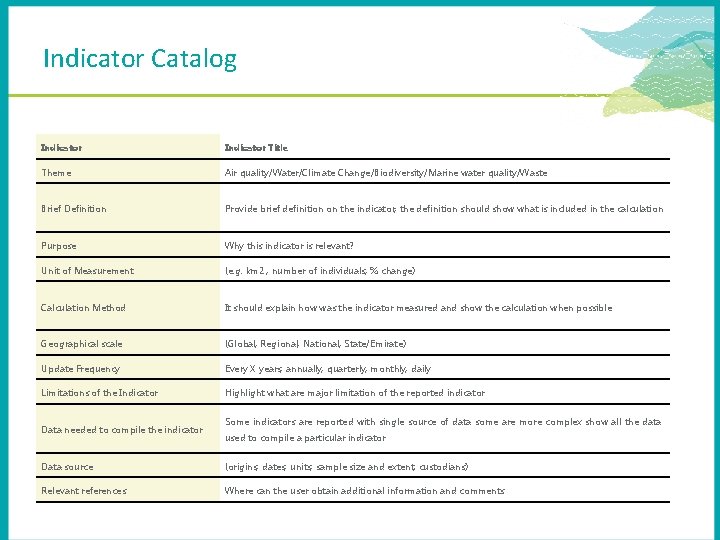
Indicator Catalog Indicator Title Theme Air quality/Water/Climate Change/Biodiversity/Marine water quality/Waste Brief Definition Provide brief definition on the indicator, the definition should show what is included in the calculation Purpose Why this indicator is relevant? Unit of Measurement (e. g. km 2 , number of individuals, % change) Calculation Method It should explain how was the indicator measured and show the calculation when possible Geographical scale (Global, Regional, National, State/Emirate) Update Frequency Every X years, annually, quarterly, monthly, daily Limitations of the Indicator Highlight what are major limitation of the reported indicator Data needed to compile the indicator Some indicators are reported with single source of data some are more complex show all the data used to compile a particular indicator Data source (origins, dates, units, sample size and extent, custodians) Relevant references Where can the user obtain additional information and comments
Considering Policy Options (PESTLE)