
Please turn in your planner and planner check



- Slides: 38
Please turn in your planner and planner check sheet on my desk. PLANNER CHECK 1
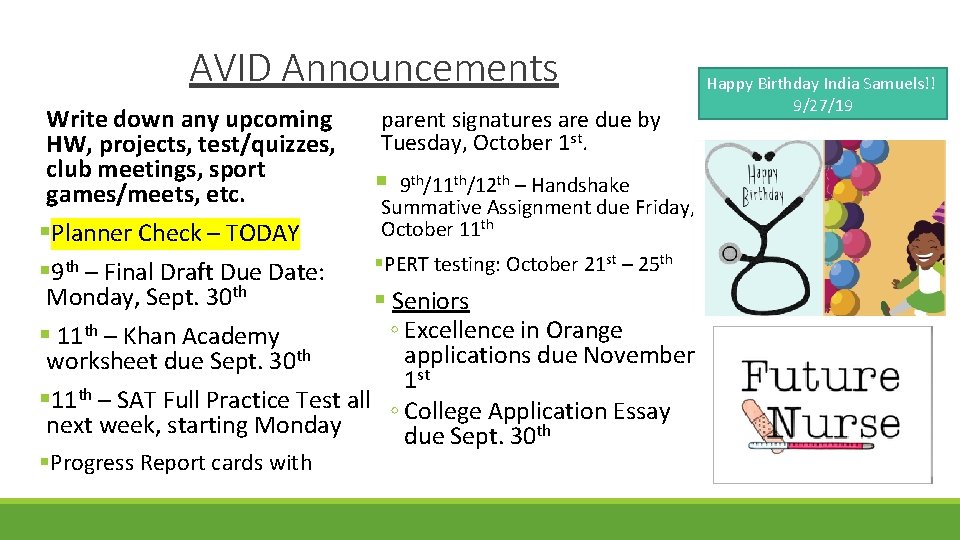
AVID Announcements Write down any upcoming parent signatures are due by Tuesday, October 1 st. HW, projects, test/quizzes, club meetings, sport th/11 th/12 th – Handshake § 9 games/meets, etc. Summative Assignment due Friday, October 11 th §Planner Check – TODAY §PERT testing: October 21 st – 25 th § 9 th – Final Draft Due Date: Monday, Sept. 30 th § Seniors ◦ Excellence in Orange § 11 th – Khan Academy applications due November worksheet due Sept. 30 th st 1 § 11 th – SAT Full Practice Test all ◦ College Application Essay next week, starting Monday due Sept. 30 th §Progress Report cards with Happy Birthday India Samuels!! 9/27/19
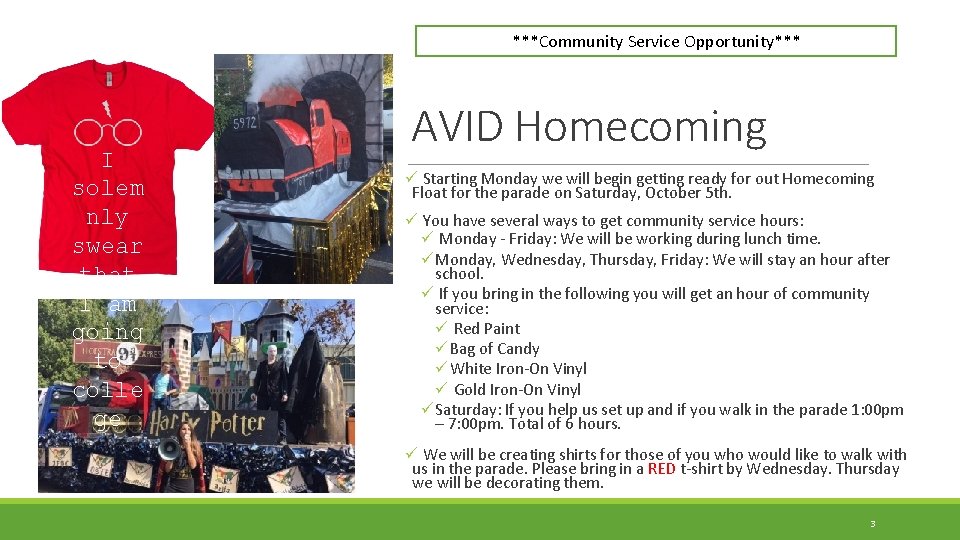
***Community Service Opportunity*** I solem nly swear that I am going to colle ge AVID Homecoming ü Starting Monday we will begin getting ready for out Homecoming Float for the parade on Saturday, October 5 th. ü You have several ways to get community service hours: ü Monday - Friday: We will be working during lunch time. ü Monday, Wednesday, Thursday, Friday: We will stay an hour after school. ü If you bring in the following you will get an hour of community service: ü Red Paint ü Bag of Candy ü White Iron-On Vinyl ü Gold Iron-On Vinyl ü Saturday: If you help us set up and if you walk in the parade 1: 00 pm – 7: 00 pm. Total of 6 hours. ü We will be creating shirts for those of you who would like to walk with us in the parade. Please bring in a RED t-shirt by Wednesday. Thursday we will be decorating them. 3
4
5
6
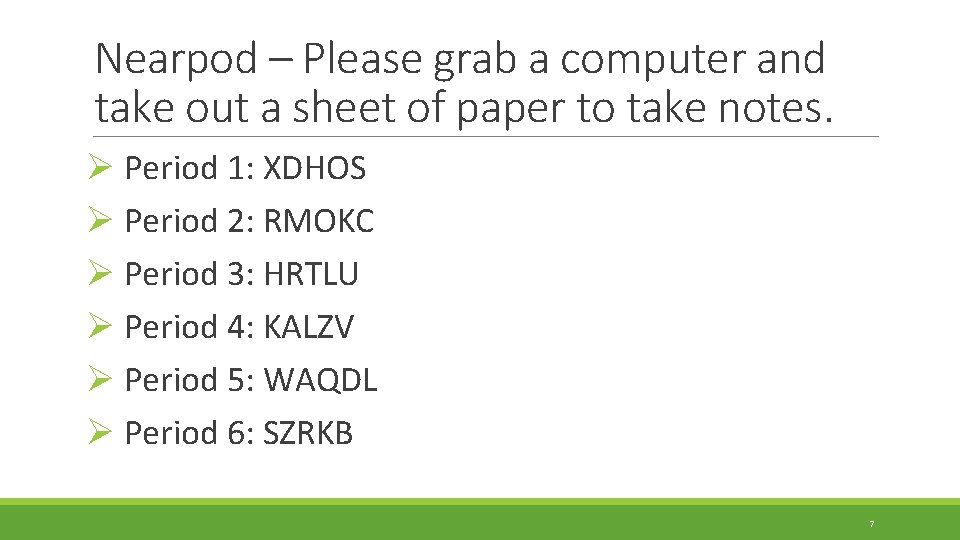
Nearpod – Please grab a computer and take out a sheet of paper to take notes. Ø Period 1: XDHOS Ø Period 2: RMOKC Ø Period 3: HRTLU Ø Period 4: KALZV Ø Period 5: WAQDL Ø Period 6: SZRKB 7
Please take out a sheet of paper to take notes. YOU CAN USE CORNELL NOTES OR WRITE YOUR NOTES ON A LINED SHEET OF PAPER. 8
TUTORIALS
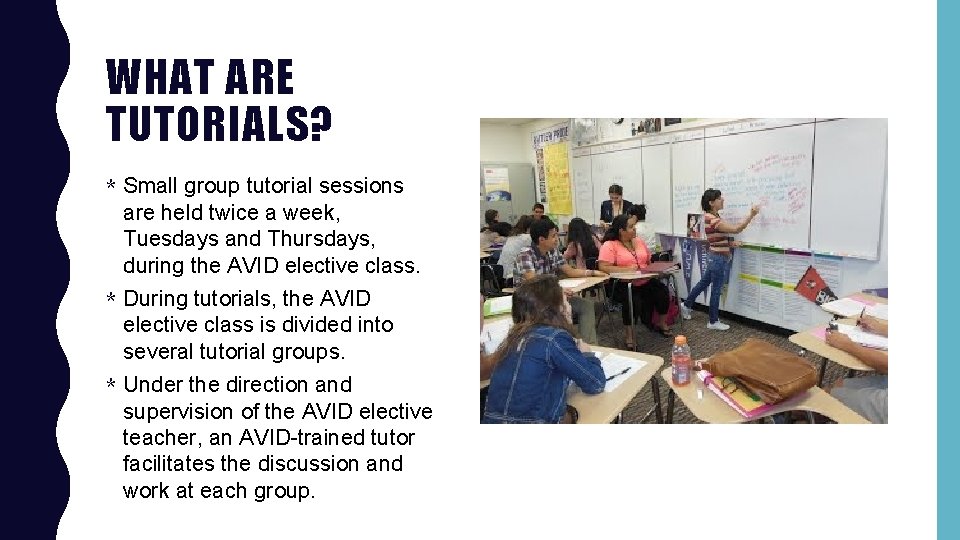
WHAT ARE TUTORIALS? * Small group tutorial sessions are held twice a week, Tuesdays and Thursdays, during the AVID elective class. * During tutorials, the AVID elective class is divided into several tutorial groups. * Under the direction and supervision of the AVID elective teacher, an AVID-trained tutor facilitates the discussion and work at each group.
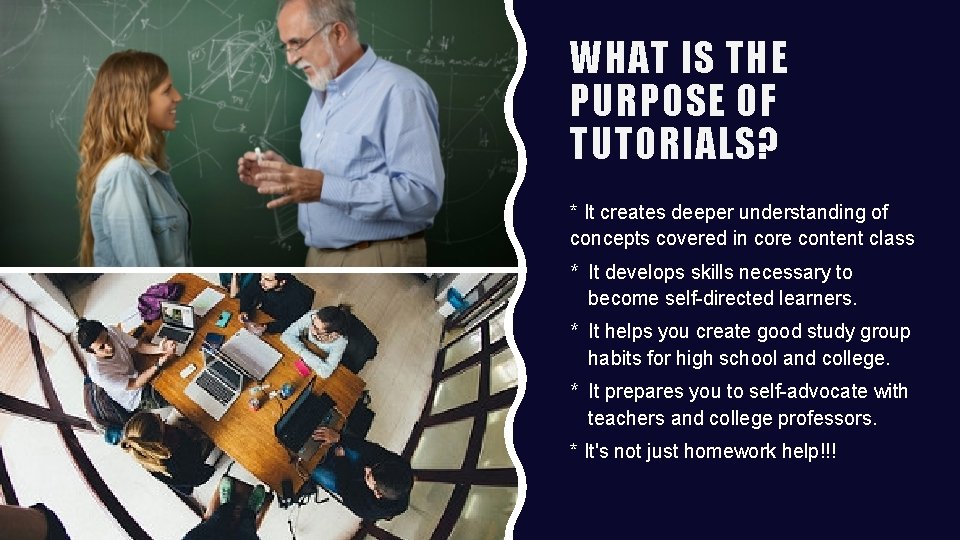
WHAT IS THE PURPOSE OF TUTORIALS? * It creates deeper understanding of concepts covered in core content class * It develops skills necessary to become self-directed learners. * It helps you create good study group habits for high school and college. * It prepares you to self-advocate with teachers and college professors. * It's not just homework help!!!
HOW DO AVID TUTORIALS DIFFER FROM TRADITIONAL “TUTORING? ” * All students must arrive to tutorials prepared with the pre-work completed and specific questions written in a Tutorial Request Form (TRF). If they believe they have no questions regarding any homework, schoolwork, quiz or test in any of their classes, they must still attend the tutorial with a completed TRF in which they ask a question that further explores the material they are studying in any of their classes. * Questions are high level thinking questions. * Students work and discuss in collaborative group. * Students must reflect on their own participation in the groups and on how the group worked together.
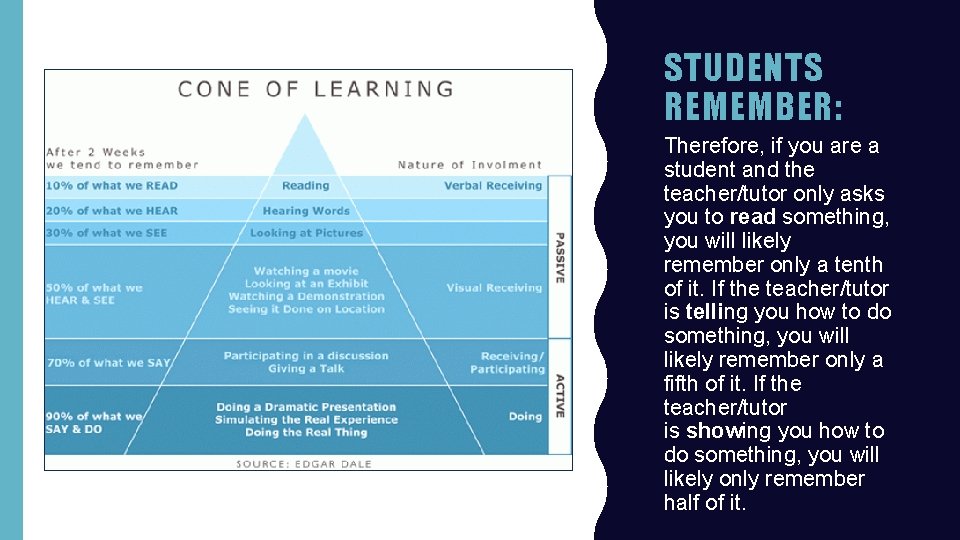
STUDENTS REMEMBER: Therefore, if you are a student and the teacher/tutor only asks you to read something, you will likely remember only a tenth of it. If the teacher/tutor is telling you how to do something, you will likely remember only a fifth of it. If the teacher/tutor is showing you how to do something, you will likely only remember half of it.
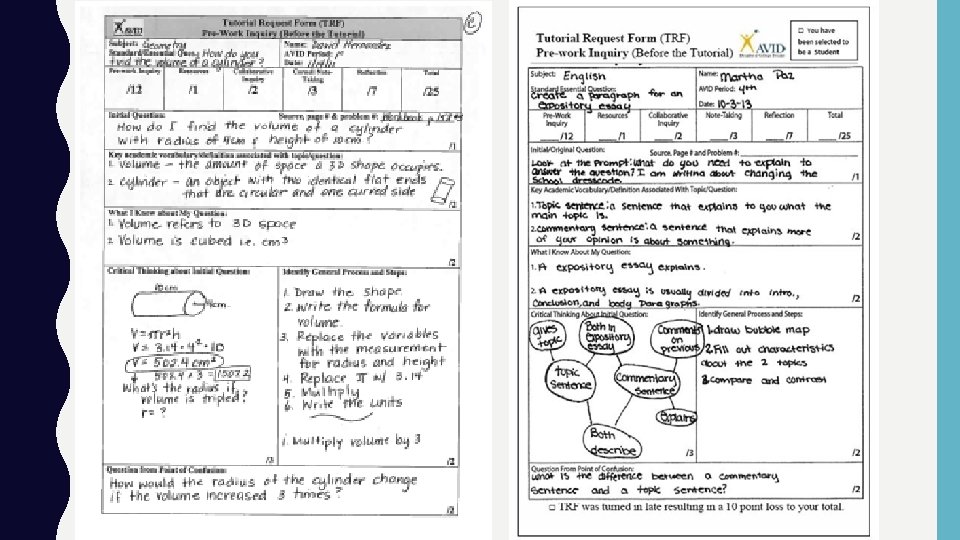
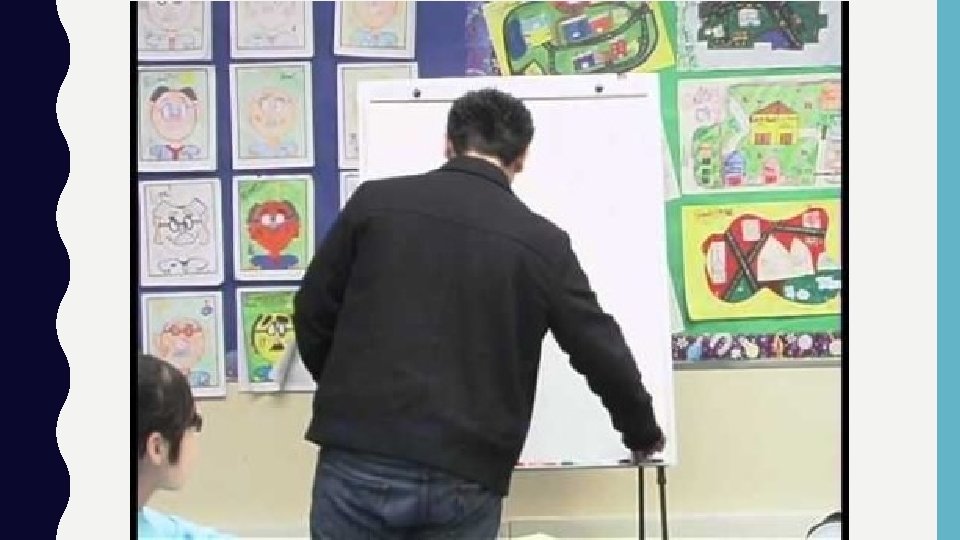
WHAT DO TUTORIALS LOOK LIKE? WALKER MIDDLE SCHOOL AVID TUTORIALS
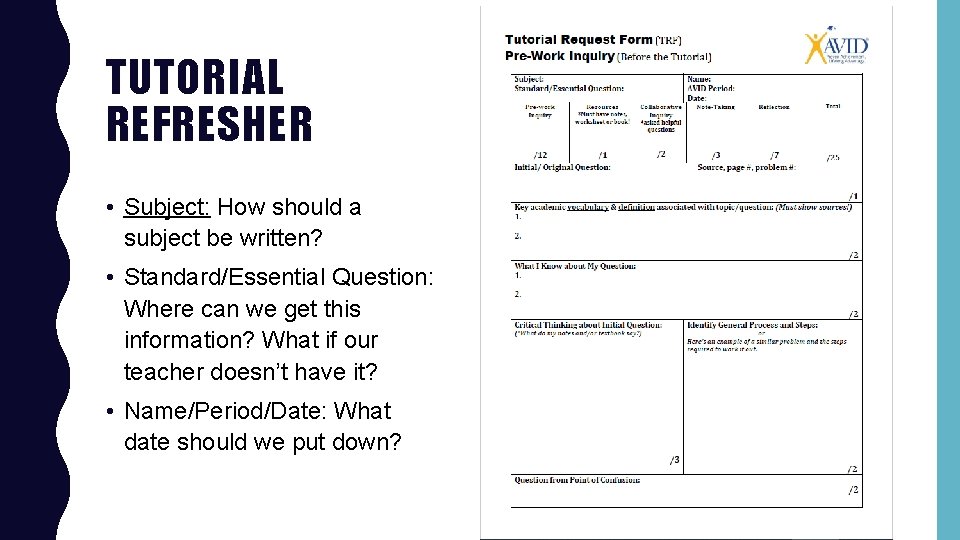
TUTORIAL REFRESHER • Subject: How should a subject be written? • Standard/Essential Question: Where can we get this information? What if our teacher doesn’t have it? • Name/Period/Date: What date should we put down?
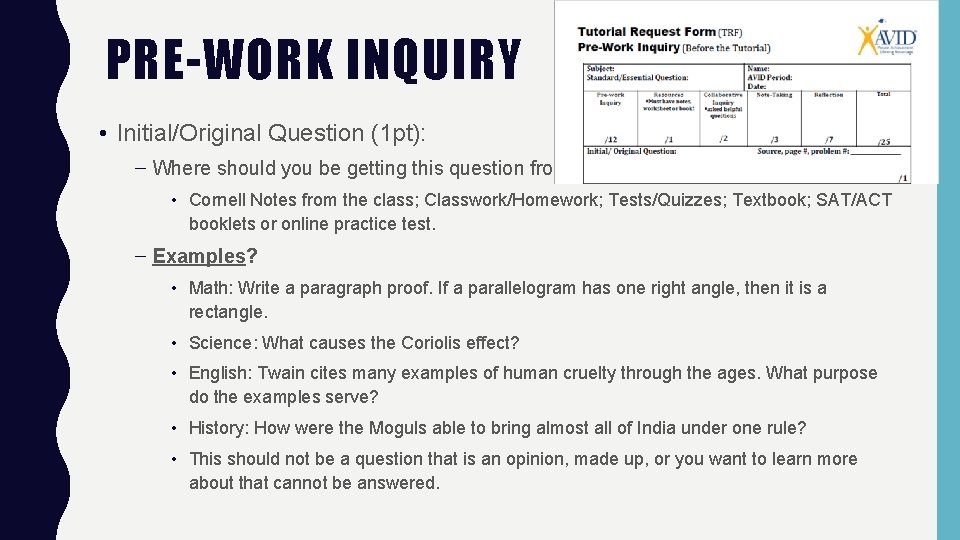
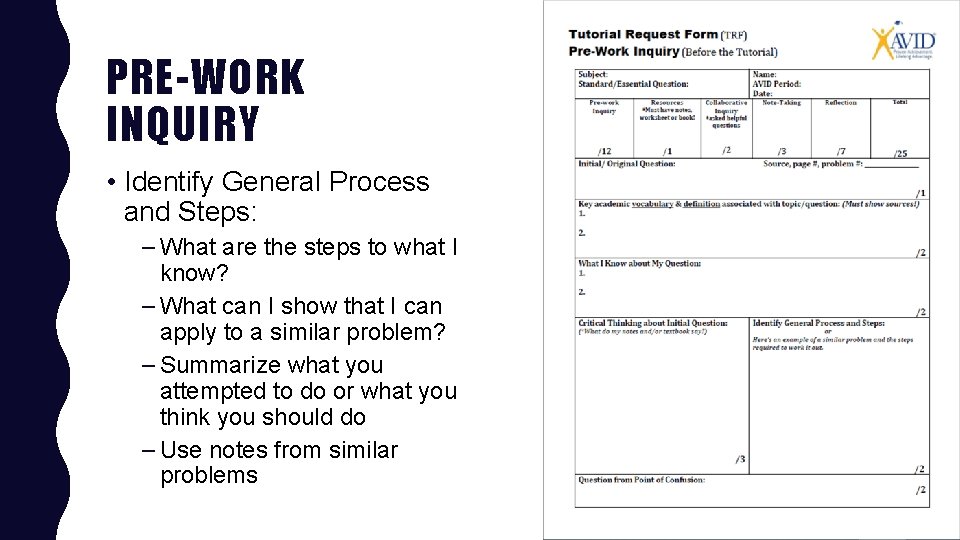
PRE-WORK INQUIRY • Initial/Original Question (1 pt): – Where should you be getting this question from? • Cornell Notes from the class; Classwork/Homework; Tests/Quizzes; Textbook; SAT/ACT booklets or online practice test. – Examples? • Math: Write a paragraph proof. If a parallelogram has one right angle, then it is a rectangle. • Science: What causes the Coriolis effect? • English: Twain cites many examples of human cruelty through the ages. What purpose do the examples serve? • History: How were the Moguls able to bring almost all of India under one rule? • This should not be a question that is an opinion, made up, or you want to learn more about that cannot be answered.
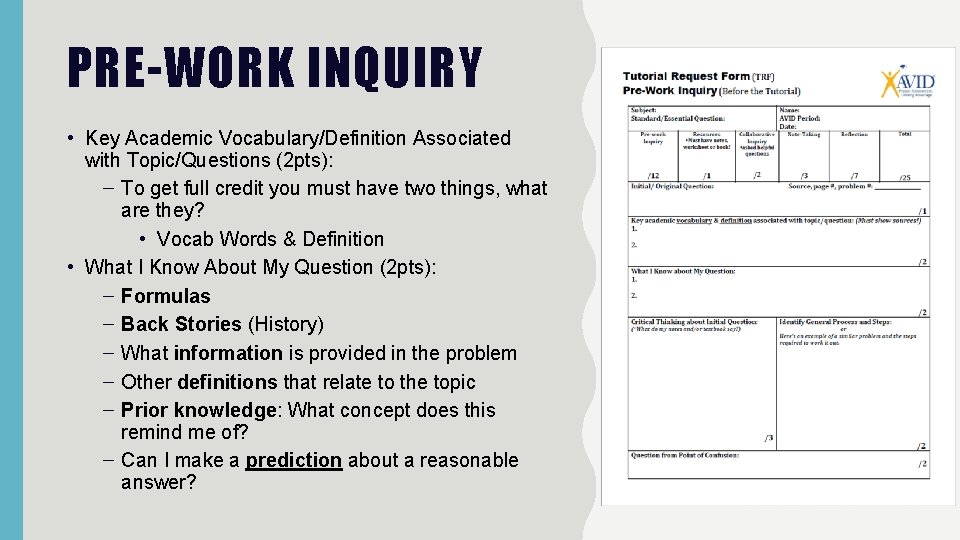
PRE-WORK INQUIRY • Key Academic Vocabulary/Definition Associated with Topic/Questions (2 pts): – To get full credit you must have two things, what are they? • Vocab Words & Definition • What I Know About My Question (2 pts): – Formulas – Back Stories (History) – What information is provided in the problem – Other definitions that relate to the topic – Prior knowledge: What concept does this remind me of? – Can I make a prediction about a reasonable answer?
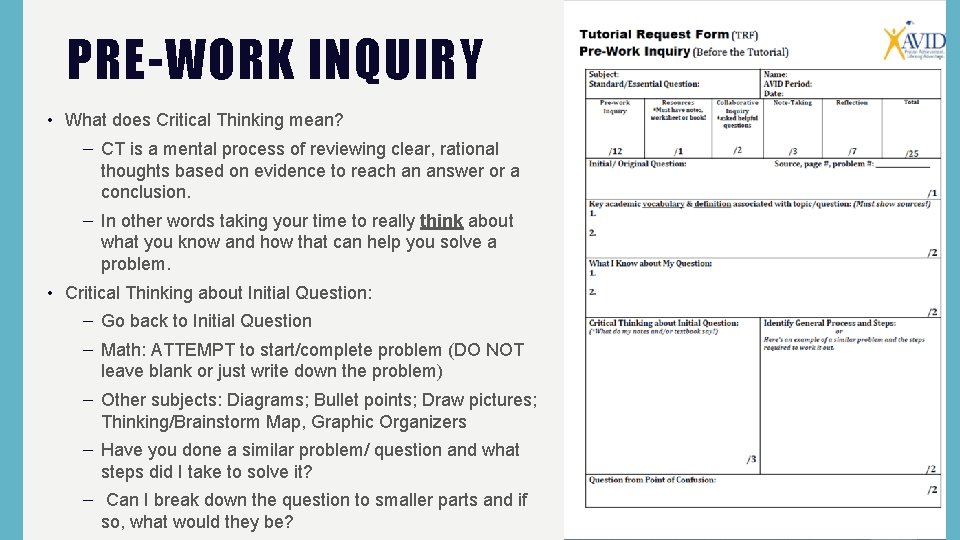
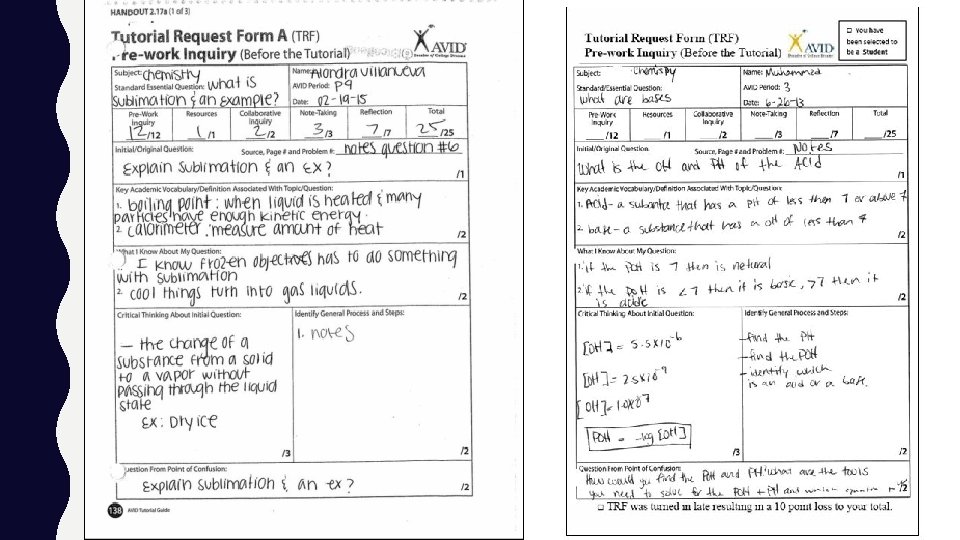
PRE-WORK INQUIRY • What does Critical Thinking mean? – CT is a mental process of reviewing clear, rational thoughts based on evidence to reach an answer or a conclusion. – In other words taking your time to really think about what you know and how that can help you solve a problem. • Critical Thinking about Initial Question: – Go back to Initial Question – Math: ATTEMPT to start/complete problem (DO NOT leave blank or just write down the problem) – Other subjects: Diagrams; Bullet points; Draw pictures; Thinking/Brainstorm Map, Graphic Organizers – Have you done a similar problem/ question and what steps did I take to solve it? – Can I break down the question to smaller parts and if so, what would they be?
PRE-WORK INQUIRY • Identify General Process and Steps: – What are the steps to what I know? – What can I show that I can apply to a similar problem? – Summarize what you attempted to do or what you think you should do – Use notes from similar problems
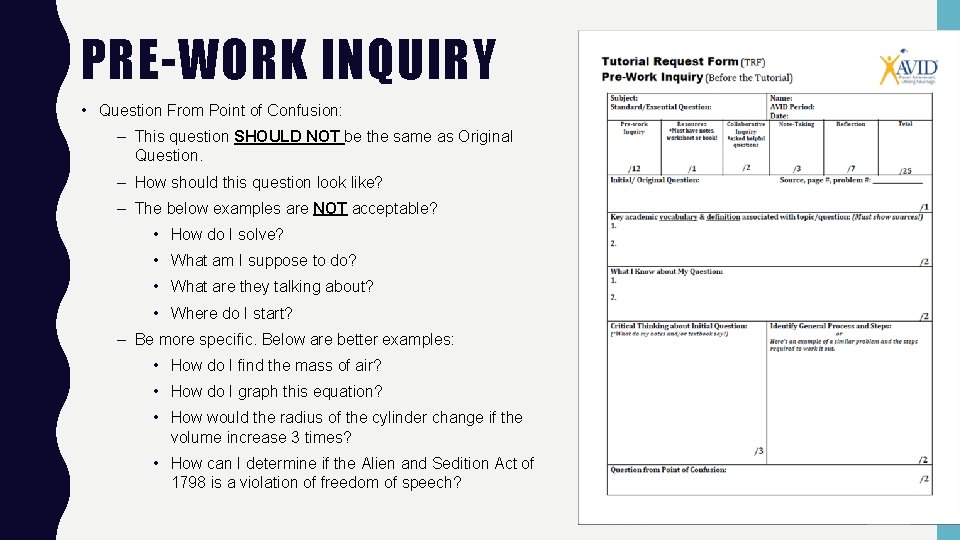
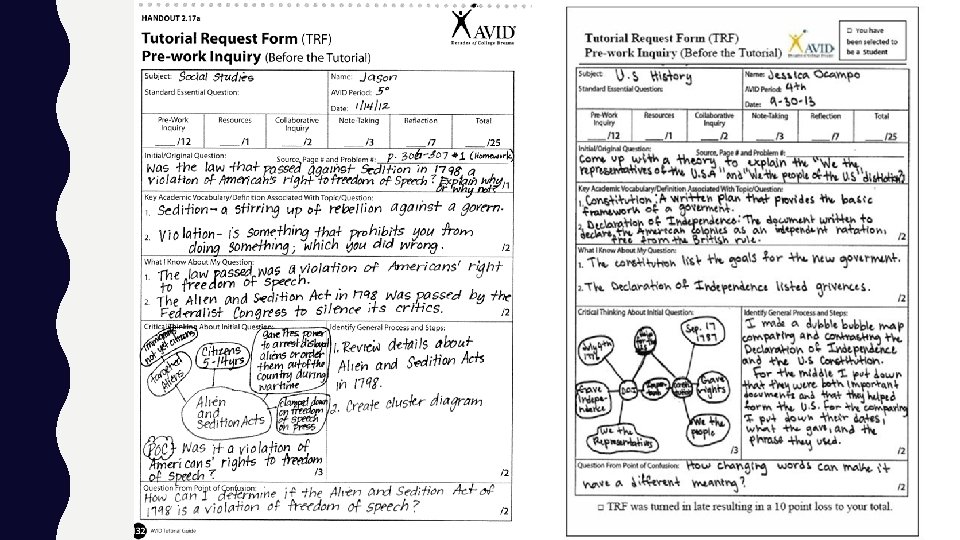
PRE-WORK INQUIRY • Question From Point of Confusion: – This question SHOULD NOT be the same as Original Question. – How should this question look like? – The below examples are NOT acceptable? • How do I solve? • What am I suppose to do? • What are they talking about? • Where do I start? – Be more specific. Below are better examples: • How do I find the mass of air? • How do I graph this equation? • How would the radius of the cylinder change if the volume increase 3 times? • How can I determine if the Alien and Sedition Act of 1798 is a violation of freedom of speech?
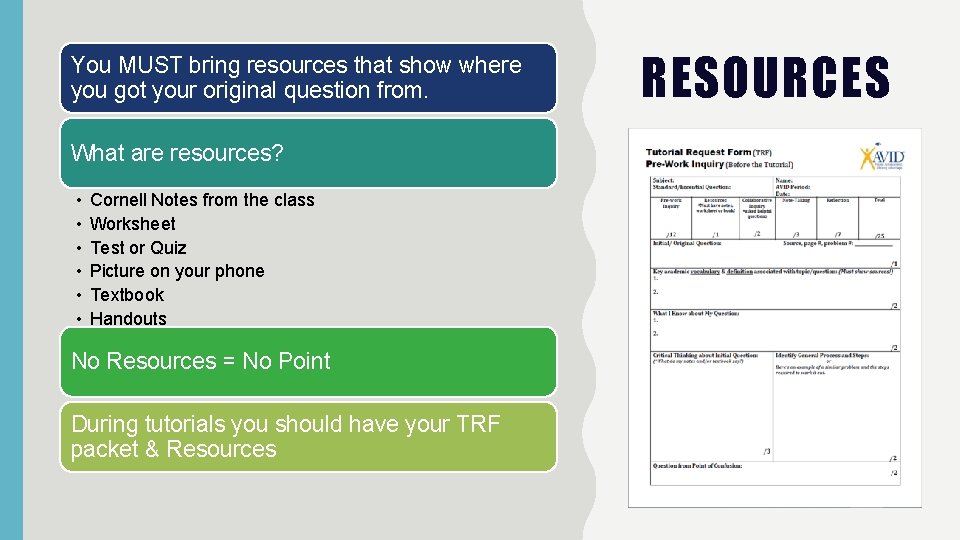
You MUST bring resources that show where you got your original question from. What are resources? • • • Cornell Notes from the class Worksheet Test or Quiz Picture on your phone Textbook Handouts No Resources = No Point During tutorials you should have your TRF packet & Resources RESOURCES
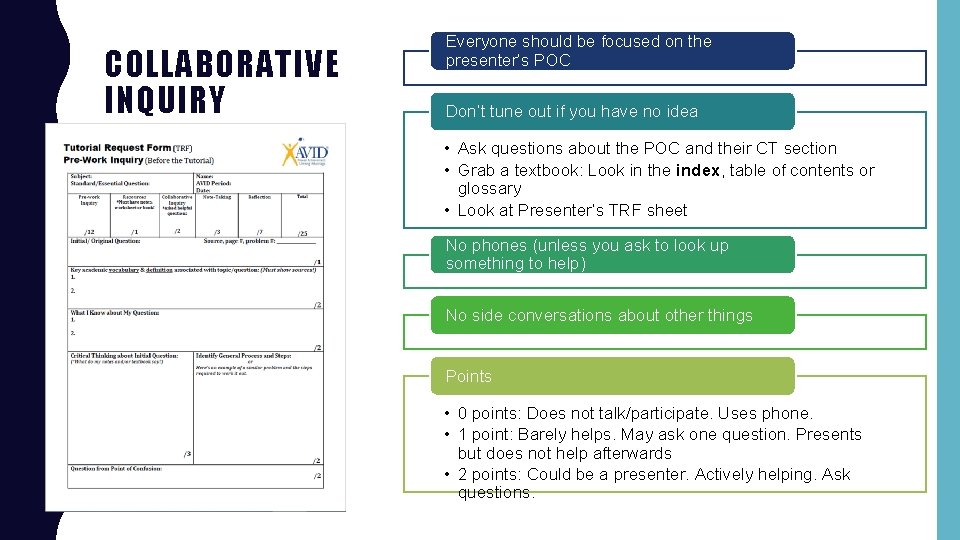
COLLABORATIVE INQUIRY Everyone should be focused on the presenter’s POC Don’t tune out if you have no idea • Ask questions about the POC and their CT section • Grab a textbook: Look in the index, table of contents or glossary • Look at Presenter’s TRF sheet No phones (unless you ask to look up something to help) No side conversations about other things Points • 0 points: Does not talk/participate. Uses phone. • 1 point: Barely helps. May ask one question. Presents but does not help afterwards • 2 points: Could be a presenter. Actively helping. Ask questions.
WHY IS IT SO IMPORTANT TO ASK QUESTIONS? * The skill of asking questions is different from the skill of answering them. Waiting to answer a question is a passive process. Asking a question is an active process. Asking questions changes a student's relationship or connection to the material they are learning.
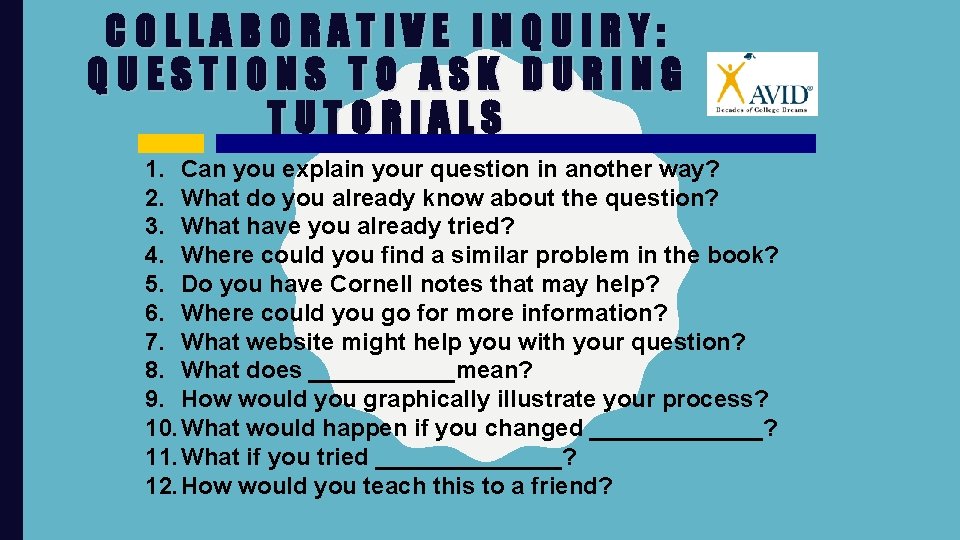
COLLABORATIVE INQUIRY: QUESTIONS TO ASK DURING TUTORIALS 1. Can you explain your question in another way? 2. What do you already know about the question? 3. What have you already tried? 4. Where could you find a similar problem in the book? 5. Do you have Cornell notes that may help? 6. Where could you go for more information? 7. What website might help you with your question? 8. What does ______mean? 9. How would you graphically illustrate your process? 10. What would happen if you changed _______? 11. What if you tried _______? 12. How would you teach this to a friend?
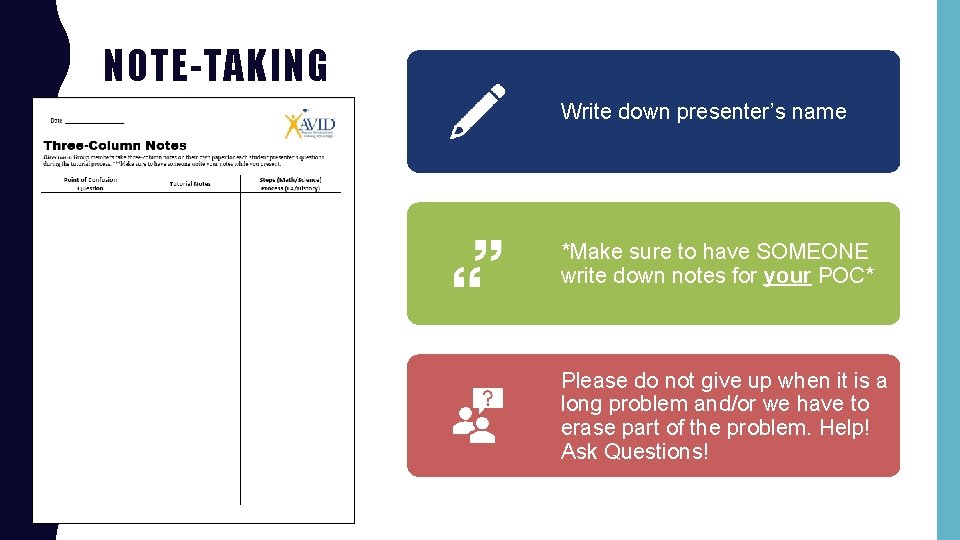
NOTE-TAKING Write down presenter’s name *Make sure to have SOMEONE write down notes for your POC* Please do not give up when it is a long problem and/or we have to erase part of the problem. Help! Ask Questions!
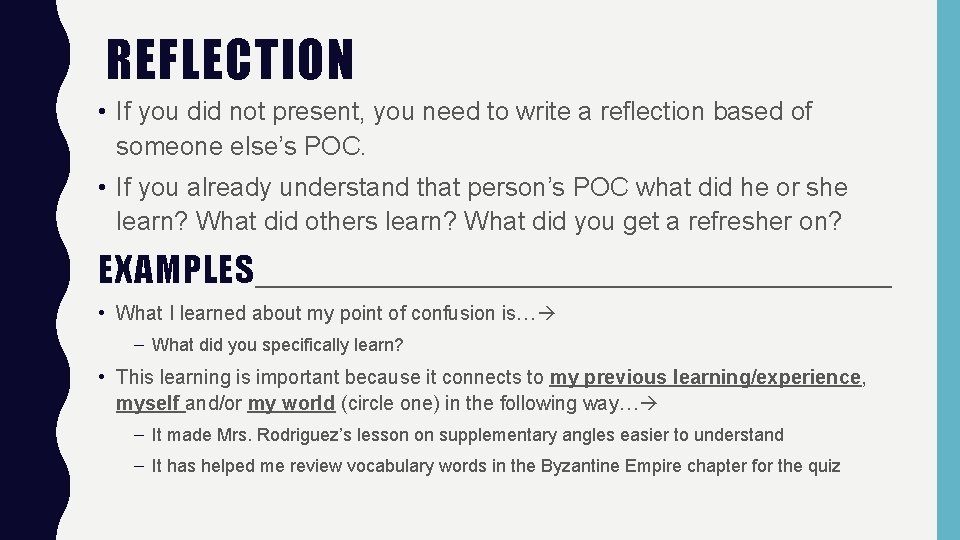
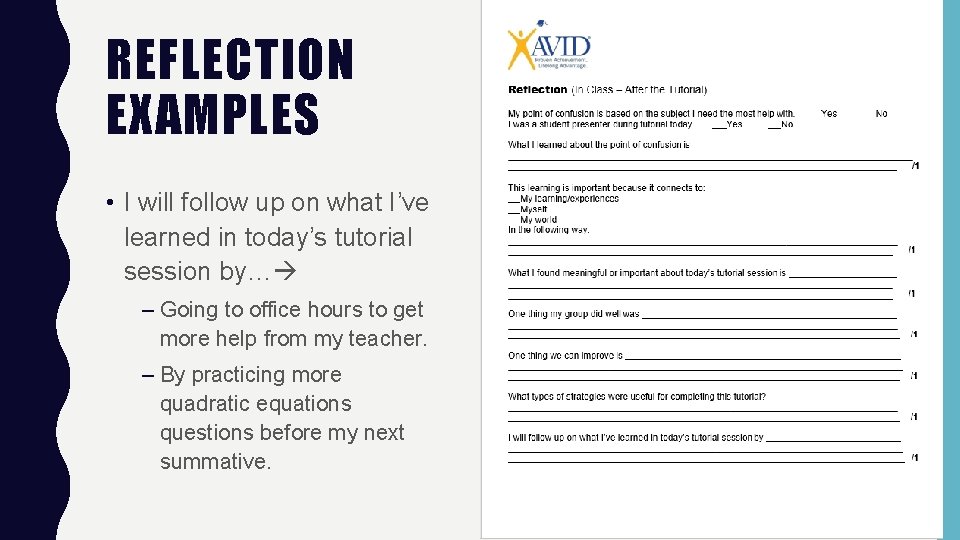
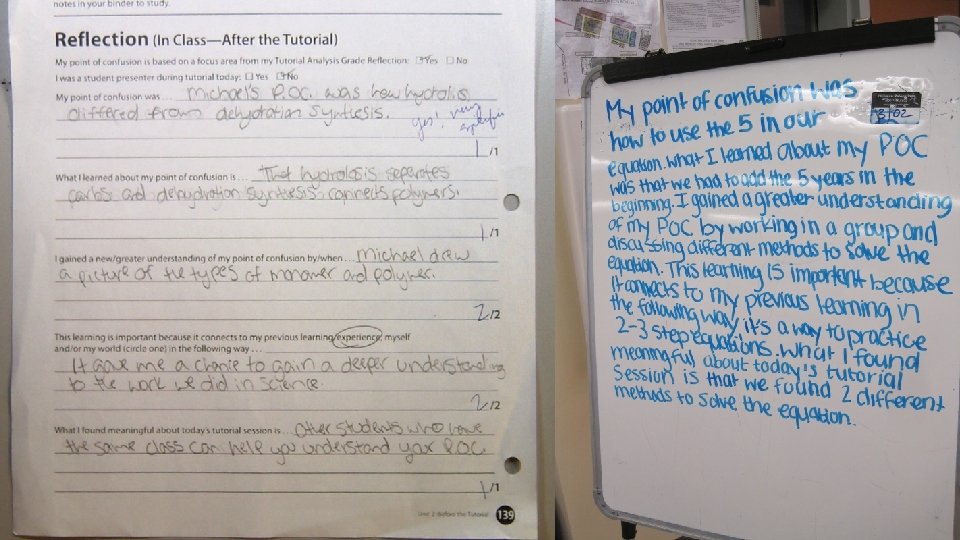
REFLECTION • If you did not present, you need to write a reflection based of someone else’s POC. • If you already understand that person’s POC what did he or she learn? What did others learn? What did you get a refresher on? EXAMPLES ______________________ • What I learned about my point of confusion is… – What did you specifically learn? • This learning is important because it connects to my previous learning/experience, myself and/or my world (circle one) in the following way… – It made Mrs. Rodriguez’s lesson on supplementary angles easier to understand – It has helped me review vocabulary words in the Byzantine Empire chapter for the quiz
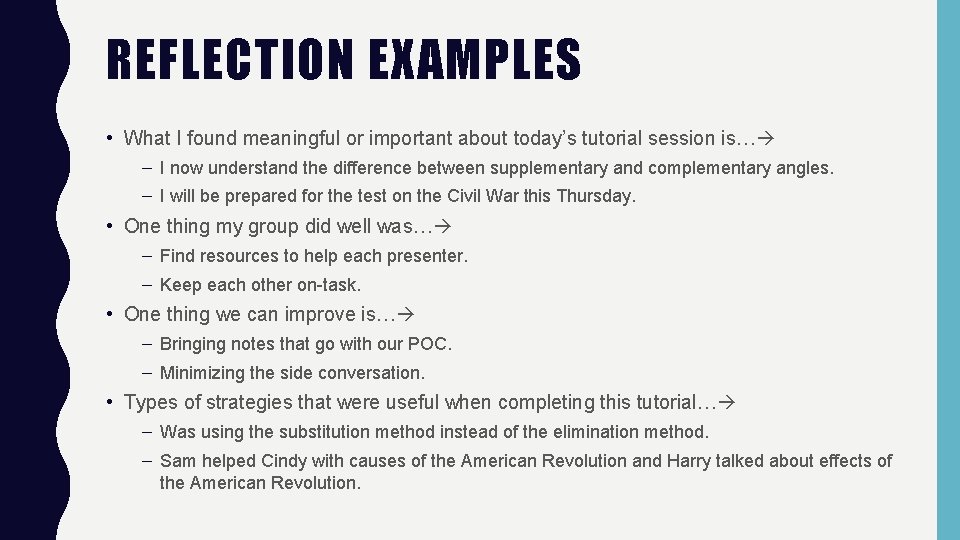
REFLECTION EXAMPLES • What I found meaningful or important about today’s tutorial session is… – I now understand the difference between supplementary and complementary angles. – I will be prepared for the test on the Civil War this Thursday. • One thing my group did well was… – Find resources to help each presenter. – Keep each other on-task. • One thing we can improve is… – Bringing notes that go with our POC. – Minimizing the side conversation. • Types of strategies that were useful when completing this tutorial… – Was using the substitution method instead of the elimination method. – Sam helped Cindy with causes of the American Revolution and Harry talked about effects of the American Revolution.
REFLECTION EXAMPLES • I will follow up on what I’ve learned in today’s tutorial session by… – Going to office hours to get more help from my teacher. – By practicing more quadratic equations questions before my next summative.
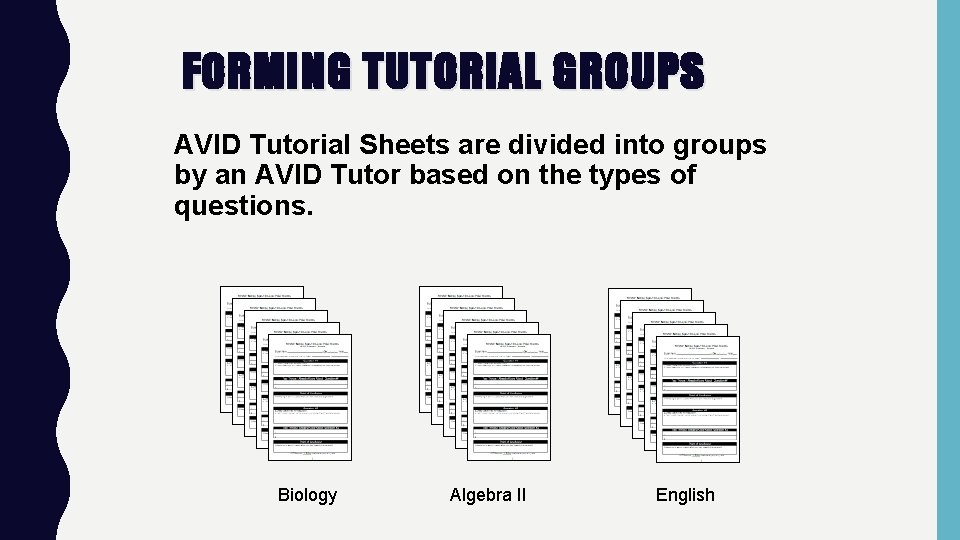
FORMING TUTORIAL GROUPS AVID Tutorial Sheets are divided into groups by an AVID Tutor based on the types of questions. Biology Algebra II English
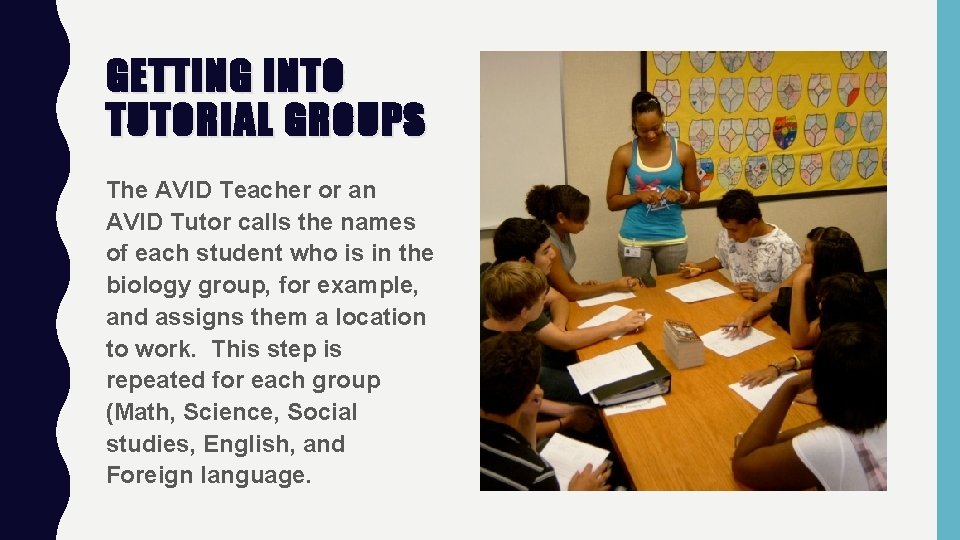
GETTING INTO TUTORIAL GROUPS The AVID Teacher or an AVID Tutor calls the names of each student who is in the biology group, for example, and assigns them a location to work. This step is repeated for each group (Math, Science, Social studies, English, and Foreign language.
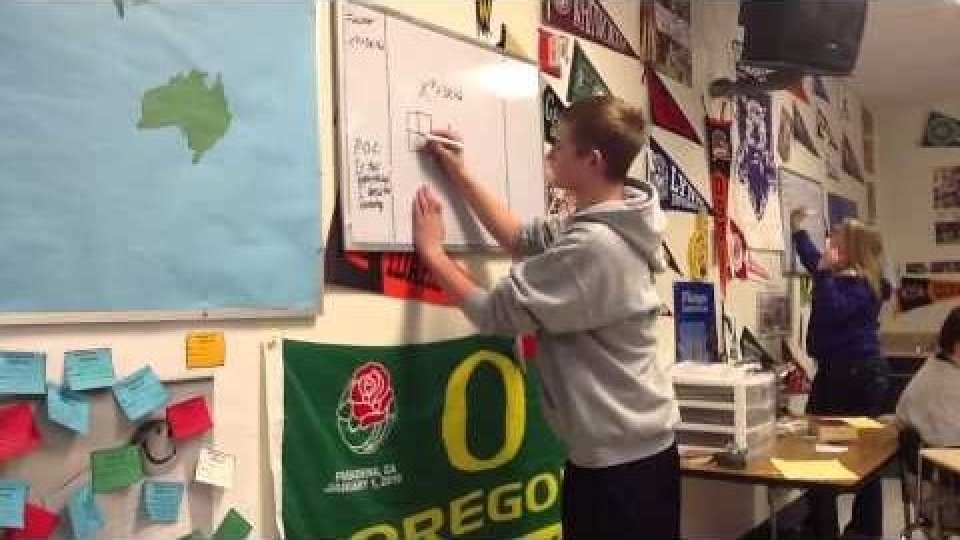
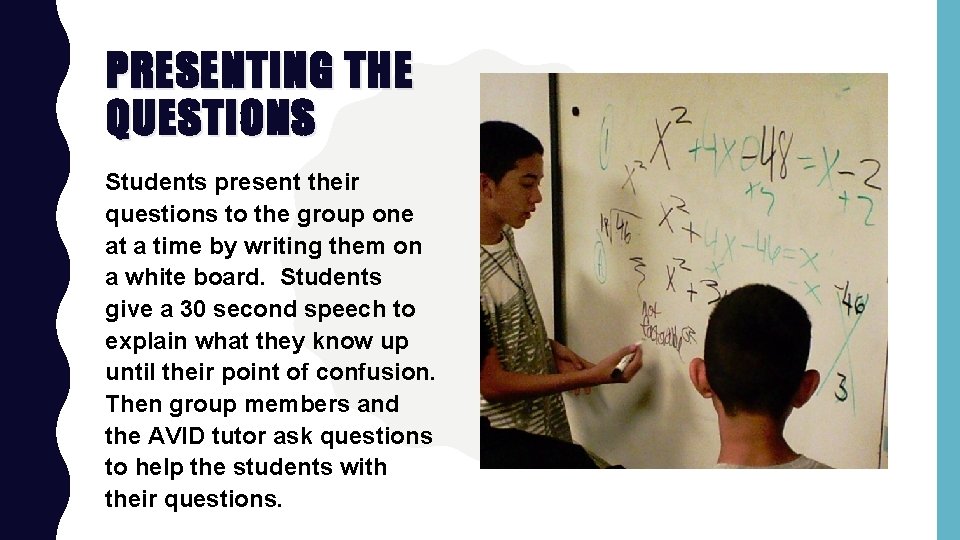
PRESENTING THE QUESTIONS Students present their questions to the group one at a time by writing them on a white board. Students give a 30 second speech to explain what they know up until their point of confusion. Then group members and the AVID tutor ask questions to help the students with their questions.
1. Write the problem neatly on the whiteboard. 2. Face the group members. 30 SEC SPEECH: HOW TO PRESENT A QUESTION 3. Read the question out loud to the group. 4. Explain any prior knowledge and what you already understand about the question. 5. Explain what strategies you used in attempting to answer the question. 6. Indicate to your group exactly where you became confused as you worked to answer this question.