
Please read this before using presentation This presentation
Please read this before using presentation • This presentation is based on content presented at the 2017 Mines Safety Roadshow in October 2017. • Department of Mines, Industry Regulation and Safety(DMIRS) supports and encourages reuse of its information (including data), and endorses use of the Australian Governments Open Access and Licensing Framework (Aus. GOAL) • This material is licensed under Creative Commons Attribution 4. 0 licence. We request that you observe and retain any copyright or related notices that may accompany this material as part of attribution. This is a requirement of Creative Commons Licences. • Please give attribution to Department of Mines, Industry Regulation REPLACE IMAGE and Safety, 2017. NOTE: Right click on the image and select Arrange and Send to Back • For resources, information or clarification, please contact: RSDComms@dmirs. wa. gov. au or visit www. dmirs. wa. gov. au/Resources. Safety
2017 Mines Safety Roadshow
Setting the scene Dangerous goods in the mining sector 3
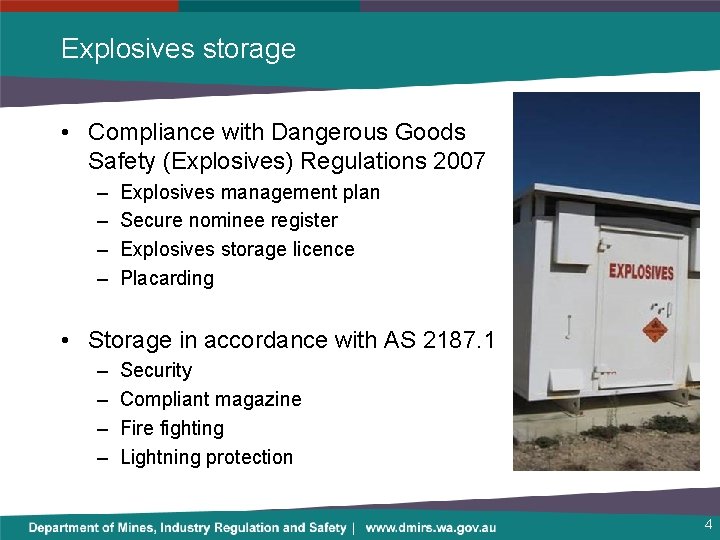
Explosives storage • Compliance with Dangerous Goods Safety (Explosives) Regulations 2007 – – Explosives management plan Secure nominee register Explosives storage licence Placarding • Storage in accordance with AS 2187. 1 – – Security Compliant magazine Fire fighting Lightning protection 4
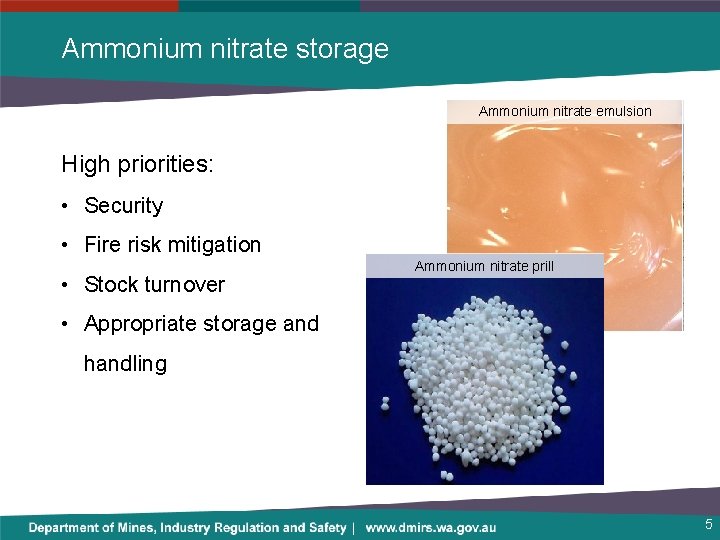
Ammonium nitrate storage Ammonium nitrate emulsion High priorities: • Security • Fire risk mitigation • Stock turnover Ammonium nitrate prill • Appropriate storage and handling 5
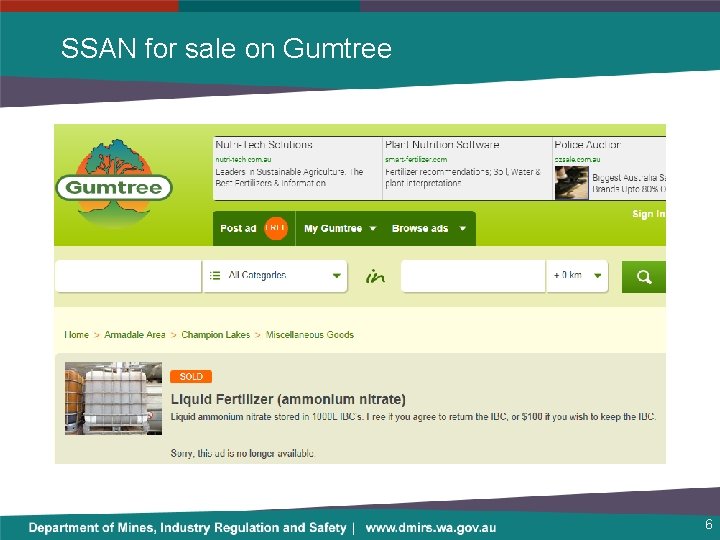
SSAN for sale on Gumtree 6
Security requirements for SSAN and explosives • Key register • Key safe • SSAN and explosives stored in secure compounds • Secure nominees • Stock reconciliation 7
Security requirements for SSAN and explosives (continued) • On 5 May 2015, WA Police uncovered theft of 100 kg of explosives taken from a gold operation near Norseman • Two men and a woman were convicted in relation to theft • Despite records showing discrepancies between the recorded quantities of explosives and the actual quantities of explosives stored, discrepancies were not investigated by the company • Appropriate controls and procedures in place to ensure explosives are secure from sabotage, theft, unexplained loss and unauthorised access 8
Security requirements for SSAN and explosives (continued) • Summary of hazard – If explosives end up in the wrong hands the safety of the community is put at risk • Actions required – Review and update your security plan and security risk assessment to ensure it remains current and effective o Check physical controls such as magazines, locks, fences, security patrols and key security o Ensure security plan is obeyed and complied with. Staff should be regularly trained on the security plan o Ensure reporting systems are working and staff are reporting suspicious activity o Regular audits and inspections are undertaken 9
Security requirements for SSAN and explosives (continued) • Actions required – Ensure dangerous goods security cards and other security clearances are current – Ensure access to explosives is monitored and controlled – Detailed records of supply and access should be kept 10
Security requirements for SSAN and explosives (continued) • Recommendations – In order to minimize the chance of sabotage or theft it is strongly recommended that: • One person does not have access to detonators, high explosives and an exploder at the same time, unless it is part of a planned blast – When accessing an explosives magazine there is always two people present to ensure accurate recordkeeping and the need for the explosives – Regularly check the national terrorism threat level http: //www. nationalsecurity. gov. au and update your security risk assessment and security plan for the current threat level 11
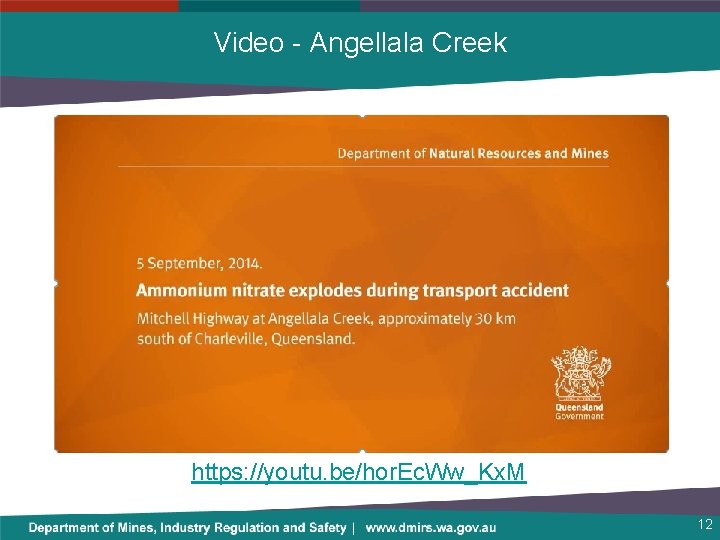
Video - Angellala Creek https: //youtu. be/hor. Ec. Ww_Kx. M 12
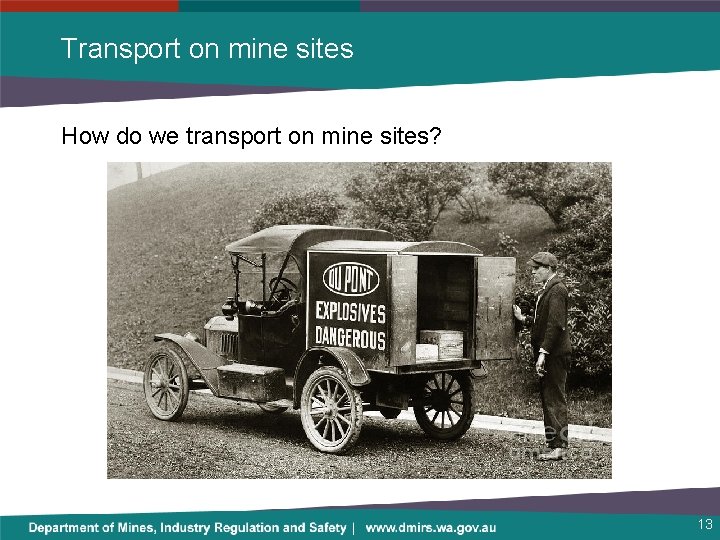
Transport on mine sites How do we transport on mine sites? 13
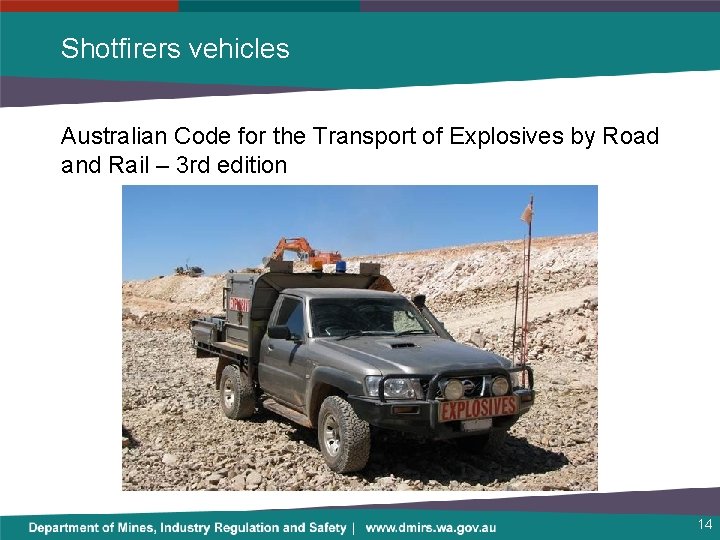
Shotfirers vehicles Australian Code for the Transport of Explosives by Road and Rail – 3 rd edition 14
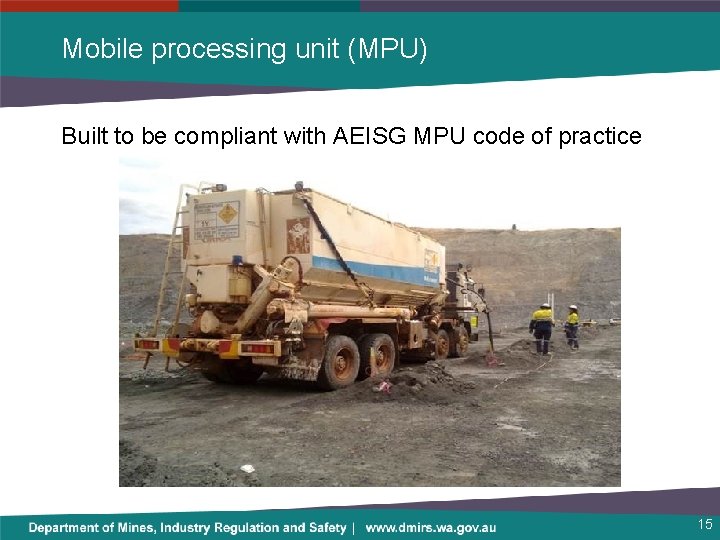
Mobile processing unit (MPU) Built to be compliant with AEISG MPU code of practice 15
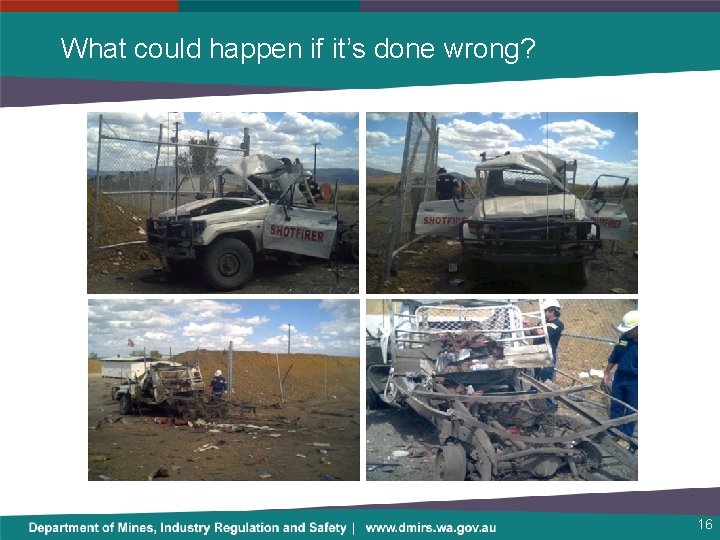
What could happen if it’s done wrong? 16
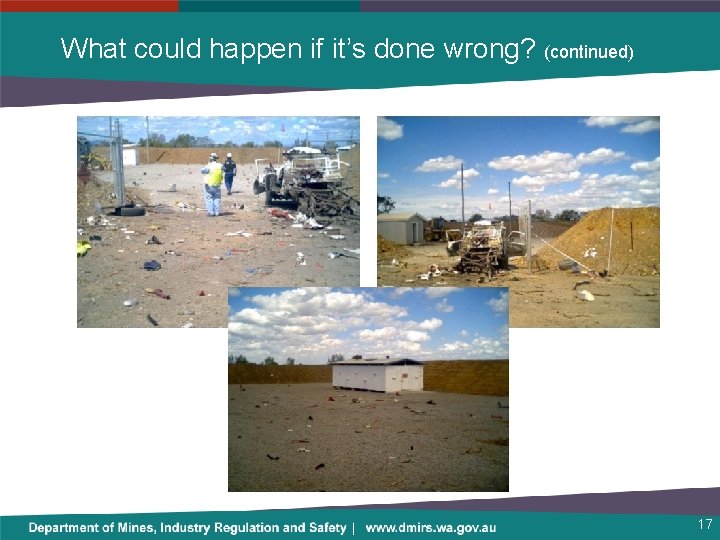
What could happen if it’s done wrong? (continued) 17
Known facts around the incident • PPE items diminishing rapidly from stock available to crew • Dedicated explosives cabinets used for detonator and booster transport were on ute tray • Opened boxes of spare boosters and detonators on ute tray • Driver was a known smoker 18
What are our key learnings? • Have a robust change management process • Explosives need to be handled correctly • Any ignition source around explosives is not only poor judgement but illegal 19
- Slides: 19