
Please pick up the following PACE Sheet Academic




- Slides: 23
Please pick up the following: • • • PACE Sheet Academic Action Plan Advising Sheet
Environmental & Sustainability Studies February 10 th, 2015
Purpose of this Advising Session • • • To provide information to assist you in registering for 2016/17 courses. To provide the “tools” to meet with your academic advisor. All students must be advised to be able to register in March.
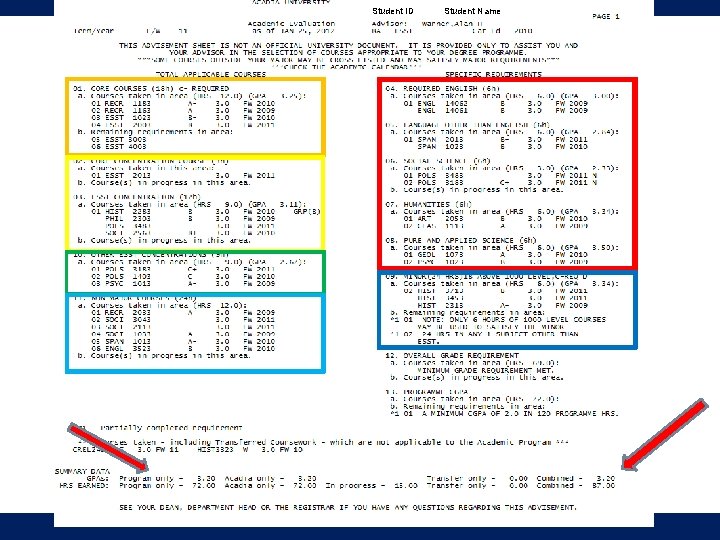
PACE Forms • • The PACE form is your academic performance. Unfortunately, the system is unable to show the courses in the correct sections on the PACE due to our complexity of the program. The First Step is to take the items from your pace and complete the Advising Sheet. This shows clearly your progress of the degree and what you have remaining to complete. If you are a BRM or BCD with ESST student the pace form works correctly the computer “puts everything where it belongs”… that doesn’t always happen with the BA pace form!
Student ID Student Name PACE Sheet-BA ESST
RECR / CODE Course Changes • • • Last year all RECR-numbered courses changed to CODE-numbered courses. This was because of the creation of the new Community Development Department and program The pink sheet in today’s package shows what the CODE number is for each of the older RECR courses. It is your responsibility to ensure that you do not register in / complete the same course twice! If you do so the most recent grade would be the one that goes on your transcript! (And you’ll only receive 3 hrs toward your degree, not 6 hrs as you might think; you did the same course twice, not two different ones!)
BA Requirements vs. BRM/BCD Requirements BA BA Requirements Arts Core (30 h) � � � 6 h in English at the 1000 level 6 h in a single language other than English 6 h in ECON, POLS, SOCI, WGST 6 h in ART, CLAS, CREL, HIST, PHIL, MUSI, WGST 6 h in the FPAS University Electives (48 h) � � � 24 h in Minor (only 6 h at 1000) 24 h University Electives Minimum GPA of 2. 0 BRM / BCD BRM Requirements � � � 39 h in Leisure Studies/ CD Core 12 h CD Electives 18 h in Management Core 27 h University Electives Non-Credits (RECR 1100, 1210, 3100) Minimum GPA of 2. 0
ESST Program • • • ESST Core (ESST 1003, 1023, 2003, 3003, 4003 & RECR 1163 [now CODE 1023]) (18 h) Core Concentration Course (3 h) • BUSI 2763 • ESST 2013 • PHIL 2303 • RECR/CODE 2033 12 h Concentration (9 h of these must be @ 3000 or 4000 level) • Innovation & Entrepreneurship for Sustainability • Environmental Advocacy, Education & Activism • Environmental Thought & Practice • Sustainable Community Development 9 h Concentration Electives from any concentration list (3 h @ 3000 or 4000 level) Minimum of 6 h from each of the Faculties of Arts, Pure and Applied Science and Professional Studies
Concentrations • Innovation and Entrepreneurship for Sustainability • Environmental Advocacy, Education & Activism Focus is on gaining knowledge and skill to help shift businesses and organizations toward sustainability in areas such as organizational development and training, procurement, and policy development. Courses such as: Busi 1703, 2733, 3753, 3773, 4553, 4613, 4633, Code 2033, 3523, 3603, Econ 2713, 3313, Educ 42 A 3/Esst 3513, 42 B 3/Esst 3523, Esst 2013, Envs 3113, 3423, Hist 2283, Idst 2213, 2706, Phil 2303 Focus is on gaining knowledge and skills to help shift social, political and educational structures and processes toward sustainability. Work and policy analysis is at multiple levels: local, regional, national, international. Courses such as: Busi 2763, 4633, Crel 2413, Code 2033, 3523, 3563, 3603, Econ 2713, 3713, Educ 42 A 3, 42 B 3, Envs 3423, Esst 3503, Hist 2283, 3383, Idst 2213, Phil 2303, Pols 2113, 3213, 3483, 3543, 3883, 4603, 4843, Soci 2413, 2563, 3223, 3633, Wgst 2913
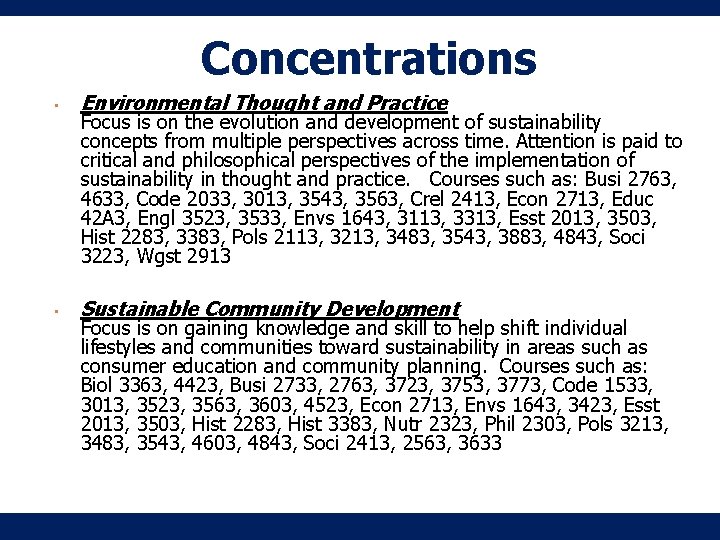
Concentrations • Environmental Thought and Practice • Sustainable Community Development Focus is on the evolution and development of sustainability concepts from multiple perspectives across time. Attention is paid to critical and philosophical perspectives of the implementation of sustainability in thought and practice. Courses such as: Busi 2763, 4633, Code 2033, 3013, 3543, 3563, Crel 2413, Econ 2713, Educ 42 A 3, Engl 3523, 3533, Envs 1643, 3113, 3313, Esst 2013, 3503, Hist 2283, 3383, Pols 2113, 3213, 3483, 3543, 3883, 4843, Soci 3223, Wgst 2913 Focus is on gaining knowledge and skill to help shift individual lifestyles and communities toward sustainability in areas such as consumer education and community planning. Courses such as: Biol 3363, 4423, Busi 2733, 2763, 3723, 3753, 3773, Code 1533, 3013, 3523, 3563, 3603, 4523, Econ 2713, Envs 1643, 3423, Esst 2013, 3503, Hist 2283, Hist 3383, Nutr 2323, Phil 2303, Pols 3213, 3483, 3543, 4603, 4843, Soci 2413, 2563, 3633
Calendar vs. Timetable • • The Calendar is a list of all courses that the university can offer, known as curriculum. The Timetable is a list of courses scheduled for a specific period of time. The timetable is located on the Registrar’s website or login to Acadia Central. The Timetable for 2015 -2016 is not yet available for you to review
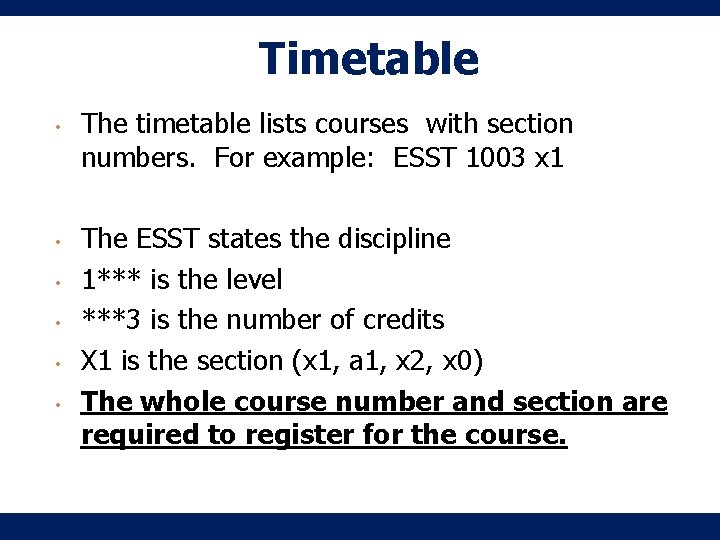
Timetable • • • The timetable lists courses with section numbers. For example: ESST 1003 x 1 The ESST states the discipline 1*** is the level ***3 is the number of credits X 1 is the section (x 1, a 1, x 2, x 0) The whole course number and section are required to register for the course.
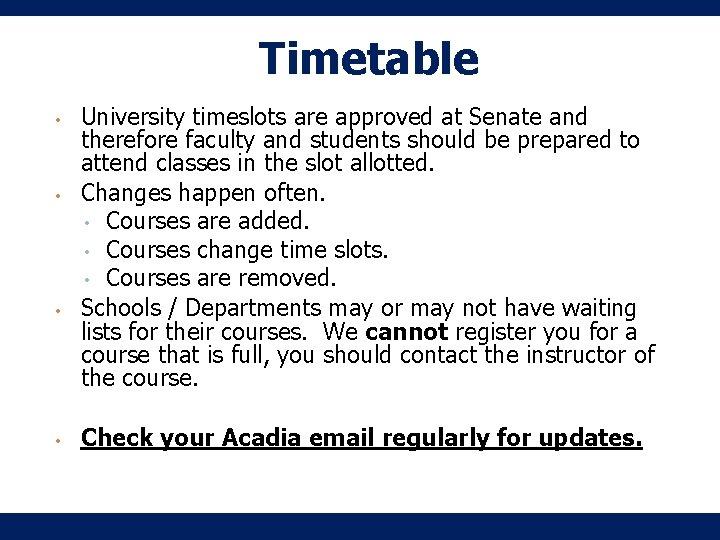
Timetable • • University timeslots are approved at Senate and therefore faculty and students should be prepared to attend classes in the slot allotted. Changes happen often. • Courses are added. • Courses change time slots. • Courses are removed. Schools / Departments may or may not have waiting lists for their courses. We cannot register you for a course that is full, you should contact the instructor of the course. Check your Acadia email regularly for updates.
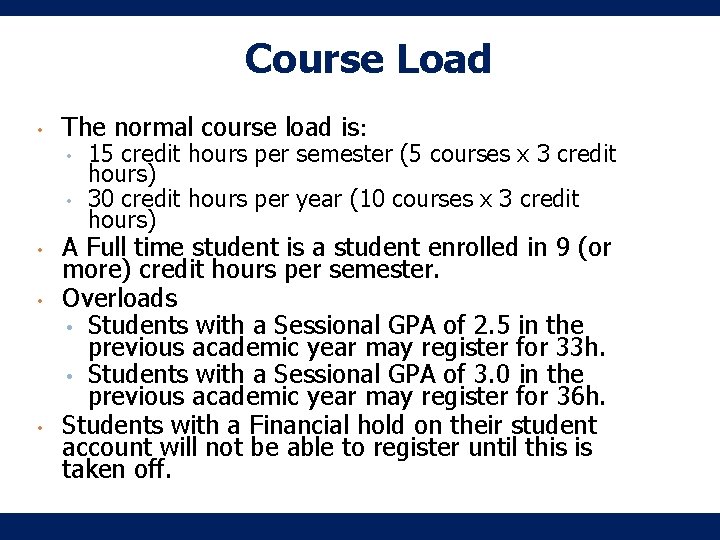
Course Load • The normal course load is: • • • 15 credit hours per semester (5 courses x 3 credit hours) 30 credit hours per year (10 courses x 3 credit hours) A Full time student is a student enrolled in 9 (or more) credit hours per semester. Overloads • Students with a Sessional GPA of 2. 5 in the previous academic year may register for 33 h. • Students with a Sessional GPA of 3. 0 in the previous academic year may register for 36 h. Students with a Financial hold on their student account will not be able to register until this is taken off.
Honours • The core GPA of 3. 00 or higher must be obtained to pursue Honours • Must have a faculty advisor willing to oversee your honours research project • Handbook online - guidelines for honours students and thesis writing
The Backpack – Acadia Central • • Log in to Acadia Central – same as Acadia email Choose Online Registration tab on the left Go to the Timetable Tab and select your courses Switch to the Backpack Tab The Backpack is like an online shopping cart, until you checkout you are not registered! When you add a course to your backpack it does NOT reserve that seat for you. Only when you “Register” for it. Make sure you click on the “Register” button once you have completed your schedule If you register for a course that has a lab make sure you choose a lab section as well
Registration Tips 1. 2. 3. Begin looking for electives now. Select 23 extra electives in case the ones you really want are full or conflict with your core courses. Register for electives. Register for the ESST Core Electives.
Academic Advisor vs. Administrative Assistant • • Your academic advisor can assist you in choosing the courses that are available on campus which will support your career goals. The administrative assistant can assist you in registering in courses that you have selected.
Responsibility • • • It is your degree therefore; it is your responsibility. Be prepared: • Know the program. • Know what courses you have completed. • Know what courses you require. Meet with your academic advisor.
Registration H E L P For assistance contact Kim. Email: kim. vaughan@acadiau. ca Phone: 585 -1307 You will need your student ID number and full course number to receive assistance.
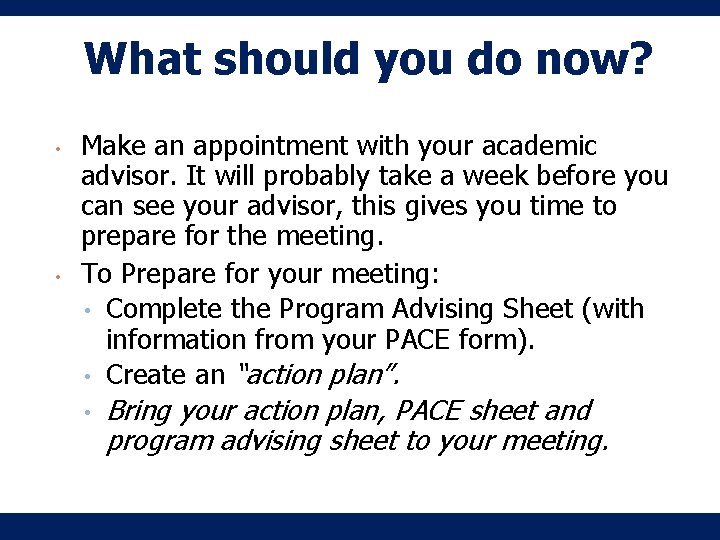
What should you do now? • • Make an appointment with your academic advisor. It will probably take a week before you can see your advisor, this gives you time to prepare for the meeting. To Prepare for your meeting: • Complete the Program Advising Sheet (with information from your PACE form). • Create an “action plan”. • Bring your action plan, PACE sheet and program advising sheet to your meeting.
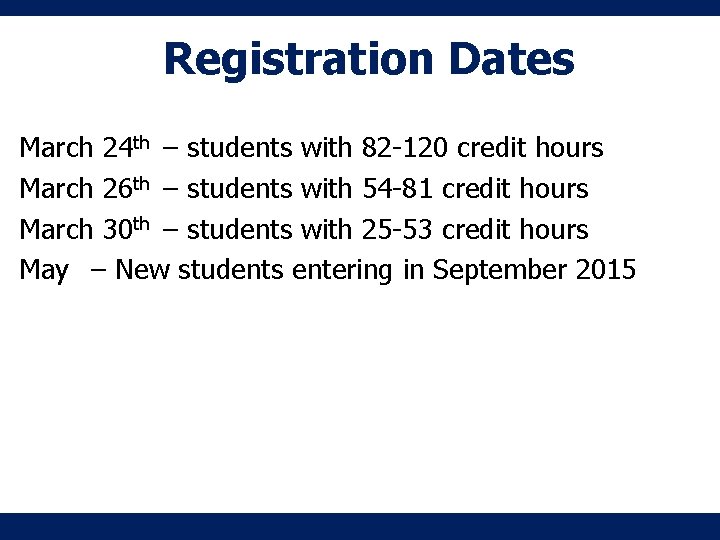
Registration Dates March 24 th – students with 82 -120 credit hours March 26 th – students with 54 -81 credit hours March 30 th – students with 25 -53 credit hours May – New students entering in September 2015
Questions & Discussion