
PLCopen for efficiency in automation Welcome at this


- Slides: 38
PLCopen for efficiency in automation Welcome at this PLCopen presentation on Safety Check also the notes coupled to each slide Page 1 printed at 9/19/2021 www. PLCopen. org ®
PLCopen for efficiency in automation PLCopen Safety The natural addition to Logic and Motion Page 2 printed at 9/19/2021 www. PLCopen. org ®
PLCopen for efficiency in automation Reasons to merge – a changing environment § Too many dialects, too many standards, including IEC 61508 and IEC 62061; § Additional governmental requirements increasing the liability issues; § No independent training material § Trend to software solutions § Too much done by machine builder § Growing market expected Page 3 printed at 9/19/2021 www. PLCopen. org ®
PLCopen for efficiency in automation Reasons to merge – a changing environment § The tendency to move from one motor (master axis) to multiple axes, driven by mechatronic solutions; § The availability and acceptance of digital networks with safety functionality built-in; § The inherent move from hardwired safety functionalities to software solutions; § The increasing importance of safety related issues regarding personnel and machines (Governmental requirements). Page 4 printed at 9/19/2021 www. PLCopen. org ®
PLCopen for efficiency in automation TC 5 - Safety : Goal Allow the user to achieve the functional safety at the machine and plant level Page 5 printed at 9/19/2021 www. PLCopen. org ®
PLCopen for efficiency in automation Why integration of safety functionality in the programming environment? § Basis for easier commissioning § Basis for product / architecture independent training § Support for safe programming techniques § Guidelines for the use of the IEC standards § In combination with Function Blocks § Identification via SAFEBOOL datatype Page 6 printed at 9/19/2021 www. PLCopen. org ®
PLCopen for efficiency in automation Overall safety related requirements The common basic requirements of a safety application for machine builders within all applicable safety standards are: § Distinction between safety and non-safety functionalities § Use of applicable programming languages and language subsets § Use of validated software blocks § Use of applicable programming guidelines § Use of recognized error-reducing measures for the lifecycle of the safety-related software Page 7 printed at 9/19/2021 www. PLCopen. org ®
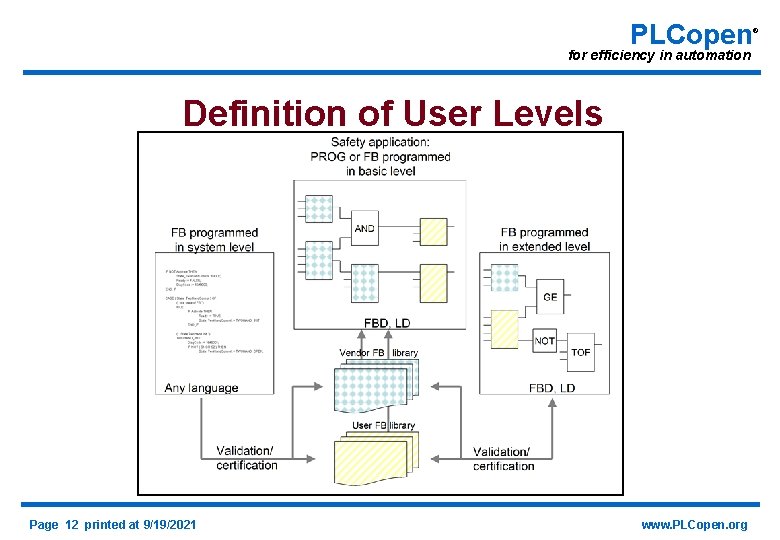
PLCopen for efficiency in automation PLCopen Safety: What is included? (1/2) § Representation of the software architecture § Definition of the programming languages § Presentation of safety-related data types § Definition of language subsets § Definition of user levels for easy programming and error prevention Page 8 printed at 9/19/2021 www. PLCopen. org ®
PLCopen ® for efficiency in automation PLCopen Safety: What is included? (2/2) § Error handling and diagnostic concept § Definition of a generic safety-related function block § The definition of a set of safety-related function blocks § The definition of a PLCopen compliance procedure combined with the use of the PLCopen Safety logo Page 9 printed at 9/19/2021 www. PLCopen. org
PLCopen for efficiency in automation PLCopen Safety – a suite of Specifications § Part 1 - Concepts and Function Blocks § Part 2 - User Examples § Part 3 - Extensions to Part 1 § Part 4 - Extensions for Presses § Separate user document: Logic, Motion, Safety Page 10 printed at 9/19/2021 www. PLCopen. org ®
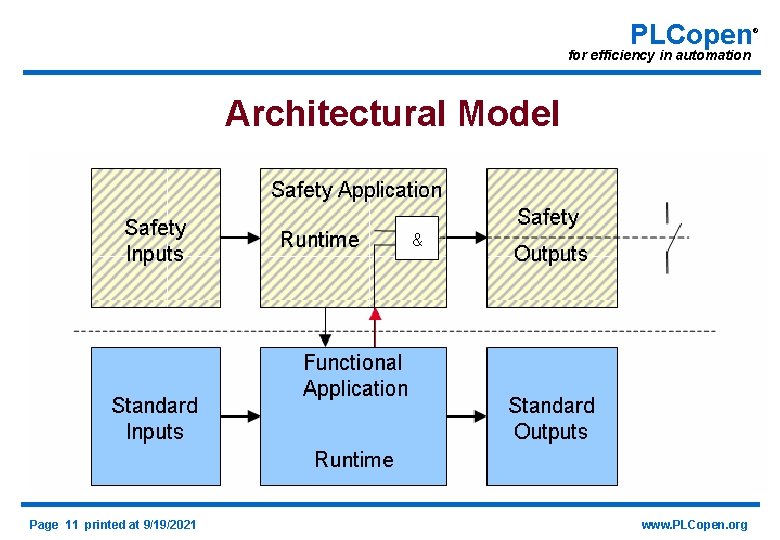
PLCopen for efficiency in automation Architectural Model Page 11 printed at 9/19/2021 www. PLCopen. org ®
PLCopen for efficiency in automation Definition of User Levels Page 12 printed at 9/19/2021 www. PLCopen. org ®
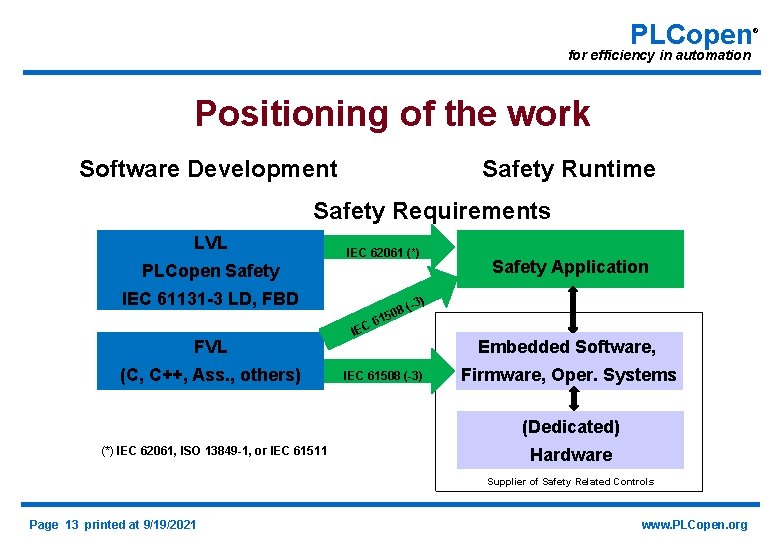
PLCopen for efficiency in automation Positioning of the work Software Development Safety Runtime Safety Requirements LVL IEC 62061 (*) Safety Application PLCopen Safety IEC 61131 -3 LD, FBD FVL (C, C++, Ass. , others) IEC 8 150 ) (-3 6 IEC 61508 (-3) Embedded Software, Firmware, Oper. Systems (Dedicated) (*) IEC 62061, ISO 13849 -1, or IEC 61511 Hardware Supplier of Safety Related Controls Page 13 printed at 9/19/2021 www. PLCopen. org ®
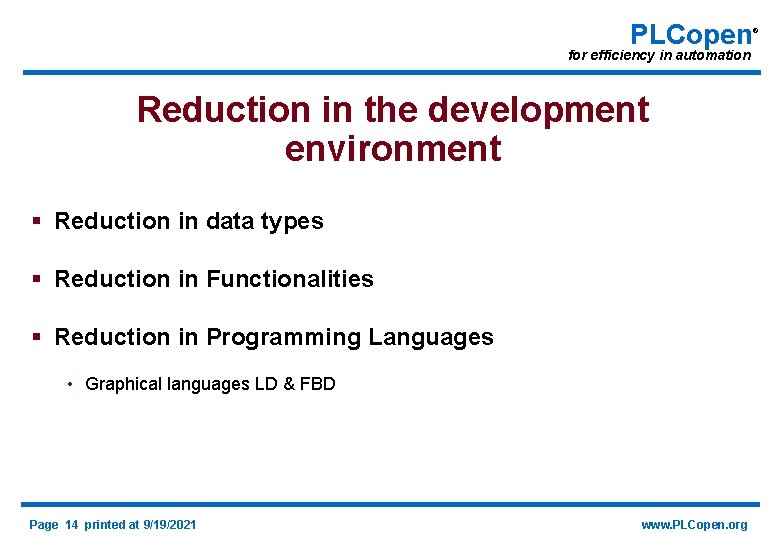
PLCopen for efficiency in automation Reduction in the development environment § Reduction in data types § Reduction in Functionalities § Reduction in Programming Languages • Graphical languages LD & FBD Page 14 printed at 9/19/2021 www. PLCopen. org ®
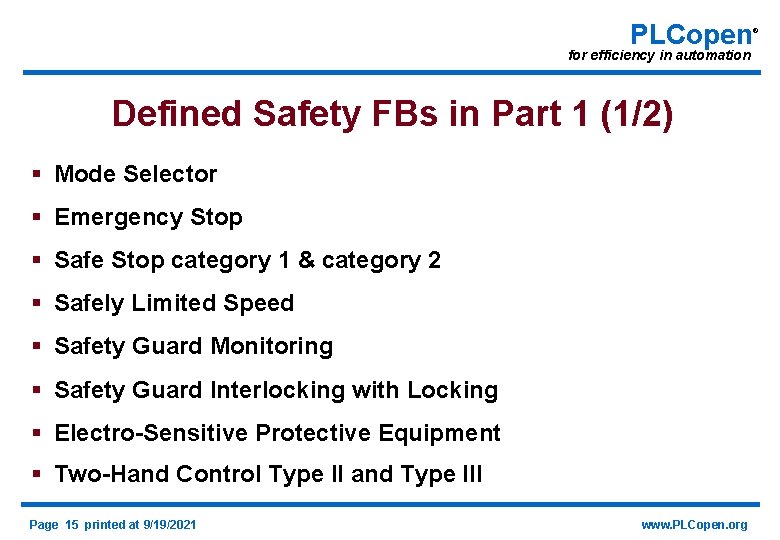
PLCopen for efficiency in automation Defined Safety FBs in Part 1 (1/2) § Mode Selector § Emergency Stop § Safe Stop category 1 & category 2 § Safely Limited Speed § Safety Guard Monitoring § Safety Guard Interlocking with Locking § Electro-Sensitive Protective Equipment § Two-Hand Control Type II and Type III Page 15 printed at 9/19/2021 www. PLCopen. org ®
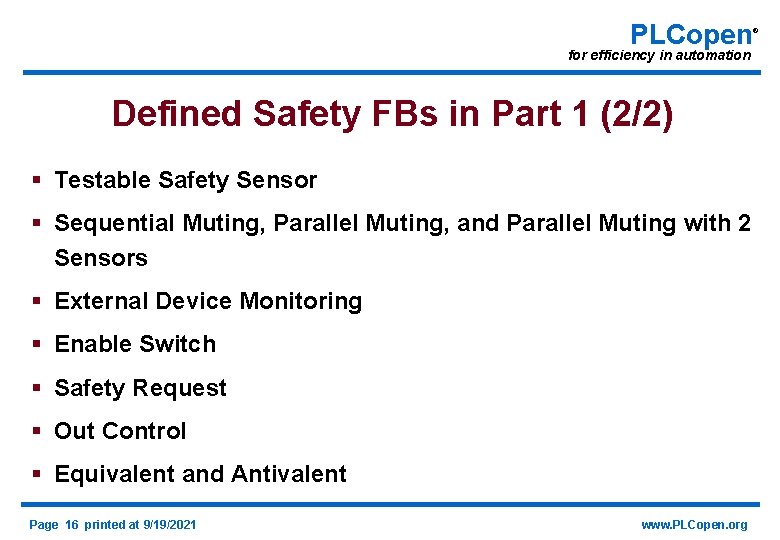
PLCopen for efficiency in automation Defined Safety FBs in Part 1 (2/2) § Testable Safety Sensor § Sequential Muting, Parallel Muting, and Parallel Muting with 2 Sensors § External Device Monitoring § Enable Switch § Safety Request § Out Control § Equivalent and Antivalent Page 16 printed at 9/19/2021 www. PLCopen. org ®
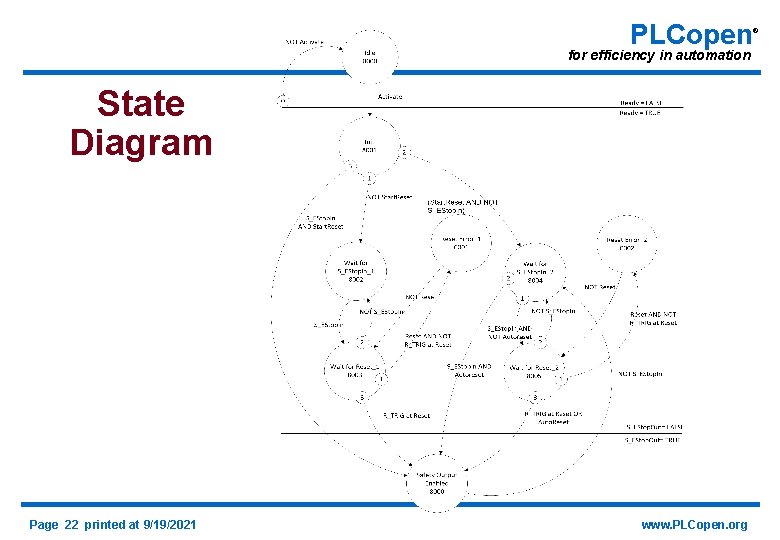
PLCopen for efficiency in automation Definitions per Safety Function Block § Applicable Safety Standards § Interface Description § Functional Description, incl. State Diagram and typical timing diagrams § Error Detection § Error Behavior § Function Block-Specific Error and Status Codes (on top of the generic diagnostics and error codes) Page 17 printed at 9/19/2021 www. PLCopen. org ®
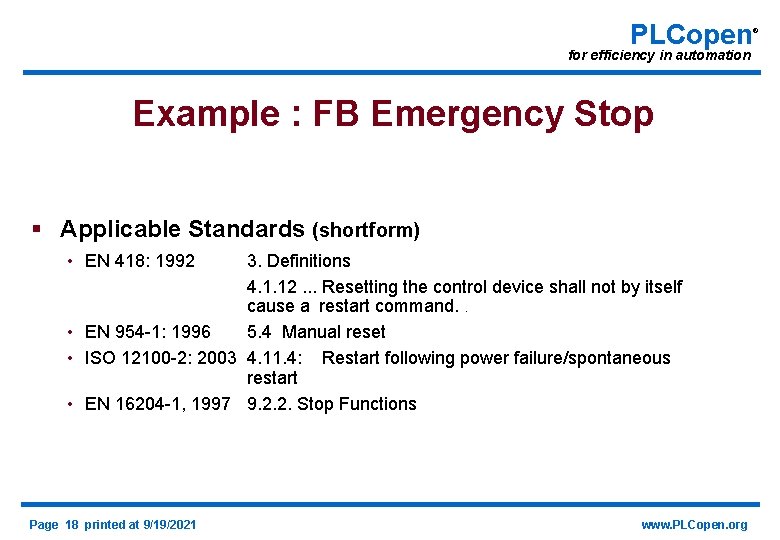
PLCopen for efficiency in automation Example : FB Emergency Stop § Applicable Standards (shortform) • EN 418: 1992 3. Definitions 4. 1. 12. . . Resetting the control device shall not by itself cause a restart command. . • EN 954 -1: 1996 5. 4 Manual reset • ISO 12100 -2: 2003 4. 11. 4: Restart following power failure/spontaneous restart • EN 16204 -1, 1997 9. 2. 2. Stop Functions Page 18 printed at 9/19/2021 www. PLCopen. org ®
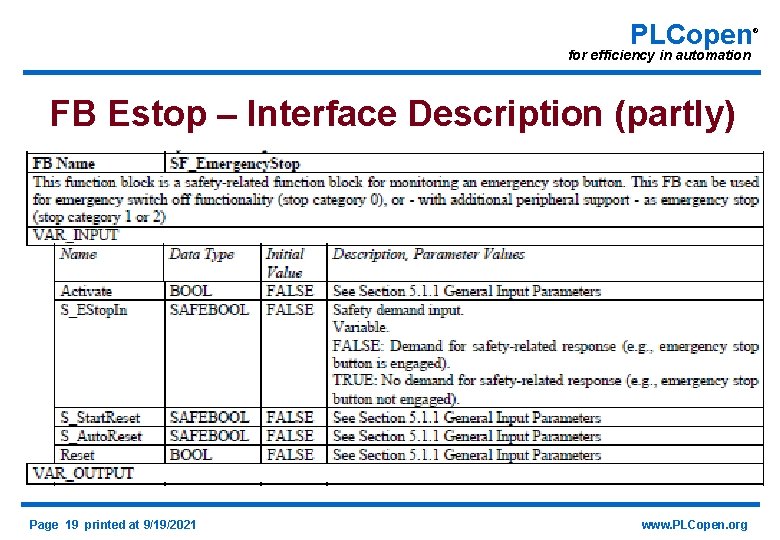
PLCopen for efficiency in automation FB Estop – Interface Description (partly) Page 19 printed at 9/19/2021 www. PLCopen. org ®
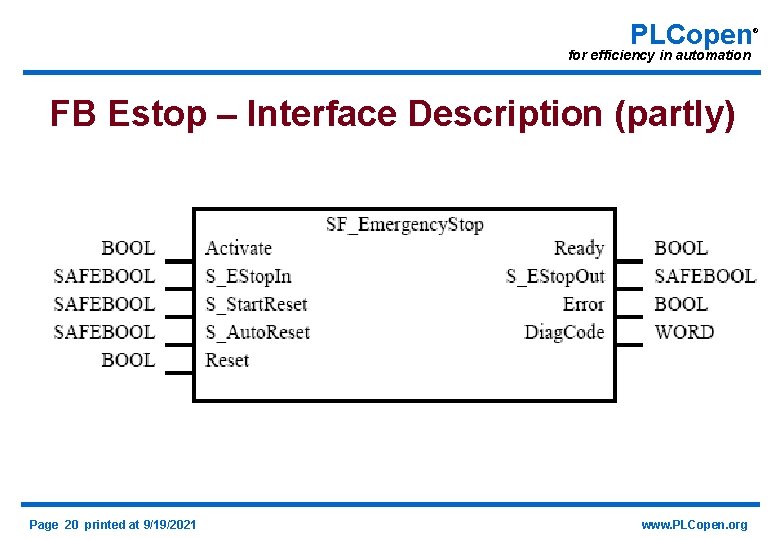
PLCopen for efficiency in automation FB Estop – Interface Description (partly) Page 20 printed at 9/19/2021 www. PLCopen. org ®
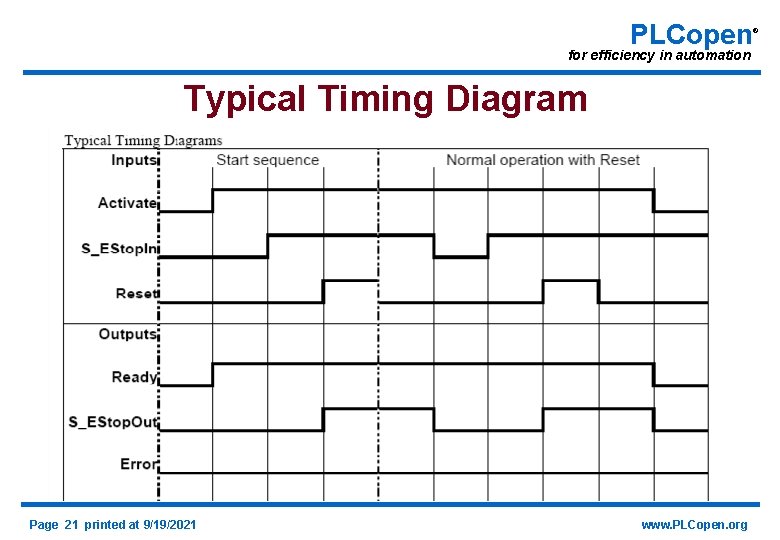
PLCopen for efficiency in automation Typical Timing Diagram Page 21 printed at 9/19/2021 www. PLCopen. org ®
PLCopen for efficiency in automation State Diagram Page 22 printed at 9/19/2021 www. PLCopen. org ®
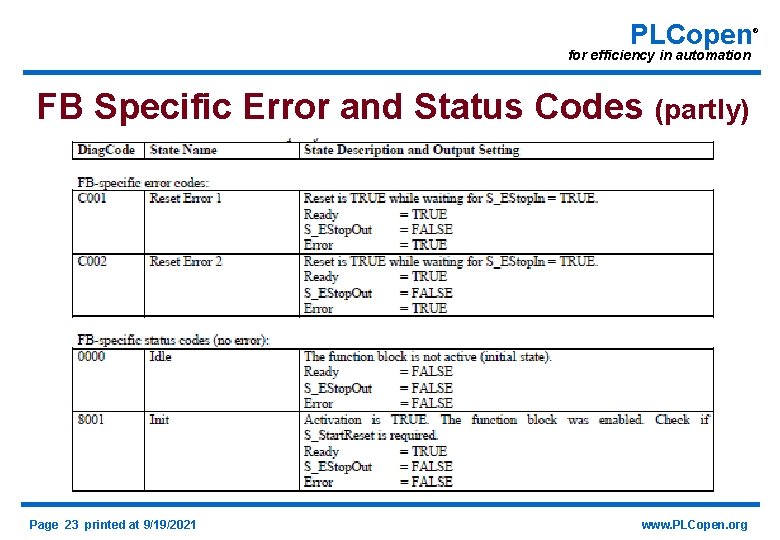
PLCopen for efficiency in automation FB Specific Error and Status Codes (partly) Page 23 printed at 9/19/2021 www. PLCopen. org ®
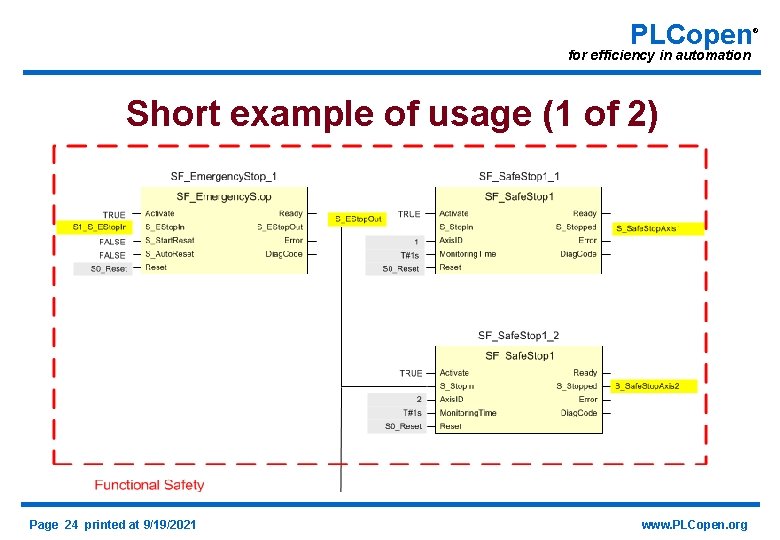
PLCopen for efficiency in automation Short example of usage (1 of 2) Page 24 printed at 9/19/2021 www. PLCopen. org ®
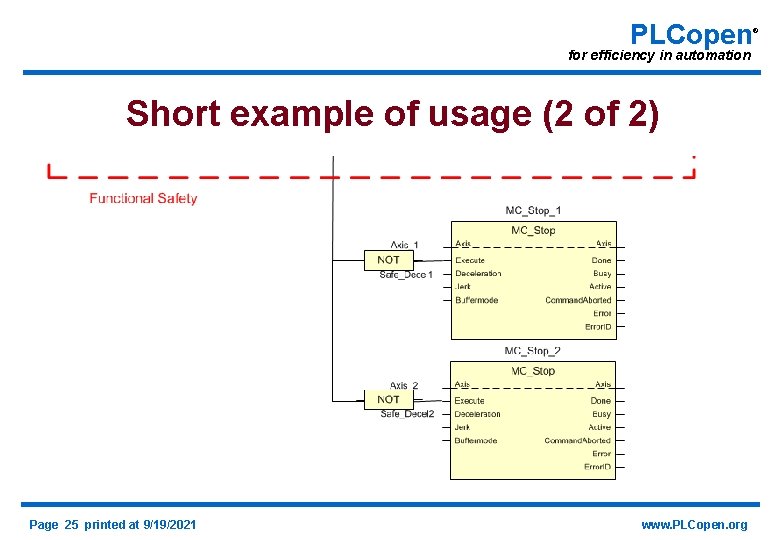
PLCopen for efficiency in automation Short example of usage (2 of 2) Page 25 printed at 9/19/2021 www. PLCopen. org ®
PLCopen for efficiency in automation Defined Safety FBs in Part 3 (1/2) § Safety Guard Interlocking with Locking (Version 2) § Safety Guard Interlocking with Locking for switches with serial contacts § Pressure Sensitive Equipment (PSE) § Diagnostic FB § Override § SF_Enable. Switch 2 (without detection of panic position) Page 26 printed at 9/19/2021 www. PLCopen. org ®
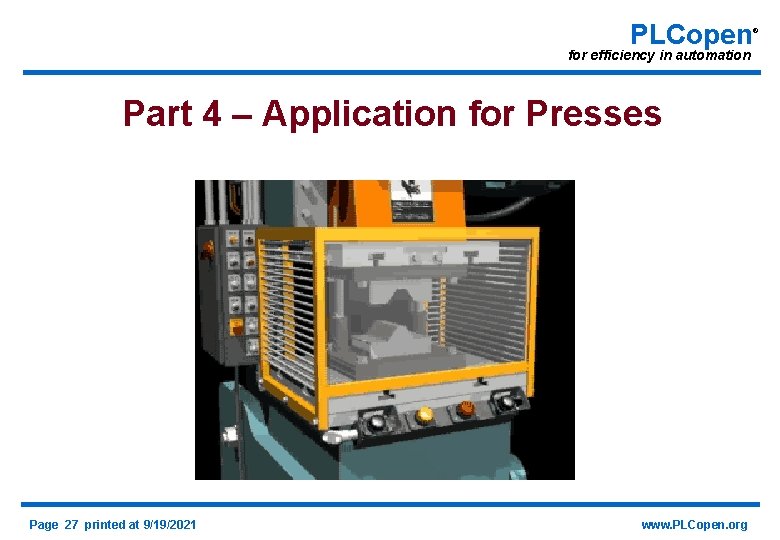
PLCopen for efficiency in automation Part 4 – Application for Presses Page 27 printed at 9/19/2021 www. PLCopen. org ®
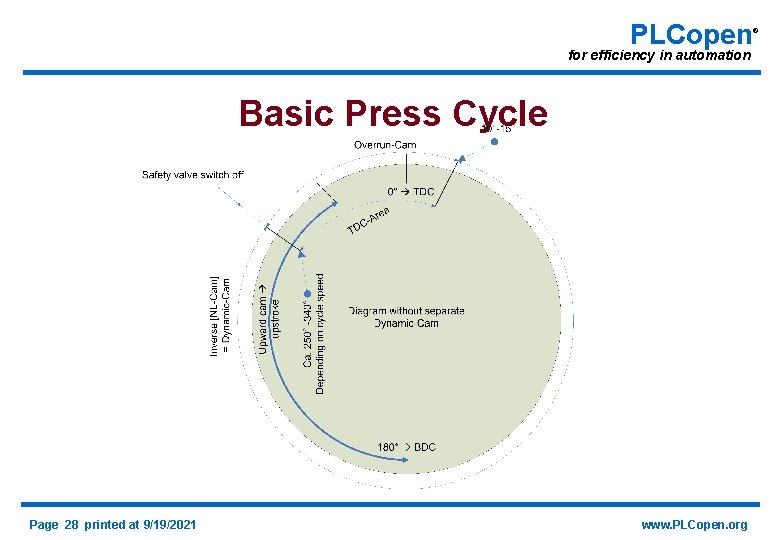
PLCopen for efficiency in automation Basic Press Cycle Page 28 printed at 9/19/2021 www. PLCopen. org ®
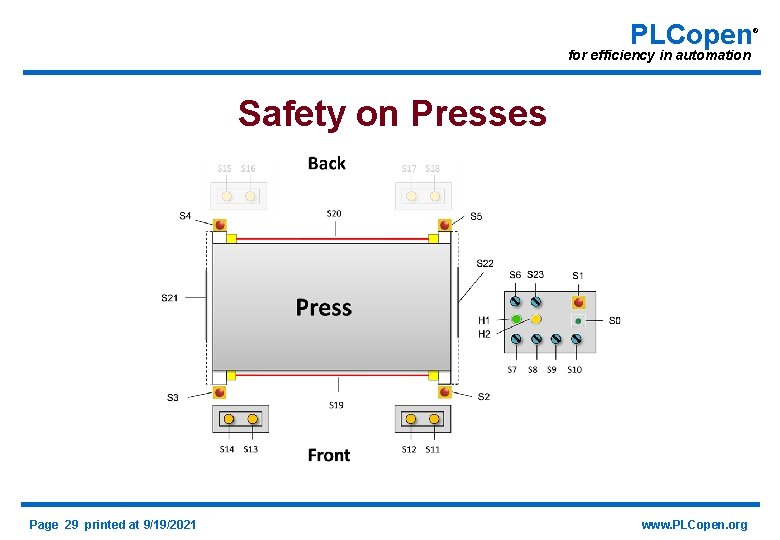
PLCopen for efficiency in automation Safety on Presses Page 29 printed at 9/19/2021 www. PLCopen. org ®
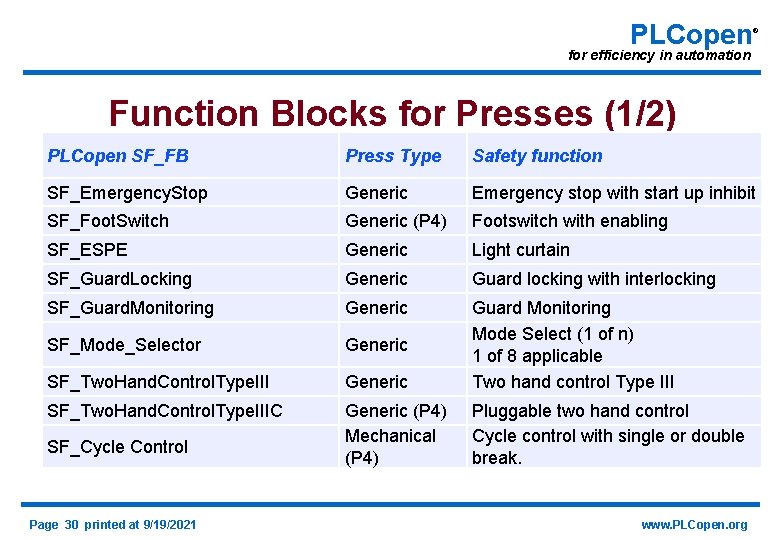
PLCopen ® for efficiency in automation Function Blocks for Presses (1/2) PLCopen SF_FB Press Type Safety function SF_Emergency. Stop Generic Emergency stop with start up inhibit SF_Foot. Switch Generic (P 4) Footswitch with enabling SF_ESPE Generic Light curtain SF_Guard. Locking Generic Guard locking with interlocking SF_Guard. Monitoring Generic SF_Mode_Selector Generic SF_Two. Hand. Control. Type. III Generic Guard Monitoring Mode Select (1 of n) 1 of 8 applicable Two hand control Type III SF_Two. Hand. Control. Type. IIIC Generic (P 4) Mechanical (P 4) Pluggable two hand control Cycle control with single or double break. SF_Cycle Control Page 30 printed at 9/19/2021 www. PLCopen. org
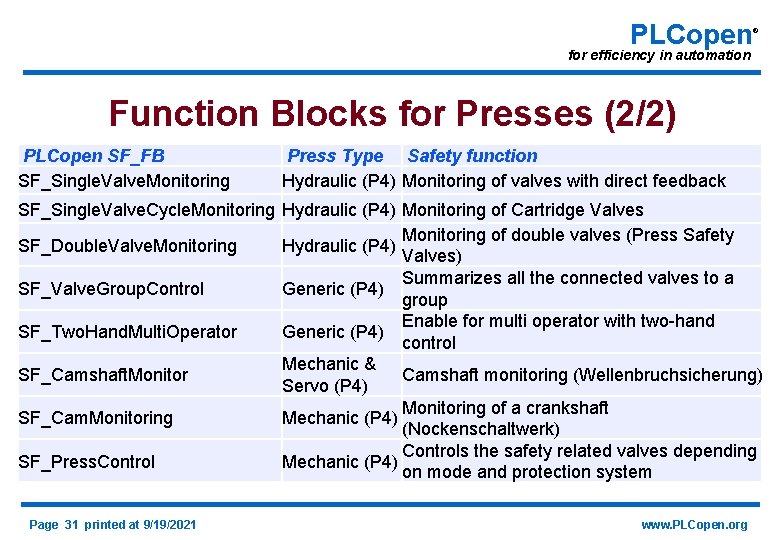
PLCopen ® for efficiency in automation Function Blocks for Presses (2/2) PLCopen SF_FB SF_Single. Valve. Monitoring Press Type Safety function Hydraulic (P 4) Monitoring of valves with direct feedback SF_Single. Valve. Cycle. Monitoring Hydraulic (P 4) Monitoring of Cartridge Valves Monitoring of double valves (Press Safety SF_Double. Valve. Monitoring Hydraulic (P 4) Valves) Summarizes all the connected valves to a SF_Valve. Group. Control Generic (P 4) group Enable for multi operator with two-hand SF_Two. Hand. Multi. Operator Generic (P 4) control Mechanic & SF_Camshaft. Monitor Camshaft monitoring (Wellenbruchsicherung) Servo (P 4) Monitoring of a crankshaft SF_Cam. Monitoring Mechanic (P 4) (Nockenschaltwerk) Controls the safety related valves depending SF_Press. Control Mechanic (P 4) on mode and protection system Page 31 printed at 9/19/2021 www. PLCopen. org
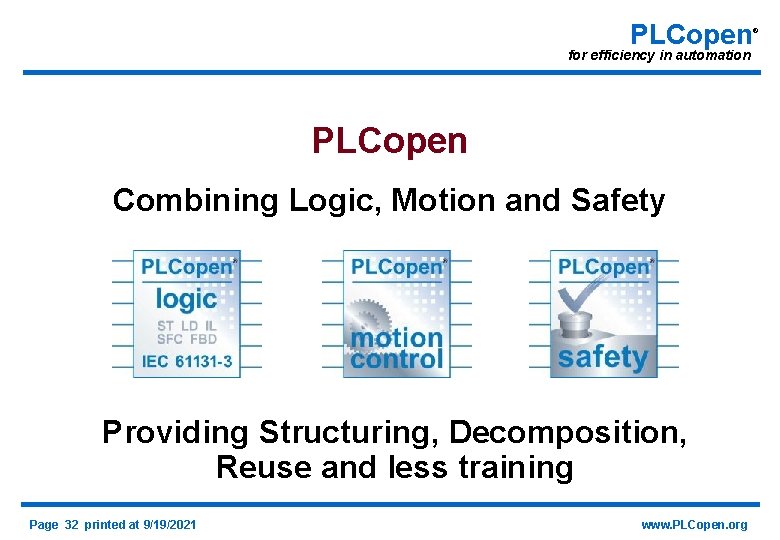
PLCopen for efficiency in automation PLCopen Combining Logic, Motion and Safety Providing Structuring, Decomposition, Reuse and less training Page 32 printed at 9/19/2021 www. PLCopen. org ®
PLCopen for efficiency in automation Some words to the Not-for-profit organization Page 33 printed at 9/19/2021 www. PLCopen. org ®
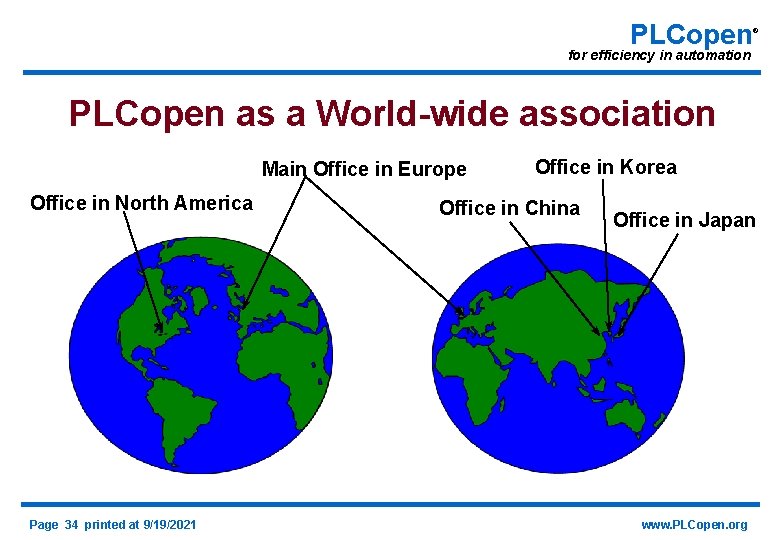
PLCopen ® for efficiency in automation PLCopen as a World-wide association Main Office in Europe Office in North America Page 34 printed at 9/19/2021 Office in Korea Office in China Office in Japan www. PLCopen. org
PLCopen for efficiency in automation One member – One vote small companies can have the same influence as large companies Page 35 printed at 9/19/2021 www. PLCopen. org ®
PLCopen for efficiency in automation Page 36 printed at 9/19/2021 www. PLCopen. org ®
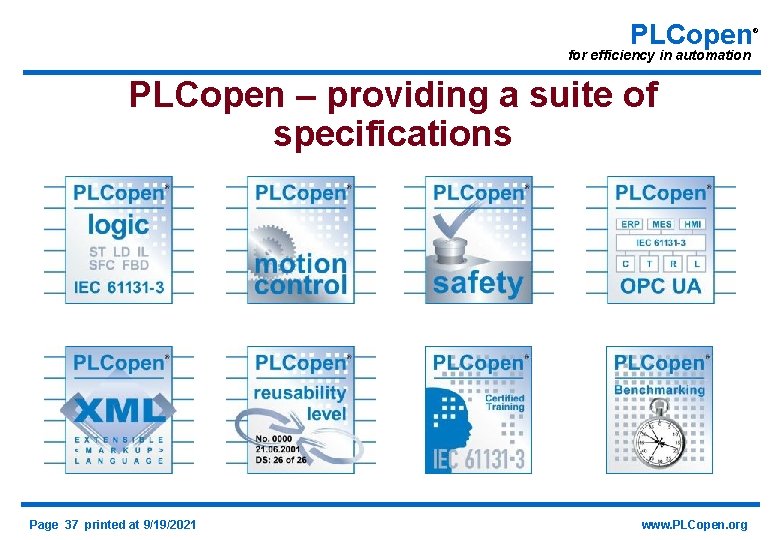
PLCopen for efficiency in automation PLCopen – providing a suite of specifications Page 37 printed at 9/19/2021 www. PLCopen. org ®
PLCopen for efficiency in automation More Information. . . and to download the specifications (f. o. c) www. PLCopen. org Free-of-Charge electronic Newsletter ‘PLCopening’ (in English) email: evdwal@PLCopen. org Page 38 printed at 9/19/2021 www. PLCopen. org ®