
Playing with Ecosystem Science Informal Modeling Games to
- Slides: 17
Playing with Ecosystem Science Informal Modeling Games to Explore the Delicate Balance in Watery Places WWW. WINDOWS. UCAR. EDU © 2003 International Art Tiles Lisa Gardiner (egardine@ucar. edu), Randy Russell, Roberta Johnson, and Dave Mastie UCAR Office of Education and Outreach, Boulder, CO, www. eo. ucar. edu
Learning about Natural Environments and Processes through Models From Benchmarks for Science Literacy: By the end of the 8 th grade, “students should know that models are often used to think about processes that happen too slowly, too quickly, or on too small a scale to observe directly, or that are too vast to be changed deliberately, or that are potentially dangerous. ” http: //www. project 2061. org/ UCAR Office of Education and Outreach, Boulder, CO, www. eo. ucar. edu
Learning about Ecosystems… “In the middle-school years, students should progress from studying life science from the point of view of individual organisms to recognizing patterns in ecosystems. . . students should broaden their understanding from the way one species lives in its environment to populations and communities of species and the ways they interact with each other and with their environment …Observations and investigations should become increasingly quantitative, incorporating the use of computers and conceptual and mathematical models. ” - National Science Education Standards UCAR Office of Education and Outreach, Boulder, CO, www. eo. ucar. edu
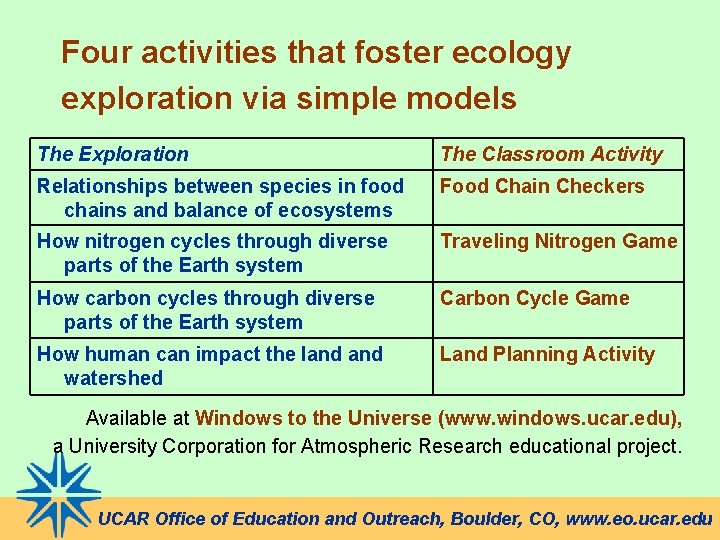
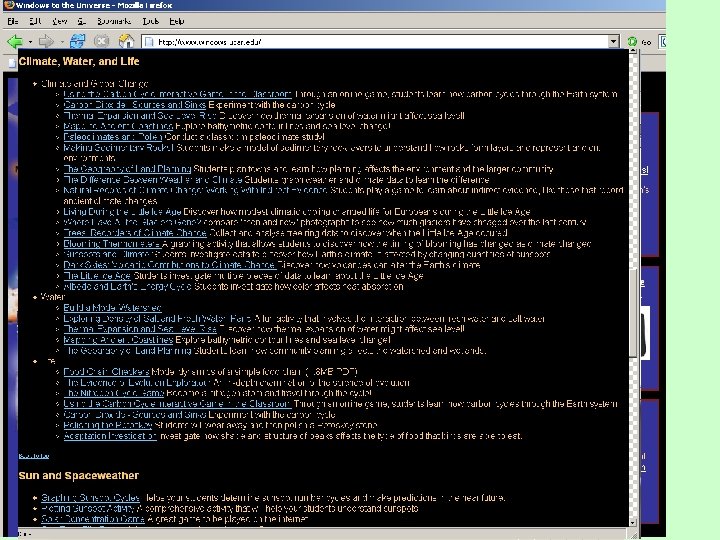
Four activities that foster ecology exploration via simple models The Exploration The Classroom Activity Relationships between species in food chains and balance of ecosystems Food Chain Checkers How nitrogen cycles through diverse parts of the Earth system Traveling Nitrogen Game How carbon cycles through diverse parts of the Earth system Carbon Cycle Game How human can impact the land watershed Land Planning Activity Available at Windows to the Universe (www. windows. ucar. edu), a University Corporation for Atmospheric Research educational project. UCAR Office of Education and Outreach, Boulder, CO, www. eo. ucar. edu
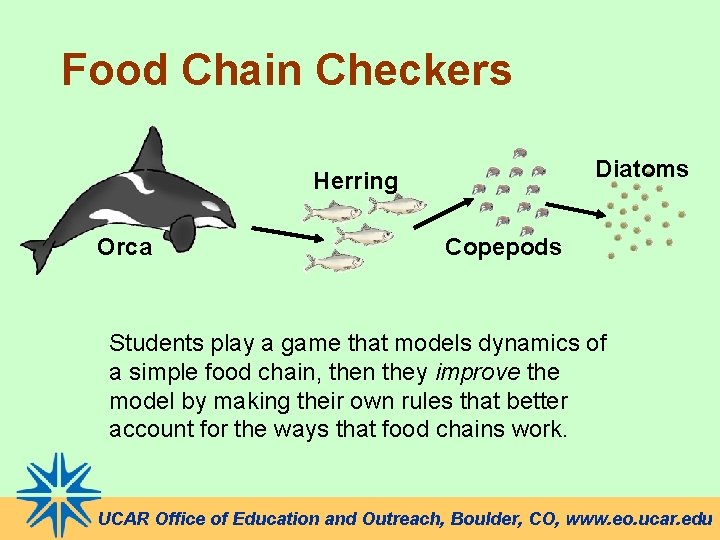
Food Chain Checkers Diatoms Herring Orca Copepods Students play a game that models dynamics of a simple food chain, then they improve the model by making their own rules that better account for the ways that food chains work. UCAR Office of Education and Outreach, Boulder, CO, www. eo. ucar. edu
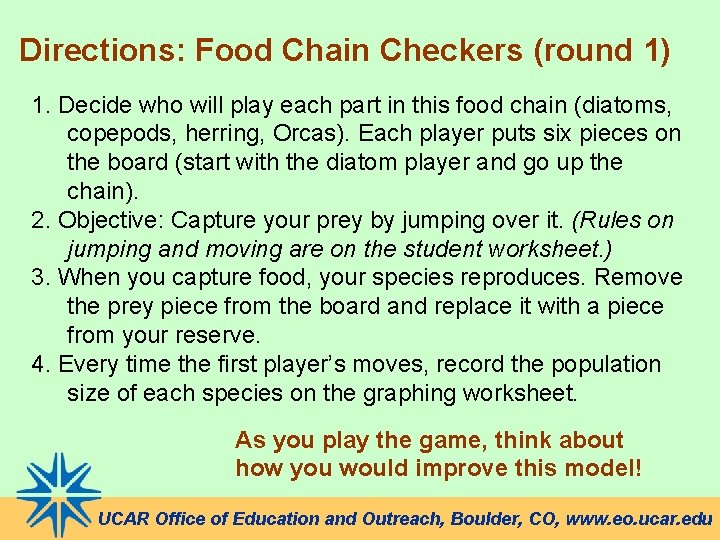
Directions: Food Chain Checkers (round 1) 1. Decide who will play each part in this food chain (diatoms, copepods, herring, Orcas). Each player puts six pieces on the board (start with the diatom player and go up the chain). 2. Objective: Capture your prey by jumping over it. (Rules on jumping and moving are on the student worksheet. ) 3. When you capture food, your species reproduces. Remove the prey piece from the board and replace it with a piece from your reserve. 4. Every time the first player’s moves, record the population size of each species on the graphing worksheet. As you play the game, think about how you would improve this model! UCAR Office of Education and Outreach, Boulder, CO, www. eo. ucar. edu
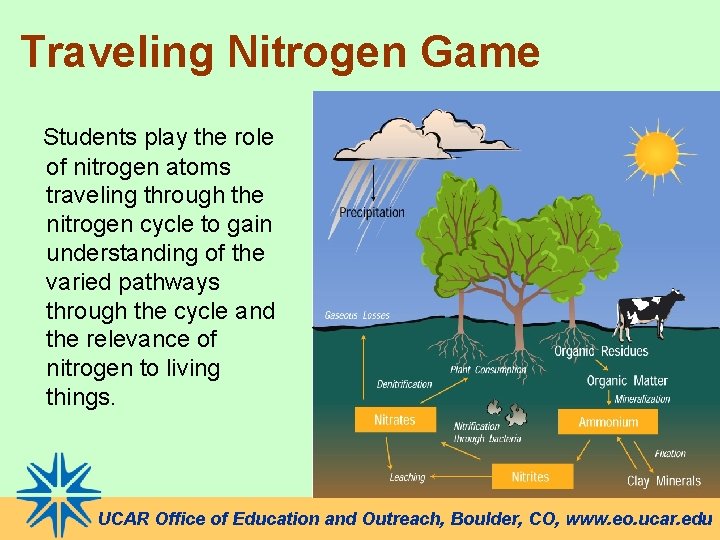
Traveling Nitrogen Game Students play the role of nitrogen atoms traveling through the nitrogen cycle to gain understanding of the varied pathways through the cycle and the relevance of nitrogen to living things. UCAR Office of Education and Outreach, Boulder, CO, www. eo. ucar. edu
Directions: Traveling Nitrogen 1. YOU are a nitrogen atom! 2. The signs around the room mark the 11 reservoirs that you are able to travel between. Chose one to be your start location and add its stamp to your passport. 3. Roll the die at the reservoir to find out where you are going next. 4. To document your travels, add a stamp to your passport at each reservoir you arrive at and record with words how you got there. Then roll the die again and move to the next reservoir! UCAR Office of Education and Outreach, Boulder, CO, www. eo. ucar. edu
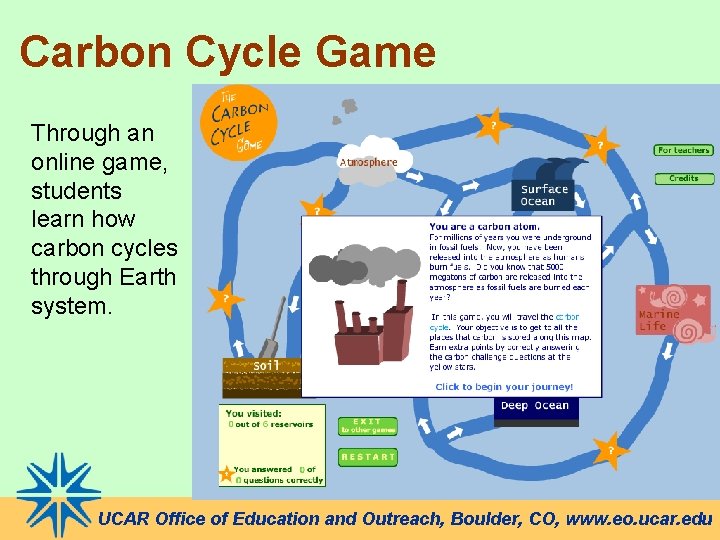
Carbon Cycle Game Through an online game, students learn how carbon cycles through Earth system. UCAR Office of Education and Outreach, Boulder, CO, www. eo. ucar. edu
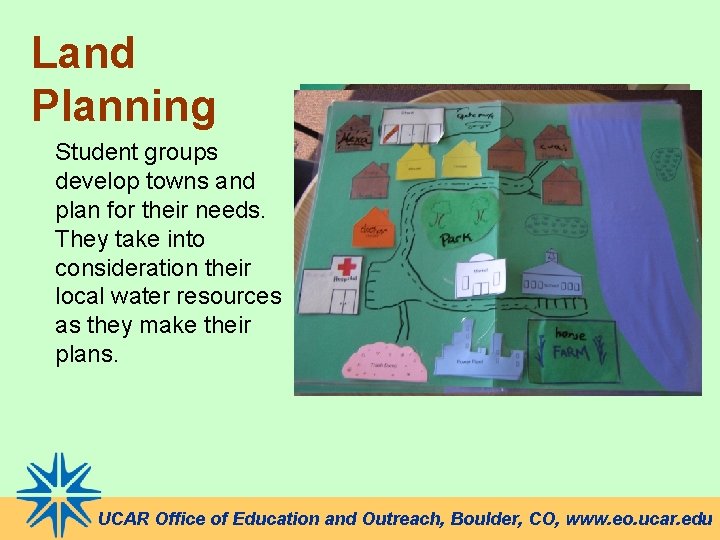
Land Planning Student groups develop towns and plan for their needs. They take into consideration their local water resources as they make their plans. UCAR Office of Education and Outreach, Boulder, CO, www. eo. ucar. edu
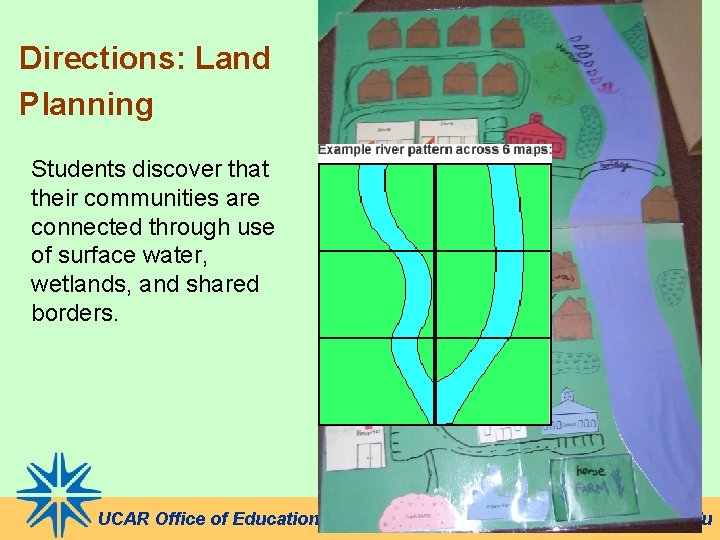
Directions: Land Planning Students discover that their communities are connected through use of surface water, wetlands, and shared borders. UCAR Office of Education and Outreach, Boulder, CO, www. eo. ucar. edu
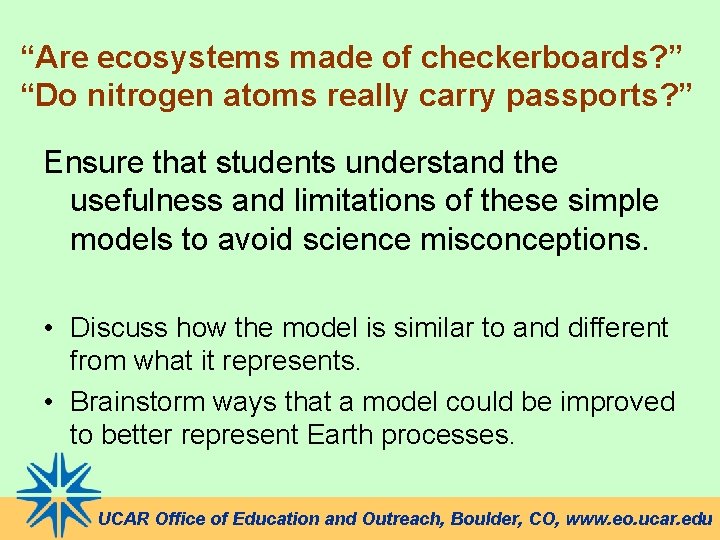
“Are ecosystems made of checkerboards? ” “Do nitrogen atoms really carry passports? ” Ensure that students understand the usefulness and limitations of these simple models to avoid science misconceptions. • Discuss how the model is similar to and different from what it represents. • Brainstorm ways that a model could be improved to better represent Earth processes. UCAR Office of Education and Outreach, Boulder, CO, www. eo. ucar. edu
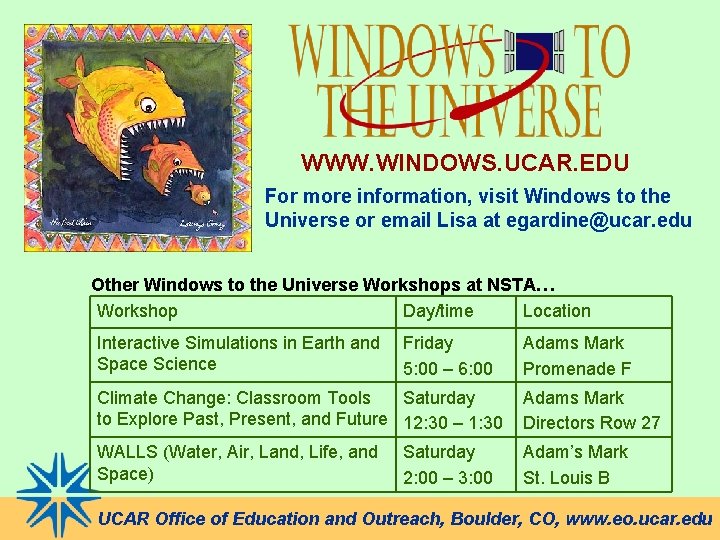
WWW. WINDOWS. UCAR. EDU For more information, visit Windows to the Universe or email Lisa at egardine@ucar. edu Other Windows to the Universe Workshops at NSTA… Workshop Day/time Location Interactive Simulations in Earth and Space Science Friday 5: 00 – 6: 00 Adams Mark Promenade F Climate Change: Classroom Tools Saturday to Explore Past, Present, and Future 12: 30 – 1: 30 Adams Mark Directors Row 27 WALLS (Water, Air, Land, Life, and Space) Adam’s Mark St. Louis B Saturday 2: 00 – 3: 00 UCAR Office of Education and Outreach, Boulder, CO, www. eo. ucar. edu
UCAR Office of Education and Outreach, Boulder, CO, www. eo. ucar. edu
UCAR Office of Education and Outreach, Boulder, CO, www. eo. ucar. edu
UCAR Office of Education and Outreach, Boulder, CO, www. eo. ucar. edu