
Playing Nicely Together FamilyCentered Practices that Can Help



- Slides: 31
Playing Nicely Together: Family-Centered Practices that Can Help Practitioners Work with Families May 19, 2015 2: 30 pm – 3: 45 pm ET (11: 30 -12: 45 PT) Note: The Power. Point is currently available on the CADRE website http: //www. directionservice. org/cadre/playingnicelywebinar. cfm Dial in: 1 -877 -512 -6886 ID: 679 683 6031 Technical Stuff: Ø All phone lines are muted – press #6 to unmute your phone during Q&A. Ø Use a phone line for best audio quality. Ø Please enter any questions or technical difficulties into the chat box. Ø Thank you for taking the time to answer the webinar poll questions! (Note: The poll questions will appear on your screen until we remove them) 1
Playing Nicely Together: Family-Centered Practices that Can Help Practitioners Work with Families
Presenters Megan Vinh, ECTA Center & Da. Sy Center Judy Swett, PACER & ECTA Center Amy Whitehorne, CADRE Yvette Plummer Burkhalter, Denver Metro CPRC Kristen Clarke Reaves, Cherry Creek Schools, CO Special thanks to Anne Lucas of the ECTA Center & Da. Sy Center, who served as advisor and content reviewer.
Content Overview • Relationship Building Blocks • Family Practices • Relationship Timeline Some of the content featured in this webinar was adapted from: • DEC Recommended Practices in Early Intervention/Early Childhood Special Education • Key practices underlying the IEP process: Supporting Family Participation, Inclusive Practices, and Positive Outcomes for Preschool Children with Disabilities • Agreed upon Practices for Providing Early Intervention Services in Natural Environments
Relationships • Built over time • Based on a foundation of: – Honesty, accountability, and trust – Mutual respect – Good communication – Acknowledged agreement to work together in the best interest of the child • Rooted in attitude of being nonjudgmental and flexible
Building Blocks of Relationships Honesty, Accountability and Trust are the: § Foundation of all successful relationships § Outcomes of consistency, predictability and follow-through § Result of the value placed on both families’ and practitioners’ experiences and perceptions § Reflection of what we say and do
Building Blocks of Relationships Mutual Respect is characterized by: § Self-respect § Appreciation and respect for new or different points of view § Exploration of your own feelings § Awareness of personal values when working with children and families
Building Blocks of Relationships Good Communication is demonstrated by: ü Conversation ü Active Listening ü Sharing Information ü Strong Working Partnerships
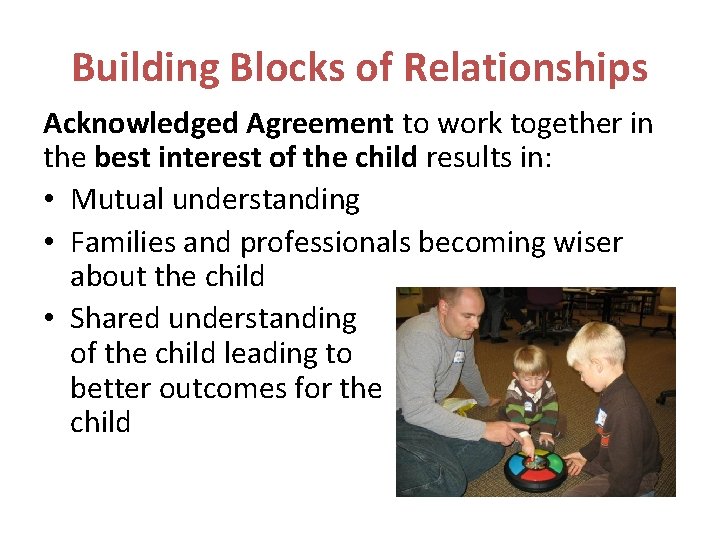
Building Blocks of Relationships Acknowledged Agreement to work together in the best interest of the child results in: • Mutual understanding • Families and professionals becoming wiser about the child • Shared understanding of the child leading to better outcomes for the child
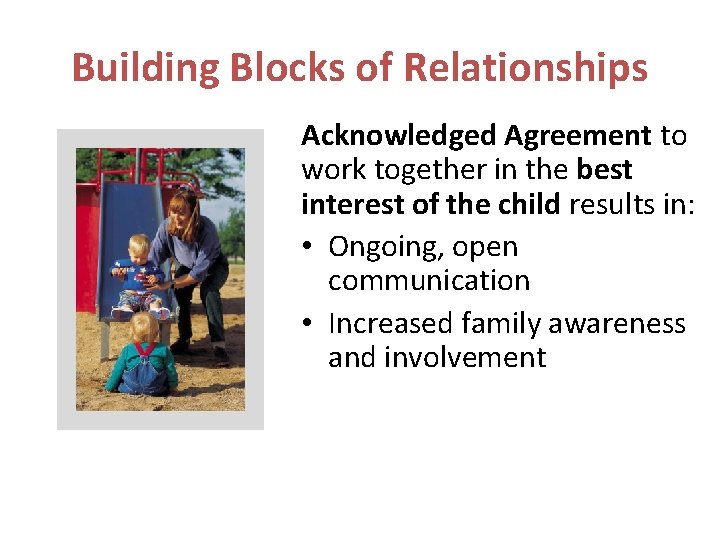
Building Blocks of Relationships Acknowledged Agreement to work together in the best interest of the child results in: • Ongoing, open communication • Increased family awareness and involvement
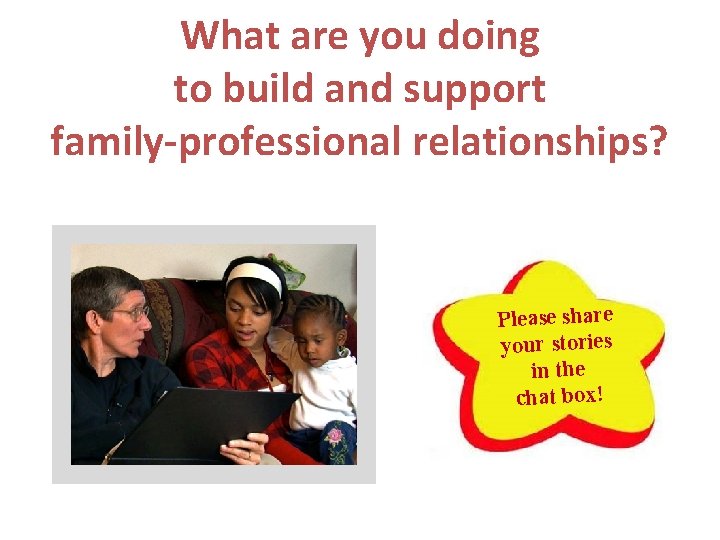
What are you doing to build and support family-professional relationships? Please share your stories in the chat box!
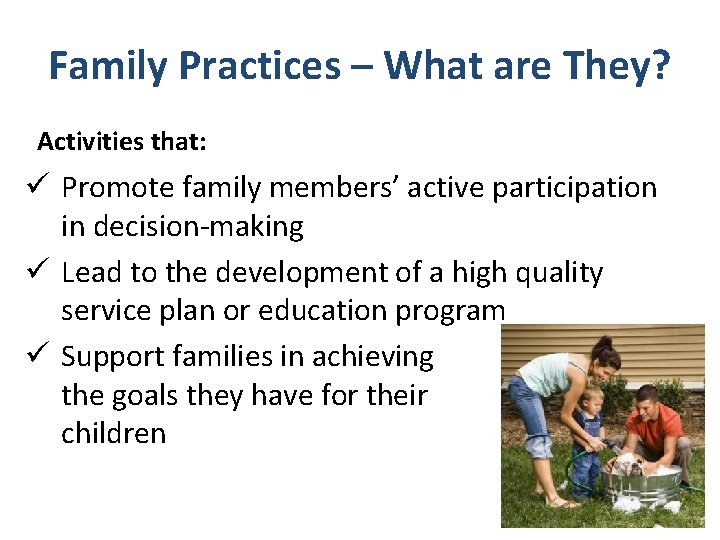
Family Practices – What are They? Activities that: ü Promote family members’ active participation in decision-making ü Lead to the development of a high quality service plan or education program ü Support families in achieving the goals they have for their children
Three Types of Family Practices 1) Family-Centered Practices 2) Family Capacity-Building Practices 3) Family and Professional Collaboration
Family-Centered Practices that: • Treat families with dignity and respect • Honor each family’s own strengths • Respond to every family’s own circumstances • Ensure family members have complete, unbiased information necessary to make informed decisions • Support participation in everyday activities as part of family and community life
Family Capacity-Building Practices that: • Help families recognize the important roles that they play in their children’s development and education through everyday activities • Afford families opportunities to build capacity relating to their children’s development and education
Family Capacity-Building Practices, cont. Practices that: • Create possibilities for families to participate in their children’s education and development • Support families to develop advocacy skills and their ability to educate others about their children’s strengths and needs
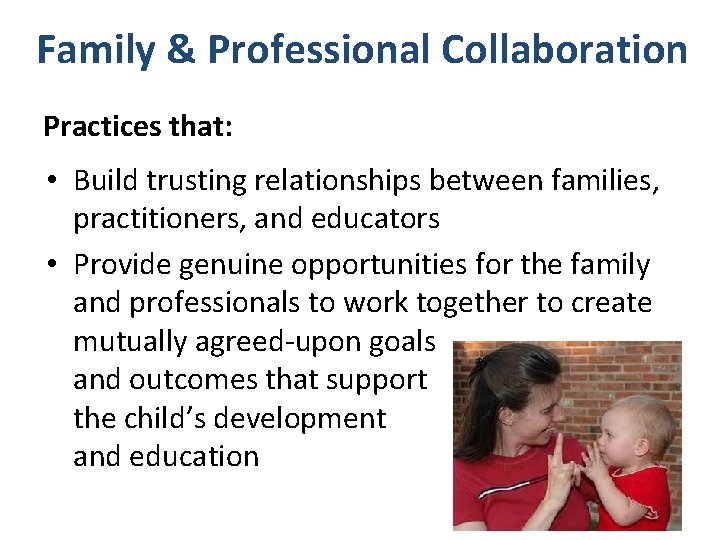
Family & Professional Collaboration Practices that: • Build trusting relationships between families, practitioners, and educators • Provide genuine opportunities for the family and professionals to work together to create mutually agreed-upon goals and outcomes that support the child’s development and education
Family & Professional Collaboration, cont. Practices that: • Support families in using opportunities to be involved in their children’s development and education • Encourage cooperative problem-solving
What are your experiences with practices that support family engagement? Please share your stories in the chat box!
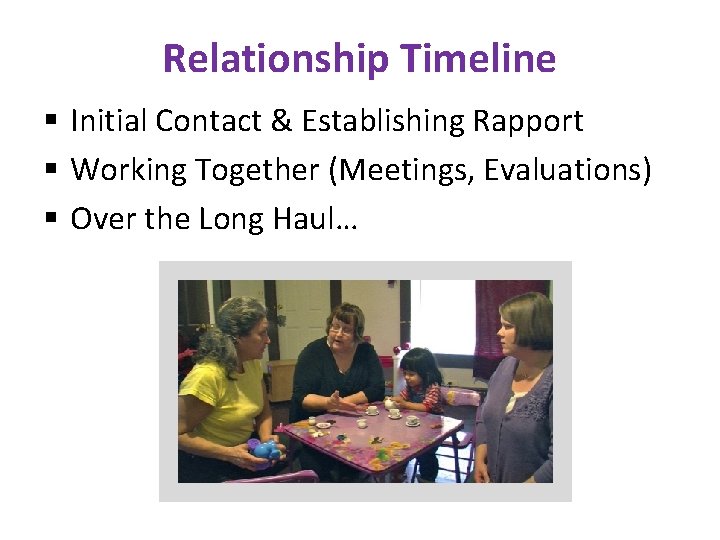
Relationship Timeline § Initial Contact & Establishing Rapport § Working Together (Meetings, Evaluations) § Over the Long Haul…
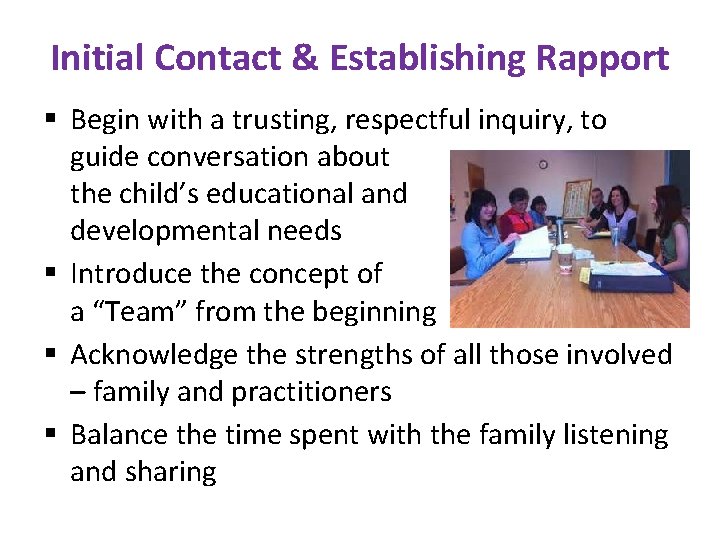
Initial Contact & Establishing Rapport § Begin with a trusting, respectful inquiry, to guide conversation about the child’s educational and developmental needs § Introduce the concept of working as a “Team” from the beginning § Acknowledge the strengths of all those involved – family and practitioners § Balance the time spent with the family listening and sharing
Initial Contact & Establishing Rapport, cont. § Encourage sensitivity to all aspects of diversity § Develop an understanding of the family’s support system § Ask the family how they view their role in their child’s education and development § Develop an understanding of family concerns, priorities, and available resources
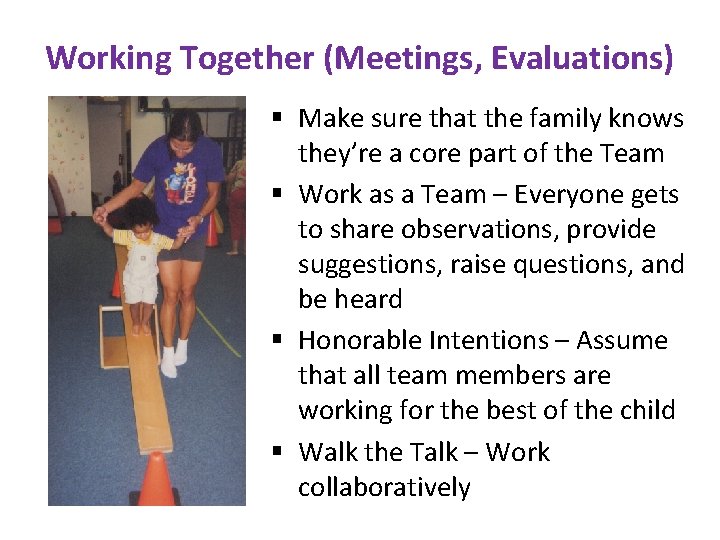
Working Together (Meetings, Evaluations) § Make sure that the family knows they’re a core part of the Team § Work as a Team – Everyone gets to share observations, provide suggestions, raise questions, and be heard § Honorable Intentions – Assume that all team members are working for the best of the child § Walk the Talk – Work collaboratively
Working Together (Meetings, Evaluations), cont. § Use warm and welcoming communication styles and social behaviors § Meet expectations – Be credible and follow though with plans that’ve been made § Balance the time spent listening and sharing § Use words that everyone can understand – Try to avoid jargon. If you use it, explain what it means and make sure others are okay with it
Over the Long Haul… § Revisit the relationship regularly to be sure everyone is working well together § Jointly consider new strategies, activities, or routines § Revise goals and outcomes as a Team
Over the Long Haul…. § Step up to assist when others could use some help § Connect with families regularly, between meetings § Be aware of resources available in the community to support the student and family
Please share your stories in the chat box! What are you doing to nurture and maintain your family-professional relationships?
Any questions or comments? Thank you!
Contact Information Megan Vinh, ECTA Center & Da. Sy Center megan. vinh@unc. edu Judy Swett, PACER & ECTA Center jswett@pacer. org Amy Whitehorne, CADRE awhitehorne@directionservice. org Yvette Plummer Burkhalter, Denver Metro CPRC yvettep@denvermetrocprc. org Kristen Clarke Reaves, Cherry Creek Schools, Colorado kreaves 3@cherrycreekschools. org
Resources § Division for Early Childhood. (2014). DEC recommended practices in early intervention/early childhood special education 2014. Retrieved from http: //www. dec-sped. org/recommendedpractices (Division for Early Childhood) § NECTAC Workgroup on Principles and Practices for the IEP Process. (2012, October). Key practices underlying the IEP process: Supporting family participation, inclusive practices, and positive outcomes for preschool children with disabilities. Retrieved from http: //ectacenter. org/topics/iep. asp (ECTA Center) § Workgroup on Principles and Practices in Natural Environments, OSEP TA Community of Practice: Part C Settings. (2008, February). Agreed upon practices for providing early intervention services in natural environments. Retrieved from http: //ectacenter. org/topics/eiservices/keyprinckeyprac. asp (ECTA Center)
Thank you for joining us! Please take a few minutes to respond to this brief survey about your experience: Webinar Survey https: //www. surveymonkey. com/s/playingnicely 31