
PLAYGROUND INDIGENOUS GAMES Pages 86 90 and Pages



- Slides: 16
PLAYGROUND & INDIGENOUS GAMES Pages 86 – 90 and Pages 105 - 107
PLAYGROUND GAMES Playground games are informal games generally played by children without adult organization.
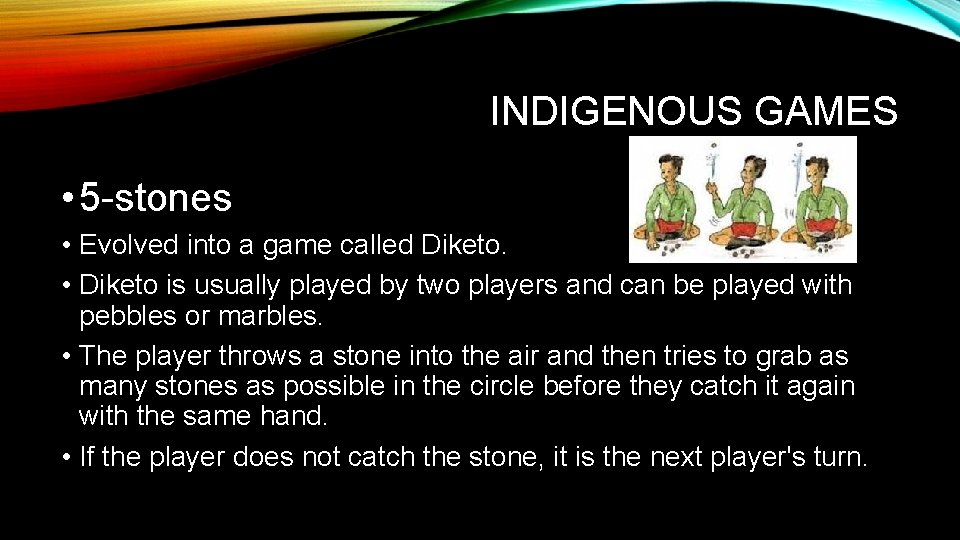
INDIGENOUS GAMES • 5 -stones • Evolved into a game called Diketo. • Diketo is usually played by two players and can be played with pebbles or marbles. • The player throws a stone into the air and then tries to grab as many stones as possible in the circle before they catch it again with the same hand. • If the player does not catch the stone, it is the next player's turn.
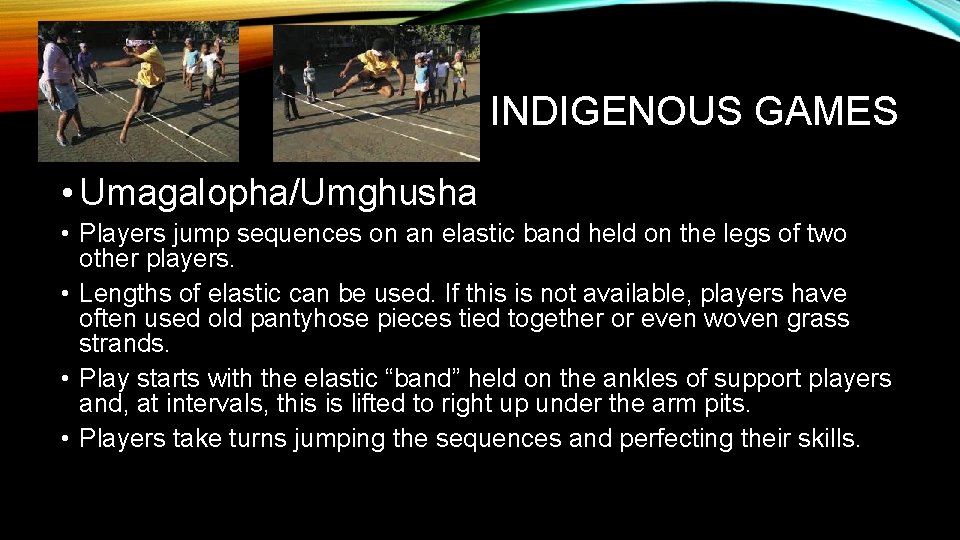
INDIGENOUS GAMES • Umagalopha/Umghusha • Players jump sequences on an elastic band held on the legs of two other players. • Lengths of elastic can be used. If this is not available, players have often used old pantyhose pieces tied together or even woven grass strands. • Play starts with the elastic “band” held on the ankles of support players and, at intervals, this is lifted to right up under the arm pits. • Players take turns jumping the sequences and perfecting their skills.
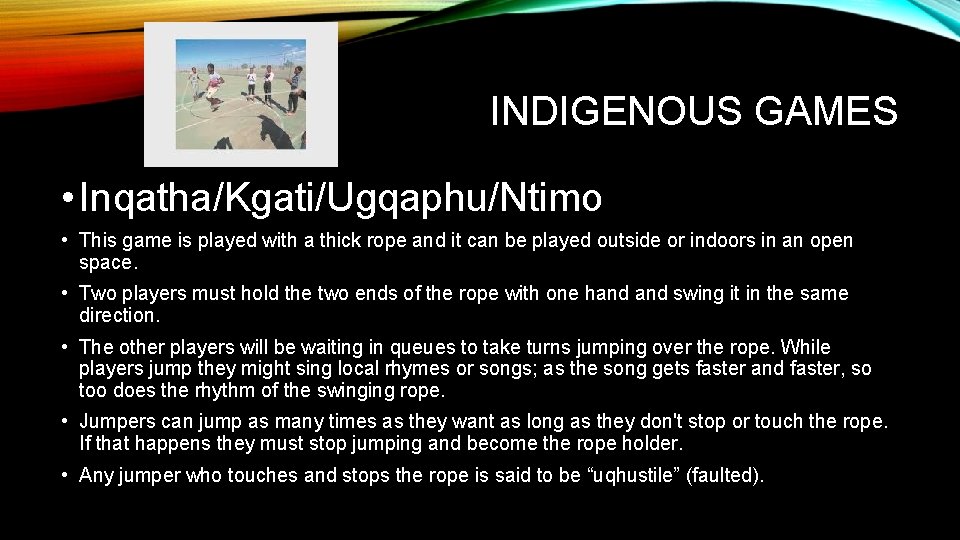
INDIGENOUS GAMES • Inqatha/Kgati/Ugqaphu/Ntimo • This game is played with a thick rope and it can be played outside or indoors in an open space. • Two players must hold the two ends of the rope with one hand swing it in the same direction. • The other players will be waiting in queues to take turns jumping over the rope. While players jump they might sing local rhymes or songs; as the song gets faster and faster, so too does the rhythm of the swinging rope. • Jumpers can jump as many times as they want as long as they don't stop or touch the rope. If that happens they must stop jumping and become the rope holder. • Any jumper who touches and stops the rope is said to be “uqhustile” (faulted).
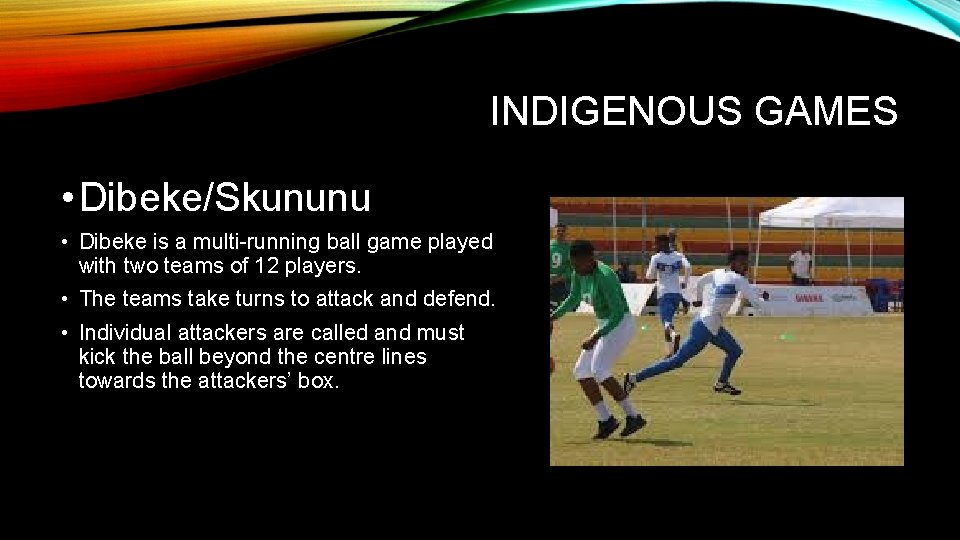
INDIGENOUS GAMES • Dibeke/Skununu • Dibeke is a multi-running ball game played with two teams of 12 players. • The teams take turns to attack and defend. • Individual attackers are called and must kick the ball beyond the centre lines towards the attackers’ box.
SAFETY ISSUES • Warm Up & Cool Down: • A warm up gradually revs up your cardiovascular system by raising your body temperature and increasing blood flow to your muscles. Warming up may also help reduce muscle soreness and lessen your risk of injury. • Cooling down after your workout allows for a gradual recovery of pre-exercise heart rate and blood pressure.
• On-field injuries: SAFETY ISSUES • Minor injuries, such as mild sprains and strains, can often be initially treated at home using PRICE therapy for two or three days. • PRICE stands for protection, rest, ice, compression and elevation. • Protection – protect the affected area from further injury – for example, by using a support. • Rest – avoid exercise and reduce your daily physical activity. Using crutches or a walking stick may help if you can't put weight on your ankle or knee. A sling may help if you've injured your shoulder. • Ice – apply an ice pack to the affected area for 15 -20 minutes every two to three hours. A bag of frozen peas, or similar, will work well. Wrap the ice pack in a towel so that it doesn't directly touch your skin and cause an ice burn. • Compression – use elastic compression bandages during the day to limit swelling. • Elevation – keep the injured body part raised above the level of your heart whenever possible. This may also help reduce swelling.
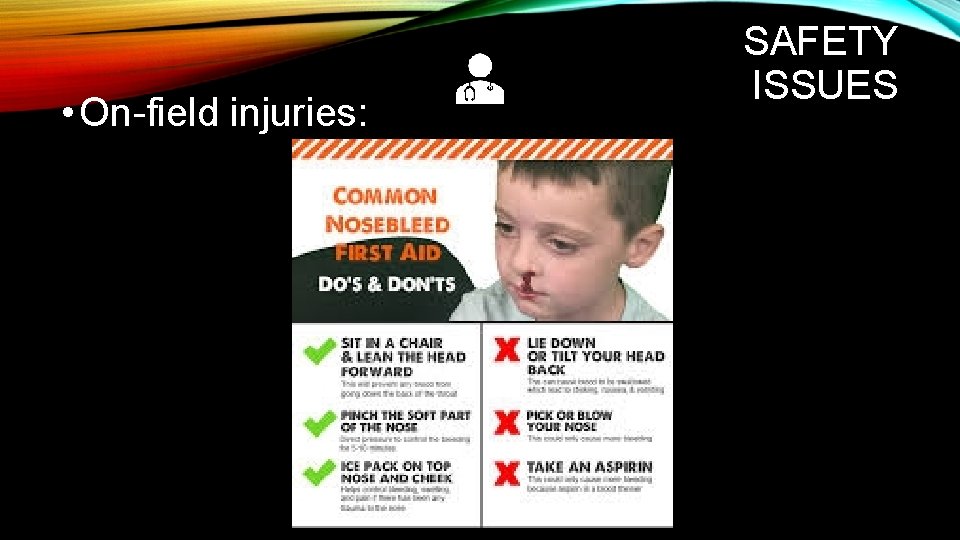
• On-field injuries: SAFETY ISSUES
LEADERSHIP STYLES • There are 3 main leadership styles: • Autocractic/authoritarian: This type of leader has absolute power over the members of the team. • Democratic: This leader encourages members of the team to contribute to the decision-making process. • Laissez-faire: This leader leaves team members to work on their own without interference.
UMPIRING & REFEREEING • Umpires and referees are also leaders in a game. • They are there to ensure that the rules off the game are followed and to ensure fair play. • It is essential that players adhere to the referees/umpire’s decisions to ensure a safe playing environment.
CODE OF CONDUCT • The code of conduct describes the expectations relating to the behaviour of players, coaches, officials and parents/spectators during the game.
CODE OF CONDUCT • The referee is expected to: • be intolerant of dangerous play, bad sportsmanship or unacceptable language. • ensure and encourage fair play at all times. • set an example by ensuring that both on and off the field his/her behaviour is consistent with the principles of good sportsmanship.
CODE OF CONDUCT • Players are expected to: • Show good sportsmanship at all times. • Respect opponents, umpires and fellow teammates regardless of results or negative decisions. • Assist coaches with putting away equipment that may have been used for practices/matches.
CODE OF CONDUCT • Team captains are expected to: • Lead by example in terms of their behaviour on and off the field, their personal levels of fitness and their wearing of the correct uniforms.
Page 105 Activity 1 No. 1 – 3 COMPLETE THE FOLLOWING ACTIVITIES Page 106 Activity 3 No. 1 Page 107 Activity 4