
Play and Language An interactive guide based on
Play and Language An interactive guide based on the book Play by Stuart Brown This presentation is designed to allow you to play around with the concepts and freely explore the topics of interest in your own way. To return to the home screen at any time, click the Rocking Horse. To proceed to the Table of Contents, click on the Blocks. Have fun!
Table Of Contents üWhat is Play? üFind Your Play Personality üPlay and Survival üAttunement üPlay and Creativity üHow Play Helps Develop Language Click on the visit a ch checkmark to apt you can a er. Remember lw by clickin ays return here go the lower n the blocks in left-hand corner.
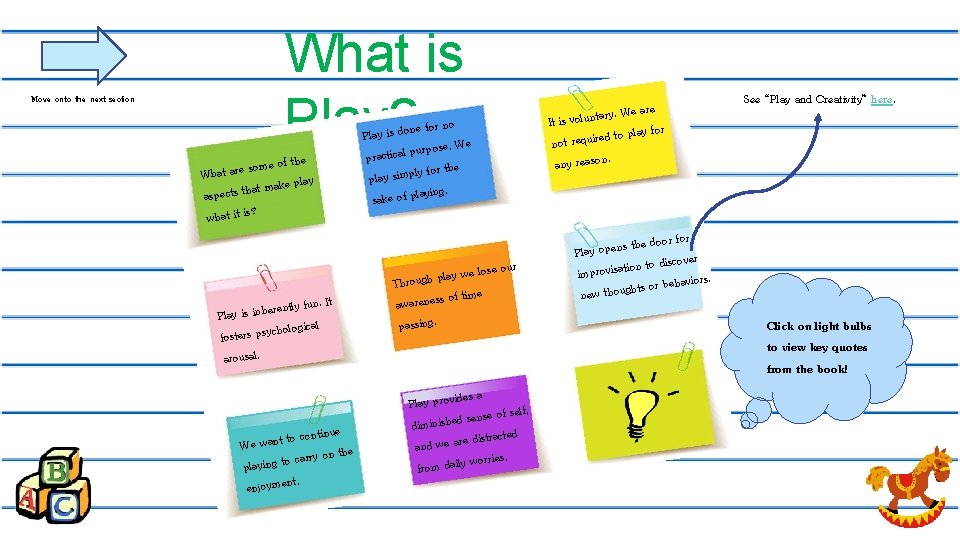
Move onto the next section What is Play? of the e m o s e r a t Wha make play t a h t s t c e p s a what it is? tly fun. It n e r e h in is y la P logical fosters psycho arousal. ntinue o c o t t n a w We on the y r r a c o t g in play enjoyment. for no e n o d is y la P se. We o p r u p l a c ti c pra r the play simply fo g. sake of playin se our lo e w y la p h g Throu time awareness of passing. a Play provides se of self, n e s d e h is in dim tracted and we are dis rries. from daily wo We are It is voluntary. play for not required to any reason. See “Play and Creativity” here. door for e th s n e p o y la P discover to n o ti a is v o r imp haviors. e b r o ts h g u o new th Click on light bulbs to view key quotes from the book!
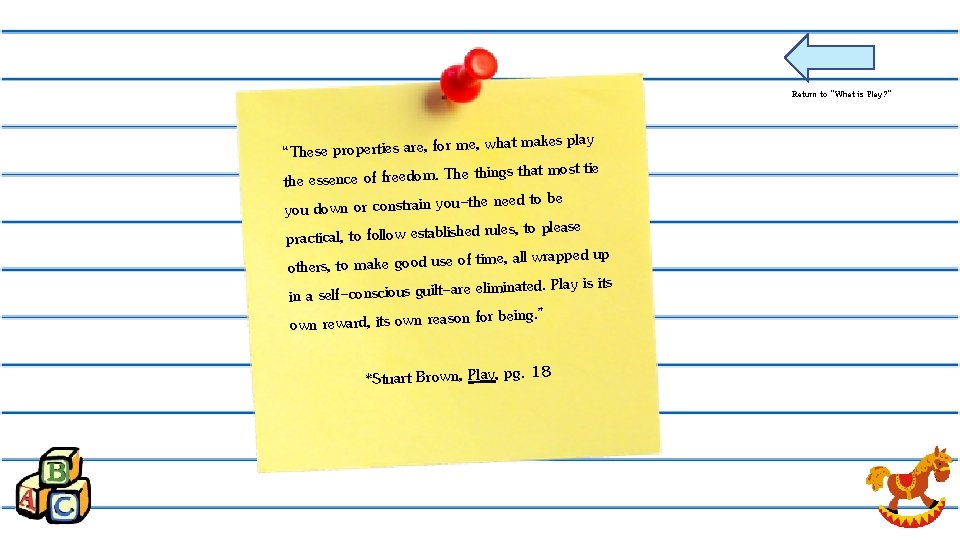
Return to “What is Play? ” es play “These properties are, for me, what mak most tie the essence of freedom. The things that you down or constrain you-the need to be ease pl to , les ru ed sh bli ta es w llo fo to al, tic ac pr ped up ap wr all e, tim of e us od go e ak m to , rs othe is its ay Pl. ed at in m eli re -a ilt gu us cio ns co lfin a se own reward, its own reason for being. ” *Stuart Brown, Play, pg. 18
The Competitor The Collector Find Your Play Personality Stuart Brown has observed that every individual approaches play Onward! differently. They participate in varying activities and have different goals. Whatever a person likes to do in their leisure time, why and how people play says a lot about who they are and these can be divided into eight different “Play Personalities. ” Click on the toys to learn more about each of the play personalities and maybe try to find which one describes you best. Your play personality would be fun to keep in mind when continuing to explore how play affects language. The Artist/Creator The Explorer The Storyteller The Joker The Kinesthete The Director
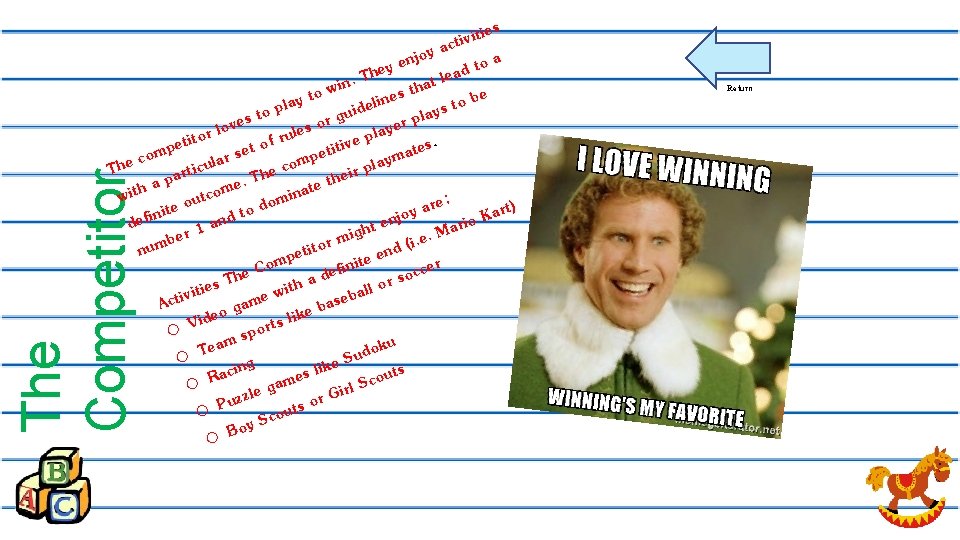
The Competitor ies t i v i t ac y o j a n e o t y e d a e Th l. t n a i w th s o e t e b n y i o l a t l e p s id y o u a t l g p s r e er so ov y l e a l l r u p o r t f ti. ve o e s i t e p t i t t e a m s e o p m r The c particula The com their play. a e te h m a t o i n c i w t e: om ou r d t) a e r t o i y a t n o i K j f d en io de an r t a h 1 g M r i e m e. . i r ( o t d i numb et en p e t m i o n er i C f c c e e o d h s T a r s o h t e l i i l t i w a Activ eo game ike baseb l d i s V t r o o sp m a oku d u o Te ing S ike l c ts s a u e o R c m o ga r Girl S e l z z o Pu Scouts o y o B o Return
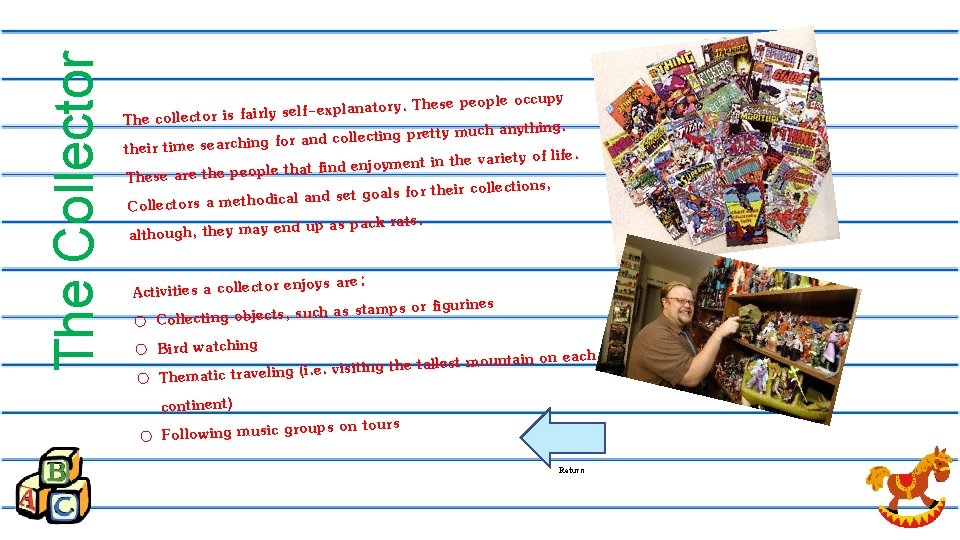
The Collector occupy le op pe se he T y. or at an pl ex lf The collector is fairly se hing. yt an h uc m ty et pr g in ct lle co d their time searching for an e. lif of y et ri va e th in t en ym jo en These are the people that find ctions, lle co r ei th r fo s al go t se d an l ca Collectors a methodi ck rats. pa as up d en ay m ey th , gh ou th al Activities a collector enjoys are: s ne ri gu fi or ps am st as ch su s, ct o Collecting obje o Bird watching ain on each nt ou m st lle ta e th ng ti si vi e. (i. o Thematic traveling continent) urs o Following music groups on to Return
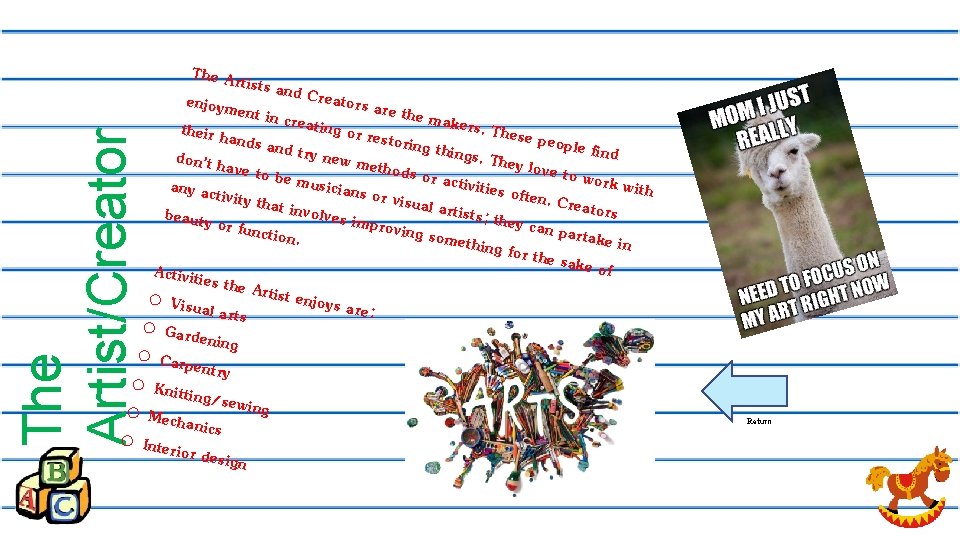
The Artist/Creator The Artis ts and Cr eators ar enjoymen e the ma t in creat kers. The ing or res their han se people toring th ds and tr find ings. The y new me don’t hav y love to thods or e to be m work with activities usicians o any activ often. Cr r visual a ity that in eators rtists; the volves im beauty or y proving s function. omething can partake in for the sa ke of Activities th o Visual e Artist enjoys are : arts o Garde ning o Carpe ntry o Knittin g/sewing o Mecha nics o Interio r design Return
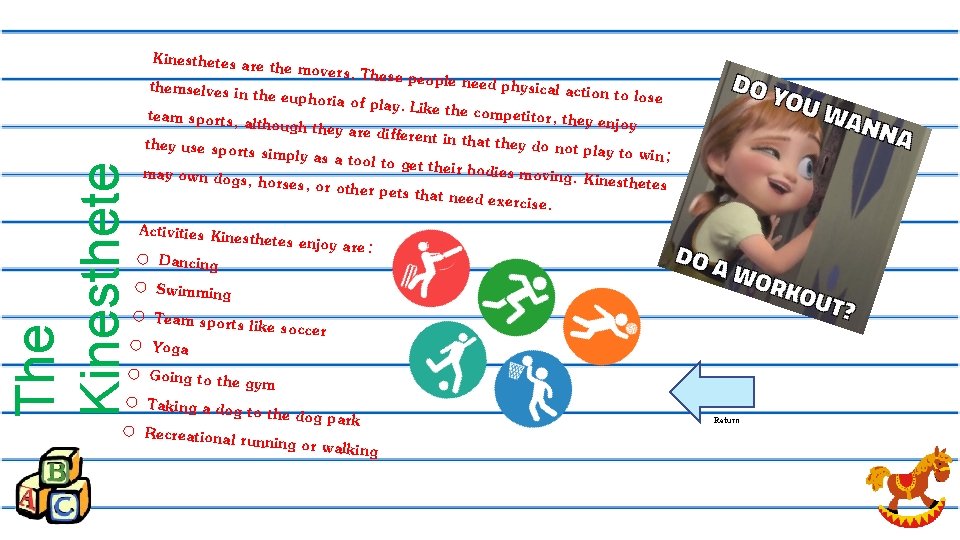
The Kinesthetes are the m overs. These people need physical action themselves in the eup to lose horia of play. Like th e competitor, they en team sports, althoug joy h they are different in that they do not play they use sports simp to win; ly as a tool to get the ir bodies moving. Kin may own dogs, horse esthetes s, or other pets that need exercise. Activities Kinesthetes enjoy are: o Dancing o Swimming o Team sports like s occer o Yoga o Going to the gym o Taking a dog to th e dog park o Recreational runnin g or walking Return
The Director are y e h T s, . d n n o e i ti r f n e g t t f a s amon of o r e e p t t b u n n o e e e r v c g e th e a r d h o t e g f n ey ne g or o n i e m n g a th ar e plan ader h s c a in th the le o play e o b d l to e o b s s e y h ov at lov simpl ll wit l r o ct ies th s, or do we. e r i l g D e r e h The l butterf ay parti oes not eir likin p ra g h d d a t o i i l r e c r o so the ho irecto nts to h c e d or y a host s. The ulate ev l p : y a o d j p f n i n o e r frie to man o d l t ec ou r i w e d l r a ab s cto a e r i lly D ies a i a c s e t e p r i s t a i e p v i , Act anning ce arts es l m n P a a g o rform n o i t e a e l P c u n m a o d ing si a f o y a l p ole R o Return
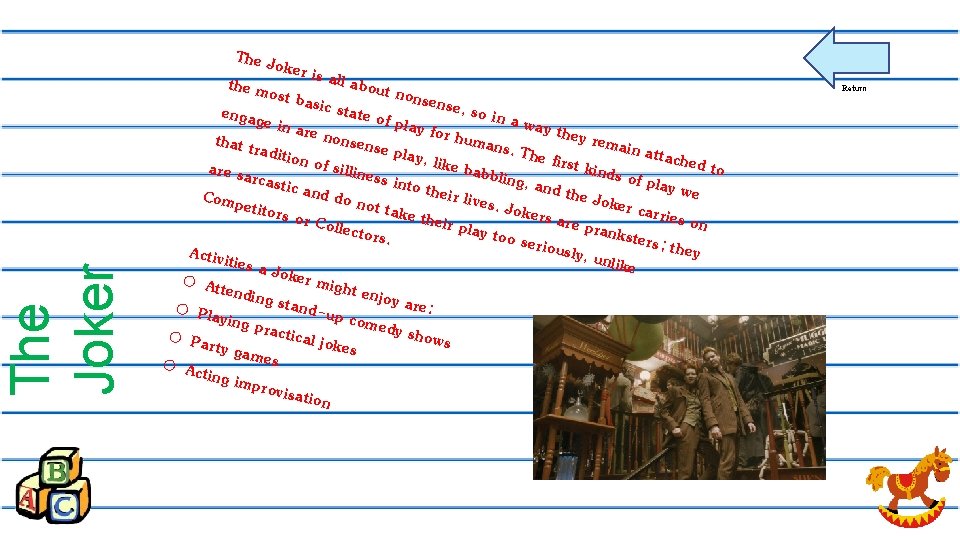
The Joker The Jok er is all about n the mos onsense t basic , so in a s t engage ate of p way the in are n lay for h y remai o umans. nsense that tra n attach play, lik dition o The firs ed to f silline t e k are sarc b i n a b d b s ling, an ss into of play astic an t d we h eir lives the Jok d do no Compet er carri. Jokers t take t itors or es on h are pra eir play Collecto nksters too seri rs. ; they ously, u Activitie nlike s a Jok er migh o Atten t enjoy ding sta are: nd-up c o Playi omedy ng prac shows t ical jok o Party es games o Actin g impro visation Return
The Storyteller n. o i t a n i g ma i t u ing o Return h b t a y l n l a a is do y l l s a i l e s w p a , s c r r e e e l l te hes yte y t r r o o n t i t l S S a , e For th omes to play cept their go ething, but ex tc i , som ) n g e e t n i a h l e e r W v tra or c , s g e n al i r m v u a o t g a m , n t t r e e you r g (a a s r a y o e g n h i n w lo. T o e s t a m t i t n o u n g f is is y citin x a l e p n a m to have ers and to the m daydrea at way. th t i e k a m y: o j ays l n p e n s e r e e r l sc es tel i r y v r o o o , t s m S n g n es oo Activiti g novels, cart ns, or watchi o o in t t i r r a c W , o els v o n g n i o Read g pretend es m a g n io in o Play laying simulat p e l o R o
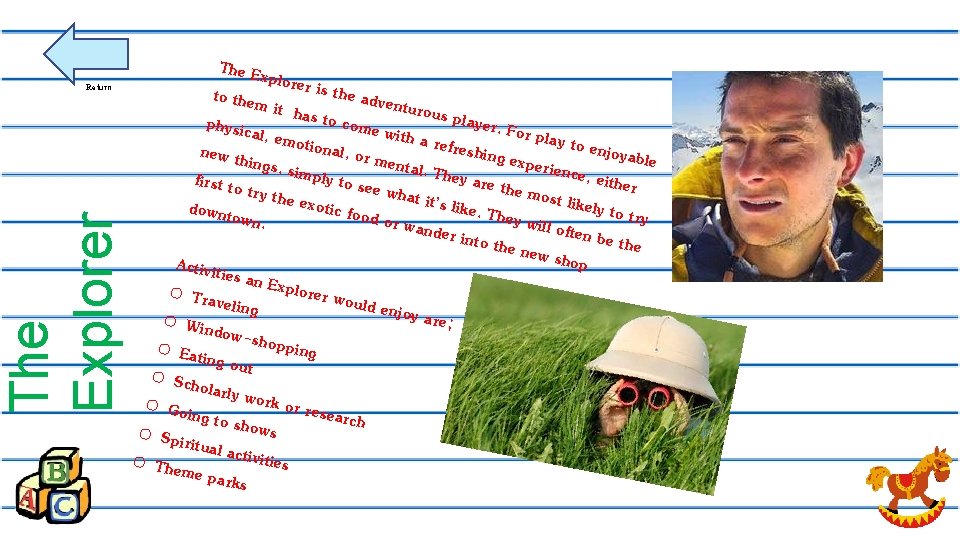
The Explorer Return The Exp lorer is the adve to them nturous it has t player. F o come physical or play with a r , emotio to enjoy e f reshing nal, or m new thin able experien ental. Th gs, simp ce, eithe ey are th ly to see first to t r e most l what it’s ry the ex ikely to otic food like. The downtow try y will of or wand n. te er into t he new n be the shop Activitie s an Exp lorer wo o Trave uld enjo ling y are; o Wind ow-shop ping o Eatin g out o Scho larly wo rk or res o Going earch to show s o Spirit ual activ itie o Them e parks s
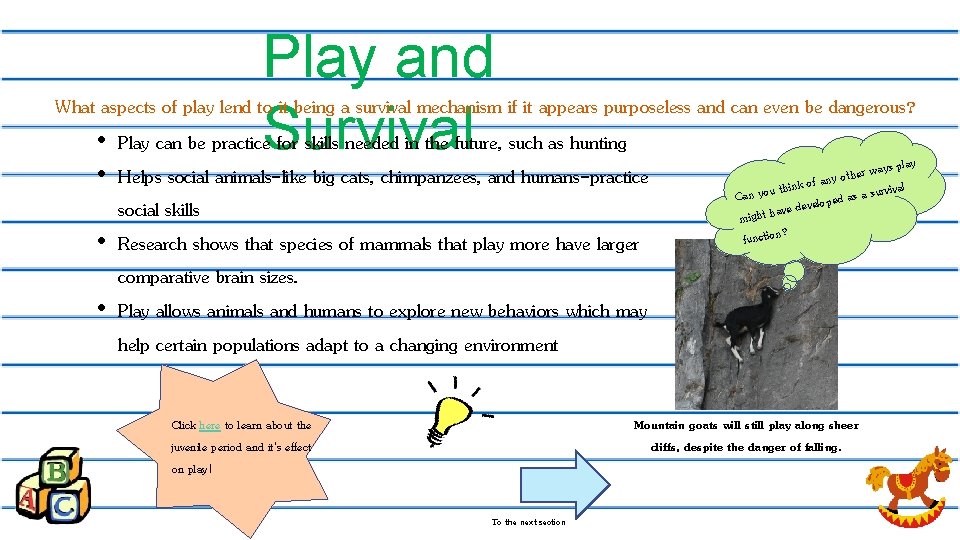
Play and What aspects of play lend to it being a survival mechanism if it appears purposeless and can even be dangerous? • Play can be practice. Survival for skills needed in the future, such as hunting • Helps social animals-like big cats, chimpanzees, and humans-practice social skills • Research shows that species of mammals that play more have larger comparative brain sizes. • Play allows animals and humans to explore new behaviors which may help certain populations adapt to a changing environment s play y a w r e h t of any o k n i h t u rvival o u s a Can y d evelope d e v a h t h mig function? Mountain goats will still play along sheer cliffs, despite the danger of falling. Click here to learn about the juvenile period and it’s effect on play! To the next section
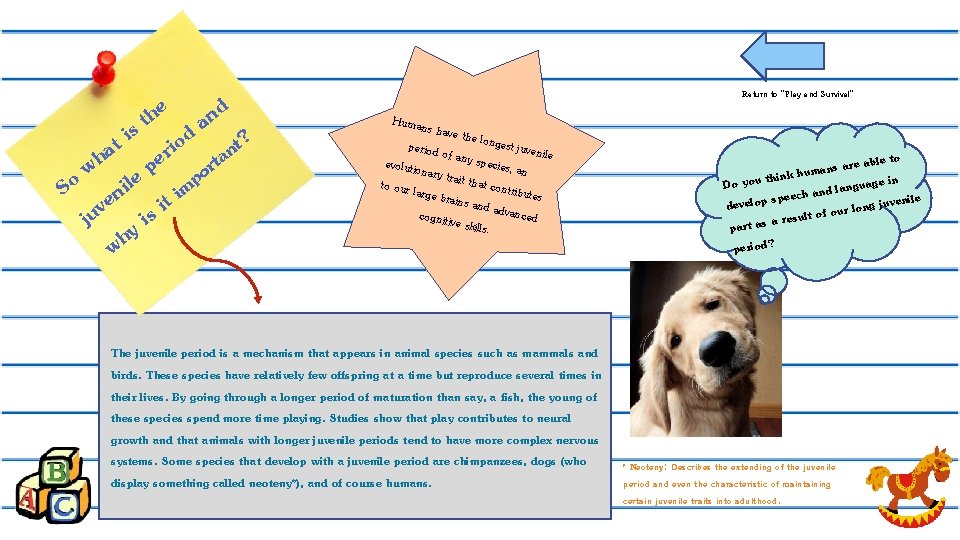
e and h t is iod nt? t a er rta h w le p po o S eni it im juv y is wh Return to “Play and Survival” Humans have the longest ju period of venile any spec evolution ary trait t ies, an hat to our lar ge brains contributes an cognitive d advanced skills. The juvenile period is a mechanism that appears in animal species such as mammals and birds. These species have relatively few offspring at a time but reproduce several times in their lives. By going through a longer period of maturation than say, a fish, the young of these species spend more time playing. Studies show that play contributes to neural growth and that animals with longer juvenile periods tend to have more complex nervous systems. Some species that develop with a juvenile period are chimpanzees, dogs (who display something called neoteny*), and of course humans. able to e r a s n a m nk hu ge in a Do you thi u g n a l d n eech a develop sp t of our long juvenile esul part as a r period? * Neoteny: Describes the extending of the juvenile period and even the characteristic of maintaining certain juvenile traits into adulthood.
Return to “Play and Survival” able to re a e w e m ti e th f o st o m “In play, ur o g in n te a re th t u o h it w s g try out thin are e W. g in e b lle w l a n o ti o m physical or e just re a e w se u ca e b ly se ci re safe p playing. ” 4 *Stuart Brown, Play, pg. 3
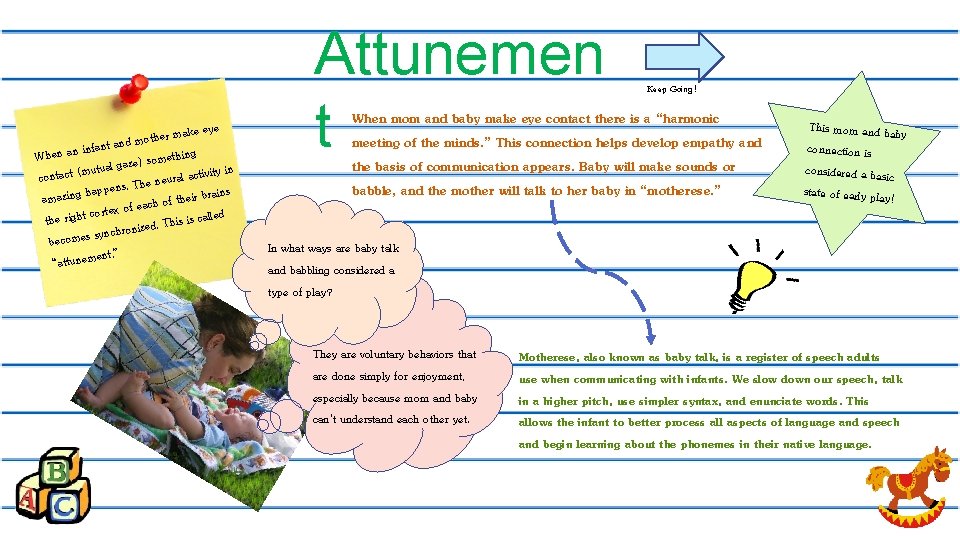
e eye k a m r e h t o fant and m in n a n e h W mething o s ) e z a g l a tu contact (mu s. The neural activity in pen amazing hap of each of their brains rtex the right co onized. This is called nchr becomes sy t. ” “attunemen Attunemen t Keep Going! When mom and baby make eye contact there is a “harmonic meeting of the minds. ” This connection helps develop empathy and the basis of communication appears. Baby will make sounds or babble, and the mother will talk to her baby in “motherese. ” This mom and baby connection is considered a basic state of early play! In what ways are baby talk and babbling considered a type of play? They are voluntary behaviors that are done simply for enjoyment, especially because mom and baby can’t understand each other yet. Motherese, also known as baby talk, is a register of speech adults use when communicating with infants. We slow down our speech, talk in a higher pitch, use simpler syntax, and enunciate words. This allows the infant to better process all aspects of language and speech and begin learning about the phonemes in their native language.
with aw gn d an s th ou m r ei th in gs in th k ic “They st their gums. They roll food around with t…Babbling tongues, sucking it in and spitting it ou are born ho w es bi Ba. ds or w le ib llig te in es m co be hearing-impaired will actually use play ally, ic ys ph e at ic un m m co to n ar le to ts en movem , ts en em ov m ric et m m sy e pl sim ith w g first babblin ge when which slowly become simple sign langua an adult signs back consistently. ” *Stuart Brown, Play, pg. 84 Return to “Attunement”
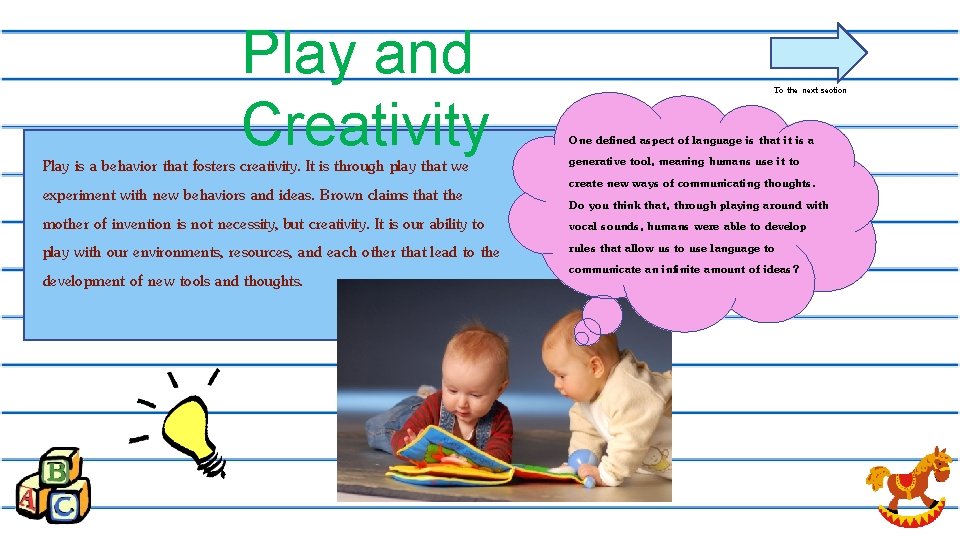
Play and Creativity Play is a behavior that fosters creativity. It is through play that we experiment with new behaviors and ideas. Brown claims that the mother of invention is not necessity, but creativity. It is our ability to play with our environments, resources, and each other that lead to the development of new tools and thoughts. To the next section One defined aspect of language is that it is a generative tool, meaning humans use it to create new ways of communicating thoughts. Do you think that, through playing around with vocal sounds, humans were able to develop rules that allow us to use language to communicate an infinite amount of ideas?
Back to “Play and Creativity” “Play is called recreation because it d makes us new again, it re-creates us an our world. ” Stuart Brown, Play, pg. 127
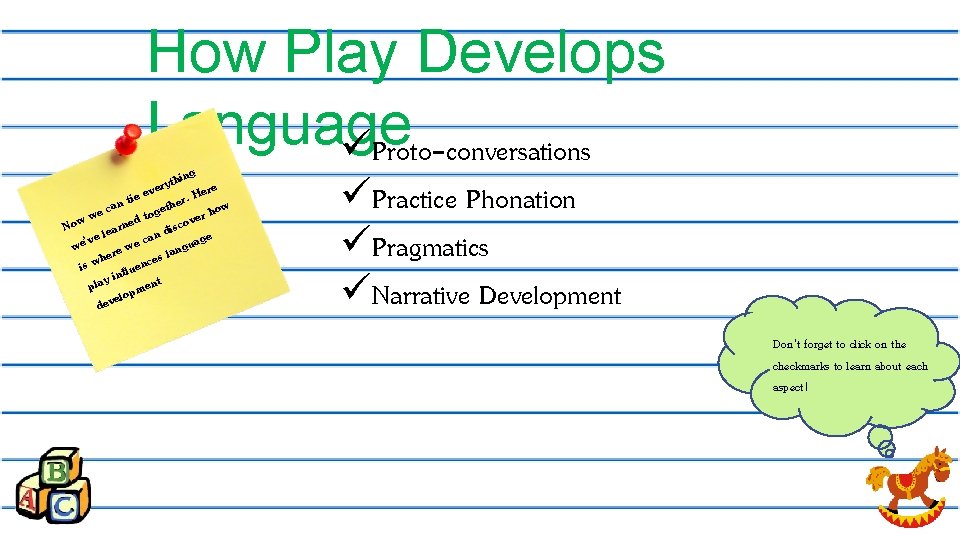
How Play Develops Language üProto-conversations ing h t y r eve r. Here e i t an ogethe c ow h e r w t e Now learned n discov e e we’v ere we ca languag s is wh nfluence i play opment l deve üPractice Phonation üPragmatics üNarrative Development Don’t forget to click on the checkmarks to learn about each aspect!
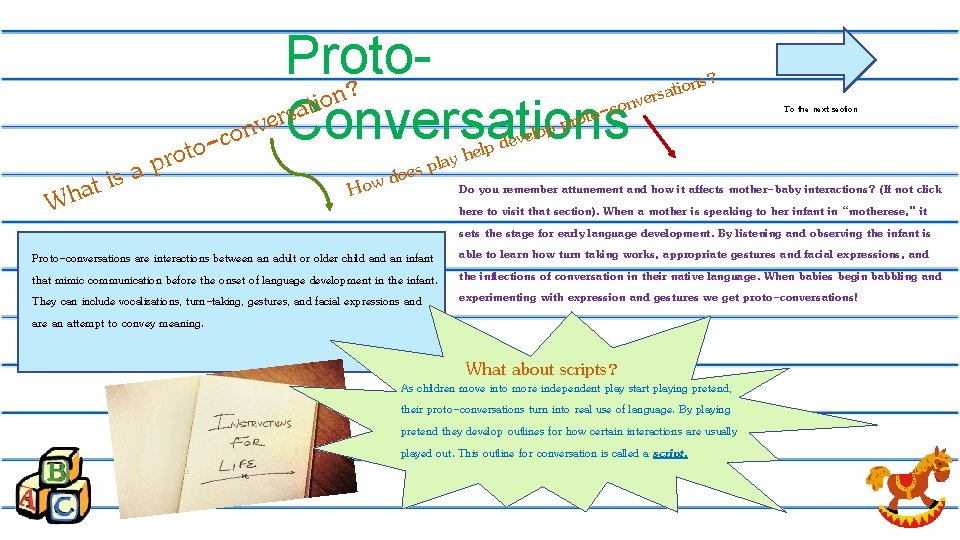
r p a at is Protos? n o i t a ? s r e n v o n i o t c a o s t r o r e p v p o n l Conversations e o v e c d p l e to oh y Wh a l p s e w do Ho Proto-conversations are interactions between an adult or older child an infant that mimic communication before the onset of language development in the infant. They can include vocalizations, turn-taking, gestures, and facial expressions and are an attempt to convey meaning. To the next section Do you remember attunement and how it affects mother-baby interactions? (If not click here to visit that section). When a mother is speaking to her infant in “motherese, ” it sets the stage for early language development. By listening and observing the infant is able to learn how turn taking works, appropriate gestures and facial expressions, and the inflections of conversation in their native language. When babies begin babbling and experimenting with expression and gestures we get proto-conversations! What about scripts? As children move into more independent play start playing pretend, their proto-conversations turn into real use of language. By playing pretend they develop outlines for how certain interactions are usually played out. This outline for conversation is called a script.
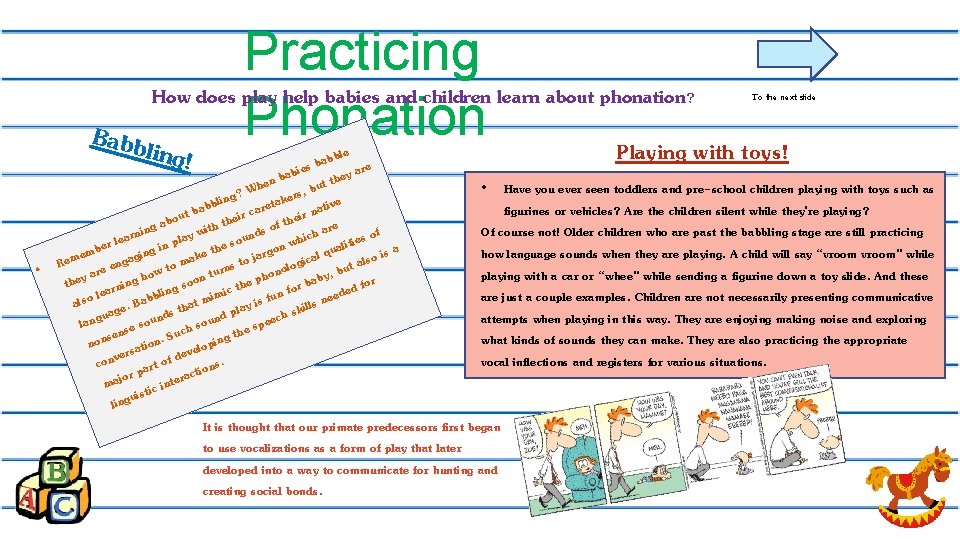
Practicing How does play help babies and children learn about phonation ? Phonation Babbli Playing with toys! n To the next slide g! bble e a b s abie t they ar b n e • Have you ever seen toddlers and pre-school children playing with toys such as Wh ers, bu ? g n k i l e a t b figurines or vehicles? Are the children silent while they’re playing? bab eir care eir nativ t u o h h b t t a ing lay with unds of hich are s of Of course not! Older children who are past the babbling stage are still practicing n r a e e o l i p s w t r i l n e e n i a b a o th u g how language sounds when they are playing. A child will say “vroom” while emem engagin to make ns to jarg ological q ut also is R • , b tur are on ow playing with a car or “whee” while sending a figurine down a toy slide. And these they arning h ing soon ic the ph for baby ed for d l n le are just a couple examples. Children are not necessarily presenting communicative also ge. Babb s that mim play is fu skills nee a attempts when playing in this way. They are enjoying making noise and exploring langu nse sound ch sound he speech u t e what kinds of sounds they can make. They are also practicing the appropriate nons rsation. S veloping e e vocal inflections and registers for various situations. conv part of d tions. c r majo tic intera is lingu It is thought that our primate predecessors first began to use vocalizations as a form of play that later developed into a way to communicate for hunting and creating social bonds.
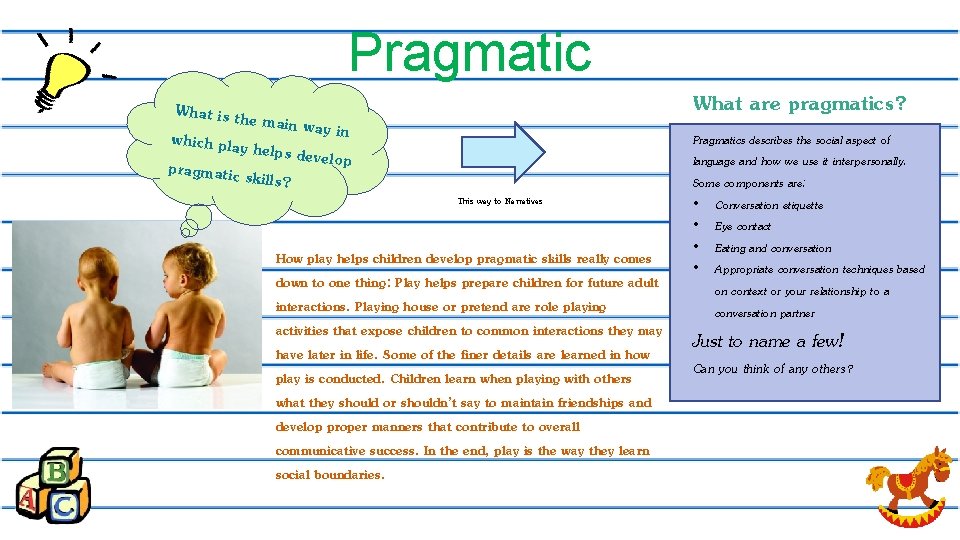
Pragmatic What is the m ain way ins which play he lps deve pragmatic ski lls? lop This way to Narratives How play helps children develop pragmatic skills really comes down to one thing: Play helps prepare children for future adult interactions. Playing house or pretend are role playing activities that expose children to common interactions they may have later in life. Some of the finer details are learned in how play is conducted. Children learn when playing with others what they should or shouldn’t say to maintain friendships and develop proper manners that contribute to overall communicative success. In the end, play is the way they learn social boundaries. What are pragmatics? Pragmatics describes the social aspect of language and how we use it interpersonally. Some components are: • Conversation etiquette • Eye contact • Eating and conversation • Appropriate conversation techniques based on context or your relationship to a conversation partner Just to name a few! Can you think of any others?
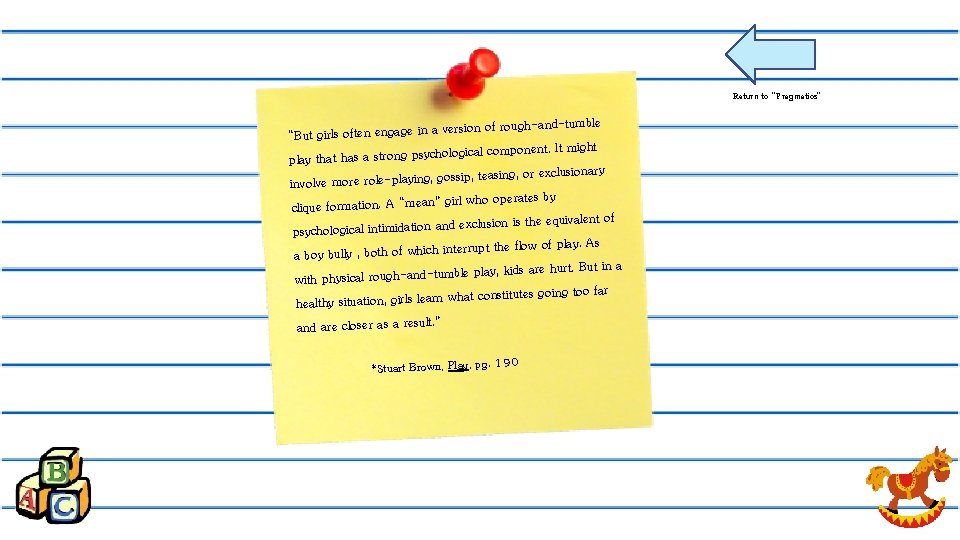
Return to “Pragmatics” ugh-and-tumble ro of on rsi ve a in ge ga en en oft ls gir ut “B onent. It might mp co l ica log ho yc ps g on str a s ha t tha y pla or exclusionary g, sin tea p, ssi go g, yin pla lero re mo e olv inv tes by clique formation. A “mean” girl who opera is the equivalent of n sio clu ex d an n tio ida im int l ica log ho yc ps flow of play. As the t up err int ich wh of th bo , lly bu y bo a s are hurt. But in a kid y, pla ble tum dan hug ro l ca ysi ph th wi tes going too far titu ns co at wh rn lea ls gir n, tio ua sit hy alt he and are closer as a result. ” *Stuart Brown, Play, pg. 190
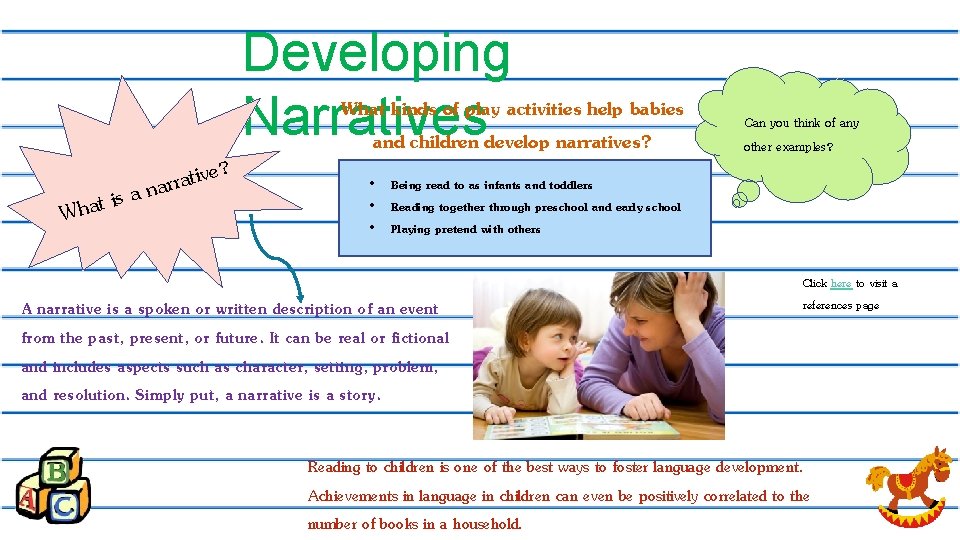
s i t a h W ? e v i t a a narr Developing What kinds of play activities help babies Narratives and children develop narratives? Can you think of any other examples? • Being read to as infants and toddlers • Reading together through preschool and early school • Playing pretend with others A narrative is a spoken or written description of an event from the past, present, or future. It can be real or fictional and includes aspects such as character, setting, problem, and resolution. Simply put, a narrative is a story. Click here to visit a references page Reading to children is one of the best ways to foster language development. Achievements in language in children can even be positively correlated to the number of books in a household.
The book that inspired this presentation is Play by Stuart Brown, M. D. The information about play and language development is sourced from this book, although this work is constructed of my own observations and analysis of the information provided in the text. I do not own any of the artwork or photography found in this presentation. Any of the images may be found with following links. https: //play. google. com/store/apps/details? id=com. ap. Widget. Test http: //cliparts. co/thomas-the-train-clip-art http: //www. clipartbest. com/rubber-duck-clip-art-free http: //www. clipartbest. com/clipart-toys http: //bsccongress. com/category/toy/page/2/ http: //www. clker. com/clipart-panda-toy. html http: //www. clipartbest. com/clip-art-toys http: //www. clipartpanda. com/categories/dog-toy-clip-art http: //www. clipartkid. com/clip-art-toy-center-cliparts/ http: //attackofthecute. com/on/? i=11211 http: //wallpapergalleryin. blogspot. com/2016/05/babies-playing-together-hd. html http: //www. lionswhiskers. com/2011_03_01_archive. html http: //www. clipartpanda. com/categories/light-bulb-idea-clip-art http: //www. publicdomainpictures. net/view-image. php? image=34882&picture=sticky-notes http: //www. clipartkid. com/blocks-cliparts/ https: //www. clipartsgram. com/baby-toys-clipart-png-711 http: //www. wordstemplates. com/lined-paper-template. html
- Slides: 27