
Platos Phaedo n n Dialogue between Socrates and
Plato’s Phaedo n n Dialogue between Socrates and his companions, last day of his life Literature, not history – tetralogy of dialogues on Trial and Death of Socrates Dialogue has three themes: 1. Meaning of philosophical life 2. Nature/immortality of the soul 3. Doctrine of Forms (Ideas) “Platonism”
Background to the Phaedo Philosophical Context: ancient Athens n n Democratic freedoms vs. aristocratic order Intellectual revolutions n Scientific revolution vs. polytheistic gods n Ethical/political skepticism vs. traditional morality included n “Sophists”: relativists, egoists, hedonists, ‘immoralists’ (might makes right) n Socrates: n n n What is the ‘good life’ (true success)? = Life of virtue/inquiry Is there a universal ethics (of human fulfillment)? YES Is there ethical knowledge? UNCLEAR (dialectical basis)
Plato and Socrates Plato: What is the meaning of Socrates? n n Euth-Apol-Crito: Socrates and the ancient city, ordinary human nature Phaedo: Socrates “transcendent reality” n Socrates = life of reason n Rational vs. honor-based ethics n n n ‘care for the soul’ & ‘detachment’/catharsis from worldly desire) Rational inquiry (‘examined life’) 2 metaphysical theories n n Immortal soul/reason in animal body Forms = real Universals = objects of knowledge
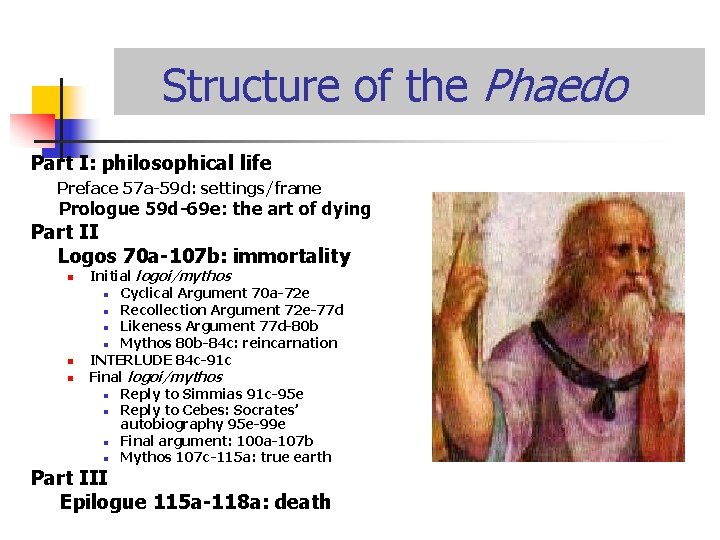
Structure of the Phaedo Part I: philosophical life Preface 57 a-59 d: settings/frame Prologue 59 d-69 e: the art of dying Part II Logos 70 a-107 b: immortality n n n Initial logoi/mythos n Cyclical Argument 70 a-72 e n Recollection Argument 72 e-77 d n Likeness Argument 77 d-80 b n Mythos 80 b-84 c: reincarnation INTERLUDE 84 c-91 c Final logoi/mythos n Reply to Simmias 91 c-95 e n Reply to Cebes: Socrates’ autobiography 95 e-99 e n Final argument: 100 a-107 b n Mythos 107 c-115 a: true earth Part III Epilogue 115 a-118 a: death
Part I: Exploratory Discussions Setting 57 a-63 e 1. 2. Frame/Pythagoreans, myth of Theseus 57 a f. Socrates’ situation 59 d f. n Xanthippe 59 d f. Pleasure and pain 59 a, 60 b; Socratic music 60 c f. Is suicide immoral? 61 b ; 2 nd “Trial”: is Socrates’ wrong to ‘abandon’ his friends? Is there reason for Socrates to hope in an afterlife? 63 c Q’s re: philosophy and living/dying 63 e-70 a n n n What is “death”? 64 c vs. 67 cd vs. 70 a; Is there an art of living/dying? An art of moral practice? 64 c-65 a’ An art of intellectual inquiry? 65 b-67 b “ Note: (i) body” = cause of war, 66 b-67 b (ii) common/honor-based vs. (iii) philosophical morality? 67 b-69 b Mythos and logos in the dialogue n Can the soul live without mythos?
Prologos: philosophy = art of living/dying n Challenge: n n n Disprove it is irrational to be a ‘theist’ re: the human soul Prove it is rational to be a ‘theist’ re: the human soul Socrates must emphasize: n n Knowledge does not depend on/reduce to empirical evidence Moral properties do not depend on/reduce to physical properties
Concept of religious world-view Human life = moral drama in which each person chooses his/her eternal destiny 2. Reality has a metaphysical structure, in which the physical world and material values are not as significant as the spiritual reality and its values; 3. Believing in (1) and (2) and practicing a spiritualreligious life = the path to true salvation and happiness, not living Phaedo expresses a religious world-view, but claims (3) is not enough: must be rational, examined belief 1.
Chief points from Prologue Philosophical life includes: n n Consciousness of death = integral to authentic life Universal morality = virtue based on “detachment” from worldly desire Universal knowledge = rational foundation for UM = ‘Forms’ Mystery aspect of soul as ‘transcending’ ordinary morality, knowledge, connecting to ‘eternal’ (Forms)
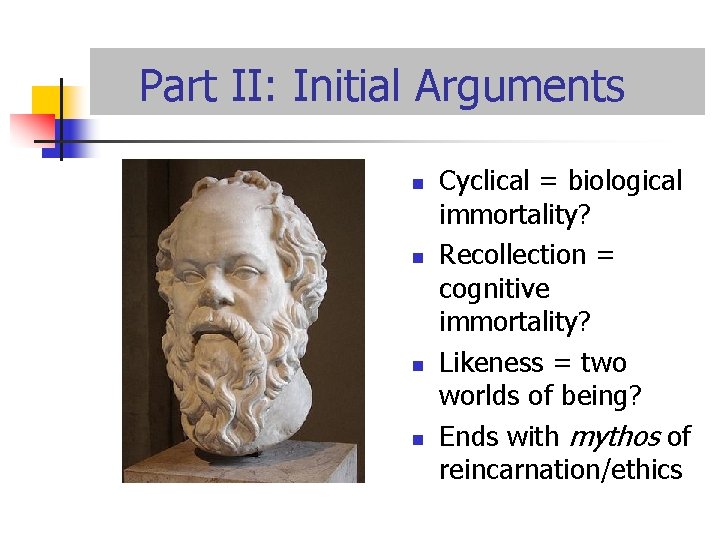
Part II: Initial Arguments n n Cyclical = biological immortality? Recollection = cognitive immortality? Likeness = two worlds of being? Ends with mythos of reincarnation/ethics
Cyclical Argument 1. 2. 3. If opposites come from opposites And the live and dead are opposites (as are dying/coming-back-to-life) Then the dead come to be from the living; and the living must come from the dead, i. e. souls must continue to exist, so they can be reborn. Criticisms? Cf. 70 de 71 e 72 b But note that ‘life’ is not, strictly speaking, a physical property. (Hence = a kind of ‘psyche’)
Recollection Argument 1. 2. 3. If we have knowledge not acquired in this life, we acquired it prior to this life We have such knowledge--knowledge of the Ideas* Therefore our souls existed prior to birth into our bodies *How do we know this? Because we cannot have acquired knowledge of the Forms from senseperception (cf. also ‘proof’ in Meno 81 -85). But what is the argument for this claim? (74 -75)
Critical passage n Do equal sticks and other equal (sense) objects ever seem equal in the same sense as the Equal itself? 74 d n Perceptual things n n = imperfectly alike = particulars in space and time seen differently by different perceivers Forms n n n = perfectly equal = eternal universals = self-same to reason
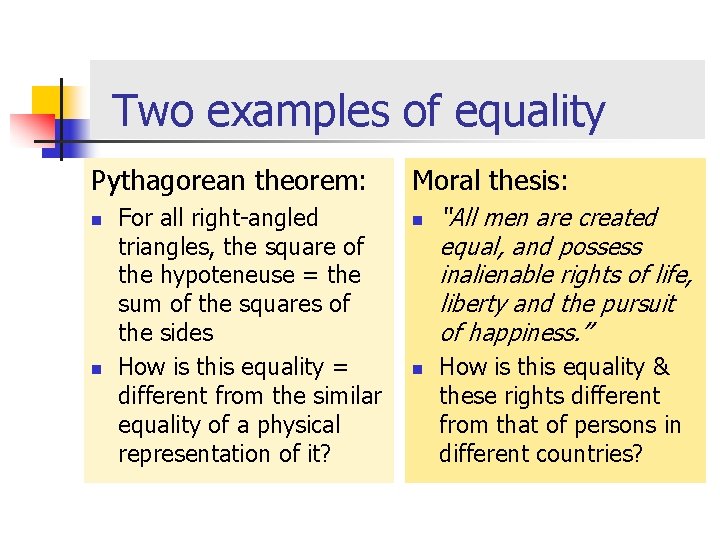
Two examples of equality Pythagorean theorem: n n For all right-angled triangles, the square of the hypoteneuse = the sum of the squares of the sides How is this equality = different from the similar equality of a physical representation of it? Moral thesis: n n “All men are created equal, and possess inalienable rights of life, liberty and the pursuit of happiness. ” How is this equality & these rights different from that of persons in different countries?
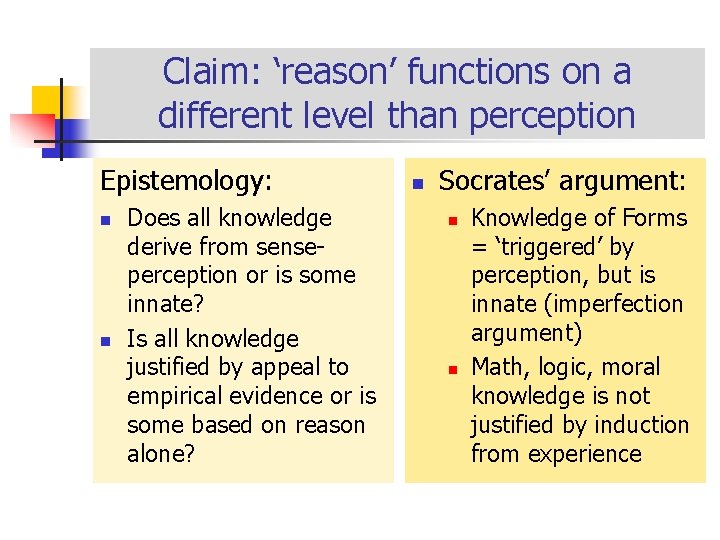
Claim: ‘reason’ functions on a different level than perception Epistemology: n n Does all knowledge derive from senseperception or is some innate? Is all knowledge justified by appeal to empirical evidence or is some based on reason alone? n Socrates’ argument: n n Knowledge of Forms = ‘triggered’ by perception, but is innate (imperfection argument) Math, logic, moral knowledge is not justified by induction from experience
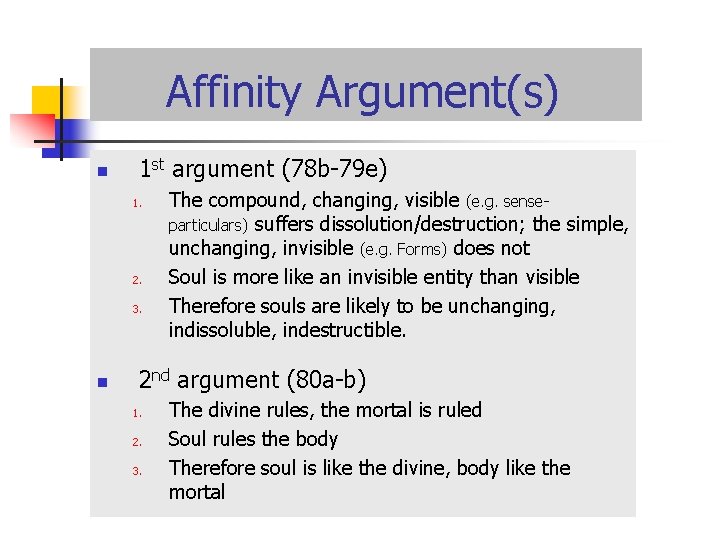
Affinity Argument(s) n 1 st argument (78 b-79 e) 1. 2. 3. n The compound, changing, visible (e. g. senseparticulars) suffers dissolution/destruction; the simple, unchanging, invisible (e. g. Forms) does not Soul is more like an invisible entity than visible Therefore souls are likely to be unchanging, indissoluble, indestructible. 2 nd argument (80 a-b) 1. 2. 3. The divine rules, the mortal is ruled Soul rules the body Therefore soul is like the divine, body like the mortal
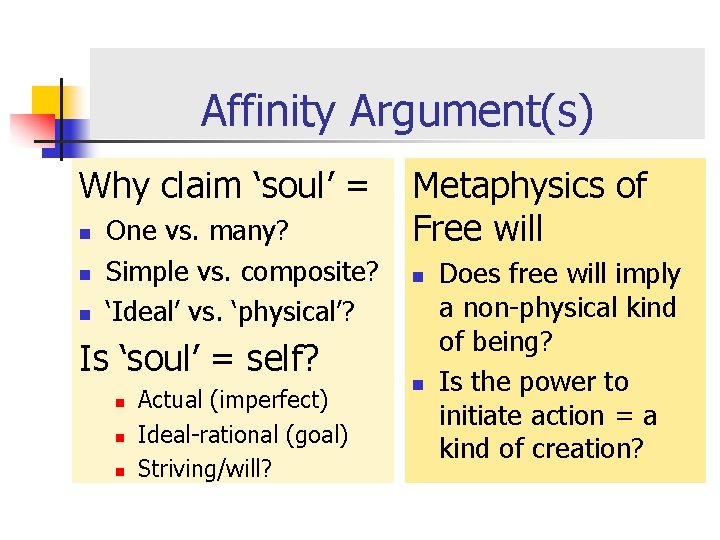
Affinity Argument(s) Why claim ‘soul’ = n n n One vs. many? Simple vs. composite? ‘Ideal’ vs. ‘physical’? Is ‘soul’ = self? n n n Actual (imperfect) Ideal-rational (goal) Striving/will? Metaphysics of Free will n n Does free will imply a non-physical kind of being? Is the power to initiate action = a kind of creation?
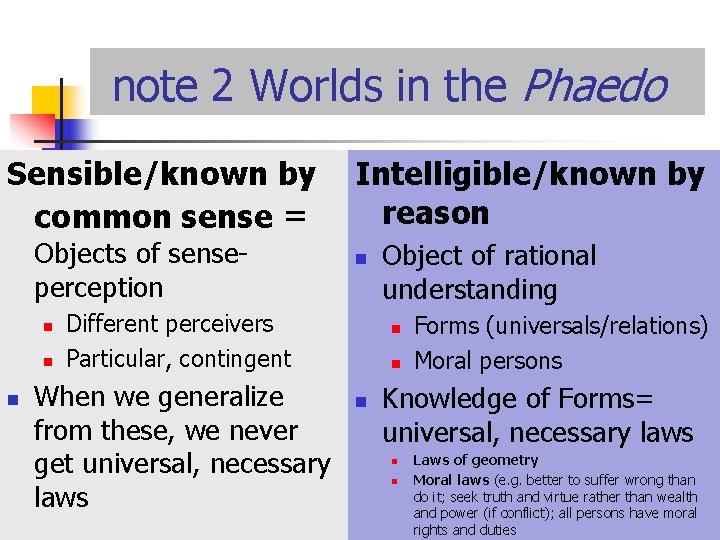
note 2 Worlds in the Phaedo Sensible/known by common sense = Objects of senseperception n Intelligible/known by reason n Different perceivers Particular, contingent When we generalize from these, we never get universal, necessary laws Object of rational understanding n n n Forms (universals/relations) Moral persons Knowledge of Forms= universal, necessary laws n n Laws of geometry Moral laws (e. g. better to suffer wrong than do it; seek truth and virtue rather than wealth and power (if conflict); all persons have moral rights and duties
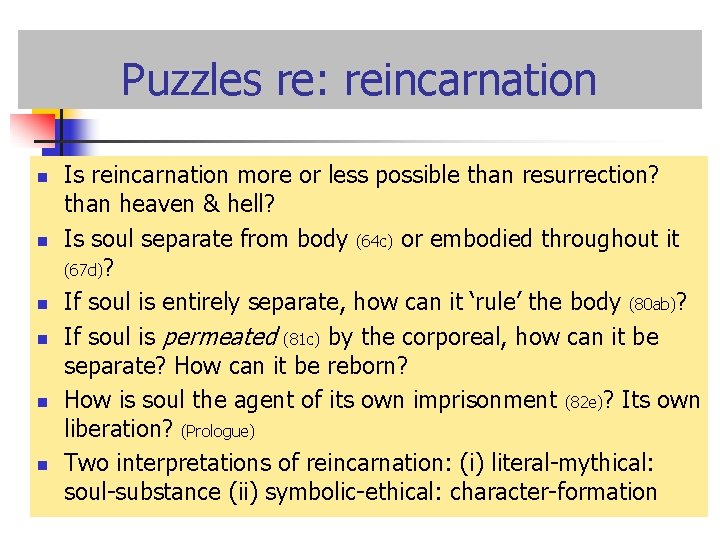
Puzzles re: reincarnation n n n Is reincarnation more or less possible than resurrection? than heaven & hell? Is soul separate from body (64 c) or embodied throughout it (67 d)? If soul is entirely separate, how can it ‘rule’ the body (80 ab)? If soul is permeated (81 c) by the corporeal, how can it be separate? How can it be reborn? How is soul the agent of its own imprisonment (82 e)? Its own liberation? (Prologue) Two interpretations of reincarnation: (i) literal-mythical: soul-substance (ii) symbolic-ethical: character-formation
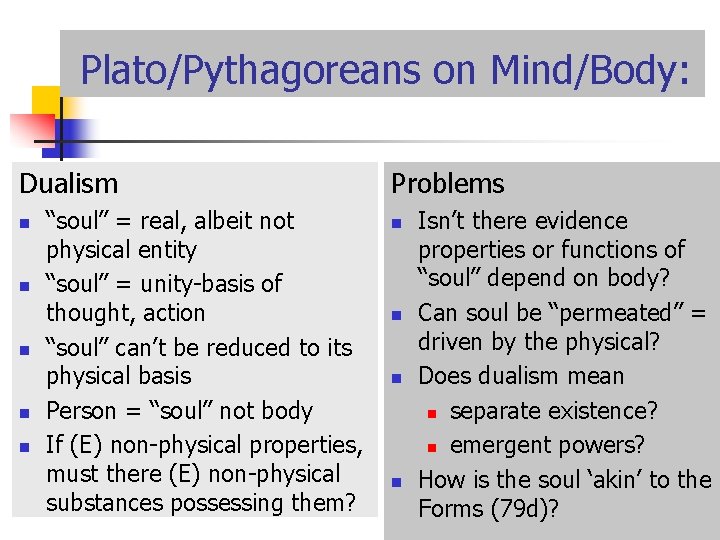
Plato/Pythagoreans on Mind/Body: Dualism n n n “soul” = real, albeit not physical entity “soul” = unity-basis of thought, action “soul” can’t be reduced to its physical basis Person = “soul” not body If (E) non-physical properties, must there (E) non-physical substances possessing them? Problems n n Isn’t there evidence properties or functions of “soul” depend on body? Can soul be “permeated” = driven by the physical? Does dualism mean n separate existence? n emergent powers? How is the soul ‘akin’ to the Forms (79 d)?
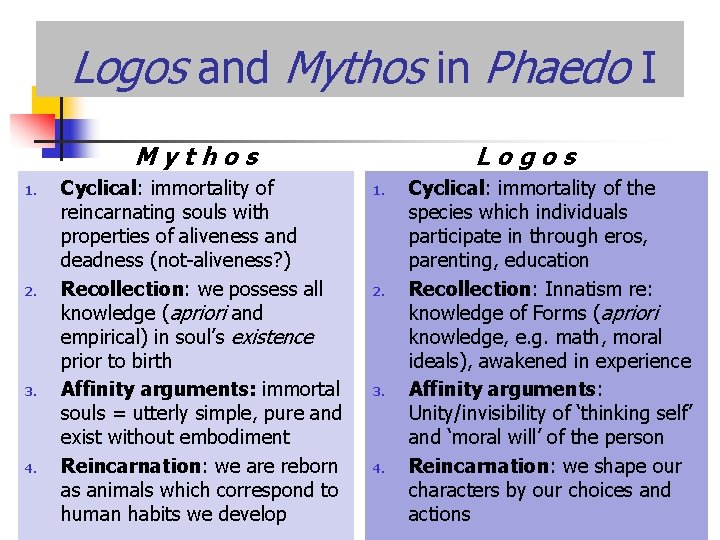
Logos and Mythos in Phaedo I Mythos 1. 2. 3. 4. Cyclical: immortality of reincarnating souls with properties of aliveness and deadness (not-aliveness? ) Recollection: we possess all knowledge (apriori and empirical) in soul’s existence prior to birth Affinity arguments: immortal souls = utterly simple, pure and exist without embodiment Reincarnation: we are reborn as animals which correspond to human habits we develop Logos 1. 2. 3. 4. Cyclical: immortality of the species which individuals participate in through eros, parenting, education Recollection: Innatism re: knowledge of Forms (apriori knowledge, e. g. math, moral ideals), awakened in experience Affinity arguments: Unity/invisibility of ‘thinking self’ and ‘moral will’ of the person Reincarnation: we shape our characters by our choices and actions
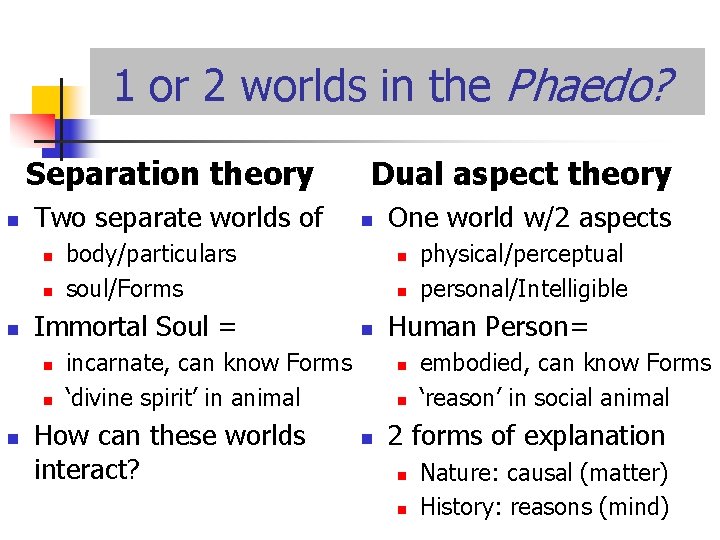
1 or 2 worlds in the Phaedo? Separation theory n Two separate worlds of n n n body/particulars soul/Forms Immortal Soul = n Dual aspect theory n n n incarnate, can know Forms ‘divine spirit’ in animal How can these worlds interact? One world w/2 aspects Human Person= n n n physical/perceptual personal/Intelligible embodied, can know Forms ‘reason’ in social animal 2 forms of explanation n n Nature: causal (matter) History: reasons (mind)
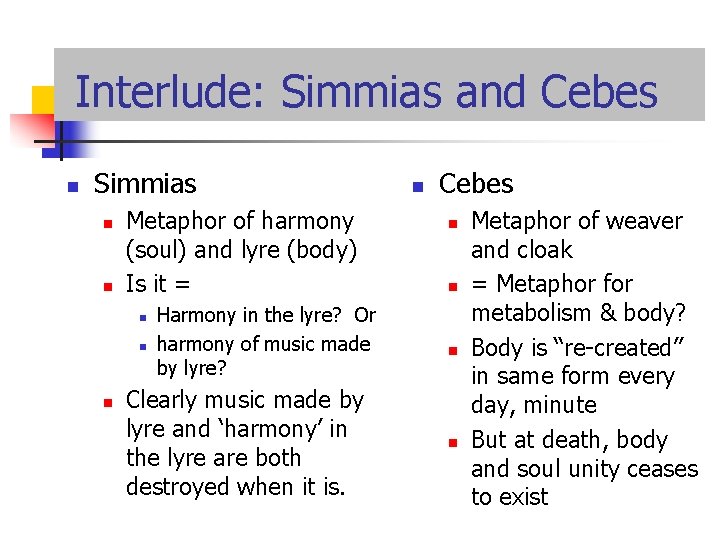
Interlude: Simmias and Cebes n Simmias n n Metaphor of harmony (soul) and lyre (body) Is it = n n n Harmony in the lyre? Or harmony of music made by lyre? Clearly music made by lyre and ‘harmony’ in the lyre are both destroyed when it is. n Cebes n n Metaphor of weaver and cloak = Metaphor for metabolism & body? Body is “re-created” in same form every day, minute But at death, body and soul unity ceases to exist
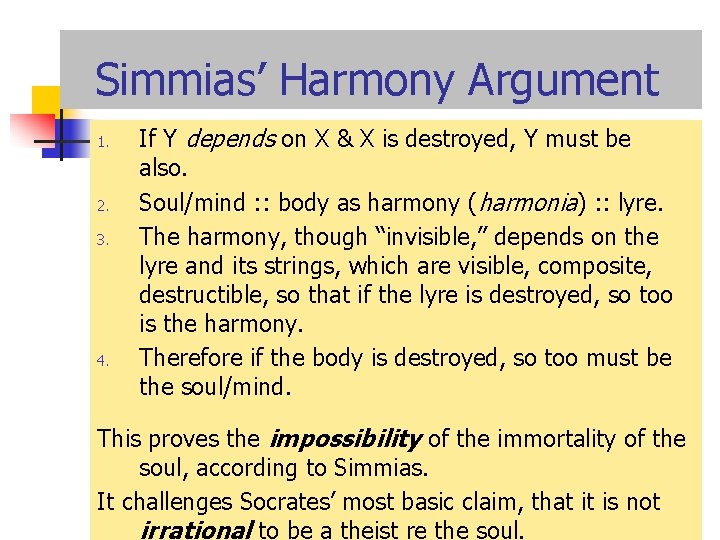
Simmias’ Harmony Argument 1. 2. 3. 4. If Y depends on X & X is destroyed, Y must be also. Soul/mind : : body as harmony (harmonia) : : lyre. The harmony, though “invisible, ” depends on the lyre and its strings, which are visible, composite, destructible, so that if the lyre is destroyed, so too is the harmony. Therefore if the body is destroyed, so too must be the soul/mind. This proves the impossibility of the immortality of the soul, according to Simmias. It challenges Socrates’ most basic claim, that it is not irrational to be a theist re the soul.
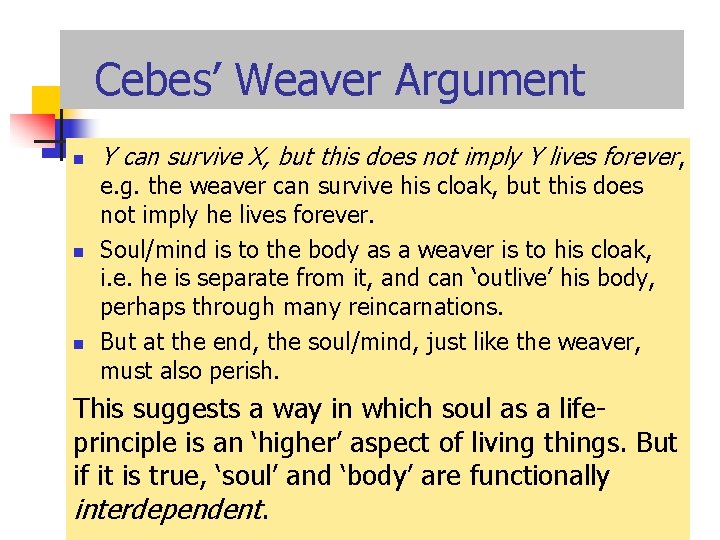
Cebes’ Weaver Argument n n n Y can survive X, but this does not imply Y lives forever, e. g. the weaver can survive his cloak, but this does not imply he lives forever. Soul/mind is to the body as a weaver is to his cloak, i. e. he is separate from it, and can ‘outlive’ his body, perhaps through many reincarnations. But at the end, the soul/mind, just like the weaver, must also perish. This suggests a way in which soul as a lifeprinciple is an ‘higher’ aspect of living things. But if it is true, ‘soul’ and ‘body’ are functionally interdependent.
Interlude: Misology, Misanthropy n n Simmias and Cebes evoke the Minotaur = Fear of Death Socrates must rally his friends emotionally, to ‘stand firm in the argument’ (need philosophical courage) The danger = power of misology, “philosophical cynicism” Analogy to misanthropy (“interpersonal cynicism”)
Death and Nihilism n … Out, out, brief candle! Life's but a walking shadow, a poor player, That struts and frets his hour upon the stage, And then is heard no more. It is a tale Told by an idiot, full of sound and fury, Signifying nothing. -- Macbeth
Simmias on Mind & Body: n Materialism n n “soul” or mental life = dependent on physical “soul” = experienced process of thought, action, perception “soul” = caused/explained by events in the body (i. e in brain, nervous system) “soul” = property of physical being n Problems n n “soul” seems independent of body in some ways “soul” = unity = center of thought and perception, free choice and action If “soul” can be reduced to body/brain, what is moral life? “soul” = seems different from physical properties
Socrates vs. Simmias n n Admits his arguments may be driven by the desire to win, we should question them 3 arguments 1. (91 c-92 d): conflict between Harmony Theory and Recollection Argument 2. (92 e-94 b): conflict between idea of good and wicked people, vs. Harmony Theory 3. (92 e-94 b): conflict between idea of self -rule vs. Harmony Theory
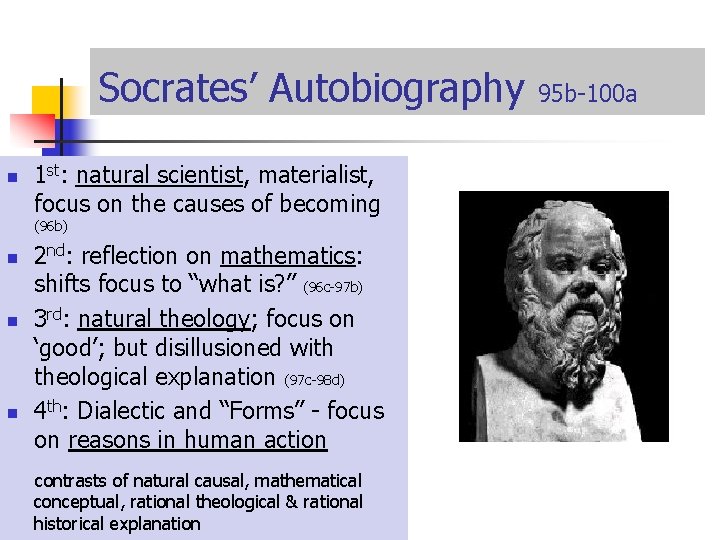
Socrates’ Autobiography n 1 st: natural scientist, materialist, focus on the causes of becoming (96 b) n n n 2 nd: reflection on mathematics: shifts focus to “what is? ” (96 c-97 b) 3 rd: natural theology; focus on ‘good’; but disillusioned with theological explanation (97 c-98 d) 4 th: Dialectic and “Forms” - focus on reasons in human action contrasts of natural causal, mathematical conceptual, rational theological & rational historical explanation 95 b-100 a
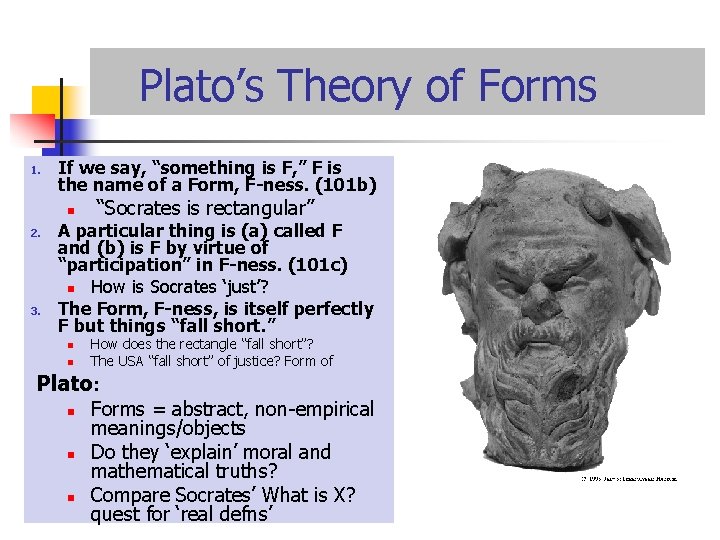
Plato’s Theory of Forms 1. If we say, “something is F, ” F is the name of a Form, F-ness. (101 b) n 2. 3. “Socrates is rectangular” A particular thing is (a) called F and (b) is F by virtue of “participation” in F-ness. (101 c) n How is Socrates ‘just’? The Form, F-ness, is itself perfectly F but things “fall short. ” n n How does the rectangle “fall short”? The USA “fall short” of justice? Form of Plato: n n n Forms = abstract, non-empirical meanings/objects Do they ‘explain’ moral and mathematical truths? Compare Socrates’ What is X? quest for ‘real defns’
‘Separation’ and ‘Intrusion’ of the Forms and the real world Form e. g. Form = ‘transcendence’ and ‘immanence’ of the Ideal Circle/circularity = ‘insight’ into the Ideal n n n Intellectual or noetic otherness of the Ideal Circles we see or imagine all = determinate, ‘imperfect’ Ambiguity of words = reference to Ideal or physical ‘instances’? n n n Does this apply to justice, beauty, goodness? To the soul striving to know and live them? If words toward Ideal realities, how are they ‘real’?
Plato’s Theory of Forms and Language If we say something is called F, F is the name of a Form, F-ness n n n “Socrates’ face is circular” Because of this, language is not ambiguous, e. g. ‘white, ’ ‘circle, ’ ‘swan, ’ ‘just’ The sophists are mistaken to say “all words are ambiguous” Forms and Reality If we say, “something is F, ” x participates in the Form, F-ness n n n e. g. “Socrates is just” Because of this, the world has an essential structure, which things strive to be The sophists are mistaken to say “all things flow” and “there is no universal knowledge”
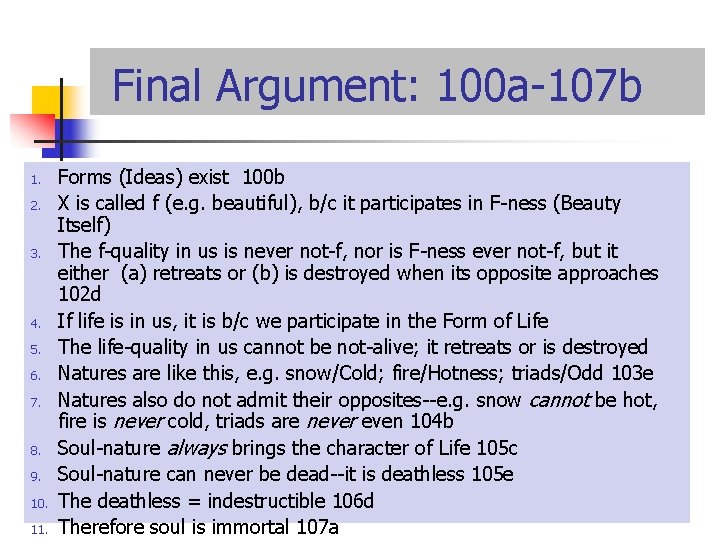
Final Argument: 100 a-107 b 1. 2. 3. 4. 5. 6. 7. 8. 9. 10. 11. Forms (Ideas) exist 100 b X is called f (e. g. beautiful), b/c it participates in F-ness (Beauty Itself) The f-quality in us is never not-f, nor is F-ness ever not-f, but it either (a) retreats or (b) is destroyed when its opposite approaches 102 d If life is in us, it is b/c we participate in the Form of Life The life-quality in us cannot be not-alive; it retreats or is destroyed Natures are like this, e. g. snow/Cold; fire/Hotness; triads/Odd 103 e Natures also do not admit their opposites--e. g. snow cannot be hot, fire is never cold, triads are never even 104 b Soul-nature always brings the character of Life 105 c Soul-nature can never be dead--it is deathless 105 e The deathless = indestructible 106 d Therefore soul is immortal 107 a
Mythos of the True Earth True earth = ideal image or norm for actual, imperfect earth n Mythos = pictures earth, human destiny in light of the Good n
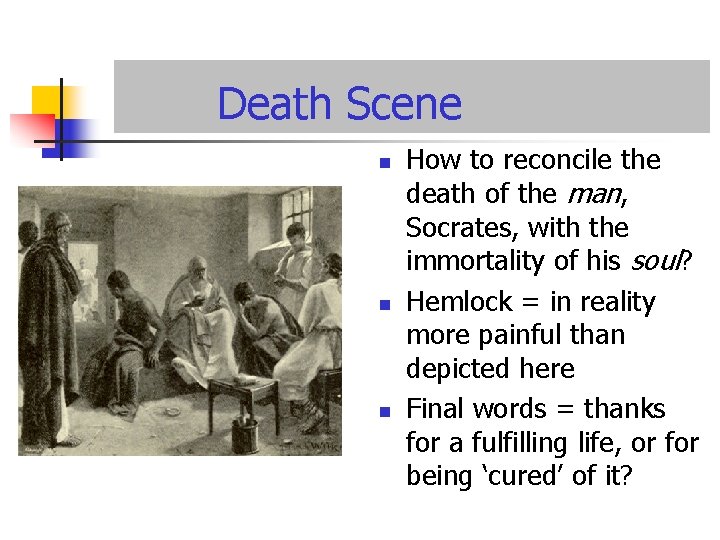
Death Scene n n n How to reconcile the death of the man, Socrates, with the immortality of his soul? Hemlock = in reality more painful than depicted here Final words = thanks for a fulfilling life, or for being ‘cured’ of it?
Questions n n n Has Socrates proved it is rational to believe in the immortality of the soul? Has he proven it is not irrational to hope for it? Does it make sense to think there are “two conceptions” of reality, one ideal (souls/Forms), another physical? Why does Socrates think knowledge (of the Forms) is innate, rather than acquired? Does it make sense to think the “Forms” exist, independent of thinking minds? How does the metaphysics of the Phaedo —the Forms, the Soul—relate to the ethics of the Apology, Crito and Gorgias?
- Slides: 36