
Plato the Philosopher By Justin Vail and Thomas
Plato the Philosopher By Justin Vail and Thomas Huneycutt
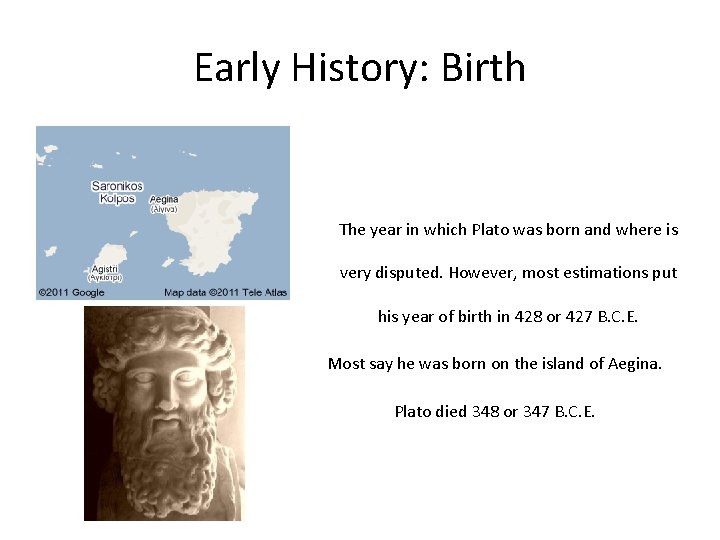
Early History: Birth The year in which Plato was born and where is very disputed. However, most estimations put his year of birth in 428 or 427 B. C. E. Most say he was born on the island of Aegina. Plato died 348 or 347 B. C. E.
Plato’s Family Plato’s father, Ariston, traced his descent from the king of Athens, Codrus, and the king of Messenia, Melanthus. Plato’s mother, Perictione, was famous because her family had ties with the lawyer Solon. Plato had two brothers, Adeimantus and Glaucon, and a sister, Potone later gave birth to Speusippus, who became head of the Academy after Plato.
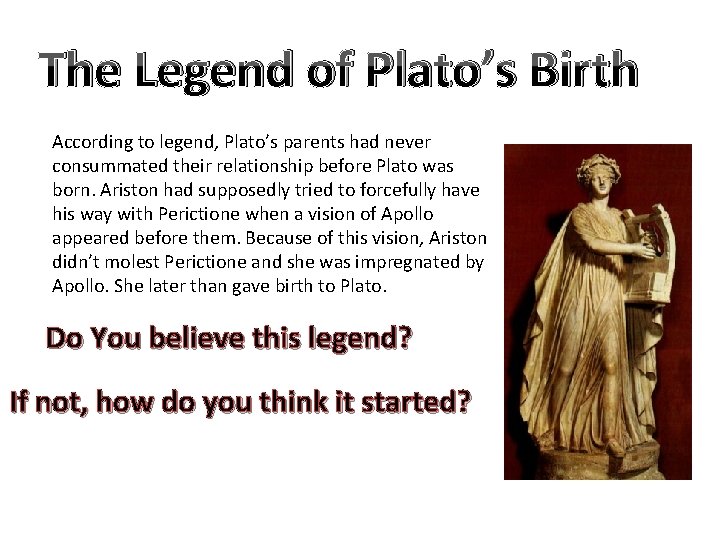
The Legend of Plato’s Birth According to legend, Plato’s parents had never consummated their relationship before Plato was born. Ariston had supposedly tried to forcefully have his way with Perictione when a vision of Apollo appeared before them. Because of this vision, Ariston didn’t molest Perictione and she was impregnated by Apollo. She later than gave birth to Plato. Do You believe this legend? If not, how do you think it started?

Childhood Plato’s father, Ariston, died early in Plato’s childhood. His mother than married her uncle Pyrilampes. Regarding education, Plato was taught by some of the best. He quickly understood what he was taught and excelled not only mentally but physically. Plato was interested in poetry at an early age, but gave this up once he met Socrates ("Plato").
Plato’s Rise in Popularity Plato began to grew in popularity and went on to create the Academy, one of the earliest schools in western civilization ever created. Plato traveled to many places, and eventually went to Syracuse. A man named Dion (brother in law of the ruler of Syracuse, Dionysus) became a disciple of Plato, but later sold him into slavery. He almost died before being bought and freed by an admirer. He later returned to help tutor Dionysus II to become a philosopher king ("Plato").
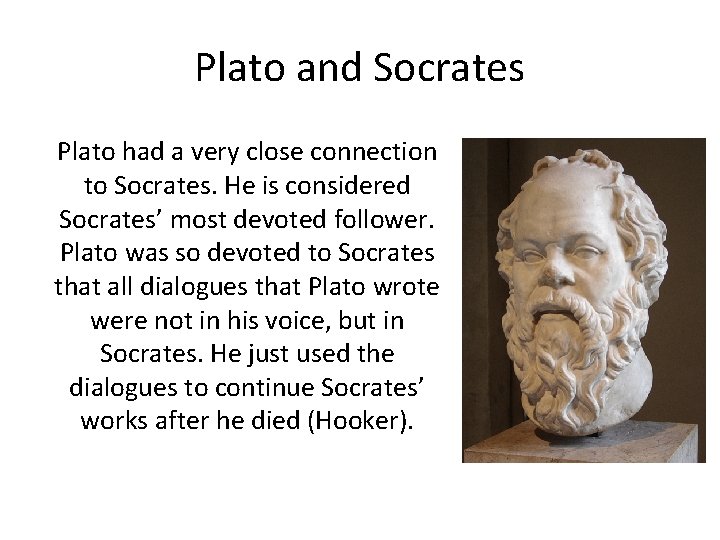
Plato and Socrates Plato had a very close connection to Socrates. He is considered Socrates’ most devoted follower. Plato was so devoted to Socrates that all dialogues that Plato wrote were not in his voice, but in Socrates. He just used the dialogues to continue Socrates’ works after he died (Hooker).
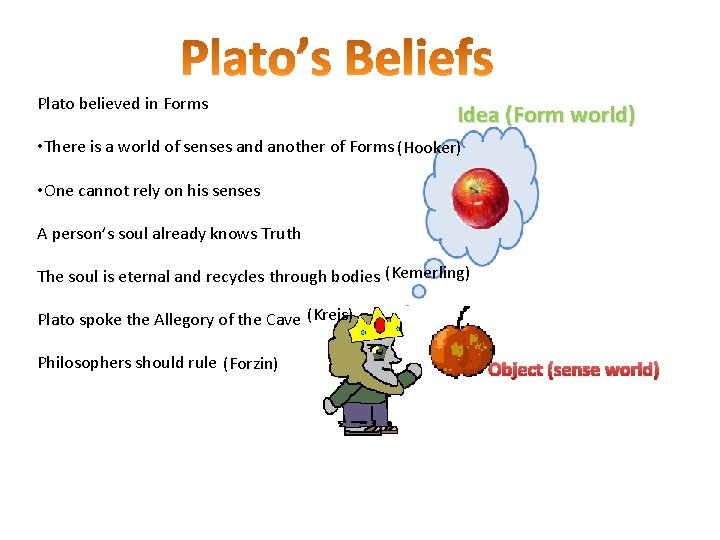
Plato believed in Forms Idea (Form world) • There is a world of senses and another of Forms (Hooker) • One cannot rely on his senses A person’s soul already knows Truth The soul is eternal and recycles through bodies (Kemerling) Plato spoke the Allegory of the Cave (Kreis) Philosophers should rule (Forzin) Object (sense world)
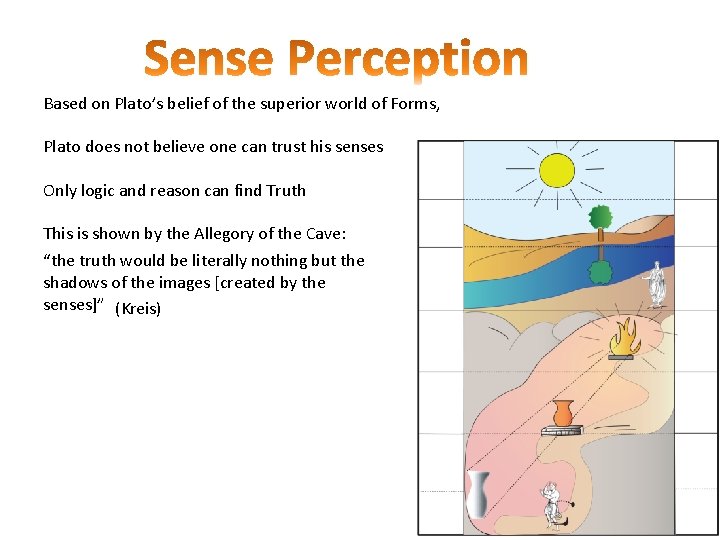
Based on Plato’s belief of the superior world of Forms, Plato does not believe one can trust his senses Only logic and reason can find Truth This is shown by the Allegory of the Cave: “the truth would be literally nothing but the shadows of the images [created by the senses]” (Kreis)

Bibliography • "Plato. " Wikipedia. Web. <http: //en. wikipedia. org/wiki/Plato>. • Hooker, Richard. "Plato. " Greek Philosophy. N. p. , 6 6 1999. Web. 11 Feb 2011. <http: //www. wsu. edu: 8080/~dee/GREECE/PL ATO. HTM>.
Bibliography Forzin, Ralda Plato the Idealist. Creatorix, 2000. Web. 10 Feb. 2011 <http: //www. creatorix. com. au/philosophy/04/04 f 09. html>. Hooker, Richard Plato. Greek Philosophy, 1996. Web. 10 Feb. 2011 <http: //www. wsu. edu: 8080/~dee/GREECE/PLATO. HTM>. Kemerling, Garth Plato: Immortality and the Forms. Philosophy Pages, 2002. Web. 10 Feb. 2011 <http: //www. philosophypages. com/hy/2 f. htm>. Kreis, Steven Plato: The Allegory of the Cave. History Guide, 2004. Web. 11 Feb. 2011 <http: //www. historyguide. org/intellect/allegory. html>. http: //farm 3. static. flickr. com/2727/42764901 39_373 f 813247_z. jpg
- Slides: 12