
Plato Mundi a voyage with Er Helena Barbas
Plato. Mundi a voyage with Er Helena Barbas Universidade Nova de Lisboa CENTRIA – Centre for Artificial Intelligence Bruges Novotel Centrum, Bruges, Belgium 16 th April 2009
Plato. Mundi. 1 has been presented as a preliminary trans-domain proposal for a COST-Action (EU) n More partners will be needed to foster this game development project n It fits the agenda of the ICT - Information and Communication Technologies - Work Programme 2009 -10, of the EC Fp 7 n
Theme: Theme the Myth of Er, as narrated in Book X of Plato’s Republic (612 a-621 d): A man named Er dies in battle. Twelve days later, on the pyre for his funeral, Er awakens and tells us about his journey through the other world. He describes the respective entities, actions and geography n Issues: Issues Justice; Individual responsibility for actions and choice n
Objective: Objective to develop an adventure/quest browser immersive, multiplayer, 3 D MMORPG serious video game n Subjects: Subjects Mythology, Ethics, History, Philosophy and Citizenship n Target group: group players of all ages, genders and nationalities n
Put the latest technical and graphical development of video-games software at the service of edutainment n Respect cultural traditions and mythology n Avoid all kind of useless violence n Design the tasks to develop thinking skills n Carefully address gender issues n
n The most successful games explore utopia worlds graphically designed with extraordinary aesthetical qualities BUT Their mythologies and characters are mixed up in unrecognizable cosmological cocktails
n plot wise, wise the majority are war/conflict games BUT the user-hero - even if female - has to develop warrior expertise through violent activities to win
n The tasks proposed are conceived for the accretion of points/speed of action BUT without any kind of ethical or historical considerations

n Plato. Mundi virtual 3 D worlds will be as faithful as possible to the platonic proposals: ¨ resort to cosmological or mythological references present in other dialogues (Timaeus, Phaedrus, Phedon, i. e. ). ¨ Use contemporary images ¨ Use later date images representing Plato’s worlds

Plato’s Geography ( Myth of Er + Timaeus) Oceanus Earth Cocitus Hades Acheronte Lake Acherusia Piriphlegetonte Tartarus
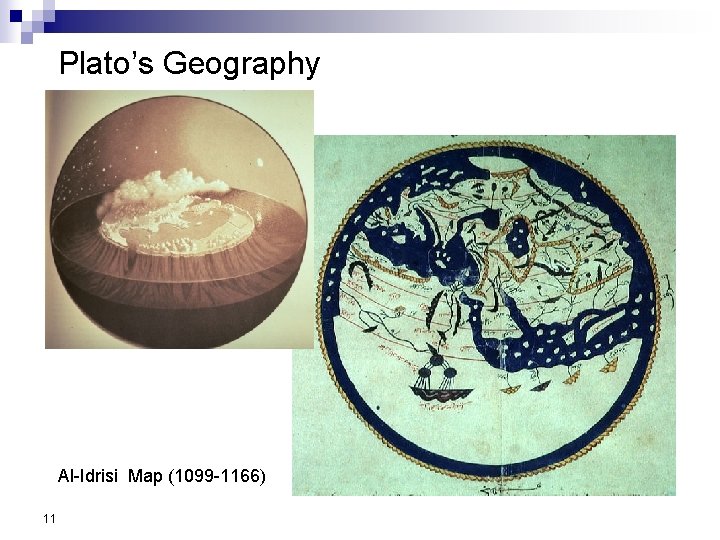
Plato’s Geography Al-Idrisi Map (1099 -1166) 11
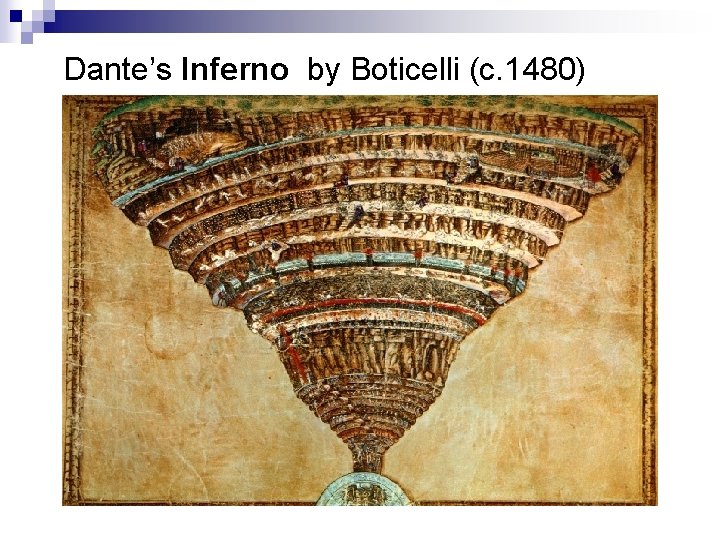
Dante’s Inferno by Boticelli (c. 1480)
n Software: Software Free Open Source platforms and programs - i. e. ¨ Source Engine (Valve) – extensible, modular environment for PC and console games that combines leading-edge tools ¨ Maya (Autodesk) free to download for student or academic purposes
Concerning visual game design: special emphasis is to be given to aesthetics role in this game experience n The drawings will be original, original inspired from the classic arts n They will avoid stereotyped, gloomy or childish representations (anime or machimina) n
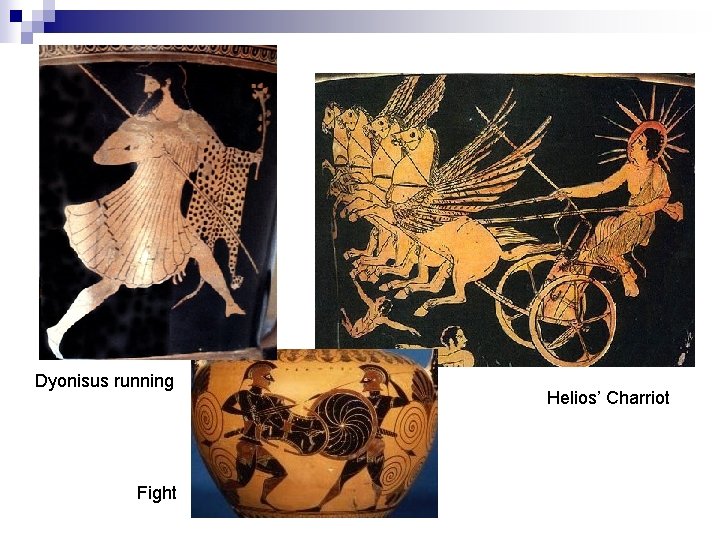
Dyonisus running Fight Helios’ Charriot
From storytelling will depart game conceptual and practical design (bible, visual and audio elements, interfaces, etc. ) n In this kind of narrative spaces (worlds and scenarios) are determinant for plot and characters, as well as action development and task planning n
Geography will be distributed by four worlds – Earth, Limbo, Heaven and Hell – all interconnected through the Rainbow column and Styx river n The interconnection and interaction between levels will open the passageways for characters/tasks n
Characters will be able to walk, run, and hide n Other activities are: n ¨ giving orders ¨ negotiate ¨ solve enigmas ¨ answer questions ¨ role-play ¨ tasks ¨ find objects
Magical objects / tokens: n The Gyges ring n Hades helm of darkness both providing invisibility n Invisibility will be used as a way of acting strategically in order to accomplish the tasks n
Normal objects / tokens: n One livery collar that the user will receive empty at the start of the game n Every success will be rewarded with precious stones/points stones n These jewels will be used for trade-offs and assessment purposes n
Two avatars - Pamphylia (female) and Pamphylius (male) - young humans without any superpowers n Main adjuvant – Er, a human guide/ messenger; he wants to help, but may make mistakes n Oracular – a couple of Philosopher(s) Socrates/Hypathia; each will serve as guide/daimon; (introduction of AI to support the best moral decision) decision n
In the case of ER, the main predicament would be the relation between the just and unjust man n This issue will also be included in the story as part of the action, action considered in the reckoning of the rewards to be received by the player n
n Storytelling will evolve through a multileveled plot: ¨ Narrative: as described in the Myth ¨ Gameplay: the tasks to be accomplish in a given period of time ¨ Phylosophical/moral: the tasks/obstacles embedded in the plot, as actions to be/or not to be taken n The questionnaires, quizzes/enigmas to be solved with syllabus content
n The plot has been structured following narratological theories (Todorov/ Barthes/ Greimas). It is divided into two main sequences: ¨ The arrival of Er/users to Limbo, and the distribution of lives ¨ The trip from the plain of Lethes to the return to earth/fall into the Cave n Learning content will be shaped within the action sequences
This project has been prepared as a firstphase/test-bed for the launching of more complex and longer developments n Plato’s Works are translated in almost every language in academic editions n ¨ large scope of audience ¨ guarantee of scientific credibility n Plato. Mundi can become an original and dynamic cultural heritage preservation project
ISSUES TO BE ADDRESSED Creation of a web database – wiki/ moodle/ encyclopedia-wise – with all the possible information on the game and themes developed, syllabus, forum and communities n The users (student / teacher) will be allowed to contribute to it, with different levels of access n
ISSUES TO BE ADDRESSED n Development of a methodology for serious games evaluation: ¨ Creation of control groups ¨ Creation of a taxonomy ¨ Systematization of the results
ISSUES TO BE ADDRESSED n Contribute to a new educational theory: ¨ Approaches to edutainment are tainted by traditional learning theories (Behaviourism, Cognitivism, Constructionism, the Sociocultural approach, on the way to Blended learning) ¨ They do not consider the specifics of ludology, nor the fresher proposals of the cognitive sciences
n In edutainment - how to transfer game concepts to the classroom: classroom ¨ trade-offs / playability ¨ intrinsic/extrinsic motivations /immersion ¨ freedom/ control / mastery ¨ the game may log the number of mistakes and self-corrections ¨ the tutorials provide gradual information
n In edutainment - how to transfer classroom concepts to the game: game ¨ logging features and tracking potential that allow the users to enhance their performance ¨ how to let the student actions adjust the game/learning variables
ISSUES TO BE ADDRESSED Assessment: n Measurement has to start at the software and game design stages n ¨ It has to follow the trend of UCD (User-centred design) ¨ Must consider the implications of continuous appraisal (hesitations, doubts) What kind of teacher/monitor grading n And cheating will always be a challenge n
Plato. Mundi - a voyage with Er Thank You Helena Barbas - UNL - CENTRIA – Portugal hbarbas@fct. unl. pt hbarbas@gmail. com
- Slides: 32