
Plato and Democracy CONVENTIONAL RELATIVISM DEMOCRACY AND PHILOSOPHER

- Slides: 19
Plato and Democracy CONVENTIONAL RELATIVISM, DEMOCRACY, AND PHILOSOPHER KINGS
Thrasymachus’ Position �“Justice is nothing else than the interest of the stronger. ” Who are the “stronger” in any given society? Who are the lawmakers in any given society? Who enforces the laws of any given society? Who shapes the “education” of the citizens of any given society? Who benefits most from the order of any given society? �So, what is meant by “justice” in any given society is whatever the “stronger” determine it to be.
Justice as Relative to Power “And the different forms of government make laws democratical, aristocratical, tyrannical, with a view to their several interests; and these laws, which are made by them for their own interests, are the justice which they deliver to their subjects, and him who transgresses them they punish as a breaker of the law, and unjust. And that is what I mean when I say that in all states there is the same principle of justice, which is the interest of the government; and as the government must be supposed to have power, the only reasonable conclusion is, that everywhere there is one principle of justice, which is the interest of the stronger. ”
Implications of Relativity �There is no objective or universal meaning of “justice” that applies to all societies. � We can determine what is “right” or “wrong” by looking to the laws or norms of any given society. �Every society is equally just/unjust. �There is no such thing a “moral progress. ” �Justice is reduced to “might makes right. ”
Socrates’ Objection �If justice is the interest of the stronger, then it is just for subjects to obey their rulers. �Rulers are fallible, that is they may sometimes make rules that are contrary to their interests. �These laws too must be obeyed. �This implies that justice is both in the interests of the stronger and against the interests of the stronger. �Hence, justice cannot be defined as the interest of the stronger.
Thrasymachus’ Response �When a person is mistaken is not the “stronger” at the time that he is mistaken. �Justice is a skill, like medicine, arithmetic or grammar. �One is a physician only when healing the sick, not when harming them. �He who errs in arithmetic or grammar is not an arithmetician or grammarian at the time when he is making the mistake, in respect of the mistake. �Thus, “the ruler, in so far as he is the ruler, is unerring, and, being unerring, always commands that which is for his own interest. ”
Socrates’ Response �If governing is an art or craft such as medicine, piloting, or the like, as Thrasymachus insists then… As medicine serves the interests of the patient, so too should governing serve the interests of the governed. As piloting serves the safety of the ship, so too should governing serve the interests of the governed. As all arts or crafts serve the interests of the subject to which the crafts are directed, so too should the craft of governing serve its subjects. �Thus, governing is a craft that serves the interests of the governed.
Thrasymachus’ final Attempt �Governing is more akin to the craft of shepherding than medicine. �Shepherds only tend to the flock for their (the shepherd’s) own good and not with the ultimate interests of the flock in mind. �Thus, the strong in society only concern themselves with the welfare of their subjects so that they can exploit them (i. e. their subjects) for their own benefit.
Socrates’ Last Response to Thrasymachus �If Thrasymachus is correct in distinguishing the art of medicine from the art of earning money, then to be consistent, he ought also to distinguish the art of shepherding from the art of butchery or fleecing. �Hence, insofar as the stronger are effective at the art of governing, their effectiveness is measured by how well they serve the interests of their subjects.
Justice is for Suckers? �Thrasymachus fails to defend his definition of justice. �But, he argues, if justice does not serve the interests of the stronger, then it would be foolish for the strong to be just. �The unjust can avoid paying taxes, gain advantages by secretly breaking rules or using deception, and can keep more of their wealth and power. �Hence, he shifts his approach, arguing instead that an intelligent person would choose injustice.
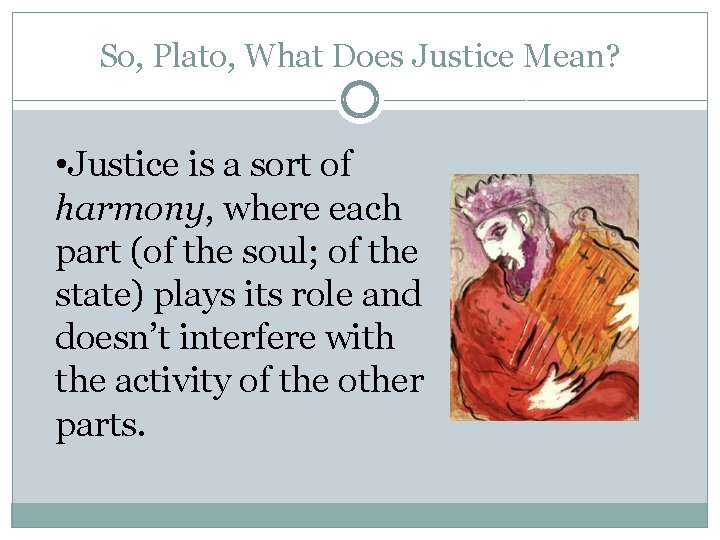
So, Plato, What Does Justice Mean? • Justice is a sort of harmony, where each part (of the soul; of the state) plays its role and doesn’t interfere with the activity of the other parts.
Justice Writ Small and Large Justice in the individual Justice in the state � The Tripartite Soul and its � The three social classes of virtues: the state; Reason: wisdom Guardians: Philosophers Spirit: courage Auxiliary: Military Appetites: moderation Artisans: Productive Workers � Justice is achieved when each part of the soul is � Justice is found when each focused on its on function in man practices only the one service to the soul, i. e. when thing most suitable to his the appetites and passions nature obey reason.
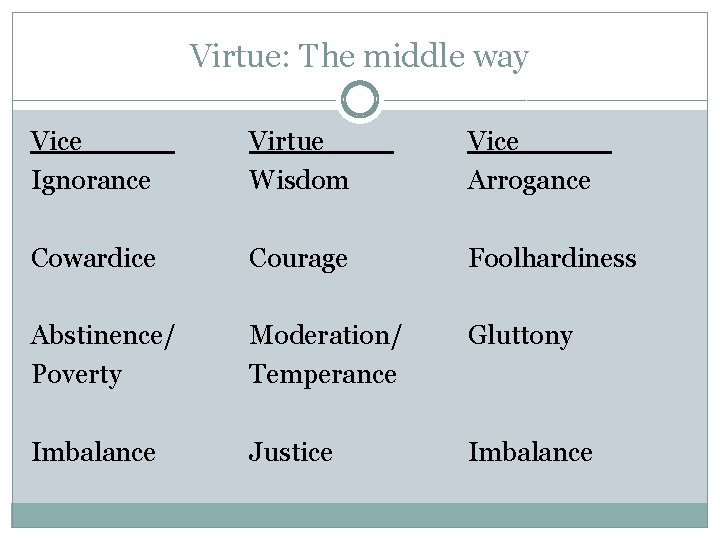
Virtue: The middle way Vice Ignorance Virtue Wisdom Vice Arrogance Cowardice Courage Foolhardiness Abstinence/ Poverty Moderation/ Temperance Gluttony Imbalance Justice Imbalance
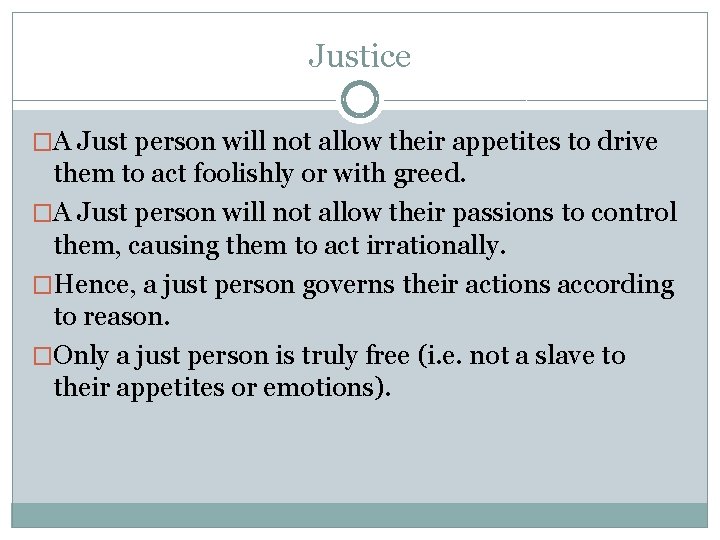
Justice �A Just person will not allow their appetites to drive them to act foolishly or with greed. �A Just person will not allow their passions to control them, causing them to act irrationally. �Hence, a just person governs their actions according to reason. �Only a just person is truly free (i. e. not a slave to their appetites or emotions).
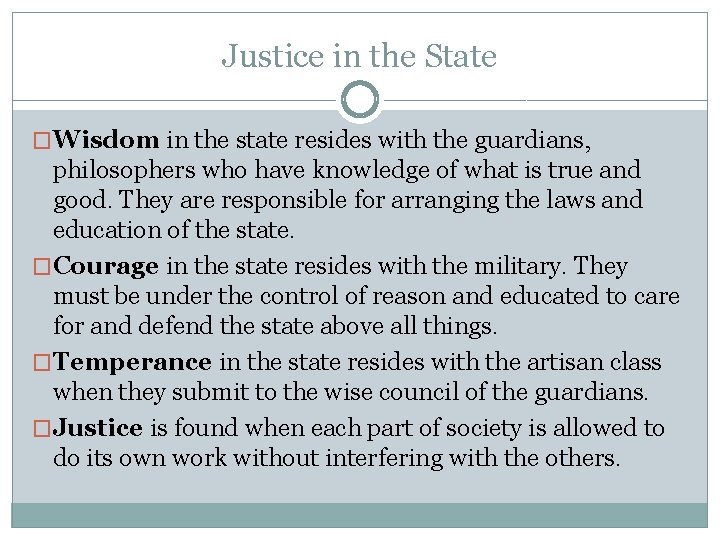
Justice in the State �Wisdom in the state resides with the guardians, philosophers who have knowledge of what is true and good. They are responsible for arranging the laws and education of the state. �Courage in the state resides with the military. They must be under the control of reason and educated to care for and defend the state above all things. �Temperance in the state resides with the artisan class when they submit to the wise council of the guardians. �Justice is found when each part of society is allowed to do its own work without interfering with the others.
What’s your place in Society? � Natural Talents: The children in the state are examined and tested to determine their abilities and determine which class they belong to. � Managed Childbearing: Conventional family life exists among Artisans, but members of the Auxiliary and Guardian class share communal responsibility for childrearing. Though there is no prohibition of members of the Artisan class moving into the Auxiliary or Guardian classes, leaders carefully arrange “marriages” so as to increase the likelihood of desired offspring (i. e. eugenic program). � Education: All children receive education in philosophy and morality. Each child is then educated according to the role they will play in society. Plato seems to recommend considerable censorship both in education and in the arts.
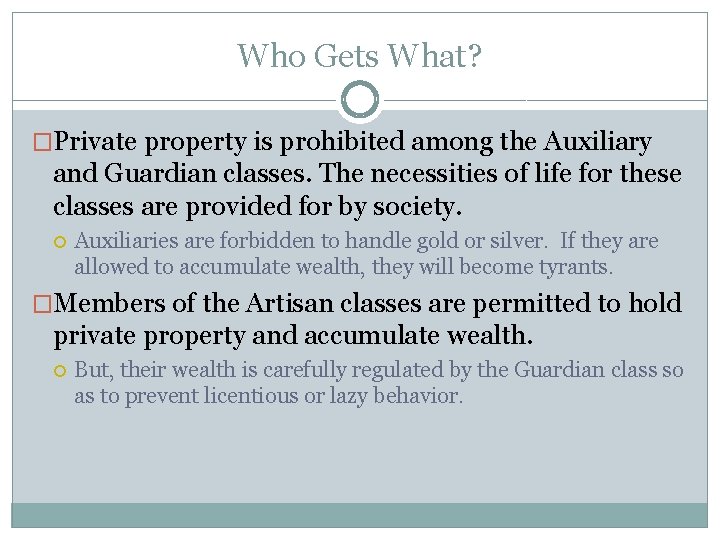
Who Gets What? �Private property is prohibited among the Auxiliary and Guardian classes. The necessities of life for these classes are provided for by society. Auxiliaries are forbidden to handle gold or silver. If they are allowed to accumulate wealth, they will become tyrants. �Members of the Artisan classes are permitted to hold private property and accumulate wealth. But, their wealth is carefully regulated by the Guardian class so as to prevent licentious or lazy behavior.
Why Would Anyone Want to Rule? �Plato allows no wealth or luxury for the Guardians of the state. �Further, the philosophers who make up this class are not permitted to do what they enjoy most, engage in philosophical contemplation. �So, why would they agree to such responsibility? �The answer is, the Guardians fear most living in a poorly governed state, where those who rule are not fit for the role. �Since Plato himself endured periods of political instability, slavery and tyrannical rule, the suffering under an unjust state was a real and present concern.
What’s Wrong with Democracy? The “Craft” analogy � Democracy is rule by the ignorant “mob” � The mob are incapable of understanding the complex operations of the state. � As we should not seek medical advice from anyone but an expert doctor, we should not accept leadership from anyone but an expert governor. � In a democracy the people will be corrupted by their appetites and passions � In a democracy the people will be fooled by imposters (i. e. actors pretending to be wise leaders) � In a democracy the people are as apt to kill the best among them as they are to respect them (recall the execution of Socrates).