
Plato 422 347 BC Plato is officially considered
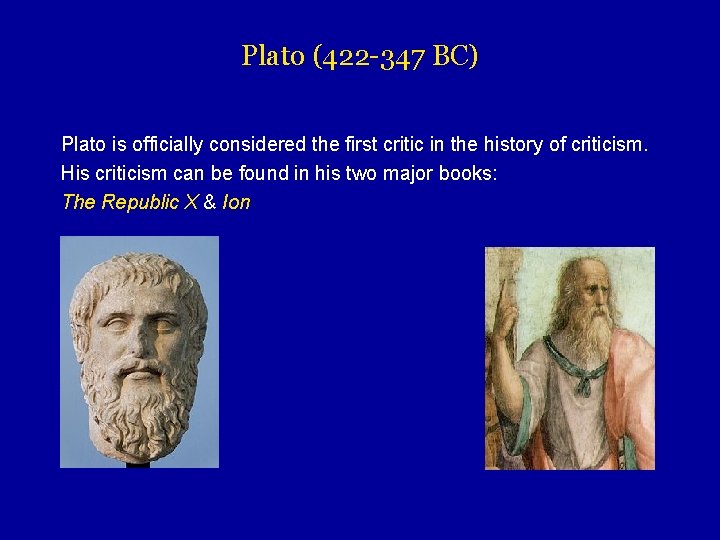
Plato (422 -347 BC) Plato is officially considered the first critic in the history of criticism. His criticism can be found in his two major books: The Republic X & Ion
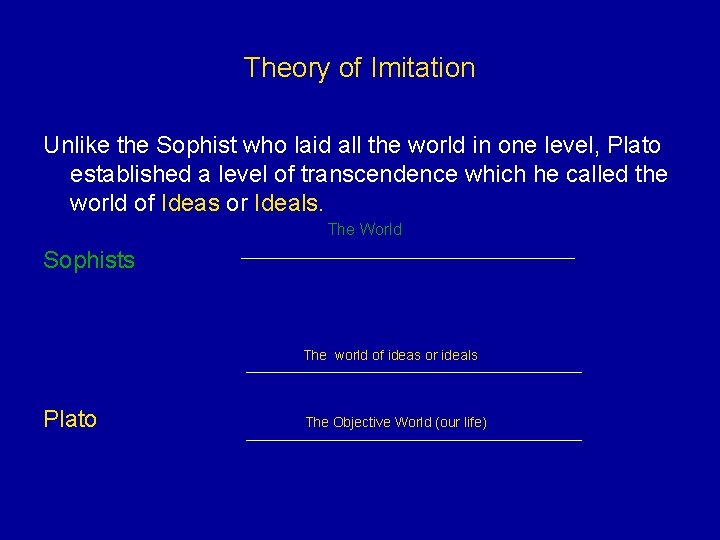
Theory of Imitation Unlike the Sophist who laid all the world in one level, Plato established a level of transcendence which he called the world of Ideas or Ideals. The World Sophists The world of ideas or ideals Plato The Objective World (our life)
Theory of Imitation • According to Plato, the world of ideas or ideals is constitutive of the objective world. • Our conception of the world of ideas or ideals is very flimsy. • The world of ideas or ideals is the domain of the truth. • The objective world is nothing but a copy of the world of ideas. • Everything in the objective world is an inferior copy of its image in the world of ideas. A HORSE is a copy of the image of the ideal HORSE. A CHAIR is a copy of the image of the ideal CHAIR. A TREE is a copy of the image of the ideal TREE.
Theory of Imitation Man, through the possession of the faculty of REASON can bridge the gap between the objective world and the world of ideas. This enables man to see beyond the appearance of things. According to Plato literature imitates life (the objective world), which is nothing but a copy of the world of ideas. This means that literature is A COPY OF A COPY or an IMITATION OF an IMITATION. LITERATURE is not ONCE BUT TWICE removed from the truth. Therefore, it can not be trusted as source for truth. IT IS USELESS & IT CAN NOT BE TRUSTWORTHY.
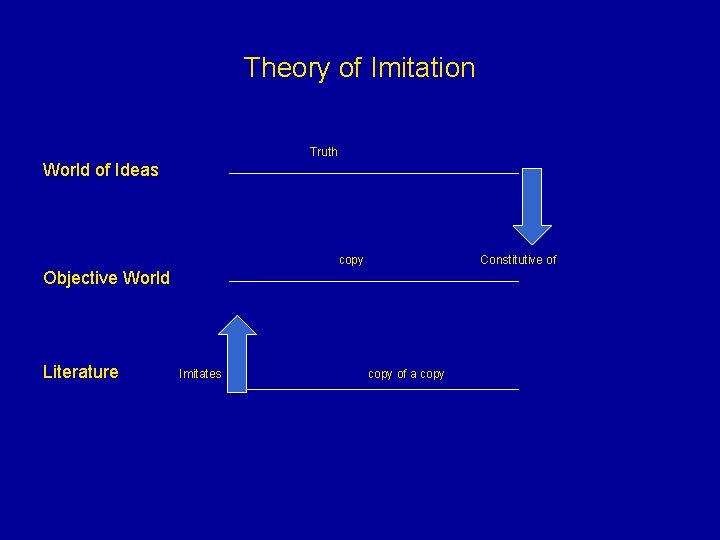
Theory of Imitation Truth World of Ideas copy Constitutive of Objective World Literature Imitates copy of a copy
Poetic Inspiration Plato writes in his Ion: “Not by art does the poet sing, but by power divine” He also mentions that: “For the poet is light and winged and holy thing, there is no invention in him until he has been inspired and is out of his senses and the mind is no longer in him: when he has not reached this state, he is powerless and is unable to utter his oracle. ” Plato sees that poetry is the result of inspiration. Poets write when they get help from an outside force. The poet writes when there is no mind in him. BUT MIND IS THE MEANS TO BRIDGE THE GAP BETWEEN THE OBJECTIVE WORLD & THE WORLD OF IDEAS. So poets can not be trusted as bringers of truth.
Plato’s Objections to Poetry Plato objects to poetry on FOUR GROUNDS: 1. Intellectual Objection: Plato thinks that poetry is illusory and false. It is far removed from the truth. It imitates the objective world. therefore, it is an imitation of an imitation. So we can not rely on it as a source for the truth. 2. Utilitarian Objection: Plato thinks that poetry is useless. It does not serve any purpose in life. It is not as useful as a bed. We can use a bed for sleeping, but poetry serves no practical purpose. 3. Emotional Objection: Plato thinks that poetry is trivial. For Plato, poetry speaks to man’s feeling and feelings are seen by him as inferior faculty. He sees mind (reason) as the superior faculty. Poetry is seen as an obstacle in the face of man’s journey to the truth.
Plato’s Objections to Poetry 4. Moral objection: Plato thinks that poetry is morally dangerous. He sees that poetry is not conducive to social morality as poets pander to human weaknesses and glorify vices. Poets tell lies about the gods. They portray them as capable of committing all the vices people commit. FOR ALL THE ABOVE REASONS, PLATO EXPELS ALL THE POETS FROM HIS IDEAL STATE, HE EXCLUDES A SMALL CLASS OF POETS WHO SING SONG OF PRAISE FOR THE HEROES & WARRIORS OF THE REPUBLIC.
- Slides: 8