
Platforms and the Public Sphere Eleanor Wynn Ronin
Platforms and the Public Sphere Eleanor Wynn, Ronin Institute Helena Vallo Hult, University West/ NU Hospital Group
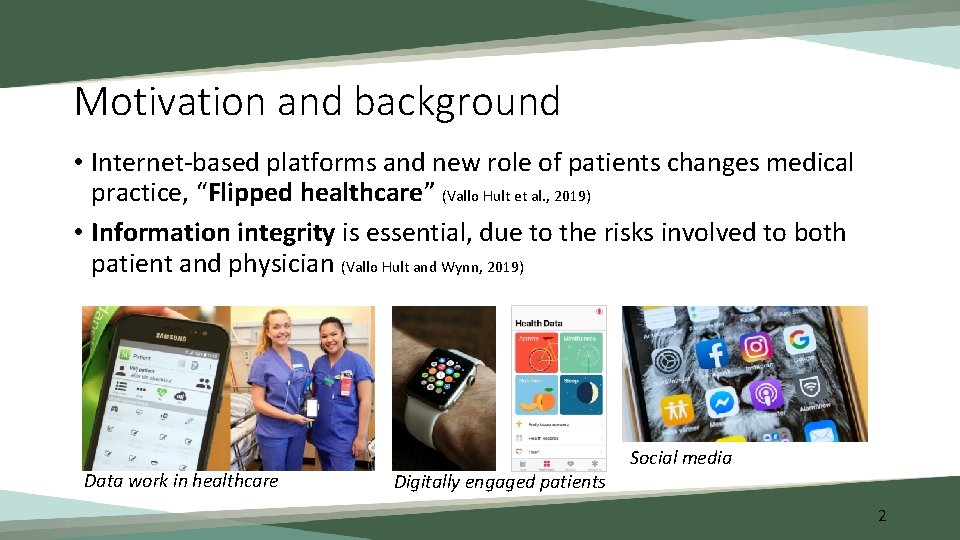
Motivation and background • Internet-based platforms and new role of patients changes medical practice, “Flipped healthcare” (Vallo Hult et al. , 2019) • Information integrity is essential, due to the risks involved to both patient and physician (Vallo Hult and Wynn, 2019) Data work in healthcare Digitally engaged patients Social media 2
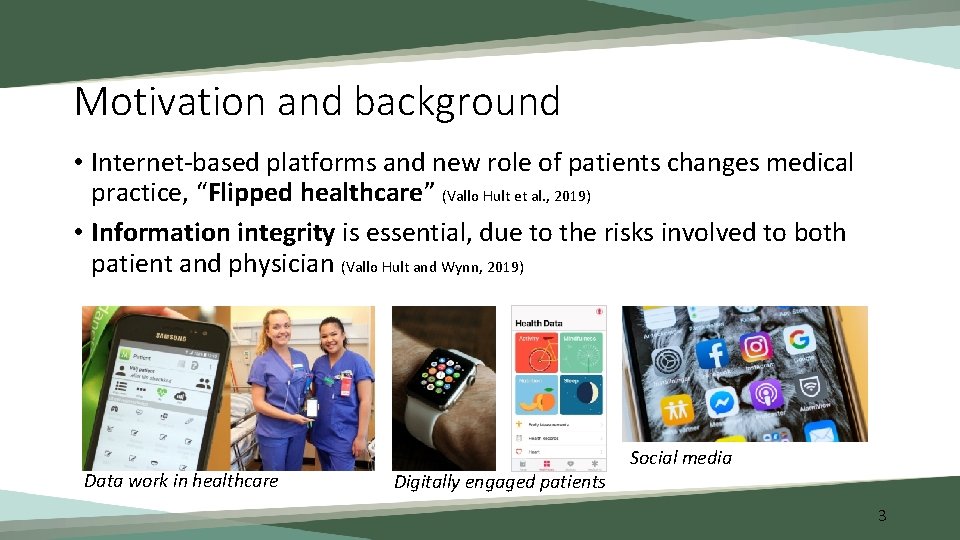
Motivation and background • Internet-based platforms and new role of patients changes medical practice, “Flipped healthcare” (Vallo Hult et al. , 2019) • Information integrity is essential, due to the risks involved to both patient and physician (Vallo Hult and Wynn, 2019) Data work in healthcare Digitally engaged patients Social media 3
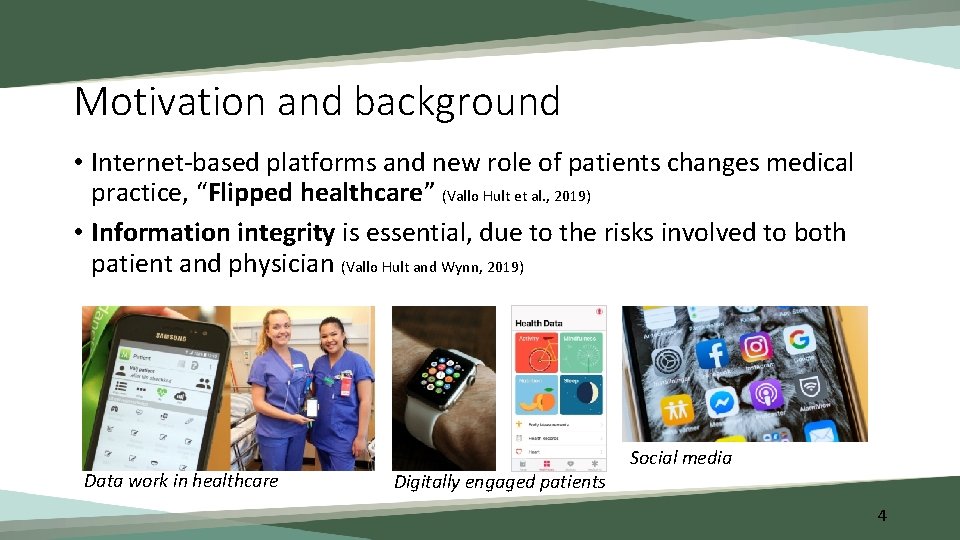
Motivation and background • Internet-based platforms and new role of patients changes medical practice, “Flipped healthcare” (Vallo Hult et al. , 2019) • Information integrity is essential, due to the risks involved to both patient and physician (Vallo Hult and Wynn, 2019) Data work in healthcare Digitally engaged patients Social media 4
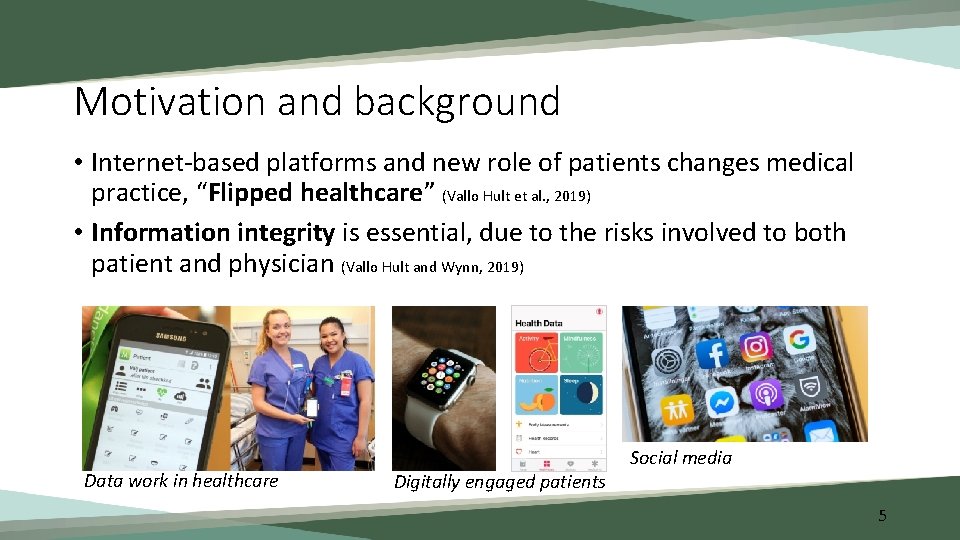
Motivation and background • Internet-based platforms and new role of patients changes medical practice, “Flipped healthcare” (Vallo Hult et al. , 2019) • Information integrity is essential, due to the risks involved to both patient and physician (Vallo Hult and Wynn, 2019) Data work in healthcare Digitally engaged patients Social media 5
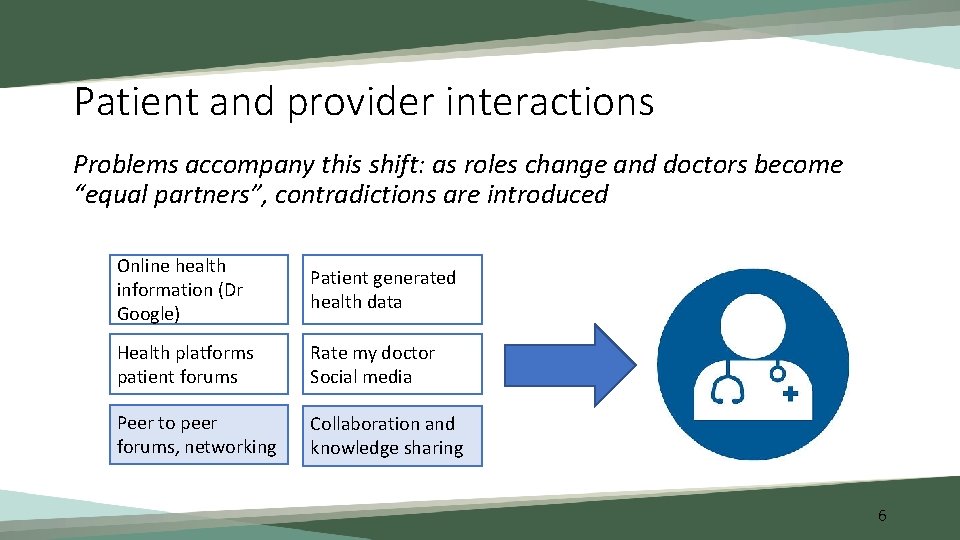
Patient and provider interactions Problems accompany this shift: as roles change and doctors become “equal partners”, contradictions are introduced Online health information (Dr Google) Patient generated health data Health platforms patient forums Rate my doctor Social media Peer to peer forums, networking Collaboration and knowledge sharing 6
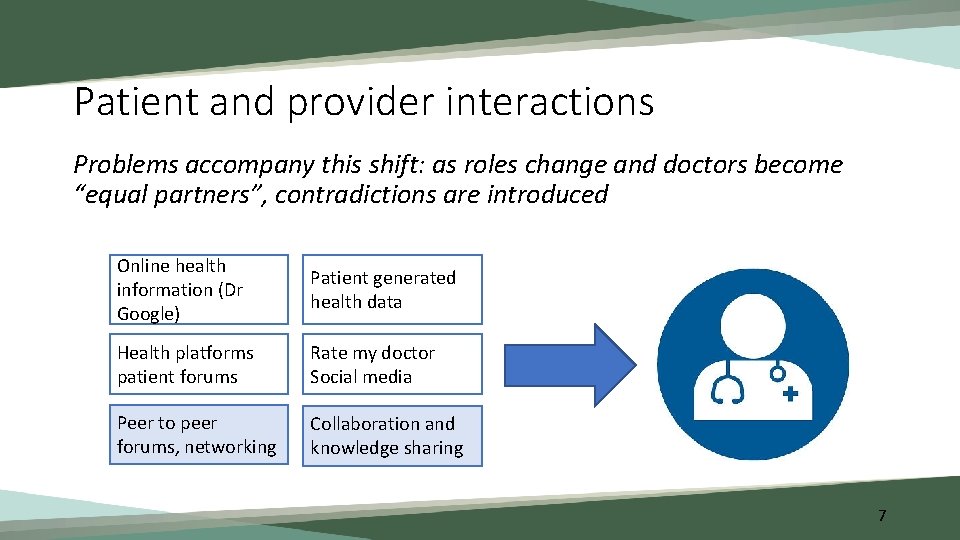
Patient and provider interactions Problems accompany this shift: as roles change and doctors become “equal partners”, contradictions are introduced Online health information (Dr Google) Patient generated health data Health platforms patient forums Rate my doctor Social media Peer to peer forums, networking Collaboration and knowledge sharing 7
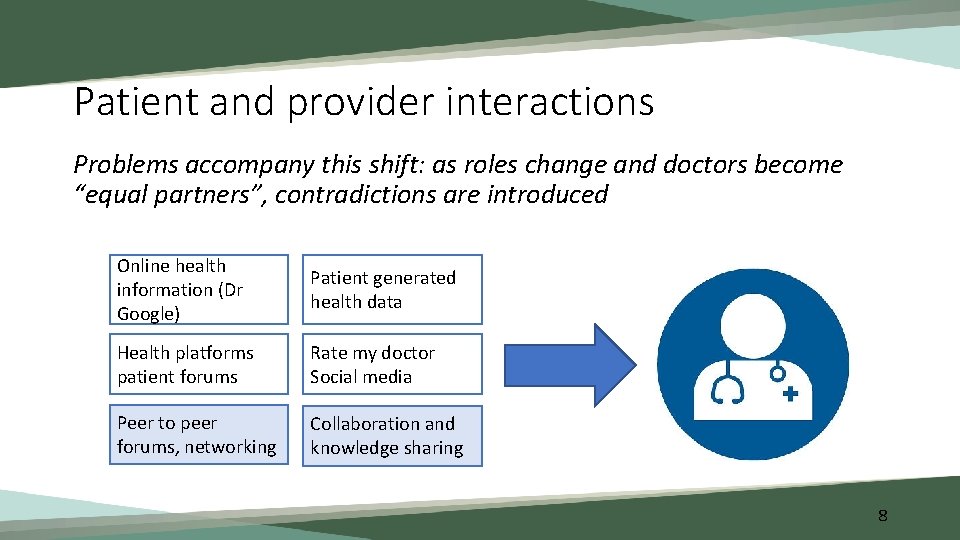
Patient and provider interactions Problems accompany this shift: as roles change and doctors become “equal partners”, contradictions are introduced Online health information (Dr Google) Patient generated health data Health platforms patient forums Rate my doctor Social media Peer to peer forums, networking Collaboration and knowledge sharing 8
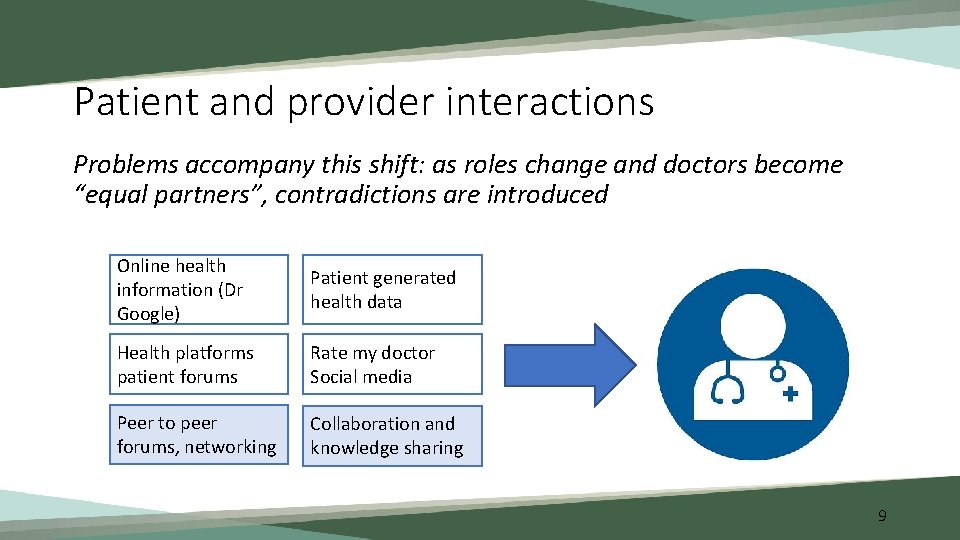
Patient and provider interactions Problems accompany this shift: as roles change and doctors become “equal partners”, contradictions are introduced Online health information (Dr Google) Patient generated health data Health platforms patient forums Rate my doctor Social media Peer to peer forums, networking Collaboration and knowledge sharing 9
Habermas’s notion of democratic dialogue • Apply Habermas’s (1962/1991) notion of democratic dialogue to design of systems, discourse styles for three domains: (political) system, life-world, public sphere • The system = state and its authority, top-down and closed. • Public sphere is the domain of political public discourse, arising in 1700 s Enlightenment, based on rationality and equality, or democratic dialogue. • Lifeworld is family and close friends and includes emotion, personal relations, and disclosures that stay within the group. • Power relations and logic different for each sphere • Control>rational exchange>bonding, respectively (Wynn & Vallo Hult, 2020). 10
Habermas’s notion of democratic dialogue • Apply Habermas’s (1962/1991) notion of democratic dialogue to design of systems, discourse styles for three domains: (political) system, life-world, public sphere • The system = state and its authority, top-down and closed. • Public sphere is the domain of political public discourse, arising in 1700 s Enlightenment, based on rationality and equality, or democratic dialogue. • Lifeworld is family and close friends and includes emotion, personal relations, and disclosures that stay within the group. • Power relations and logic different for each sphere • Control>rational exchange>bonding, respectively (Wynn & Vallo Hult, 2020). 11
Habermas’s notion of democratic dialogue • Apply Habermas’s (1962/1991) notion of democratic dialogue to design of systems, discourse styles for three domains: (political) system, life-world, public sphere • The system = state and its authority, top-down and closed. • Public sphere is the domain of political public discourse, arising in 1700 s Enlightenment, based on rationality and equality, or democratic dialogue. • Lifeworld is family and close friends and includes emotion, personal relations, and disclosures that stay within the group. • Power relations and logic different for each sphere • Control>rational exchange>bonding, respectively (Wynn & Vallo Hult, 2020). 12
Habermas’s notion of democratic dialogue • Apply Habermas’s (1962/1991) notion of democratic dialogue to design of systems, discourse styles for three domains: (political) system, life-world, public sphere • The system = state and its authority, top-down and closed. • Public sphere is the domain of political public discourse, arising in 1700 s Enlightenment, based on rationality and equality, or democratic dialogue. • Lifeworld is family and close friends and includes emotion, personal relations, and disclosures that stay within the group. • Power relations and logic different for each sphere • Control>rational exchange>bonding, respectively (Wynn & Vallo Hult, 2020). 13
Habermas’s notion of democratic dialogue • Apply Habermas’s (1962/1991) notion of democratic dialogue to design of systems, discourse styles for three domains: (political) system, life-world, public sphere • The system = state and its authority, top-down and closed. • Public sphere is the domain of political public discourse, arising in 1700 s Enlightenment, based on rationality and equality, or democratic dialogue. • Lifeworld is family and close friends and includes emotion, personal relations, and disclosures that stay within the group. • Power relations and logic different for each sphere • Control>rational exchange>bonding, respectively (Wynn & Vallo Hult, 2020). 14
Applying Critical Theory to Healthcare • Habermas’s concepts of system, lifeworld, and public sphere as a framework • System (controlled environment of formal medical records) • top-down • Life-world (unstructured, personal space of patient information & ideas from social media, Internet, and alternative practices) • Unvetted, can be irrational • Public Sphere (democratic dialogue bridging worlds with rational discourse)—not designed into socio-tech or healthcare systems as ongoing negotiated domain. (see also Taxen 2020) 15
Applying Critical Theory to Healthcare • Habermas’s concepts of system, lifeworld, and public sphere as a framework • System (controlled environment of formal medical records) • top-down • Life-world (unstructured, personal space of patient information & ideas from social media, Internet, and alternative practices) • Unvetted, can be irrational • Public Sphere (democratic dialogue bridging worlds with rational discourse)—not designed into socio-tech or healthcare systems as ongoing negotiated domain. (see also Taxen 2020) 16
Applying Critical Theory to Healthcare • Habermas’s concepts of system, lifeworld, and public sphere as a framework • System (controlled environment of formal medical records) • top-down • Life-world (unstructured, personal space of patient information & ideas from social media, Internet, and alternative practices) • Unvetted, can be irrational • Public Sphere (democratic dialogue bridging worlds with rational discourse)—not designed into socio-tech or healthcare systems as ongoing negotiated domain. (see also Taxen 2020) 17
Applying Critical Theory to Healthcare • Habermas’s concepts of system, lifeworld, and public sphere as a framework • System (controlled environment of formal medical records) • top-down • Life-world (unstructured, personal space of patient information & ideas from social media, Internet, and alternative practices) • Unvetted, can be irrational • Public Sphere (democratic dialogue bridging worlds with rational discourse)—not designed into socio-tech or healthcare systems as ongoing negotiated domain. (see also Taxen 2020) 18
Applying Critical Theory to Healthcare • Habermas’s concepts of system, lifeworld, and public sphere as a framework • System (controlled environment of formal medical records) • top-down • Life-world (unstructured, personal space of patient information & ideas from social media, Internet, and alternative practices) • Unvetted, can be irrational • Public Sphere (democratic dialogue bridging worlds with rational discourse)—not designed into socio-tech or healthcare systems as ongoing negotiated domain. (see also Taxen 2020) 19
Applying Critical Theory to Healthcare • Habermas’s concepts of system, lifeworld, and public sphere as a framework • System (controlled environment of formal medical records) • top-down • Life-world (unstructured, personal space of patient information & ideas from social media, Internet, and alternative practices) • Unvetted, can be irrational • Public Sphere (democratic dialogue bridging worlds with rational discourse)—not designed into socio-tech or healthcare systems as ongoing negotiated domain. (see also Taxen 2020) 20
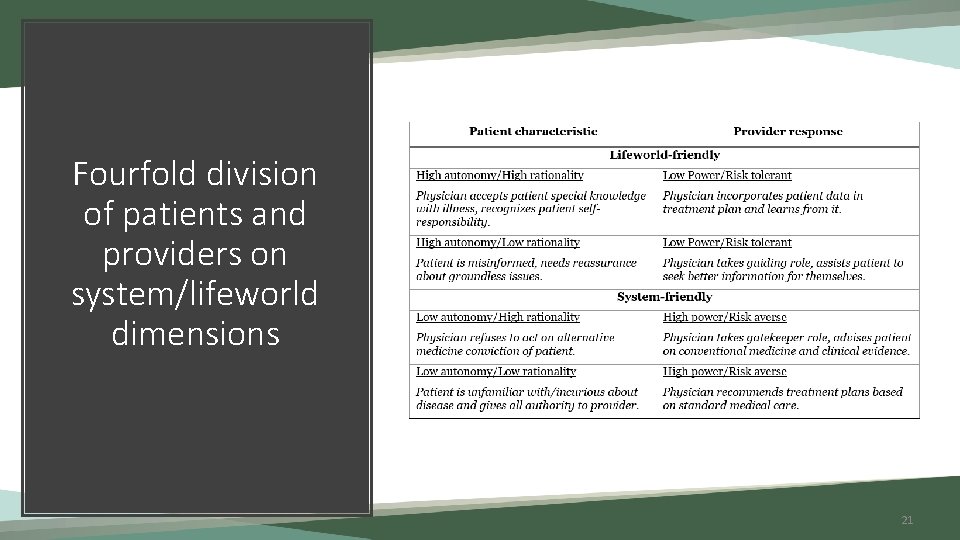
Fourfold division of patients and providers on system/lifeworld dimensions 21
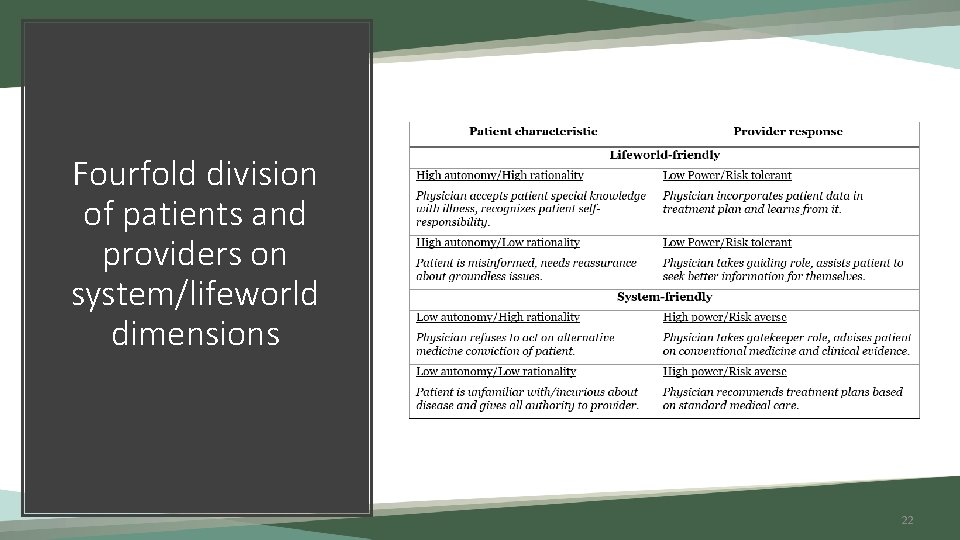
Fourfold division of patients and providers on system/lifeworld dimensions 22
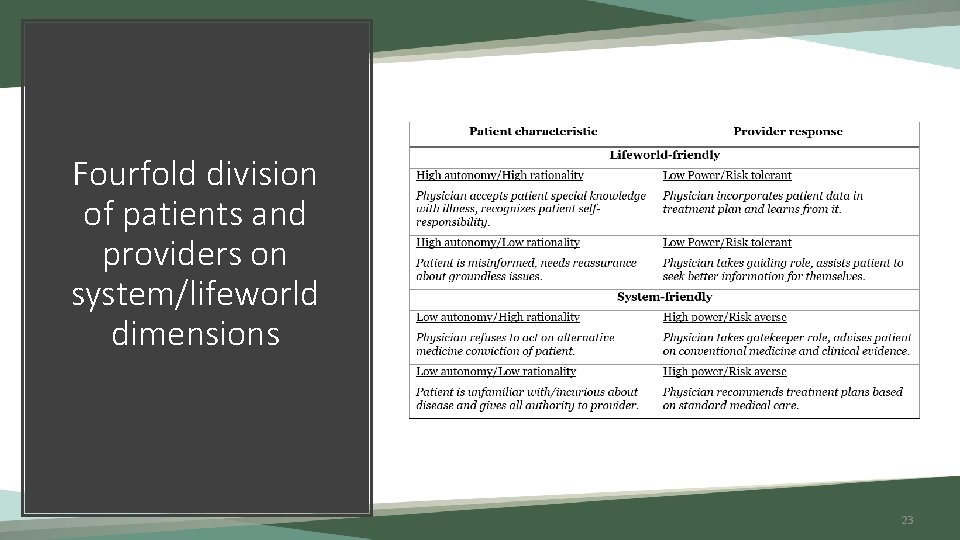
Fourfold division of patients and providers on system/lifeworld dimensions 23
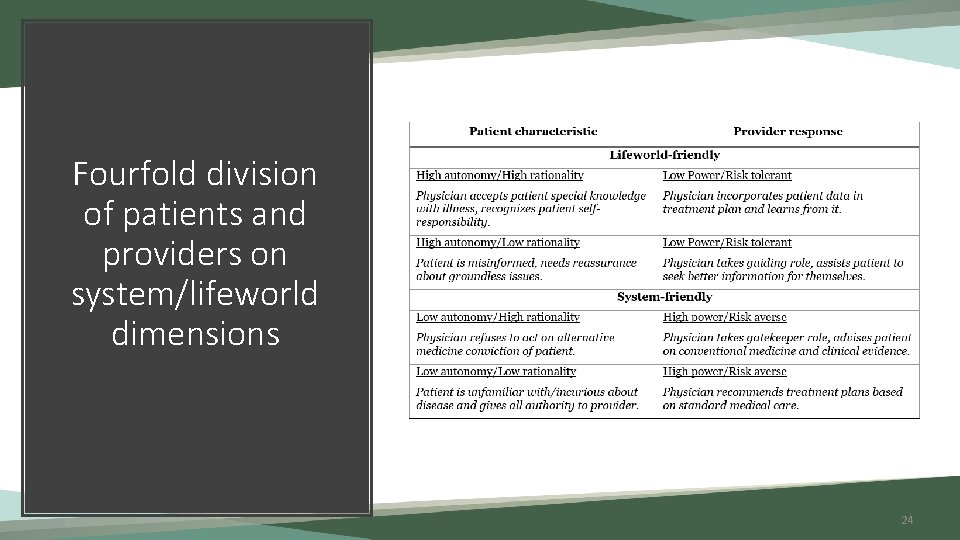
Fourfold division of patients and providers on system/lifeworld dimensions 24
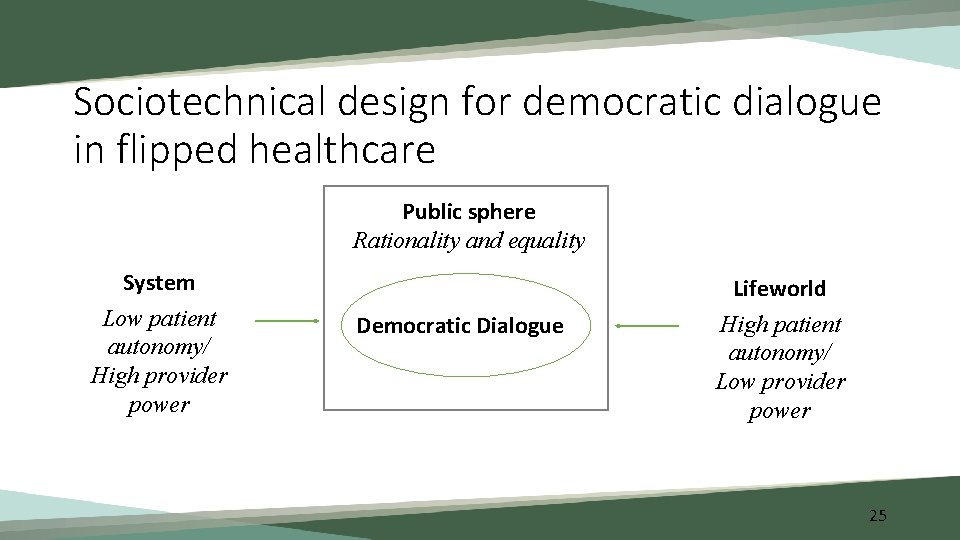
Sociotechnical design for democratic dialogue in flipped healthcare Public sphere Rationality and equality System Low patient autonomy/ High provider power Democratic Dialogue Lifeworld High patient autonomy/ Low provider power 25
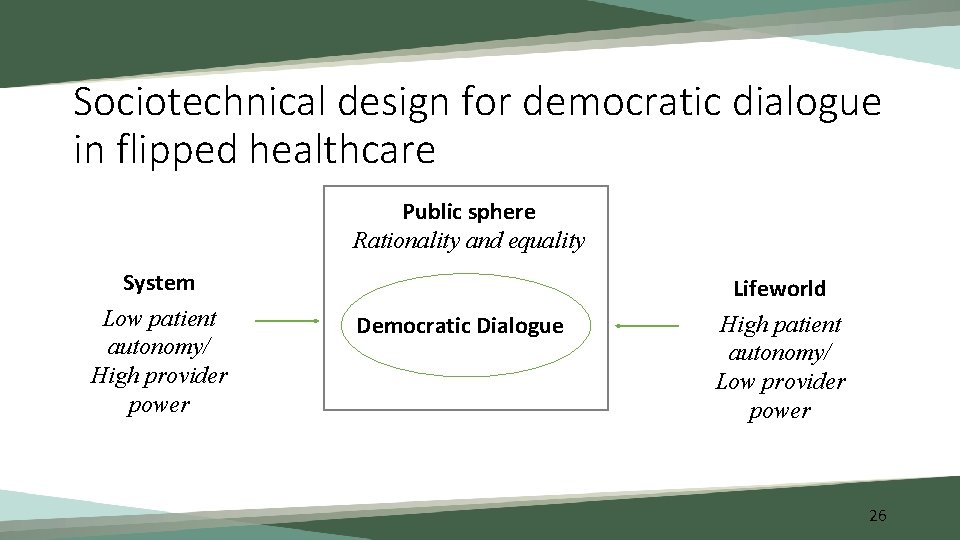
Sociotechnical design for democratic dialogue in flipped healthcare Public sphere Rationality and equality System Low patient autonomy/ High provider power Democratic Dialogue Lifeworld High patient autonomy/ Low provider power 26
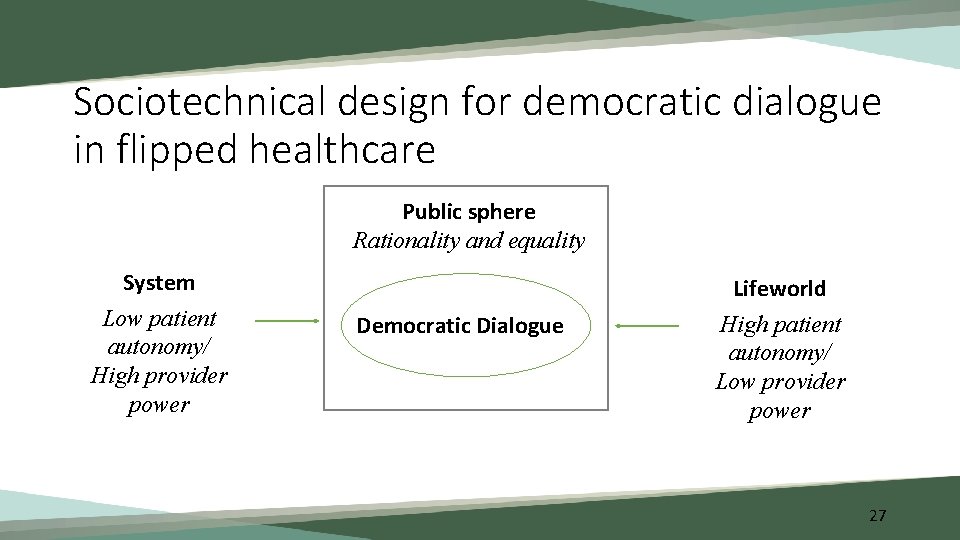
Sociotechnical design for democratic dialogue in flipped healthcare Public sphere Rationality and equality System Low patient autonomy/ High provider power Democratic Dialogue Lifeworld High patient autonomy/ Low provider power 27
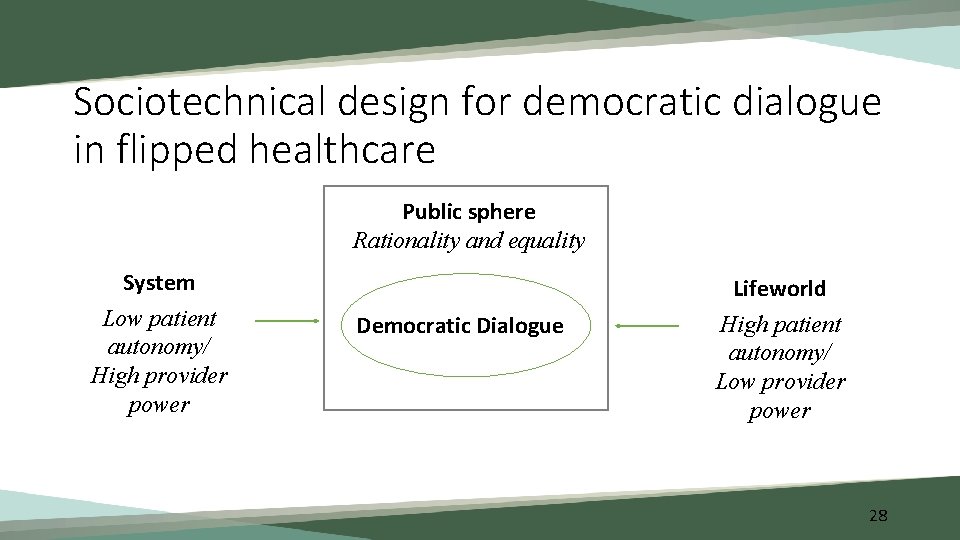
Sociotechnical design for democratic dialogue in flipped healthcare Public sphere Rationality and equality System Low patient autonomy/ High provider power Democratic Dialogue Lifeworld High patient autonomy/ Low provider power 28
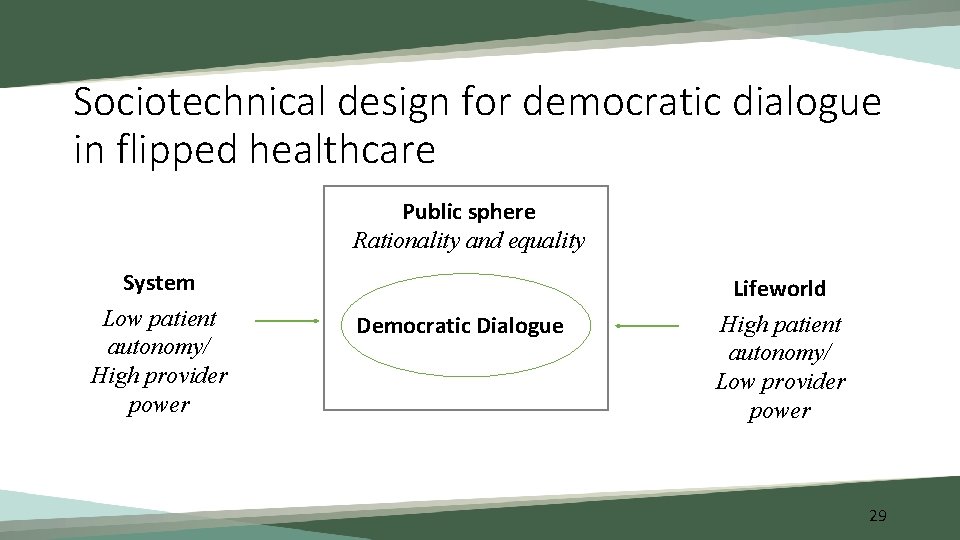
Sociotechnical design for democratic dialogue in flipped healthcare Public sphere Rationality and equality System Low patient autonomy/ High provider power Democratic Dialogue Lifeworld High patient autonomy/ Low provider power 29
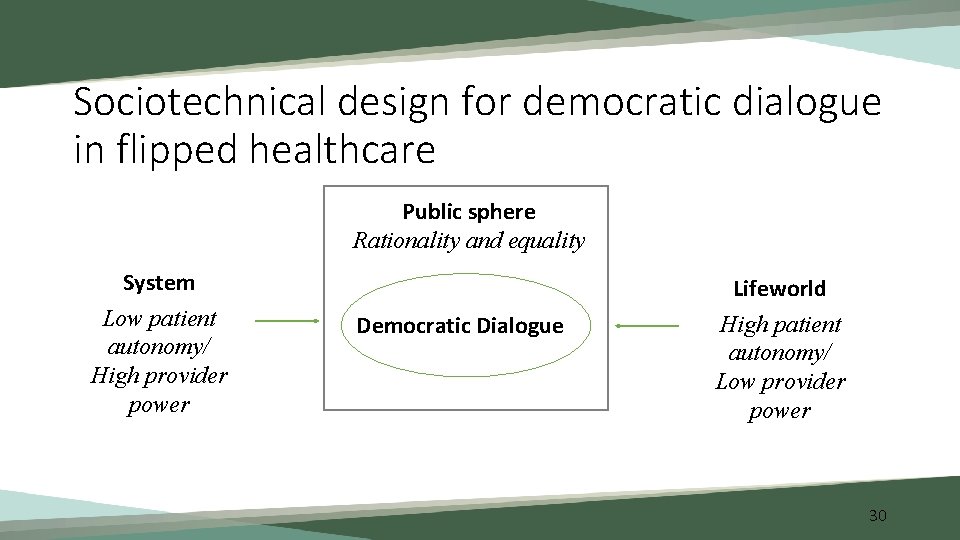
Sociotechnical design for democratic dialogue in flipped healthcare Public sphere Rationality and equality System Low patient autonomy/ High provider power Democratic Dialogue Lifeworld High patient autonomy/ Low provider power 30

Thank you! Questions and discussion 31
- Slides: 31