
Plate Tectonics Rock Theory of Plate Tectonics A
- Slides: 10
Plate Tectonics Rock!!!
Theory of Plate Tectonics A rigid slab of solid rock is called a plate. Tectonics is a Greek word meaning “to build”. The theory of plate tectonics states that the lithosphere is broken into several plates that are moving relative to one another as they ride on top of hotter, more mobile material known as the asthenosphere.
How Does Plate Tectonics Work? • The plates ride on top of the asthenosphere due to the fact that the elements of the rock in the lithosphere are less dense than the elements of the rock in the ductile asthenosphere. • These plates have different types of boundaries with each other and each type of boundary has different characteristics.
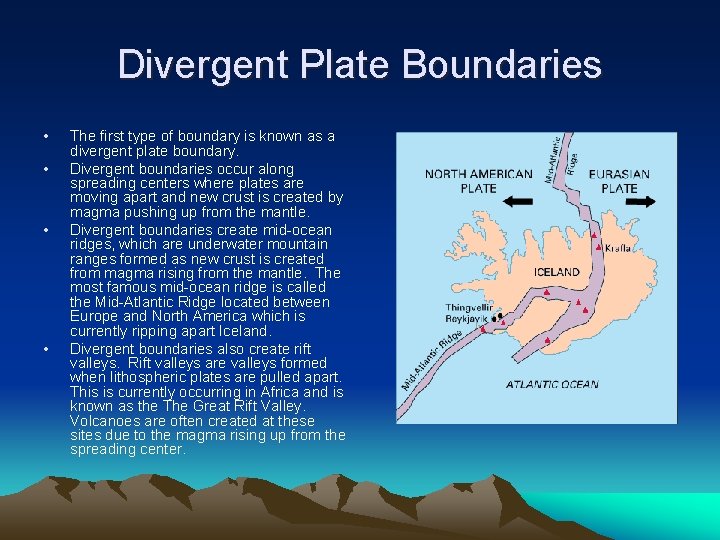
Divergent Plate Boundaries • • The first type of boundary is known as a divergent plate boundary. Divergent boundaries occur along spreading centers where plates are moving apart and new crust is created by magma pushing up from the mantle. Divergent boundaries create mid-ocean ridges, which are underwater mountain ranges formed as new crust is created from magma rising from the mantle. The most famous mid-ocean ridge is called the Mid-Atlantic Ridge located between Europe and North America which is currently ripping apart Iceland. Divergent boundaries also create rift valleys. Rift valleys are valleys formed when lithospheric plates are pulled apart. This is currently occurring in Africa and is known as the The Great Rift Valley. Volcanoes are often created at these sites due to the magma rising up from the spreading center.
Convergent Plate Boundaries • Convergent boundaries, the next type of plate boundary, is where crust destruction occurs. This is where two plates collide together. • There are three different types of convergent boundaries. They are called oceanic-continental convergence, oceanic-oceanic convergence and continental-continental convergence. Different processes occur at each of these convergent settings.
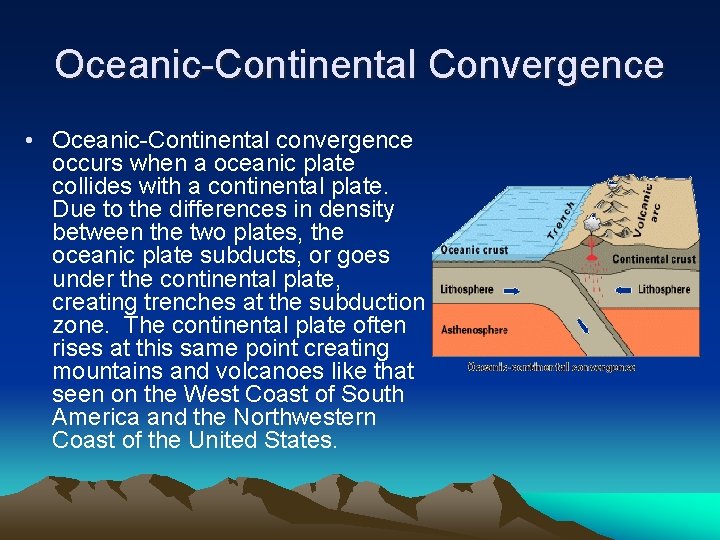
Oceanic-Continental Convergence • Oceanic-Continental convergence occurs when a oceanic plate collides with a continental plate. Due to the differences in density between the two plates, the oceanic plate subducts, or goes under the continental plate, creating trenches at the subduction zone. The continental plate often rises at this same point creating mountains and volcanoes like that seen on the West Coast of South America and the Northwestern Coast of the United States.
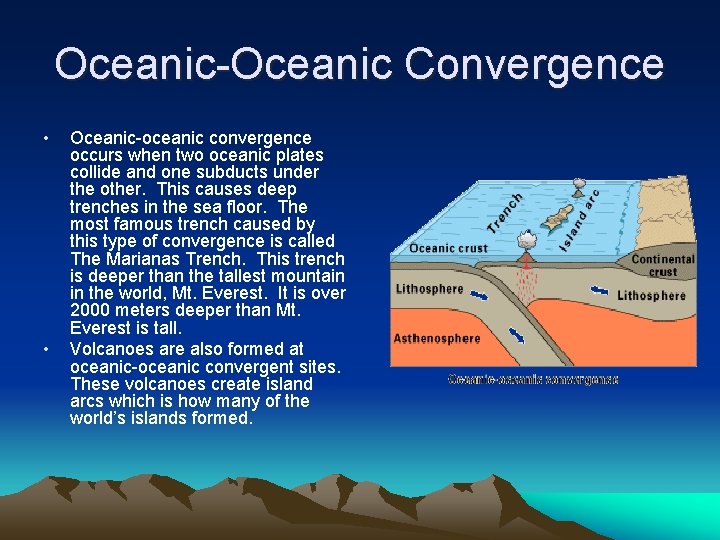
Oceanic-Oceanic Convergence • • Oceanic-oceanic convergence occurs when two oceanic plates collide and one subducts under the other. This causes deep trenches in the sea floor. The most famous trench caused by this type of convergence is called The Marianas Trench. This trench is deeper than the tallest mountain in the world, Mt. Everest. It is over 2000 meters deeper than Mt. Everest is tall. Volcanoes are also formed at oceanic-oceanic convergent sites. These volcanoes create island arcs which is how many of the world’s islands formed.
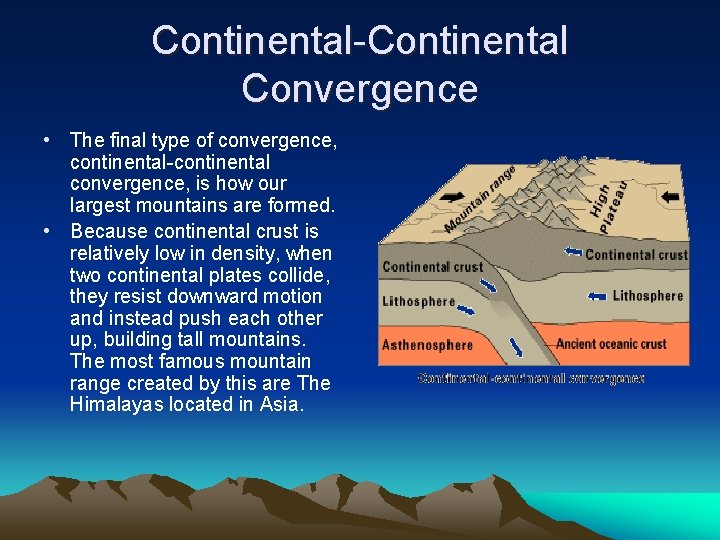
Continental-Continental Convergence • The final type of convergence, continental-continental convergence, is how our largest mountains are formed. • Because continental crust is relatively low in density, when two continental plates collide, they resist downward motion and instead push each other up, building tall mountains. The most famous mountain range created by this are The Himalayas located in Asia.
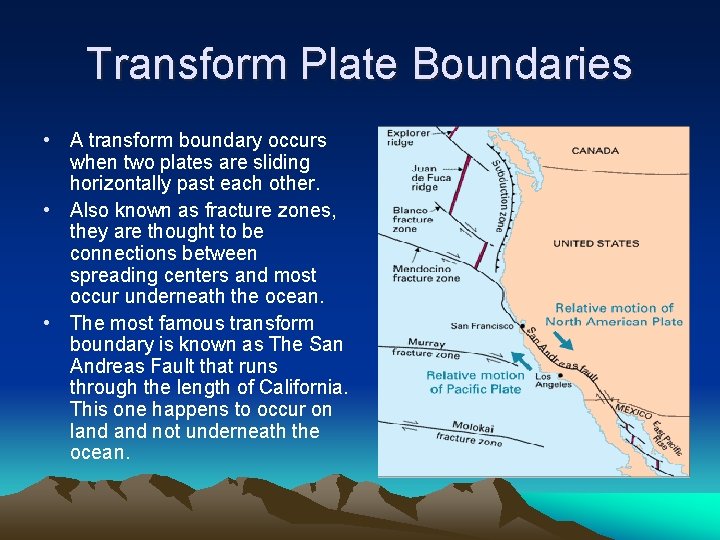
Transform Plate Boundaries • A transform boundary occurs when two plates are sliding horizontally past each other. • Also known as fracture zones, they are thought to be connections between spreading centers and most occur underneath the ocean. • The most famous transform boundary is known as The San Andreas Fault that runs through the length of California. This one happens to occur on land not underneath the ocean.
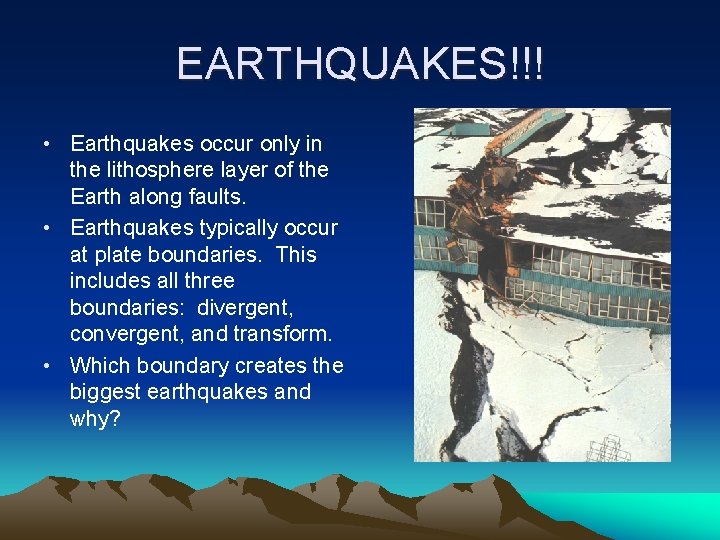
EARTHQUAKES!!! • Earthquakes occur only in the lithosphere layer of the Earth along faults. • Earthquakes typically occur at plate boundaries. This includes all three boundaries: divergent, convergent, and transform. • Which boundary creates the biggest earthquakes and why?