
Plate Tectonics Greg Donitzen Middle School Plate Tectonics
- Slides: 12
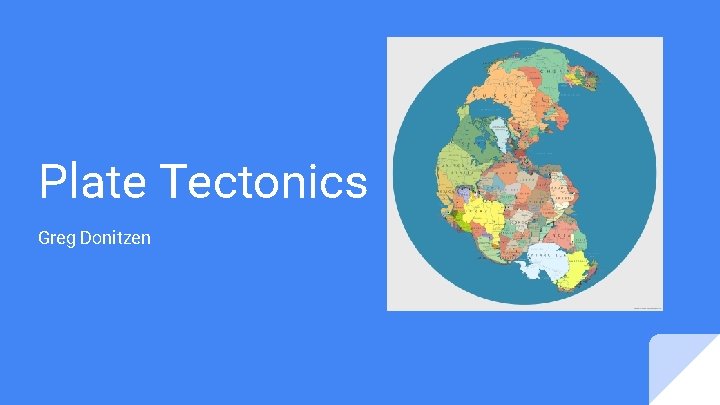
Plate Tectonics Greg Donitzen
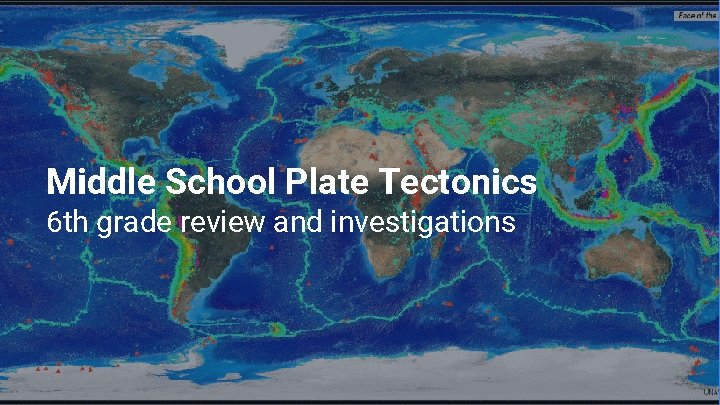
Middle School Plate Tectonics 6 th grade review and investigations
NGSS Alignment Practices Analyzing and Interpreting Data (Lessons 1 & 2) Constructing Explanations and Designing Solutions (Lesson 2) Scientific Knowledge is Open to Revision Core Ideas Cross Cutting Concepts ESS 1. C: The History of Planet Earth Scale, Proportion, and Quantity The geologic time scale interpreted from rock strata provides a way to organize Earth’s history. Analyses of rock strata and the fossil record provide only relative dates, not an absolute scale. Time, space, and energy phenomena can be observed at various scales using models to study systems that are too large or too small. Tectonic processes continually generate new ocean sea floor at ridges and destroy old sea floor at trenches. ESS 2. B: Plate Tectonics and Large-Scale System Interactions Maps of ancient land water patterns, based on investigations of rocks and fossils, make clear how Earth’s plates have moved great distances, collided and spread apart.
1) Students will be able to observe the occurrences of fossils to prove theory of Pangaea. 2) Students will be able to model the movement of plates over a period of time. The Objectives 3) Students will be able to analyze different layers of the Earth and how they are connected. 4) Students will be able to apply new knowledge to explain how plate tectonics movement affects us. 5) Students will be able to discuss theory of Pangaea and its validity. 6) Students will be able to make predictions about the future of the plate movements.
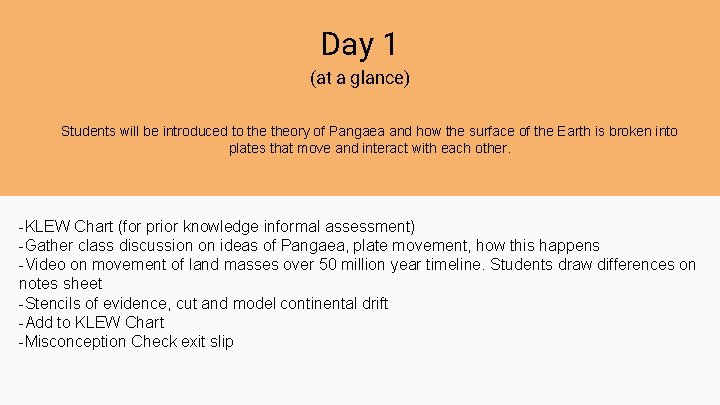
Day 1 (at a glance) Students will be introduced to theory of Pangaea and how the surface of the Earth is broken into plates that move and interact with each other. -KLEW Chart (for prior knowledge informal assessment) -Gather class discussion on ideas of Pangaea, plate movement, how this happens -Video on movement of land masses over 50 million year timeline. Students draw differences on notes sheet -Stencils of evidence, cut and model continental drift -Add to KLEW Chart -Misconception Check exit slip
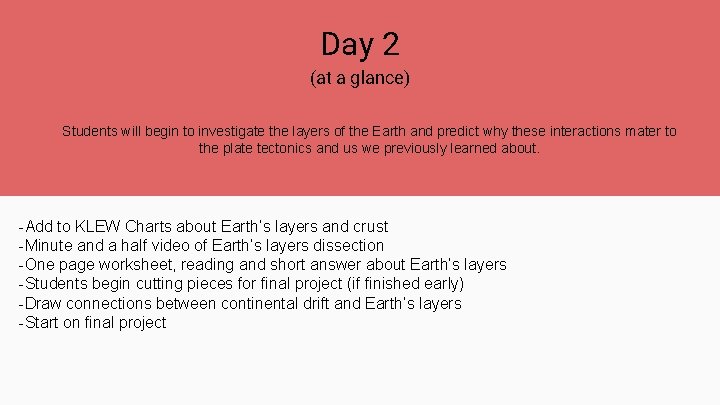
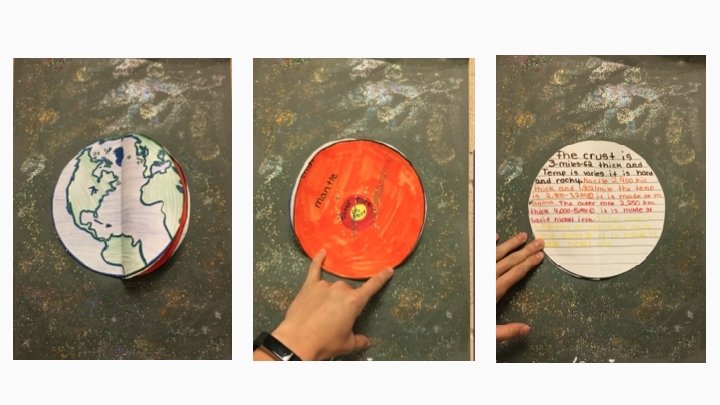
Day 2 (at a glance) Students will begin to investigate the layers of the Earth and predict why these interactions mater to the plate tectonics and us we previously learned about. -Add to KLEW Charts about Earth’s layers and crust -Minute and a half video of Earth’s layers dissection -One page worksheet, reading and short answer about Earth’s layers -Students begin cutting pieces for final project (if finished early) -Draw connections between continental drift and Earth’s layers -Start on final project
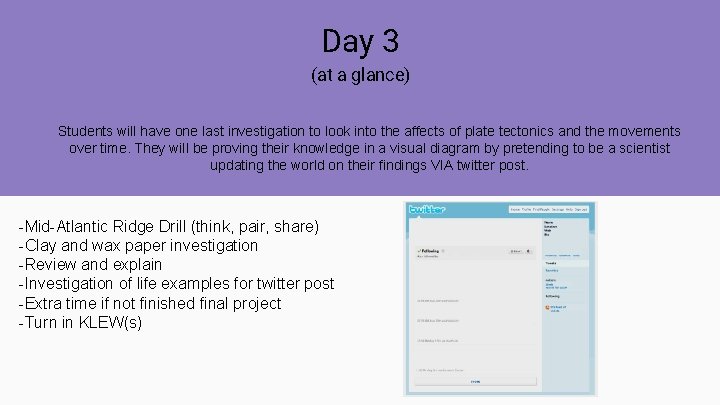
Day 3 (at a glance) Students will have one last investigation to look into the affects of plate tectonics and the movements over time. They will be proving their knowledge in a visual diagram by pretending to be a scientist updating the world on their findings VIA twitter post. -Mid-Atlantic Ridge Drill (think, pair, share) -Clay and wax paper investigation -Review and explain -Investigation of life examples for twitter post -Extra time if not finished final project -Turn in KLEW(s)
Challenges While Creating - Focusing on objective alignment rather than engaging activities Remembering to revisit the NGSS connections Drawing the line between what should be prior knowledge and what you should elaborate on
New Things - Plan backwards from goal - Importance of tracking sources - Constructing and connecting assessments
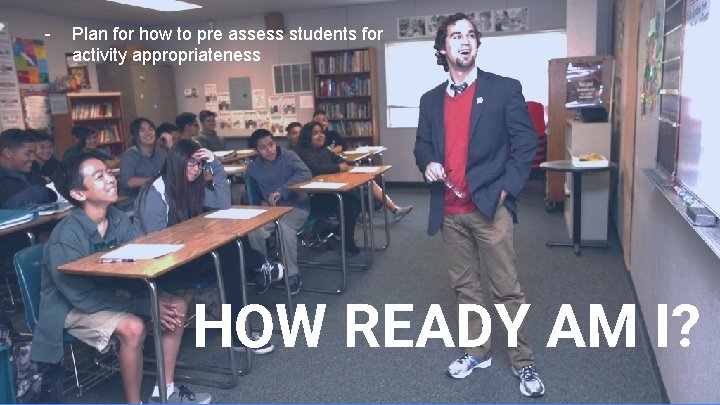
- Plan for how to pre assess students for activity appropriateness HOW READY AM I?
Final Questions 1) Adjustments for GT or lower level? 2) Additional explanations? 3) Where could I add more technology or resources?