
Plate Tectonics and Earth Structure Lab 4 Concepts
Plate Tectonics and Earth Structure Lab 4
Concepts n Internal Structure of the Earth n n n Plate Tectonics n n n Theory Evidence of Continental Drift Plate Movement n n 3 components (core, mantle, crust) Seismic tomography Convergence Divergence Transform Hot Spots
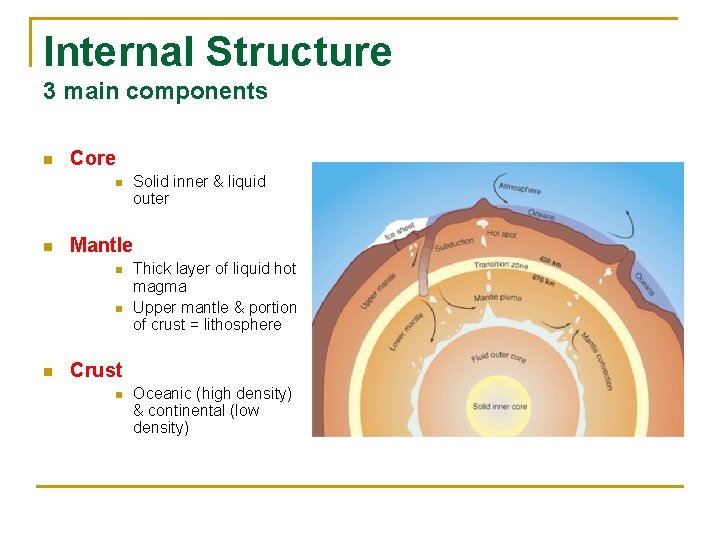
Internal Structure 3 main components n Core n n Mantle n n n Solid inner & liquid outer Thick layer of liquid hot magma Upper mantle & portion of crust = lithosphere Crust n Oceanic (high density) & continental (low density)
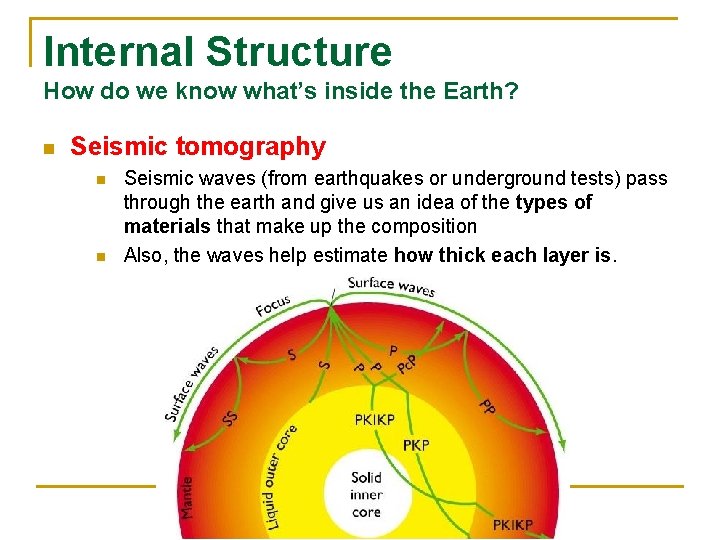
Internal Structure How do we know what’s inside the Earth? n Seismic tomography n n Seismic waves (from earthquakes or underground tests) pass through the earth and give us an idea of the types of materials that make up the composition Also, the waves help estimate how thick each layer is.
Plate Tectonics Fact or Fiction? n Theory: Earth’s crust is composed of numerous plates, which move due to convection processes in the mantle. n Idea developed in early 1900 s, not taken seriously until 1960 s. n n Alfred Wegener proposed the idea of “continental drift” in 1912. Evidence of continental drift 1. 2. 3. 4. 5. Convection Model (explains how plates move around) “Puzzle”-like fit of continents Fossil records Geologic & Glacial records Coal records
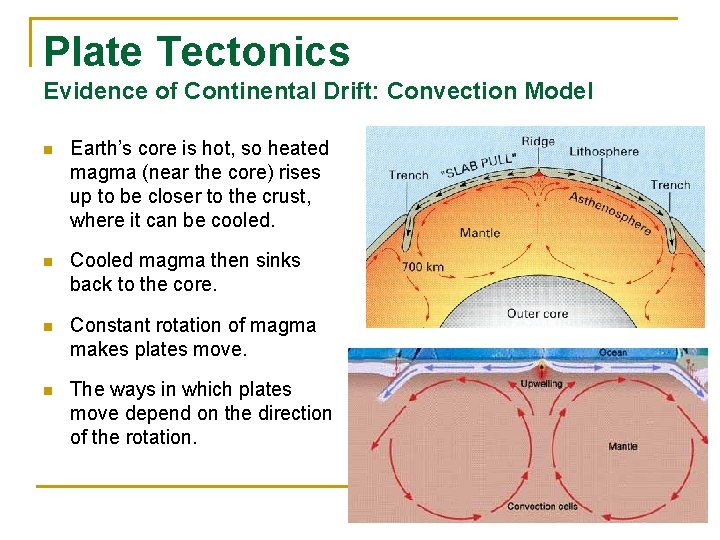
Plate Tectonics Evidence of Continental Drift: Convection Model n Earth’s core is hot, so heated magma (near the core) rises up to be closer to the crust, where it can be cooled. n Cooled magma then sinks back to the core. n Constant rotation of magma makes plates move. n The ways in which plates move depend on the direction of the rotation.
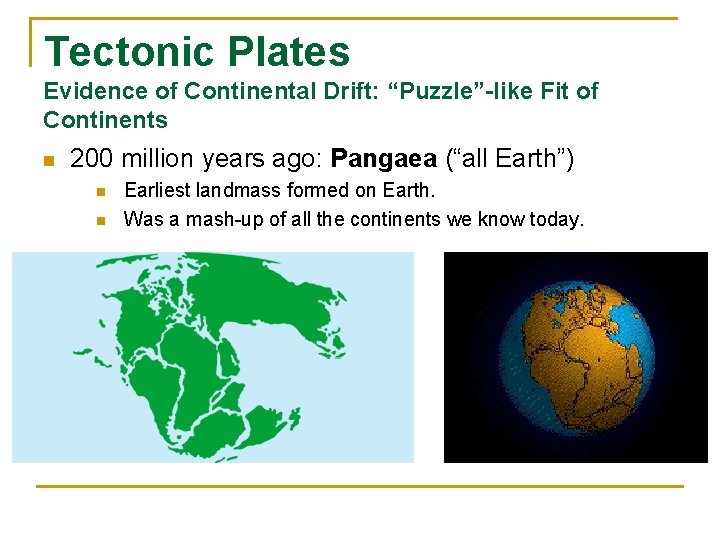
Tectonic Plates Evidence of Continental Drift: “Puzzle”-like Fit of Continents n 200 million years ago: Pangaea (“all Earth”) n n Earliest landmass formed on Earth. Was a mash-up of all the continents we know today.
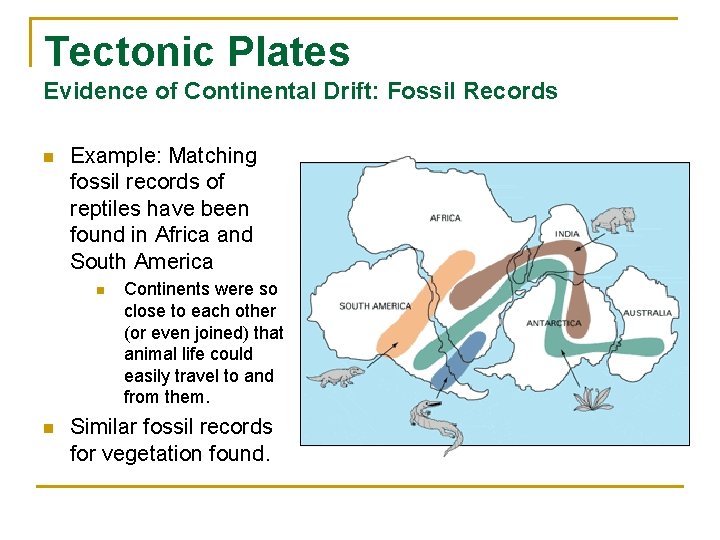
Tectonic Plates Evidence of Continental Drift: Fossil Records n Example: Matching fossil records of reptiles have been found in Africa and South America n n Continents were so close to each other (or even joined) that animal life could easily travel to and from them. Similar fossil records for vegetation found.
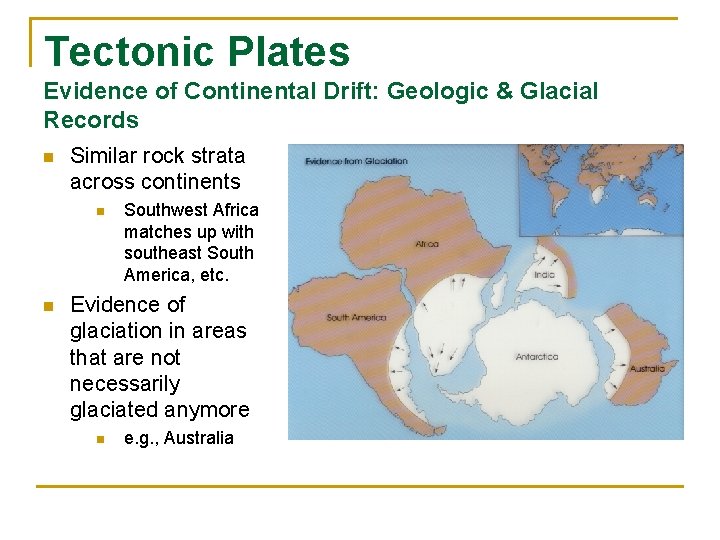
Tectonic Plates Evidence of Continental Drift: Geologic & Glacial Records n Similar rock strata across continents n n Southwest Africa matches up with southeast South America, etc. Evidence of glaciation in areas that are not necessarily glaciated anymore n e. g. , Australia
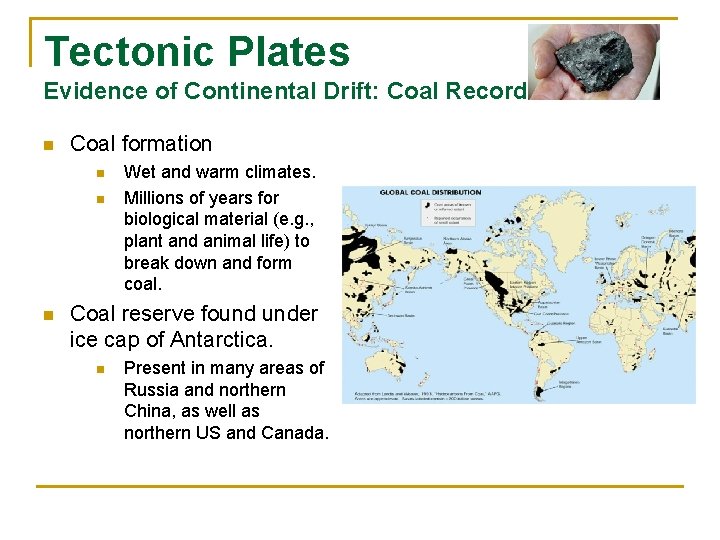
Tectonic Plates Evidence of Continental Drift: Coal Records n Coal formation n Wet and warm climates. Millions of years for biological material (e. g. , plant and animal life) to break down and form coal. Coal reserve found under ice cap of Antarctica. n Present in many areas of Russia and northern China, as well as northern US and Canada.
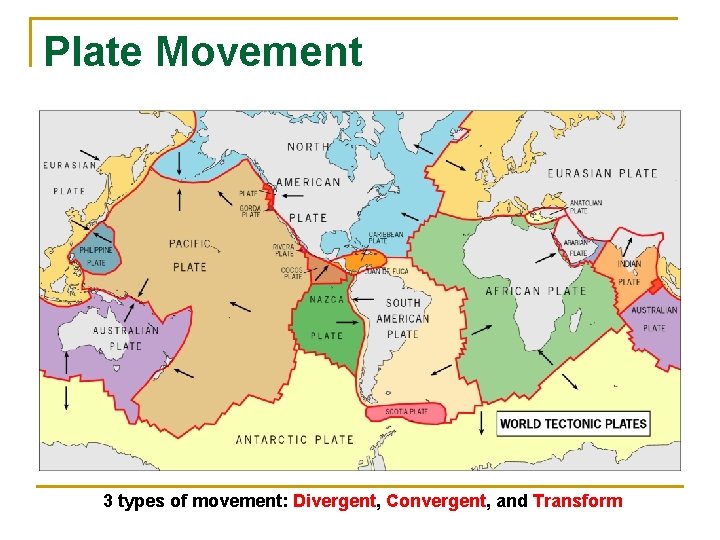
Plate Movement 3 types of movement: Divergent, Convergent, and Transform
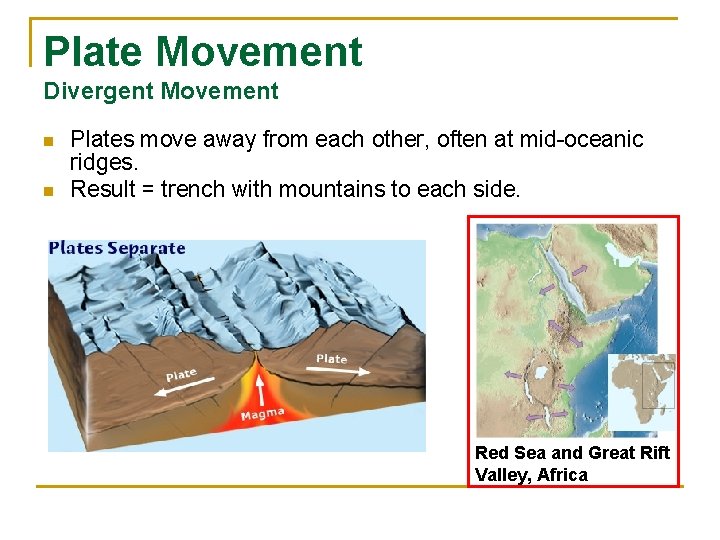
Plate Movement Divergent Movement n n Plates move away from each other, often at mid-oceanic ridges. Result = trench with mountains to each side. Red Sea and Great Rift Valley, Africa
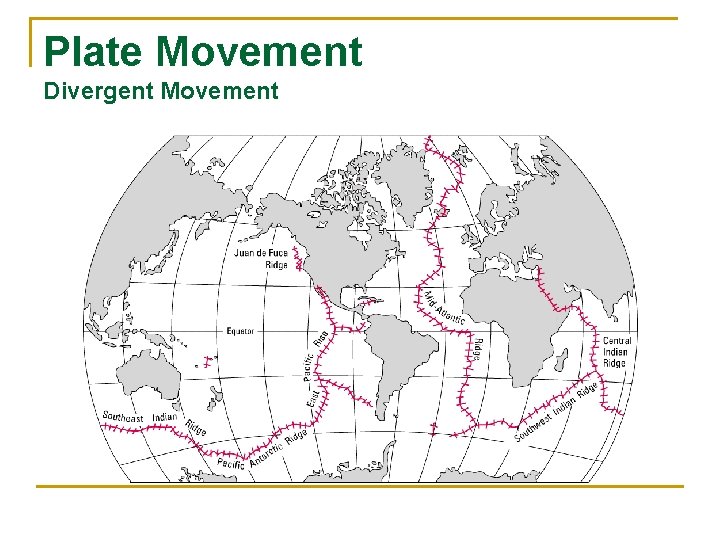
Plate Movement Divergent Movement
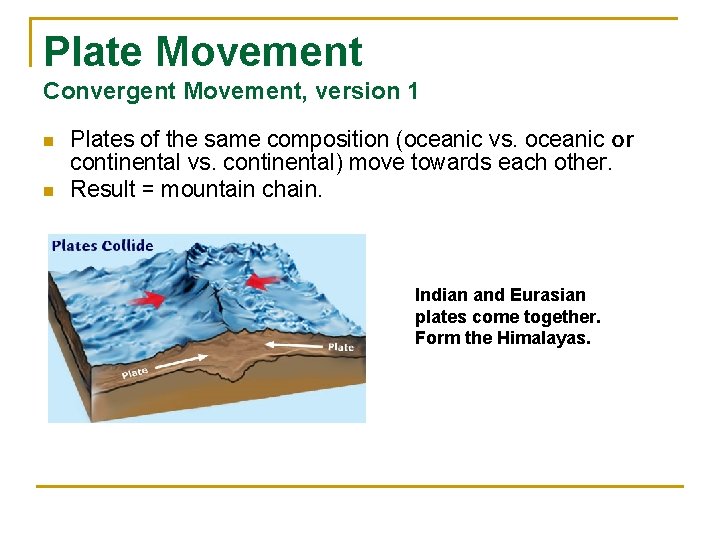
Plate Movement Convergent Movement, version 1 n n Plates of the same composition (oceanic vs. oceanic or continental vs. continental) move towards each other. Result = mountain chain. Indian and Eurasian plates come together. Form the Himalayas.
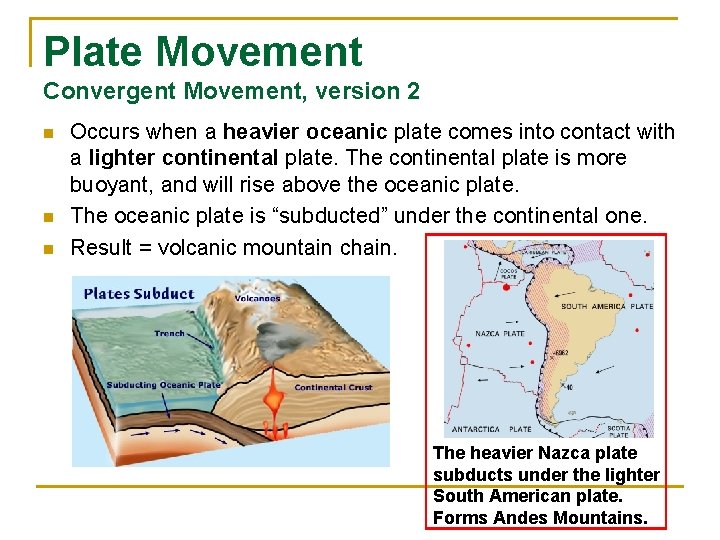
Plate Movement Convergent Movement, version 2 n n n Occurs when a heavier oceanic plate comes into contact with a lighter continental plate. The continental plate is more buoyant, and will rise above the oceanic plate. The oceanic plate is “subducted” under the continental one. Result = volcanic mountain chain. The heavier Nazca plate subducts under the lighter South American plate. Forms Andes Mountains.
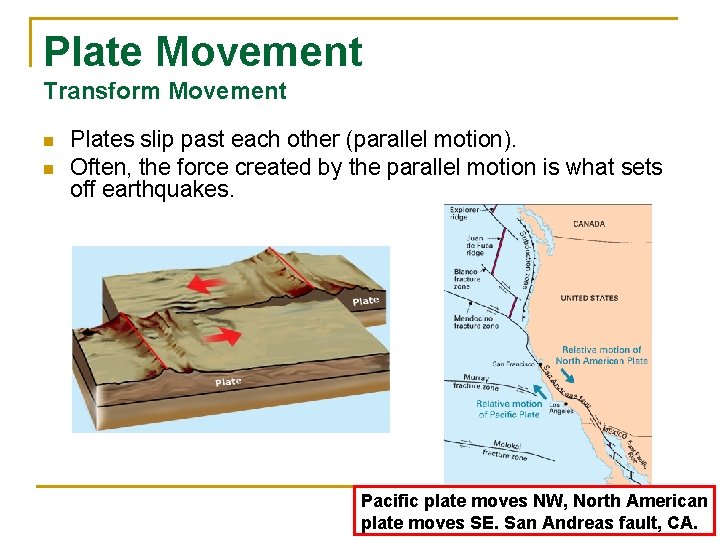
Plate Movement Transform Movement n n Plates slip past each other (parallel motion). Often, the force created by the parallel motion is what sets off earthquakes. Pacific plate moves NW, North American plate moves SE. San Andreas fault, CA.
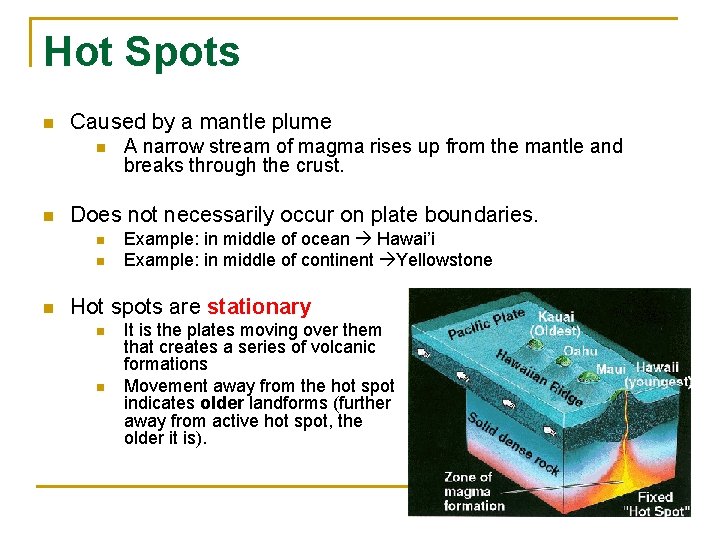
Hot Spots n Caused by a mantle plume n n Does not necessarily occur on plate boundaries. n n n A narrow stream of magma rises up from the mantle and breaks through the crust. Example: in middle of ocean Hawai’i Example: in middle of continent Yellowstone Hot spots are stationary n n It is the plates moving over them that creates a series of volcanic formations Movement away from the hot spot indicates older landforms (further away from active hot spot, the older it is).
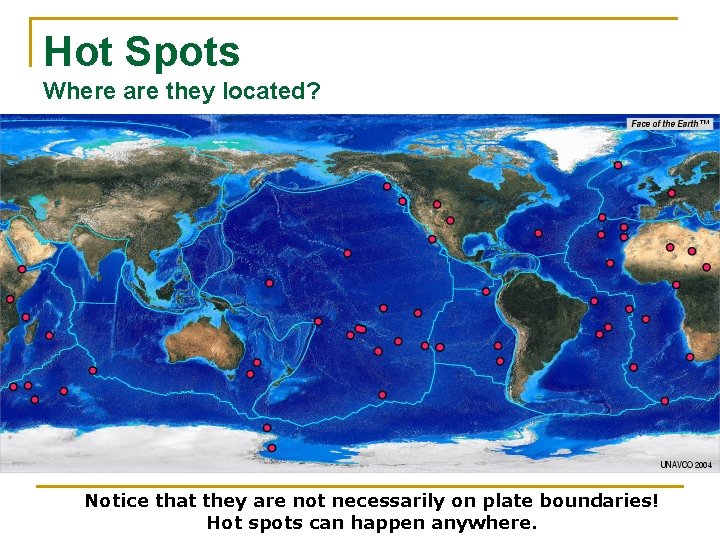
Hot Spots Where are they located? Notice that they are not necessarily on plate boundaries! Hot spots can happen anywhere.
![Hot Spots Hawai’i: X marks the [active hot] spot x “X” marks the current](http://slidetodoc.com/presentation_image_h2/e04272d437f08743e009ddacd1601f91/image-19.jpg "Hot Spots Hawai’i: X marks the [active hot] spot x “X” marks the current")
Hot Spots Hawai’i: X marks the [active hot] spot x “X” marks the current location of the Hawai’ian hot spot. It is creating a new landform, “Lo’ihi”, which is still 3, 200 feet below the water surface.
- Slides: 19