
Plate Motion Lesson 1 2 a Introduction to
- Slides: 25
Plate Motion Lesson 1. 2 a - Introduction to Plate Motion
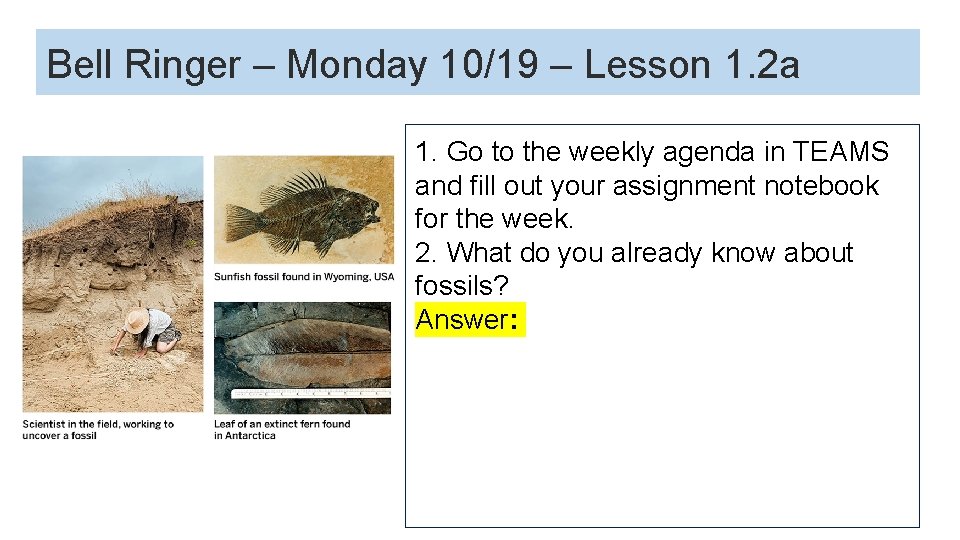
Bell Ringer – Monday 10/19 – Lesson 1. 2 a 1. Go to the weekly agenda in TEAMS and fill out your assignment notebook for the week. 2. What do you already know about fossils? Answer:
Agenda 1 Bell Ringer 2 Introduction to Unit 2: Plate Motion • Meet a Paleontologist • Your role in this unit • What phenomenon are we trying to explain? - Unit Question 3 4 Chapter 1 Question Exit Ticket
Objectives CONTENT OBJECTIVE: I CAN DESCRIBE MY ROLE AS A SCIENTIST IN THE PLATE MOTION UNIT. LANGUAGE OBJECTIVE: I CAN RECORD IN WRITING MY INITIAL EXPLANATION OF THE UNIT PHENOMENON.
Read this! Checklist. . . what needs to completed by end of the lesson üPM - Lesson 1. 2 a Power. Point (Answer each prompt in this ppt and “Turn in” in Teams) üUnit Question & Chapter Question recorded in science notebook.
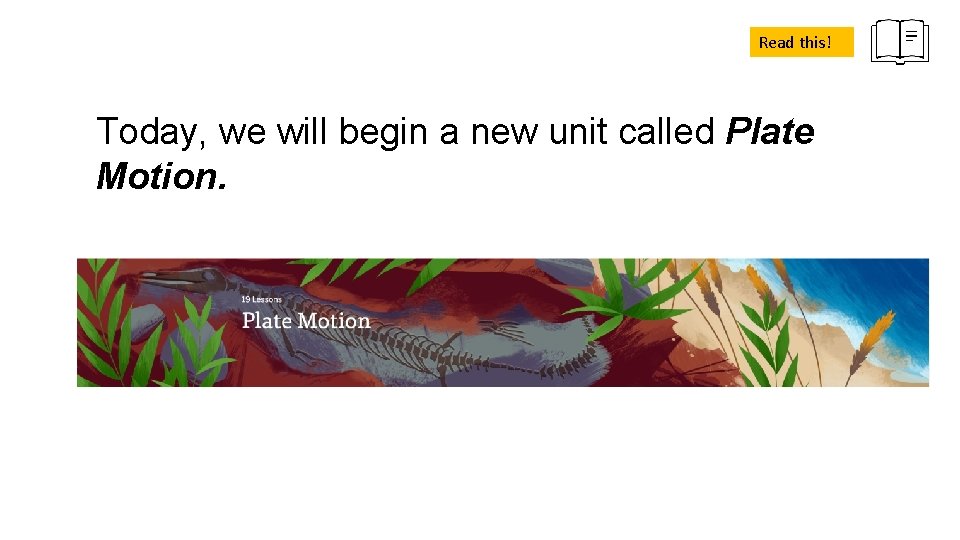
Read this! Today, we will begin a new unit called Plate Motion.
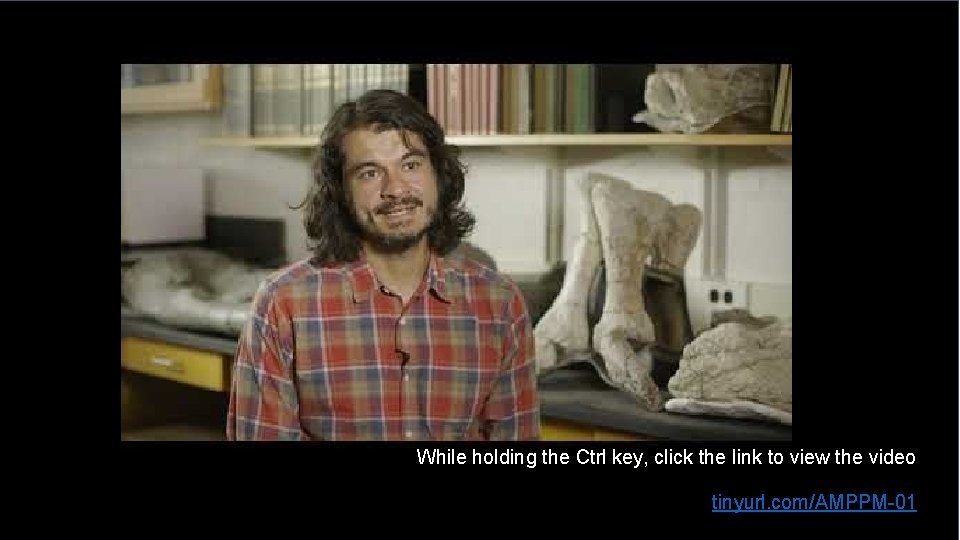
Read this! Fossils are like time capsules. Scientists use fossils to better understand what Earth was like when that fossil formed—thousands or even millions of years ago! Next, you’ll watch a video about a real-life scientist, Dr. Wilson, who is investigating fossils to tell the story of Earth’s past.
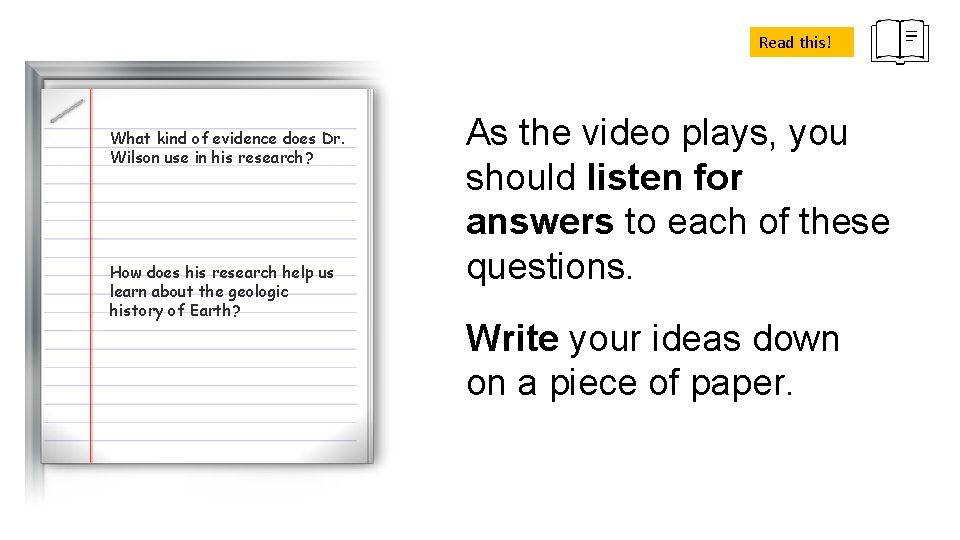
Read this! What kind of evidence does Dr. Wilson use in his research? How does his research help us learn about the geologic history of Earth? As the video plays, you should listen for answers to each of these questions. Write your ideas down on a piece of paper.
While holding the Ctrl key, click the link to view the video tinyurl. com/AMPPM-01
Do this! Look at the notes you took during the video and answer these questions: What kind of evidence does Dr. Wilson use in his research? Answer: How does his research help us learn about the geologic history of Earth? Answer:
In the Plate Motion unit we will be thinking about this question: IMPORTANT- THIS MUST BE ADDED TO YOUR SCIENCE NOTEOOK! Unit Question Why are fossils of species that once lived together found in different locations on Earth now? Watch this video---> PM Unit Question to see how to record the unit question in your notebook.
Read this! In this unit you will take on the role of student geologists. A geologist is someone who studies the Earth. Dr. Wilson studies fossils to learn about the history of life on Earth. Like Dr. Wilson, you will be using fossils to guide your investigation of what Earth was like in the past.
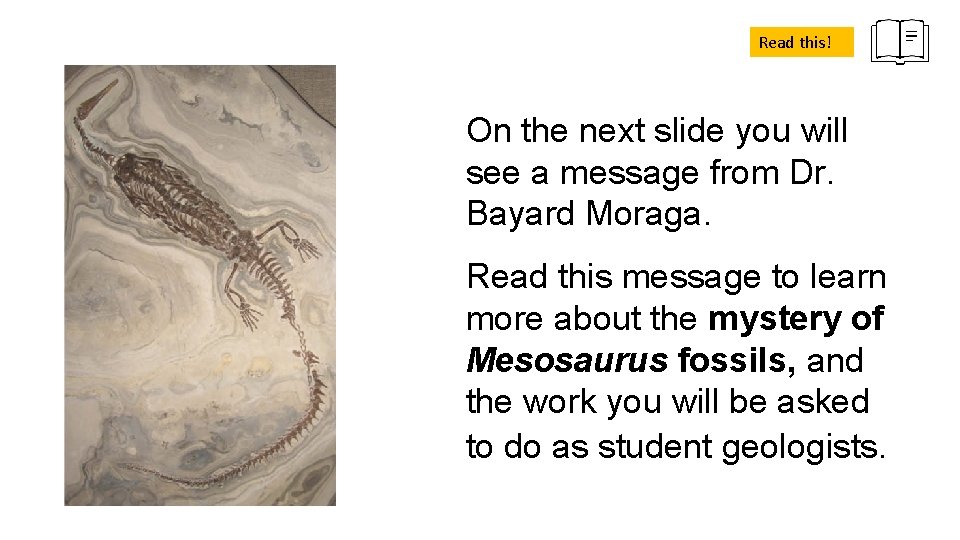
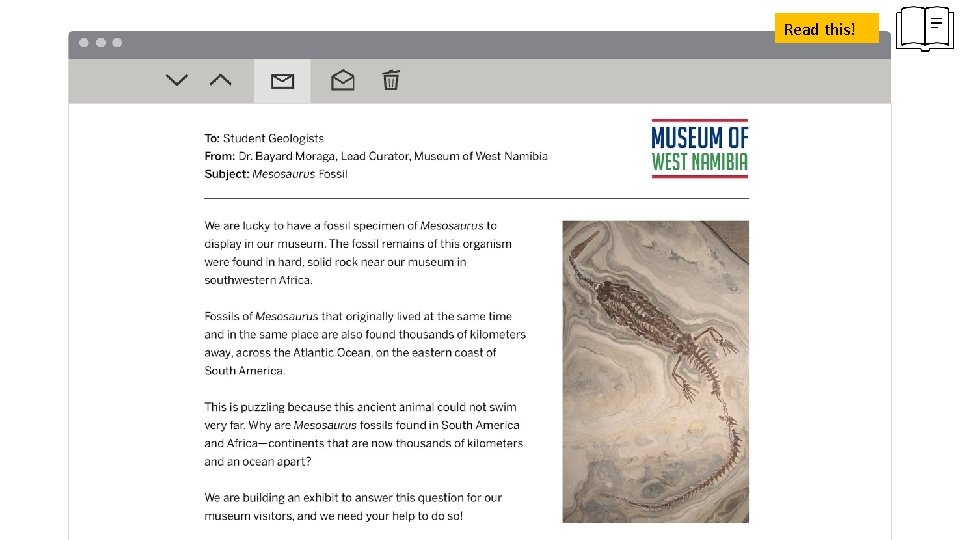
Read this! On the next slide you will see a message from Dr. Bayard Moraga. Read this message to learn more about the mystery of Mesosaurus fossils, and the work you will be asked to do as student geologists.
Read this!
Read this! In this unit, you’ll use your understanding of geology to explain what happened to the rock that the Mesosaurus fossils were found in and why the fossilized remains of these reptiles that once lived together are now found so far away from each other. Your task is to understand more about the land where Mesosaurus fossils are found and look for clues that will help us learn about Earth’s past.
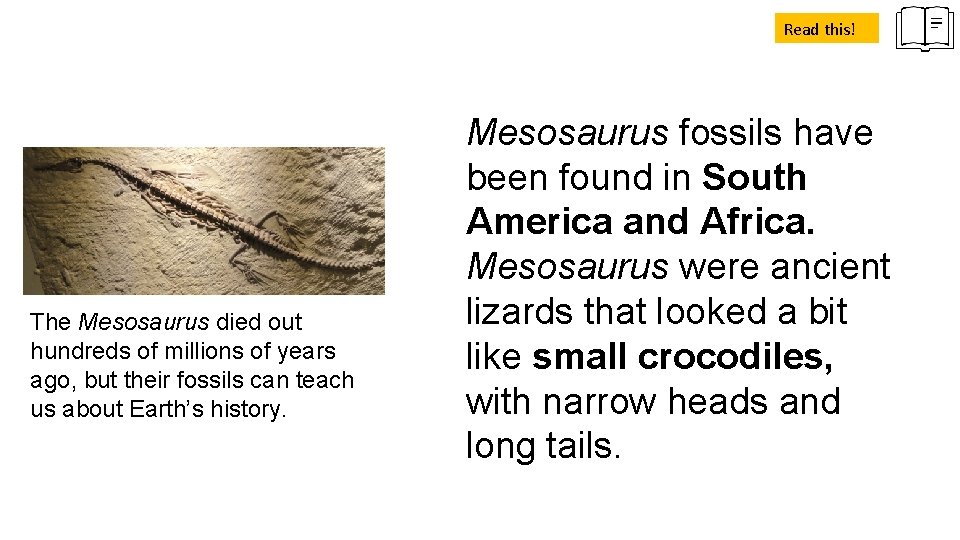
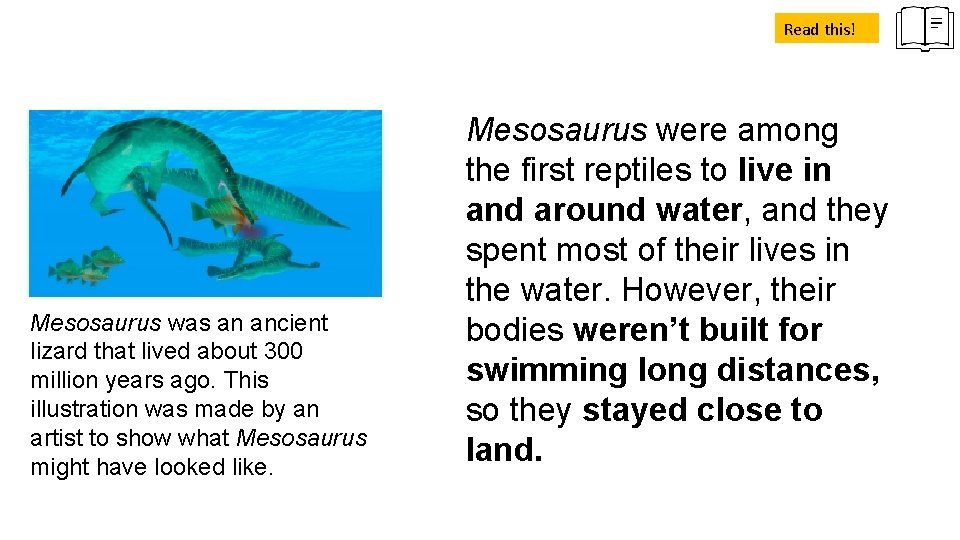
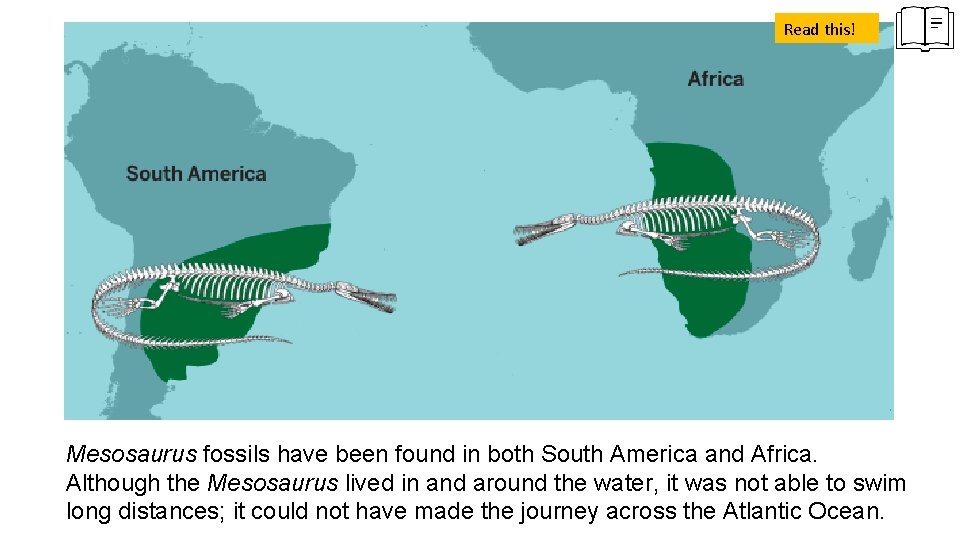
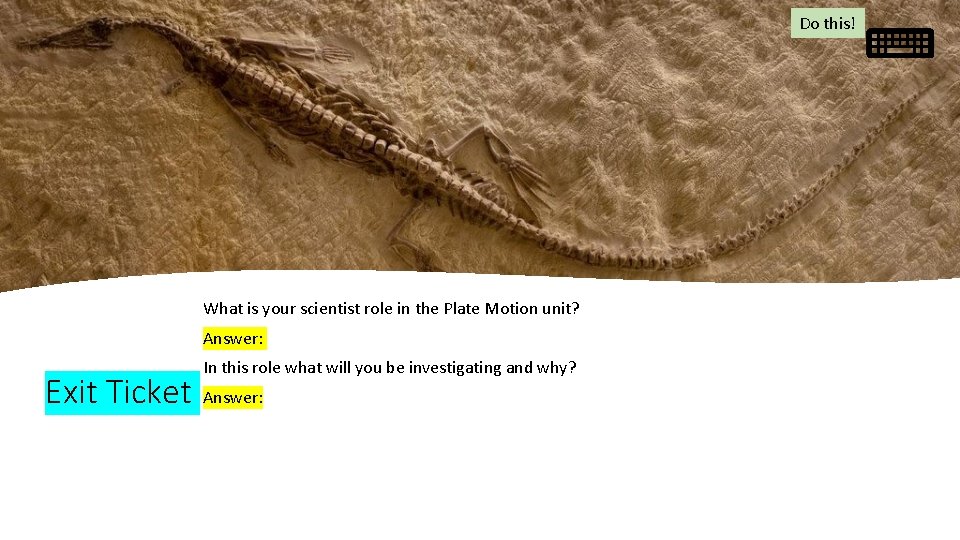
Read this! The Mesosaurus died out hundreds of millions of years ago, but their fossils can teach us about Earth’s history. Mesosaurus fossils have been found in South America and Africa. Mesosaurus were ancient lizards that looked a bit like small crocodiles, with narrow heads and long tails.
Read this! Mesosaurus was an ancient lizard that lived about 300 million years ago. This illustration was made by an artist to show what Mesosaurus might have looked like. Mesosaurus were among the first reptiles to live in and around water, and they spent most of their lives in the water. However, their bodies weren’t built for swimming long distances, so they stayed close to land.
Read this! Mesosaurus fossils have been found in both South America and Africa. Although the Mesosaurus lived in and around the water, it was not able to swim long distances; it could not have made the journey across the Atlantic Ocean.
Read this! Scientists find Mesosaurus fossils embedded in hard, solid rock on the coasts of South America and Africa. The earliest fossil evidence for these animals indicates that they were alive about 300 million years ago, and their species went extinct about 260 million years ago. Studying these fossils can help scientists understand what the land in South America and Africa was like 300 million years ago.
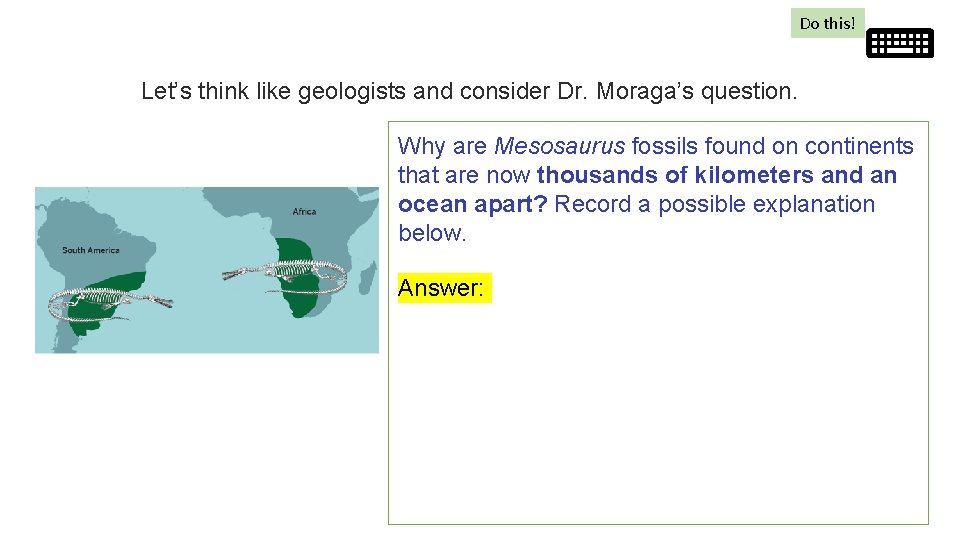
Do this! Let’s think like geologists and consider Dr. Moraga’s question. Why are Mesosaurus fossils found on continents that are now thousands of kilometers and an ocean apart? Record a possible explanation below. Answer:
Do this! This question will help guide us as we think about the problem of why these fossils were found so far apart. IMPORTANT- THIS MUST BE ADDED TO YOUR SCIENCE NOTEOOK! Chapter 1 Question What is the land like where Mesosaurus fossils are found? Watch this video---> PM Ch. 1 Question to see how to record the Ch. 1 question in your notebook.
Read this! The fossil specimens of Mesosaurus are real, Dr. Wilson from the video is a real scientist, and the mystery that you are going to investigate is real. However, some aspects of this unit are fictional. The Museum of West Namibia and Dr. Moraga, the lead curator at this museum, are not real. They are included in this unit to give you an opportunity to collect data and communicate your findings in ways that are very similar to the ways that scientists do their work.
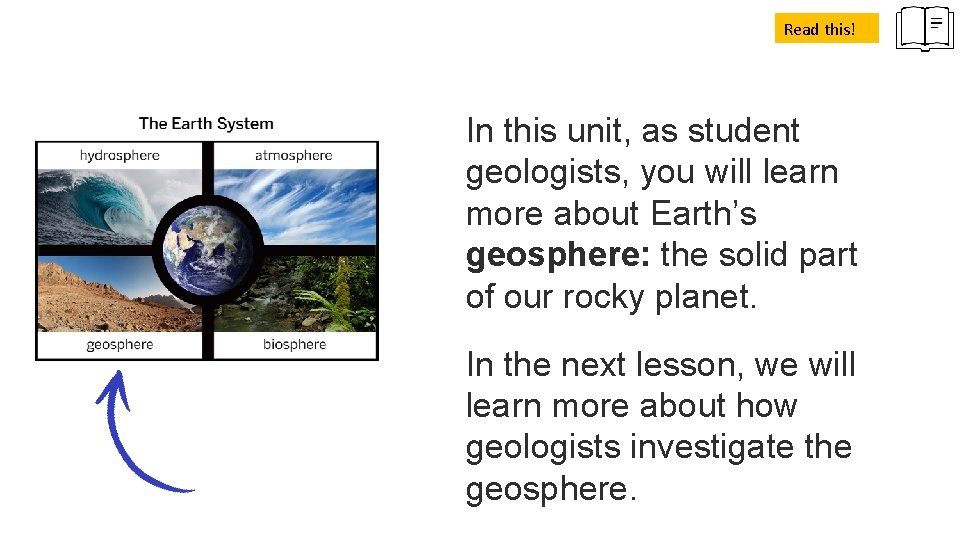
Read this! In this unit, as student geologists, you will learn more about Earth’s geosphere: the solid part of our rocky planet. In the next lesson, we will learn more about how geologists investigate the geosphere.
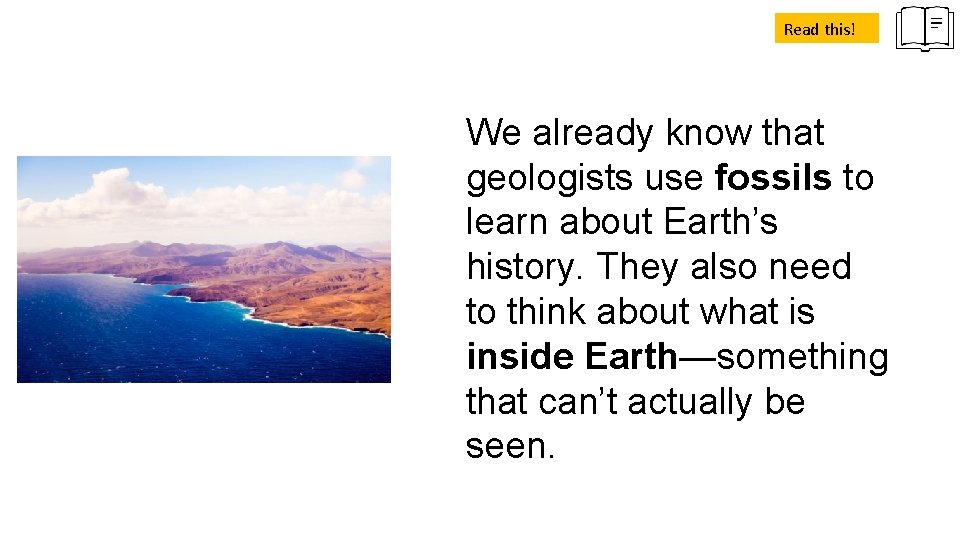
Read this! We already know that geologists use fossils to learn about Earth’s history. They also need to think about what is inside Earth—something that can’t actually be seen.
Do this! What is your scientist role in the Plate Motion unit? Answer: Exit Ticket In this role what will you be investigating and why? Answer: