
Plate Boundaries Plate boundaries are where plates interact
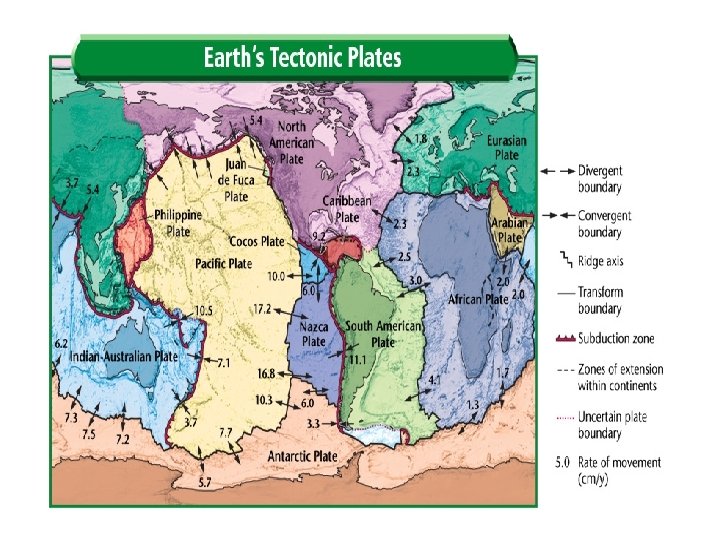
Plate Boundaries • Plate boundaries are where plates interact with each other. • 3 Type: • Divergent • Convergent • Transform
Tectonic Plates • The discovery of seafloor spreading led to the concept of continental plates. • The theory of plate tectonics states that Earth’s crust and rigid upper mantle are broken into enormous moving slabs called plates.
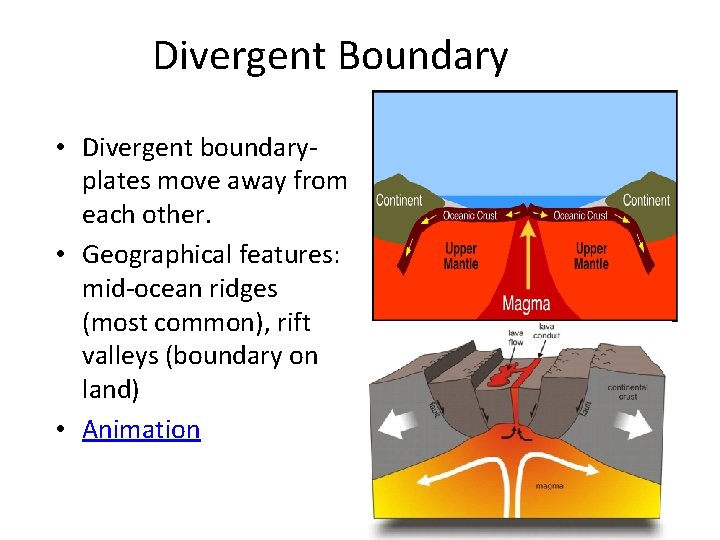
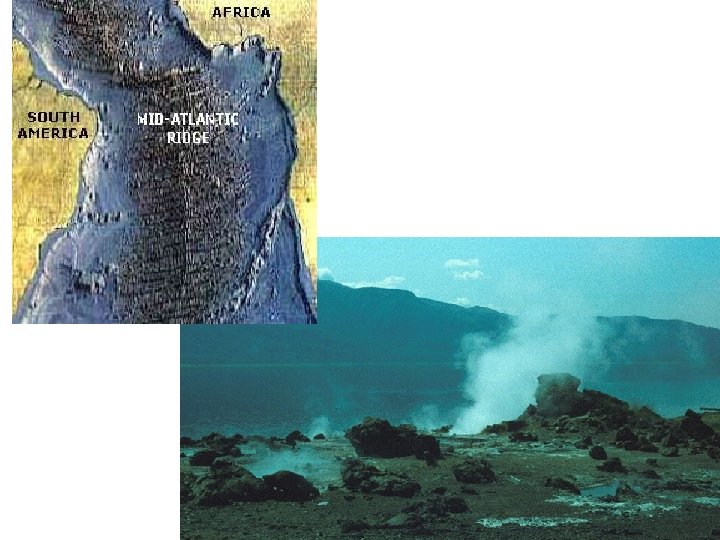
Divergent Boundary • Divergent boundaryplates move away from each other. • Geographical features: mid-ocean ridges (most common), rift valleys (boundary on land) • Animation
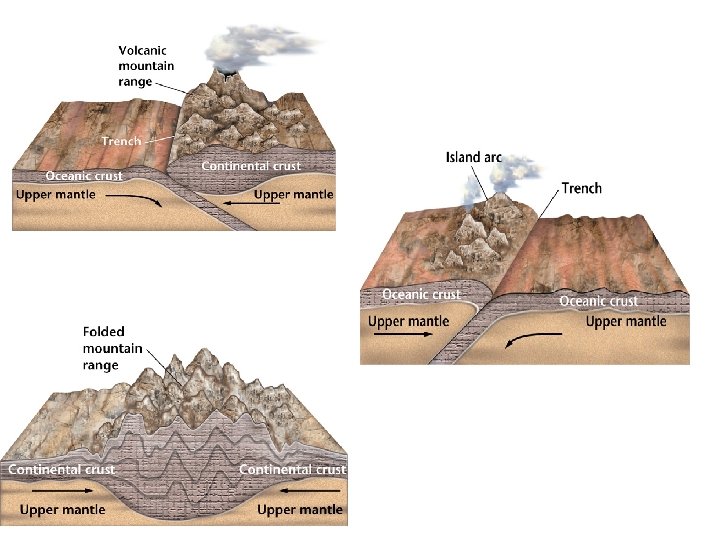
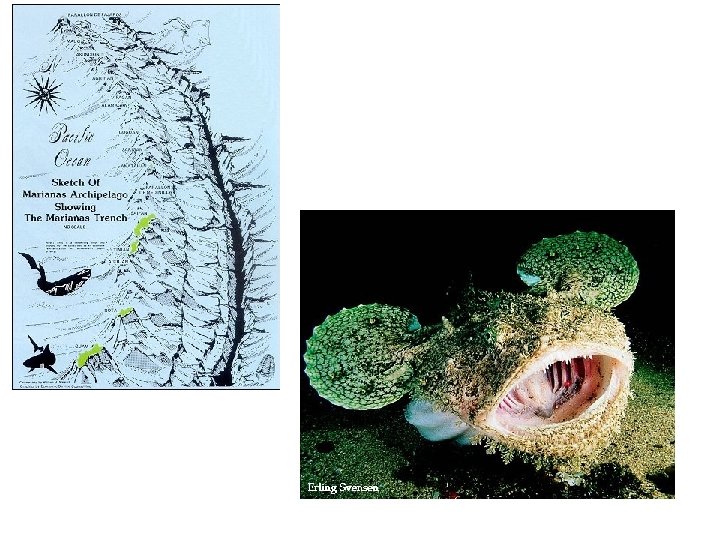
Convergent Boundaries • Convergent boundaries-plates move toward each other. – Oceanic-oceanic…. . usually find island arcs, ocean trench – Oceanic-continental…. usually find volcanic mountain range, ocean trench – Continental-continental…. . usually find mountain range Animation
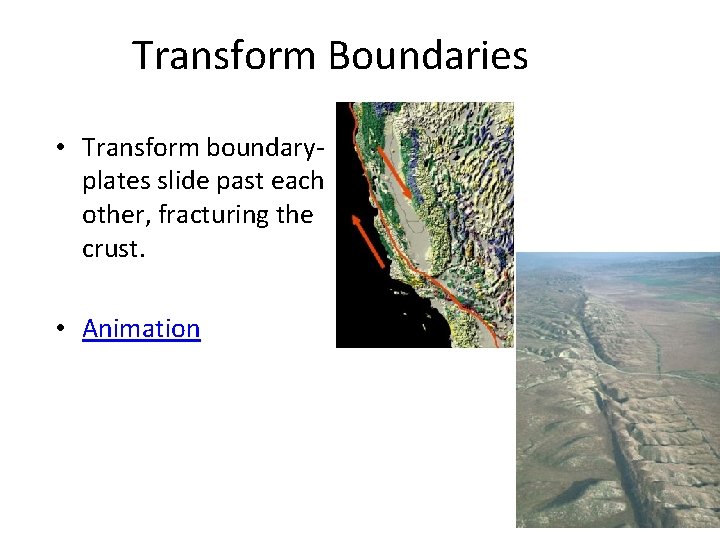
Transform Boundaries • Transform boundaryplates slide past each other, fracturing the crust. • Animation
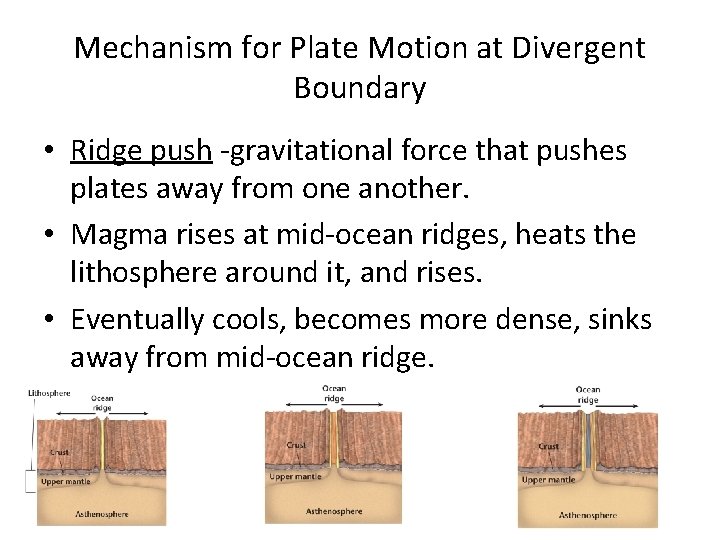
Mechanism for Plate Motion at Divergent Boundary • Ridge push -gravitational force that pushes plates away from one another. • Magma rises at mid-ocean ridges, heats the lithosphere around it, and rises. • Eventually cools, becomes more dense, sinks away from mid-ocean ridge.
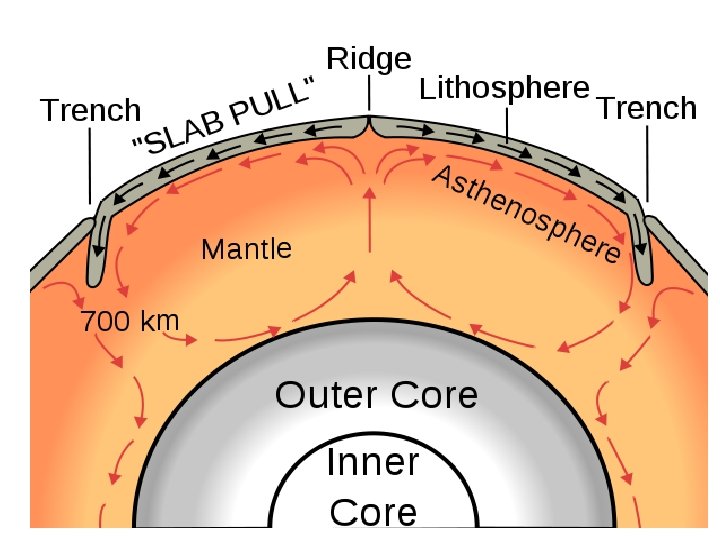
Mechanism for Plate Movement at Convergent Boundaries • Slab pull -motion of cool, dense plate towards core due to subduction. • As plates move away from mid-ocean ridges, they become more dense. Subduction occurs when gravity pulls the more dense plate at a convergent boundary to sink and form an oceanic trench. • The weight of this sinking action causes a strong pulling force to continue to drag the rest of the plate.
Final Proposed Mechanism for Plate Movement • Mantle Convection-continued cycle of heated magma closest to the Earth’s core moving towards the lithosphere at mid-ocean ridges and returning to the direction of Earth’s core due to subduction at ocean trenches. • As magma, it warms up again, forming a circular current motion.
- Slides: 14