
PLATE BOUNDARIES By Jesse Towns Grace Tauscher CONVERGENT
PLATE BOUNDARIES By: Jesse Towns & Grace Tauscher
CONVERGENT � When two plates meet, its known as a convergent boundary. � The collision of the two plates buckle the edge of one or both of the plates into a mountain range, and sometimes bend the other one down into a deep seafloor trench.
CONVERGENT FACTS � If one of the plates is topped with the oceanic crust, it can be forced downward. Then Magma is formed from melting plates which is made into granite, a lightly colored, low-density material that makes up the large land masses.
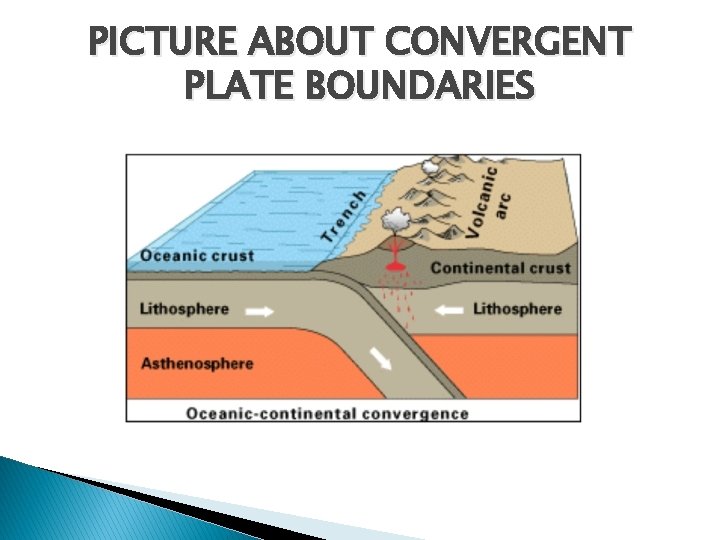
PICTURE ABOUT CONVERGENT PLATE BOUNDARIES
DIVERGENT �A divergent boundary occurs when two tectonic plates move away from each other. The weakness in the crust allows molten lava to move upward to the Earth's surface on the ocean floors. The lava flowing out of the vents on the ocean floor form a top of a long mountain range where tectonic plates are seperated. �
DIVERGENT BOUNDARY Divergent boundaries areas where two crustal plates separate. Most of the tectonic plate boundaries are located on the floor of the ocean. � The separation of plates form the rift valleys under the ocean floor where the weaknesses are in the crust. �

Example of Divergent
Transform Boundaries � A transform boundary happens when tectonic plates slide past each other. A transform boundary is a fault zone when two tectonic plates slide past each other. Most transform faults are found under the ocean where the offset spreading ridges create a zigzag pattern in between the tectonic plates.
TRANSFORM BOUNDARIES � Some of the transform faults occur on land. The most known transform fault is the San Andreas Fault which connects to the East Pacific Rise and to the Juan de Fuca Plates that are separated by a transform fault don’t glide past each other.
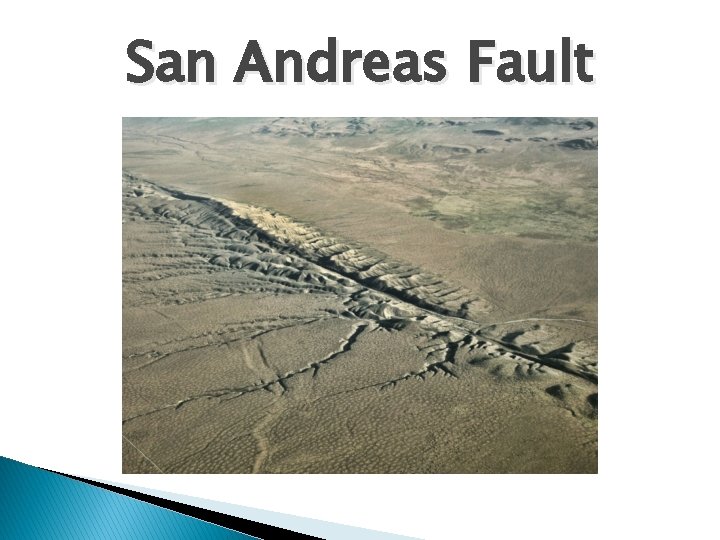
San Andreas Fault

CREDITS � www. learner. org � www. kids-fun-science. com � www. bing. com www. oceanexplorer. noaa. gov www. pubs. usgs. gov
- Slides: 11