
Plate Boundaries and Plate Interactions Unit 1 Chapter
Plate Boundaries and Plate Interactions Unit 1, Chapter 2, Activity 2
Plate Boundaries and Plate Interactions n Where do you suppose you would have the most “interesting” ride on a plate? Would it be at the center, on a leading edge, on a trailing edge, or somewhere else on the plate?

Plate Boundaries and Plate Interactions n n New plates are being formed and old plates are being destroyed The surface area of the Earth does not change so this has to happen at exactly the same rate!
Plate Boundaries and Plate Interactions n n There are three kinds of plate boundaries: convergent, divergent and parallel Plate boundaries is where the action is!
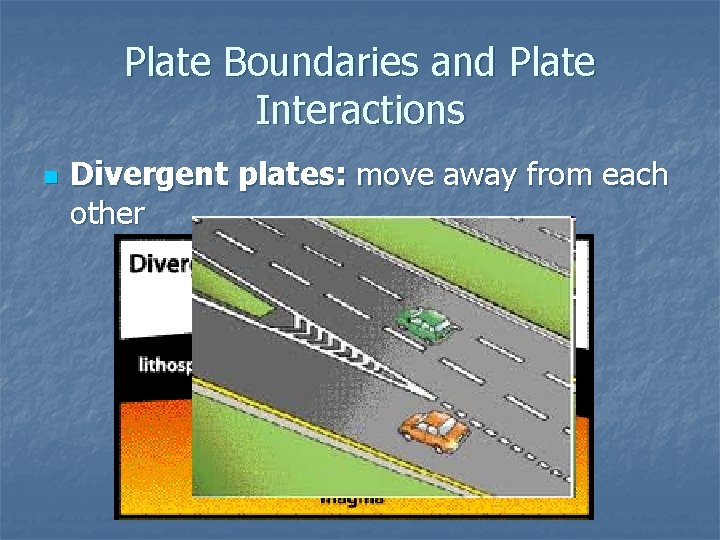
Plate Boundaries and Plate Interactions n Divergent plates: move away from each other

Plate Boundaries and Plate Interactions n Converging Plates: two plates move towards each other
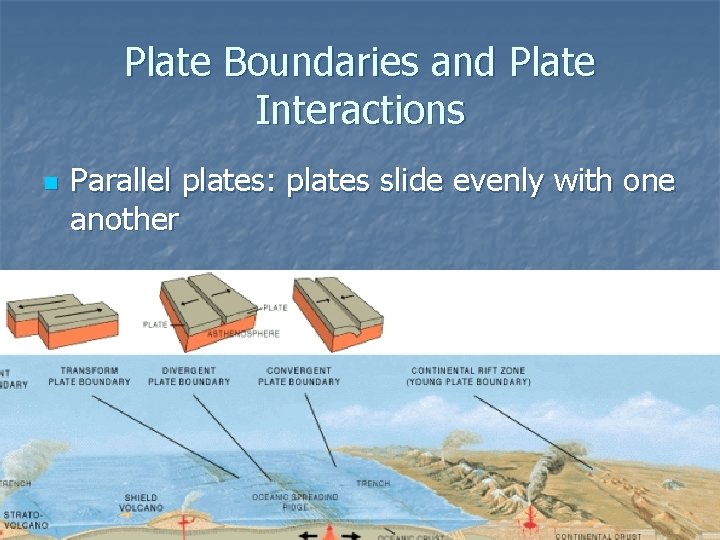
Plate Boundaries and Plate Interactions n Parallel plates: plates slide evenly with one another
Plate Boundaries and Plate Interactions n n n The mid-ocean ridges are divergent plate boundaries Divergent plate boundaries lead to new ocean basins Describe what you think happens…
Plate Boundaries and Plate Interactions Turn to p. 79 n n A new ocean begins when hot mantle material begins to move upward beneath a continent. (don’t know why) The lithosphere gets stressed until it cracks which forms a rift valley Magma rises up to increase the rift until the land completely pulls apart A new ocean basin
Plate Boundaries and Plate Interactions n Describe what you think happens when two plates converge…
Plate Boundaries and Plate Interactions n There are three circumstances of plates converging: ocean to ocean, ocean to land to land.
Plate Boundaries and Plate Interactions n Ocean to ocean n Look at the western edge of the Pacific Ocean on the world map you were given n Subduction: One plate stays at the surface and one plate is pushed under n Trenches (the deepest part of the ocean) form n The plate pushed into the asthnosphere becomes magma which rises and creates volcanoes=volcanic island arc
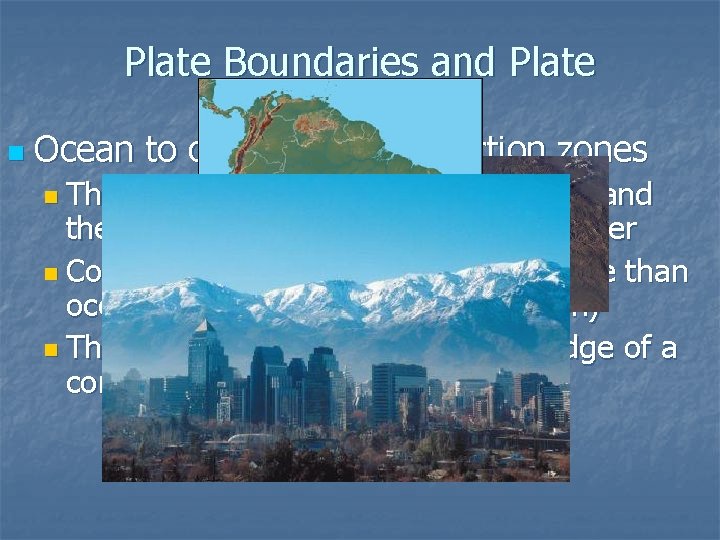
Plate Boundaries and Plate Interactions n Ocean to continental subduction zones n The continental land is always on top and the oceanic land is always pushed under n Continental land (granite) is less dense than oceanic land (basalt, has a lot of iron) n The volcanic arc gets built on the edge of a continent
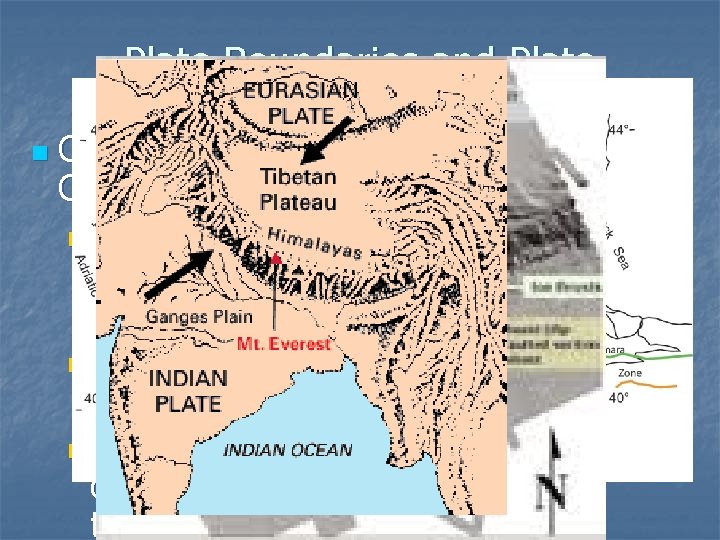
Plate Boundaries and Plate Interactions n Continental to Continental Convergence n As oceanic land is subducted under continental land it can bring two continents together! n Continental land cannot be subducted so subduction stops n Suture zone: Where two continents have been welded together
Plate Boundaries and Plate Interactions n n n Transform boundaries: plates slide past one another Transform fault the surface along which two plates slide along each other The San Andres Fault along CA is a transform plate boundary
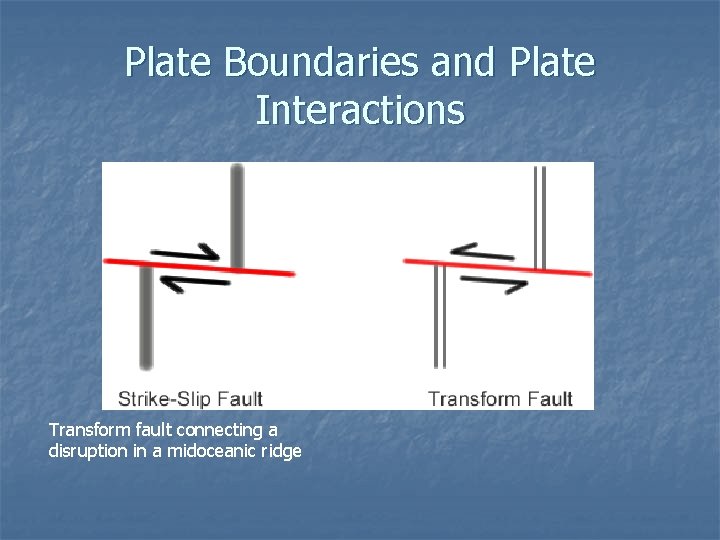
Plate Boundaries and Plate Interactions Transform fault connecting a disruption in a midoceanic ridge
Plate Boundaries and Plate Interactions
Plate Boundaries and Plate Interactions
Plate Boundaries and Plate Interactions
- Slides: 19