
PLASTIC SURGERY DWAYNE THOMAS PERIOD 1 TABLE OF
PLASTIC SURGERY ! DWAYNE THOMAS. . . PERIOD 1
TABLE OF CONTENTS 1. History 2. Surgery gone wrong 3. Most common procedures 4. Why 5. Bibliography
HISTORY Techniques of reconstructive surgery were originated in India by 800 B. C. Sushruta was the father of surgery and gave important insight to the plastic and cataract surgery in 6 th century B. C. Joseph Constantine Carpue spent 20 years in India studying local plastic surgery methods. Joseph was able to perform the first major surgery in the Western world by 1815. The ancient Egyptians and Romans also performed plastic cosmetic surgery. The Romans were able to perform simple techniques, such as repairing damaged ears from around the 1 st century BC. For religious reasons, they did not dissect neither human beings or animals. In 1793, Chopart performed operative procedure on a lip using a flap from the neck and In 1814, Joseph Carpue successfully performed operative procedure on a British military officer who had lost his nose to the toxic effects of mercury treatments. Mercury is a chemical element with the symbol Hg and atomic number 80, A heavy, silvery d-block element; the only metal that is liquid at standard conditions for temperature and pressure.
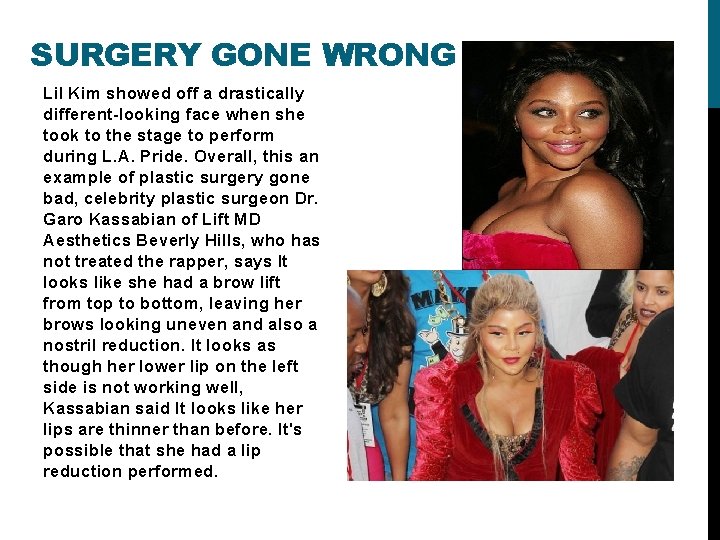
SURGERY GONE WRONG Lil Kim showed off a drastically different-looking face when she took to the stage to perform during L. A. Pride. Overall, this an example of plastic surgery gone bad, celebrity plastic surgeon Dr. Garo Kassabian of Lift MD Aesthetics Beverly Hills, who has not treated the rapper, says It looks like she had a brow lift from top to bottom, leaving her brows looking uneven and also a nostril reduction. It looks as though her lower lip on the left side is not working well, Kassabian said It looks like her lips are thinner than before. It's possible that she had a lip reduction performed.
MOST COMMON PROCEDURES Abdominoplasty ("tummy tuck"): reshaping and firming of the abdomen Blepharoplasty ("eyelid surgery"): reshaping of the eyelids or the application of permanent eyeliner. Phalloplasty ("penile liposuction") : construction or reconstruction of a penis or, sometimes, artificial modification of the penis by surgery, often for cosmetic purposes Breast augmentations ("breast implant" or "boob job"): augmentation of the breasts by means of fat grafting, saline, or silicone gel prosthetics, which was initially performed to women with micromastia Reduction mammoplasty ("breast reduction"): removal of skin and glandular tissue, which is done to reduce back and shoulder pain in women with gigantomastia and/or for psychological benefit men with gynecomastia Mastopexy ("breast lift"): Lifting or reshaping of breasts to make them less saggy, often after weight loss (after a pregnancy, for example). It involves removal of breast skin as opposed to glandular tissue Buttock augmentation ("butt implant"): enhancement of the buttocks using silicone implants or fat grafting ("Brazilian butt lift") and transfer from other areas of the body Buttock lift: lifting, and tightening of the buttocks by excision of redundant skin Lip enhancement: surgical improvement of lips' fullness through enlargement Rhinoplasty ("nose job"): reshaping of the nose Rhytidectomy ("face lift"): removal of wrinkles and signs of aging from the face Browplasty ("brow lift" or "forehead lift"): elevates eyebrows, smooths forehead skin Midface lift ("cheek lift"): tightening of the cheeks Brachioplasty ("Arm lift"): reducing excess skin and fat between the underarm and the elbow Liposuction: removal of fat deposits by traditional suction technique or ultrasonic energy to aid fat removal
WHY ? These people usually are insecure about how they look and they spend thousands of dollars to reconstruct their body and sometimes it can go wrong but if not then they become addicted to this operations and continue to reconstruct themselves. Though media and advertising do play a large role in influencing many people's lives, researchers believe that plastic surgery obsession is linked to psychological disorders. Body dimorphic disorder is seen as playing a large role in the lives of those who are obsessed with plastic surgery in order to correct a perceived defect in their appearance.

BIBLIOGRAPHY http: //www. wewomen. com/celebrities/album 897250/celebrity-plastic-surgerygone-wrong-before-and-after-22365292. html http: //www. ibtimes. com/lil-kim-plastic-surgery-gone-wrong-fans-shockedrappers-transformation-photos-700725 http: //en. wikipedia. org/wiki/Plastic_surgery
- Slides: 7