
PLASTIC RECYCLING What are Plastics Types and uses

- Slides: 47
PLASTIC RECYCLING ª What are Plastics? ª Types and uses of Plastics ª What is Recycling? ª What is the Need of Plastic Recycling? ª Coding of Plastics ª Process of Plastic Recycling ª What are the Benefits of Plastic Recycling? ª Plastic Recycling in India ª What does Law say? ª Why Can’t we Recycle more? ª What Can we do? ª References
What are Plastics ? v Plastics are polymers, that is long chain molecules, made from smaller molecules called monomers. v The basic raw materials for plastic are petroleum and natural gas. The fossil fuels are sometimes combined with other elements, such as oxygen or chlorine to make different types of plastics. v Alexander Parkes discovered plastics in 1860, however mass production has only occurred in the past few decades. Plastic production worldwide now exceeds 80 million tonnes a year.
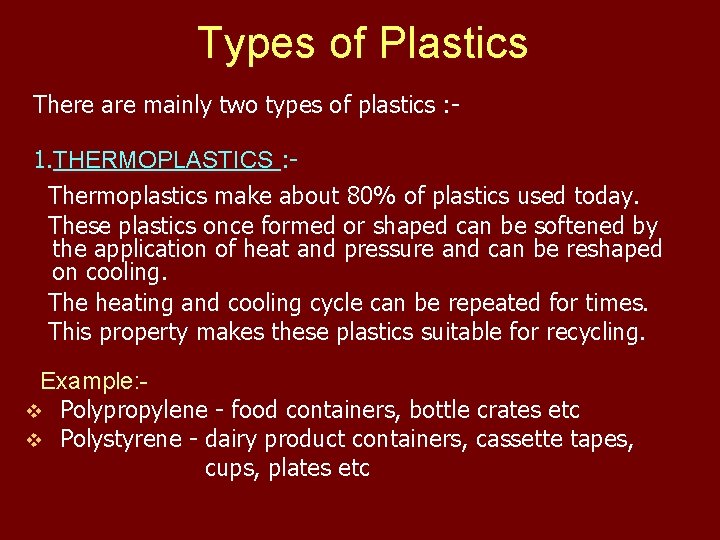
Types of Plastics There are mainly two types of plastics : 1. THERMOPLASTICS : Thermoplastics make about 80% of plastics used today. These plastics once formed or shaped can be softened by the application of heat and pressure and can be reshaped on cooling. The heating and cooling cycle can be repeated for times. This property makes these plastics suitable for recycling. Example: v Polypropylene - food containers, bottle crates etc v Polystyrene - dairy product containers, cassette tapes, cups, plates etc
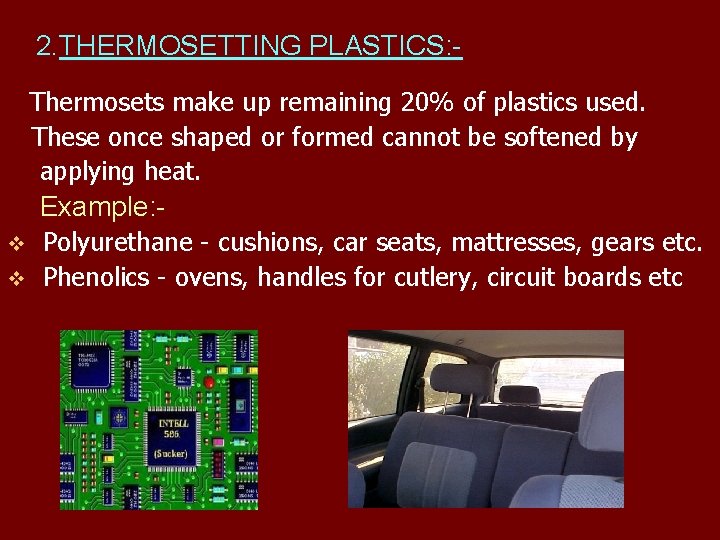
2. THERMOSETTING PLASTICS: Thermosets make up remaining 20% of plastics used. These once shaped or formed cannot be softened by applying heat. Example: Polyurethane - cushions, car seats, mattresses, gears etc. v Phenolics - ovens, handles for cutlery, circuit boards etc v
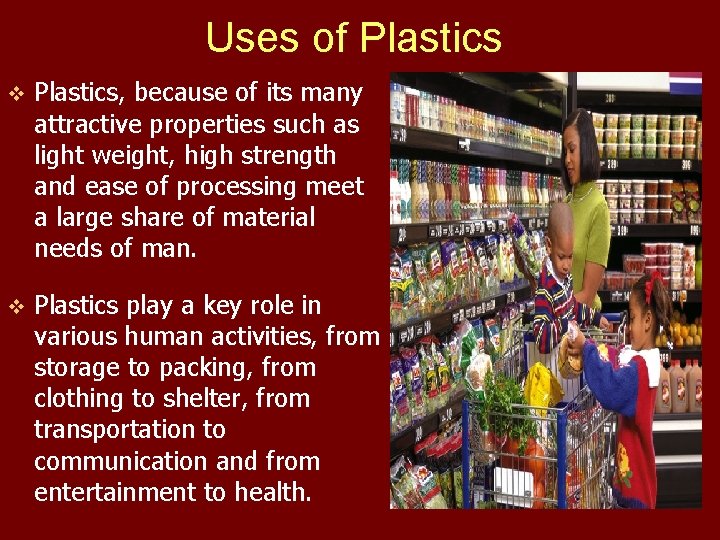
Uses of Plastics v Plastics, because of its many attractive properties such as light weight, high strength and ease of processing meet a large share of material needs of man. v Plastics play a key role in various human activities, from storage to packing, from clothing to shelter, from transportation to communication and from entertainment to health.
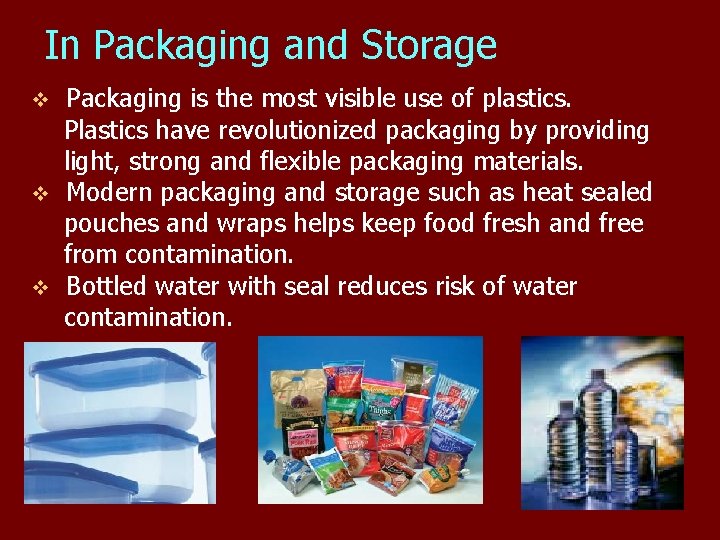
In Packaging and Storage Packaging is the most visible use of plastics. Plastics have revolutionized packaging by providing light, strong and flexible packaging materials. v Modern packaging and storage such as heat sealed pouches and wraps helps keep food fresh and free from contamination. v Bottled water with seal reduces risk of water contamination. v
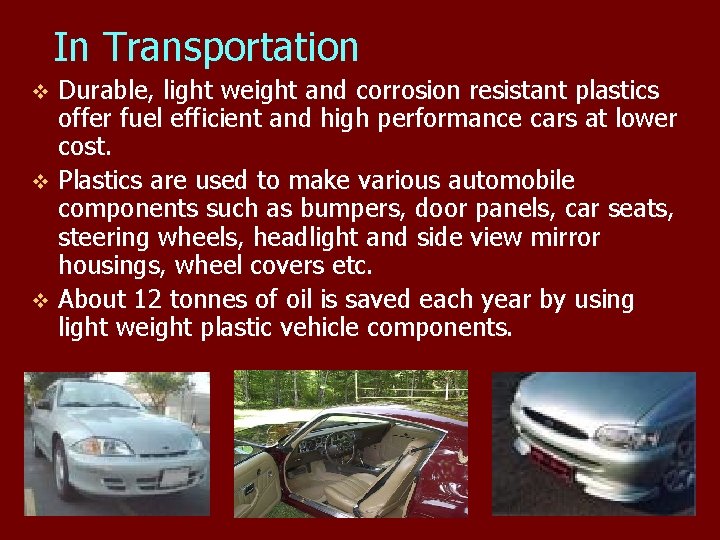
In Transportation Durable, light weight and corrosion resistant plastics offer fuel efficient and high performance cars at lower cost. v Plastics are used to make various automobile components such as bumpers, door panels, car seats, steering wheels, headlight and side view mirror housings, wheel covers etc. v About 12 tonnes of oil is saved each year by using light weight plastic vehicle components. v
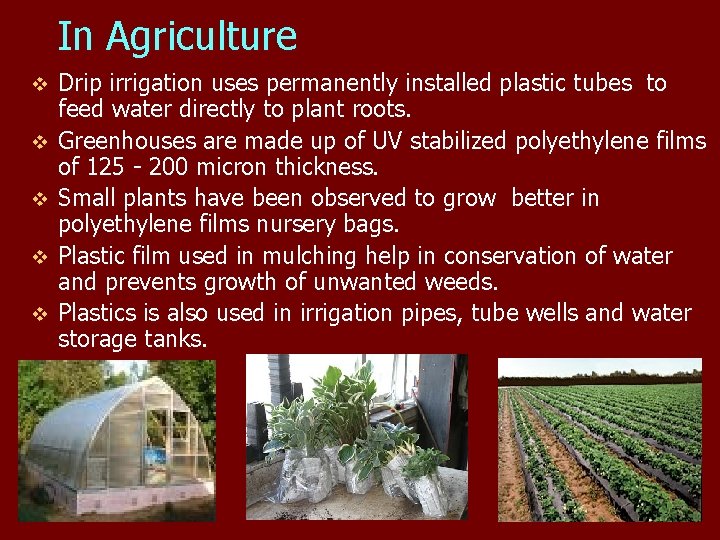
In Agriculture v v v Drip irrigation uses permanently installed plastic tubes to feed water directly to plant roots. Greenhouses are made up of UV stabilized polyethylene films of 125 - 200 micron thickness. Small plants have been observed to grow better in polyethylene films nursery bags. Plastic film used in mulching help in conservation of water and prevents growth of unwanted weeds. Plastics is also used in irrigation pipes, tube wells and water storage tanks.
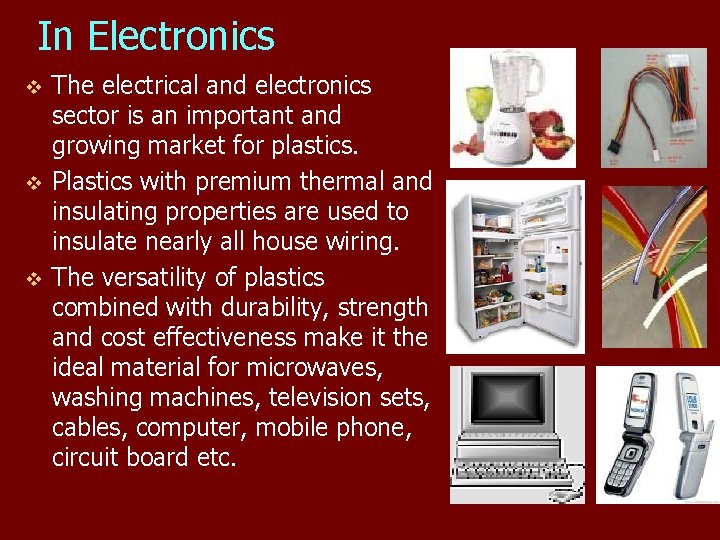
In Electronics The electrical and electronics sector is an important and growing market for plastics. v Plastics with premium thermal and insulating properties are used to insulate nearly all house wiring. v The versatility of plastics combined with durability, strength and cost effectiveness make it the ideal material for microwaves, washing machines, television sets, cables, computer, mobile phone, circuit board etc. v
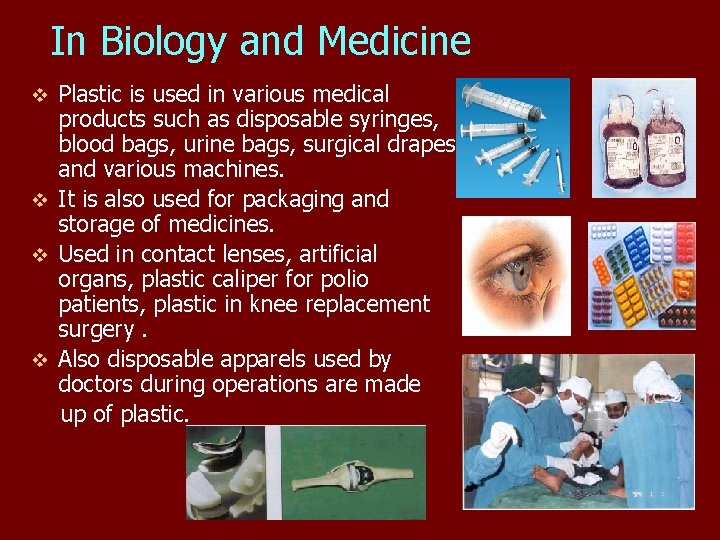
In Biology and Medicine Plastic is used in various medical products such as disposable syringes, blood bags, urine bags, surgical drapes and various machines. v It is also used for packaging and storage of medicines. v Used in contact lenses, artificial organs, plastic caliper for polio patients, plastic in knee replacement surgery. v Also disposable apparels used by doctors during operations are made up of plastic. v
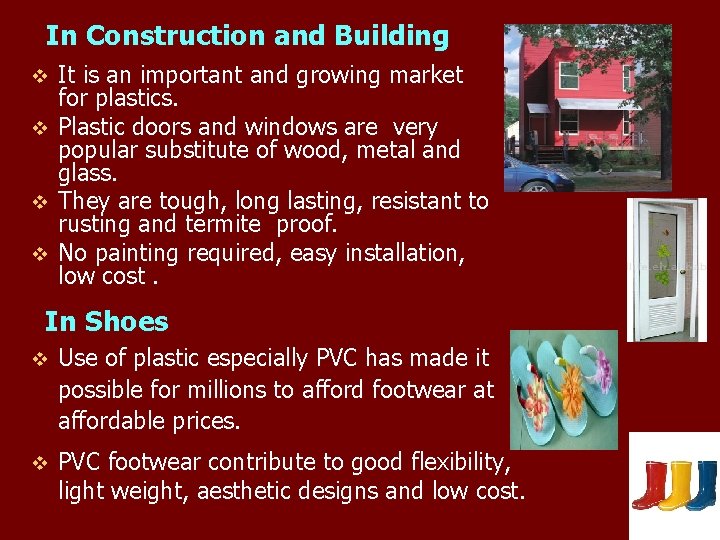
In Construction and Building It is an important and growing market for plastics. v Plastic doors and windows are very popular substitute of wood, metal and glass. v They are tough, long lasting, resistant to rusting and termite proof. v No painting required, easy installation, low cost. v In Shoes v Use of plastic especially PVC has made it possible for millions to afford footwear at affordable prices. v PVC footwear contribute to good flexibility, light weight, aesthetic designs and low cost.
What is Recycling ? Recycling is a series of activities that includes collecting recyclable materials that would otherwise be considered waste, sorting and processing recyclables into raw materials such as fibres and manufacturing raw materials into new products. Plastic recycling is the process of taking scrap or waste plastics and recovering the material for use in manufacturing.
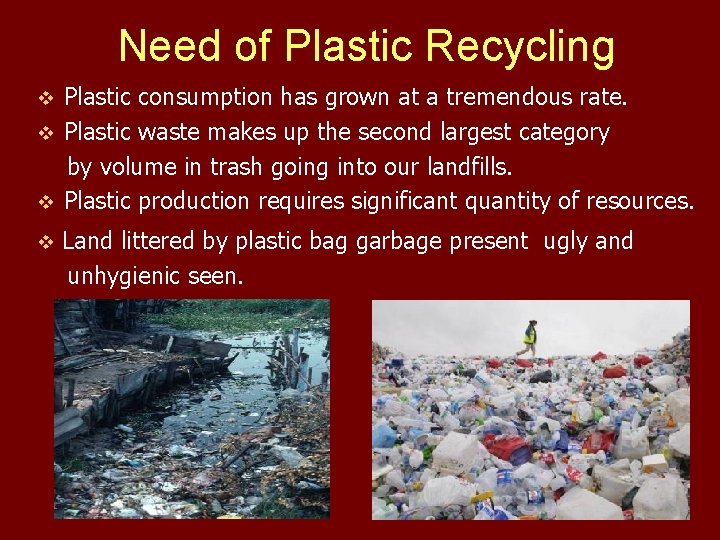
Need of Plastic Recycling Plastic consumption has grown at a tremendous rate. v Plastic waste makes up the second largest category by volume in trash going into our landfills. v Plastic production requires significant quantity of resources. v v Land littered by plastic bag garbage present ugly and unhygienic seen.
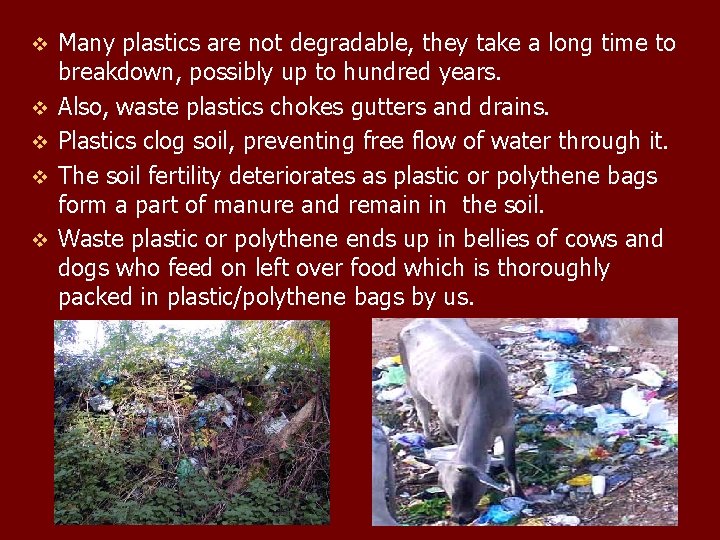
v v v Many plastics are not degradable, they take a long time to breakdown, possibly up to hundred years. Also, waste plastics chokes gutters and drains. Plastics clog soil, preventing free flow of water through it. The soil fertility deteriorates as plastic or polythene bags form a part of manure and remain in the soil. Waste plastic or polythene ends up in bellies of cows and dogs who feed on left over food which is thoroughly packed in plastic/polythene bags by us.
What are the Sources of waste plastics? 1. Pre-consumer waste : - It is created before it reaches the consumer. It consists of trimming and scraps from manufacturing and other converting processes. Thus, it is a result of manufacturing product. 2. Post-consumer waste : - The waste that has served its intended purpose and has been separated from the solid waste, to be recycled into new plastic is known as the “post consumer waste”. It is the waste which is generated by the consumer after use.
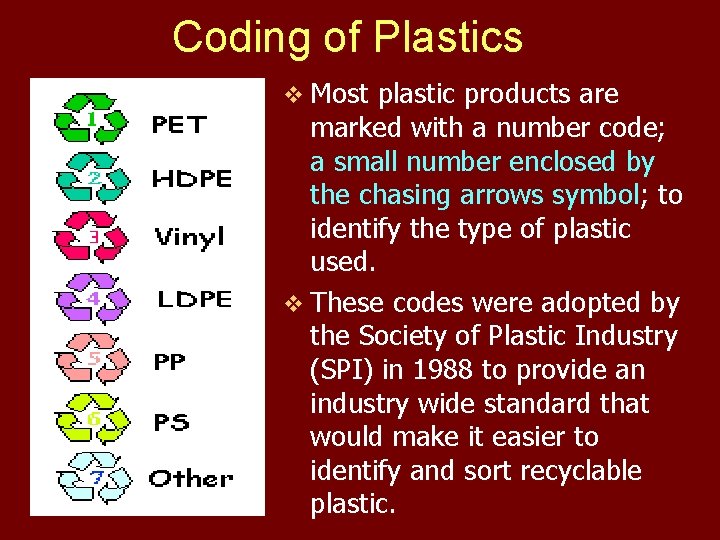
Coding of Plastics v Most plastic products are marked with a number code; a small number enclosed by the chasing arrows symbol; to identify the type of plastic used. v These codes were adopted by the Society of Plastic Industry (SPI) in 1988 to provide an industry wide standard that would make it easier to identify and sort recyclable plastic.
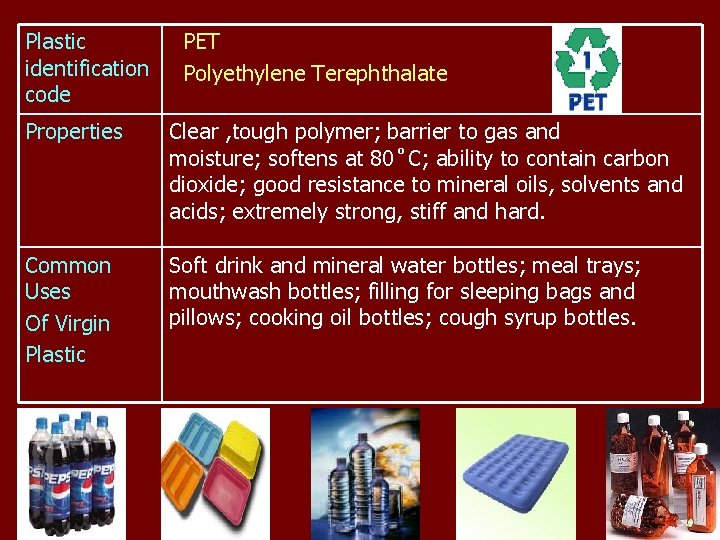
Plastic identification code PET Polyethylene Terephthalate Properties Clear , tough polymer; barrier to gas and moisture; softens at 80 C; ability to contain carbon dioxide; good resistance to mineral oils, solvents and acids; extremely strong, stiff and hard. Common Uses Of Virgin Plastic Soft drink and mineral water bottles; meal trays; mouthwash bottles; filling for sleeping bags and pillows; cooking oil bottles; cough syrup bottles.
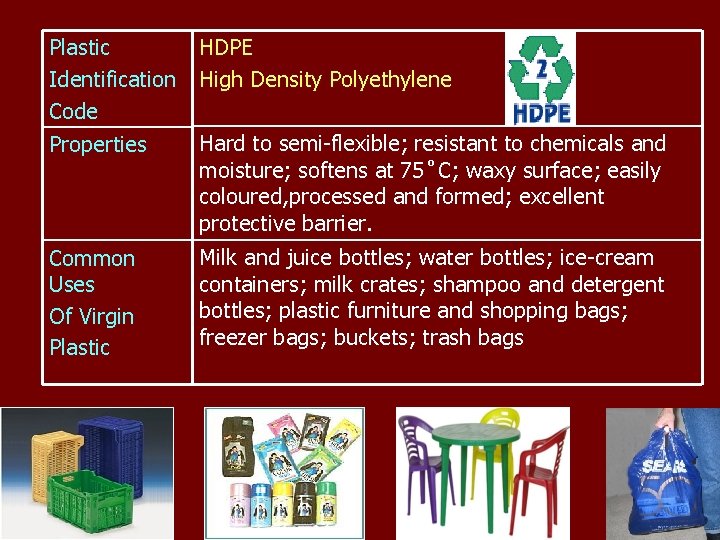
Plastic Identification Code Properties HDPE High Density Polyethylene Common Uses Of Virgin Plastic Milk and juice bottles; water bottles; ice-cream containers; milk crates; shampoo and detergent bottles; plastic furniture and shopping bags; freezer bags; buckets; trash bags Hard to semi-flexible; resistant to chemicals and moisture; softens at 75 C; waxy surface; easily coloured, processed and formed; excellent protective barrier.
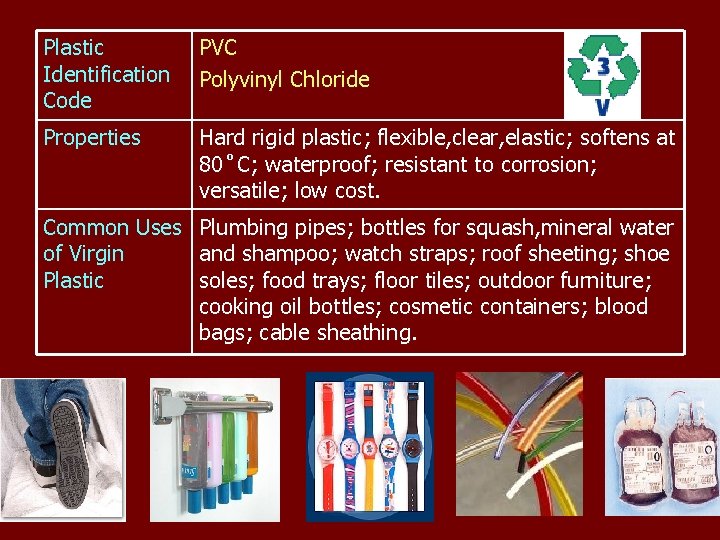
Plastic Identification Code PVC Polyvinyl Chloride Properties Hard rigid plastic; flexible, clear, elastic; softens at 80 C; waterproof; resistant to corrosion; versatile; low cost. Common Uses of Virgin Plastic Plumbing pipes; bottles for squash, mineral water and shampoo; watch straps; roof sheeting; shoe soles; food trays; floor tiles; outdoor furniture; cooking oil bottles; cosmetic containers; blood bags; cable sheathing.
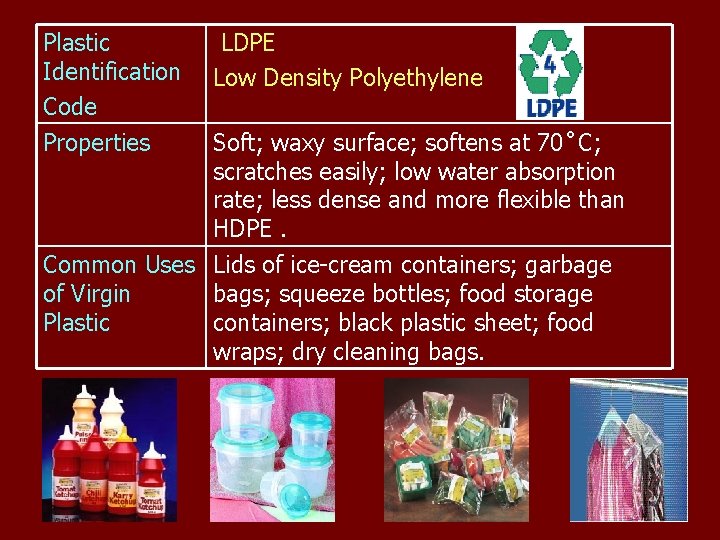
Plastic Identification Code Properties LDPE Low Density Polyethylene Soft; waxy surface; softens at 70 C; scratches easily; low water absorption rate; less dense and more flexible than HDPE. Common Uses Lids of ice-cream containers; garbage of Virgin bags; squeeze bottles; food storage Plastic containers; black plastic sheet; food wraps; dry cleaning bags.
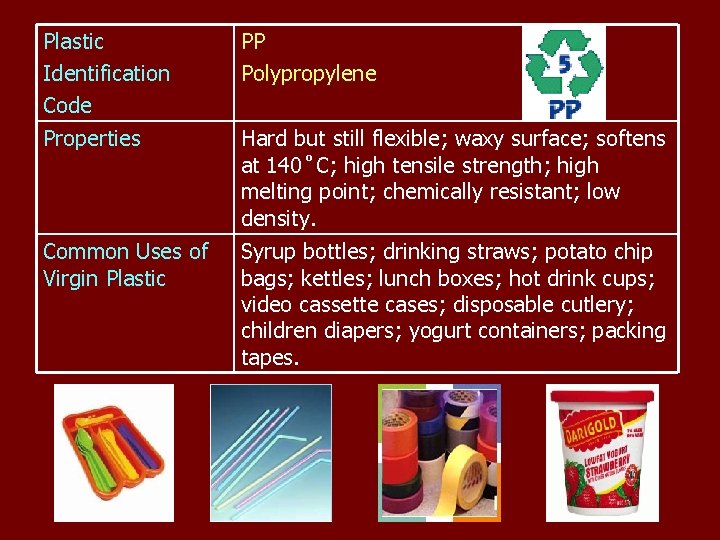
Plastic Identification Code Properties Common Uses of Virgin Plastic PP Polypropylene Hard but still flexible; waxy surface; softens at 140 C; high tensile strength; high melting point; chemically resistant; low density. Syrup bottles; drinking straws; potato chip bags; kettles; lunch boxes; hot drink cups; video cassette cases; disposable cutlery; children diapers; yogurt containers; packing tapes.
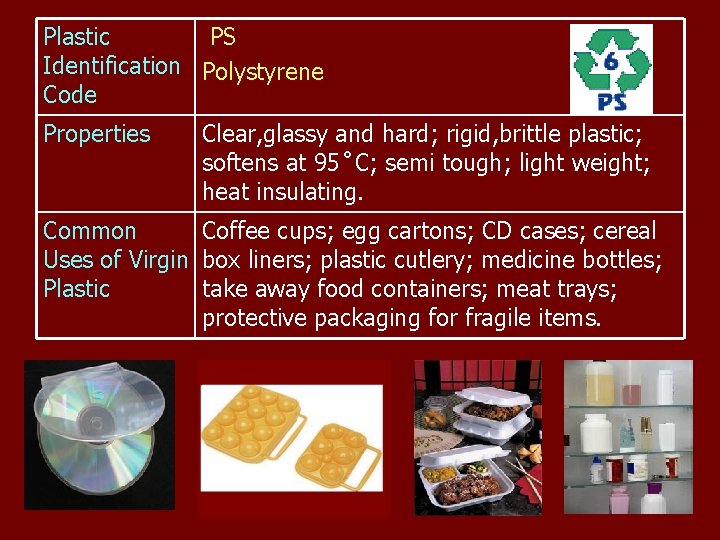
Plastic PS Identification Polystyrene Code Properties Clear, glassy and hard; rigid, brittle plastic; softens at 95 C; semi tough; light weight; heat insulating. Common Uses of Virgin Plastic Coffee cups; egg cartons; CD cases; cereal box liners; plastic cutlery; medicine bottles; take away food containers; meat trays; protective packaging for fragile items.
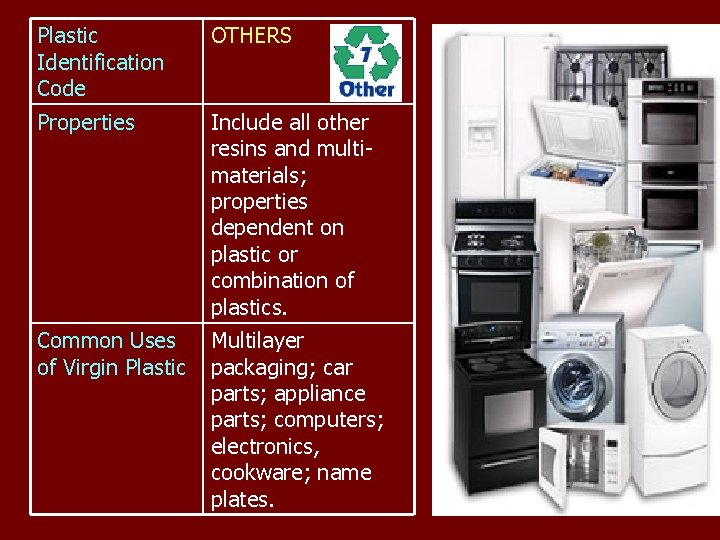
Plastic Identification Code Properties Common Uses of Virgin Plastic OTHERS Include all other resins and multimaterials; properties dependent on plastic or combination of plastics. Multilayer packaging; car parts; appliance parts; computers; electronics, cookware; name plates.
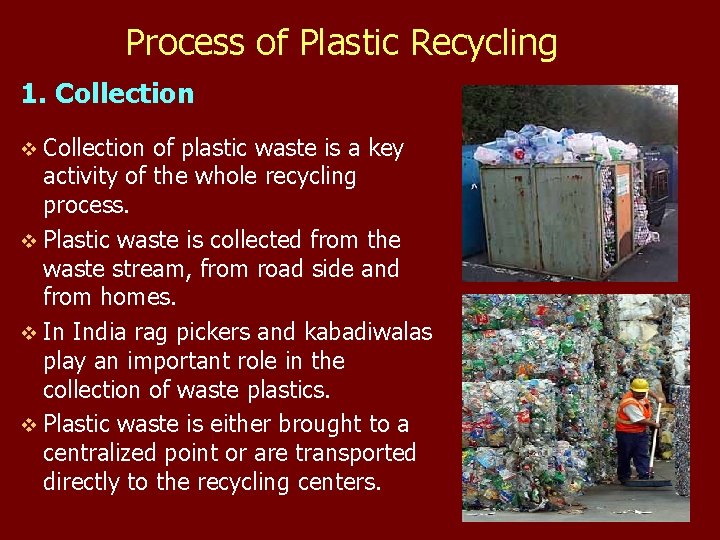
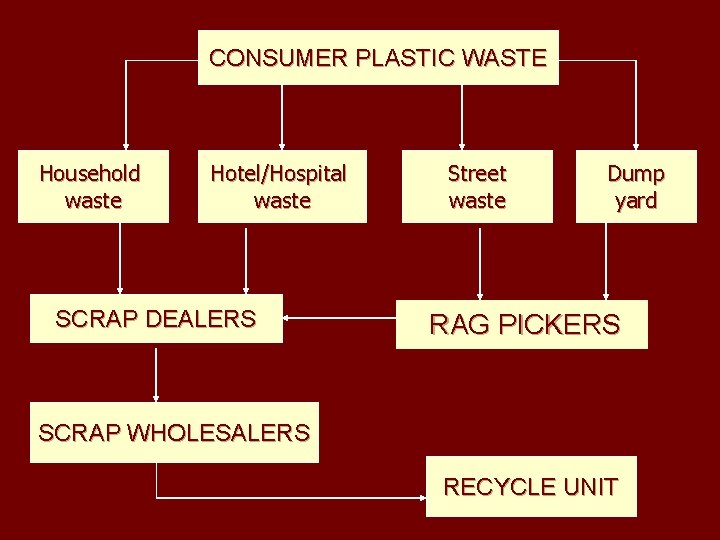
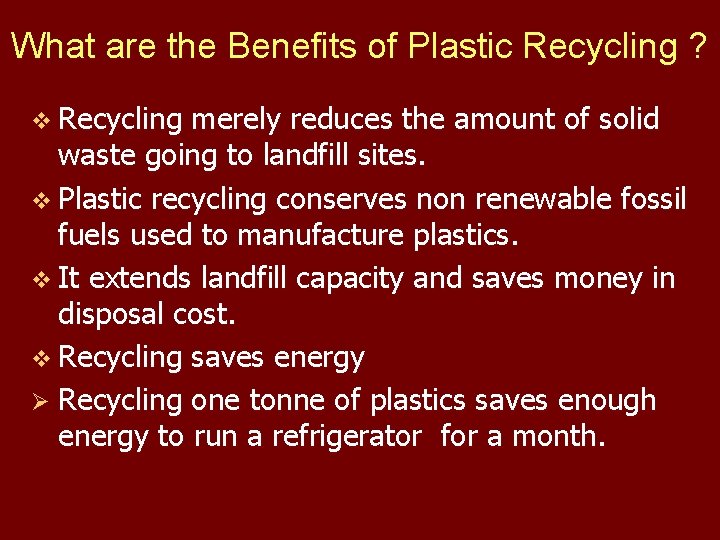
Process of Plastic Recycling 1. Collection v Collection of plastic waste is a key activity of the whole recycling process. v Plastic waste is collected from the waste stream, from road side and from homes. v In India rag pickers and kabadiwalas play an important role in the collection of waste plastics. v Plastic waste is either brought to a centralized point or are transported directly to the recycling centers.
CONSUMER PLASTIC WASTE Household waste Hotel/Hospital waste SCRAP DEALERS Street waste Dump yard RAG PICKERS SCRAP WHOLESALERS RECYCLE UNIT
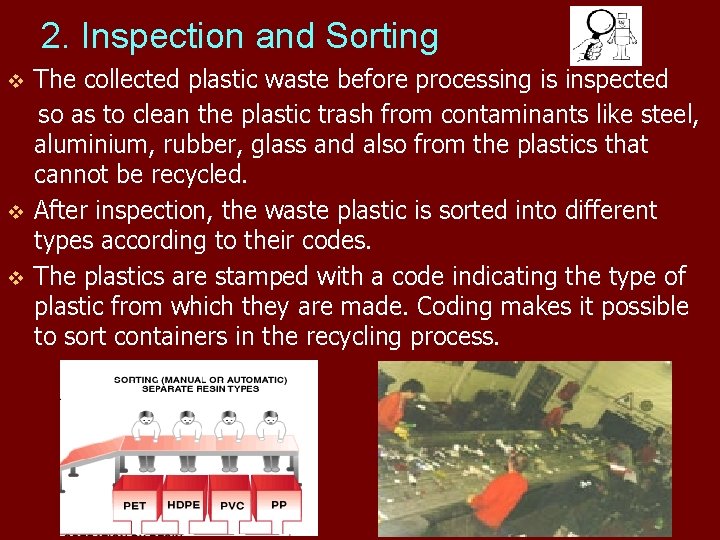
2. Inspection and Sorting The collected plastic waste before processing is inspected so as to clean the plastic trash from contaminants like steel, aluminium, rubber, glass and also from the plastics that cannot be recycled. v After inspection, the waste plastic is sorted into different types according to their codes. v The plastics are stamped with a code indicating the type of plastic from which they are made. Coding makes it possible to sort containers in the recycling process. v
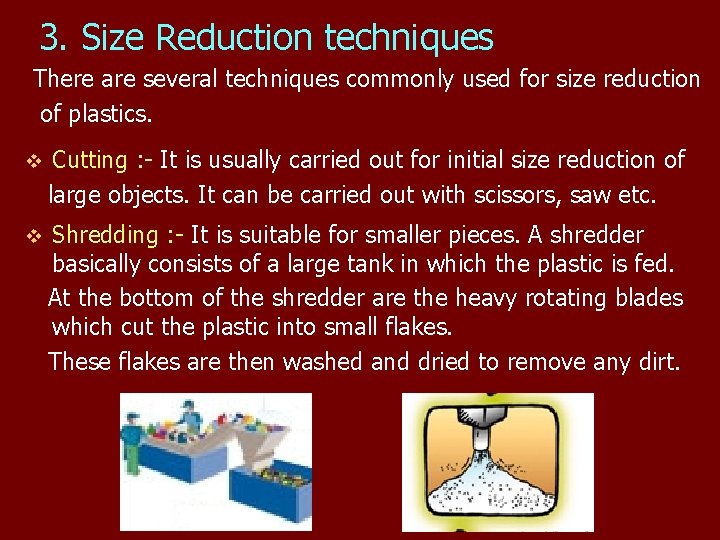
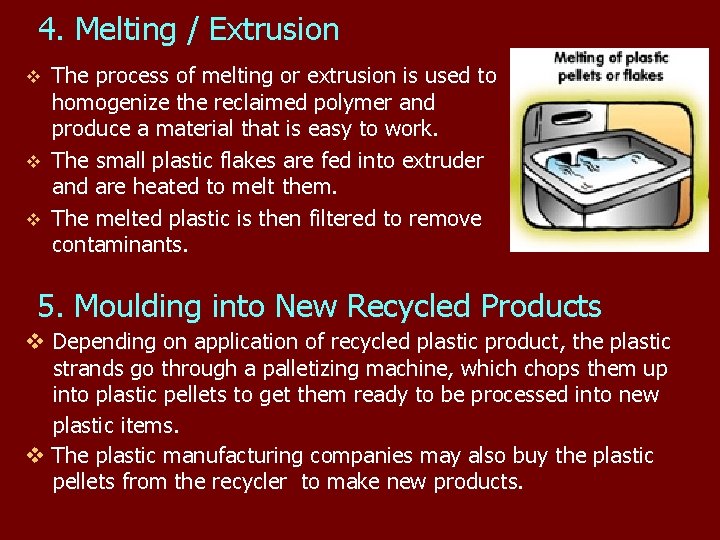
3. Size Reduction techniques There are several techniques commonly used for size reduction of plastics. v Cutting : - It is usually carried out for initial size reduction of large objects. It can be carried out with scissors, saw etc. v Shredding : - It is suitable for smaller pieces. A shredder basically consists of a large tank in which the plastic is fed. At the bottom of the shredder are the heavy rotating blades which cut the plastic into small flakes. These flakes are then washed and dried to remove any dirt.
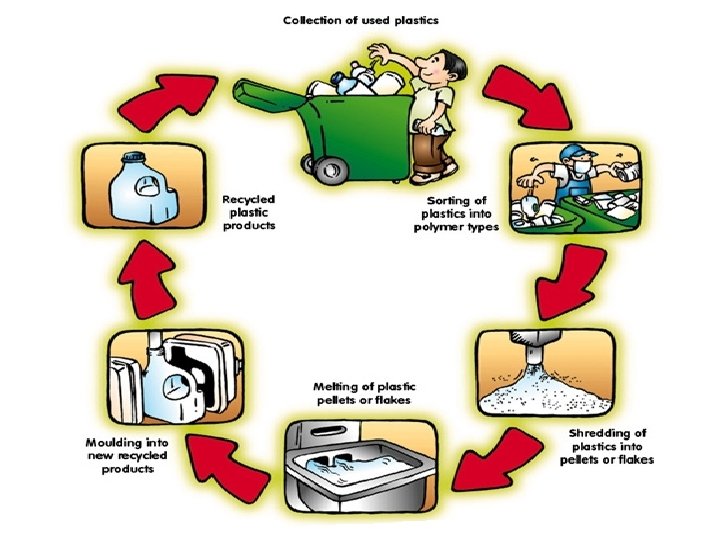
4. Melting / Extrusion The process of melting or extrusion is used to homogenize the reclaimed polymer and produce a material that is easy to work. v The small plastic flakes are fed into extruder and are heated to melt them. v The melted plastic is then filtered to remove contaminants. v 5. Moulding into New Recycled Products v Depending on application of recycled plastic product, the plastic strands go through a palletizing machine, which chops them up into plastic pellets to get them ready to be processed into new plastic items. v The plastic manufacturing companies may also buy the plastic pellets from the recycler to make new products.
What are the Benefits of Plastic Recycling ? v Recycling merely reduces the amount of solid waste going to landfill sites. v Plastic recycling conserves non renewable fossil fuels used to manufacture plastics. v It extends landfill capacity and saves money in disposal cost. v Recycling saves energy Ø Recycling one tonne of plastics saves enough energy to run a refrigerator for a month.
v Manufacturing plastics from recycled materials use only 30% of the energy required to make virgin plastic products from fossil fuels. v Plastic containers get turned into new products at a much lower rate than glass bottles. v It also creates jobs. v Recycling provides a reliable, cost effective feed stock to plastic industry. v Recycled plastic products is used in various fields.
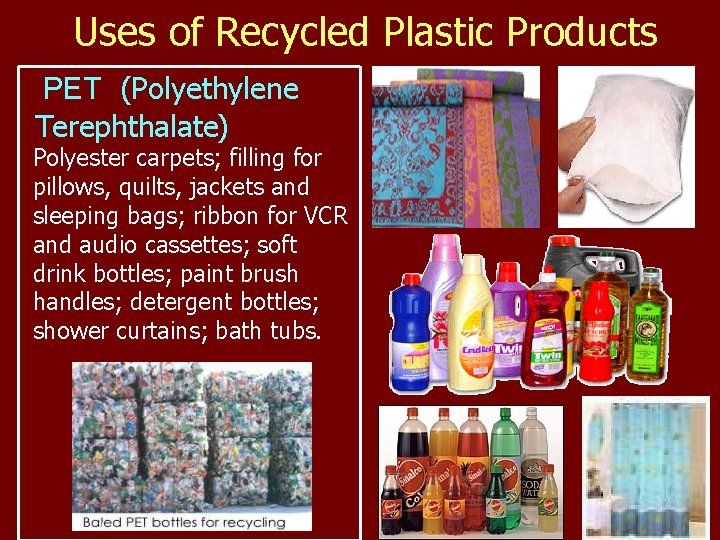
Uses of Recycled Plastic Products PET (Polyethylene Terephthalate) Polyester carpets; filling for pillows, quilts, jackets and sleeping bags; ribbon for VCR and audio cassettes; soft drink bottles; paint brush handles; detergent bottles; shower curtains; bath tubs.
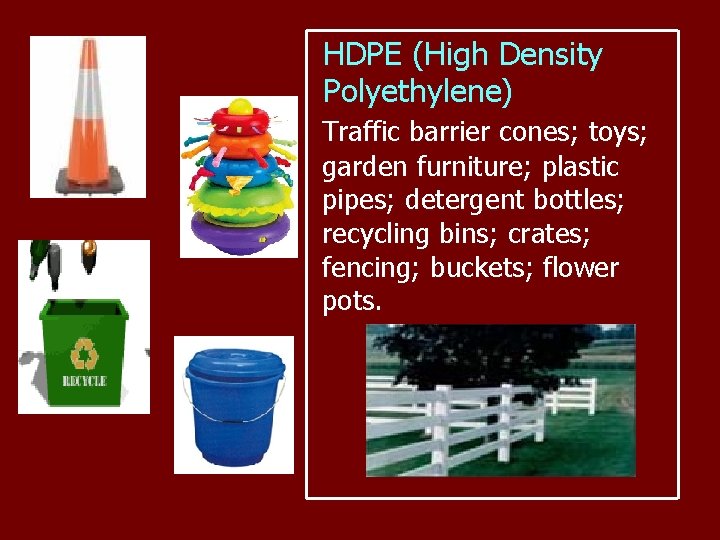
HDPE (High Density Polyethylene) Traffic barrier cones; toys; garden furniture; plastic pipes; detergent bottles; recycling bins; crates; fencing; buckets; flower pots.
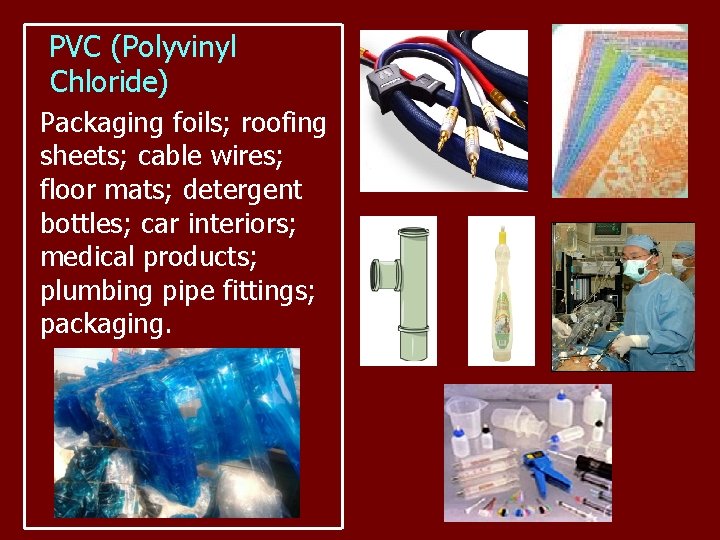
PVC (Polyvinyl Chloride) Packaging foils; roofing sheets; cable wires; floor mats; detergent bottles; car interiors; medical products; plumbing pipe fittings; packaging.
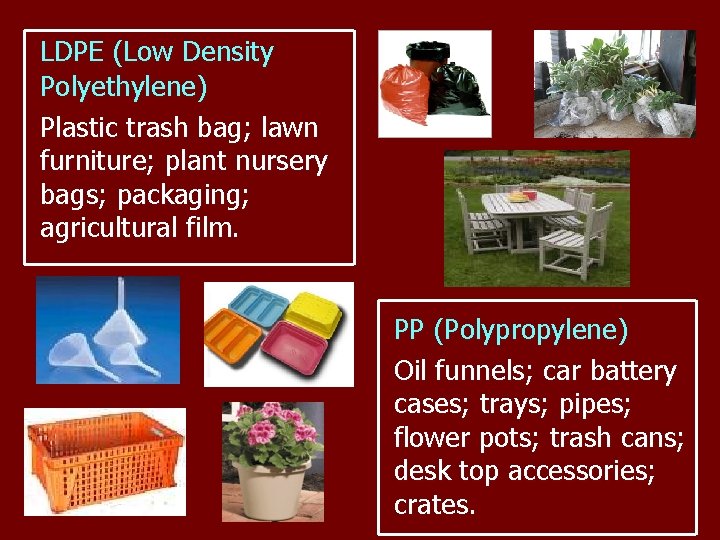
LDPE (Low Density Polyethylene) Plastic trash bag; lawn furniture; plant nursery bags; packaging; agricultural film. PP (Polypropylene) Oil funnels; car battery cases; trays; pipes; flower pots; trash cans; desk top accessories; crates.
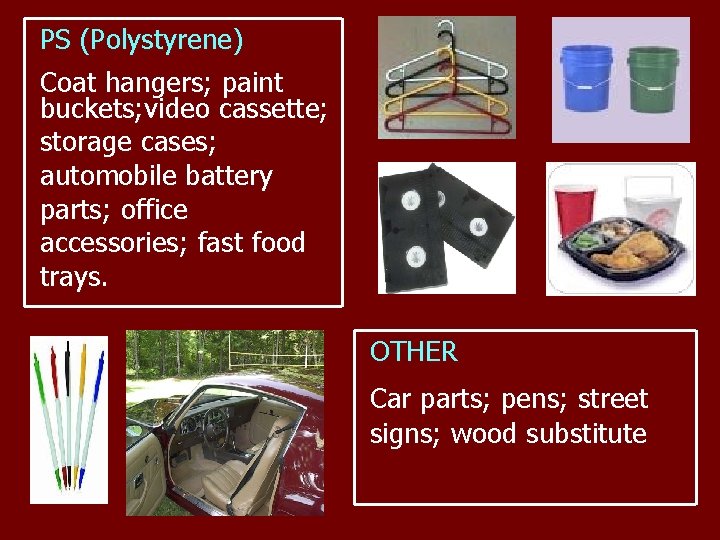
PS (Polystyrene) Coat hangers; paint buckets; video cassette; storage cases; automobile battery parts; office accessories; fast food trays. OTHER Car parts; pens; street signs; wood substitute
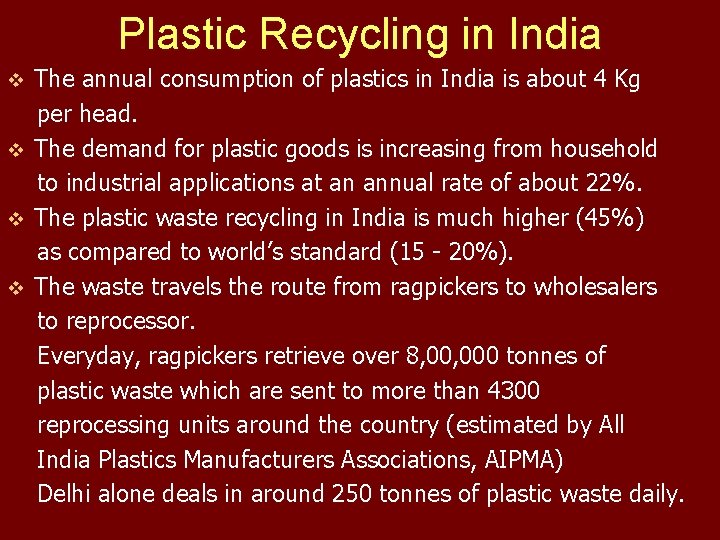
Plastic Recycling in India The annual consumption of plastics in India is about 4 Kg per head. v The demand for plastic goods is increasing from household to industrial applications at an annual rate of about 22%. v The plastic waste recycling in India is much higher (45%) as compared to world’s standard (15 - 20%). v The waste travels the route from ragpickers to wholesalers to reprocessor. Everyday, ragpickers retrieve over 8, 000 tonnes of plastic waste which are sent to more than 4300 reprocessing units around the country (estimated by All India Plastics Manufacturers Associations, AIPMA) Delhi alone deals in around 250 tonnes of plastic waste daily. v
The Recycled Plastics Manufacture and Usage Rules, 1999 v These Rules have been enacted with the aim to prohibit the use of carry bags or containers made of recycled plastics for storing, carrying, dispensing or packaging of foodstuffs. v These Rules prescribe conditions for manufacturing of carry bags and container of plastics. v The recycling of plastic shall be undertaken strictly in accordance with the Bureau of Indian Standards specifications. v Minimum thickness of carry bags made of virgin plastics or recycled plastics shall not be less than 20 microns.
Why Can’t We Recycle More ? v v v v Recycling plastics is difficult because the plastic waste that comes through is a mixture of plastics having different properties. The waste plastic which is collected and used for recycling is highly contaminated. Another problem in recycling is sorting of plastic waste, as it is labour intensive. Task of recycling is further complicated due to multilayer packaging. The useful life of plastic is extremely limited, after which it must be landfilled. Not all plastics lend themselves to recycling. The economics of recycling plastics are not always favourable.
What Can We Do ? v v v v Choose the goods with minimal packaging, and which are packed in a material that can be recycled. Try to reduce the need to throw away the plastics. Separate plastic that can be recycled from other trash. Rather than throwing them away, give plastic toys or containers to children scrap stores or playgroups for reuse. Use plastic containers and bags again or make them into something else. Buy products that can be refilled. Close the recycling loop by buying the plastic recycling products. Role of Manufacturers / Industries v Manufacturers should seek viable, cost effective products that use recycled materials and products that are designed for efficient recycling.
v Industries should minimize packaging of products. v Taking up lead role in establishing effecting waste collection system through various projects. Role of Government Govt. should set up and encourage the plastic recycling industries. v Make the polluter pay for the pollution caused. v A small deposit can be charged for the plastic bottles. This way even if some individual litter, there is an incentive for others to pick up the bottles and return them. v v Charge on polythene bags should be kept to ensure that polythene bags will no longer be handed out for free by shopkeepers.
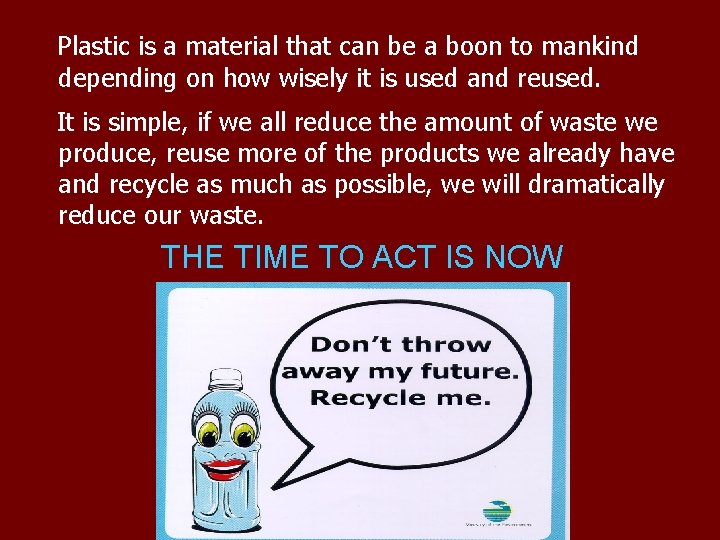
Plastic is a material that can be a boon to mankind depending on how wisely it is used and reused. It is simple, if we all reduce the amount of waste we produce, reuse more of the products we already have and recycle as much as possible, we will dramatically reduce our waste. THE TIME TO ACT IS NOW
References • Jaswal & Jaswal; Environmental Law; Page 383 -385; 2006; Pioneer Publications; Delhi • Indian Centre for Plastics in the Environment & Central Institute of Plastics Engineering & Technology; Plastics for Environment & Sustainable Development; 2003; Thomson Press (India) Limited; New Delhi • NIIR Board; Modern Technology of Waste Management : Pollution Control, Recycling, Treatment & Utilization; Page 275 -337; 2003; Asia Pacific Business Press; Delhi Smith. W. Mayo; Manufacture of Plastics; 1964; Wilton www. Central Pollution Control Board. Org www. Ecofacts: Plastics. org www. Energy Kids Page. org www. ENVIS-ICPE. htm www. ewswa. org www. globaleye. org www. makingindiagreen. org • •
• www. municipal Solid waste – recycling. Org • www. plastics. org • www. plasticrecyclers. com • www. plastic recycling – Wikipedia, the free encyclopedia. htm • www. recycling. Org • www. recycle. net/recycle/Plastic. org • www. recycling plastics – CSM Earthworks Club. org • www. recycling-saves resources. org • www. vigyanprasar. com • www. wasteonline. org • www. wastewatch. org • www. waste Management. org
Thank You