
Plasma Window Options and Opportunities for Inertial Fusion


- Slides: 17
Plasma Window Options and Opportunities for Inertial Fusion Applications Leslie Bromberg Ady Herskovitch* MIT Plasma Science and Fusion Center ARIES meeting UCSD January 10 -11, 2002 *Brookhaven National Laboratory, NY
HIBD-Chamber Vacuum Interface • Heavy Ion Beam Driver requires high vacuum for operation • 10 -6 -10 -9 Torr • Chamber operation requires low to intermediate vacuum • 10 -3 - 10 Torr • Because of the large openings required for beam propagation, large gas throughput across the HIB final focus and the chamber exits • Large vacuum pumping speeds required • Not clear whether it is possible to maintain that large pressure differential with the available space for pumps.
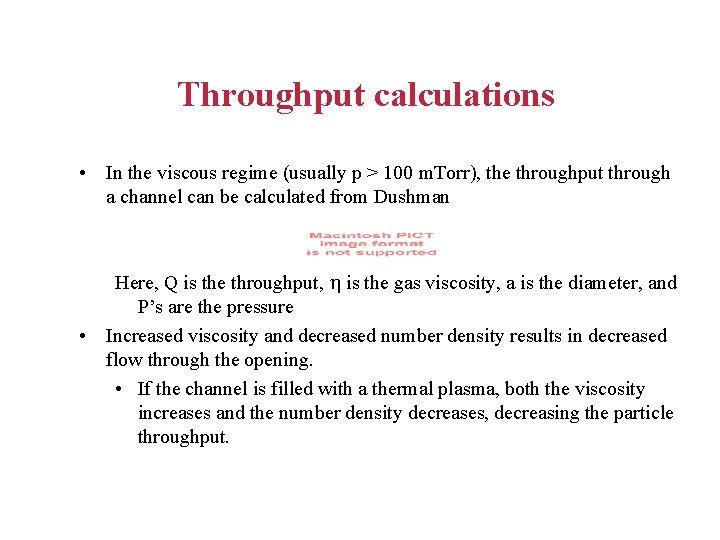
Throughput calculations • In the viscous regime (usually p > 100 m. Torr), the throughput through a channel can be calculated from Dushman Here, Q is the throughput, h is the gas viscosity, a is the diameter, and P’s are the pressure • Increased viscosity and decreased number density results in decreased flow through the opening. • If the channel is filled with a thermal plasma, both the viscosity increases and the number density decreases, decreasing the particle throughput.
Plasma Window • Under certain circumstances, plasmas can function as vacuum windows. • plasmas can be confined in vacuum (by electric and magnetic fields) with minimal wall contact • provide increased impedance to balance large pressure differential • This ‘plasma window’ establishes a barrier to gas flow creating a hot plasma discharge that results in • higher effective viscosity • lower number density • Plasma windows can separate • high pressure and atmosphere • high and low vacuum
Schematic of plasma window operation
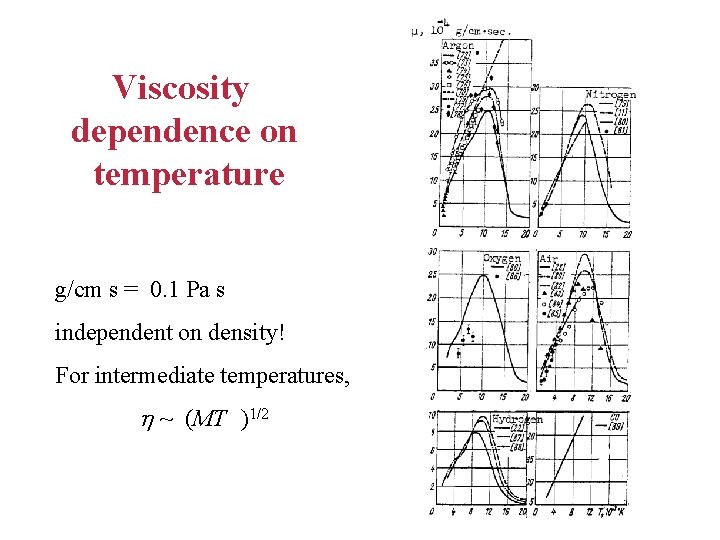
Viscosity dependence on temperature g/cm s = 0. 1 Pa s independent on density! For intermediate temperatures, h ~ (MT )1/2
Plasma window diagram
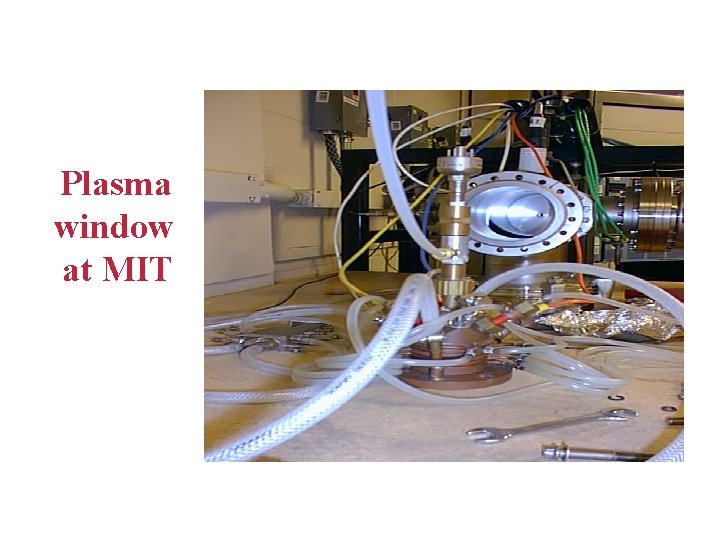
Plasma window at MIT
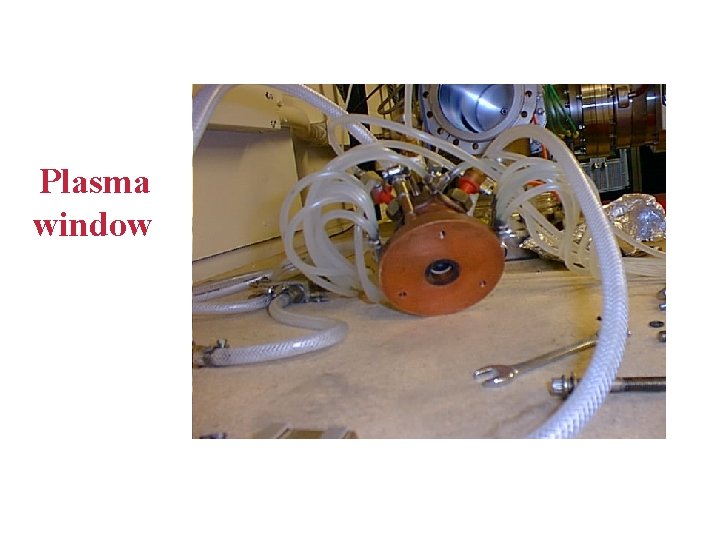
Plasma window
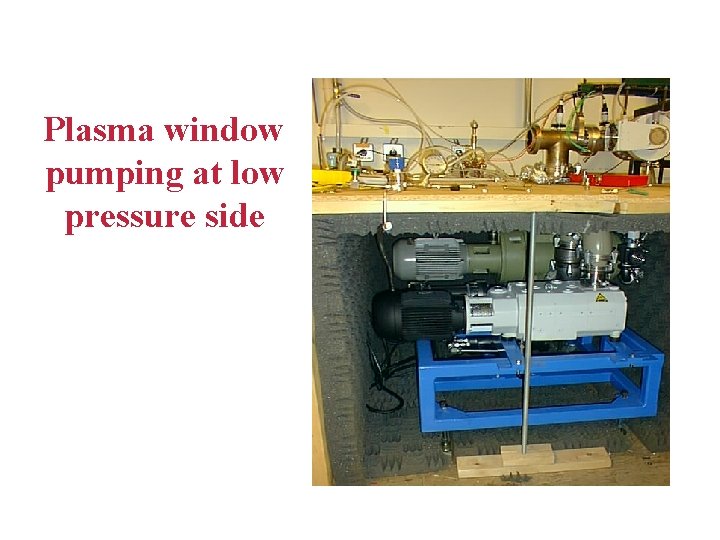
Plasma window pumping at low pressure side
Plasma window parameters • Limited experience with arc diameter • range from 2 mm to 11 mm in diameter. • Electrical power consumption scales roughly as the arc diameter • 10 k. W/cm of arc diameter. • 7. 5 k. W/cm of arc diameter if venturi is used in the high pressure chamber
Plasma windows experience • Best high-pressure results obtained to-date using argon as both the highpressure, the low pressure and the arc gas. • High pressure to atmospheric pressure • 5 bar chamber separated from 1 bar chamber • 2. 85 bar absolute was isolated from 0. 6 mbar • The use of atmospheric arc plasmas to establish a vacuum-atmosphere interface been demonstrated • 2. 36 -mm diameter 40 - mm long arc. • When coupled to a three-stage differential pumping system the background pressure of 5 x 10 -9 bar was reached • Results recently duplicated with a 5 - mm diameter 30 - mm long arc. • rf emission from the arc is negligible
Particle/photon transport through plasma window • Transport of particles through plasma windows has been demonstrated • 175 ke. V electron beam was transported from the vacuum into the atmosphere • 2 Me. V proton beam was successfully transmitted through a plasma window with negligible energy losses • X-ray transmission experiments through a plasma window were performed at the National Synchrotron Light Source (NSLS) at BNL • National Spallation Neutron Source and some of its experiments ad planning to use the plasma window concept • 2 - inch diameter plasma window is being considered for a 1 -inch proton beam
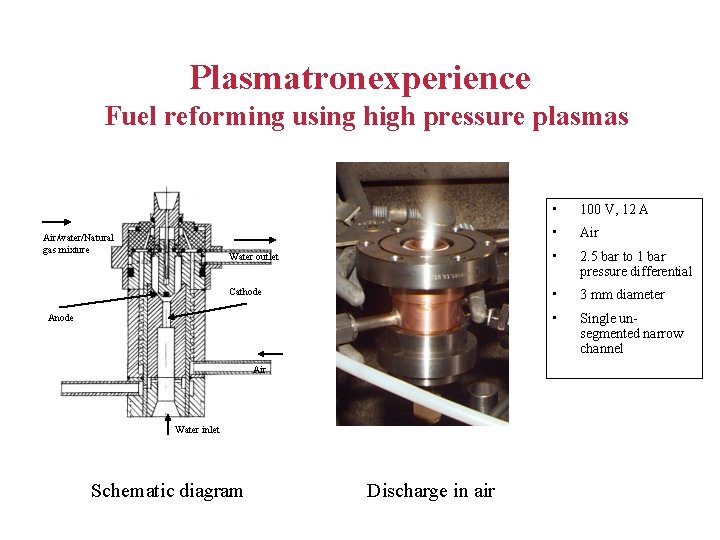
Plasmatronexperience Fuel reforming using high pressure plasmas Air/water/Natural gas mixture • 100 V, 12 A • Air Water outlet • 2. 5 bar to 1 bar pressure differential Cathode • 3 mm diameter • Single unsegmented narrow channel Anode Air Water inlet Schematic diagram Discharge in air
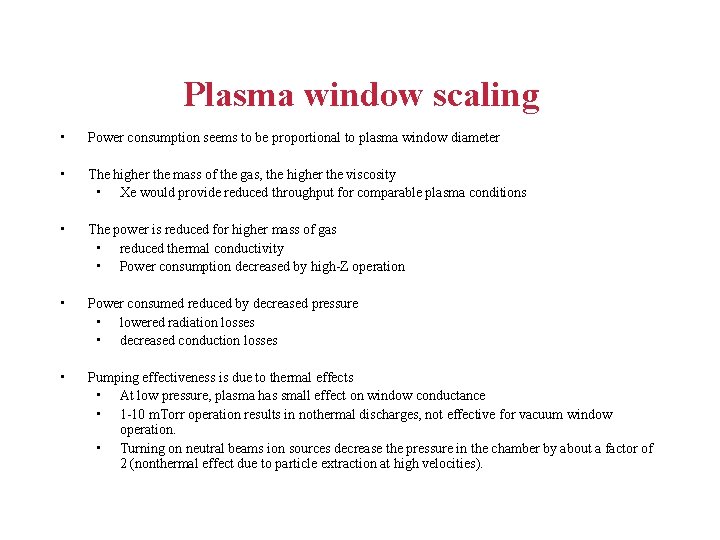
Plasma window scaling • Power consumption seems to be proportional to plasma window diameter • The higher the mass of the gas, the higher the viscosity • Xe would provide reduced throughput for comparable plasma conditions • The power is reduced for higher mass of gas • reduced thermal conductivity • Power consumption decreased by high-Z operation • Power consumed reduced by decreased pressure • lowered radiation losses • decreased conduction losses • Pumping effectiveness is due to thermal effects • At low pressure, plasma has small effect on window conductance • 1 -10 m. Torr operation results in nothermal discharges, not effective for vacuum window operation. • Turning on neutral beams ion sources decrease the pressure in the chamber by about a factor of 2 (nonthermal effect due to particle extraction at high velocities).
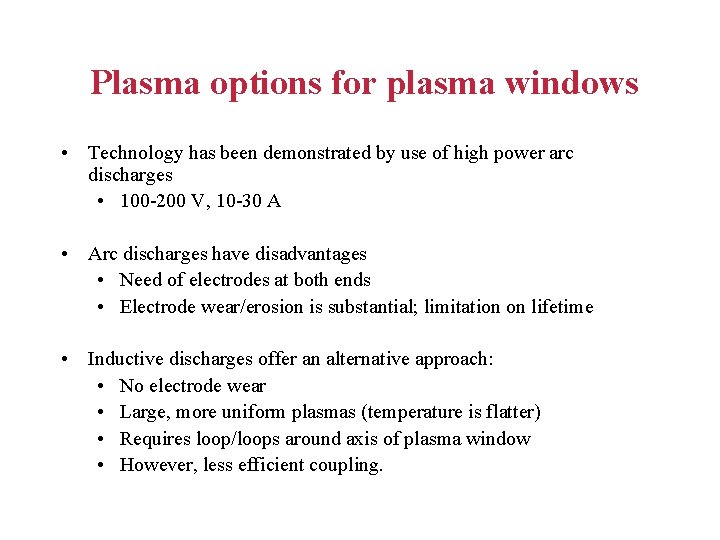
Plasma options for plasma windows • Technology has been demonstrated by use of high power arc discharges • 100 -200 V, 10 -30 A • Arc discharges have disadvantages • Need of electrodes at both ends • Electrode wear/erosion is substantial; limitation on lifetime • Inductive discharges offer an alternative approach: • No electrode wear • Large, more uniform plasmas (temperature is flatter) • Requires loop/loops around axis of plasma window • However, less efficient coupling.
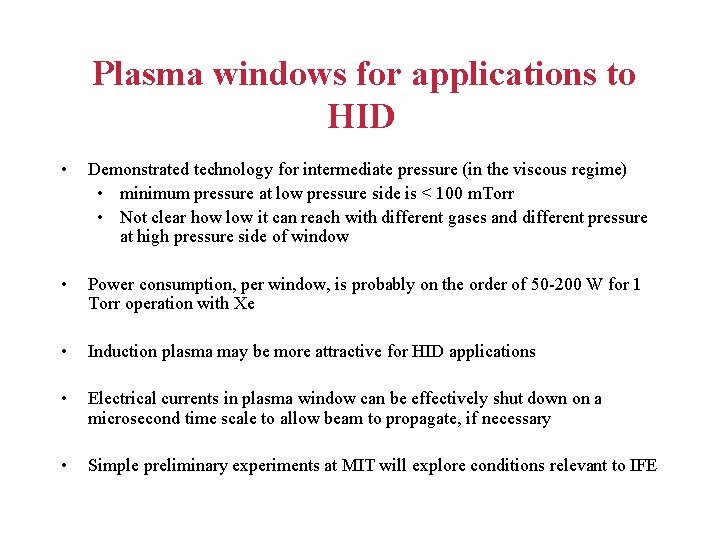
Plasma windows for applications to HID • Demonstrated technology for intermediate pressure (in the viscous regime) • minimum pressure at low pressure side is < 100 m. Torr • Not clear how low it can reach with different gases and different pressure at high pressure side of window • Power consumption, per window, is probably on the order of 50 -200 W for 1 Torr operation with Xe • Induction plasma may be more attractive for HID applications • Electrical currents in plasma window can be effectively shut down on a microsecond time scale to allow beam to propagate, if necessary • Simple preliminary experiments at MIT will explore conditions relevant to IFE