
PLASMA PROPAGATION THROUGH POROUS BONE SCAFFOLDING Runchu Ma
PLASMA PROPAGATION THROUGH POROUS BONE SCAFFOLDING* Runchu Ma, Juliusz Kruszelnicki and Mark J. Kushner University of Michigan, Ann Arbor, MI 48109 -2122 USA runma@umich. edu, jkrusze@umich. edu, mjkush@umich. edu 71 st Gaseous Electronic Conference Portland, Oregon USA * Work supported by the Department of Energy Office of Fusion Energy Science and the National Science Foundation
AGENDA · · · GEC_2018 Plasma treatment of tissue scaffolds Model description and initial conditions Base case and surface electron distributions Angle of pore chain and size of pore openings Concluding Remarks University of Michigan Institute for Plasma Science & Engr.
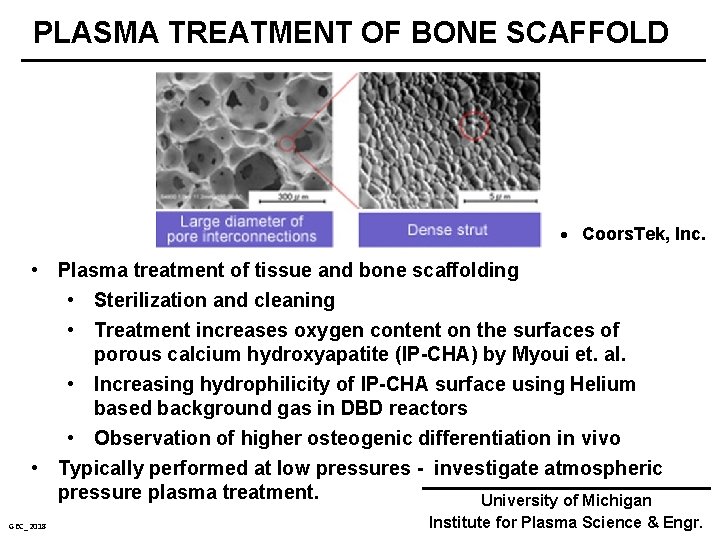
PLASMA TREATMENT OF BONE SCAFFOLD · Coors. Tek, Inc. • Plasma treatment of tissue and bone scaffolding • Sterilization and cleaning • Treatment increases oxygen content on the surfaces of porous calcium hydroxyapatite (IP-CHA) by Myoui et. al. • Increasing hydrophilicity of IP-CHA surface using Helium based background gas in DBD reactors • Observation of higher osteogenic differentiation in vivo • Typically performed at low pressures - investigate atmospheric pressure plasma treatment. University of Michigan GEC_2018 Institute for Plasma Science & Engr.
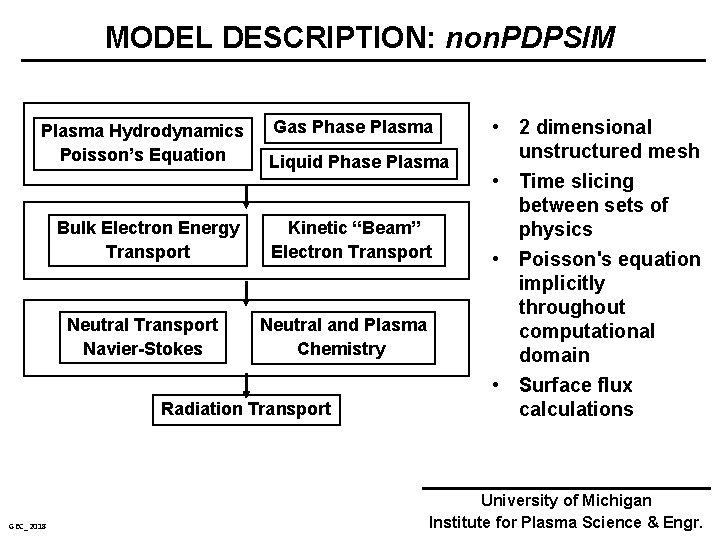
MODEL DESCRIPTION: non. PDPSIM Plasma Hydrodynamics Poisson’s Equation Bulk Electron Energy Transport Neutral Transport Navier-Stokes Gas Phase Plasma Liquid Phase Plasma Kinetic “Beam” Electron Transport Neutral and Plasma Chemistry Radiation Transport GEC_2018 • 2 dimensional unstructured mesh • Time slicing between sets of physics • Poisson's equation implicitly throughout computational domain • Surface flux calculations University of Michigan Institute for Plasma Science & Engr.
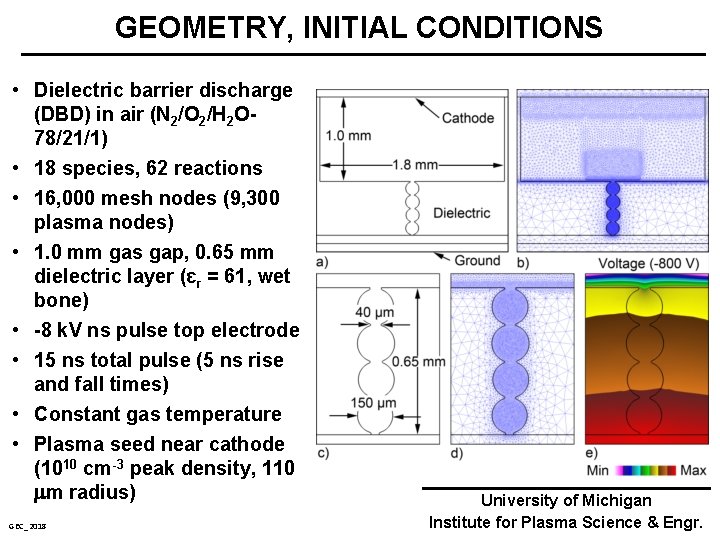
GEOMETRY, INITIAL CONDITIONS • Dielectric barrier discharge (DBD) in air (N 2/O 2/H 2 O 78/21/1) • 18 species, 62 reactions • 16, 000 mesh nodes (9, 300 plasma nodes) • 1. 0 mm gas gap, 0. 65 mm dielectric layer (ԑr = 61, wet bone) • -8 k. V ns pulse top electrode • 15 ns total pulse (5 ns rise and fall times) • Constant gas temperature • Plasma seed near cathode (1010 cm-3 peak density, 110 m radius) GEC_2018 University of Michigan Institute for Plasma Science & Engr.
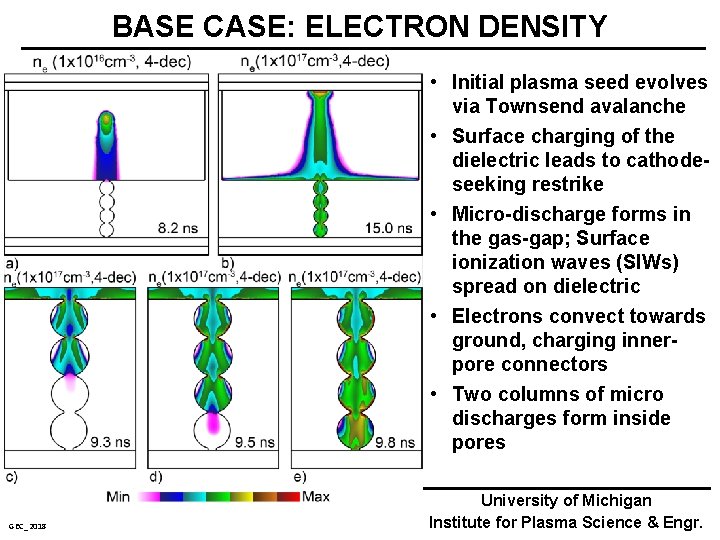
BASE CASE: ELECTRON DENSITY • Initial plasma seed evolves via Townsend avalanche • Surface charging of the dielectric leads to cathodeseeking restrike • Micro-discharge forms in the gas-gap; Surface ionization waves (SIWs) spread on dielectric • Electrons convect towards ground, charging innerpore connectors • Two columns of micro discharges form inside pores GEC_2018 University of Michigan Institute for Plasma Science & Engr.
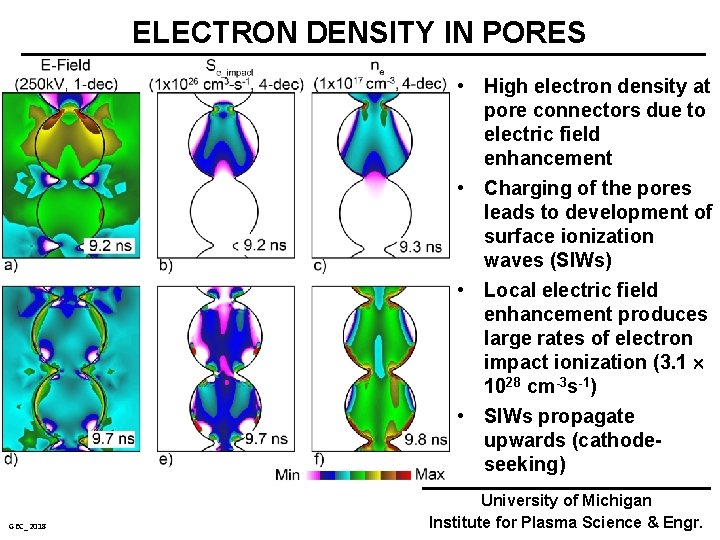
ELECTRON DENSITY IN PORES • High electron density at pore connectors due to electric field enhancement • Charging of the pores leads to development of surface ionization waves (SIWs) • Local electric field enhancement produces large rates of electron impact ionization (3. 1 1028 cm-3 s-1) • SIWs propagate upwards (cathodeseeking) GEC_2018 University of Michigan Institute for Plasma Science & Engr.
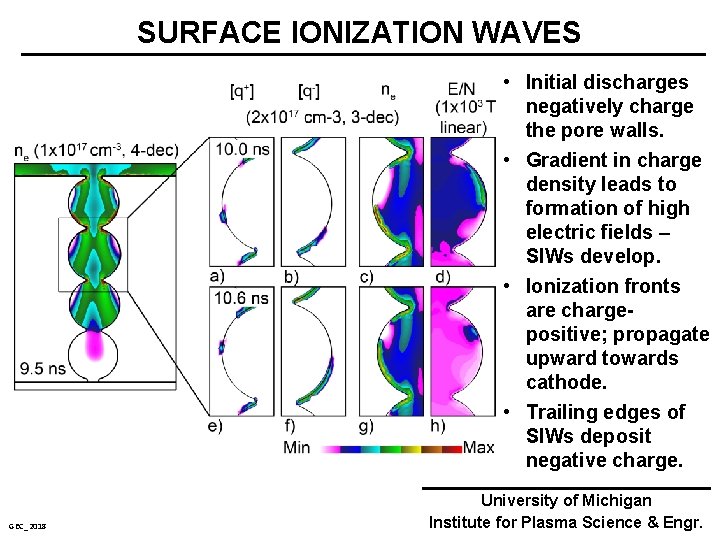
SURFACE IONIZATION WAVES • Initial discharges negatively charge the pore walls. • Gradient in charge density leads to formation of high electric fields – SIWs develop. • Ionization fronts are chargepositive; propagate upward towards cathode. • Trailing edges of SIWs deposit negative charge. GEC_2018 University of Michigan Institute for Plasma Science & Engr.
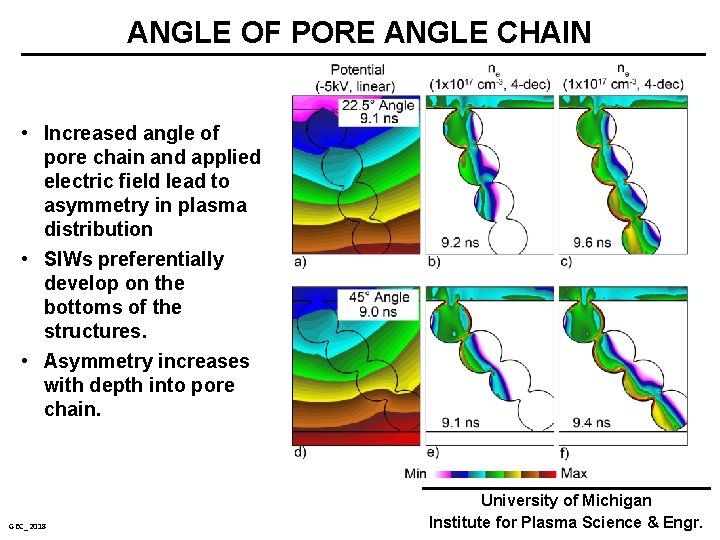
ANGLE OF PORE ANGLE CHAIN • Increased angle of pore chain and applied electric field lead to asymmetry in plasma distribution • SIWs preferentially develop on the bottoms of the structures. • Asymmetry increases with depth into pore chain. GEC_2018 University of Michigan Institute for Plasma Science & Engr.
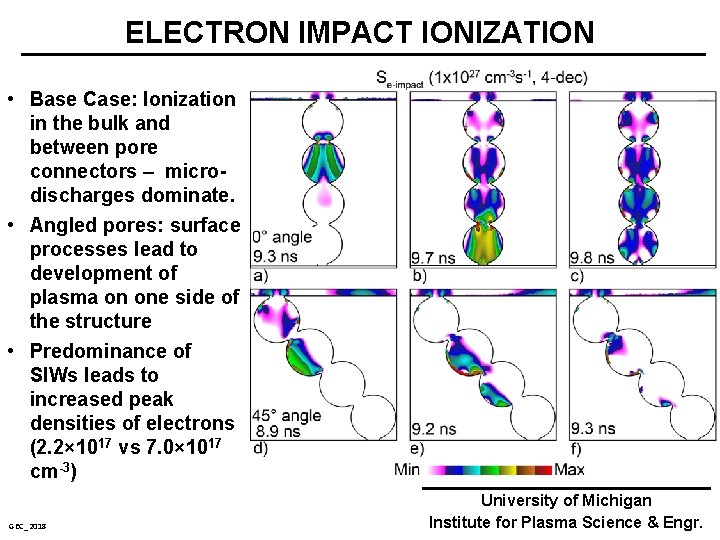
ELECTRON IMPACT IONIZATION • Base Case: Ionization in the bulk and between pore connectors – microdischarges dominate. • Angled pores: surface processes lead to development of plasma on one side of the structure • Predominance of SIWs leads to increased peak densities of electrons (2. 2× 10¹⁷ vs 7. 0× 1017 cm-3) GEC_2018 University of Michigan Institute for Plasma Science & Engr.
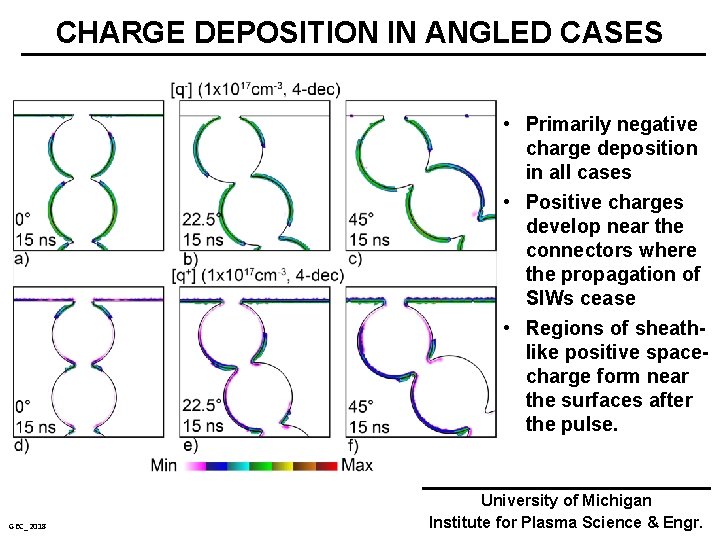
CHARGE DEPOSITION IN ANGLED CASES • Primarily negative charge deposition in all cases • Positive charges develop near the connectors where the propagation of SIWs cease • Regions of sheathlike positive spacecharge form near the surfaces after the pulse. GEC_2018 University of Michigan Institute for Plasma Science & Engr.

PLASMA ON DIELECTRIC LAYER • Asymmetry in topology leads to variation in potential distribution on top of dielectric layer • Larger asymmetry of the main discharge column • Less uniformity in electron distribution as discharges are more surface driven in higher-degree angled cases GEC_2018 University of Michigan Institute for Plasma Science & Engr.
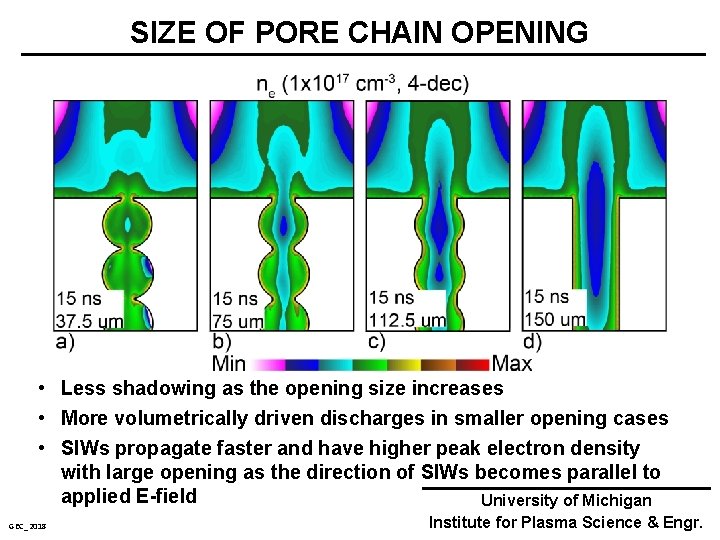
SIZE OF PORE CHAIN OPENING • Less shadowing as the opening size increases • More volumetrically driven discharges in smaller opening cases • SIWs propagate faster and have higher peak electron density with large opening as the direction of SIWs becomes parallel to applied E-field University of Michigan GEC_2018 Institute for Plasma Science & Engr.
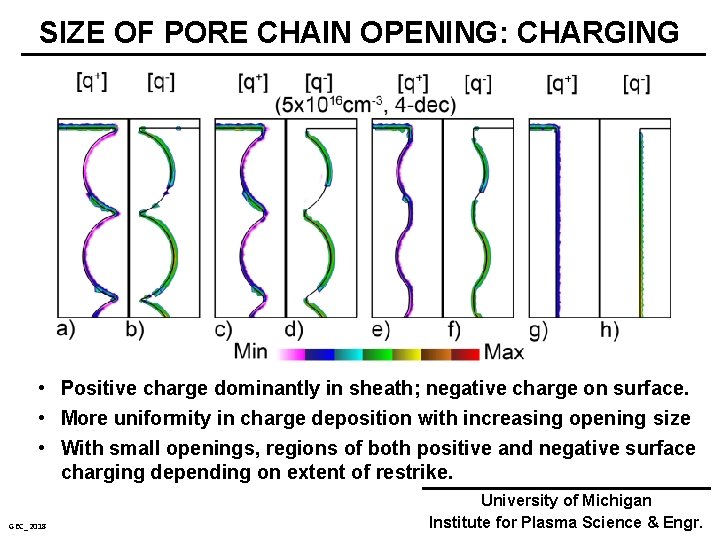
SIZE OF PORE CHAIN OPENING: CHARGING • Positive charge dominantly in sheath; negative charge on surface. • More uniformity in charge deposition with increasing opening size • With small openings, regions of both positive and negative surface charging depending on extent of restrike. GEC_2018 University of Michigan Institute for Plasma Science & Engr.
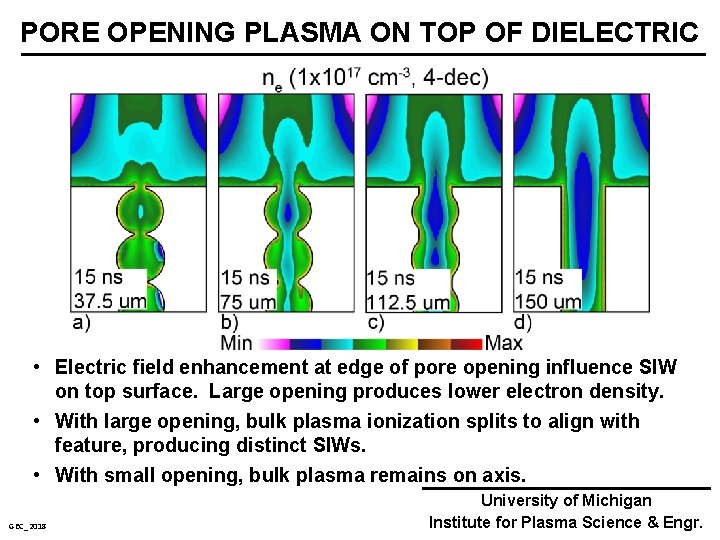
PORE OPENING PLASMA ON TOP OF DIELECTRIC • Electric field enhancement at edge of pore opening influence SIW on top surface. Large opening produces lower electron density. • With large opening, bulk plasma ionization splits to align with feature, producing distinct SIWs. • With small opening, bulk plasma remains on axis. GEC_2018 University of Michigan Institute for Plasma Science & Engr.
CONCLUDING REMARKS • Investigation of atmospheric pressure DBD of pores in ceramic bone scaffolding. • Plasma cascade through interconnected pores, forming columns of micro-discharges in pores • Dominant ionization in pores changes from bulk microplasmas to surface ionization waves as angle of pore chain increases. • Small pore chain openings shadow ionization waves in pores, producing volumetric ionization waves. • Increasing size of pore chain opening produces more surface ionization waves. • Challenging to produce uniform ionization throughout pores at atmospheric pressure. • Though ion fluxes to surface are non-uniform, neutral radical fluxes can be generally more uniform in pores. Atmospheric pressure processing may be viable. GEC_2018 University of Michigan Institute for Plasma Science & Engr.
- Slides: 16