
Plasma membrane structure and function August 27 28
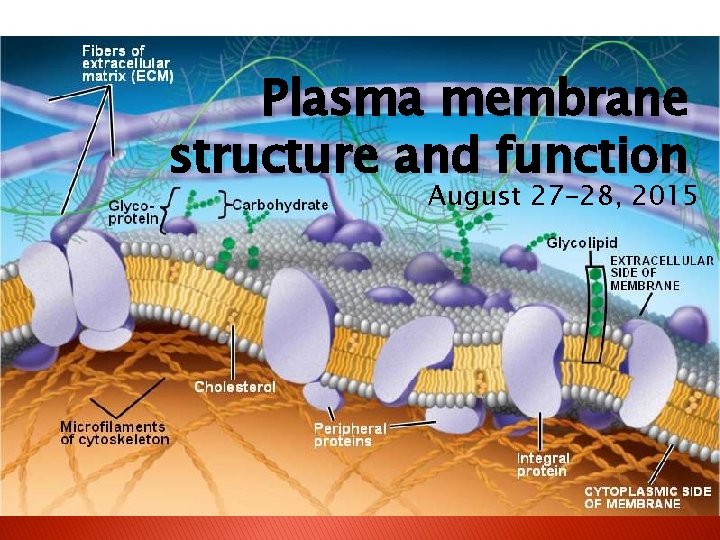
Plasma membrane structure and function August 27 -28, 2015
Plasma Membrane � Selectively permeable barrier between the cell and the environment.
Plasma Membrane � Selectively permeable barrier between the cell and the environment. What does ‘selectively permeable’ mean?
Plasma Membrane � Selectively permeable barrier between the cell and the environment. What does ‘selectively permeable’ mean? Only some materials can cross the membrane Selective permeability is necessary for the cell to maintain the correct internal environment for physiological functions.
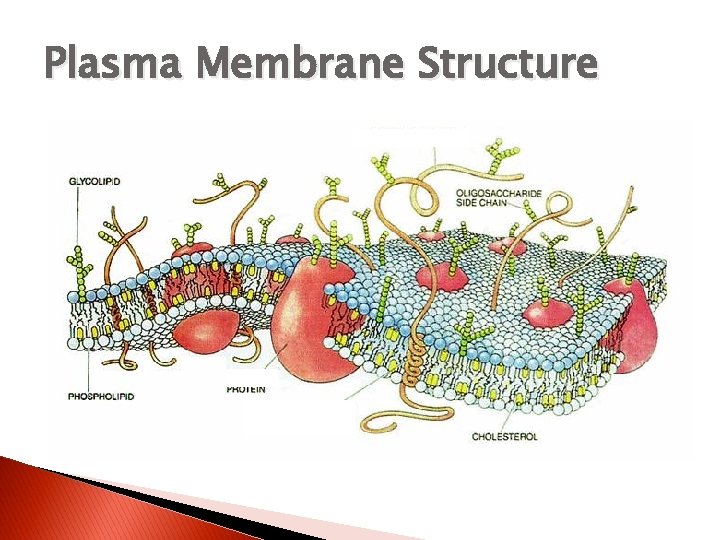
Plasma Membrane Structure
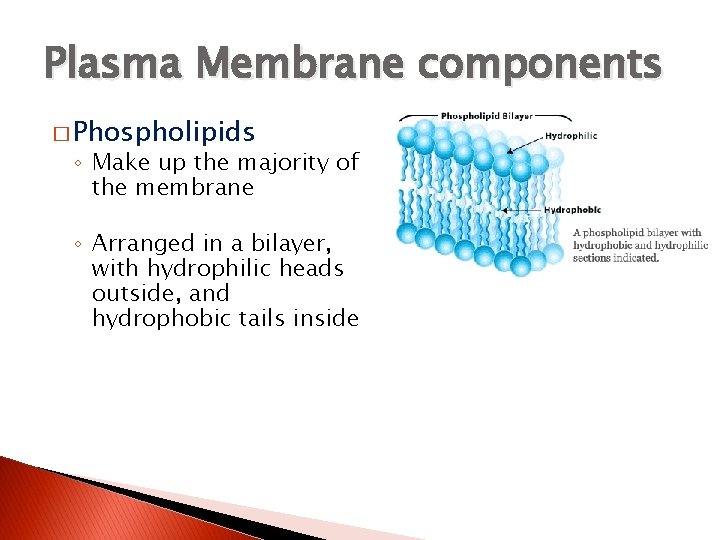
Plasma Membrane components � Phospholipids ◦ Make up the majority of the membrane ◦ Arranged in a bilayer, with hydrophilic heads outside, and hydrophobic tails inside
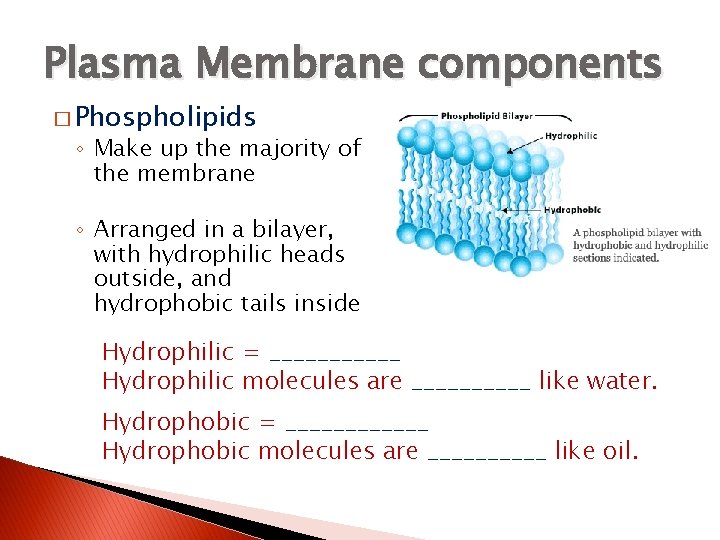
Plasma Membrane components � Phospholipids ◦ Make up the majority of the membrane ◦ Arranged in a bilayer, with hydrophilic heads outside, and hydrophobic tails inside Hydrophilic = ______ Hydrophilic molecules are _____ like water. Hydrophobic = ______ Hydrophobic molecules are _____ like oil.
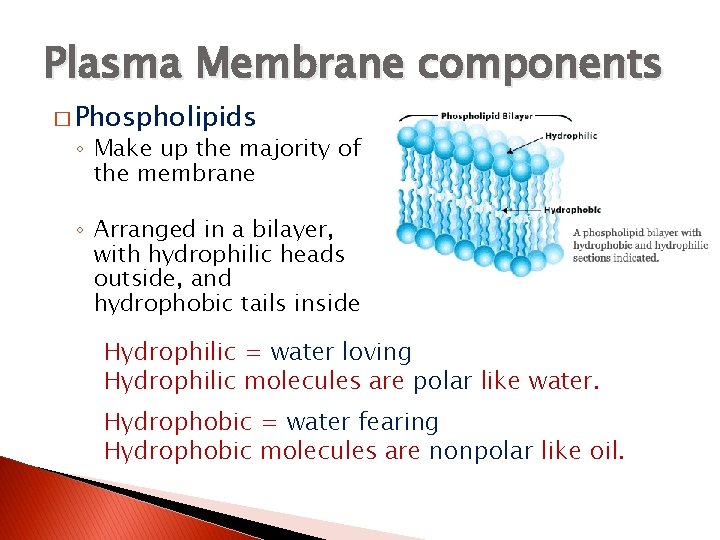
Plasma Membrane components � Phospholipids ◦ Make up the majority of the membrane ◦ Arranged in a bilayer, with hydrophilic heads outside, and hydrophobic tails inside Hydrophilic = water loving Hydrophilic molecules are polar like water. Hydrophobic = water fearing Hydrophobic molecules are nonpolar like oil.
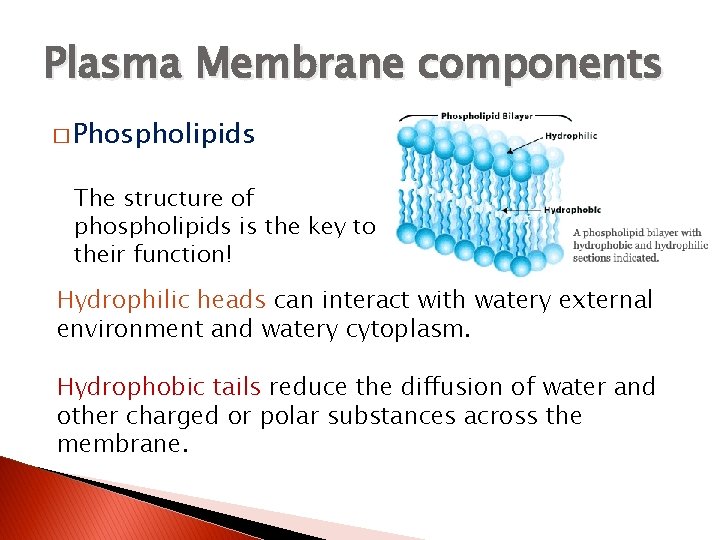
Plasma Membrane components � Phospholipids The structure of phospholipids is the key to their function! Hydrophilic heads can interact with watery external environment and watery cytoplasm. Hydrophobic tails reduce the diffusion of water and other charged or polar substances across the membrane.
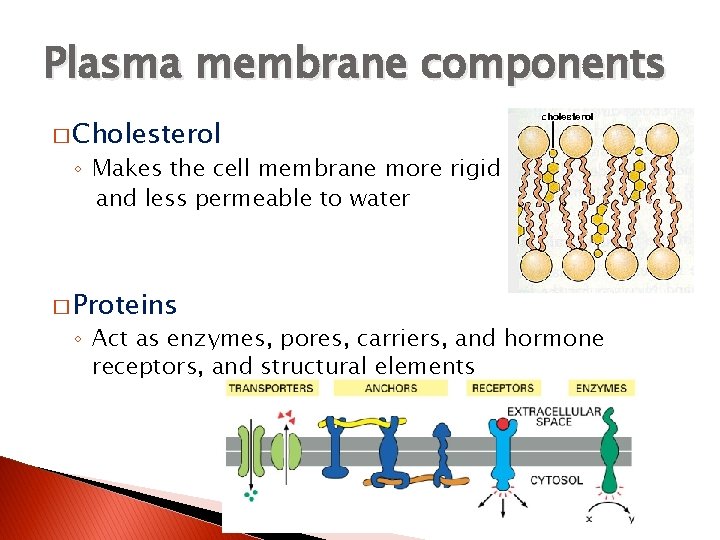
Plasma membrane components � Cholesterol ◦ Makes the cell membrane more rigid and less permeable to water � Proteins ◦ Act as enzymes, pores, carriers, and hormone receptors, and structural elements
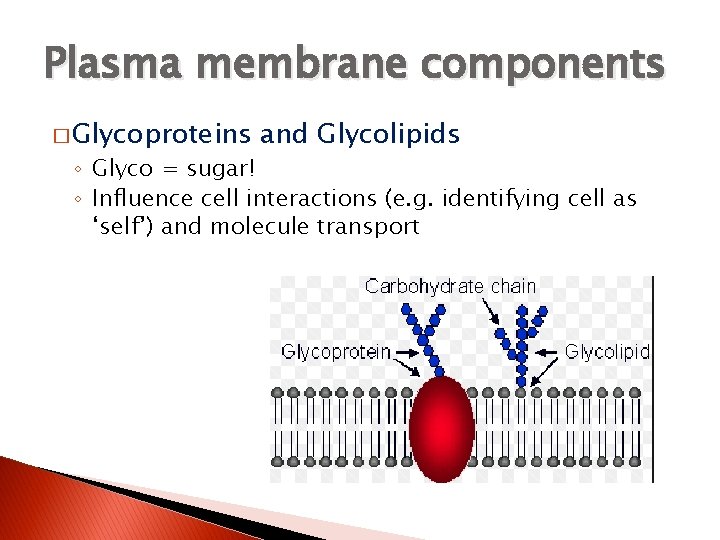
Plasma membrane components � Glycoproteins and Glycolipids ◦ Glyco = sugar! ◦ Influence cell interactions (e. g. identifying cell as ‘self’) and molecule transport
Quick Review: Plasma Membrane Structure Talk with a partner then share as a class � Scholar on the left answers … � Scholar on the right answers … ◦ What are the 4 membrane components? ◦ Which component has most functions? Why? ◦ Name 4 functions of membrane proteins ◦ Which two components are primarily responsible for reducing fluid loss through the cell? What do those components have in common?
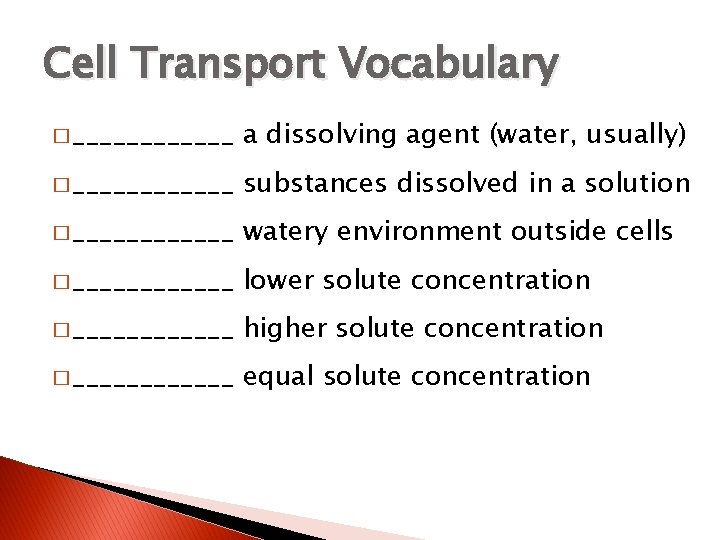
Cell Transport Vocabulary � ______ a dissolving agent (water, usually) � ______ substances dissolved in a solution � ______ watery environment outside cells � ______ lower solute concentration � ______ higher solute concentration � ______ equal solute concentration
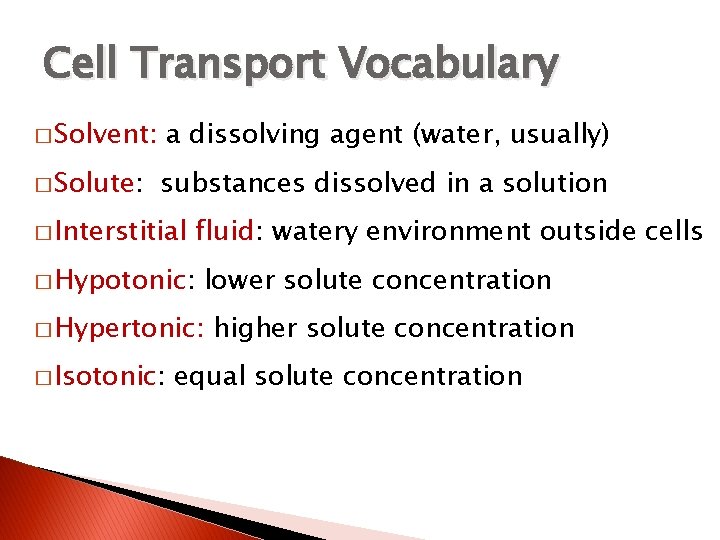
Cell Transport Vocabulary � Solvent: a dissolving agent (water, usually) � Solute: substances dissolved in a solution � Interstitial � Hypotonic: fluid: watery environment outside cells lower solute concentration � Hypertonic: � Isotonic: higher solute concentration equal solute concentration
Transport mechanisms Transport of materials across the cell membrane can be characterized as passive or active.
Transport mechanisms Transport of materials across the cell membrane can be characterized as passive or active. Passive mechanisms require NO ENERGY from the cell. ALL passive mechanisms transport molecules down their concentration gradient. Active mechanisms require energy from the cell.
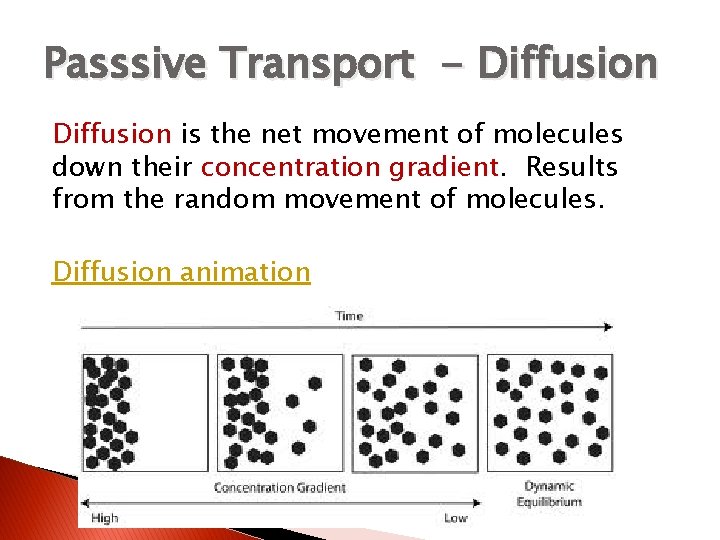
Passsive Transport - Diffusion is the net movement of molecules down their concentration gradient. Results from the random movement of molecules. Diffusion animation
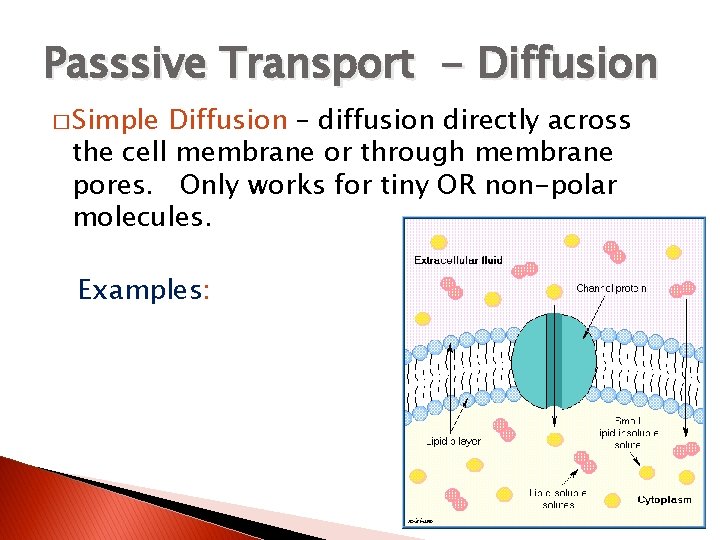
Passsive Transport - Diffusion � Simple Diffusion – diffusion directly across the cell membrane or through membrane pores. Only works for tiny OR non-polar molecules. Examples:
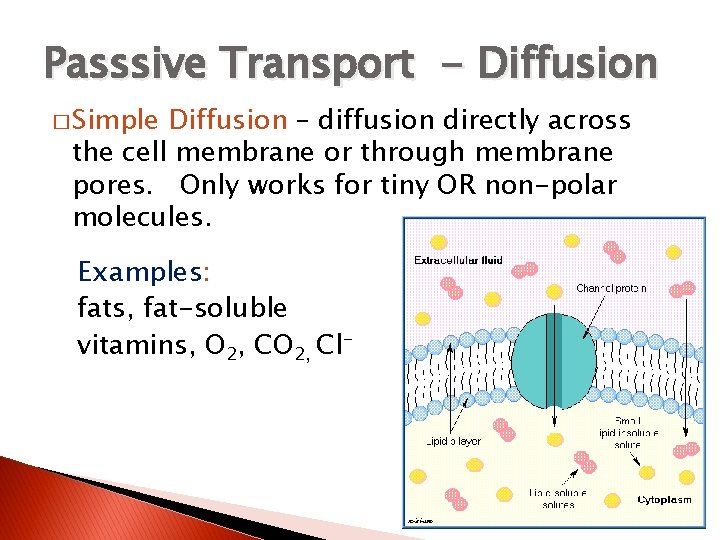
Passsive Transport - Diffusion � Simple Diffusion – diffusion directly across the cell membrane or through membrane pores. Only works for tiny OR non-polar molecules. Examples: fats, fat-soluble vitamins, O 2, Cl-
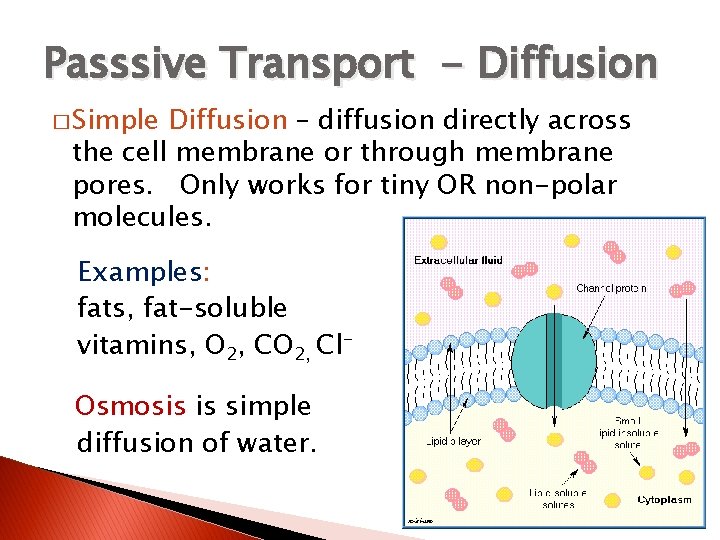
Passsive Transport - Diffusion � Simple Diffusion – diffusion directly across the cell membrane or through membrane pores. Only works for tiny OR non-polar molecules. Examples: fats, fat-soluble vitamins, O 2, Cl. Osmosis is simple diffusion of water.
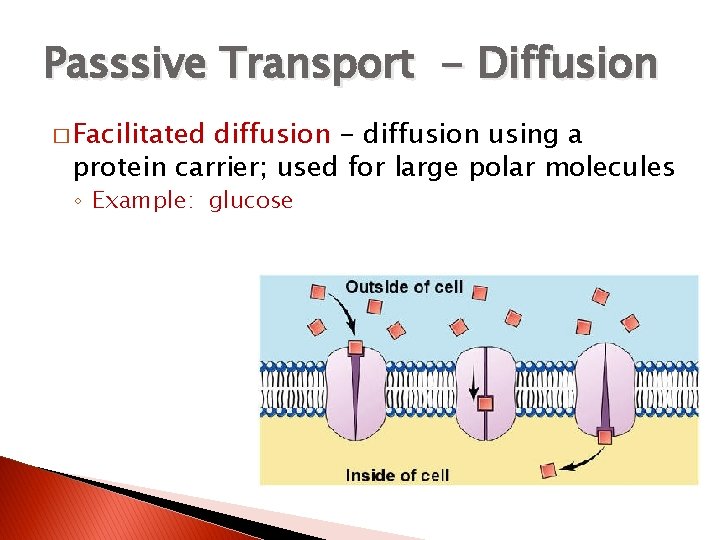
Passsive Transport - Diffusion � Facilitated diffusion - diffusion using a protein carrier; used for large polar molecules ◦ Example: glucose
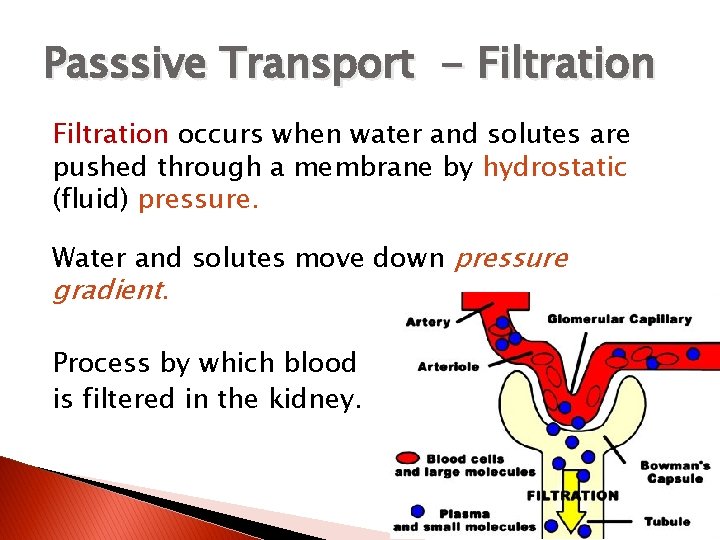
Passsive Transport - Filtration occurs when water and solutes are pushed through a membrane by hydrostatic (fluid) pressure. Water and solutes move down pressure gradient. Process by which blood is filtered in the kidney.
Quick Review: Passive Transport Wait 30 sec, then show answer with your fingers � What 2 things do all passive transport mechanisms have in common? 1) Membrane proteins are always involved and no energy is required 2) Membrane proteins are always involved and energy is required 3) Molecules move down a gradient and no energy is required 4) Molecules move down a gradient and energy is required
Quick Review: Passive Transport Wait 30 sec, then show answer with your fingers � What 2 things do simple and facilitated diffusion have in common? 1) Membrane proteins are always involved and no energy is needed 2) Membrane proteins are always involved and energy is required 3) Molecules move down their concentration gradient and no energy is needed 4) Molecules move down their concentration gradient and energy is required
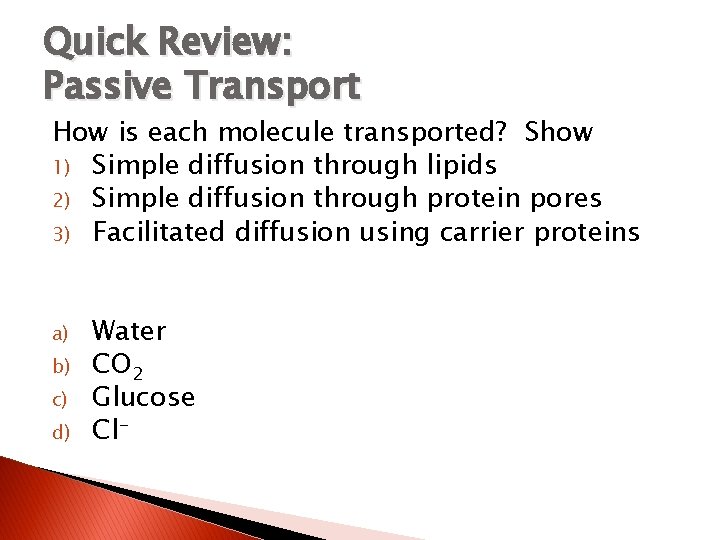
Quick Review: Passive Transport How is each molecule transported? Show 1) Simple diffusion through lipids 2) Simple diffusion through protein pores 3) Facilitated diffusion using carrier proteins a) b) c) d) Water CO 2 Glucose Cl-
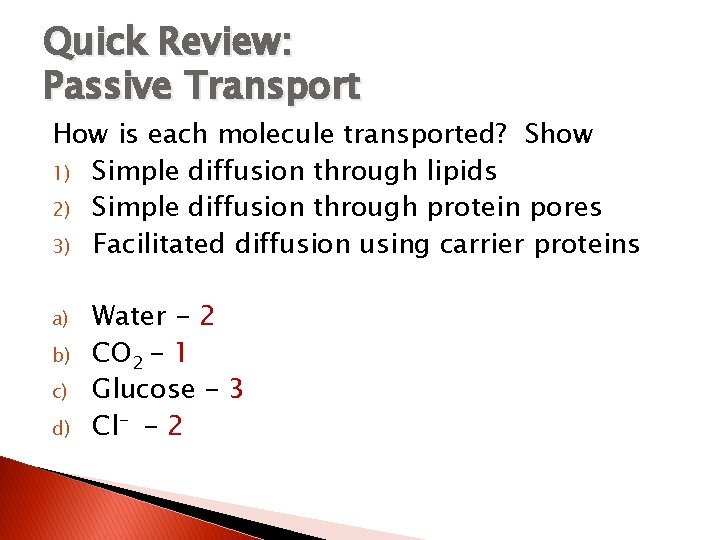
Quick Review: Passive Transport How is each molecule transported? Show 1) Simple diffusion through lipids 2) Simple diffusion through protein pores 3) Facilitated diffusion using carrier proteins a) b) c) d) Water - 2 CO 2 - 1 Glucose - 3 Cl- - 2
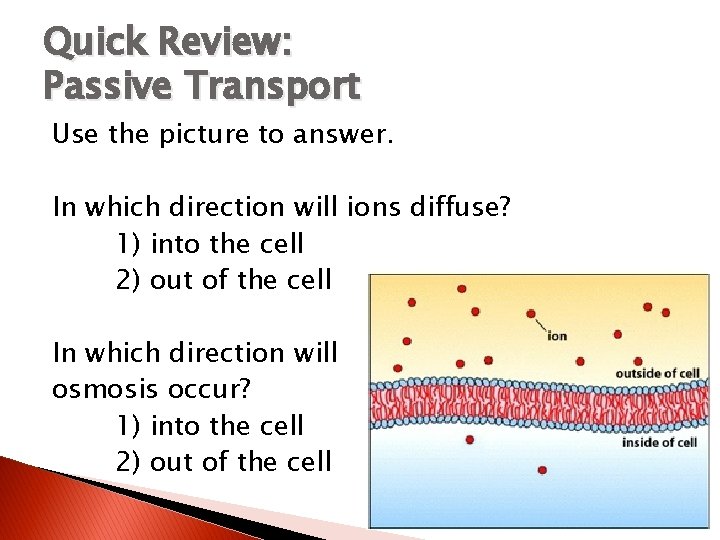
Quick Review: Passive Transport Use the picture to answer. In which direction will ions diffuse? 1) into the cell 2) out of the cell In which direction will osmosis occur? 1) into the cell 2) out of the cell
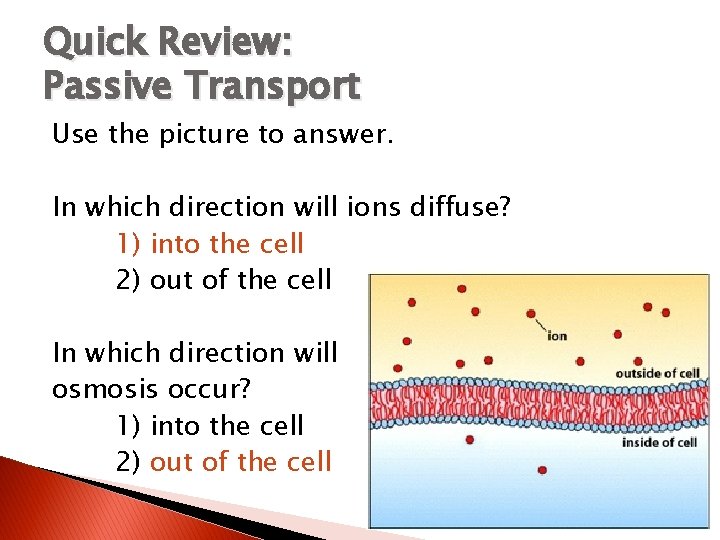
Quick Review: Passive Transport Use the picture to answer. In which direction will ions diffuse? 1) into the cell 2) out of the cell In which direction will osmosis occur? 1) into the cell 2) out of the cell
Active Transport Active transport requires the use of energy (ATP) to transport material across the cell. Active transport is used for ◦ Solutes moving against the concentration gradient - or ◦ Very large substances
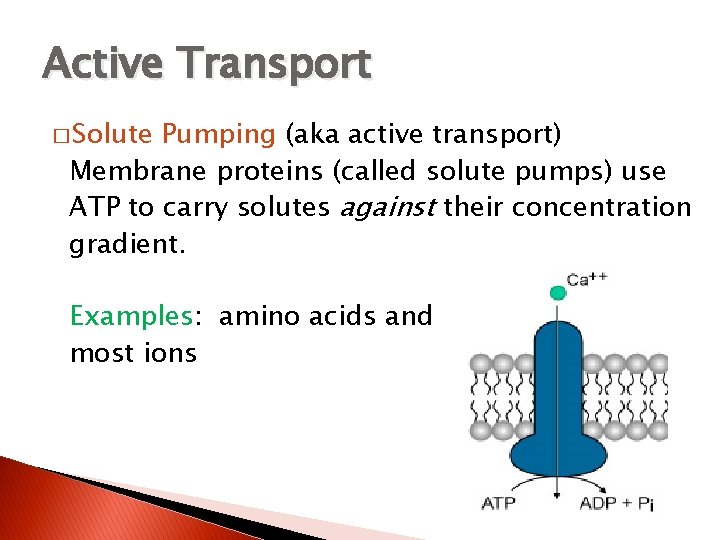
Active Transport � Solute Pumping (aka active transport) Membrane proteins (called solute pumps) use ATP to carry solutes against their concentration gradient. Examples: amino acids and most ions
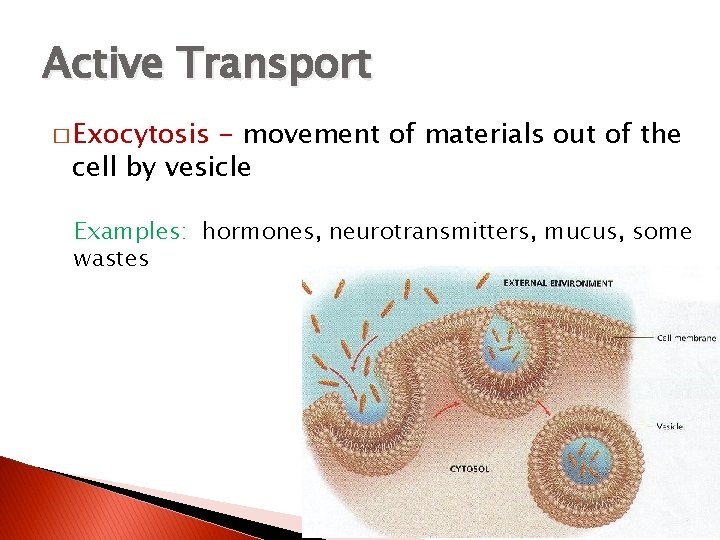
Active Transport � Exocytosis - movement of materials out of the cell by vesicle Examples: hormones, neurotransmitters, mucus, some wastes
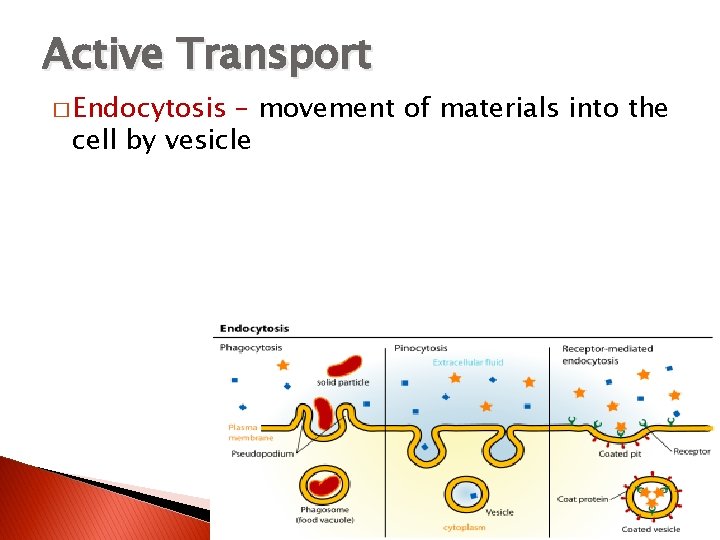
Active Transport � Endocytosis – movement of materials into the cell by vesicle
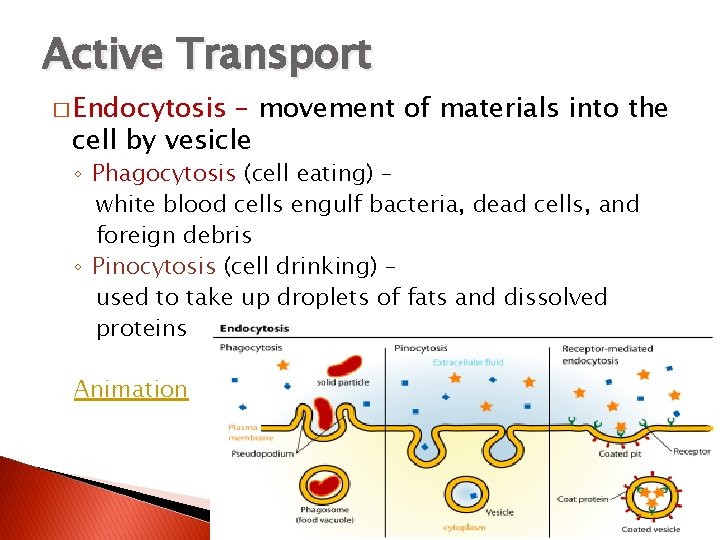
Active Transport � Endocytosis – movement of materials into the cell by vesicle ◦ Phagocytosis (cell eating) – white blood cells engulf bacteria, dead cells, and foreign debris ◦ Pinocytosis (cell drinking) – used to take up droplets of fats and dissolved proteins Animation
Homeostatic Imbalance Many diseases are caused by malfunctions in cell membrane transport. Examples: � Cystic Fibrosis: a Cl- channel is missing, causing Cl- to build up within the cell � Familial hypercholesterolemia – cholesterol receptors on cell membrane missing, so cholestrol builds up in the blood � Burned tissue ‘weeps’ fluids, proteins, ions, etc.
Exit Ticket Draw a detailed picture of the cell membrane. Include, and label: � The structural components �Phospholipids, cholesterol, membrane proteins, glycolipids � The transport mechanisms �Simple diffusion, osmosis, facilitated diffusion, solute pumping, exocytosis, pinocytosis, phagocytosis When done, compare with a neighbor, but don’t add to it.
- Slides: 35